Protective Cases for Optics, Cameras & Precision Instruments
Short answer: an optics or camera case is specified by where the item can be touched and where it cannot, and then by three published numbers on one named model - internal depth, the lid-to-base split and the wall thickness. Camera and instrument damage is overwhelmingly surface damage and edge damage: a lens front element resting against a hard pocket wall, a filter thread catching a lid that closes over it, a glass flat chipping at its rim, a monitor face loaded by a battery. KeXin publishes internal and external dimensions and usable interior volume for all 155 thermoplastic shells, wall thickness for 148 of them between 2.0 and 6.0 mm, lid and base depth separately for 100, and empty mass for 93, with a compressible gasket in a moulded channel recorded on 124. What we publish for no model is an ingress code, a humidity or dry-air figure, a free-fall height, a shock rating or a temperature range, so a dustproof, waterproof, anti-humidity or shockproof claim is answered here as a construction fact plus an optional accredited test on the exact build.
Key points
- Design the interior so no weight rests on a glass face, a filter thread or a connector; that single rule prevents most camera case damage.
- Read lid depth and base depth separately: a 140/25 mm split and a 43/149 mm split are different cases at the same total height.
- No ingress, humidity or shock figure is published for any model; 124 of 155 shells record a gasket in a moulded channel and 31 do not.
- Long items outrank deep ones: slider rails and jib sections want KX-86216, KX-89616 or KX-814641 rather than one large cube.
- Wheels are published on 19 of 155 shells, all of them mid-size or larger, and each is published as non-stackable.
- Small optics are a stiff-wall problem, not a volume problem: KX-62810 gives 3.2 litres on a 4.0 mm ABS wall at about 900 g.
How A Case For Optics, Cameras And Precision Instruments Is Actually Specified
Camera and instrument owners buy protection against two failure modes that hand-tool and hardware buyers rarely think about. The first is surface damage: a front element, a viewfinder cover glass, a monitor face or a polished bearing surface touched by something that moved inside the case, which is why the item is carried on its strongest datum - the mount flange, the chassis or the base plate - and the glass hangs over a relieved pocket. The second is edge and thread damage: a filter thread, a rim, a prism corner or a graduated edge chipping because a neighbouring item shifted, which is why the pocket wall is a controlled distance from the item rather than a generous one. Everything else follows from those two: wall thickness for stacking, lid depth for whatever stands proud, gasket construction for grit and splash, empty mass and carry format for the distance crossed. KeXin publishes those figures per model, and leaves an unmeasured field marked not measured rather than filling it with a series average, which is the reason this page can name millimetres but not ratings.
Action Camera & Accessories All-In-One Case
An action camera kit is the hardest thing in this category to pack well, because it is many small high-value parts rather than one object: the camera body, two or three batteries, a frame or housing with a protruding lens port, mounts with thumbscrews, a short handlebar, spare adhesive bases, a filter set and a cable. A single case is only worth having if each part has its own shape, because the loose metal mounts are exactly the items that scratch a lens. Choose a small stiff shell and cut it in two layers: a base plank locating the bodies and the housing with its port unloaded, and a shallow lid tray for screws, filters and cables. The polypropylene KX-2507 lists 245 x 175 x 64 mm internal on a 2.0 mm wall at about 340 g and 2.3 litres, and KX-2508 is the same footprint at 68 mm high and about 338 g; both record no gasket, so a wet-pocket kit is better served by the gasketed KX-3207 at 308 x 230 x 64 mm, 3.0 mm wall and about 570 g, or by the ABS KX-62109 at 195 x 128 x 81 mm, 3.0 mm wall and about 470 g for a two-camera set with minimal accessories. Where a kit really must travel as one unit with a gimbal and a microphone, step up to KX-3213 at 308 x 230 x 118 mm with a 86 mm lid over a 32 mm base and 7.2 litres at about 860 g.
Camera And Lens Storage Case
The everyday photographer or inspection-team case is a body with a lens attached plus two or three more lenses, and the decision is internal height rather than footprint, because a lens on a body is taller than the body alone and a mounted hood is taller still. If the glass travels on the body, the whole assembly lies in one cavity and nothing may touch the front element; if lenses travel separately, they stand or lie in their own pockets with the mount flange carrying the load. Good published starting points: KX-2813 at 260 x 200 x 117 mm internal on a 2.8 mm engineering-PP wall, about 800 g and 5.2 litres, takes a mirrorless body with a standard zoom plus one prime (note it records no gasket); KX-3113 gives 296 x 258 x 121 mm at about 1,060 g and 7.9 litres for a two-lens kit; KX-3315 is the stiffer choice at 303 x 224 x 135 mm on a 4.1 mm wall with a 100 mm lid over a 35 mm base and about 1,670 g; and the ABS KX-63612 covers 333 x 217 x 114 mm at 3.5 mm and about 1,300 g with a gasket recorded. For a larger DSLR or a body with a grip and a 70-200 mm class lens attached, KX-84118 gives 375 x 270 x 160 mm internal on a 5.0 mm wall with 13.0 litres.
Compartmentalized Lens Storage Case
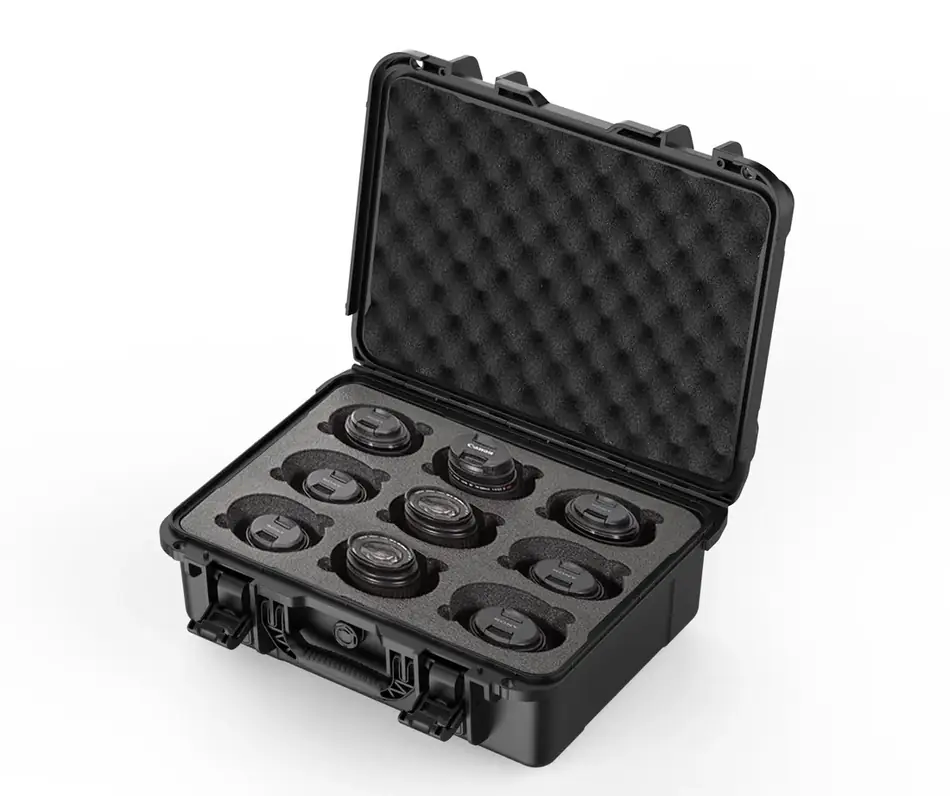
A lens library is a row of cylinders with different lengths and the same requirement: no glass face loaded, no mount-to-mount metal contact, and each optic visible so a missing lens is noticed the moment the lid opens. The best formats are shallow shells with enough internal height for the longest barrel lying on its side, because lying lenses down stops them rolling and keeps the front element over an open relief rather than against a neighbour. The KX-3607 is the archetype: 355 x 280 x 60 mm internal on a 3.0 mm wall at about 800 g with 5.2 litres and a gasket recorded, with KX-3608 and KX-3609 the same footprint at 70 mm and 80 mm high for larger barrels at about 870 g and 900 g. Where the set includes a telephoto or a cine lens, KX-4010 gives 390 x 315 x 88 mm with a 44 mm lid over a 44 mm base at about 1,015 g and 9.3 litres, and KX-4610 covers 455 x 338 x 84 mm at about 1,115 g with 11.1 litres. Pocket walls in a lens layout should be a controlled 8 to 10 mm of firm carrier rather than soft pluck, because a lens pushed into loose foam tips over and lands on its filter thread; and a film or broadcast department that restocks weekly should ask for a printed outline per position so a substitution is visible.
Camera Lens Anti-Humidity Sealed Hard Case: What Controls Mildew
We have to be blunt about this phrase, because it is where a case supplier can do the most damage with a comfortable sentence. Fungus on optics grows where relative humidity is high for long periods, and the two things that control that are a desiccant with enough capacity and a measured way to know when it is exhausted - not a moulding. Our published data records a compressible gasket in a continuous moulded channel on 124 of the 155 shells and no gasket on 31, and it records no humidity figure, no dry-air hold time and no interior relative-humidity value for any model, because we have not measured one. So a gasketed hard shell is a useful outer casing that slows air exchange and keeps grit off a rim; the humidity control itself comes from a recharging desiccant, a hygrometer you can read, and a routine. If the requirement is genuinely a controlled low-humidity store, a powered dry cabinet is the right equipment and a case is the wrong one. Where a sealed box is still wanted for a lens travelling between humid and air-conditioned environments, choose a model that actually records the gasket and a wall that resists a stack: KX-3315 at 303 x 224 x 135 mm on a 4.1 mm wall, KX-2811 at 253 x 180 x 98 mm on 5.0 mm with a 71 mm lid over a 27 mm base, or the deep KX-92817 at 253 x 180 x 152 mm on the same 5.0 mm wall at about 940 g. Raise the agent, the environment and the required figure at quotation, and we will confirm the gasket material and compound for that exact SKU rather than promising a number.
Camcorder Lens Dustproof Waterproof Trolley Case: Two Words, One Honest Answer
Dustproof and waterproof are the two most requested and least measurable words in this category. Across our library both are recorded as not measured, and no ingress code is published for any of the 155 models, so we do not offer a case as dustproof or waterproof in the sense a specification means. What we can show instead is the construction that produces the behaviour: a gasket channel that is recorded for the named model, latch count specified per configuration because uneven compression is what lets grit in, a shell material and wall thickness, and a rim geometry that can be wiped down. For the trolley half of the request, 19 models publish wheels and a fixed telescopic handle, and all 19 are published as non-stackable: KX-85021 at 437 x 308 x 164 mm internal and about 4,912 g, KX-85022 at 437 x 308 x 180 mm and about 5,012 g, KX-85424 at 483 x 363 x 190 mm and about 6,000 g, and KX-85427 at 483 x 363 x 220 mm with a 150 mm lid over a 70 mm base at about 6,100 g. A camcorder with its zoom and a shoulder rig sits in KX-85424; a kit with two bodies, a tripod head and lights belongs in KX-85827 at 500 x 400 x 220 mm with a published 295 mm telescopic height and about 7,800 g empty. If a tender names a code, commission the accredited test on the ordered configuration; do not accept it from a product name, ours included.
Cinema Camera Transport Case
A cinema package is a body with a top handle, a mattebox, a follow-focus and a motor, a recorder, magazine batteries, a lens or two, and often a shoulder rig - and almost none of it collapses flat. The sizing method that works is to choose the case for the assembled configuration that actually travels, usually body plus mattebox plus the longest lens on it, and to build the interior so the rig never has to be stripped at the roadside. What decides the model is internal height plus the lid split, because a top handle and a mattebox rod stack stand proud. KX-84122 gives 385 x 313 x 205 mm internal on a 3.7 mm wall with 21.2 litres for a stripped-down body with one lens. Larger builds sit in KX-85224 at 483 x 363 x 220 mm on a 4.5 mm wall and 30.9 litres, KX-85023 at 463 x 338 x 211 mm and 26.4 litres, or KX-86122 at 530 x 360 x 203 mm on a 5.0 mm wall with a 155 mm lid over a 48 mm base and 31.0 litres. Where the outfit includes a tripod and support kit, the deep bases are the answer: KX-84825 at 410 x 360 x 240 mm with a 200 mm lid, KX-85835 at 500 x 400 x 305 mm with wheels and a 295 mm handle at about 8,520 g, KX-86136 at 530 x 360 x 304 mm with wheels, or the ABS KX-66232 at 507 x 385 x 290 mm on a 5.3 mm wall and about 7,940 g for a rigid non-wheeled body. Rods, mattebox flags and any 15 mm support are the items that stop a lid closing, so measure the rig as it travels and keep those in their own channel.
DSLR Camera & Lens Trolley Protective Case
A photographer who walks 300 metres from a car to a venue does not need wheels; one who crosses a wedding marquee, a sports concourse or a construction site does, and the purchase should be made on that distance rather than on volume. The published wheeled options in the size a two-body DSLR kit occupies are KX-85021 at 437 x 308 x 164 mm internal, 4.5 mm engineering-PP wall, about 4,912 g empty and 17.7 litres; KX-85022 at 437 x 308 x 180 mm and about 5,012 g; KX-85424 at 483 x 363 x 190 mm, about 6,000 g and 26.6 litres; KX-85427 at 483 x 363 x 220 mm and about 6,100 g with 30.9 litres; and KX-85726 at 520 x 296 x 210 mm with a published 385 mm telescopic height, about 5,600 g and 25.8 litres for a long kit. Compare that with the non-wheeled equivalents to see the price of the hardware: KX-84818 publishes the identical 437 x 308 x 164 mm cavity with no wheels and no handle, we do not publish an empty mass for it at all, and it is recorded as stackable - so a trolley buys distance and gives up a flat stacking face. Two checks before committing: external height, because a wheeled shell has to clear a vehicle floor and a doorway, and the fact that all 19 wheeled models are published as non-stackable, which matters the moment a distributor palletises them.
Director Monitor Specialized Protective Case
Field monitors are the flattest and most fragile object in the grip kit: a large glass face with a thin bezel, a sun hood that folds but never flattens, a bracket that stands proud of the back, and HDMI or SDI connectors on an edge. Two rules do nearly all the work. The monitor lies face-up in its own relieved pocket so nothing can rest on the glass, and the bracket and hood go in a separate shallow lid tray so the closure line never crosses the panel. Because the panel is wide and thin, the deciding figure is internal length and width with a short total height, which points at the flat formats: KX-4610 at 455 x 338 x 84 mm internal on a 3.0 mm wall, about 1,115 g and 11.1 litres; KX-4613 at the same footprint with 116 mm of height and 15.3 litres; KX-4312 at 420 x 260 x 104 mm, 3.5 mm wall and about 1,170 g; and KX-64114 at 378 x 307 x 120 mm in ABS on a 4.0 mm wall at about 2,100 g where a 5-inch monitor travels with a transmitter, batteries and a set of leads. Wider panels want KX-4710 at 458 x 345 x 90 mm or KX-4716 at 458 x 345 x 150 mm, with the honest caveat that all three of the 2.5 mm KX-4710, KX-4713 and KX-4716 record no gasket channel, so a rain-covered set is a different trade: protection from grit and splash against minimum mass.
Camera Motorized Slider & Controller Box
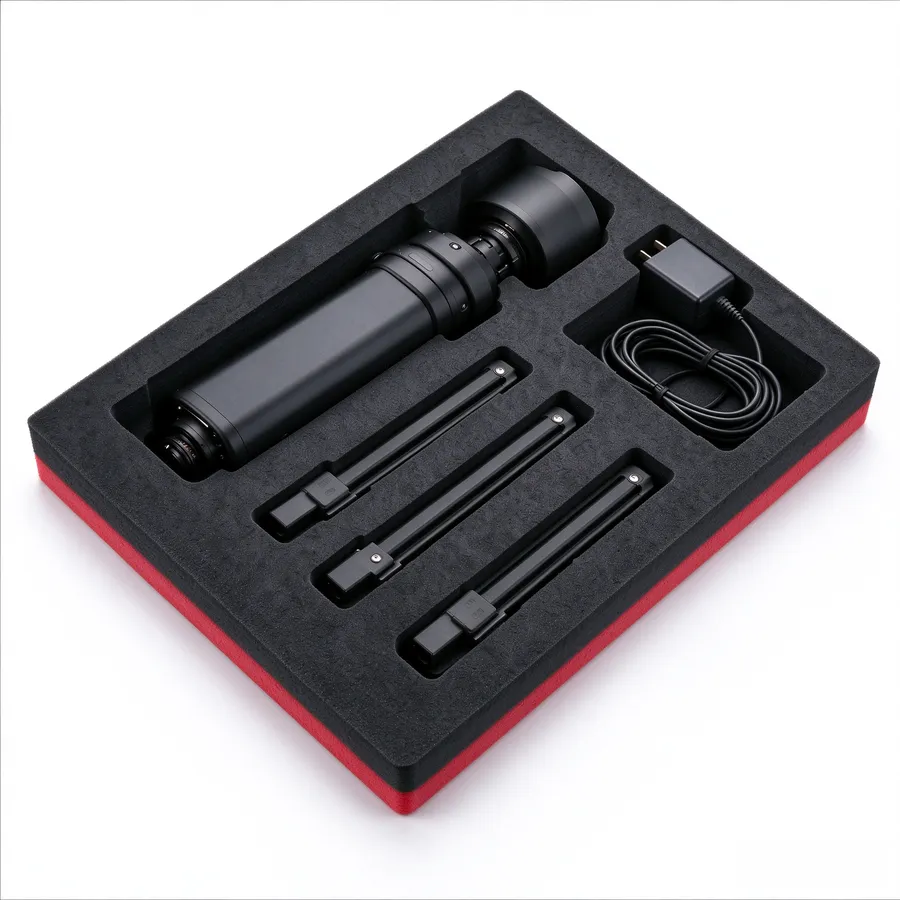
A motorised slider is two specification problems wearing one name. The rails are long, thin and made of extrusion that bends at a point load, so they want a flat cavity with a channel per rail and a base plank that stops them sliding against each other; the head, motor, controller, battery and brackets are dense small items that want their own pockets and must never ride on top of the rails. Splitting them is usually the better answer: rails in a long shallow shell such as KX-86216 at 582 x 300 x 130 mm internal with a 100 mm lid over a 30 mm base and 19.5 litres, or KX-88015 at 725 x 350 x 140 mm on a 5.0 mm wall with 28.4 litres, with the controller, motor and accessories in a mid-size box such as KX-84416 at 395 x 295 x 135 mm, 4.2 mm wall, a 90 mm lid over a 45 mm base and 12.6 litres. Where a short travel slider travels assembled, the deciding figure is internal length rather than volume, so compare KX-86216, KX-87926 at 737 x 257 x 240 mm with a 175 mm lid over a 65 mm base and 36.4 litres, and KX-89616 at 880 x 350 x 140 mm. Belt drives and end stops are the parts that crush, so they go in relief, not under a foam wall.
Camera Slider & Motor Shockproof Trolley Case
The word shockproof has the same honest answer here as everywhere else on this site: our shock field is a manufacturer option that requires a specified foam layout, because the shell alone is not a shock rating, and the impact field states a wall thickness with no free-fall height claimed without a test. A slider is the clearest illustration of why the layout matters more than the word: an extrusion immobilised in a channel per rail does not care about a knock, while a rail loose in a deep bed of soft pluck becomes a hammer inside its own case. For the trolley half, note what the published library does and does not contain. The 19 wheeled models are mid-size and larger, and the longest cavities among them are KX-88337 at 723 x 368 x 329 mm internal on a 5.0 mm wall with a 280 mm lid over a 49 mm base, about 10,866 g empty and 70.0 litres with a published 240 mm telescopic height, then KX-88434 and KX-88442 at 740 mm in plan. That rolls a travel slider with its head, motor and supports, but it will not take a long studio rail, so the honest recommendation is to split the load: rails in a long carried shell such as KX-89616 at 880 mm or KX-814641 at 1,280 mm internal length, with motor, head, controller and legs in a wheeled box. Accredited testing of any figure a rental house demands is quoted on the configuration you order, not taken from the word shockproof.
Camera Jib Arm Control Box Protective Case
A jib travels as two completely different objects and they should not share a case. The arm sections are long tubular or extruded members with cable guides, counterweight collar and a head that has a pan and tilt mechanism with small protruding controls; the control box, video transmitter, batteries, remote and tools are a dense, connector-rich bundle. For the control side, choose a shallow-to-mid cavity that keeps the box flat with its connectors relieved: KX-4318 and KX-4319 both publish 407 x 187 x 178 mm internal on a 3.0 mm wall with a 38 mm lid over a 140 mm base, so everything heavy sits in the deep base and the leads lie in the thin lid; KX-4321 gives 411 x 208 x 202 mm with a 164 mm lid over a 38 mm base at about 2,330 g; KX-83620 is the compact option at 290 x 220 x 185 mm with a 135/50 mm split and 10.1 litres; and KX-93221 covers a box plus receiver at 300 x 200 x 200 mm on a 5.0 mm wall with a 165 mm lid at about 1,230 g. For the arm itself the requirement is length and a channel per section: KX-87926 at 737 x 257 x 240 mm, KX-89616 at 880 x 350 x 140 mm, or KX-814641 at 1,280 x 350 x 140 mm and 50.2 litres, which is the longest cavity in the catalogue. Jib heads fail at the tilt axis, so the head travels on its plate with the mechanism unloaded rather than bolted down through the body.
VR 360 Camera Precision Shockproof Box
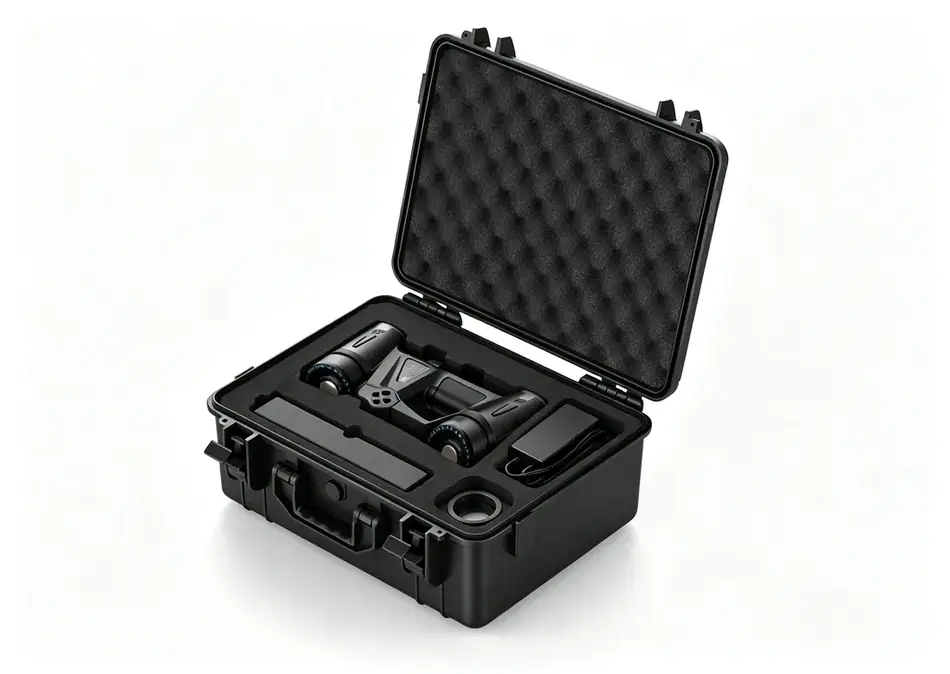
A stereo or 360 rig is a set of matched lenses on a body that cannot be re-collimated by the user, so it is the most unforgiving object in this list: two fisheye elements stand proud at opposite ends, the calibration is sensitive to a knock that leaves no visible mark, and the whole thing is usually packed warm from a shoot. Precision here means pocket tolerance rather than a rating, and it is achieved by carrying the body on its mount - usually the tripod socket and the side flats - with both lens faces hanging free in relieved pockets and a retainer so the unit cannot lift out of its seat when the case is inverted. Small stiff cavities do this best: the ABS KX-62810 lists 253 x 182 x 86 mm internal on a 4.0 mm wall at about 900 g with 3.2 litres and a gasket recorded; KX-2811 gives 253 x 180 x 98 mm on a 5.0 mm wall with a 71 mm lid over a 27 mm base and 3.6 litres at about 890 g; KX-63317 covers 300 x 178 x 152 mm on a 4.0 mm ABS wall at about 1,370 g with 6.5 litres; and KX-92817 gives 253 x 180 x 152 mm at 5.0 mm and 5.5 litres where a rig travels with its handle and a spare battery. On the word shockproof: no shock figure and no free-fall height is published for any model, so the protection is the cut plus a wall that resists a stack, and a documented test is commissioned on that build.
Optical And Precision Instruments: Flatness, Edge Chips And The Narrow Width
Bench optics, measurement instruments and field optics share the same specification logic with less tolerance for improvisation. A surface plate, an optical flat or a granite reference edge must travel on its own mass with nothing resting on a working face, and lifting it out means a routed finger recess rather than a pocket you have to pry. A theodolite, a laser scanner head, a borescope or a spectroprobe carries a protruding objective and a battery compartment, and its case should be chosen so the objective hangs free. Two figures matter more than volume. The first is the lid-to-base split, because an instrument that bridges the closure line is crushed by the lid and not by the ground; the deep-base formats KX-4318, KX-4319 and KX-6621 all publish 43 mm of lid over 149 mm of base, which is exactly this shape. The second is the narrow internal width, which several models publish because the cavity tapers: KX-4616 lists 302 mm at its narrow point against a nominal 338 mm, and a machined tray that clears the wide section can bind there. For flat panel-sized optics the wide shallow shells KX-4710 at 458 x 345 x 90 mm and KX-4713 at 458 x 345 x 120 mm are the practical formats, with the reminder that both record no gasket. Cleanliness, calibration intervals and any particulate or static requirement stay with the instrument and its own procedure; we state none of them for a transport shell.
Camera Interiors: Cut Foam, EVA And The Rules That Stop Scratches
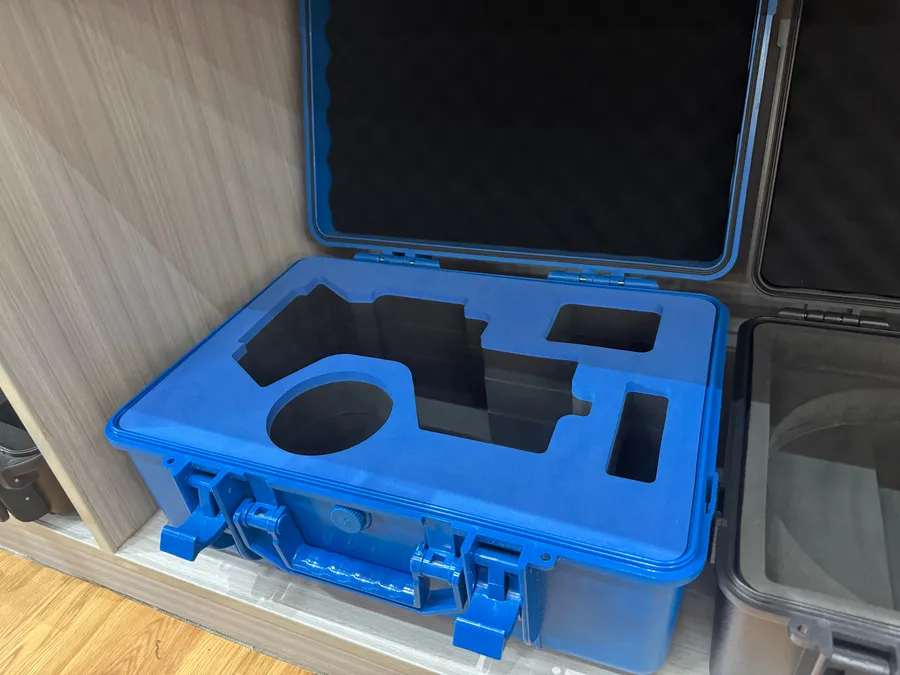
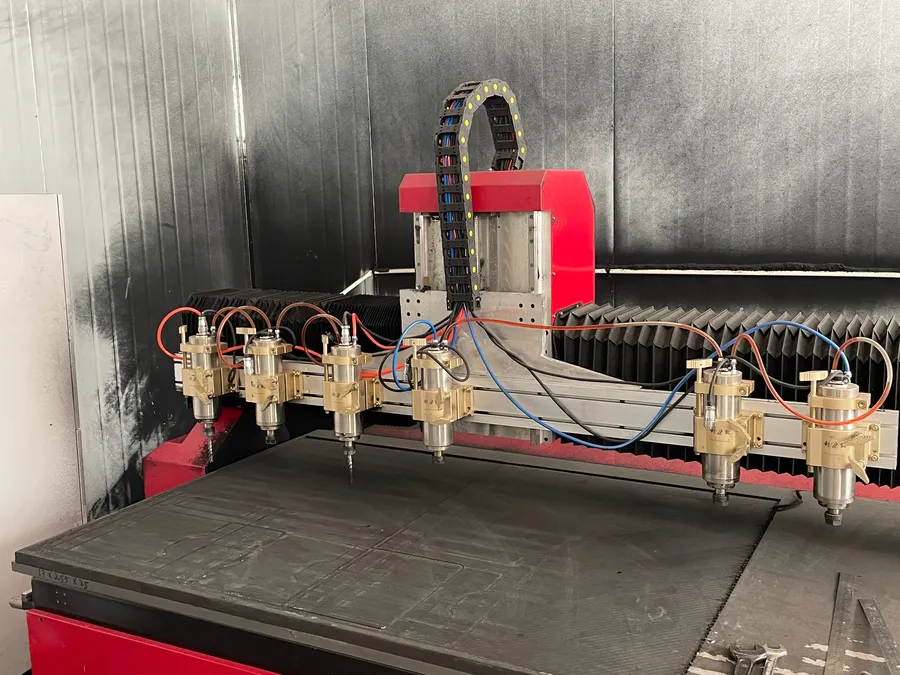
Nearly all of the protective behaviour in a camera case lives in the insert, which is also the least expensive part of it. We cut cross-linked PE, EVA or EPE plank by zone: die-cut where a production layout repeats, CNC-cut where a pocket wall must hold tolerance around a lens barrel or a body, layered builds with a firmer carrier under mass and a softer face against a finished barrel, and a pick-and-pluck top only where the kit genuinely changes. Four rules prevent most surface damage: the item is carried on its mount flange, chassis or base plate rather than on a barrel or a panel; every glass face hangs over an open relief instead of against a wall; nothing shares a pocket, including a lens cap, a filter or a coin of loose metal; and leads get a routed channel so a plug cannot travel into a socket. EVA is our usual face layer for camera work because it is closed-cell, so a wet hand or a spilled drink wipes off rather than soaking in, and it keeps a firm skin through repeated issue. An anti-static or conductive liner is a separate material specification evidenced by a report on that batch, not an attribute of a moulding. Custom foam starts at one unit on an existing shell, and needs a drawing, a scale photograph of the packed kit or the physical item.
Buyer Search Phrase To The Published Figure That Decides It
Each figure in this table is a published specification for the model named, not a performance rating, and the comparison is only valid against the packed envelope you measure on your own kit. Where a rental house, a broadcaster or an instrument purchaser needs documented proof of ingress, free-fall or static behaviour, we quote accredited testing of that exact shell, gasket, latch and foam configuration as a separate work package rather than printing a number we cannot document, and we say plainly when a stock cavity is closer and cheaper than a new moulding.
| Buyer Search | Deciding Published Figure | Published Example |
|---|---|---|
| action camera & accessories all-in-one case | Small stiff cavity cut in two layers so metal mounts cannot touch glass | KX-3207: 308 x 230 x 64 mm internal, 3.0 mm wall, about 570 g, 3.9 L, gasket recorded; KX-62109: 195 x 128 x 81 mm ABS, about 470 g |
| camcorder lens dustproof waterproof trolley case | No ingress code published; gasket recorded per model, plus wheels and telescopic height | KX-85424: 483 x 363 x 190 mm, 4.5 mm, about 6,000 g, wheels, gasket recorded; 124 of 155 shells record a gasket |
| camera and lens storage case | Internal height for a body with a lens attached, and a mount that carries the load | KX-3315: 303 x 224 x 135 mm, 4.1 mm wall, 100/35 mm lid/base, about 1,670 g; KX-84118: 375 x 270 x 160 mm at 5.0 mm |
| camera jib arm control box protective case | Deep base for the box, separate long shell for the arm sections | KX-4318: 407 x 187 x 178 mm, 3.0 mm, 38/140 mm lid/base; KX-87926: 737 x 257 x 240 mm, 175/65 mm, 36.4 L |
| camera lens anti-humidity sealed hard case | No humidity figure published; gasket channel is recorded per model, desiccant is separate | KX-2811: 253 x 180 x 98 mm, 5.0 mm wall, 71/27 mm lid/base, about 890 g, 3.6 L, gasket recorded |
| camera motorized slider & controller box | A channel per rail in a long shallow cavity; controller in its own box | KX-86216: 582 x 300 x 130 mm, 3.3 mm, 100/30 mm lid/base, 19.5 L; KX-84416: 395 x 295 x 135 mm, 90/45 mm |
| camera slider & motor shockproof trolley case | Immobilised rails rather than a shock rating, which no model publishes | KX-88337: 723 x 368 x 329 mm internal, 5.0 mm, 280/49 mm lid/base, wheels, 240 mm handle, about 10,866 g |
| vr 360 camera precision shockproof box | Pocket tolerance with both lens faces over reliefs, plus a retainer | KX-62810: 253 x 182 x 86 mm ABS, 4.0 mm, about 900 g, 3.2 L; KX-63317: 300 x 178 x 152 mm, about 1,370 g, 6.5 L |
| cinema camera transport case | Internal height plus lid split for a top handle and mattebox rod stack | KX-86122: 530 x 360 x 203 mm, 5.0 mm, 155/48 mm lid/base, 31.0 L; KX-85835: 500 x 400 x 305 mm, wheels, 295 mm handle |
| compartmentalized lens storage case | Shallow cavity sized to the longest barrel lying down, with 8-10 mm carrier walls | KX-3607: 355 x 280 x 60 mm, 3.0 mm, about 800 g, 5.2 L; KX-3609: same footprint at 80 mm high, about 900 g |
| director monitor specialized protective case | Wide shallow cavity, panel face-up in a relief, hood and bracket in the lid | KX-4610: 455 x 338 x 84 mm, 3.0 mm, about 1,115 g, 11.1 L; KX-4716: 458 x 345 x 150 mm, 2.5 mm, no gasket recorded |
| dslr camera & lens trolley protective case | Carry distance, empty mass, external height and the loss of the stacking face | KX-85021: 437 x 308 x 164 mm, 4.5 mm, about 4,912 g, wheels; KX-85726: 520 x 296 x 210 mm, 385 mm telescopic height |
Selection Guidance: Five Checks Before A Camera Or Optics Order
One: decide what carries the load. A lens on its mount flange, a body on its tripod socket, a monitor on its back plate, a rail in its channel - and if the answer is that the glass carries it, the interior is wrong before the shell is chosen. Two: measure the assembled travel configuration, not the catalogue body size, and record the tallest standing item separately, because that is what the lid will meet. Three: read lid depth and base depth apart, since a 38/140 mm split and a 140/25 mm split are different cases at similar totals; 100 of the 155 models publish both figures. Four: check the narrow internal width where it is published, and the external dimensions against the shelf, boot or rack the case must live in. Five: confirm hardware on that model's datasheet - gasket recorded or not, latch count, handle, wheels and telescopic height - rather than assuming a series capability, then write down which documents your purchaser actually needs, because a case for a location shoot and a case written into an instrument procurement specification are two different briefs and only the second needs a commissioned test.
Where These Cases Are Used
The buyers are wider than the film industry. Production and broadcast crews need camera, lens, monitor, slider and jib cases that survive a vehicle load and a wet location. Still-life, wildlife and survey photographers need lens libraries that stay organised between trips and survive an airline hold. Drone and robotics teams need the same cavities for aerial cameras, gimbals and mapping heads, which is why this page sits next to the drone and UAV page in the catalogue. Metrology, quality and laboratory users move surface plates, optical flats, gauges, borescopes, spectrometers and alignment heads, where the requirement is flatness preserved and edges unchipped rather than impact absorbed. Inspection, insurance and forensic teams carry camera and lighting kits into buildings. OEM camera and instrument makers ship a unit and its accessories as one issuable package and make the interior drawing the reorder standard. All draw on the same shells and differ in the cut, the gasket, the carry format and the marking.
Customisation: Interior, Hardware, Marking And Tooling
Interior work is where a camera case is won, and it starts at one unit. We cut layered plank with a firm carrier under mass and a softer face against a barrel, through-pockets for lens rows, relieved windows under a front element or an objective, routed channels for HDMI, SDI and power runs, retainers so an inverted case cannot lift a rig out of its seat, printed or routed outlines so a missing lens shows at a glance, and colour-coded zones where several people share one kit. A fixed base with a pluck top suits a department whose lens set changes between productions. Shell-side configuration - colour, printed or in-mould logo, extra latches, a document holder, a shoulder strap, a pressure-equalisation option, buyer-branded packaging - is quoted per build. Colour, logo and OEM hardware begin at 300 units; only a change to the shell itself needs a mould, near 3,000 units per component and about 125 days from approved drawings, while an OEM first sample on an approved existing shell takes about 45 days. Send the packed-state dimensions, a scale photograph of the kit or the item itself, and we will confirm the nominated model's material datasheet rather than assuming one grade across 155 shells.
Procurement Notes: Wholesale Terms, Verification And What We Will Not Claim
KeXin New Materials (Guangdong) Co., Ltd. manufactures these shells and supplies wholesale and OEM or ODM buyers on EXW or FOB terms only. There is no retail channel, no delivered-duty-paid quotation and no overseas warehouse, so landed cost is an FOB figure plus your own freight and clearance; carton size and pieces per carton are published on 64 of the 155 models, and pallet and container arithmetic is built from those or supplied with the quotation. Minimum order is one unit on a stock shell and one on a custom foam layout, near 300 units for colour, logo or OEM hardware and near 3,000 per component for a dedicated mould, with a first OEM article about 45 days on existing tooling and a new mould about 125 days. Payment is a 30 per cent deposit with the balance after inspection, and third-party factory inspection before shipment is welcome. Then apply the same three questions to us as to any supplier: which accredited report produced this figure, what method and conditions were used, and does it cover the exact build being bought. Any field our datasheet records as not measured - ingress, humidity, free-fall height, shock, temperature, stack load - is the answer we will give you. Enquiries go to Fred Zhao or the KeXin Sales Team, WhatsApp +86 135 3588 0002.
Customisation
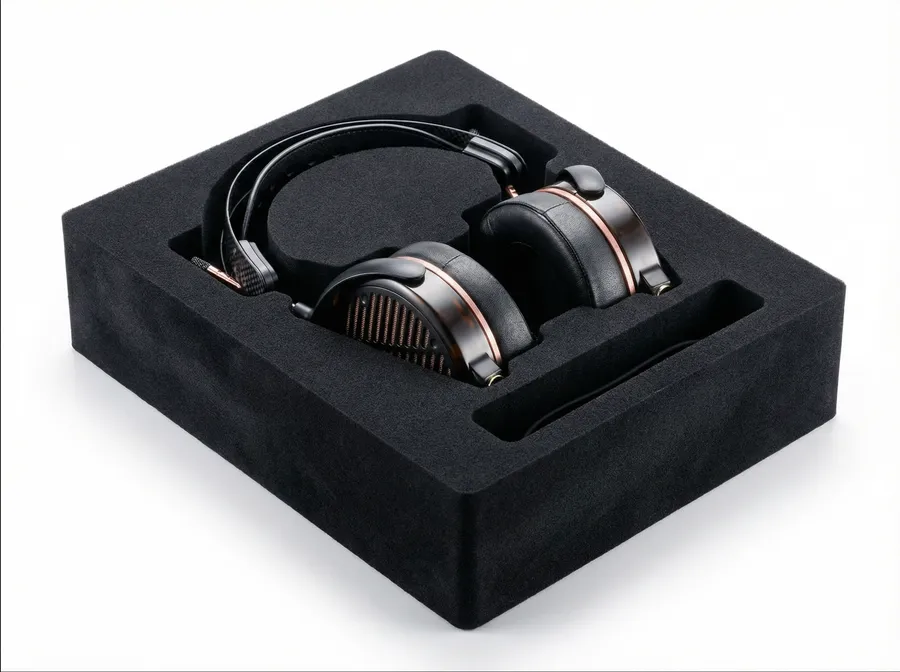
Everything described above is configurable on a standard shell: interior layout (pick-and-pluck, die-cut or CNC-cut), foam grade and thickness, colour, logo method, latch and lock count, pressure-equalisation valve, cable ports, document holder and identification plate. A bespoke exterior geometry requires a new mould — 125 days, from 3,000 units per moulded component.
Procurement considerations
| Question | What to send us |
|---|---|
| Which shell fits? | Equipment L × W × H as packed, plus required clearance per axis |
| What does it cost? | Order quantity and estimated annual quantity — the two drive different answers |
| Is tooling needed? | Whether an existing shell clears the envelope with usable foam depth |
| Lead time? | Your required delivery date, not just the order date |
| Certification? | The exact standard your tender names — we will say whether we can test to it |
| Freight? | Destination and preferred terms; carton and pallet data supplied with the quotation |
Comparison and selection guide
The tables on this page exist because a protective case is chosen by comparing three things: the envelope, the environment and the handling chain. Where no table applies, the rule below is.
| Situation | What To Do |
|---|---|
| Changing kits | Layered pluck foam, rebuilt by hand. |
| Fixed rental fleet | CNC silhouette with serial pockets and an inventory list. |
| Harsh locations | Sealed shell plus desiccant provision in the lid. |
- Size on internal dimensions plus clearance, never on a product name.
- Choose the carrying method before the shell: it changes the series, not just the price.
- Specify the interior last, and decide up front whether the end user will reconfigure it.
Protective Cases for Optics, Cameras & Precision Instruments relates to Protective Case Basics. Related families: Camera & Photography Cases / Optical Equipment Cases / Instrument & Equipment Cases / Electronics Cases / Rolling Cases / Custom Protective Cases / Equipment Transport Cases / Waterproof Cases / Outdoor Protective Cases / Long Equipment Cases. Related sectors: field and industrial equipment. Continue in the Protective Case Basics cluster.
This page is written from our own production data. If your requirement differs, send the dimensions and we will tell you which of the 155 models fits, or whether a custom route is needed.