What affects case locks for a hard-shell equipment case?
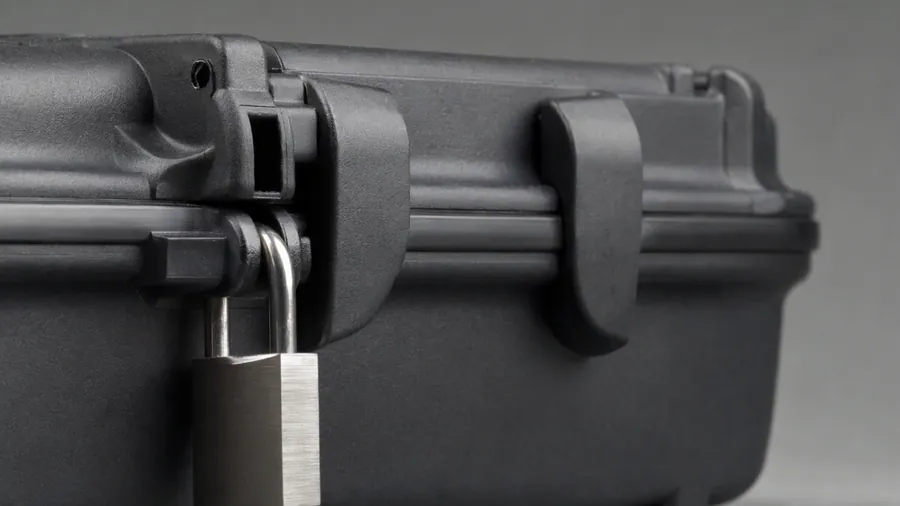
Six things decide it: what the latch body was tooled to accept, how many latch points the ordered configuration carries, where the parting line sits between lid and base, how much wall the fixing bites into, whether the shell is built with a compressible gasket at all, and whether a pressure difference is allowed to load the closure. On our published 155-model file the lock field is recorded as measured on 155 of 155 listings with the note 'Latch body accepts a standard padlock', while the latch field carries no number on any of them - all 155 state 'Count specified per configuration'. A compressible gasket in a continuous moulded channel is stated on 124 listings and 'None offered on this shell' on 31. Lid depth and base depth are both published on 100 listings and absent on 55, with lid depth ranging from 16 mm to 320 mm. Wall thickness, the material a lock fixing actually bites, is published on 148 of 155 listings from 2.0 mm to 6.0 mm, median 3.9 mm. Hasp size, lock type, keyway and hardware grade are stated on 0 listings, and pressure equalisation is recorded as an option with no value on all 155. So case locks are decided by published geometry and published silence, not by the hardware in the photograph.
Key points
- The only lock statement our file makes is measured on 155 of 155 listings: the latch body accepts a standard padlock. Hasp size, lock type and keyway are stated on none.
- Latch count is not a catalogue field: 0 of 155 listings publish a number, because all 155 record 'Count specified per configuration', so put the count on the drawing you approve.
- A lock is not a seal. 124 of 155 listings state a compressible gasket in a continuous moulded channel and 31 state none, and the ingress rating is recorded as not measured on every model.
- Lid depth and base depth are published on 100 listings: 65 have a deeper lid, 29 an even split, 6 a deeper base, and a latch on a 320 mm lid behaves nothing like one on a 44 mm base.
- Wall thickness is published on 148 of 155 listings, from 2.0 mm to 6.0 mm with a median of 3.9 mm; the same seven shells that leave wall thickness blank also record no gasket.
- Hinges and moulded feet are recorded as measured on all 155 listings, so a latch that releases the lid hands the lid load to the hinge line and the stacking rim beside it.
- Lock work is configuration or tooling: custom hardware on all 155 listings samples in 45 days on an existing mould from a MOQ of 300, while moving a boss across the gasket line needs a 125-day new mould.
What affects case locks: the six factors, in the order they bite
A lock on a hard shell is not one component but the last stage of a closure system that begins in the mould, so the honest answer to what affects case locks is a sequence of six checks rather than a preference for one brand of hasp. The first check is what the latch body was tooled to accept, and it is the only lock statement our published file makes: on 155 of 155 listings the lock field is recorded as measured with the note that the latch body accepts a standard padlock. The second is how many latch points the ordered configuration carries - a field that 0 of our 155 listings state as a number, because all 155 record 'Count specified per configuration'. The third is the parting line: lid depth and base depth are both published on 100 listings and absent on 55, and that split decides where a latch can be placed and what it has to hold.
The fourth check is wall thickness, because a lock fixing is only as good as the polymer it bites into: 148 of 155 listings publish a nominal wall from 2.0 mm to 6.0 mm, median 3.9 mm, with 30 models at 5.0 mm or more. The fifth is whether the shell is built with a sealing channel at all, since 124 listings state a compressible gasket in a continuous moulded channel while 31 state 'None offered on this shell'. The sixth is the pressure difference between a closed shell and the air around it, recorded on all 155 listings as a manufacturer option with no published value. Run the six in order and the hardware conversation becomes arithmetic; run them in any other order and you are buying a photograph of a latch, which is how most lock complaints start.
The closure fields our published file states, and the ones it leaves blank
Every row below can be checked against our own specification file before you order anything, and each row is a question to put to any other supplier in the same words. Printing the blanks is not modesty: a lock specification that cannot be traced to a stated field on a named model is a description, and descriptions do not survive receiving inspection. Where our file is empty and a competitor prints a figure, they are ahead of us on that line - ask only which shell the figure was measured on, and whether it was measured or copied.
| Closure Field On A Specification Sheet | What Our 155-Model File States | What To Demand From Any Supplier |
|---|---|---|
| Padlock acceptance of the latch body | Recorded as measured on 155 of 155 listings, with the note that the latch body accepts a standard padlock | Which latch part is fitted to which shell, and photographs of the hasp open, closed and locked |
| Latch count per shell | No number on any listing: all 155 record 'Count specified per configuration' | The count on the drawing you approve, per side, plus the spacing along the lid edge |
| Hasp size, lock type and keyway | Stated on 0 of 155 listings; no padlock, keyed or combination hardware is recorded as supplied | Whether the lock itself is in the price, its shackle clearance envelope and its keyway standard |
| Hardware material and finish | 'Metal or polymer by configuration' on 155 of 155 listings, recorded as an option rather than a grade | Material and finish of latch spring, pin, hasp and screw fixings on the build you ordered |
| Gasket under the closure line | Compressible gasket in a continuous moulded channel on 124 listings; 'None offered on this shell' on 31 | Which of those two groups the quoted model belongs to, in writing on the quotation line |
| Lid depth over base depth | Both figures on 100 listings, neither on 55; published lid depth runs from 16 mm to 320 mm | The lid-to-base split, because it decides latch spacing and how far an unsupported lid can flex |
| Wall thickness at the fixing | 148 of 155 listings, 2.0 mm to 6.0 mm, median 3.9 mm, with seven shells leaving the field blank | Nominal wall where the screws land, and whether the fixing reaches a moulded boss or only skin |
| Pressure equalisation valve | Recorded as an option with no value on all 155 listings | Whether the quoted configuration carries one, and how much force is left on the latch after a leg |
| Hinge and feet | Both recorded as measured on 155 of 155 listings | Which hinge line carries the lid once the latch is released, and whether feet keep the rim clear |
Padlock-ready is a moulding fact, not a lock specification
The padlock-ready latch body is the field buyers read as security, and it is worth stating exactly what it does and does not say. Across all 155 listings the hardware record marks the lock as measured with the note that the latch body accepts a standard padlock: the hasp and the staple exist, they are moulded or fitted as part of the shell build, and a padlock shackle can pass through them. What the same file does not say anywhere is which lock is supplied, what the shackle clearance is, whether the hardware is keyed, combination or padlock-only, or what any of it costs. No padlock appears in our packing or quotation fields as a supplied item, so the honest reading is that the shell is prepared for a lock rather than delivered with one.
That distinction changes the order rather than the sentence. If your procedure needs locks issued and re-keyed, that is a hardware supply decision to name on the purchase order, and the same order should state the hasp envelope the issued padlock has to clear - a shackle that cannot pass a moulded hasp is a rework, not a preference. If your procedure only needs the case to be visibly securable at a gate or a vehicle, the published field already answers it for 155 of 155 models, and the conversation should move to latch count and gasket compression instead of circling the hasp.
Latch count and gasket compression: the pair nobody publishes together
Latch count and gasket compression are the two fields that decide whether a closed shell stays closed, and our file deliberately states one as an option and the other as a measured fact. The gasket side is published: 124 listings record a compressible gasket in a continuous moulded channel, and the seal is described as EPDM or equivalent compressible material by configuration. The count side is not: all 155 listings say the latch count is specified per configuration, and none prints a number. That is not an oversight - the same shell tool can be sold to a buyer who wants two draw-bolts and to one who wants four latches, and a catalogue that copies one number onto a series page is describing somebody's order rather than a moulding.
Why the pairing matters is simple mechanics. A gasket seals because it is compressed roughly evenly along its channel, and the only things that compress it are the latch points and the stiffness of the lid between them. A four-latch lid with an even split holds its compression line predictably; the same lid with two latches at the ends loses compression in the middle of each span, which is where water and dust get in and where a buyer later says the seal failed. Read the series pattern in our file and the risk concentrates: all 20 of the 6 Series listings state a gasket, 58 of 62 in the 8 Series do, and 18 of the 19 T Series rolling shells do - those are the shells where latch spacing is a sealing decision first and a security decision second.
Parting line and lid depth: where the latch line actually sits
The parting line and lid depth are a lock question wearing a size label. Of our 155 listings, 100 publish both a lid depth and a base depth, and the shape of the split is uneven: 65 have a deeper lid than base, 29 publish an even split and 6 publish a deeper base. Published lid depth runs from 16 mm to 320 mm with a median of 97.5 mm, base depth from 15 mm to 168 mm with a median of 44 mm, and 50 listings carry a lid of 100 mm or more. A latch on a shallow, even split clamps directly across a short unsupported span. A latch on a deep lid clamps a wall that can deflect between fixing points, so the same hardware on those two shells produces two different closure behaviours and two different sealing outcomes.
The extremes in our own file make the point better than a diagram. KX-88442 publishes a 320 mm lid over a 44 mm base with a 5.0 mm wall and a gasket stated; KX-84430 publishes 230 mm over 45 mm at 4.2 mm wall. At the other end, KX-97227 publishes 42 mm of lid over a 168 mm base at 6.0 mm wall, and KX-6621 publishes 43 mm over 149 mm at 6.0 mm. The 29 even-split shells are all in the small series - 18 in the 0 Series, 6 in the 1 Series and 5 in the 7 Series - where the whole parting line is close to mid-height and the latch span is short enough that spacing rarely governs. Note also that the depth fields do not fill in evenly: 33 of 62 8 Series listings publish both figures while only 1 of the 20 6 Series listings does, so on those shells the split has to be requested rather than assumed.
Wall thickness at the fixing: 2.0 mm to 6.0 mm, median 3.9 mm
A lock on a hard shell puts its pulling load straight into wall thickness, and that is the field our file publishes most usefully: nominal wall is stated on 148 of 155 listings, from 2.0 mm to 6.0 mm, with a median of 3.9 mm and 30 models at 5.0 mm or above. Read against the closure question, the low end explains a lot of field complaints. The six listings published at 2.0 mm wall - KX-2005, KX-2305, KX-2405, KX-2406, KX-2507 and KX-2508 - are all 0 Series shells whose published internal depth runs from 40 mm to 68 mm, so a driver-tightened draw-bolt in 2.0 mm of polymer is a torque conversation rather than a fastener conversation. At the other end, KX-6621 and KX-97227 publish 6.0 mm walls, while the 9 Series deep-body range publishes anything from 2.8 mm to 6.0 mm across the 16 listings that state a figure at all - which is why a bolt pattern copied from one series onto another is a real risk rather than a theoretical one.
The seven shells that leave wall thickness blank deserve naming, because they are also the seven shells that state no gasket: KX-84814, KX-84815, KX-84823, KX-84824, KX-95419, KX-6922 and KX-5126. On those listings the closure conversation has two unknowns at once, and the honest procurement move is to request the wall figure and the sealing position together before approving a sample. Where wall thickness is published, treat it as nominal shell wall rather than as a boss thickness: our file records a wall, not a local insert depth, so a bolted lock fitting on a 3.0 mm wall may need a through-bolt and a back plate that nobody wrote down. Ask which.
Shell material, hardware material and the corrosion question a lock raises
Two different materials sit in a closure and buyers keep collapsing them into one sentence. The shell is published per model: 94 listings state PP, 38 state Engineering PP, 22 state ABS and one states PP / ABS. The hardware is published as a configuration choice, not a grade: hardware material is recorded as 'Metal or polymer by configuration' on all 155 listings, and the seal as EPDM or equivalent. The measured corrosion statement in our file is about the shell, not the latch: corrosion resistance is recorded as measured on 155 of 155 listings with the note that the thermoplastic shell leaves no ferrous corrosion path. That is a real advantage - a polymer shell does not rust at the screw line the way a steel panel does - but it says nothing about a steel spring or a zinc-plated hasp in salt air, and we do not stretch it into a claim about the lockware.
Where the two materials interact is creep and screw retention rather than rust. A latch that is over-tightened on a polymer lid loads the wall continuously, and long-term load in a thermoplastic relaxes around a fixing; that is why we treat driver torque on lock fittings as an assembly instruction, and why bolt-on hardware on an ABS listing such as KX-62810 at a 4.0 mm wall should be quoted with the fastening method stated. Buyers comparing PP and ABS shells for hardware retention have a written comparison on this site rather than a guess: see the pages on how ABS affects case weight and durability and on PP versus ABS protective cases, which use the same published material fields as this one.
The load path a lock shares with hinges, feet and the stacking flag
No latch works alone. Our file records a hinge as measured on 155 of 155 listings and moulded feet as measured on 155 of 155 listings, and those two fields are what a closed shell actually leans on: the hinge carries the lid weight and any prying load when the case is lifted by the lid, and the feet hold the base rim off the deck so the parting line and the latch seats stay undistorted. The stacking record then changes the freight consequence of the same hardware. Stackable is published on every listing - true on 136 and false on the 19 T Series shells that carry two wheels and a telescopic handle - and a case that sits in a column stack has its latch line loaded by the weight above it through the base rim, not through the hasp.
Two published mass figures show why this is a real load rather than a theory. Net shell mass is published on 93 of 155 listings, from 100 g on KX-1204 to 15,320 g on KX-88442, with a median of 1,480 g, and 24 listings publish 4,000 g or more before contents and foam. A stack of those shells above a latch line, plus the equipment inside, plus the acceleration of a loading bay, is exactly the situation where an under-spaced four-latch lid shows up - and it shows up as a wet instrument, not as a broken hasp. When you compare closure systems, ask the supplier to state the hinge record, the feet record and the stacking flag on the same line as the latch option, because a quotation that keeps a stacking claim while adding lock hardware is describing a tool that has not been cut.
Pressure equalisation and re-opening the lid without loading the latch
Pressure equalisation and re-opening the lid is the factor nobody labels as a lock issue, and it is the one that most often gets a latch blamed. A sealed shell taken from a cool warehouse to a warm dock, or flown and then opened, carries a pressure difference across its gasket line; the lid has to be pulled against that difference, and the force arrives at the latch seats and the hasp rather than at the valve. Our file records a pressure valve as a manufacturer option on all 155 listings with no published value for any model, which means the correct reading is that a valve is a configuration decision to be quoted and confirmed on a drawing, not a feature already fitted to a gasket-stating shell. Of the 124 listings that state a compressible gasket, that gap between option and record is exactly where a buyer's complaint about stiff or damaged latches is born.
There is a second consequence at the closure line. A valve is an opening in the shell, and its position relative to the gasket channel and to the latch line decides whether the seal stays continuous; that is why moving a valve is not accessory work here. For programmes with altitude cycles, ferry flights between climates or long sea legs, write the valve decision, the latch count and the gasket position into the same drawing approval, and read the pressure equalisation page on this site before the sample rather than after the delivery, because the fields involved are configured together or not at all.
Closure fields model by model, exactly as published
The rows below are taken straight from our specification file, chosen to show how unevenly the useful closure fields fill in even inside one catalogue. Nothing here is a recommendation to buy the biggest shell; it is a demonstration that a lock conversation needs named models, because the same words - padlock ready, gasket stated, deep lid - attach to very different geometry from row to row. Where a cell says not published, treat it as an open question to us or to any other supplier rather than as a zero.
| Model | Series | Shell | Wall Mm | Lid Over Base Mm | Gasket Stated | Padlock-Ready Latch | Latch Count |
|---|---|---|---|---|---|---|---|
| KX-88442 | T Series | PP | 5.0 | 320 over 44 | Compressible channel | Yes, measured | Per configuration |
| KX-84430 | 8 Series | PP | 4.2 | 230 over 45 | Compressible channel | Yes, measured | Per configuration |
| KX-97227 | T Series | Engineering PP | 6.0 | 42 over 168 | Compressible channel | Yes, measured | Per configuration |
| KX-6621 | 9 Series | Engineering PP | 6.0 | 43 over 149 | Compressible channel | Yes, measured | Per configuration |
| KX-3315 | 9 Series | Engineering PP | 4.1 | 100 over 35 | Compressible channel | Yes, measured | Per configuration |
| KX-62810 | 6 Series | ABS | 4.0 | not published | Compressible channel | Yes, measured | Per configuration |
| KX-1905 | 0 Series | PP | 3.0 | 25 over 15 | Compressible channel | Yes, measured | Per configuration |
| KX-1204 | 0 Series | PP | 2.6 | 16 over 16 | None offered on this shell | Yes, measured | Per configuration |
| KX-5126 | T Series | PP | not published | not published | None offered on this shell | Yes, measured | Per configuration |
Customising locks: configuration work versus a new mould
Custom hardware is recorded as available on all 155 listings, and the boundary that matters is whether a change cuts steel. Configuration work covers substituting an equivalent bought-in latch on the same fixing, changing latch or hasp finish, fitting bolt-on lock plates to moulded inserts, choosing a keyed or combination closure hardware set against a padlock-only build, and selecting the latch count on a shell we already run. That route quotes against OEM terms on an existing mould at 45 days to first sample, from a MOQ of 300 pieces for OEM, custom colour or custom logo work, while standard cases and custom foam carry a MOQ of 1.
Tooling work starts where the mould is wrong: adding a latch or hasp boss where the tool has none, moving a fixing line across the gasket channel, relocating a parting line so a deep lid closes differently, or converting a two-wheel rolling shell into something that can stack again. A new mould runs 125 days with a MOQ from 3,000 pieces per component. Payment terms on our commercial frame are a 30 percent deposit with the balance after your inspection; terms are EXW or FOB; we work wholesale and OEM or ODM only, with no retail orders, no DDP terms and no overseas warehouse. Third-party factory inspection is welcome, and for lock work it is cheaper than discovering at receiving that the hasp never cleared the issued shackle.
What we do not claim about case locks
Say the negatives plainly, because the search phrases around this topic are full of grades we do not hold. No ingress protection code is stated for any of our 155 models: the protection rating field is recorded as not measured on every listing, and waterproof and dust resistance are recorded as not measured on every listing too. No drop height is claimed without a test record, which is the note carried in the impact field of each model page. Stack load and internal load capacity are recorded as not measured on all 155 listings, and no temperature range or ultraviolet figure is published for any model, so nothing on this page says a latch keeps working at a stated cold or heat. Where a tender names such a requirement, we state whether we hold data for the ordered configuration; where we do not, we quote accredited third-party testing of that configuration as a separate work package with the method agreed in advance, so the evidence belongs to your build rather than to a series page.
The same discipline applies to the lock hardware itself. No security grade, insurance grade or tamper-evidence claim is made anywhere on this site; the measured statement is only that the latch body accepts a standard padlock. No electrical or static-dissipative figure is published for any hardware item on any listing, so no conductive closure path is claimed either - a continuous dissipative route has to run through latch, fastener, boss and shell, and a polymer shell with an insulating fitting is not that route however the brochure reads. Nor do we state a latch cycle count, an opening force or a torque figure for any model, because none of those are recorded in the file this page is written from.
Procurement notes: putting case locks in writing
Buying case locks on a hard-shell equipment case without surprises means the purchase order carries the fields rather than the email thread carrying the hope. State the latch count and the spacing, the hasp envelope and whether the lock is supplied, the wall figure the fixings bite and the fastening method, the gasket position and the compression expectation, the valve decision, and the stacking or racking consequence you accepted. Order a spares kit by quantity band - latch springs, pins and staple plates are serviceable items, and a spare kit costs far less than a grounded case mid-deployment. At receiving inspection, check latch count against the drawing rather than the photograph, close every latch over the gasket and look for an even compression line, confirm the hasp clears the lock you actually issue, run the hinge through its full travel, and record any field your supplier left blank so the next order does not inherit it.
Send us the equipment dimensions, the closure expectation and the environment the shell will actually see, and the reply comes back with published figures for named models, the model page beside every number, and an explicit statement of which fields are measured and which are recorded as not measured. Fred Zhao, KeXin Sales Team, WhatsApp +86 135 3588 0002. Written by KeXin New Materials (Guangdong) Co., Ltd.
Customisation
Everything described above is configurable on a standard shell: interior layout (pick-and-pluck, die-cut or CNC-cut), foam grade and thickness, colour, logo method, latch and lock count, pressure-equalisation valve, cable ports, document holder and identification plate. A bespoke exterior geometry requires a new mould — 125 days, from 3,000 units per moulded component.
Procurement considerations
| Question | What to send us |
|---|---|
| Which shell fits? | Equipment L × W × H as packed, plus required clearance per axis |
| What does it cost? | Order quantity and estimated annual quantity — the two drive different answers |
| Is tooling needed? | Whether an existing shell clears the envelope with usable foam depth |
| Lead time? | Your required delivery date, not just the order date |
| Certification? | The exact standard your tender names — we will say whether we can test to it |
| Freight? | Destination and preferred terms; carton and pallet data supplied with the quotation |
Comparison and selection guide
The tables on this page exist because a protective case is chosen by comparing three things: the envelope, the environment and the handling chain. Where no table applies, the rule below is.
| Situation | What To Do |
|---|---|
| Fastest | Standard shell plus CNC foam — typically 45 days from approved drawing. |
| Branded | Standard shell plus custom colour and logo — MOQ applies to the resin colour. |
| Bespoke geometry | New mould — 125 days, MOQ from 3,000 units per component. |
- Size on internal dimensions plus clearance, never on a product name.
- Choose the carrying method before the shell: it changes the series, not just the price.
- Specify the interior last, and decide up front whether the end user will reconfigure it.
What affects case locks for a hard-shell equipment case? relates to Protective Case Basics. Related families: Custom Protective Cases / Equipment Transport Cases / Electronics Cases / Instrument & Equipment Cases / Military Protective Cases / Ammunition Storage & Transport Boxes / Tool Cases / Waterproof Cases. Related sectors: field and industrial equipment. Continue in the Protective Case Basics cluster.
This page is written from our own production data. If your requirement differs, send the dimensions and we will tell you which of the 155 models fits, or whether a custom route is needed.


