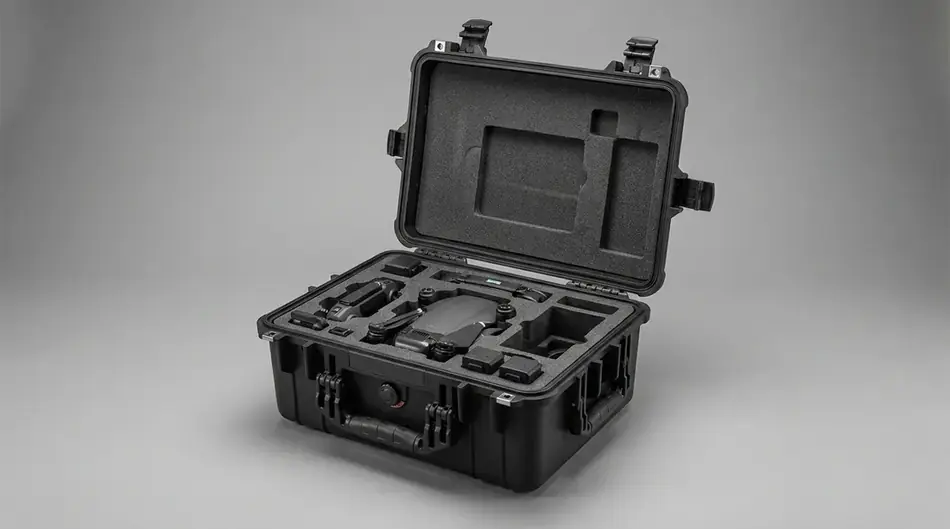
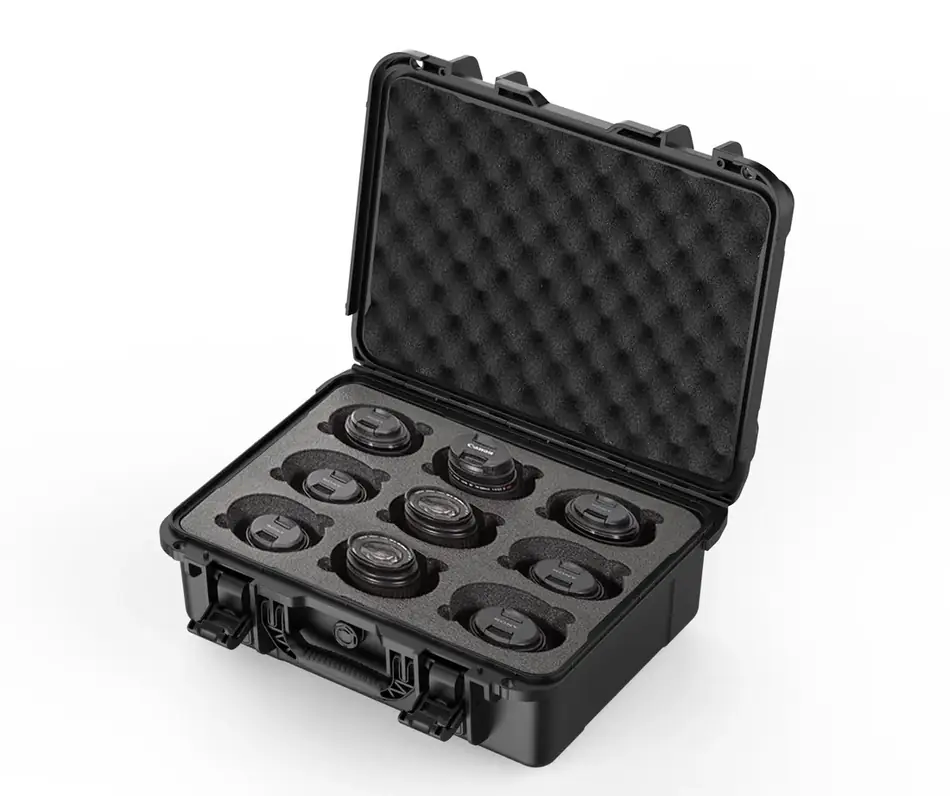
Protective Cases for Drones & UAV Payload Equipment
Short answer: a drone case is bought as three cavities rather than one box - the airframe in its folded carry state, the payload (gimbal camera, mapper, speaker or LiDAR head), and the ground side (controller, ground control station, spare batteries, propellers and charger) - and each is sized against the published internal length, width, height and lid depth of one named model. KeXin manufactures 155 injection-moulded thermoplastic shells and publishes internal and external dimensions and usable interior volume for all of them, wall thickness for 148, lid and base depth for 100 and empty mass for 93, with a compressible gasket in a moulded channel recorded on 124. What we do not publish for any model is an ingress code, a free-fall height, a shock figure, a temperature range or a static-dissipative rating, so this page gives construction figures instead of ratings and quotes accredited testing of the exact build as a separate work package.
Key points
- Size the airframe, the payload and the ground kit as three separate cavities; one box asked to hold all three usually fails at the lid line.
- Wall thickness is published per model from 2.0 to 6.0 mm, so a UAV case is chosen on a number rather than on the word heavy-duty.
- No ingress code, free-fall height or shock figure is published for any model; 124 of 155 shells record a gasket in a moulded channel.
- Lightness has a published cost: KX-4716 gives 20.4 litres at about 1,680 g on a 2.5 mm wall and is one of 31 shells with no gasket.
- Propellers and long booms are a length problem: KX-86216, KX-89616 and KX-814641 publish 582, 880 and 1,280 mm internal length.
- Wheels are published on 19 of 155 shells, and those 19 give up the flat stacking face that the other 136 keep.
Aerial Photography Drone Case: Size The Three Loads Separately
Most drone case purchases go wrong at the brief rather than at the moulding. Aerial photography kit arrives as three different loads: the airframe with its landing gear, antennas and quick-release plates; the payload, which is the glass, the gimbal motor and a connector that stands proud of the body; and the ground side - controller, notebook or ground control station, spare battery bricks, propellers, filters, charger and tether. A single box asked to carry all three forces one of two compromises: either the payload lies on top of the airframe, or the lid will not close over a standing antenna. Our published cavity range runs from 115 x 78 x 32 mm on KX-1204 to 740 x 518 x 364 mm on KX-88442, so an envelope exists for every one of those loads; the specification work is deciding which two or three shells carry them and how each is cut. Measure every item in the state it is actually carried - arms folded, gear fitted or removed, antenna standing, cable coiled - and record the extremes rather than the body dimensions.
Drone Equipment Storage Case: The Airframe Envelope
For the airframe the deciding figures are internal length and width against the folded footprint, and internal height against whatever stands proud: skids, a raised antenna, an RTK mast or a mounted spotlight. A mid-size folding survey airframe sits comfortably in the 437 x 308 x 164 mm cavity of KX-84818 on a 4.5 mm engineering-polypropylene wall with 17.7 litres, or in KX-85819 at 500 x 400 x 165 mm on a 4.75 mm wall with a published 120 mm lid over a 45 mm base and 26.4 litres. Where the kit carries taller stands, KX-85823 gives 500 x 400 x 210 mm with a 165 mm lid and 33.6 litres, KX-86224 gives 538 x 408 x 220 mm at 5.0 mm with 38.6 litres, and KX-87323 reaches 650 x 430 x 210 mm with 47.0 litres. If one person has to move the loaded box across a pad, a gravel shoulder or an apron, the same class of cavity is available with hardware added: KX-85827 publishes 500 x 400 x 220 mm internal, about 7,800 g empty, wheels and a 295 mm telescopic height, and KX-86830 publishes 595 x 460 x 255 mm internal at about 10,160 g with a 310 mm handle and 55.8 litres. Nineteen of the 155 models publish wheels, and each of those nineteen is published as non-stackable, which is the trade fleet buyers most often underestimate.
Drone Payload Equipment Case: Gimbal Cameras, Mappers And Sensors
The payload is the item nobody can afford to break, and it fails in two specific places: the optical face and the connector. Two rules follow. Nothing rests on the gimbal or lens face, so the payload travels in a cavity that carries it on its mount plate or top ring with the glass over an empty relieved pocket; and the connector, card-door and any quick-release pin get their own relief so a descending lid never loads them. For a single aerial camera, the ABS KX-63912 lists 360 x 240 x 104 mm internal on a 3.8 mm wall at about 1,600 g with 7.7 litres, and KX-63917 is the same footprint at 360 x 240 x 150 mm, about 1,810 g and 11.2 litres when the payload travels with its remote and cable. A mapping head or two-axis gimbal fits the 395 x 295 x 165 mm cavity of KX-84419 at 4.2 mm with a 120/45 mm lid-and-base split and 15.4 litres, or KX-64117 at 393 x 280 x 156 mm in ABS at about 2,100 g. Where a fleet rotates several sensor types, KX-84820 (437 x 308 x 180 mm, 4.5 mm, 19.4 litres) and KX-85017 (463 x 338 x 156 mm, 4.5 mm, 19.5 litres) take two payloads side by side with an accessory layer above them.
Drone Controller Storage Case
A transmitter is the smallest thing in the kit and the most frequently cracked, because it has a screen on one face, sticks and a yoke on another, folding antennas, and it lives on a passenger seat or a dashboard for the rest of the day. Choose a stiff, shallow cavity and cut it rather than choosing a large box and filling the air: the ABS KX-63413 lists 310 x 255 x 106 mm internal on a 4.8 mm wall at about 1,680 g with 6.7 litres and a gasket recorded for the model, which suits a controller with a mounted tablet. KX-63416 is the same footprint at 310 x 255 x 138 mm, about 1,800 g and 8.7 litres where a larger tablet, a spare yoke or a receiver rack has to stand. A phone-clamp transmitter travels well in the polypropylene KX-3213 at 308 x 230 x 118 mm internal, 3.0 mm wall, about 860 g and 7.2 litres, and KX-63912 covers wide controllers at 360 x 240 x 104 mm. Whatever the shell, route the antenna in its own channel instead of pressing it flat, give the sticks a relief pocket and keep the lanyard clear of the closure line.
Drone Ground Control Station Case
A ground control station is the load buyers most often under-size, because it is not one object: notebook or panel PC, radio modem or link unit, field monitor, mapping controller, lead set, charger, spare battery and the printed flight plan. Decide first whether it travels as one case or as a station case plus a link bag. For the single-case version the deciding figure is the lid depth under which the notebook and modem lie flat. KX-64114 gives 378 x 307 x 120 mm internal in ABS at 4.0 mm and about 2,100 g with 11.1 litres, which carries a notebook and a modem with leads in a second layer; KX-85215 gives 483 x 363 x 140 mm at 4.5 mm and 19.6 litres for a station with a monitor lying flat; KX-85218 keeps that footprint at 483 x 363 x 165 mm and 23.1 litres where a battery brick joins it. KX-64618 is a useful format when the station travels with a printer, because it publishes 430 x 290 x 165 mm internal with a 140 mm lid over a 25 mm base at about 2,775 g, so mass stays in the base and paper and forms stay in the shallow lid. Where the station crosses a yard, compare KX-85424 at 483 x 363 x 190 mm, about 6,000 g empty with wheels, against KX-85726 at 520 x 296 x 210 mm with wheels, a published 385 mm telescopic height and about 5,600 g. A notebook or charger that has just run is cooled before it is packed: we publish no temperature range for any model.
Drone Propeller Storage Case
Propellers are the clearest example in this category of length rather than volume deciding the answer. A bent or scalped blade is an airworthiness problem, so the requirement is that nothing lies on top of a blade and no blade touches another: a shallow plank with a pocket per prop and a routed outline that shows an empty slot at a glance is the standard build. Flat formats cover short sets - KX-4610 at 455 x 338 x 84 mm internal, 3.0 mm wall, about 1,115 g and 11.1 litres, and KX-4613 at the same footprint with 116 mm of height and 15.3 litres. For longer folders the library runs to KX-86216 at 582 x 300 x 130 mm with a published 100 mm lid over a 30 mm base and 19.5 litres, KX-88015 at 725 x 350 x 140 mm on a 5.0 mm wall and 28.4 litres, KX-89616 at 880 x 350 x 140 mm and 34.5 litres, and KX-814641 at 1,280 x 350 x 140 mm and 50.2 litres, which is the longest internal cavity published in this catalogue. Note the trade-off in the same data: none of those long shells is among the 19 wheeled models, so a propeller case is a carried case, and a long thin box ships awkwardly, which is why we ask for the prop span and the quantity before proposing one.
Drone Case With Modular Inserts
Modularity is a layout decision rather than a moulding feature, and it is the reason a drone programme can survive a change of airframe without a change of tooling. The pattern we build most often is a fixed carrier plank in the base that locates the airframe or the payload, a set of shallow trays that lift out for batteries, props, filters and charger, and a pluck or grid top layer for whatever changes between missions. Because 100 of the 155 models publish a lid depth and a base depth separately, the split itself is a design tool. KX-84421 at 410 x 280 x 198 mm publishes 140 mm of lid over 58 mm of base; KX-84430 at 395 x 295 x 275 mm publishes 230/45 mm for a kit whose accessories stand in the lid; KX-93221 at 300 x 200 x 200 mm publishes 165/35 mm, which is the classic battery-brick format; and KX-5321 at 481 x 373 x 192 mm on a 5.8 mm wall publishes the opposite ratio, a 43 mm lid over a 149 mm base, which keeps everything heavy below the closure line. A two-case fleet is the other half of the answer: one mission case that travels to the aircraft and one support case that stays in the vehicle, cut from the same shell family so trays interchange between them.
Drone Aerial Photography Shockproof Plastic Case: What We State And What We Do Not
This is the search phrase that needs the most honesty. In our published data the shock field is a manufacturer option with a note attached: it requires a specified foam layout, and the shell alone is not a shock rating. The impact field states the wall thickness for the model and records no free-fall height without a test. No ingress code and no drop height is published for any of the 155 models, so we do not describe a shell as shockproof in the sense a specification means it. What can be specified and checked is the mechanism: an item immobilised in a cut cavity sees far less of a knock than a loose one inside soft foam, because a loose item simply accelerates and strikes the far wall with more energy. So the practical build for aerial photography kit is a wall thick enough for the stacking you actually do, a cut that carries the payload on its strongest points, and a relief pocket over the glass. On published wall figures that means ABS shells such as KX-63413 and KX-63416 at 4.8 mm, KX-84215 at 384 x 285 x 135 mm on a 5.0 mm wall, KX-5321 at 5.8 mm, KX-6621 at 587 x 434 x 192 mm on a 6.0 mm wall at about 6,420 g, or the wheeled KX-97227 at 590 x 435 x 210 mm with a 6.0 mm wall, a 42 mm lid over a 168 mm base, about 10,000 g empty and a published 485 mm telescopic height. If a contract names a figure, we quote accredited testing of that exact shell, gasket, latch and foam build as a separate work package.
Custom Foam Cutting For Drone Cases
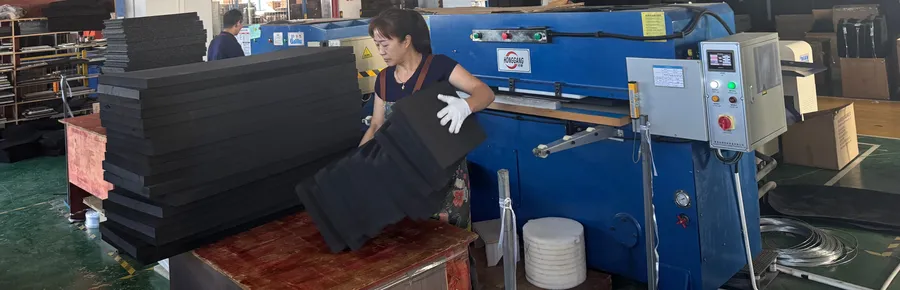
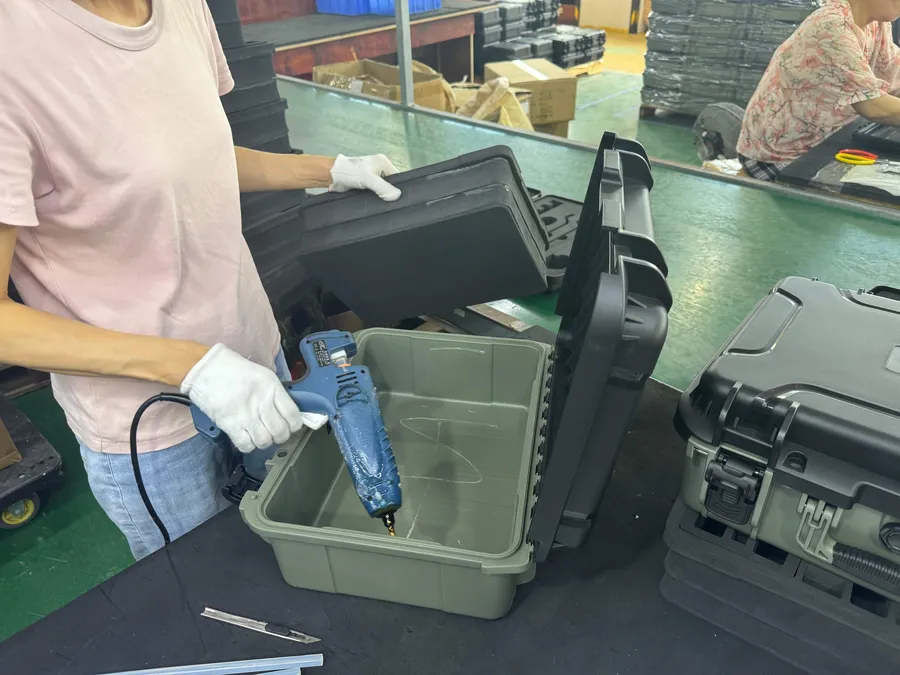
Almost all of the protective behaviour in a drone case lives in the insert, and the insert is the cheap part. We cut cross-linked PE, EVA or EPE plank by zone: die-cut for a repeated production layout, CNC-cut where a pocket wall has to hold tolerance around a gimbal body or a mount plate, layered builds with a firmer carrier under battery mass and a softer face against optics, routed channels so a lead cannot push its plug into a socket, relief windows under a connector, standing pockets for battery bricks, and printed or routed outlines so a missing prop or filter shows as an empty shape at check-in. The sizing rule we apply is about 20 mm of working clearance per axis once the foam is counted, read against the published internal figures rather than the external size in a product name. Custom foam starts at one unit on an existing shell and needs no new tooling; send a drawing, a photograph of the kit as it is actually packed with a scale reference, or the physical item. One limit worth stating: an anti-static or conductive liner is a separate material specification evidenced by a report on that batch, not something assumed from a moulding, and a pluck bed cannot be relied on to show a missing item the way a cut outline can.
EVA Lining Design For Drone Cases
EVA is the lining we most often recommend for field drone kits, for three reasons that come from the material rather than from a brochure. It is closed-cell, so a wet landing-pad splash, a spilled drink or condensation on a battery sits on the surface and wipes off instead of soaking in; it takes a firm skin when carved, so a pocket keeps its shape through repeated issue and return in a way loose pluck material does not; and it laminates in layers, so a soft EVA face can meet a finished gimbal while a firmer PE carrier takes the mass underneath. Where a mission changes weekly, an EVA face layer over a fixed base with a pluck top keeps the layout current without reprinting the whole cavity. Where the pockets are small and hard-wearing - props, filters, batteries, tools, spare antennas - the formats that suit an EVA build include KX-1905 at 180 x 160 x 40 mm and about 250 g, KX-2507 at 245 x 175 x 64 mm and about 340 g, KX-2811 at 253 x 180 x 98 mm on a 5.0 mm wall with a 71 mm lid over a 27 mm base at about 890 g, and KX-92817 at 253 x 180 x 152 mm on the same 5.0 mm wall at about 940 g. Two honest limits: EVA is quoted by zone and contact pressure rather than as a blanket density, and an EVA liner is not a static-control feature.
Lightweight Drone Case Design
Weight is the constraint a flight crew argues about longest, because a case carried to an aircraft is carried by a person, often twice, often up a slope. The published library lets the arithmetic be done instead of guessed. Thin-wall engineering-polypropylene formats buy the most litres per gram: KX-705 lists 420 x 270 x 112 mm on a 2.1 mm wall at about 830 g for 10.9 litres, KX-706 gives 443 x 285 x 126 mm at about 1,030 g for 13.7 litres, KX-707 gives 465 x 310 x 140 mm at 2.5 mm and about 1,360 g for 17.4 litres, and KX-4716 gives 458 x 345 x 150 mm at about 1,680 g for 20.4 litres. Dividing the published mass by the published volume puts those four in the region of 75 to 82 grams per litre, against about 175 for the thick-wall KX-5321, about 222 for the wheeled KX-85827 and about 278 for KX-85021 - hardware, not resin, is where the grams really go. The trades are explicit in the same data. KX-705, KX-706, KX-707 and KX-4716 are all four among the 31 models that record no gasket channel, so lightness costs you the sealed rim, and a thin wall transmits more point load and stacks worse than a 5.0 mm one. A lightweight design is therefore four decisions stated as numbers on one datasheet: resin, wall, envelope, and not adding wheels.
Drone Case Technical Purchasing Requirements
A drone programme needs a technical requirement list a supplier can answer line by line, and the useful entries are these. An item list in carry state with measured length, width, height and mass for every part. Required cavity figures per case: internal length, width and height; lid depth and base depth separately; usable interior volume; wall thickness; resin; empty mass where published; and the narrow internal width, which several models publish because the cavity tapers. Hardware: latch count, whether the latch body accepts a standard padlock (published as yes for all 155 models here), gasket recorded or not for that specific model, handle, wheels and published telescopic height. Interior: foam type, layer build, pocket per item, relief positions and outline marking. Marking, colour, logo and packaging. Commercial terms: the minimum order ladder of one unit on a stock shell and one on a custom foam layout, 300 units for colour, logo or OEM hardware and 3,000 per component for a new mould; an OEM first sample about 45 days on existing tooling and a new mould about 125 days; EXW or FOB; a 30 per cent deposit with the balance after inspection. Carton size and pieces per carton for the freight plan, published on 64 models. And the line that protects you: no ingress code, free-fall height, shock figure, temperature range or static rating is accepted from a product name, only from an accredited report on the build actually being bought.
Buyer Search Phrase To The Published Figure That Decides It
Every figure in this table is a published specification for the model named, not a performance rating, so the comparison is only valid against your own measured packed envelope and the mass a crew will actually carry. Where a tender needs evidence of ingress, free-fall or static behaviour, we quote accredited testing for that exact shell, gasket, latch and foam build as a separate work package instead of printing a number we cannot document, and we will tell you plainly when a stock cavity is closer and cheaper than a new mould.
| Buyer Search | Deciding Published Figure | Published Example |
|---|---|---|
| aerial photography drone case | Internal length and width against the folded footprint, plus lid depth for anything standing | KX-85819: 500 x 400 x 165 mm internal, 4.75 mm wall, 120/45 mm lid/base, 26.4 L |
| drone equipment storage case | Cavity volume and wall, then whether the loaded box is carried or rolled | KX-84818: 437 x 308 x 164 mm, 4.5 mm, 17.7 L; KX-86830: 595 x 460 x 255 mm, 4.8 mm, wheels, 310 mm handle, about 10,160 g |
| drone payload equipment case | Relief over the optical face and the connector; stiffness per millimetre of wall | KX-63912: 360 x 240 x 104 mm ABS, 3.8 mm, about 1,600 g, 7.7 L; KX-63917: 360 x 240 x 150 mm, 11.2 L |
| drone controller storage case | Shallow stiff cavity cut to the transmitter rather than a deep box half filled with air | KX-63413: 310 x 255 x 106 mm ABS, 4.8 mm, about 1,680 g, 6.7 L, gasket recorded |
| drone ground control station case | Lid depth under the notebook and modem, with mass kept in the base | KX-64114: 378 x 307 x 120 mm ABS, about 2,100 g; KX-64618: 430 x 290 x 165 mm with a 140/25 mm lid/base |
| drone propeller storage case | Internal length with one pocket per blade; none of these long shells is a wheeled model | KX-86216: 582 x 300 x 130 mm, 100/30 mm lid/base; KX-89616: 880 x 350 x 140 mm; KX-814641: 1,280 x 350 x 140 mm, 50.2 L |
| drone case with modular inserts | Published lid and base split plus a lift-out tray layout | KX-5321: 481 x 373 x 192 mm with 43 mm lid over 149 mm base; KX-84430: 395 x 295 x 275 mm, 230/45 mm |
| drone aerial photography shockproof plastic case | Wall thickness per model; no shock figure or free-fall height is published | KX-6621: 587 x 434 x 192 mm on a 6.0 mm wall, about 6,420 g, 39.1 L; KX-97227: 590 x 435 x 210 mm, 6.0 mm, wheels |
| custom foam cutting for drone cases | Pocket tolerance and relief positions, die-cut or CNC-cut by zone, quoted from one unit | KX-84419: 395 x 295 x 165 mm, 4.2 mm wall, 120/45 mm lid/base, 15.4 L, with a gimbal relief pocket |
| eva lining design for drone cases | Closed-cell face layer over a firmer carrier, with wipeable pocket walls | KX-2811: 253 x 180 x 98 mm, 5.0 mm wall, about 890 g, 3.6 L; KX-92817: 253 x 180 x 152 mm, 5.0 mm, about 940 g |
| lightweight drone case design | Grams per litre at a published wall, and what the thin wall gives up | KX-4716: 458 x 345 x 150 mm, 2.5 mm, about 1,680 g, 20.4 L - and one of the 31 shells with no gasket |
| drone case technical purchasing requirements | Datasheet fields per model plus the MOQ and lead-time ladder | 155 models: internal and external size and volume on all; wall on 148; lid and base depth on 100; empty mass on 93; carton data on 64 |
Selection Guidance: Four Checks That Reach A Model Number
First, split the load: name the case that carries the airframe, the case that carries payloads and the case that carries the ground kit, then size each against the published internal figures and add about 20 mm of working clearance per axis for the cut. Second, read lid depth separately from total internal height whenever something stands - a modem antenna, a battery brick, a gimbal on its plate - or move to a model that publishes a deep base with a thin lid. Third, decide the carry: 136 of the 155 shells are published as non-wheeled and stackable, and the 19 that publish wheels and a telescopic height are published as non-stackable and several kilograms heavier empty. Fourth, fix the hardware and the interior on the datasheet of the nominated model rather than assuming a series capability: latch count, whether that shell records a gasket, handle, document holder, breather option, colour and logo. If the document your purchaser must show names a rating, budget the test; if it names a dimension, a wall or a volume, our datasheet answers it today and the shortlist usually reduces to two shells plus one foam layout.
Where These Cases Are Used
The buyer is rarely the flight crew alone. Airframe and payload manufacturers ship a unit with its accessories as one issuable package and need the interior drawing to become the reorder standard. Survey, mapping, inspection and utility-patrol teams build a per-crew kit that goes out on a vehicle and comes back muddy. Agricultural operators move batteries, nozzles and spare booms between fields, where the propeller and long-part case matters as much as the aircraft case. Training organisations and flight schools issue and recover identical kits weekly, which is an outline-marking and modular-tray problem. Distributors and integrators assemble a demonstration case that has to survive a car boot, a hotel room and an air-freight leg. All of them draw on the same shells and differ mainly in the cut, the gasket, the carry format and the marking. Related pages in this catalogue cover the drone and UAV category, the aerospace, defence, electronics, field-equipment and telecommunications applications, and the foam-insert and material guides.
Customisation: Interior, Hardware, Marking And Tooling
Interior work is the fast path and starts at one unit: die-cut or CNC-cut cross-linked PE, EVA or EPE; layered builds; lift-out trays; standing pockets for battery bricks; relief under connectors and optics; printed or routed outlines; and a pluck top over a fixed base for kits that change between issues. Hardware is ordered the same way - latch count, hinge and stay arrangement, handle, document holder, shoulder strap and a pressure-equalisation option are manufacturer options quoted per configuration, and every model in this library publishes a latch body that accepts a standard padlock. Colour, logo, printed identification and buyer-branded packaging begin at 300 units. Only a change to the shell itself needs a mould: near 3,000 units per component and about 125 days from approved drawings, while an OEM first sample on an approved existing shell takes about 45 days. Most drone programmes never need new tooling, because the published cavity range already brackets the kit - so tell us which of the three loads you are solving, send the packed-state dimensions, and we propose shells rather than promising a mould.
Procurement Notes: Wholesale Terms, Verification And What We Will Not Claim
KeXin New Materials (Guangdong) Co., Ltd. is the manufacturer of these shells and works wholesale, OEM and ODM only, on EXW or FOB terms. There is no retail channel, no delivered-duty-paid quotation and no overseas warehouse stock, so build landed cost from an FOB figure plus your own freight and clearance; we publish no pallet loading figure, but carton size and pieces per carton are published on 64 models so the pallet arithmetic can be done from them. Payment is a 30 per cent deposit with the balance payable after inspection, and third-party factory inspection before goods leave is welcome. Spare-battery movement is governed by the applicable dangerous-goods rules for the pack and the carrier rather than by the case, and nothing in this catalogue is offered as regulated battery transport packaging in that sense. Then apply the same three questions to us that you would apply to any supplier: which accredited report produced this figure, what method and conditions were used, and does that report cover the exact build being bought. Any field our data sheet records as not measured is the answer we will give you - not an estimate and not a label borrowed from the industry. Enquiries go to Fred Zhao or the KeXin Sales Team, WhatsApp +86 135 3588 0002.
Customisation
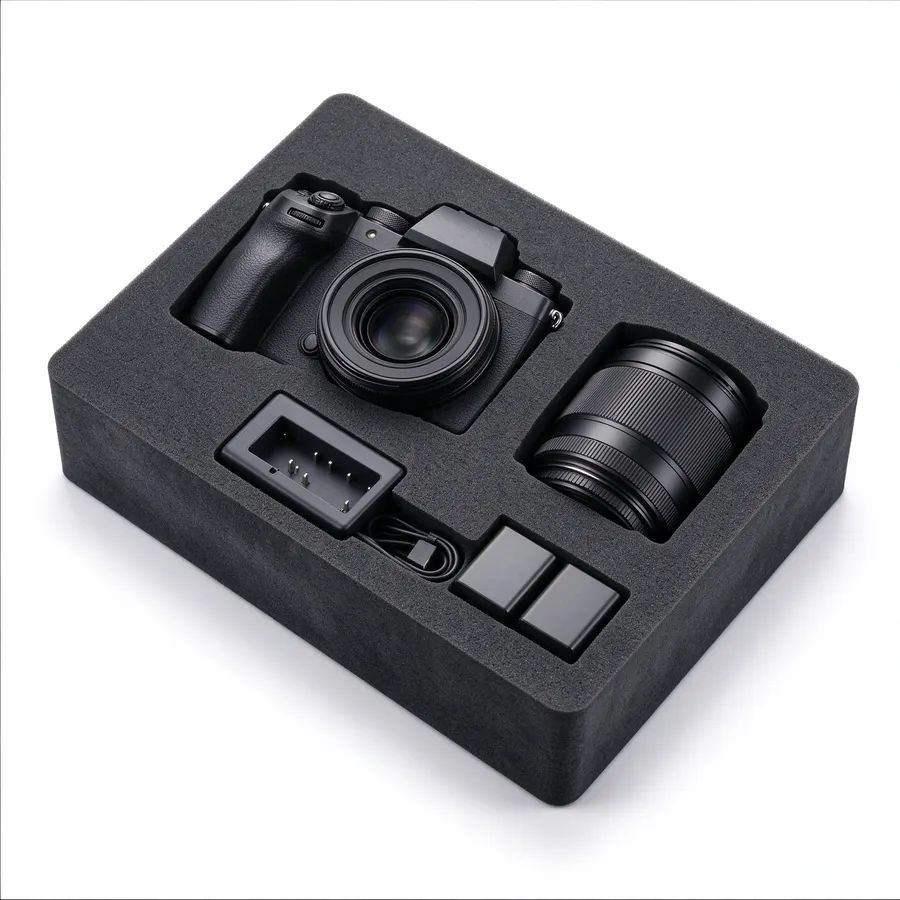
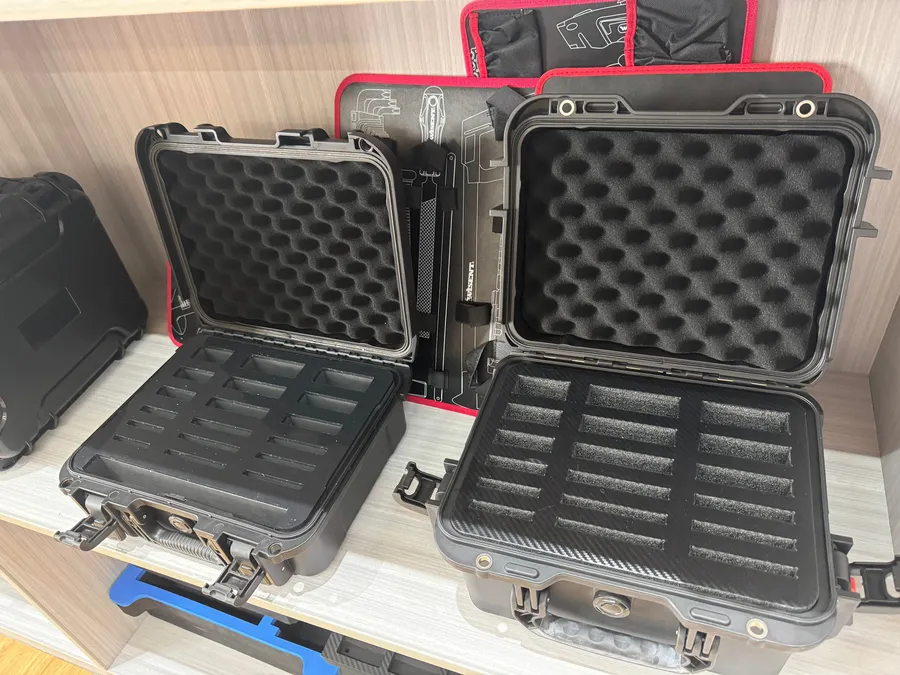
Everything described above is configurable on a standard shell: interior layout (pick-and-pluck, die-cut or CNC-cut), foam grade and thickness, colour, logo method, latch and lock count, pressure-equalisation valve, cable ports, document holder and identification plate. A bespoke exterior geometry requires a new mould — 125 days, from 3,000 units per moulded component.
Procurement considerations
| Question | What to send us |
|---|---|
| Which shell fits? | Equipment L × W × H as packed, plus required clearance per axis |
| What does it cost? | Order quantity and estimated annual quantity — the two drive different answers |
| Is tooling needed? | Whether an existing shell clears the envelope with usable foam depth |
| Lead time? | Your required delivery date, not just the order date |
| Certification? | The exact standard your tender names — we will say whether we can test to it |
| Freight? | Destination and preferred terms; carton and pallet data supplied with the quotation |
Comparison and selection guide
The tables on this page exist because a protective case is chosen by comparing three things: the envelope, the environment and the handling chain. Where no table applies, the rule below is.
| Situation | What To Do |
|---|---|
| Folded or fixed | Measure the airframe in its folded transport configuration, then add 20 mm. |
| Battery count | Each battery needs its own pocket, not a shared compartment. |
| Ground station | Controllers, tablets and monitors are best in a separate lid layer. |
- Size on internal dimensions plus clearance, never on a product name.
- Choose the carrying method before the shell: it changes the series, not just the price.
- Specify the interior last, and decide up front whether the end user will reconfigure it.
Protective Cases for Drones & UAV Payload Equipment relates to Protective Case Basics. Related families: Drone & UAV Cases / Camera & Photography Cases / Electronics Cases / Communication Equipment Cases / Equipment Transport Cases / Custom Protective Cases / Rolling Cases / Outdoor Protective Cases / Long Equipment Cases / Instrument & Equipment Cases. Related sectors: field and industrial equipment. Continue in the Protective Case Basics cluster.
This page is written from our own production data. If your requirement differs, send the dimensions and we will tell you which of the 155 models fits, or whether a custom route is needed.