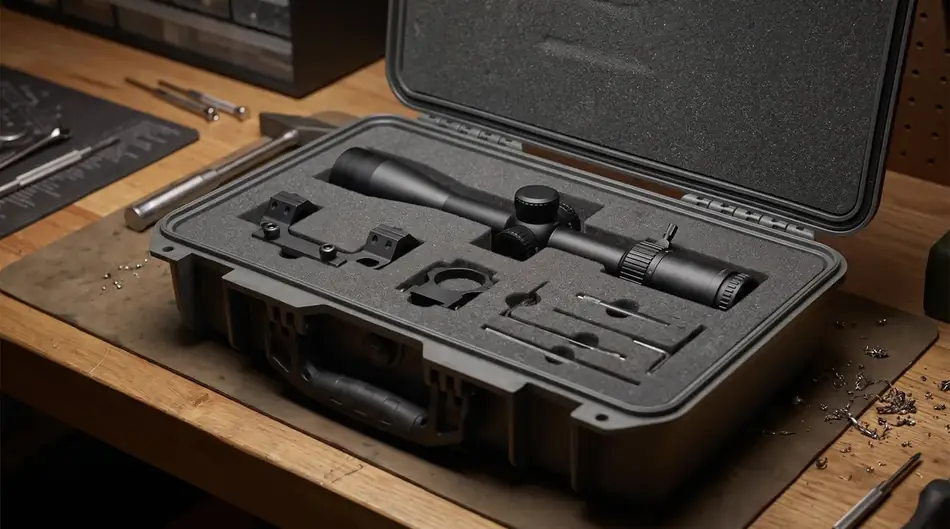
Protective Cases for Automotive, Rail Equipment
Buy for the duty cycle the case lives in, not for the industry name. An automotive or rail case spends its life in a van, on a tray, in a cab or in a possession box at the side of a track, which means repeated small impacts, continuous vibration, grit, stacked loads and hand-offs between people who are not thinking about the lid - so the buying order is packed envelope first, published cavity second, lid-to-base split third, carry format fourth and interior cut fifth. KeXin publishes internal and external dimensions, wall thickness between 2.0 and 6.0 mm per model, lid and base depth, usable volume, empty mass, narrow internal width, gasket construction and carton packing model by model, and buys nothing with a rating word: no ingress figure, no shock rating, no drop height, no UV or temperature range and no stack load is published for any of the 155 models, so a shockproof automotive equipment case is an assembled specification of shell, wall and cut foam that you approve, not a label you read off a page. Wholesale and OEM only, on EXW or FOB terms.
Key points
- Buy against the packed envelope - tool with case, cable coiled, battery fitted - then read published internal length, width and height plus about 20 mm per axis.
- Lid-to-base split decides usable space: the ABS KX-64618 publishes a 140 mm lid over a 25 mm base, so mass belongs in the lid half.
- Shock protection is an assembly of shell, wall and a specified foam layout; the moulding alone is not a rating and we publish none.
- Vehicle duty is vibration before impact: continuous vibration walks loose items and chafes foam, so retainers and a firm carrier layer matter more than thickness.
- Only 19 of 155 models publish wheels and 124 publish a gasket channel; both are per-model fields rather than a house standard you can assume.
- Wholesale terms are fixed: one piece standard, one piece for custom foam, about 300 for logo or OEM, about 3,000 per component for a new mould, 45 or 125 days.
An Automotive Equipment Case Buying Guide: The Order Of Decisions
Most case purchases in this sector start from the wrong end - a colour, a brand equivalence or a word such as waterproof - and then try to make the equipment fit the answer. An automotive equipment case buying guide that is worth anything runs the decisions in the order that actually determines whether the tool arrives working. One: measure the load as it travels, which for a workshop means the tool with its case, the charger with its coiled lead, the torque wrench with its calibration certificate sleeve and the consumables box that always ends up on top. Two: read the published internal length, width and height of a named model and add roughly twenty millimetres per axis for the cut, never inferring a cavity from the digits in a product name. Three: read lid depth and base depth separately, because a shallow base plus a deep lid is a different object from an even split at the same total height. Four: read the narrow internal width before drawing any rigid tray, because models taper and a plank that clears the wide section binds at the waist. Five: settle the carry from loaded mass and the surface crossed - a kerb, a workshop ramp, a ballast shoulder - and only then choose the interior. Six: write down what you need proved, and ask for it as a test on the configuration you are ordering.
Automotive Programming Equipment Case
A programming kit is a laptop or tablet, a pass-thru interface or vehicle communication interface, a bundle of adapters and dongles, a lead to the diagnostic socket, a power supply and often a battery maintainer, and it is the most easily ruined kit in the van because almost every part of it has a connector sticking out of it. The failure pattern is not a dramatic crush but a lap strap or a tool handle pressing an adapter into its socket while the case is being squeezed past a wheel arch. What works is a cavity per body with each interface laid connector-up in a relieved pocket, a channel per lead at a radius that will not work-harden the conductors, a separate layer for the adapter set so a metal body never shares a cavity with a plastic housing, and a defined home for the maintainer so its mass sits low. For a laptop plus interface, the ABS KX-63912 lists 360 by 240 by 104 millimetres internal on a 3.8 millimetre wall at about 1,600 grams with 7.7 litres and a published gasket construction; the polypropylene KX-84113 gives 380 by 267 by 115 millimetres with 10.1 litres, and the KX-64112 covers 393 by 280 by 112 millimetres at about 1,820 grams and 10.6 litres where a tablet, interface and adapter set travel together. A small flash tool with its leads and a spare battery fits the engineering-polypropylene KX-92817 at 253 by 180 by 152 millimetres with a 125 millimetre lid over a 27 millimetre base at about 940 grams. Where one box serves a bay with two interfaces and a maintainer, the KX-85215 gives 483 by 363 by 140 millimetres and 19.6 litres.
Off-Road Vehicle Exterior Gear Protective Box
An off-road vehicle exterior gear protective box lives on a rack, in a tray, under a canopy or behind a seat, and it is the toughest duty in this catalogue: sun, grit, wash-down, fuel and oil contact, load thrown against it, and a lid that gets opened with gloves on. Two published fields decide the choice more than any other. The first is wall thickness. A box that gets climbed on and stacked against wants the 4.2 millimetre wall of the KX-84816 at 410 by 360 by 140 millimetres with a 100 millimetre lid over a 40 millimetre base and 16.6 litres, the 4.5 millimetre wall of the engineering-polypropylene KX-85218 at 483 by 363 by 165 millimetres and 23.1 litres, or the 5.0 millimetre wall of the KX-87319 at 650 by 430 by 170 millimetres and 38.0 litres. The second is the lid-to-base split, because recovery straps, a snatch block, gloves and a first-aid pouch want to lie in the base rather than hang in the lid: the KX-85823 publishes a 165 millimetre lid over a 45 millimetre base at 500 by 400 by 210 millimetres and 33.6 litres, and the KX-88421 gives 740 by 518 by 189 millimetres with a 145 millimetre lid over a 44 millimetre base and 57.9 litres for a full tray load. A long flat load such as recovery boards, a shovel or a pole saw suits the KX-86216 at 582 by 300 by 130 millimetres with a 100 millimetre lid over a 30 millimetre base and 19.5 litres. What we do not publish is the two figures that exterior mounting really raises: no ingress figure and no ultraviolet resistance figure is recorded for any model, so a box that lives outside is a material question to be tested on the configuration you order, not a catalogue adjective.
Shockproof Automotive Equipment Case Design
The phrase buyers search is a shockproof automotive equipment case, and the design answer is an assembly rather than a material. Vehicle duty has two distinct mechanics. Impact is what happens when a box leaves the bench and hits the floor: energy goes in over a few milliseconds and the job of the interior is to stretch that pulse out by distance, which is what a firm carrier layer of the right thickness under the mass does. Vibration is what happens for four hundred kilometres: it does not deliver a peak, it walks things. Loose items migrate, foam chafes and polishes a finished surface, a cable creeps out of its channel until its own plug is being pushed into a socket, and a light item resting on a heavy one slowly works a mark into it. A design that survives both has a firm carrier under mass with a softer face against the instrument, one pocket per item with a wall of foam between bodies rather than a shared cavity, a retainer for anything that can lift out of its pocket, relief cut under screens, connector panels and calibrated faces so nothing is loaded along an axis it does not like, and a base depth that keeps the mass below the lid line so opening the case does not drop something on the mechanic. In practice that means the ABS KX-64618 with a 140 millimetre lid over a 25 millimetre base at 430 by 290 by 165 millimetres and about 2,775 grams is a lid-heavy layout that must be retained, while the polypropylene KX-84419 at 395 by 295 by 165 millimetres with a 120 millimetre lid over a 45 millimetre base and 15.4 litres puts more of the working volume in the base. A dense load such as a hydraulic tool or a compressor wants the engineering-polypropylene KX-5723 at 500 by 340 by 211 millimetres on a 5.0 millimetre wall, about 4,680 grams empty and 28.7 litres, and where a rigid divider plate is planned, the KX-4616 publishes a narrow internal width of 302 millimetres against a nominal 338.
Vehicle-Mounted Protective Case Mounting Solutions
A case that stays in the vehicle is a different product from a case that travels to the vehicle, and vehicle-mounted protective case mounting solutions start from three questions we can answer from published data. Does the model publish stackable - a bolted shelf box is stacked against by definition, and the wheeled KX-88442 publishes stackable as false, as do the other eighteen wheeled models, because wheels and a stack are contradictory instructions. Does it publish feet and a fixed folding handle, and where do they sit relative to the rim, because a strap that crosses a handle or a foot picks its own wear point. And how many latches does the configuration carry, since latch count is specified per configuration precisely so closing pressure spreads around the frame instead of concentrating at two corners on a chassis that is permanently out of true. The layouts that work in practice are a shelf box whose lid opens into clear height, chosen so the closed external dimension plus the hinge radius fits the bay - the polypropylene KX-84116 at 385 by 313 by 145 millimetres and 15.0 litres or the KX-84120 at 385 by 313 by 180 millimetres and 18.7 litres; a deep bay box such as the KX-84825 at 410 by 360 by 240 millimetres with a 200 millimetre lid over a 40 millimetre base and 28.3 litres; and a heavy fixed installation where wall thickness earns its mass, as in the 6.0 millimetre engineering-polypropylene KX-6621 at 587 by 434 by 192 millimetres, about 6,420 grams empty and 39.1 litres. Bracketry, bolt-through flanges, a strap channel cut in the foam, a cut-out for a cable gland or a recess for a locking hasp are all configuration work quoted per build, and we will tell you when a stock shell plus a cut plank is the cheaper answer than a new mould.
Rail And Track Maintenance Cases
Rail kit has its own logic. A possession box goes out on a trolley or on foot along a ballast shoulder, comes back greasy, and has to be auditable at the boundary in daylight: geometry gauges, torque tools and their calibration sleeves, a spirit level, scribes, shims, a camera for the record, high-visibility items and the paperwork. Long rigid instruments govern the cavity, so the useful models are the long bodies - the polypropylene KX-87926 at 737 by 257 by 240 millimetres with a 175 millimetre lid over a 65 millimetre base and 36.4 litres, the KX-88015 at 725 by 350 by 140 millimetres with a 100 millimetre lid over a 40 millimetre base and 28.4 litres, and the KX-89616 at 880 by 350 by 140 millimetres and 34.5 litres where a gauge beam and a level travel together. A dense electronics load with a rugged rim suits the ABS KX-5021 at 465 by 315 by 196 millimetres, about 3,430 grams empty and 24.7 litres. Two habits make the difference between a box that passes its count and one that does not. First, printed or routed outlines so an absent tool reads as an empty pocket, because a tool left on track is a safety event rather than a loss. Second, a layout in which everything fits without the lid being forced, because a lid under strain is how a calibrated face gets loaded. Track-side environmental exposure, non-slip performance and any fire-behaviour requirement sit outside what we publish: no ingress figure, no flame-spread rating and no temperature range is recorded for any model, so those are named as test requirements against the ordered configuration.
Buyer Search Phrase To The Published Figure That Decides It
| Search Phrase | Figure That Decides It | Published Example |
|---|---|---|
| automotive equipment case buying guide | Packed envelope, then published internal dimensions plus about 20 mm per axis, then lid-to-base split | KX-84113: 380 x 267 x 115 mm internal, PP, 3.4 mm wall, 10.1 L, gasket published |
| automotive programming equipment case | A relieved pocket per interface with connectors unloaded, plus a channel per lead | KX-63912: 360 x 240 x 104 mm internal, ABS, 3.8 mm wall, about 1,600 g, 7.7 L |
| off-road vehicle exterior gear protective box | Wall thickness and lid depth, because exterior loads are stacked against and climbed on | KX-84816: 410 x 360 x 140 mm internal, 4.2 mm wall, 100/40 mm lid/base, 16.6 L |
| shockproof automotive equipment case design | Firm carrier under mass, one pocket per item, retainers; the shell alone is not a shock rating | KX-64618: 430 x 290 x 165 mm internal, ABS, 4.7 mm wall, 140/25 mm lid/base, about 2,775 g |
| vehicle-mounted protective case mounting solutions | Published stackable state, external size against clear lid-opening height, latch count per configuration | KX-6621: 587 x 434 x 192 mm internal, engineering PP, 6.0 mm wall, about 6,420 g, 39.1 L |
| wholesale automotive repair case purchasing | Carton footprint and pieces per carton, then pallet and container figures calculated for your lane | KX-3213: 308 x 230 x 118 mm internal, 16 pieces per 645 x 530 x 520 mm carton |
| rail possession and track maintenance box | Internal length for the gauge beam, and printed outlines so a missing tool is visible at the count | KX-87926: 737 x 257 x 240 mm internal, PP, 4.0 mm wall, 175/65 mm lid/base, 36.4 L |
| van shelving box that also carries | Whether the model publishes wheels at all - only 19 of 155 do - and whether it publishes stackable | KX-85021: 437 x 308 x 164 mm internal, engineering PP, wheels, telescopic handle, about 4,912 g |
Wholesale Automotive Repair Case Purchasing
Wholesale automotive repair case purchasing is where a fleet standardises, and the commercial shape of it is fixed and worth stating up front. KeXin New Materials (Guangdong) Co., Ltd. supplies on wholesale and OEM or ODM terms only, on EXW or FOB. There is no retail channel, no delivered-duty-paid quotation and no overseas warehouse, so freight and clearance sit with the buyer and the case has to be worth the volume it occupies. Minimums run in layers: one piece on a standard model, one piece for a custom foam cut so a layout can be proven in one van before it is written into a purchasing standard, around 300 pieces for colour, printed or in-mould logo and OEM production, and around 3,000 pieces per component for a dedicated new mould. A first OEM article on existing tooling runs about 45 days; a new mould about 125 days from approved drawings. Payment is a 30 per cent deposit with the balance before shipment after inspection, and third-party inspection at our facility is welcome. On the logistics side, 58 of the 155 models publish a carton size and a pieces-per-carton figure - the KX-64112 ships ten to a 705 by 430 by 650 millimetre carton, the KX-3213 ships sixteen to a 645 by 530 by 520 millimetre carton, and the KX-6621 ships three to a 665 by 500 by 650 millimetre carton - while pallet quantities are calculated from the carton footprint against your pallet size and 20GP, 40GP and 40HQ loading is supplied with the quotation rather than guessed from a screen.
Shell Material, Wall And Hardware In Vehicle Duty
Three shell families cover the catalogue: polypropylene on 94 models, engineering polypropylene on 38 and ABS on 22, with one model published as a polypropylene and ABS combination. Polypropylene is the light per litre and takes oil, solvent and grit without complaint, which is most of what a workshop bay throws at it. Engineering polypropylene is the tougher formulation for a case that is stacked, dropped from a tray height or driven over a ballast shoulder all week. ABS is denser and stiffer per millimetre, so it protects a screen, a connector panel or a thin housing better at the cost of grams - the ABS KX-5021 buys a 3.7 millimetre wall and about 3,430 grams empty for 24.7 litres. Wall thickness is recorded per model between 2.0 and 6.0 millimetres, and it is the figure to compare when two cavities look identical. Hardware published per model includes a fixed folding handle, hinge, feet, a latch count specified per configuration and a latch body recorded as accepting a standard padlock; wheels and a telescopic handle appear on 19 models; a compressible gasket in a continuous moulded channel is published on 124. A shoulder strap, a document holder, a pressure-equalisation option and buyer-branded packaging are configuration items quoted per build rather than attributes you can assume across a series.
What We Publish And What We Do Not
Automotive and rail buyers are used to specifications written in code letters, and it is cheaper for both sides if we say plainly which of them we cannot fill in. No ingress figure is published for any model, so we describe construction instead: a gasket set in a continuous moulded channel on 124 of the 155 models, with latch count specified per configuration so rim compression is even. No shock rating, drop height or stack load in kilograms is published, because a shock result is a property of a specified foam layout with the item immobilised, and the impact field we do record states the wall thickness of that model and notes that no drop height is claimed without a test. No ultraviolet resistance figure and no temperature range is published, which matters more here than in any other sector, because a box on a rack or in a cab spends its summer at temperatures no warehouse shelf ever sees; if your procedure names a temperature, a UV exposure or a fire-behaviour class, that is a named test on the configuration you order and we quote it as a separate work package. Where a figure has not been measured on the model you are buying, we leave the field blank rather than filling it with a series average, and we would rather lose an order than win it on a number we cannot evidence.
Selection Guidance: Four Checks Before A Fleet Order
Check one, standardise on two or three cavities rather than one per tool. A fleet that runs a programming box, a bay box and a long box buys better, spares better and stacks predictably, and the published ladders make that easy: 380 by 267 by 115 millimetres on the KX-84113, 455 by 338 by 148 millimetres on the KX-4616 and 587 by 434 by 192 millimetres on the KX-6621 are three different jobs, not three sizes of the same job. Check two, confirm lid-clear height in the actual installation, since a case bolted under a bench with 240 millimetres of clearance above the base line cannot open a 200 millimetre lid. Check three, fix the interior once and make the drawing the reorder standard, because a fleet whose pockets drift is a fleet whose tools go missing. Check four, put the environmental words in your enquiry in the form of a test rather than a claim - name the ingress procedure, the temperature exposure or the UV condition you need evidence for and ask for a quotation against the exact SKU. Send packed-state dimensions, a scale photograph of the kit, the hardware you want and the annual quantity, and we will tell you when a stock shell plus a cut plank beats a new mould.
Where These Cases Are Used
The buyers here are rarely the mechanic at the vehicle. Franchise and independent service networks standardise a programming box and a bay box so a technician arriving at a different site finds the same pockets. Mobile tyre, fleet-maintenance and breakdown operators buy boxes that live on a tray and get rained on. Vehicle converters and upfitters take cases as componentry to be mounted into a build, which is where strap channels, latch access and lid-clear height start to matter more than appearance. Motorsport and test teams run mixed kits of instruments, sensors and hand tools where vibration retention is the whole design problem. Rail maintenance contractors and infrastructure teams buy possession boxes and long-instrument cases that must survive a walk along the ballast and an auditable count at the boundary. Agricultural, plant, mining-service and marine engineering buyers take the same shells for the same reasons, since the duty cycle is similar even where the industry name is not. What they share is the specification method: a named tool set, a measured packed envelope, a chosen published model, an approved interior drawing, and a stated list of tests the purchaser needs to see before the order is placed.
Procurement Notes: Wholesale Terms, MOQ And Lead Time
KeXin supplies automotive and rail programmes on wholesale and OEM or ODM terms only, EXW or FOB, with no retail channel, no delivered-duty-paid quotation and no overseas warehouse. Minimums: one piece on a standard model, one piece for a custom foam layout, about 300 pieces for colour, logo or OEM production and about 3,000 pieces per component for a dedicated new mould. Lead time: about 45 days for a first OEM article on existing tooling and about 125 days for a new mould from approved drawings, against a 30 per cent deposit with the balance before shipment after inspection; third-party verification at our facility is welcome. Published per model: internal and external dimensions, wall thickness, lid and base depth, usable volume, empty mass, narrow internal width, gasket construction, handle, hinge, feet, latch and padlock details, and carton packing where measured. Pallet figures are calculated from the carton footprint against your pallet size, and 20GP, 40GP and 40HQ loading is supplied with the quotation. Anything not measured on the SKU you order is recorded as not measured and quoted as a test rather than estimated. Contact Fred Zhao or the KeXin Sales Team, WhatsApp +86 135 3588 0002.
Automotive testing equipment case: the buyer wording, answered against published model data
The phrase buyers search here names a job, not a product line: an instrument, data logger or sensor kit that leaves a bench, rides in a van and comes back with a loom of leads coiled over it. The rows below answer it from the fields we publish per model - internal and external dimensions, wall thickness, lid and base depth, usable interior volume, empty mass, gasket channel, latch details, order minimums and lead times - and leave blank whatever has not been measured on the SKU rather than filling it with a series average.
| Search | What We Publish |
|---|---|
| automotive testing equipment case | Two published cavities cover most test-kit duties. The ABS KX-5021 lists 465 x 315 x 196 mm internal on a 3.7 mm wall, a 134 mm lid over a 62 mm base, about 3,430 g empty and 24.7 litres usable - the deep-base format that keeps a logger and its supply brick low in the case. The engineering-polypropylene KX-85218 lists 483 x 363 x 165 mm internal on a 4.5 mm wall with 23.1 litres usable for a wider sensor set travelling with its own carry tray. Size on the packed envelope plus roughly 20 mm per axis for the cut foam, then check which half carries the mass. Dust, water, shock, drop, temperature and ultraviolet figures are recorded as not measured on both models; what the records do publish is a compressible gasket in a continuous moulded channel and a latch count specified per configuration so rim compression stays even. |
| which case carries a data-logger and sensor loom kit | Read the lid-to-base split before the volume. The ABS KX-64618 publishes a 140 mm lid over a 25 mm base inside 430 x 290 x 165 mm at about 2,775 g empty - a lid-heavy layout that only works with retainers, because closing the case lifts everything above the waist line. The polypropylene KX-84825 inverts it: 200 mm of base under a 40 mm lid inside 410 x 360 x 240 mm on a 4.2 mm wall, 28.3 litres usable, which keeps a heavy logger in the base and the coiled cable in the lid. Neither column is a shock figure; in our records shock protection is a manufacturer option that depends on the foam layout you specify, and the shell alone is not a rating. |
Interior rules that survive van vibration better than wall thickness
What we do not state about a test-equipment case
Where an enquiry names an ingress procedure, a fall height, a temperature window or an ultraviolet exposure, KeXin New Materials (Guangdong) Co., Ltd. records it as a test requirement against the exact configuration ordered and quotes accredited third-party testing as a separate work package. What stays in the datasheet are the measured fields: internal and external dimensions in millimetres, wall thickness recorded per model between 2.0 and 6.0 mm, lid and base depth, usable volume, empty mass and carton packing where recorded - 58 of the 155 models publish carton figures, as the ABS KX-5021 does at 6 pieces to a 765 x 485 x 650 mm carton. Terms are wholesale and OEM or ODM only on EXW or FOB, 1 piece on a standard model and 1 piece for a custom foam layout, about 45 days for a first OEM article on existing tooling.

Customisation
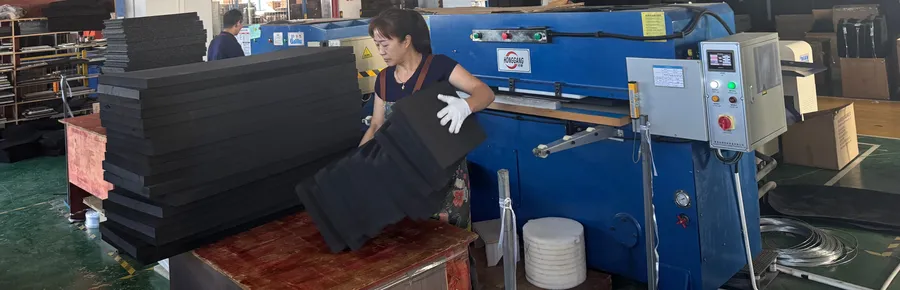
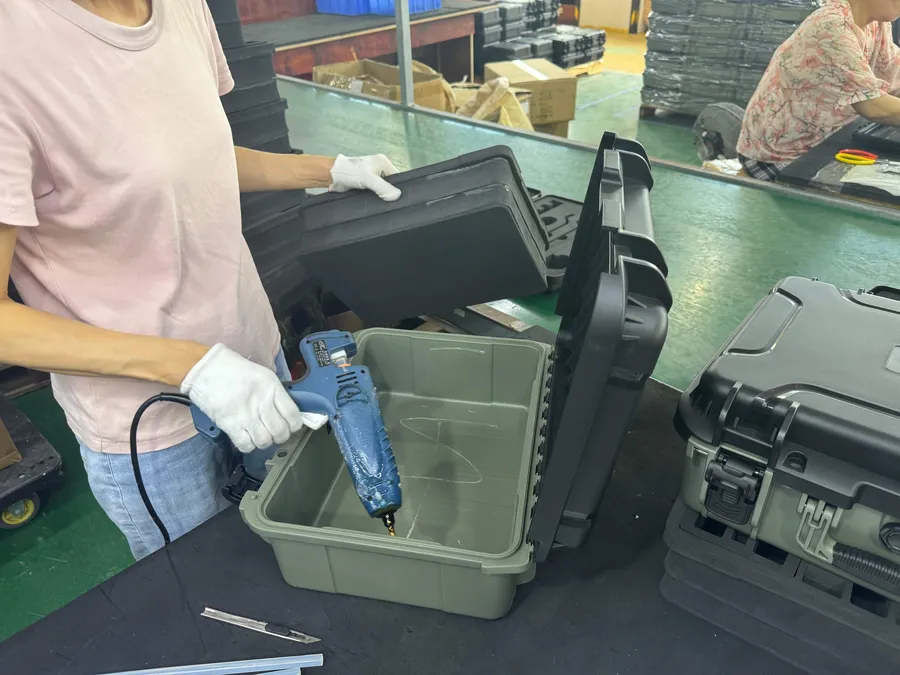
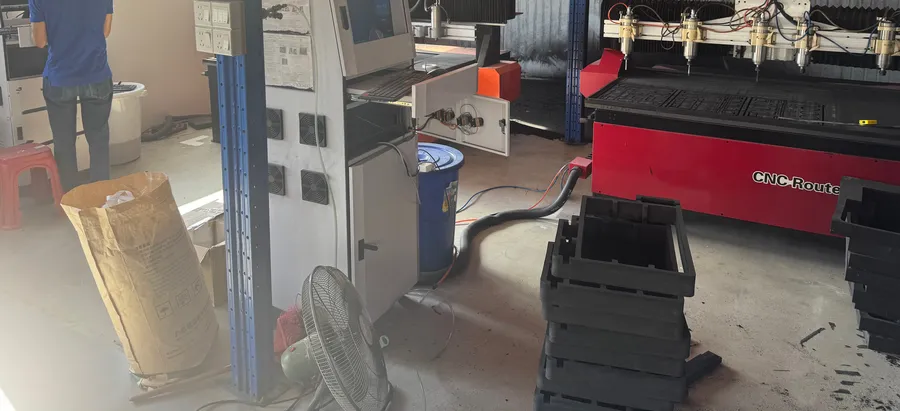
Everything described above is configurable on a standard shell: interior layout (pick-and-pluck, die-cut or CNC-cut), foam grade and thickness, colour, logo method, latch and lock count, pressure-equalisation valve, cable ports, document holder and identification plate. A bespoke exterior geometry requires a new mould — 125 days, from 3,000 units per moulded component.
Procurement considerations
| Question | What to send us |
|---|---|
| Which shell fits? | Equipment L × W × H as packed, plus required clearance per axis |
| What does it cost? | Order quantity and estimated annual quantity — the two drive different answers |
| Is tooling needed? | Whether an existing shell clears the envelope with usable foam depth |
| Lead time? | Your required delivery date, not just the order date |
| Certification? | The exact standard your tender names — we will say whether we can test to it |
| Freight? | Destination and preferred terms; carton and pallet data supplied with the quotation |
Comparison and selection guide
The tables on this page exist because a protective case is chosen by comparing three things: the envelope, the environment and the handling chain. Where no table applies, the rule below is.
| Situation | What To Do |
|---|---|
| Fixed inventory | CNC or die-cut silhouette with part numbers printed on the foam. |
| Variable kit | Pluck foam plus a loose tray. |
| Bench work | Removable trays that lift out square so the case doubles as a stand. |
- Size on internal dimensions plus clearance, never on a product name.
- Choose the carrying method before the shell: it changes the series, not just the price.
- Specify the interior last, and decide up front whether the end user will reconfigure it.
Protective Cases for Automotive, Rail Equipment relates to Protective Case Basics. Related families: Tool Cases / Equipment Transport Cases / Custom Protective Cases / Electronics Cases / Field Equipment Cases / Rolling Cases / Outdoor Protective Cases / Waterproof Cases / Long Equipment Cases. Related sectors: field and industrial equipment. Continue in the Protective Case Basics cluster.
This page is written from our own production data. If your requirement differs, send the dimensions and we will tell you which of the 155 models fits, or whether a custom route is needed.