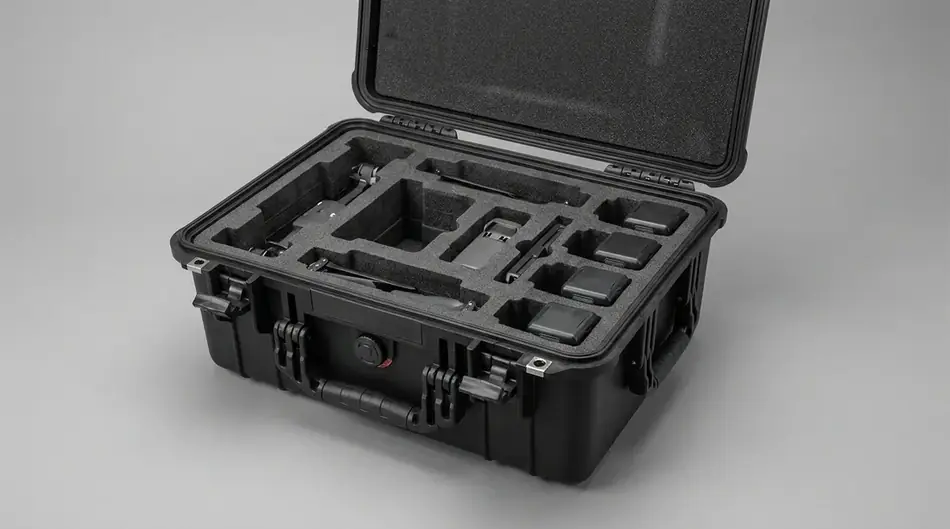
Fire and Rescue Equipment Case?
A fire and rescue equipment case is a stowage and transport case for the kit a crew carries to a call: breathing apparatus masks and regulators, thermal cameras, hand and cutting tools, road inspection lamps and engineering instruments. It is chosen from the kit, not from the sector name, and the published data covers the shell, the liner and the packing rather than any protective rating. Shells used here come from 155 active models across seven series, with internal volume, usable volume, wall thickness, lid and base depth and carton data published per model, so a station can check fit before a drawing is made. No heat, flame, ingress or impact figure is published for any model.
Key points
- Start from the kit and its carried mass: a mask set, a thermal camera and a hydraulic ram each want a different shell, and one case rarely covers all three.
- Usable volume is the working number: KX-707 publishes 17.4 L usable from 20.2 L internal, and KX-89616 34.5 L from 43.1 L.
- Lid depth sets the layout: KX-85221 splits a 150 mm lid over a 45 mm base, while KX-707 splits 70 mm and 70 mm for a flat tool layer.
- Long tools need length, not depth: KX-89616 publishes 880 mm internal at 5.0 mm wall thickness.
- Heat, flame, ingress, dust and impact are recorded as not measured on all 155 models; ask for an accredited test on the exact configuration.
- Orders are wholesale and OEM only, EXW or FOB, at 1 unit for a standard shell or a liner on an existing mould.
What a fire and rescue equipment case is in this catalogue
It is a stowage and transport case for the tools a rescue crew carries to a call: breathing apparatus masks and regulators, thermal imaging cameras, hand tools, cutting gear, road inspection lamps and cones, medical pouches and engineering instruments. The case itself is not a piece of firefighting equipment and we do not present it as one; the published product data covers the shell, the liner and the packing, and that is what this page describes. The range it is drawn from is 155 active models across seven series, with the shells used here published under outdoor, field equipment and military protective cases.
The first selection decision is the kit, not the sector name. A mask and regulator set is bulky but light and needs room above the facepiece; a thermal camera is small, heavy and expensive and wants a shallow cut in a firm grade; a hydraulic ram is long and heavy and wants length plus a wall that does not flex under the load. Because one case rarely takes all three, rescue units usually buy two or three sizes rather than one, and the published dimension table is the fastest way to see whether a kit fits before a drawing is made.
Published sizes that cover rescue, road and engineering kits
The five records below are the published shells most often shortlisted for station and vehicle stowage. Internal dimensions and usable volume are quoted from the model record, and the gap between the two is the liner allowance rather than a tolerance. Seal indicates that the model carries a compressible gasket in a continuous moulded channel; it is a build feature, not an ingress rating.
| Model | Internal (Mm) | Usable Volume | Wall | Net Weight | Lid / Base |
|---|---|---|---|---|---|
| KX-2614 | 240 x 200 x 120 | 5.0 L of 5.8 L | 2.2 mm | 460 g | 60 / 60 mm |
| KX-3308 | 325 x 236 x 76 | 5.0 L of 5.8 L | 2.3 mm | 575 g | 38 / 38 mm |
| KX-707 | 465 x 310 x 140 | 17.4 L of 20.2 L | 2.5 mm | 1,360 g | 70 / 70 mm |
| KX-85221 | 483 x 363 x 195 | 27.4 L of 34.2 L | 4.5 mm | not listed on the record | 150 / 45 mm |
| KX-89616 | 880 x 350 x 140 | 34.5 L of 43.1 L | 5.0 mm | not listed on the record | 100 / 40 mm |
Cutting the foam around a rescue kit's order of use
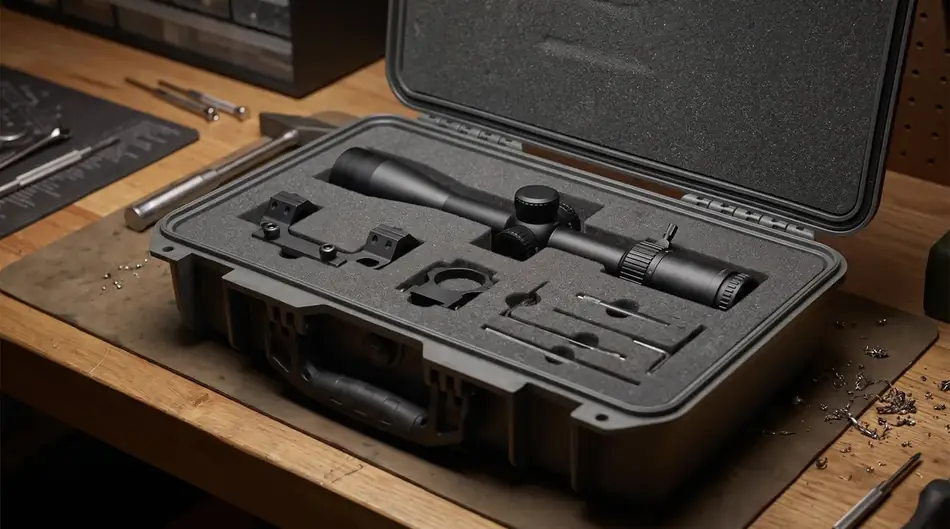
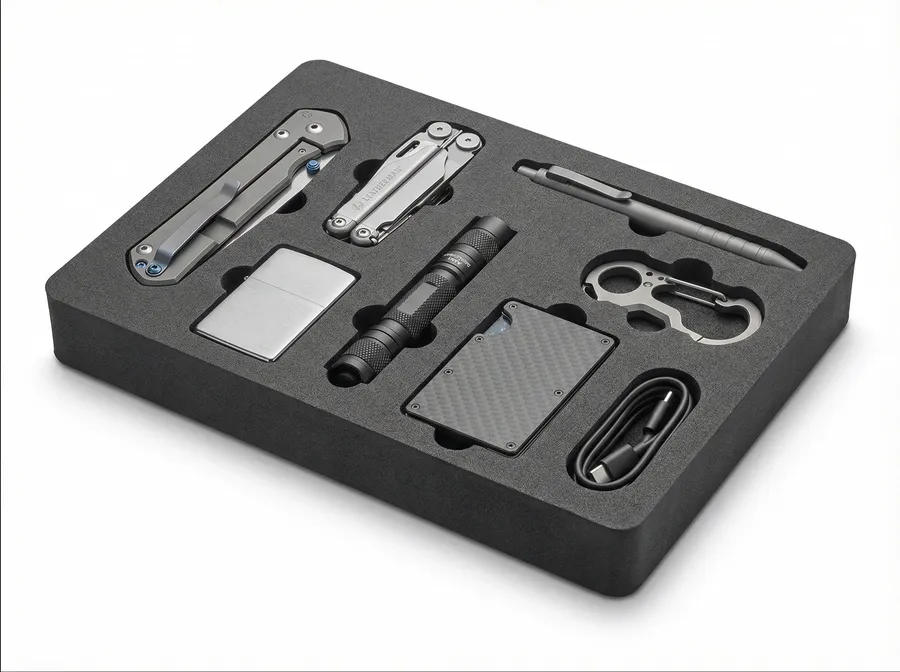
A rescue liner is laid out by the order the kit is used, not by size. The facepiece sits in its own shaped pocket so nothing loads the mask; the regulator and hose run in a routed channel rather than a deep well that would crush them; a thermal camera gets a shallow pocket in a firmer grade so a heavy body does not creep into soft foam over months in a vehicle. Removable trays let a responder lift a whole layer onto a tailgate or a treatment surface instead of unpacking item by item.
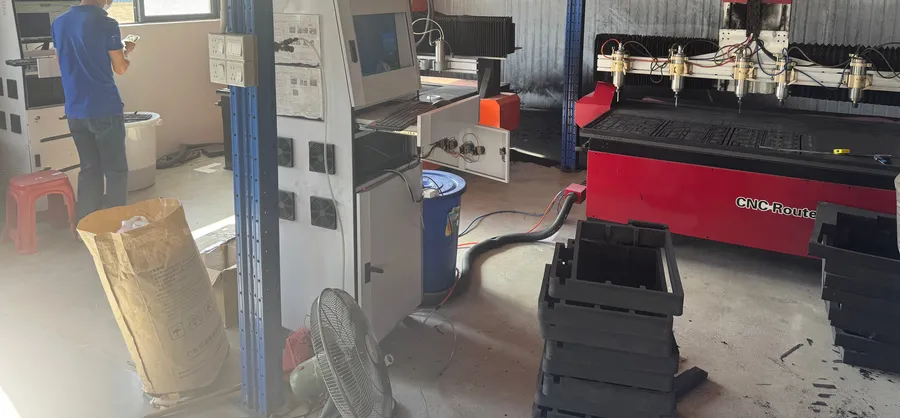
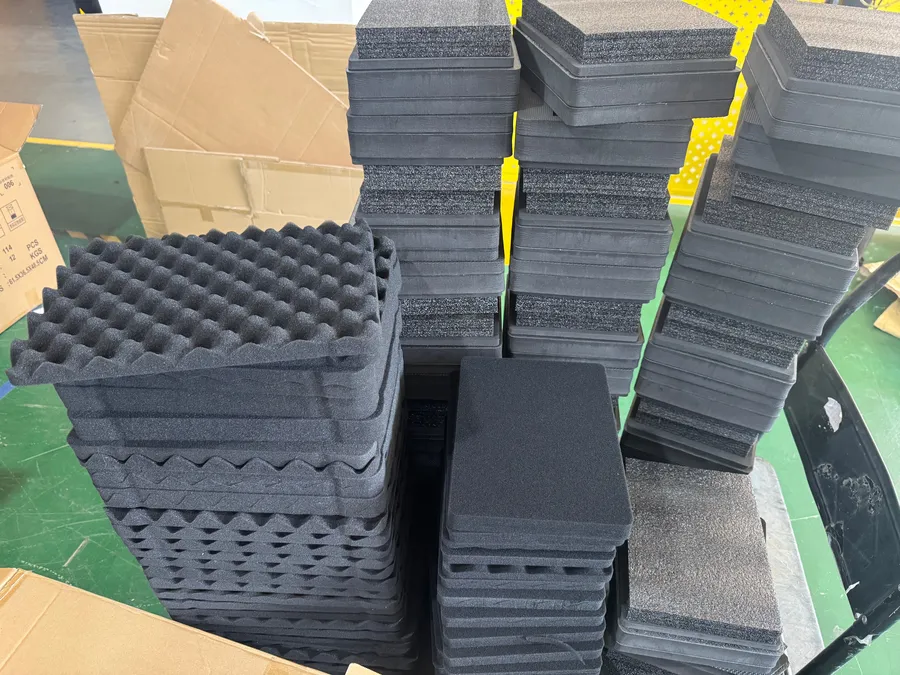
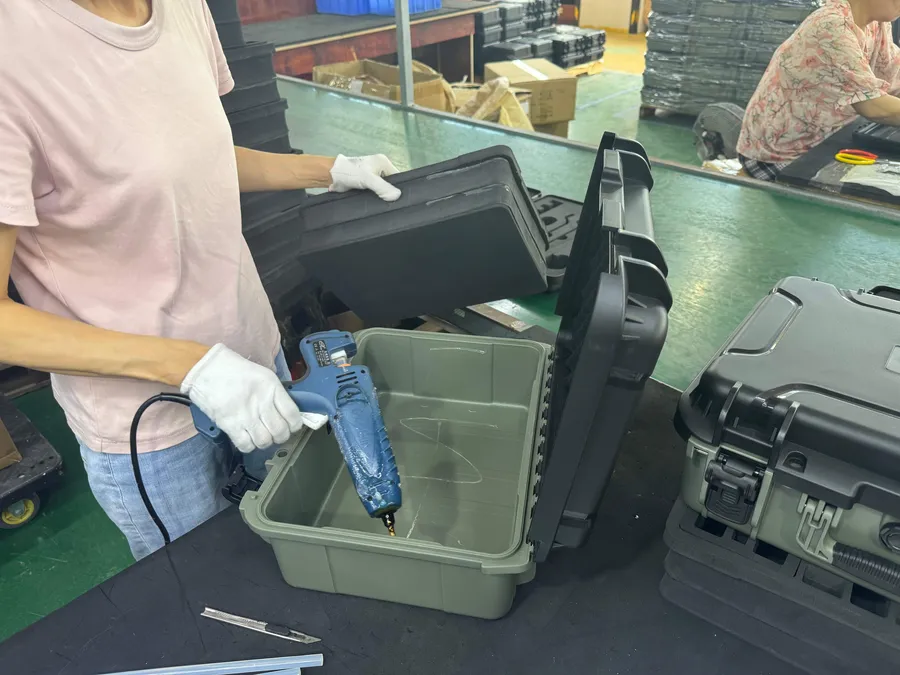
The liner is cut from a drawing, a scaled photograph of the packed kit or the items themselves, and die-cut and CNC cutting are listed on every model record. Top foam, base foam, egg-crate, layered and fully custom structures are all quoted, and lid depth decides which of them is possible: KX-85221 with a 150 mm lid can stack two layers in the lid and leave the base for the heavy items, while KX-707 at 70 mm and 70 mm spreads a flat tool layer across both halves. A first sample on an existing mould follows 45 days with a 30 percent deposit, and custom foam starts at 1 unit because no new tooling is involved.
Road inspection and engineering kits: length, wall and carried mass
Road inspection kit is mostly long and light: cones, lamps, signage and a measuring wheel, which is why internal length matters more than internal height. KX-89616 publishes 880 mm internal at 34.5 L usable behind a 5.0 mm wall, so a long lamp or a survey pole fits in a straight line instead of diagonally. Engineering kit is the opposite: short, heavy and often sharp, which is a 4.5 mm wall such as KX-85221 and a firm grade of foam with a hard base layer under the heaviest item.
For a mixed kit, the practical split is one long case for the length items and one deep case for the instruments and spares. Where a station also carries a small response bag, KX-2614 at 240 x 200 x 120 mm and 460 g is the published compact shell, and KX-3308 at 325 x 236 x 76 mm is the flat option for documents, forms and thin instruments. Stowage in a vehicle also decides the shape: KX-707 publishes 465 x 310 x 140 mm at 1,360 g and stacks, which suits a shelf in a compartment rather than a deep well.
Soot, water and mud: what the case is exposed to
A rescue case lives in a harder environment than its specification suggests: soot, standing water, mud, de-icer and the inside of a vehicle that is washed regularly. What we can state is narrow. The shells are thermoplastic - PP on 94 models, engineering PP on 38, ABS on 22 and a PP blend on one - and corrosion resistance is the only protection column recorded as measured across all 155 records, because there is no ferrous path to rust. Ingress, dust, ultraviolet, temperature and stack load are recorded as not measured.
The liner is the part that takes the dirt, and it is a cut component rather than a washable one, so a soiled layer is replaced instead of laundered. Because the drawing is retained, a replacement cut ordered later matches the pockets already in service, and a custom-foam change on an existing shell carries a published minimum of 1 unit. Chemical and detergent compatibility is not measured, so we recommend a wipe trial on a sample liner before a cleaning routine is written into a station procedure.
What we do not claim
No heat, flame, ingress, dust, impact or load rating is published for any model, and none is implied by the words used on this page. Temperature and stack-load columns are recorded as not measured across all 155 records, the seal is a build feature rather than a rating, and no third-party conformity result is presented for a standard shell. We do not describe a case as suitable for entry into a fire environment, because that is a claim the data cannot support.
When a tender or an internal procedure needs a number, we quote an accredited laboratory test on the exact configuration. The result then belongs to the build that was tested, not to the family, and the buyer can state what was measured without overstating the catalogue. That is also why the specification sheet lists dimensions first: they are the only figures that apply to every unit without a test.
Ordering terms for a station or a fleet
KeXin New Materials (Guangdong) Co., Ltd. supplies wholesale and OEM orders on EXW or FOB terms only: no retail channel, no delivered-duty-paid arrangement and no overseas warehouse, so the buyer plans collection and import. Standard shells and custom foam on an existing mould start at 1 unit, a logo, colour or OEM package at 300, and a new case geometry at 3,000 pieces per component. A first sample on an existing mould follows 45 days with a 30 percent deposit; a new mould follows 125 days after drawing sign-off.
Carton data is published on 64 of the 155 records, for example KX-707 packs 8 pieces to a 735 x 480 x 595 mm carton and KX-3308 packs 20 to a 670 x 550 x 425 mm carton. Pallet and container quantities follow the buyer's pallet size, so they are calculated from the carton footprint with the quotation. Send the kit list with masses, the vehicle compartment the case must fit and the quantity per station, and the reply can be a shell shortlist with a liner layout rather than a single guessed size.
Customisation
Everything described above is configurable on a standard shell: interior layout (pick-and-pluck, die-cut or CNC-cut), foam grade and thickness, colour, logo method, latch and lock count, pressure-equalisation valve, cable ports, document holder and identification plate. A bespoke exterior geometry requires a new mould — 125 days, from 3,000 units per moulded component.
Procurement considerations
| Question | What to send us |
|---|---|
| Which shell fits? | Equipment L × W × H as packed, plus required clearance per axis |
| What does it cost? | Order quantity and estimated annual quantity — the two drive different answers |
| Is tooling needed? | Whether an existing shell clears the envelope with usable foam depth |
| Lead time? | Your required delivery date, not just the order date |
| Certification? | The exact standard your tender names — we will say whether we can test to it |
| Freight? | Destination and preferred terms; carton and pallet data supplied with the quotation |
Comparison and selection guide
The tables on this page exist because a protective case is chosen by comparing three things: the envelope, the environment and the handling chain. Where no table applies, the rule below is.
| Situation | What To Do |
|---|---|
| Marine or wet | Sealed configuration with a drain-friendly interior and stainless hardware. |
| Dry and dusty | A close-fitting rim and a lid that can be opened one-handed without spilling contents. |
| Carried far | Under 10 kg packed, with a padded handle or shoulder webbing. |
- Size on internal dimensions plus clearance, never on a product name.
- Choose the carrying method before the shell: it changes the series, not just the price.
- Specify the interior last, and decide up front whether the end user will reconfigure it.
Fire and Rescue Equipment Case? relates to Protective Case Basics. Related families: Outdoor Protective Cases / Field Equipment Cases / Tool Cases. Related sectors: field and industrial equipment. Continue in the Protective Case Basics cluster.
This page is written from our own production data. If your requirement differs, send the dimensions and we will tell you which of the 155 models fits, or whether a custom route is needed.