How can foam inserts improve equipment organization?
A foam insert improves organisation by removing the three things an empty shell cannot control: where each item sits, which way it faces, and whether anything is missing before the lid closes. A cut layout gives every item one pocket, so the return trip takes the same time as the outgoing one, and an empty pocket becomes a visible signal that a piece of the kit did not come back. On our sheet the numbers that make this possible are published, not improvised: 145 of 155 listings carry the outdoor case group, internal floors run from 115 x 78 mm on KX-1204 to 880 x 350 mm on KX-89616, and on the 100 listings where both halves are recorded the lid and base depths add back to the internal depth exactly, which is what lets a layout be split into a base tray, an accessory layer and a lid bed instead of one undifferentiated block. Top, base, egg-crate, custom-cut and layered constructions are recorded on all 155 models, with custom shape and custom thickness offered on every listing, so organisation is specified from a drawing, a photograph of the packed kit or a physical sample, starting from one piece.
Key points
- Fixed pockets beat a loose interior on time: one place per item and one facing direction is what makes packing repeatable in the dark or in the rain.
- An empty pocket is an inventory signal: a cut layout turns a completeness check into a glance instead of a count, which is the main field benefit.
- Use the published split, not the total depth: KX-89616 is 100 mm in the lid over 40 mm in the base, so the body is a tray and the lid is the locker.
- Plan pockets on the usable interior: theoretical volume is above usable volume on 154 of 155 models because corner radii, seal channel and hardware take room.
- Where a narrow internal width is published, on 36 listings, design to it: KX-705 gives 270 mm of internal width but only 243 mm at the narrow point.
- Spare cavities are the cheapest part of the plan: kit grows, and a layout with empty pockets absorbs it without a new case or a new mould.
- Layouts start from one piece with a drawing, a photograph of the packed kit or a sample; logo, colour and OEM work on an existing mould starts at 300 pieces.
What an insert actually changes: four failure modes of an empty shell
An empty case is a container, not a system, and it fails in four predictable ways. Items migrate, so the shape of the load changes every trip and whatever the shell was asked to carry on the way out is not what it carries on the way back. Orientation is lost, so a lens, a connector or a burner head ends up facing whichever way it fell, which is how the damage happens even in a shell with good walls. Packing time rises, because somebody has to decide where each thing goes on the spot, usually in poor light. And nothing detects a missing item, so a torch, a guy-line set or a spare cell simply stops travelling and is discovered a week later at the other end of a journey.
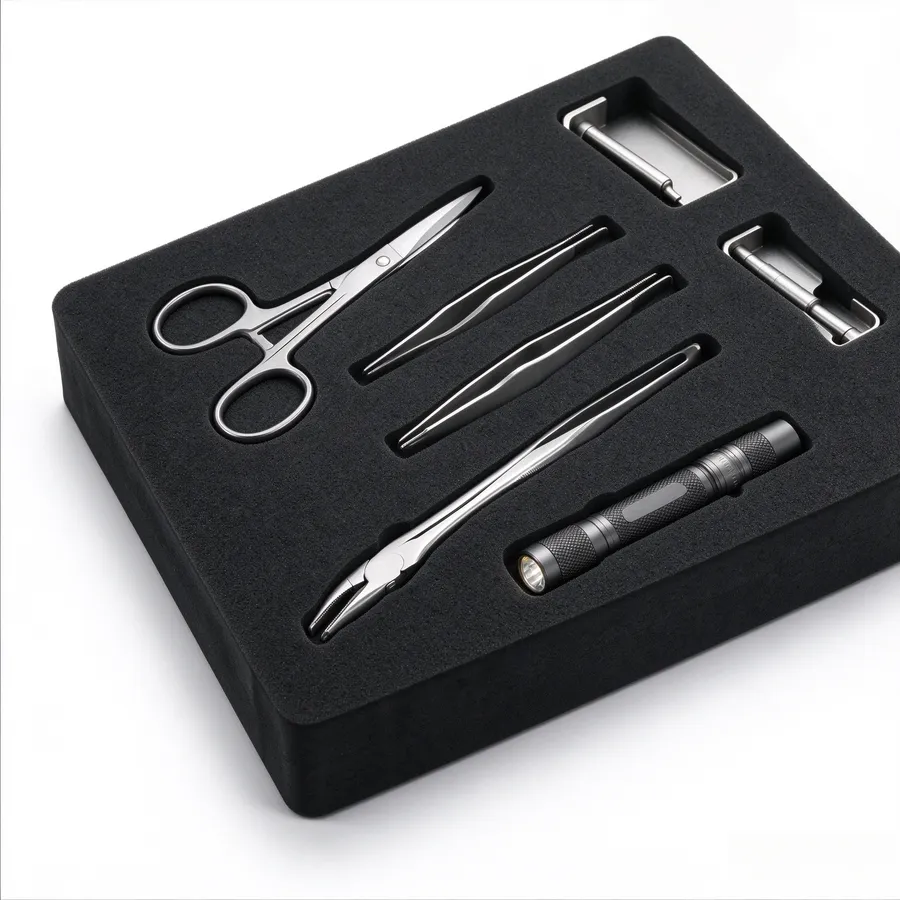
A cut insert answers those four failure modes mechanically. One pocket per item removes migration. A pocket cut to a shape removes the orientation decision. A layout that is learned once removes the thinking time, which is why crews with a cut interior are faster than crews with a good one. And an empty pocket is visible: the same geometry that stops items moving also tells you, in one glance, that something did not come back. None of that depends on the foam being protective, which is why we treat organisation and protection as two separate conversations about the same centimetres.
The space you are organising inside is published, and it is not the outside size
Organisation is planned against three internal numbers and one qualifier. The first two are the internal length and width, which give the floor the pockets are cut into: our outdoor-tagged listings run from 115 x 78 mm on KX-1204 and 180 x 160 mm on KX-1905 through 420 x 270 mm on KX-705 and 507 x 385 mm on KX-65522 to 880 x 350 mm on KX-89616, with internal width recorded from 78 mm to 460 mm across the group. The third is depth, from 32 mm to 304 mm in that same group. The qualifier is that usable interior volume is stated below the theoretical figure on 154 of 155 models, because corner radii, the seal channel and the hardware occupy room a rectangular pocket cannot: KX-89616 publishes 43.1 litres theoretical against 34.5 usable, KX-65522 37.1 against 29.7, and KX-705 12.7 against 10.9.
The split is the fourth number and it decides whether a layout will make sense. On the 100 listings where we publish lid depth and base depth separately, those two figures add back to the internal depth exactly, and 90 of them sit inside the outdoor-tagged group, ranging from 16 mm to 260 mm in the lid and 15 mm to 168 mm in the base. That is the difference between a case that organises and a case that merely holds: KX-2813 offers 260 x 200 mm of floor but only 25 mm of base with 92 mm of lid, so its body can only be a shallow locating tray and anything tall has to live above the rim. Where no split is published, as on KX-62109 and KX-65522, ask for it before drawing pockets, because the same floor area supports a completely different layout at 40 mm of base depth than at 140 mm.
Four organisation jobs and the geometry that serves each one
The last row is the one buyers under-value. A kit that changes by season or by crew will outgrow a single fixed layout, and the cost of that is either a rebuilt interior or a second case. Building the base for the items that never change and leaving the top layer configurable is the cheaper answer, and it is a geometry decision made at the drawing stage rather than a material upgrade later. Our listings record top, base, egg-crate, custom-cut and layered arrangements as construction options on all 155 models, so a two-tier interior is a normal specification rather than a special request.
| Organisation Job | What Goes Wrong In An Empty Shell | What The Insert Does | Published Envelope That Suits It |
|---|---|---|---|
| Flat kit that must stay flat | Stove plates, solar panels, seat pads and lids slide and stack on edge until something cracks | A base tray with shallow pockets, each cut to one item so nothing can overlap | KX-89616 at 880 x 350 x 140 mm interior, split 100 and 40 mm, or KX-88015 at 725 x 350 x 140 mm, same split |
| Tall mixed kit carried upright | Bottles, tripods, poles and cookware lean, fall and rattle against each other | A deep lid bed that locates the tops while a base tray holds the feet | KX-87926 at 737 x 257 x 240 mm interior, split 175 and 65 mm, or KX-92817 at 253 x 180 x 152 mm, split 125 and 27 mm |
| Small parts that are easy to lose | Guy lines, pegs, burners, cells and fittings mix together and cannot be audited | A grid of narrow pockets with a visible gap between them, so an absent item reads as an empty square | KX-1905 at 180 x 160 x 40 mm, split 25 and 15 mm, or KX-62109 at 195 x 128 x 81 mm where the split is confirmed on request |
| One case for several crews or several trips | The layout that worked for the spring kit is wrong for the winter kit and the case is rebuilt or replaced | A reconfigurable top layer over a fixed base, plus spare pockets left open for kit not yet bought | KX-705 at 420 x 270 x 112 mm, split 56 and 56 mm, or KX-65522 at 507 x 385 x 190 mm with the split published on request |
Worked layouts on three real listings
KX-2813 has a 260 x 200 mm internal floor and a 92 over 25 mm split, so the arithmetic forces a specific answer. The 25 mm body can hold a routed tray for items that lie flat or on their side, and nothing taller than roughly that depth can be supported by the base alone. Everything with height belongs above the rim, restrained by the lid bed. It is also one of the 31 listings with no seal option, which is a hint about its intended use: a dry-bag style interior that is opened often, not a sealed store. Empty mass is published at 800 g, so the case itself is a small part of the load and the layout can be dense.
KX-705 shows the value of the narrow-width field. Its floor reads 420 x 270 mm and its split is an even 56 and 56 mm, which is enough for two real layers. But the narrow internal width is published at 243 mm against the 270 mm internal width, so a pocket that runs the full 270 mm in one place will bind where the shell tapers. Plan the grid against 243 mm, then open pockets out where the shell allows it. With 12.7 litres theoretical against 10.9 usable, that is roughly a seventh of the volume already committed before any foam is cut, which is why layouts drawn from the theoretical figure always come back too tight.
KX-89616 is what a long-kit organiser looks like: 880 x 350 mm of floor, only 140 mm of depth, split 100 mm in the lid and 40 mm in the base. The base is a shallow tray and the lid does the enclosing, so the honest layout here is two or three bays along the length with the flat items in the tray and the taller kit under the lid. Its published external size is 956 x 408 x 154 mm and it carries a seal option, which makes it a store as well as a carrier. Empty mass is not published on this listing, one of 60 in the outdoor-tagged group where that field is blank, so a loaded weight has to be calculated from your own contents.
Zones rather than one uniform block
The interior we supply is described by zone rather than as one material: cross-linked polyethylene, EVA or EPS chosen per zone as a construction option, recorded the same way on all 155 listings. For organisation that is the useful frame, because different pockets do different jobs. A locating pocket needs to be firm enough that the item does not sink sideways when the case is lifted. A face that is frequently opened needs a softer, more forgiving cut so fingers can get under the item. Long flat items stacked in a bay benefit from a convoluted or egg-crate face that keeps air paths between them, and a lid bed that touches nothing can be lighter than the base it sits over. Specifying all of that as one blanket thickness is how an organised case ends up half empty.
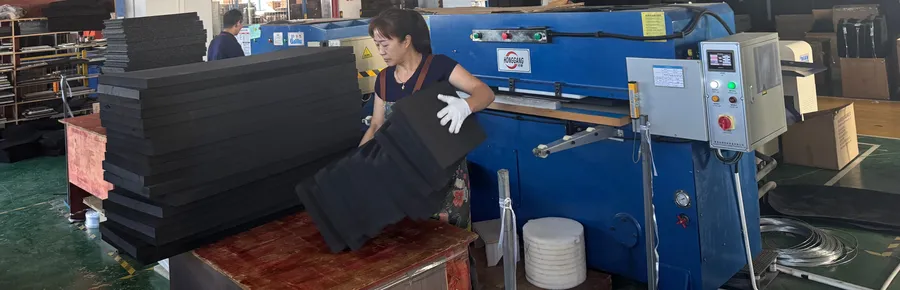
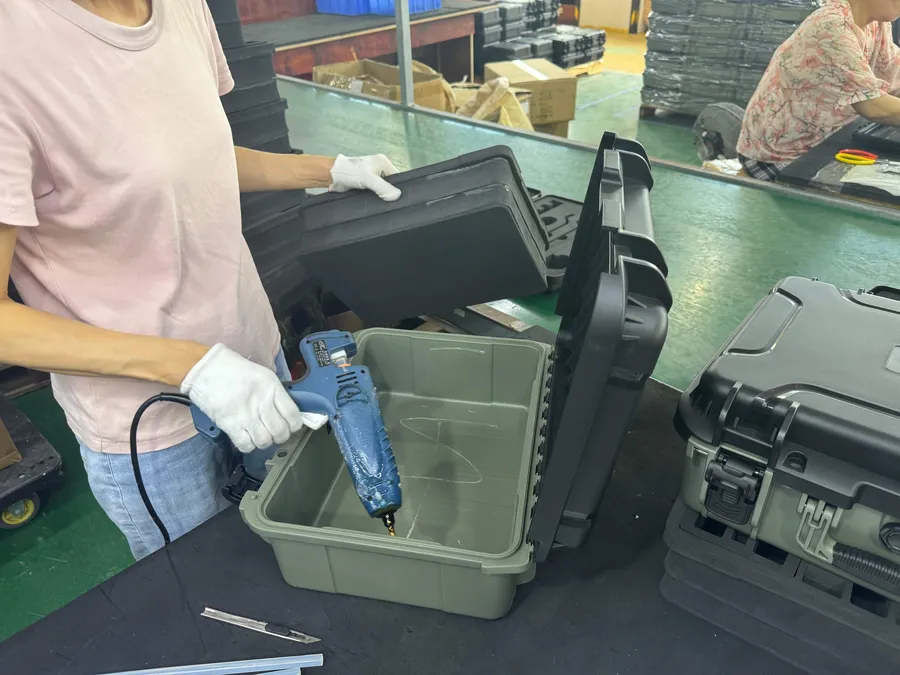
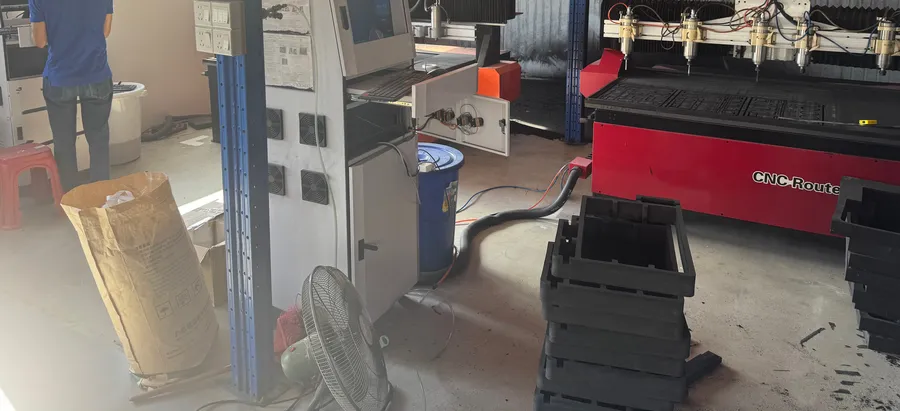
Pick-and-pluck is the right answer when the layout is expected to change and the budget is not there to redraw it: a pre-perforated block can be re-keyed on site, which suits kits that grow through a season. A die-cut or CNC-cut layout is the right answer when the geometry has settled, because the pockets then match the item rather than a grid, and the audit function is much sharper: a routed outline shows an absence, a torn pluck face usually does not. Where the two are combined, the usual pattern is a fixed cut base carrying the items that never change and a pluck or layered top carrying everything else, and that pattern needs no new tooling on any listing in our catalogue.
Verification: the empty pocket as an inventory signal
The organisational gain most buyers do not expect is the check rather than the fit. A cut layout makes completeness visible: the number of pockets is known, each has one intended occupant, and a missing item is obvious before the lid closes rather than after the next opening. That matters on shared kit, on hire or rental fleets, on loaned instruments and on any box that changes hands, because it converts a task that needs a list and a count into a task that needs a glance. It also creates a cheap handover record: the layout drawing itself becomes the reference for what should be in the case, and a discrepancy is a specific pocket rather than a general suspicion.
For that to work the layout has to be drawn from the kit rather than from a guess, which is why our listings record the drawing requirement identically on all 155 models: a drawing of the packed kit, a photograph of it laid out, or a physical sample. Send the packing list at the same time and note the items you expect to be absent on some trips, so those pockets can be specified as deliberately open instead of being read as lost. Colour and logo on an existing mould are available as OEM work from 300 pieces, which is where high-contrast pocket edges and marked positions usually become economical; below that quantity the same clarity is cheaper to achieve by cut geometry than by print.
Where organisation work belongs: field, camp and transport use
The outdoor-tagged group is where this page matters most, and its shape explains why. 145 of 155 listings carry that category, spread across 60 in the 8 Series, 23 in the 0 Series, 20 in the 6 Series, 18 in the 9 Series, 11 in the T Series and 7 and 6 in the 1 and 7 Series. Internal length runs to 880 mm, internal depth to 304 mm, and internal volume to 58.7 litres within that group, so most camp and field kits can be housed in a single case if the pockets are planned rather than improvised. Hardware supports the same logic: 134 of the 145 are recorded as stackable, 11 carry wheels, and 114 of them offer a seal option, which is what lets one case be both a store on site and a carrier in transit.
Packing behaviour is the second reason buyers get this wrong. Carton data is published on 58 listings, ranging from one piece per carton on large shells such as KX-95419 and KX-5723 to 40 pieces per carton on the small 0 Series minis KX-2005 and KX-2305, so a wholesale order of the same layout in two very different shell sizes is two very different freight conversations. If you are standardising a kit across a fleet, size the layout first and then choose between the small shells that pack forty to a carton and the large ones that pack one, because the internal geometry you planned may not survive the switch.
Ordering an organised interior
Custom foam has no minimum beyond the case order: our published minimums are one piece for stock models and one piece for custom foam, so a single organised prototype is a normal request rather than a favour. Logo, colour, OEM and private-label work on existing moulds starts at 300 pieces with first samples planned at 45 days on a 30 percent deposit. A new shell size, a modified rib pattern or a changed sealing rim is mould work at 3,000 pieces per component and 125 days, and an organisation change alone never needs it, because pockets are cut to the interior rather than formed with the shell.
Terms are the same whatever the layout: wholesale and OEM production only, sold EXW or FOB, with no retail orders, no DDP quotations and no overseas warehouse stock, so your forwarder handles the freight and the carton and pallet figures are calculated against your pallet size.
Procurement notes and the limits of what we state
Send the packing list with dimensions and heights, the items that travel assembled versus stripped, the orientation each item should be stored in, and how often the case is opened between trips. Those four answers decide the pocket count, the layer split and whether the top should be fixed or reconfigurable. We reply with candidate listings and their published internal and external envelopes, the lid-to-base split where it is recorded on 100 of 155 models, the narrow internal width on the 36 listings that carry it, usable interior volume, the seal state, empty mass where published, and packing data.
What we do not do is attach a performance promise to an organised interior. Waterproof, dust resistance, UV exposure, service temperature range, stack load, load capacity and any protection rating are recorded as not measured on all 155 listings, no IP code is printed on our pages, and no drop height is stated for any configuration; shock and impact protection are recorded as construction options that require a specified foam layout, and the shell alone is not a shock rating. Accredited testing can be commissioned for a named configuration as a separate work package. Signed: KeXin New Materials (Guangdong) Co., Ltd.
Customisation
Everything described above is configurable on a standard shell: interior layout (pick-and-pluck, die-cut or CNC-cut), foam grade and thickness, colour, logo method, latch and lock count, pressure-equalisation valve, cable ports, document holder and identification plate. A bespoke exterior geometry requires a new mould — 125 days, from 3,000 units per moulded component.
Procurement considerations
| Question | What to send us |
|---|---|
| Which shell fits? | Equipment L × W × H as packed, plus required clearance per axis |
| What does it cost? | Order quantity and estimated annual quantity — the two drive different answers |
| Is tooling needed? | Whether an existing shell clears the envelope with usable foam depth |
| Lead time? | Your required delivery date, not just the order date |
| Certification? | The exact standard your tender names — we will say whether we can test to it |
| Freight? | Destination and preferred terms; carton and pallet data supplied with the quotation |
Comparison and selection guide
The tables on this page exist because a protective case is chosen by comparing three things: the envelope, the environment and the handling chain. Where no table applies, the rule below is.
| Situation | What To Do |
|---|---|
| Marine or wet | Sealed configuration with a drain-friendly interior and stainless hardware. |
| Dry and dusty | A close-fitting rim and a lid that can be opened one-handed without spilling contents. |
| Carried far | Under 10 kg packed, with a padded handle or shoulder webbing. |
- Size on internal dimensions plus clearance, never on a product name.
- Choose the carrying method before the shell: it changes the series, not just the price.
- Specify the interior last, and decide up front whether the end user will reconfigure it.
How can foam inserts improve equipment organization? relates to Protective Case Basics. Related families: Outdoor Protective Cases / Custom Protective Cases / Field Equipment Cases / Tactical Equipment Cases / Equipment Transport Cases. Related sectors: field and industrial equipment. Continue in the Protective Case Basics cluster.
This page is written from our own production data. If your requirement differs, send the dimensions and we will tell you which of the 155 models fits, or whether a custom route is needed.


