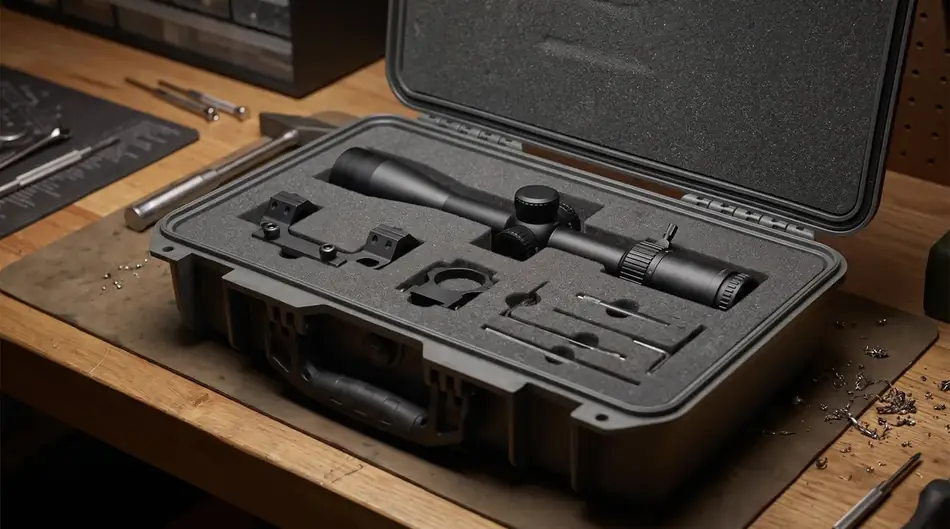
Protective Cases for Hand Tools, Power Tools & Hardware for Hydraulic Tools
Size the case from the packed hydraulic kit and the pressure source, not from a category name: a gasketed polypropylene or ABS hard case with custom-cut foam, chosen against published internal length, width and height per model, is the working default for hand tools, power tools and hardware used with hydraulic tools. A torque wrench with its hose and reaction arm is compared against a long bed such as 582 x 300 x 130 mm or the 737 mm cavity of the KX-87926, a pump or power pack against a deeper box on a 4.75 to 5.0 mm wall, gauges and couplers against a cut plank laid over them, and a two-person crew against a wheeled moulding with a telescopic handle. Every figure in this page is published model by model, and a field that has not been measured on that model is left blank rather than filled with a catalogue average. Where a customer specification or a tender demands an ingress class, a drop height or an impact value, we state plainly whether that measurement exists for the configuration you order and, if it does not, quote it as accredited laboratory testing on that exact build instead of printing a claim we cannot evidence.
Key points
- A torque wrench needs internal length plus a clear lid line; hose coils need depth instead, so measure the packed set, not the tool.
- Pumps and power packs carry the most mass per litre in the kit, so wall thickness and a firmer foam base come before internal volume.
- Gauges, couplers and adapters are where uncased hydraulic kits fail; they belong in a cut plank above the tools, not loose in the lid.
- Long beds at 737, 725, 880 and 1280 mm internal take bars and hose sets end to end instead of splitting one kit into two boxes.
- A protection class or impact value belongs to a named test report, so ask any supplier for the method and the sample, and we test the ordered build.
- KeXin is wholesale and OEM or ODM only on EXW or FOB terms: first article near 45 days, a new mould near 125 days, 30 per cent deposit.
Start From The Hydraulic Kit, Not From A Case Label
A hydraulic tool kit is several different packing problems that happen to share a hose. The wrench body is long, with a reaction arm and a protruding swivel; the pump or power pack is the densest thing in the box and usually the heaviest item per litre; the hose wants to be coiled rather than bent; the gauge is fragile, glass-fronted and expensive; the fittings are small, sharp and designed to disappear into grit. One cavity cannot answer all five, which is why professional buyers shortlist by published internal length, width, height and lid depth first, and by appearance second. KeXin lists internal and external dimensions, wall thickness, lid and base depth, usable volume and net weight model by model, so a crew fit-out becomes arithmetic against the equipment that actually exists in the van today. Where a figure has not been measured on a given moulding it is left blank rather than estimated, and where a customer specification demands a documented protection level we treat that as a separate test work package on the ordered configuration, not as a property of the plastics. Thermoplastic shells also have no ferrous corrosion path, so washing mud and hydraulic fluid out of a box at the end of a shift is a rinse rather than a refinishing job.
Industrial High-Altitude Anti-Drop Tool Box
An industrial high-altitude anti-drop tool box means two separate risks to the buyer: a kit that could fall from a platform and become a hazard below, and a case that has to survive being dropped from a deck or a ladder. A plastics box cannot fix the first one by itself, so the honest answer is a combination of lid-line sealing, a tether point and an interior that holds every tool in a pocket: shadow-cut foam with printed outlines, retention straps over anything with an anvil or a handle, and an optional tether or lanyard eye fitted as an OEM change. Two mechanical facts do carry the second risk. A deeper lid keeps a standing tool below the closing line, which is where a dropped box usually splits open: the engineering-polypropylene KX-4318 lists 407 by 187 by 178 millimetres internal with a 38 millimetre lid over a 140 millimetre base on a 3.0 millimetre wall at about 1,970 grams, and the KX-84430 gives 395 by 295 by 275 millimetres with a 230 millimetre lid over a 45 millimetre base on a 4.2 millimetre wall. At altitude and in air freight a sealed lid also stands a pressure difference, so a breather is quoted per build rather than assumed. If a tender demands a recorded drop height or a retention proof load, we say whether that test exists for the model you order and arrange it at an independent laboratory on that configuration.
Hydraulic Equipment Tool Case
The hydraulic equipment tool case is the core pairing: a wrench, its hose, its reaction arm and the couplers that join them. Length decides the shell. The KX-86216 lists 582 by 300 by 130 millimetres internal on a 3.3 millimetre wall with about 19.5 litres usable and a 100 millimetre lid over a 30 millimetre base, which lays a wrench and a coiled hose down side by side; the KX-87926 gives 737 by 257 by 240 millimetres on a 4.0 millimetre wall with about 36.4 litres and a 175 millimetre lid over a 65 millimetre base for longer lever tools and a second hose. Where the crew stands the wrench on its base, the KX-4321 covers 411 by 208 by 202 millimetres with a 164 millimetre lid over a 38 millimetre base at about 2,330 grams. Gauges and couplers then go into a cut plank above the tools: a pocket per fitting size, a deeper well for the gauge, and an outline that shows a missing adapter in seconds. Oil and grit decide the cleaning routine, not the shell choice, so a flat interior floor with no fabric liner is easier to rinse than a soft one.
Industrial Hydraulic Tool Heavy-Duty Transit Case
A transit case is loaded, driven over, stacked and reloaded, so the specification is about mass management rather than delicacy. Electric and battery pumps, bolt-tensioning power packs and bottle jacks concentrate weight in one corner of the cavity, and the case must carry it through the base and the stackable footprint, never through the lid. The KX-85819 lists 500 by 400 by 165 millimetres internal on a 4.75 millimetre wall with about 26.4 litres and a 120 millimetre lid over a 45 millimetre base, and the KX-85823 gives the same footprint at 500 by 400 by 210 millimetres with a 165 millimetre lid and about 33.6 litres, both offered with a gasket and both stackable. Where the crew lifts the whole outfit into a vehicle rather than rolling it, the wheeled KX-85427 pairs 483 by 363 by 220 millimetres and a 4.5 millimetre wall with wheels and a telescopic handle at about 6,100 grams empty, and the KX-85827 covers 500 by 400 by 220 millimetres on a 5.0 millimetre wall with wheels at about 7,800 grams. Inside, a firmer plank sits under the pump and a softer face against the hose ends.
Impact-Resistant Construction Tool Case
Buyers who search for an impact-resistant construction tool case are usually being asked to sign a document that uses the word impact without defining it. Two questions turn that into a specification: which test method and unit is the figure taken from, and which part of the box was the sample - a moulded corner, a flat wall or a cut coupon. Ask any supplier for the report behind the adjective, and read whether it covers the model being purchased or a similar one. Mechanically, the published construction tells you a great deal: the engineering-polypropylene KX-6621 lists 587 by 434 by 192 millimetres internal on a 6.0 millimetre wall with about 39.1 litres usable, a 43 millimetre lid over a 149 millimetre base and a stackable body at about 6,420 grams, which suits a gang box parked in a container or lifted onto scaffolding. The KX-4821 covers 447 by 312 by 194 millimetres on a 4.5 millimetre wall at about 3,670 grams for one tradesperson, and the KX-95419 gives a wide flat 525 by 400 by 170 millimetres with about 30.7 litres at about 3,600 grams where the crew carries plates, props and hand tools together. Latch count, a padlockable hasp and a flat stacking footprint are the items that fail first on site, so specify them with the shell.
Jungle Off-Road Plastic Hard Tool Box
A jungle off-road plastic hard tool box is bought for wet heat, mud and vegetation rather than for a workshop floor. The three practical requirements are that the box closes when the foam is damp, that mud can be washed out without destroying a finish, and that nothing inside rusts onto something else. Polypropylene answers the third by having no ferrous body, and a gasketed lid line where a plain rim would let grit in is a listed feature rather than an assumption: the KX-4610 lists 455 by 338 by 84 millimetres internal on a 3.0 millimetre wall at about 1,115 grams with a gasket option, the KX-4613 the same footprint at 455 by 338 by 116 millimetres, and the KX-84816 gives 410 by 360 by 140 millimetres on a 4.2 millimetre wall with a 100 millimetre lid over a 40 millimetre base and about 16.6 litres for a small pump riding with its tools. Strap points, a drain-off routine at the end of a track day and a lid that never descends onto a standing hose matter more than any single material claim, and if a kit must survive immersion rather than splash, that is a test-report conversation, not a gasket assumption.
Marine Maintenance Tool Case
Salt is the marine problem: on a vessel, a quay or an offshore platform the failure mode is corrosion of the tools and grit packed into the lid line, not the shell collapsing. The case's job is to keep spray and grit out of the interior and to let the crew rinse the box afterwards, so a gasket plus a latch that still closes after a rinse is the specification. The KX-4312 lists 420 by 260 by 104 millimetres internal on a 3.5 millimetre wall with about 9.8 litres at about 1,170 grams, a common size for a hydraulic torque set and its hose; the ABS KX-64114 gives 378 by 307 by 120 millimetres on a 4.0 millimetre wall at about 2,100 grams with a stiffer, more scratch-resistant shell for gauges and measuring gear; and the KX-86122 covers 530 by 360 by 203 millimetres on a 5.0 millimetre wall with about 31.0 litres for an engine-room crew box. Where a vessel specification or a classification rule names an exposure test, we say what has actually been measured for that model and quote the remaining evidence as testing on the ordered configuration, because a salt-spray figure without a named chamber method and a duration is only a sentence.
Modular Automotive Tool Case Design
Modular design means a family of mouldings that share one footprint so layers can be added, swapped or carried singly, and the practical way to build it is from published cavity ladders rather than bespoke sizes. Two real ones cover hydraulic automotive work: the 455 by 338 millimetre family in three depths - KX-4610 at 84 millimetres, KX-4613 at 116 and KX-4616 at 148 - all on a 3.0 millimetre wall with a gasket option, so a bay can run a tool layer, a consumables layer and a pump layer in the same rack width; and the 483 by 363 millimetre family - KX-85215 at 140, KX-85218 at 165 and KX-85221 at 195 millimetres internal, all on a 4.5 millimetre wall with about 19.6, 23.1 and 27.4 litres usable. A module system is decided by the shelf, trolley bay or vehicle drawer first, because a case that cannot be parked where the crew works is not a module but an obstruction. Interchangeable cut plank, dividers and a common latch position are what make the family behave as one system; colour and marking are the last decision, not the first.
Pipeline Construction Operation Tool Case
A pipeline construction operation tool case is a length problem before it is anything else. Bevel profilers, tapers, alignment clamps, long torque bars and hose sets for bolt tensioning are carried end to end, and splitting them across two short boxes is how kits get left at the laydown yard. The KX-89616 lists 880 by 350 by 140 millimetres internal on a 5.0 millimetre wall with about 34.5 litres and a 100 millimetre lid over a 40 millimetre base; the KX-814641 extends the same width to 1280 by 350 by 140 millimetres with about 50.2 litres for the longest bars and a coiled hose alongside; the KX-88015 gives 725 by 350 by 140 millimetres on a 5.0 millimetre wall with about 28.4 litres where a crew box has to fit a rack. Check the external figure against the vehicle, not just the internal one, and plan the carry: an 880 or 1280 millimetre box is a two-person lift or a trolley, and trench mud is rinsed out rather than brushed. Couplers, seals and spare o-rings go into a pocket strip along one long side so they are found without unloading the box.
Industrial Pneumatic Tool Hard Plastic Casing
Pneumatic tools are the oily, protruding half of a hydraulic crew's kit: impact guns with an anvil and an inlet fitting, air ratchets, die grinders, needle scalers and nailers, usually greasy and often with a hose already attached. The casing problem is retention rather than cushioning, because a tool that moves in transit knocks its own neighbours. Where a gun stands on its base, the KX-4321 gives 411 by 208 by 202 millimetres with a 164 millimetre lid over a 38 millimetre base on a 3.0 millimetre wall; where the crew prefers a flat tray of two guns plus blow nozzles, the ABS KX-64120 lists 378 by 307 by 187 millimetres on a 4.0 millimetre wall with about 17.4 litres at about 2,640 grams and a gasket; and on a maintenance cart the wheeled KX-85021 pairs 437 by 308 by 164 millimetres and a 4.5 millimetre wall with wheels and a telescopic handle at about 4,912 grams empty. Straps over the anvil, a pocket for each inlet fitting and a firm base under the heaviest gun are the cut details that stop the damage, since most pneumatic tool failures in transit are to the fitting, not the body.
Pneumatic Tool Storage Case
A pneumatic tool storage case lives on a rack or under a bench and is opened at the station rather than carried, so depth per layer, a readable interior and stackability decide it. The KX-2811 lists 253 by 180 by 98 millimetres internal on a 5.0 millimetre wall with about 3.6 litres, a 71 millimetre lid over a 27 millimetre base and about 890 grams, which suits a driver set, a blow gun and a small air ratchet at one station; the KX-92817 keeps the same footprint at 253 by 180 by 152 millimetres with a 125 millimetre lid and about 5.5 litres where a tool stands on end. For a reel, a coiled hose and a gun together, the deep KX-84430 offers 395 by 295 by 275 millimetres with a 230 millimetre lid over a 45 millimetre base on a 4.2 millimetre wall. Storage in a container or a store room is a footprint and stacking conversation: every model cited here is published as stackable, so pallet and rack planning is done against the external dimensions, and the interior carries the retention because a stackable moulding is not a rack.
Railway Maintenance Tool Case
A railway maintenance tool case is bought under a different constraint: the possession window ends when the kit is complete, so countability is the safety feature. Shadow-cut foam with a printed outline and an item number per pocket makes a missing tool visible in seconds, and the crew list drives the layout rather than a catalogue image. The KX-87926 gives a 737 by 257 by 240 millimetre bed for tongs, long spanners and lever tools; the KX-86216 covers 582 by 300 by 130 millimetres for a torque set and a hose; and the KX-4319 lists 407 by 187 by 178 millimetres with a 38 millimetre lid over a 140 millimetre base at about 1,587 grams for a wrench, a gauge and a fitting tray. Hi-visibility colour, a marking band and a latch arrangement are OEM changes quoted per build. Track-side documentation, insulation requirements and tool-control procedure belong to the operator's own rules, and we describe only what the case and the cut do; nothing printed on a lid makes a toolbox compliant with a working method it has not been given.
Roadside Assistance Tool Case
Roadside and recovery crews carry the widest, dirtiest and most irregular kit: jump leads, tow straps, wheel chocks, gloves, warning devices, a bottle jack, a small hydraulic pump and a box of mixed hardware, all of it loaded in the dark beside a live carriageway. The case must close without forcing, because a lid that needs a knee lifts its gasket and then lets in water. The KX-84430 gives 395 by 295 by 275 millimetres with a 230 millimetre lid over a 45 millimetre base on a 4.2 millimetre wall and about 25.6 litres, enough for a jack with its pump; the KX-95419 offers a wide flat 525 by 400 by 170 millimetres with about 30.7 litres at about 3,600 grams for lead sets and chocks; and the KX-85823 covers 500 by 400 by 210 millimetres on a 4.75 millimetre wall with about 33.6 litres and a gasket option where the outfit is larger. Decide the box against the van rack or the boot shelf first, then divide the interior into wet items, electrical items and hardware so a crew never searches for a coupler with a gloved hand.
Comparison Table: Hydraulic Crew Load To The Figure You Should Check
| Crew Load | Figure To Check | Published Example | Long Tail This Answers |
|---|---|---|---|
| Hydraulic wrench, reaction arm and one hose | Internal length plus lid clearance at the swivel | KX-86216: 582 x 300 x 130 mm internal, 3.3 mm wall, 100/30 mm lid/base, PP, gasket option | hydraulic equipment tool case |
| Pump or power pack plus tools | Wall thickness, base depth and stackable footprint | KX-85823: 500 x 400 x 210 mm internal, 4.75 mm wall, 165/45 mm lid/base, about 33.6 L | industrial hydraulic tool heavy-duty transit case |
| Gang box on a deck or scaffold | Published wall figure and the latch and hasp arrangement | KX-6621: 587 x 434 x 192 mm internal, 6.0 mm wall, 43/149 mm lid/base, about 6,420 g | impact-resistant construction tool case |
| Wet-heat, muddy track kit | Gasket availability per model plus rinse routine | KX-4610: 455 x 338 x 84 mm internal, 3.0 mm wall, about 1,115 g, gasket option | jungle off-road plastic hard tool box |
| Engine-room or quay torque set | Internal footprint and a stiff shell for the gauge layer | KX-64114: 378 x 307 x 120 mm internal, 4.0 mm wall, ABS, about 2,100 g | marine maintenance tool case |
| Rack-and-layer bay fit-out | One footprint in three published depths | KX-4610 / KX-4613 / KX-4616: 455 x 338 mm at 84, 116 and 148 mm internal height | modular automotive tool case design |
| Long bars, tapers and hose runs | Internal length and external size against the vehicle | KX-814641: 1280 x 350 x 140 mm internal, 5.0 mm wall, about 50.2 L | pipeline construction operation tool case |
| Impact gun or air ratchet standing on end | Lid depth over a base plank, plus retention straps | KX-4321: 411 x 208 x 202 mm internal, 164/38 mm lid/base, about 2,330 g | industrial pneumatic tool hard plastic casing |
| Station box at the bench | Depth per layer and stackable external footprint | KX-92817: 253 x 180 x 152 mm internal, 125/27 mm lid/base, 5.0 mm wall | pneumatic tool storage case |
| Track-side counted kit | Bed length plus a printed shadow-cut layout | KX-87926: 737 x 257 x 240 mm internal, 4.0 mm wall, 175/65 mm lid/base | railway maintenance tool case |
| Patrol and recovery outfit | Lid clearance so the box closes without forcing | KX-84430: 395 x 295 x 275 mm internal, 230/45 mm lid/base, about 25.6 L | roadside assistance tool case |
| Kit carried to a platform or mast | Tether point, pocket retention and lid depth | KX-4318: 407 x 187 x 178 mm internal, 3.0 mm wall, 38/140 mm lid/base | industrial high-altitude anti-drop tool box |
Selection Guidance: Five Checks Before You Commit
The first check is arithmetic: the outside size of every packed item as it is actually carried, plus roughly ten millimetres per side and five to ten at the lid line, read against published internal length, width, height and lid depth for a named model. The second is mass: which layer of the interior carries the pump, because a power pack resting on a soft plank or against a lid will find the weakest part of any box. The third is behaviour: how the kit is opened on a deck, in a trench or beside a live lane, which decides strap points, pocket visibility and whether wheels are justified. The fourth is documentary: what your purchaser or the customer's specification actually asks to see, since a box that only has to survive a workshop floor is a different build from one written into a tender. The fifth is the carry envelope: the external figure against the rack, drawer, boot or trolley it must live on. KeXin will not build a proposal around a number it has not measured on the model you order; where a datasheet field is blank we say so and quote the missing measurement as a test work package on that configuration.
Where These Cases Are Used
The same mouldings serve bolt-tensioning and flange-management contractors, water and gas utilities, pipeline and lay-barge crews, mobile hydraulics and hose-repair workshops, plant hire fleets, quarries and aggregate handling, rail infrastructure and signalling maintenance teams, shipyards and vessel engineering departments, wind and tower service crews, agricultural machinery workshops, fire and rescue equipment maintenance, and the tool cribs of municipal and highways crews. The overlap is deliberate: a hydraulic equipment tool case, a railway maintenance tool case and a roadside assistance tool case may share one moulding and differ only in the cut, the strap count, the marking and the latch arrangement. Buyers who specify by the item that has to survive, then build the interior around it, stop paying for volume they cannot fill and start solving the actual failure, which is nearly always a loose fitting, a lifted lid or a pump that moved in transit.
Customising The Interior And The Shell
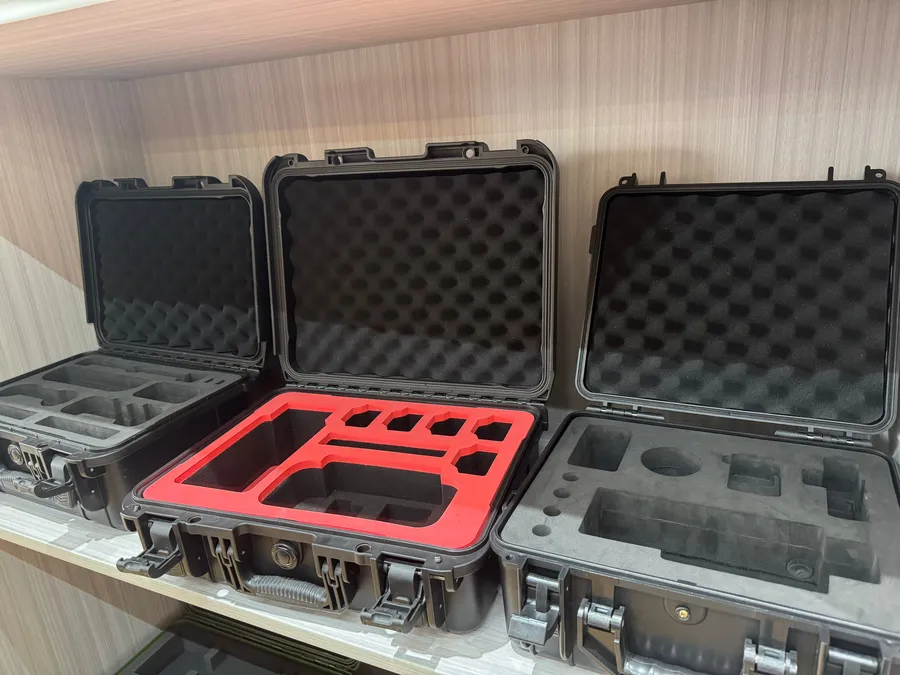
Interior work is routine for hydraulic loads and carries most of the protective behaviour: layered cut plank with a firmer base under steel and a softer face against gauges, dedicated pockets for wrench bodies, hose ends, couplers and spare seal kits, retention straps over anything with an anvil, printed outlines and item numbers for tool control, and a document holder in the lid for the calibration sheet or the kit list. Shell changes are OEM or ODM projects quoted per build because the tooling path differs for each: colour, an added handle, extra latches, a padlockable hasp, a tether eye, a breather position, a moulded logo or a marking band. Since we ask what is actually going inside before proposing a shell, send a drawing, a photograph of the packed kit or a physical sample, and we confirm the material datasheet for the nominated model rather than assuming one grade across the catalogue.
Procurement Notes: Wholesale Terms, MOQ And Lead Time
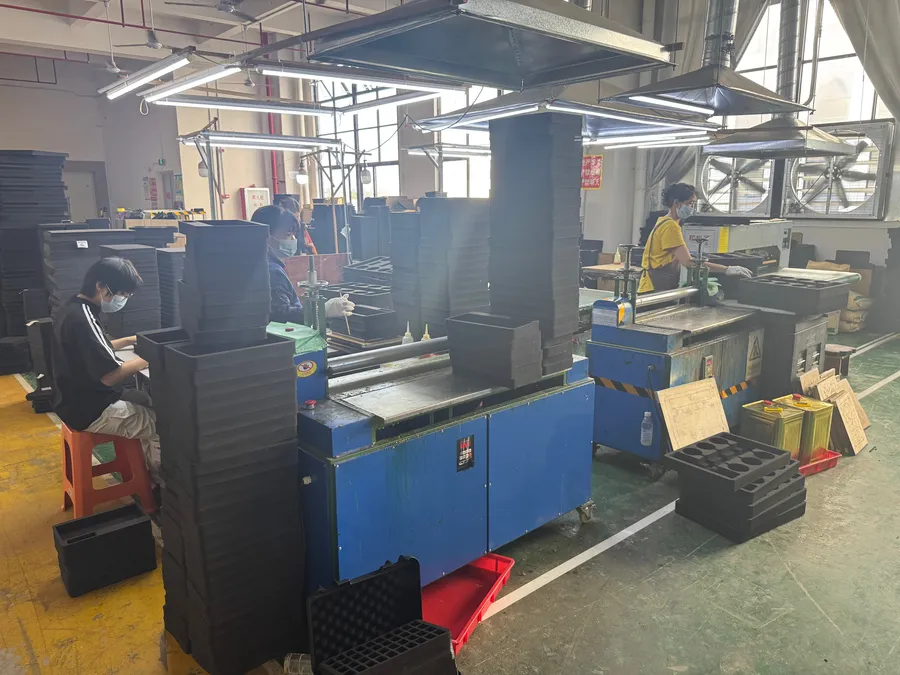
KeXin New Materials (Guangdong) Co., Ltd. sells to wholesale and OEM or ODM buyers on EXW or FOB terms only. There is no retail channel, no delivered-duty-paid quotation and no overseas warehouse, so freight is arranged by the buyer or quoted separately as logistics rather than built into a unit price. On existing moulds the standard MOQ starts at a single piece and custom foam is likewise quoted from one, which lets a crew trial one case before fitting out a fleet; logo, colour and OEM production begin near 300 pieces and a custom mould near 3,000 pieces per component. A first OEM article on existing tooling runs about 45 days and a new mould about 125 days, with a 30 per cent deposit and the balance paid after inspection and before shipment. Third-party inspection at our facility is welcome before goods leave. Send the packed dimensions and the quantity to Fred Zhao or the KeXin Sales Team, WhatsApp +86 135 3588 0002, and the answer comes back as a named model with its published figures or a statement of what has not been measured.
Customisation
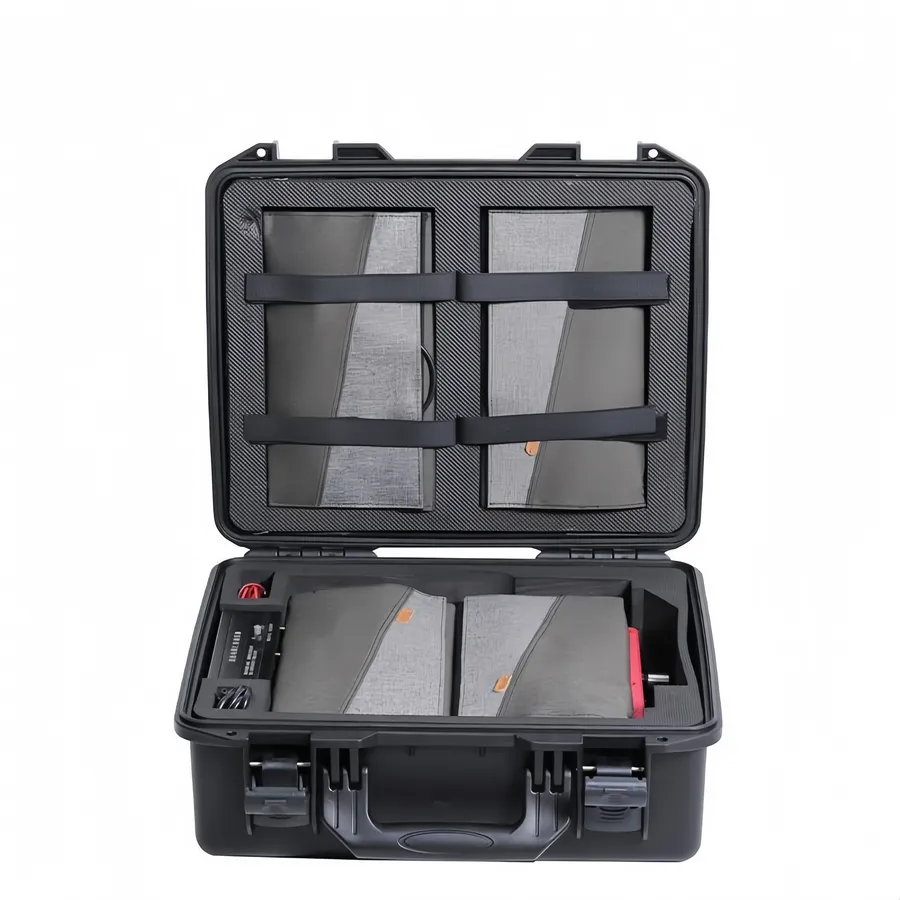
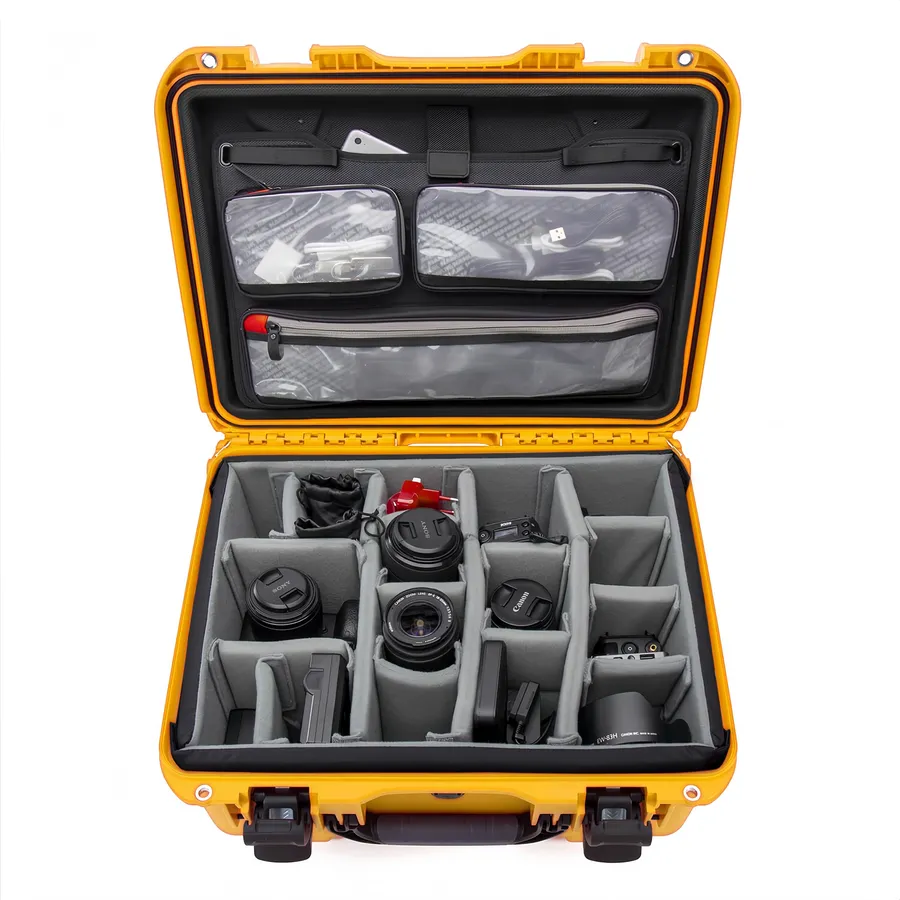
Everything described above is configurable on a standard shell: interior layout (pick-and-pluck, die-cut or CNC-cut), foam grade and thickness, colour, logo method, latch and lock count, pressure-equalisation valve, cable ports, document holder and identification plate. A bespoke exterior geometry requires a new mould — 125 days, from 3,000 units per moulded component.
Procurement considerations
| Question | What to send us |
|---|---|
| Which shell fits? | Equipment L × W × H as packed, plus required clearance per axis |
| What does it cost? | Order quantity and estimated annual quantity — the two drive different answers |
| Is tooling needed? | Whether an existing shell clears the envelope with usable foam depth |
| Lead time? | Your required delivery date, not just the order date |
| Certification? | The exact standard your tender names — we will say whether we can test to it |
| Freight? | Destination and preferred terms; carton and pallet data supplied with the quotation |
Comparison and selection guide
The tables on this page exist because a protective case is chosen by comparing three things: the envelope, the environment and the handling chain. Where no table applies, the rule below is.
| Situation | What To Do |
|---|---|
| Fixed inventory | CNC or die-cut silhouette with part numbers printed on the foam. |
| Variable kit | Pluck foam plus a loose tray. |
| Bench work | Removable trays that lift out square so the case doubles as a stand. |
- Size on internal dimensions plus clearance, never on a product name.
- Choose the carrying method before the shell: it changes the series, not just the price.
- Specify the interior last, and decide up front whether the end user will reconfigure it.
Protective Cases for Hand Tools, Power Tools & Hardware for Hydraulic Tools relates to Protective Case Basics. Related families: Tool Cases / Custom Protective Cases / Equipment Transport Cases / Field Equipment Cases / Military Protective Cases / Rolling Cases / Tactical Equipment Cases. Related sectors: field and industrial equipment. Continue in the Protective Case Basics cluster.
This page is written from our own production data. If your requirement differs, send the dimensions and we will tell you which of the 155 models fits, or whether a custom route is needed.