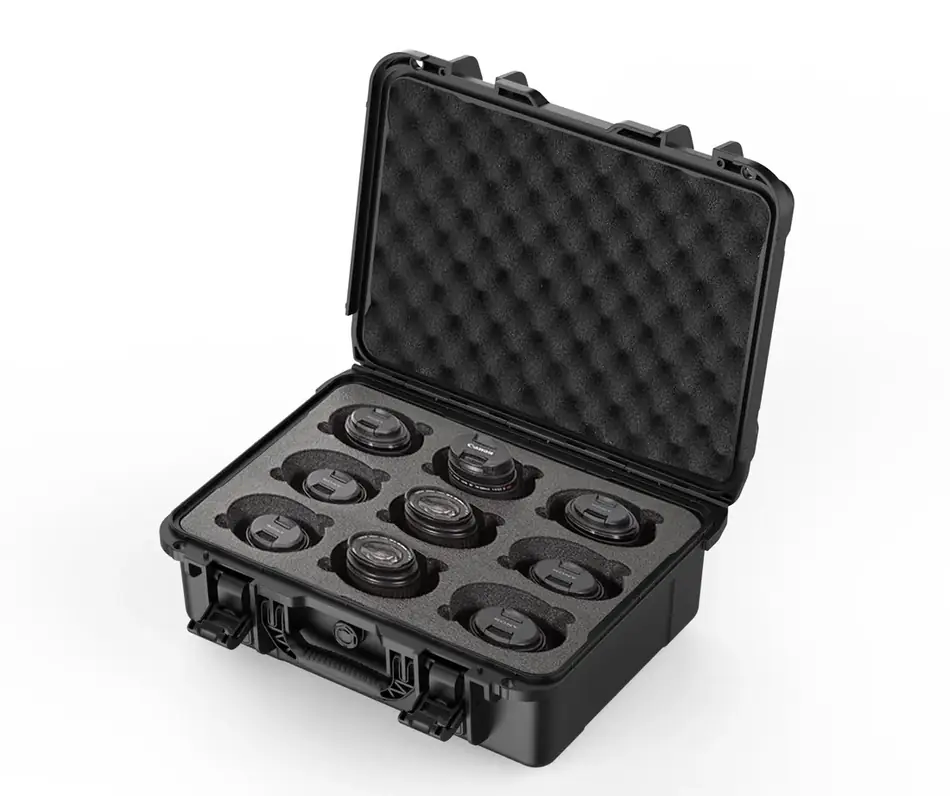
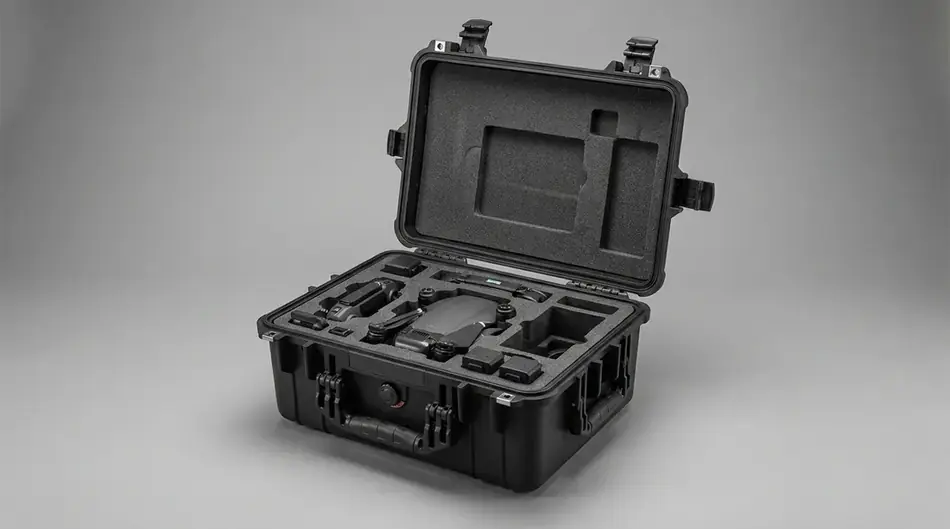
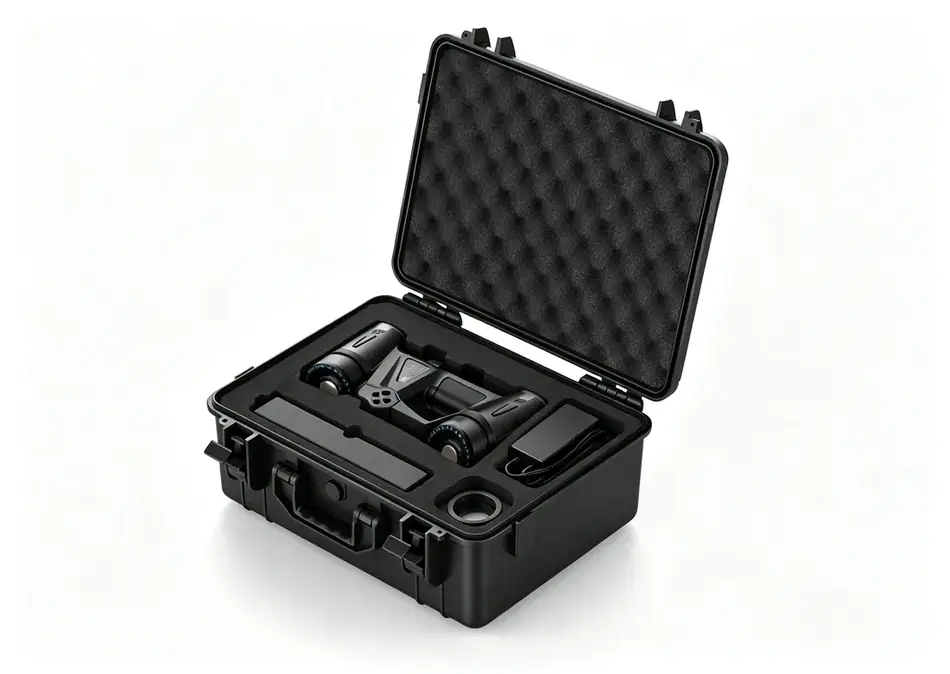
Film Focus Puller & Accessories Safety Case: Sizing It From Published Specifications
A film focus puller and accessories safety case is a rigid injection-moulded shell whose job is to stop travel, abrasion and cable crush inside a vehicle or a flight case stack; the protection that matters to the kit comes from the cut interior, not from a rating printed on the lid. Our published camera-tagged range runs from 5.8 to 24.7 litres internal, with wall thickness recorded from 2.1 to 5.0 mm and empty weight from 460 g to 5,012 g, and 70 of those 85 models publish a compressible gasket in a continuous moulded channel. For a typical follow-focus kit (hand unit, two motors, brackets, cables and a spare battery) the useful envelope starts around 308 x 230 x 118 mm internal, which is model KX-3213 at 860 g empty, while monitor and transmitter sets with a sun hood need the 13 to 21 litre band.
Key points
- Size the case around the widest single item, usually the hand unit with its mount or a monitor with hood, not around the total volume of the kit.
- Shock and impact are recorded as configuration items that depend on the foam layout; a bare shell carries no impact figure in our data.
- Water and dust performance is recorded as not measured for these models, so specify the published gasket channel instead of asking for a rating.
- Battery, charger and cable items belong in separated pockets with terminals covered; our published data carries no fire or explosion rating for any shell.
- Thick-wall ABS shells publish 3.8 to 4.7 mm walls and weigh 1,300 to 3,000 g empty, which is the trade for rigidity in a loaded vehicle.
- Wholesale and OEM only: custom foam from 1 unit, logo and colour from 300 units, 45 days on an existing mould and 125 days for a new one.
What has to fit, and why that decides the case
A follow-focus kit is an awkward set of objects: a hand unit with a protruding mount, two or three motors that are dense and round, brackets and rods, a tangle of cables, and usually a battery or two thrown on top. None of those items is fragile in the way a lens is fragile, but all of them are fragile at the connector. The hand unit's mount, the motor gear housings and the cable ends are the three things that get damaged, and all three are damaged by travelling against each other rather than by the case being hit.
That changes what the case is for. Its real task is to hold each object in its own pocket so nothing can travel, and to keep cable ends from being crushed by the item next to them. A shell with a generic pluck layer will let a motor roll into a hand unit mount on the second row of a van; a die-cut layout with a shallow channel for each cable will not. Our product records treat shock protection as a configuration that requires a specified foam layout, and record impact resistance against the published wall thickness with no drop height stated where no test record exists.
The second decision is whose kit it is. A single operator's box is carried by hand and goes on a shelf, so weight and external footprint dominate. A rental house box is stacked in a vehicle with four other boxes, so wall thickness, latch hardware and a padlockable latch dominate, and the empty weight of the shell becomes a freight cost you pay on every return journey.
The published sizes that map to film accessories
Every figure in the table is taken from our own specification records for the model named, not from a typical value. Internal dimensions are the usable envelope before foam; net weight is the empty shell; the pack column is the published carton and quantity, which is what you need for your own freight estimate.
For the common focus-puller load, the 8 to 12 litre band is where most kits settle: KX-3213 gives 308 x 230 x 118 mm internal at 860 g empty, KX-4010 gives a flat 390 x 315 x 88 mm envelope at 1,015 g, and KX-4312 gives 420 x 260 x 104 mm at 1,170 g. If the kit includes a hand unit with a mounted bridge and two motors standing upright, the deeper ABS shells are the practical answer, because 114 to 138 mm of internal height lets the motors stand in their own pockets instead of lying across the cables.
| Model | Internal Mm | External Mm | Wall Mm | Lid Plus Base Mm | Net G | Internal Volume L | Gasket Published | Published Pack |
|---|---|---|---|---|---|---|---|---|
| KX-3308 | 325 x 236 x 76 | 330 x 272 x 82 | 2.3 | 38 + 38 | 575 | 5.8 | no seal option on this model | 20 pcs per 670 x 550 x 425 mm carton |
| KX-712 | 308 x 250 x 96 | 315 x 290 x 110 | 2.8 | 54 + 42 | 710 | 7.4 | no seal option on this model | 16 pcs per 635 x 585 x 455 mm carton |
| KX-63612 | 333 x 217 x 114 | 356 x 267 x 120 | 3.5 | no split published; internal depth quoted | 1300 | 8.2 | compressible gasket in a moulded channel | 8 pcs per 585 x 385 x 560 mm carton |
| KX-3213 | 308 x 230 x 118 | 315 x 260 x 128 | 3.0 | 86 + 32 | 860 | 8.4 | compressible gasket in a moulded channel | 16 pcs per 645 x 530 x 520 mm carton |
| KX-63413 | 310 x 255 x 106 | 339 x 310 x 125 | 4.8 | no split published; internal depth quoted | 1680 | 8.4 | compressible gasket in a moulded channel | 10 pcs per 670 x 365 x 710 mm carton |
| KX-4010 | 390 x 315 x 88 | 400 x 360 x 100 | 3.0 | 44 + 44 | 1015 | 10.8 | compressible gasket in a moulded channel | 10 pcs per 710 x 410 x 500 mm carton |
| KX-63416 | 310 x 255 x 138 | 339 x 310 x 155 | 4.8 | no split published; internal depth quoted | 1800 | 10.9 | compressible gasket in a moulded channel | 8 pcs per 675 x 365 x 360 mm carton |
| KX-4312 | 420 x 260 x 104 | 430 x 300 x 115 | 3.5 | 52 + 52 | 1170 | 11.4 | compressible gasket in a moulded channel | 10 pcs per 615 x 440 x 560 mm carton |
| KX-93221 | 300 x 200 x 200 | 323 x 243 x 212 | 5.0 | 165 + 35 | 1230 | 12.0 | compressible gasket in a moulded channel | no carton figure published; quote on request |
| KX-64114 | 378 x 307 x 120 | 405 x 362 x 135 | 4.0 | no split published; internal depth quoted | 2100 | 13.9 | compressible gasket in a moulded channel | quote on request |
| KX-64117 | 393 x 280 x 156 | 413 x 336 x 168 | 3.8 | no split published; internal depth quoted | 2100 | 17.2 | compressible gasket in a moulded channel | 8 pcs per 705 x 430 x 735 mm carton |
| KX-64619 | 430 x 288 x 166 | 456 x 340 x 186 | 4.7 | no split published; internal depth quoted | 2840 | 20.6 | compressible gasket in a moulded channel | 6 pcs per 740 x 485 x 615 mm carton |
| KX-64621 | 430 x 288 x 186 | 456 x 340 x 210 | 4.7 | no split published; internal depth quoted | 3000 | 23.0 | compressible gasket in a moulded channel | 6 pcs per 740 x 485 x 685 mm carton |
V-mount batteries and chargers: what we publish and what we do not
Batteries and chargers are the part of this enquiry where a supplier can get away with saying too much, so here is the exact position. A bracket battery is dense, has exposed terminals, and is full of energy that does not want to be shorted across those terminals by a metal bracket or a cable end. A charger is a heavy block with a mains lead and a fan opening. Neither needs a special enclosure from us; both need not to move and not to touch each other.
What we publish for these shells is construction: a wall thickness figure per model, a gasket in a moulded channel on 70 of the 85 camera-tagged models, a latch body that accepts a padlock, moulded feet, a fixed carry handle, and a pressure valve listed as a configuration option across the whole 155-model range. What we do not publish is any fire, explosion or battery-storage rating for any of these shells; temperature range is recorded as not measured, and we are not going to state a figure that no record supports.
If your own safety requirement calls for an approved enclosure for cell storage or transport, treat that as a specification you supply to us rather than a feature you read off our page. Tell us the requirement, the cell chemistry, the state of charge you store at and the quantity per box, and we will build the interior and the hardware around it, then quote the shell against the models we actually make. What we will not do is sell you a word.
For the practical interior work, three rules cover almost every battery and charger layout: pockets deep enough that the terminal of one battery cannot meet the body of another, a separate channel for the mains lead so it cannot be crushed under the charger's own mass, and a lid-side recess for the plates and screws people put in the box because there is nowhere else. A die-cut layout handles all three; a pluck layer handles the first one only.
Monitors and video transmitters
A field monitor and a video transmitter are the two most easily damaged items on this list, and they fail in specific ways: a screen edge chipped against a hard case wall, a transmitter's antenna stub bent or sheared, and a monitor's sun hood crushed by something stacked on the lid. The fix is geometric rather than material. The screen should stand in a pocket whose wall is not the shell wall, so a knock on the case never reaches the glass edge directly; the hood should sit in its own recess with nothing on top of it; and the transmitter's antennas should either be removed and pocketed separately or housed in a compartment deep enough to clear them standing up.
In size terms, that pushes you past the flat shells. A 7-inch monitor with a hood and a transmitter with two attached antennas will not lie flat in the 88 mm internal height of KX-4010 without something on top of the hood, while the 156 mm internal depth of KX-64117 or the 138 mm of KX-63416 gives you a hood compartment and a separate transmitter pocket in the same box. Where multiple monitors and transmitters travel together, the 20 to 23 litre band, KX-64619 and KX-64621, is what rental fleets normally end up ordering, at 2,840 g and 3,000 g empty.
One trade-off worth stating out loud: the deeper and thicker-walled ABS shells are heavier. Camera-tagged models publish empty weights from 460 g to 5,012 g, and the thick-wall group sits at the upper end. If the box is carried to a rooftop, the 1,170 g KX-4312 with a well-cut interior may protect the kit just as well; if it is stacked in a van with six other cases, the mass is the price of the wall.
Drone batteries and small field packs
Drone battery sets get asked about in the same breath as film accessories because the same crew carries both. The published range tagged for drone use covers 59 models from 17.2 to 69.8 litres, with walls from 2.5 to 6.0 mm and empty weights from 1,680 g to 10,160 g, which is the band for aircraft, gimbals and payload sets rather than loose cells. For batteries alone, crews usually want a much smaller box with individual pockets, and the camera-tagged 8 to 12 litre models above do that job.
The reasoning is the same as for V-mount packs: separated pockets, terminals protected, nothing that can bridge contacts, and a layout that keeps a damaged cell away from the others and visible. We publish no cell-storage rating for these shells, so a battery requirement that depends on one has to be sourced as an approved product elsewhere; we will tell you plainly when that is the case rather than quoting you a shell under a name it does not deserve.
For mixed film and drone days, the practical arrangement we see most often is two boxes rather than one: a focus and monitor box that stays with the camera cart, and a small battery box that stays in the vehicle with a defined pocket per cell and a lid recess for the charger. Two mid-size boxes are cheaper to carry, easier to keep tidy and far easier to audit than one large box that has everything in it.
Comparing the four common ways to spec this case
Buyers searching this topic are usually trying to reconcile a kit list with a case they can order once and reuse for years. The table below sets the four patterns side by side, with the published number that controls each decision and the limit of what we claim for it.
| Search Wording | Controlling Published Number | What We Do | Limit Of The Claim |
|---|---|---|---|
| Film focus puller & accessories safety case | Internal envelope 308 x 230 x 118 mm (KX-3213) to 310 x 255 x 138 mm (KX-63416) | Die-cut or CNC-cut pockets for hand unit, motors, brackets and each cable, in a shell with a moulded gasket channel and a padlockable latch | Shock protection depends on the foam layout; no drop height is published for the model |
| Film V-mount battery & charger protective case | Internal depth 104 to 156 mm across the camera-tagged band; net shell 860 to 2,100 g | One pocket per battery with the terminal face isolated, a separate charger compartment, a channel for the mains lead | No fire, explosion or cell-storage rating is published; temperature range recorded as not measured |
| Monitor & video transmitter protective case | Internal volume 10.9 to 23.0 litres; wall 3.8 to 4.7 mm on the thick-wall group | A hood recess with nothing stacked on it, screen-edge pockets that stop short of the shell wall, antenna pockets or an antenna-clear compartment | Water and dust performance recorded as not measured, so a gasket is a construction item, not a rating |
| Drone battery explosion-proof fireproof case | Drone-tagged band 17.2 to 69.8 litres, 59 models; battery-only loads use the 8 to 12 litre camera models | Separated cell pockets, a lid recess for the charger, and honest wording that an approved cell enclosure is outside what we publish | We publish no fire or explosion rating for any shell; if your requirement needs one, it is not a packaging feature we can supply |
Choosing the right one: a short decision path
Start with the widest and tallest single object, not with the total kit volume. For a focus puller that is usually the hand unit with its bridge fitted; for a monitor it is the hood; for a transmitter it is the antennas standing up. Find the published internal dimension that clears that object with about 10 mm to spare, then decide whether the remaining items fit in the leftover space or need a second box.
Second, decide where the box lives. Hand-carried and shelf-stored favours a polypropylene shell in the 8 to 12 litre band, 860 to 1,170 g empty. Vehicle-stacked and fleet-shared favours the thick-wall ABS group at 3.5 to 4.8 mm and 1,300 to 3,000 g empty, where the mass you add to every journey buys you a wall that does not flex when four other cases sit on it.
Third, decide what the interior is made of. Pick-and-pluck is right while a kit is still changing; die-cut or CNC-cut foam is right once the contents are known, because fixed pockets are what stop terminals and cable ends meeting. Our MOQ record treats a custom foam layout as a one-unit item, so the layout can be proved before any shell order is committed.
Fourth, only then look at the closure: latch count, a padlock, a pressure valve if the box breathes through altitude or temperature swings, and whether you want a gasket model at all. All of these are configuration items we quote against the model number, and we will tell you which are recorded as fitted on that model and which are options.
Customising for a production or a rental fleet
Custom work on these shells follows the same three tiers as the rest of our range. Interior work, which is die-cut or CNC-cut foam, EVA, PE or EPE layouts cut to your contents, starts from 1 unit. Identity work, which is a logo, a body colour or packaging, starts from 300 units. Tooling work, a new mould, starts from 3,000 units per component. Lead time is 45 days for OEM work on an existing mould and 125 days for a new mould, with a 30 per cent deposit on the tooling element.
For rental houses, the useful customisation is rarely a new shell. It is a layout that is repeatable and visually obvious: a pocket per item with the item silhouette cut into the foam, a colour-coded layer so a missing cable is spotted at the door rather than on set, and a lid-side recess for small hardware. Fleet numbering is a print on the shell, which belongs to the 300-unit identity tier.
For a single operator, the more common request is a smaller box that carries a defined kit exactly. Send the item list with dimensions and weights, say which items must never touch, and confirm whether the box travels in a vehicle, in the hold, or by hand; the answer changes whether we recommend the polypropylene band or the thick-wall ABS band, and how deep the pockets need to be.
Buying notes: wholesale terms and what to put in writing
We work wholesale and OEM only. Quotations are issued EXW or FOB; we do not sell retail, we do not quote DDP, and we hold no overseas warehouse, so a freight comparison against a delivered marketplace price is not a like-for-like comparison. Pallet quantities are not published as a fixed figure; they are calculated from the carton footprint against your pallet size, so tell us which pallet you load.
Put four things in the specification you send back: the model number and its published internal dimensions and net weight; the interior layout with pocket depth per item; which hardware is fitted on that model and which is a configuration item, including latch count, padlock, valve and gasket; and an explicit statement of which performance items are recorded as not measured. That last line is the one that protects you on set, because it tells the crew what the box is not.
If a production or a safety officer needs a figure we do not hold, accredited third-party testing can be commissioned against the configuration you intend to order. That is a separate scope with its own cost and lead time, quoted when you ask for it, and it does not change the shell or the foam you already specified.
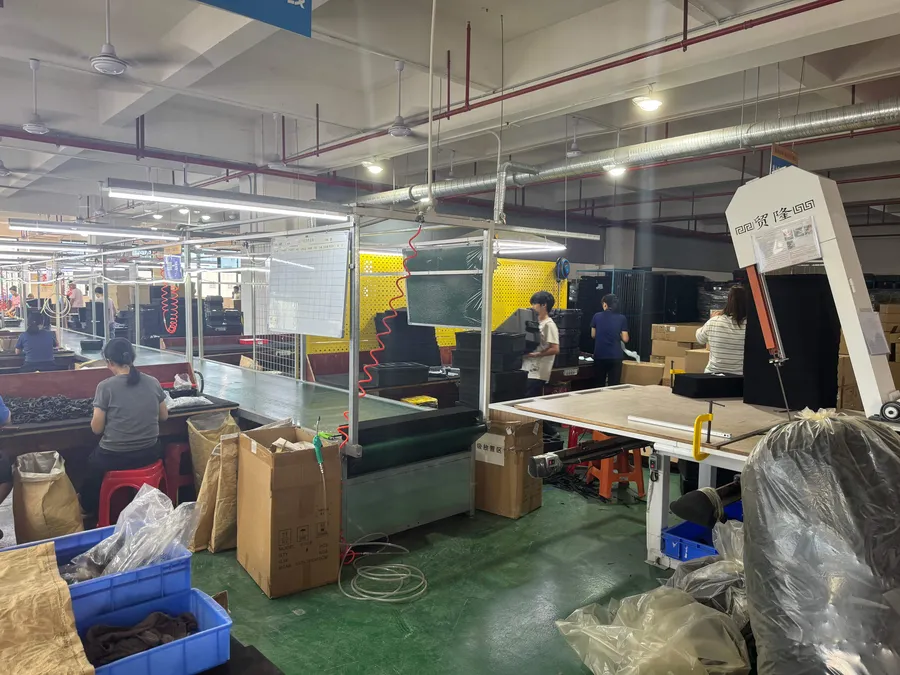
Customisation
Everything described above is configurable on a standard shell: interior layout (pick-and-pluck, die-cut or CNC-cut), foam grade and thickness, colour, logo method, latch and lock count, pressure-equalisation valve, cable ports, document holder and identification plate. A bespoke exterior geometry requires a new mould — 125 days, from 3,000 units per moulded component.
Procurement considerations
| Question | What to send us |
|---|---|
| Which shell fits? | Equipment L × W × H as packed, plus required clearance per axis |
| What does it cost? | Order quantity and estimated annual quantity — the two drive different answers |
| Is tooling needed? | Whether an existing shell clears the envelope with usable foam depth |
| Lead time? | Your required delivery date, not just the order date |
| Certification? | The exact standard your tender names — we will say whether we can test to it |
| Freight? | Destination and preferred terms; carton and pallet data supplied with the quotation |
Comparison and selection guide
The tables on this page exist because a protective case is chosen by comparing three things: the envelope, the environment and the handling chain. Where no table applies, the rule below is.
| Situation | What To Do |
|---|---|
| Changing kits | Layered pluck foam, rebuilt by hand. |
| Fixed rental fleet | CNC silhouette with serial pockets and an inventory list. |
| Harsh locations | Sealed shell plus desiccant provision in the lid. |
- Size on internal dimensions plus clearance, never on a product name.
- Choose the carrying method before the shell: it changes the series, not just the price.
- Specify the interior last, and decide up front whether the end user will reconfigure it.
Film Focus Puller & Accessories Safety Case: Sizing It From Published Specifications relates to Protective Case Basics. Related families: Camera & Photography Cases / Drone & UAV Cases / Optical Equipment Cases / Custom Protective Cases. Related sectors: field and industrial equipment. Continue in the Protective Case Basics cluster.
This page is written from our own production data. If your requirement differs, send the dimensions and we will tell you which of the 155 models fits, or whether a custom route is needed.