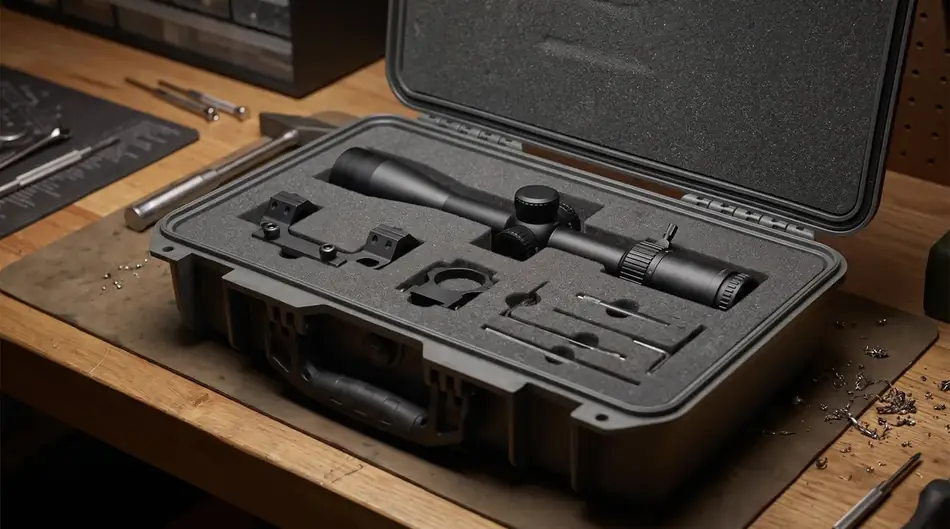
Protective Cases for Hand Tools, Power Tools & Hardware for Workshop Assemblies
Short answer: a workshop assembly kit is specified as a set of cut cavities measured against published numbers, not as one box sold on a borrowed label. KeXin New Materials (Guangdong) Co., Ltd. injection-moulds 155 thermoplastic shells and publishes internal and external dimensions and usable interior volume for every one of them, wall thickness for 148 (2.0 mm to 6.0 mm), the lid-over-base depth split for 100, empty mass for 93, and a compressible gasket in a continuous moulded channel on 124 shells while 31 record none. What we publish for none of the 155 is an ingress code, a free-fall height, a shock figure, a load capacity or a temperature range, because those fields are recorded as not measured. For gripper service tools, cordless drivers, torque sets, hand-tool drawers, kitting hardware and stage or sound boxes, the decision reduces to four figures on one named datasheet: internal length and width against the packed footprint, internal height against whatever stands proud, lid depth against the tallest accessory, and wall thickness against how the box is actually moved around the cell. This page takes each of the eight buyer searches in turn and gives the published figures that settle it.
Key points
- Split an assembly kit into three cavities before looking at any shell: power tool with cells, hand tools, and consumables or hardware that must not crush.
- Measure in the carried state, add about 20 mm per axis for the foam cut, then read that against published internal length, width and height on one named model.
- Wall thickness is published per model from 2.0 mm to 6.0 mm on 148 of 155 shells, so stiffness is a quoted figure rather than a heavy-duty adjective.
- 124 of the 155 shells record a compressible gasket in a moulded channel and 31 record none, including several of the shallowest and lightest formats.
- The 19 wheeled shells publish a telescopic handle and give up the flat stacking face that the other 136 keep, so trolley choice is a stacking decision first.
- Custom foam starts at one unit on an existing shell; colour, logo and OEM hardware start near 300 units and a new mould near 3,000 units and about 125 days.
Industrial Robot Gripper Maintenance Tool Box: Precision Parts And Small Torque Tools
Gripper service on a cobot or an automated cell is a small, specific load: a set of thin hex keys, a torque driver to a Nm range, feeler gauges for the parallel-jaw gap, a spring hook, locating pins, spare fingers or pads in a bag, and a consumable set of thread-lock and anti-seize sachets. Nothing there is heavy, but everything there is either easily lost or easily cross-threaded, and the failure mode in a shop is a missing part found at the next planned stop rather than a broken shell. So this load is planned as pockets rather than volume. KX-2811 publishes 253 x 180 x 98 mm internal on a 5.0 mm polypropylene wall, a 71 mm lid over a 27 mm base, about 890 g empty and 3.6 litres usable, with a gasket recorded in the moulded channel. For a deeper standing load - a torque driver with its ratchet set in a rack - KX-93221 gives 300 x 200 x 200 mm internal on a 5.0 mm engineering polypropylene wall with a 165 mm lid over a 35 mm base, about 1,230 g and 9.6 litres. Where a cell keeps both a tool box and a spare-part box, the ABS KX-63317 at 300 x 178 x 152 mm internal on a 4.0 mm wall, about 1,370 g and 6.5 litres, takes the parts while a KX-3213 at 308 x 230 x 118 mm, 3.0 mm wall and 7.2 litres takes the tools. The lid-over-base split matters more than total depth here: 71/27 mm keeps a shallow tray of shims under the lid, while 165/35 mm buries a rack of drivers deep and keeps only the sachets under the cover.
Sound Equipment Tool Case: Cables, Wireless Receivers And Stage Hardware
A sound and stage service kit is a mixed-density load: coiled XLR and speaker cable on one side, a wireless receiver or two with their rack ears, a microphone set with clips and windscreens, a soldering iron and a small reel, adapters and gaffer, and the one item everybody forgets until it is crushed - the stands' collar hardware. Cable coils are the volume, wireless gear is the fragile part, and the reason boxes fail at a venue is a connector panel pressed by a descending lid. Plan two layers with a lift-out tray rather than one deep hole. KX-64120 in ABS publishes 378 x 307 x 187 mm internal on a 4.0 mm wall at about 2,640 g and 17.4 litres, which is the depth that takes a receiver with its ears plus a cable layer beneath. Where the load is wider than it is tall, KX-84825 gives 410 x 360 x 240 mm internal in polypropylene on a 4.2 mm wall with a 200 mm lid over a 40 mm base and 28.3 litres, and KX-84430 gives 395 x 295 x 275 mm on a 4.2 mm wall with a 230 mm lid over a 45 mm base and 25.6 litres. A two-person patch kit with a small mixer suits KX-64621 at 430 x 288 x 186 mm, 4.7 mm ABS wall, about 3,000 g and 18.4 litres. Foam does the protective work: a firm carrier under a receiver chassis, a soft closed-cell face against a display or grille, and routed channels so a coiled multicore cannot push its plug into a socket.
Source Factory Plastic Tool Box OEM ODM: What Actually Changes At The Factory
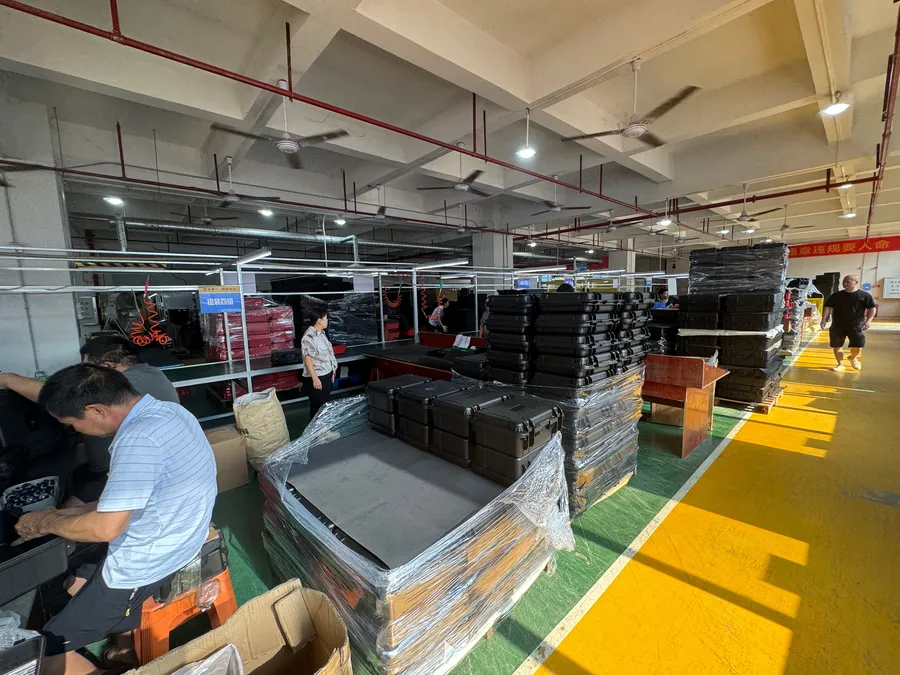
Buying direct from the moulding plant is a decision about which layer you change, and the layers cost very differently. Layer one is the interior: a die-cut or CNC-cut cross-linked PE, EVA or EPE layout in your own cavity pattern, on an existing shell, starting at one unit with no tooling at all. Layer two is identification: colour, logo, printed marking and buyer-branded packaging begin near 300 units, and latch count, hinge and stay arrangement, handle, document holder, shoulder strap and a pressure-equalisation option are quoted per configuration rather than fixed by series. Layer three is the shell itself, which is the only change that needs a mould, near 3,000 units per component and about 125 days from approved drawings; an OEM first sample on approved existing tooling takes about 45 days. ODM work means we design to your equipment rather than your drawing, which is normal for assembly cells that have grown kit nobody ever measured. One point of scope, stated plainly: KeXin is a wholesale manufacturer working on OEM and ODM terms only, quoted EXW or FOB, with a 30 per cent deposit and the balance after inspection. There is no retail channel, no delivered-duty-paid price and no overseas warehouse stock to draw from, so landed cost is your freight decision on top of an FOB figure. Third-party factory inspection before shipment is welcome and is the cheapest verification a buyer can do.
Industrial Hard Plastic Tool Box Wholesale: How A Wholesale Order Is Actually Priced
Wholesale arithmetic on a workshop programme is a carton question before it is a unit question, and we would rather you saw the real shape of our data than a tidied-up version of it. Internal and external dimensions and usable interior volume are published for all 155 models; carton size is published on 64 of them and pieces per carton on 58; we publish no pallet loading figure for any model, because pallet columns are a function of your pallet standard and stacking plan rather than of the shell. So a buyer prices a fleet by taking the carton footprint for the nominated model and doing the pallet arithmetic themselves. The figures that carry weight are those. KX-3213 ships on a 645 x 530 x 520 mm carton of 16 pieces; KX-3218 on the same 645 x 530 footprint at 550 mm high with 12 pieces; KX-4010 on 710 x 410 x 500 mm with 10; KX-4312 on 615 x 440 x 560 mm with 10; KX-64114 on 755 x 425 x 580 mm with 8; KX-64120 on 750 x 425 x 640 mm with 6; KX-65522 on 565 x 450 x 665 mm with 3. Small boxes pack tight: the ABS KX-62205 at 200 x 98 x 41 mm internal goes 20 to a 475 x 285 x 320 mm carton. Stacking is a published property too: 136 of the 155 shells record as stackable and the 19 wheeled ones do not.
Plastic Tool Box Injection Molding Custom: When A New Mould Pays For Itself
Injection moulding is why this catalogue can answer a size question at all: every shell is a tool, and a tool is what makes a repeatable cavity cheap at volume. Our 155 moulded shells cover internal cavities from 115 x 78 x 32 mm on KX-1204 to 740 x 518 x 364 mm on the trolley KX-88442, across seven series, with published wall thickness from 2.0 mm to 6.0 mm on 148 models and resin split of 94 polypropylene, 38 engineering polypropylene, 22 ABS and one PP/ABS. Before paying for tooling, check that range, because most workshop programmes can be met by picking a shell and cutting foam. A new mould becomes rational when one of four things is true: you need a cavity outside the published envelope in a way that cannot be met by combining two shells; you need a moulded-in feature such as a divider wall, a card carrier, a specific latch position or a stacking lip; you need a resin or colour that only makes sense committed to one tool; or your annual volume is high enough that a dedicated tool beats a shared one. In our terms that is near 3,000 units per component and about 125 days from approved drawings, against about 45 days for an OEM first sample on approved existing tooling and one unit minimum for custom foam. The honest advice is to buy the foam first, run the cell for a quarter, and let the cuts tell you whether the shell is wrong.
Industrial Trolley Type Plastic Heavy Duty Tool Box: The 19 Wheeled Shells
Trolley selection is a trade, not an upgrade. Nineteen of the 155 models publish wheels, and every one of them also publishes a telescopic handle and a non-stackable status, which means a wheeled box that will not sit on a rack or in a column of identical boxes. If your cell stores boxes on shelving, that trade is the whole decision. Where a loaded box is pushed across a shop floor or a yard, it is worth giving up the stacking face. Published options run from KX-85021 at 437 x 308 x 164 mm internal, engineering polypropylene on a 4.5 mm wall, about 4,912 g empty and 17.7 litres, through KX-85424 at 483 x 363 x 190 mm, 4.5 mm, about 6,000 g and 26.6 litres, to KX-85827 at 500 x 400 x 220 mm on a 5.0 mm wall with a 175 mm lid over a 45 mm base, a 295 mm telescopic height, about 7,800 g and 35.2 litres. KX-96027 gives 502 x 337 x 214 mm on 5.0 mm with a 170/44 mm split and about 6,110 g. The largest is KX-88442 at 740 x 518 x 364 mm internal, 5.0 mm wall, a 320 mm lid over a 44 mm base, about 15,320 g empty and 111.6 litres usable. Two cautions from the data: the trolley KX-5126 is one of the 31 shells recording no gasket, and a wheeled box ships one to a carton, so the freight arithmetic is per unit rather than per box-of-boxes.
Industrial Waterproof Oil-Resistant Tool Case: What We Record And What We Do Not
This is the question a shop-floor buyer asks and the one we answer least comfortably, so the split has to be explicit. Construction we can state: 124 of the 155 shells record a compressible gasket in a continuous moulded channel, seated against the closure line, and a pressure-equalisation option is quoted per configuration; 31 shells record no gasket offered on that shell, including KX-1204, KX-2805, KX-5126, KX-706, KX-707 and KX-95419. Performance we cannot state: waterproof, dust resistance, protection rating, UV resistance, temperature range, stack load and load capacity are recorded as not measured on every model, which is why we print no ingress code anywhere in this catalogue. A gasket channel is a sealing construction; it is not a validated barrier, and the difference is exactly what a purchasing audit finds. Cut and oil resistance get the same treatment. Nothing in this library is published as oil-resistant or chemical-resistant, so we describe what the resin is doing instead: a thermoplastic shell has no ferrous corrosion path, which is why corrosion resistance is the one protection field recorded as measured across all 155 models; and hydraulic fluid, cutting oil and penetrating oil are wiped off a smooth moulded face rather than absorbed by a foam face, which is why an oil-exposed kit should use a sealed or wipeable carrier layer and routed pockets rather than open pluck foam. Where a specification sheet insists on a code or an immersion result, we quote accredited third-party testing against the exact shell, gasket, latch and foam build as a separate work package.
Wind Turbine Maintenance Tool Case: Torque Sets, Socket Racks And Field Visits
Turbine service kit is the hardest version of this category: a torque set with long handles and impact sockets, a hydraulic bolt-tensioner accessory, puller plates, a ladder-bolt rack, spreader tools, plus personal kit - and every trip up a tower or out to a nacelle moves the box through a hatch, so the external footprint is as binding as the internal one. This is a length-and-mass load, not a volume load. For socket and torque racks KX-85819 publishes 500 x 400 x 165 mm internal on a 4.75 mm wall with a 120 mm lid over a 45 mm base and 26.4 litres; KX-86220 gives 538 x 408 x 180 mm on a 5.0 mm wall and 31.6 litres; KX-6621 gives 587 x 434 x 192 mm in engineering polypropylene on a 6.0 mm wall - the thickest published in the library - with a 43 mm lid over a 149 mm base, about 6,420 g and 39.1 litres. Where the load includes bars and pullers, treat length as the constraint: KX-85718 publishes 520 x 296 x 155 mm, KX-86216 publishes 582 x 300 x 130 mm and KX-87319 publishes 650 x 430 x 170 mm with a 120/50 mm split and 38.0 litres. For a crew case that must be pushed across a laydown yard, the wheeled KX-85427 gives 483 x 363 x 220 mm on a 4.5 mm wall with a 150 mm lid over a 70 mm base, about 6,100 g and 30.9 litres. Nothing here is published as a rating for salt spray, temperature or impact, and an offshore environment should be treated as a specification question with an accredited test attached rather than an assumption about a thick wall.
Model Comparison For Workshop Assembly Loads
Every column above is a published specification for the model named in that row, not a performance rating and not a series-wide capability. Where a field reads not published, our datasheet carries no record for that model and configuration, and we will not fill it with a typical figure. Carton size and pieces per carton exist on 64 and 58 models respectively and are the only packing numbers we publish, because no pallet loading figure is measured for any model.
| Workshop Load | Model | Internal Mm | Wall Mm | Lid Over Base Mm | Empty Mass G | Usable Volume L | Gasket Recorded |
|---|---|---|---|---|---|---|---|
| Gripper and cell service kit | KX-2811 | 253 x 180 x 98 | 5.0 | 71 / 27 | about 890 | 3.6 | yes |
| Torque drivers and spare fingers | KX-93221 | 300 x 200 x 200 | 5.0 | 165 / 35 | about 1,230 | 9.6 | yes |
| Hand tools plus hardware drawers | KX-3213 | 308 x 230 x 118 | 3.0 | 86 / 32 | about 860 | 7.2 | yes |
| Cordless driver kit with cells | KX-4613 | 455 x 338 x 116 | 3.0 | 74 / 42 | about 1,370 | 15.3 | yes |
| Sound and stage service kit | KX-64120 | 378 x 307 x 187 | 4.0 | not published | about 2,640 | 17.4 | yes |
| Two-person patch and mixer kit | KX-64621 | 430 x 288 x 186 | 4.7 | not published | about 3,000 | 18.4 | yes |
| Trolley kit for a moving cell | KX-85424 | 483 x 363 x 190 | 4.5 | not published | about 6,000 | 26.6 | yes |
| Turbine torque and socket rack | KX-6621 | 587 x 434 x 192 | 6.0 | 43 / 149 | about 6,420 | 39.1 | yes |
| Long bars and pullers | KX-87319 | 650 x 430 x 170 | 5.0 | 120 / 50 | not published | 38.0 | yes |
| Light bench box, no gasket | KX-2805 | 270 x 190 x 46 | 2.1 | 23 / 23 | about 340 | 2.1 | no |
Buyer Search Phrases Mapped To The Published Figure That Decides Them
Each phrase in that table is a search a buyer actually types, and each answer is a specification we publish rather than a claim we would rather not make. Where a phrase asks for a result - waterproof, oil-resistant, heavy-duty - the honest reply is a construction figure plus a note that the corresponding performance field is recorded as not measured on all 155 models, and that accredited testing can be commissioned on the exact build as a separate work package.
| Buyer Search | Deciding Published Figure | Published Example |
|---|---|---|
| industrial robot gripper maintenance tool box | Pocket count and lid depth for standing drivers, not total volume; 71/27 mm and 165/35 mm lid-over-base splits both published | KX-2811: 253 x 180 x 98 mm internal, 5.0 mm, about 890 g, 3.6 L; KX-93221: 300 x 200 x 200 mm, 5.0 mm, about 1,230 g |
| sound equipment tool case | Two-layer build with a lift-out tray; internal height against a receiver with rack ears plus a cable layer beneath | KX-64120: 378 x 307 x 187 mm ABS, 4.0 mm, about 2,640 g, 17.4 L; KX-84430: 395 x 295 x 275 mm, 230/45 mm lid/base |
| source factory plastic tool box oem odm | Which layer changes: foam from one unit, logo and colour near 300, a new mould near 3,000 and about 125 days; EXW or FOB only | All 155 shells; OEM first sample on approved tooling about 45 days, 30 per cent deposit with balance after inspection |
| industrial hard plastic tool box wholesale | Carton footprint and pieces per carton, which exist on 64 and 58 models; no pallet figure is published for any model | KX-3213: 645 x 530 x 520 mm carton of 16; KX-4010: 710 x 410 x 500 mm of 10; KX-65522: 565 x 450 x 665 mm of 3 |
| plastic tool box injection molding custom | Cavity range of the existing tool set before paying for a mould, with wall thickness published per model | 155 shells from 115 x 78 x 32 mm on KX-1204 to 740 x 518 x 364 mm on KX-88442; wall 2.0 mm to 6.0 mm on 148 models |
| industrial trolley type plastic heavy duty tool box | Wheels, telescopic handle and non-stackable status, all published together on the same 19 models | KX-85021: 437 x 308 x 164 mm, about 4,912 g; KX-85827: 500 x 400 x 220 mm, 295 mm telescopic height; KX-88442: 740 x 518 x 364 mm, 111.6 L |
| industrial waterproof oil-resistant tool case | Gasket recorded on 124 shells and none offered on 31; water, dust and chemical resistance recorded as not measured on all 155 | Gasket on KX-4613, KX-84818 and the trolley KX-85424; no gasket on KX-1204, KX-2805, KX-5126, KX-706 and KX-95419 |
| wind turbine maintenance tool case | Internal length and external footprint against the hatch and the torque rack; thickest published wall in the library | KX-6621: 587 x 434 x 192 mm on a 6.0 mm wall, about 6,420 g, 39.1 L; KX-87319: 650 x 430 x 170 mm, 120/50 mm lid/base |
Selection Guidance: Four Checks That Reach A Model Number
First, split the kit into cavities before opening a catalogue. An assembly cell usually has a powered tool with its cells, a hand-tool layer, and a consumables or hardware layer; three pockets in one box, or two boxes, beat one deep box with everything loose in it, because a loose load crushes the item on top and hides the item at the bottom. Second, measure in the carried state and add working clearance: driver with battery fitted, socket rack in its tray, cable coils at their natural diameter, plus about 20 mm per axis for the cut, then read that against published internal length, width and height, which exist for all 155 models. Third, read the two depth numbers separately: a model publishing a 71 mm lid over a 27 mm base and a model publishing 43 mm over 149 mm are different boxes even at similar total depth, and the lid figure is what decides whether a standing tool or a rack fits under the tray. Fourth, decide the carry and the storage on the datasheet of the nominated model: 136 shells record as stackable and 19 wheeled ones do not; gasket presence is model-specific rather than series-wide; wall thickness is published from 2.0 mm to 6.0 mm on 148 models. If your document names a dimension, a wall or a volume, we can answer it today. If it names a rating, budget the test as its own line item.
Where These Cases Are Used
The buyer is usually not the person carrying the box, which is why workshop specifications fail in predictable places. Automation and robotics integrators issue a gripper service kit per cell and need the cut to be repeatable when a second line is built, so an interior drawing becomes the reorder standard. Contract assembly shops build a kitting box per work order and turn it around weekly, so lid depth and a wipeable face matter more than a rating. Maintenance and reliability teams carry a driver, a torque set and a consumable rack between machines, and the box lives on a trolley or a shelf edge. Sound, lighting and stage contractors load a case into a van with three other cases, so the external footprint decides whether the load plan works at all. Wind and heavy-machinery service crews move tools through a hatch and up a ladder, so a box that fits the equipment may not fit the access route. Distributors and toolroom suppliers buy the same shells in fleet quantities and differentiate by foam and marking rather than by mould. Training providers and technical colleges issue identical boxes to every bench so a missing tool is visible at the end of a class. Across all of them the shell choice is a shortlist of published cavities and the difference is made in the insert, the carry format and the marking - which is why the tool-case and foam-insert pages on this site are as important as any datasheet.
Customisation: Interior, Hardware, Marking And Tooling
Interior work is the fast path and needs no new tooling. We cut cross-linked PE, EVA or EPE die-cut or CNC-cut in layered builds, lift-out trays, pluck tops over a fixed base, egg-crate faces and routed outlines, so a missing driver or socket shows as an empty shape at issue and at the end of a shift. For workshop loads the features that earn their cost are a firm carrier under tool mass rather than soft pluck, a routed channel so a cable cannot push its plug home, standing pockets for cells and batteries so mass stays below the closure line, and a wipeable face where cutting oil and anti-seize are handled. Custom foam starts at one unit and needs a drawing, a photograph of the packed kit or a physical sample. Hardware is ordered per configuration: latch count, hinge and stay arrangement, handle, document holder, shoulder strap and a pressure-equalisation option, and every one of the 155 models publishes a latch body that accepts a standard padlock. Colour, logo, printed identification and buyer-branded packaging begin near 300 units. Only a change to the shell itself requires a mould, near 3,000 units per component and about 125 days from approved drawings, against about 45 days for an OEM first sample on approved existing tooling. Most assembly programmes never need new tooling, because the published cavity range already brackets the kit.
Procurement Notes: Wholesale Terms, Verification And What We Will Not Claim
KeXin New Materials (Guangdong) Co., Ltd. moulds these shells and works wholesale, OEM and ODM only, on EXW or FOB terms. There is no retail channel, no delivered-duty-paid quotation and no overseas warehouse stock, so build landed cost from an FOB figure plus your own freight and clearance. Payment is a 30 per cent deposit with the balance after inspection, and third-party factory inspection before goods leave is welcome. The protection block on our datasheet is deliberately uneven, and that is the point: corrosion resistance is recorded as measured across all 155 shells on the plain grounds that a thermoplastic shell has no ferrous corrosion path, while water resistance, dust resistance, protection rating, UV resistance, temperature range, stack load and load capacity are recorded as not measured on every model, and impact and shock are recorded as manufacturer options because the protection sits in a specified foam layout rather than in the shell alone. No ingress code, free-fall height or load figure appears anywhere in this catalogue, and a compressible gasket recorded on 124 shells describes construction, not a validated barrier. Apply the same three questions to us that you would apply to any supplier, because they are the ones that catch an inflated catalogue: which accredited report produced this figure, what method and conditions were used, and does that report cover the exact build being bought. Send your packed dimensions, the carried-state photograph and the quantity you need through the RFQ page and we will answer against the named model.
Customisation
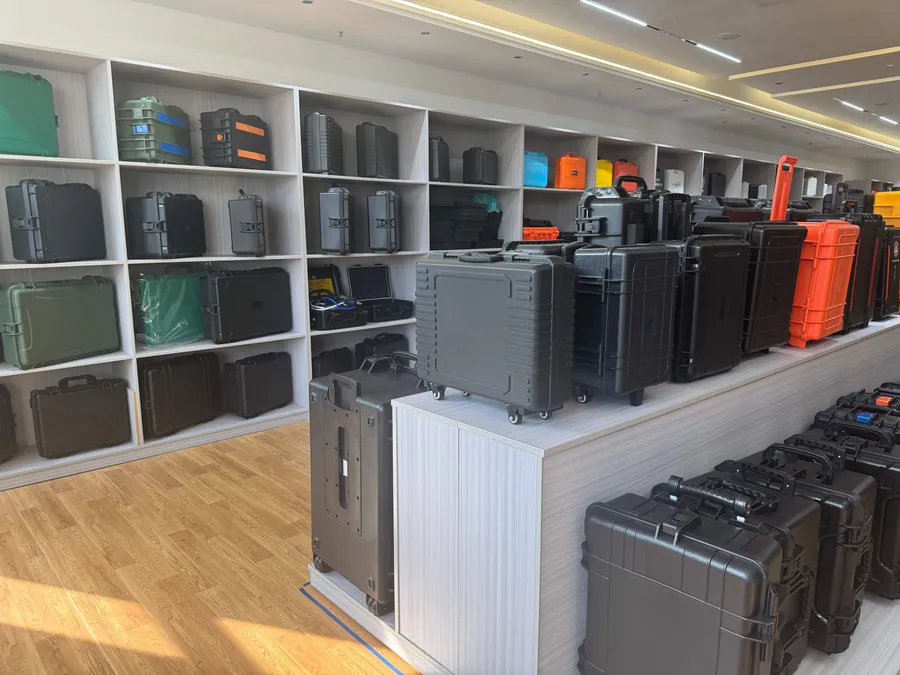
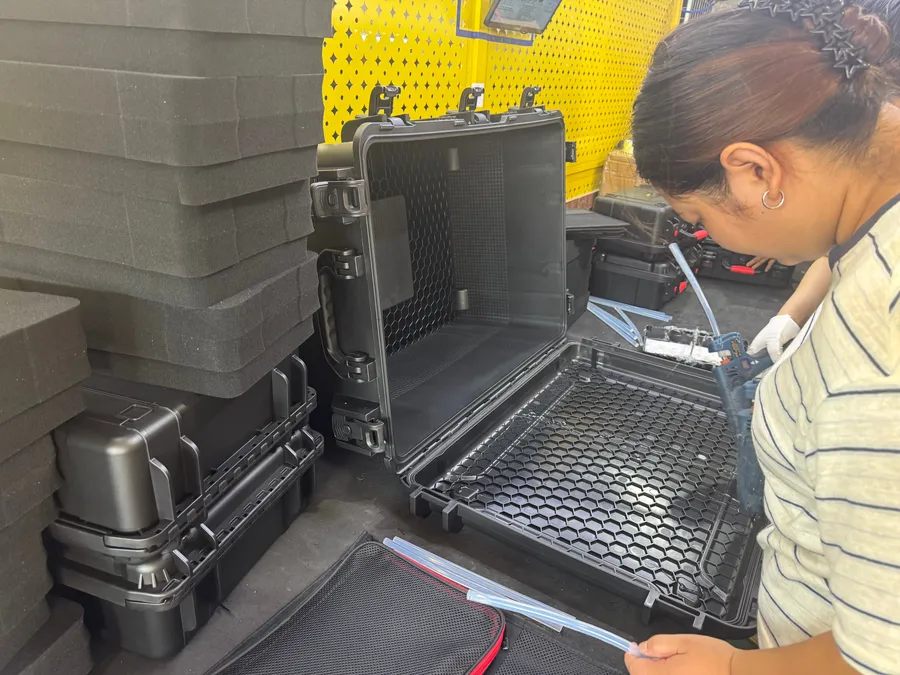
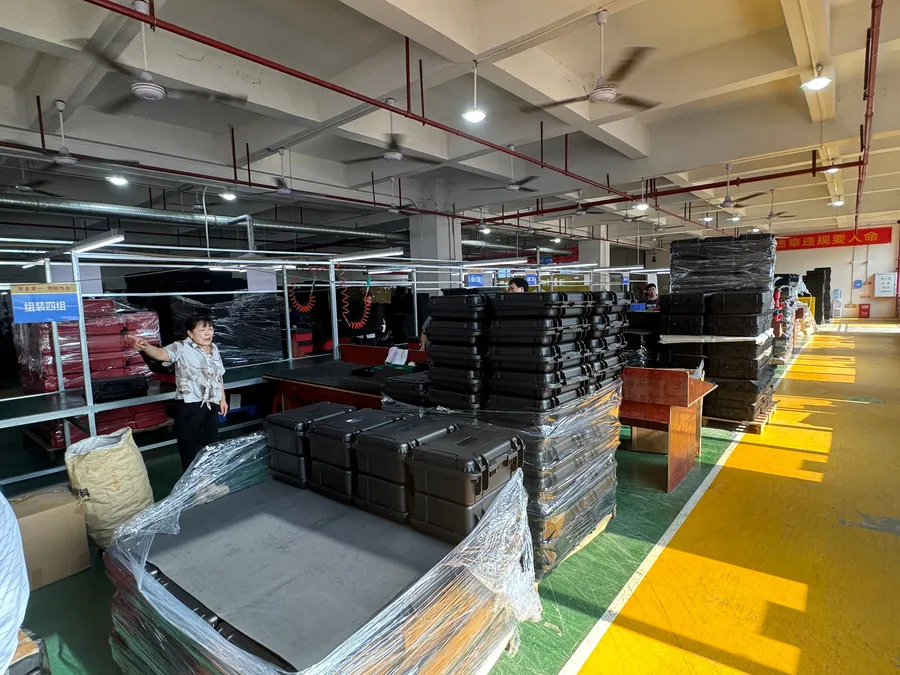
Everything described above is configurable on a standard shell: interior layout (pick-and-pluck, die-cut or CNC-cut), foam grade and thickness, colour, logo method, latch and lock count, pressure-equalisation valve, cable ports, document holder and identification plate. A bespoke exterior geometry requires a new mould — 125 days, from 3,000 units per moulded component.
Procurement considerations
| Question | What to send us |
|---|---|
| Which shell fits? | Equipment L × W × H as packed, plus required clearance per axis |
| What does it cost? | Order quantity and estimated annual quantity — the two drive different answers |
| Is tooling needed? | Whether an existing shell clears the envelope with usable foam depth |
| Lead time? | Your required delivery date, not just the order date |
| Certification? | The exact standard your tender names — we will say whether we can test to it |
| Freight? | Destination and preferred terms; carton and pallet data supplied with the quotation |
Comparison and selection guide
The tables on this page exist because a protective case is chosen by comparing three things: the envelope, the environment and the handling chain. Where no table applies, the rule below is.
| Situation | What To Do |
|---|---|
| Fixed inventory | CNC or die-cut silhouette with part numbers printed on the foam. |
| Variable kit | Pluck foam plus a loose tray. |
| Bench work | Removable trays that lift out square so the case doubles as a stand. |
- Size on internal dimensions plus clearance, never on a product name.
- Choose the carrying method before the shell: it changes the series, not just the price.
- Specify the interior last, and decide up front whether the end user will reconfigure it.
Protective Cases for Hand Tools, Power Tools & Hardware for Workshop Assemblies relates to Protective Case Basics. Related families: Tool Cases / Equipment Transport Cases / Custom Protective Cases / Waterproof Cases / Rolling Cases / Field Equipment Cases / Electronics Cases. Related sectors: field and industrial equipment. Continue in the Protective Case Basics cluster.
This page is written from our own production data. If your requirement differs, send the dimensions and we will tell you which of the 155 models fits, or whether a custom route is needed.