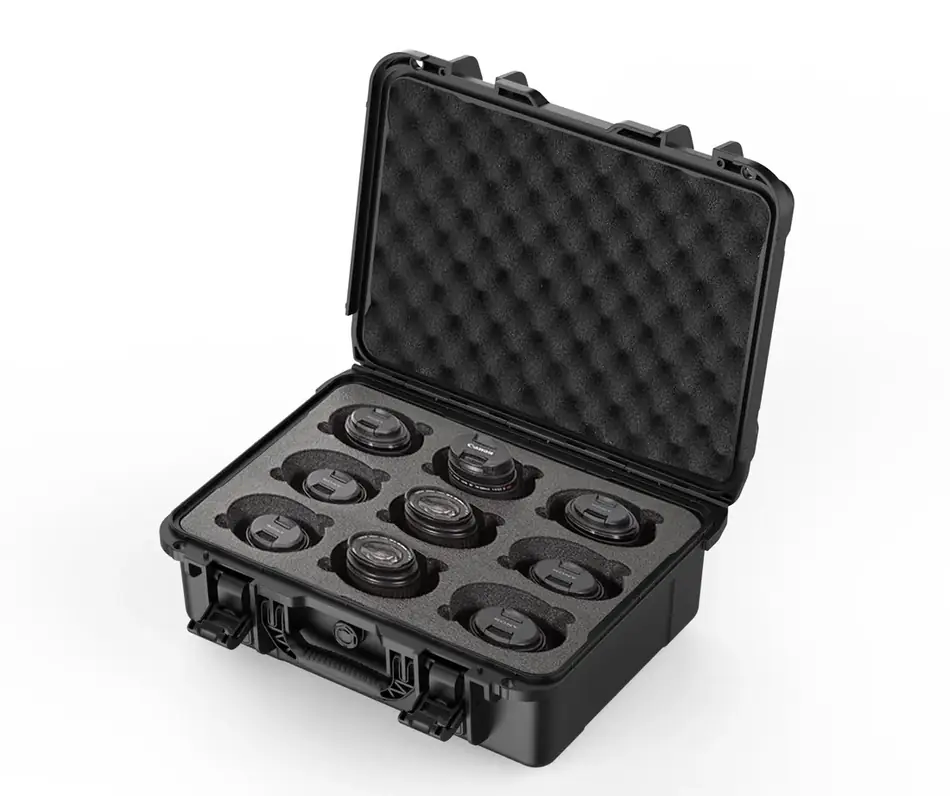
What case size is suitable for camping equipment?
The case size that suits camping equipment is set by the largest item in its packed configuration plus a clearance allowance, not by a litre figure - and once that arithmetic is done, most camp load plans land in a working band of about 3 to 20 litres. That band is where 72 of the 145 models in our catalogue that carry an outdoor designation sit, with a median published internal volume of 17.2 litres, because it is large enough for a stove and cook set, a lantern and fuel, a first-aid and repair pouch, or a camera and binocular pair, and small enough that one person can still carry it from a vehicle to a pitch. A single 40-litre box is the wrong answer for the same kit: camp equipment is carried in short legs over uneven ground, and a big box gets left in the car. Size by item envelope first, then split the kit into two or three shells that each stay liftable, and check the published internal width, the taper and the lid-to-base depth split before the interior is cut.
Key points
- Size from the largest packed item plus clearance, then from the family of items - a litre figure on its own decides nothing.
- 72 of our 145 outdoor-designated models sit between 3 and 20 litres, which is the practical camping band for one-person carry.
- Internal volume is theoretical; usable interior volume after corner radius, seal channel and hardware has a median ratio of 0.85.
- Where a shell tapers we publish narrow internal width - recorded on 36 models from 70 mm to 308 mm - and that figure, not the nominal width, must clear the item.
- The lid-to-base split matters more than total depth: one model publishes 92 mm lid over 25 mm base, another 38 mm over 38 mm at the same internal height.
- Carried mass is a real limit: 32 outdoor-designated models publish a shell at or below 1 kg, and median published shell mass is 1.37 kg.
- Long items break the size logic entirely - tent poles, tripods, mats and an axe handle need internal length before any volume argument applies.
Why a camp load is sized differently from a depot load
Camping equipment is not stored and then moved occasionally; it is packed, carried a short distance over rough ground, unpacked, used with dirty or damp hands, and repacked in the dark. That sequence changes the sizing question. In a depot or a rack, the largest box that fits the pallet wins because a forklift carries it. On a campsite, the box that one person will actually carry wins, because a case that gets left in the vehicle protects nothing. The practical consequence is that a camp load plan is usually two or three shells of different footprints rather than one big one, sized so that each leg of the carry is short and each lid closes without rearranging the kit.
The second difference is that camp kit is mixed. A single shell may hold a gas stove, a fuel canister, a folding kettle, a plate set and a spork pouch - objects with completely different shapes and masses, some of them greasy, one of them a pressure vessel that must not be crushed or have its valve loaded. Mixed geometry is exactly the case for an interior with cut zones plus a loose press layer, and it is also the reason a nominal litre figure tells you so little: two boxes of identical volume can hold or fail to hold the same stove depending on depth and taper.
The third difference is handling abuse that never appears in a specification. A camp case goes on a rock, on a car roof rack, on a muddy tailgate, and it gets dropped from a comfortable standing height more often than from a laboratory one. Our published listings record impact and shock resistance as a construction option with no drop height claimed, so the honest sizing advice is about the envelope and the closure you can verify, not about an absorbed-energy figure we do not publish.
The four published numbers that actually decide the fit
The first is internal length, width and height, which we publish for all 155 models in millimetres. Measure every camp item as it travels - stove with its legs folded, lantern with its handle down, trip stand with its feet out - and take the largest single envelope. Add at least 20 mm of clearance on every axis before a shell is shortlisted, because foam has to exist between the item and the wall and because a pocket cut to the exact size of an item is a pocket you will fight every time you pack.
Number two is narrow internal width, published for the 36 models where the taper is worth recording and running from 70 mm to 308 mm. In the small outdoor formats it is routinely 15 to 30 mm tighter than the nominal internal width: the KX 2808 publishes 190 mm internal width with a narrow internal width of 170 mm, and the KX 701 publishes 180 mm with 158 mm at the narrow point. A hard case is moulded with a draft angle, so the widest point of your item must clear the narrowest point of the box, not the average.
Number three is the lid-to-base depth split. Total internal depth is only half the story: one model publishes 260 x 200 x 117 mm with 92 mm of that depth in the lid over a 25 mm base, while another publishes 265 x 190 x 76 mm split 38 mm and 38 mm. The first is a shell for a tall object that must be lifted out of a shallow base and held by the lid half; the second is a tray shell for flat kit. Across the 100 models that publish the split, lid depth runs from 16 mm to 320 mm with a median near 98 mm, and base depth from 15 mm to 168 mm with a median of 44 mm.
Number four is mass - both the shell's and the load's. Shell net mass is published on 93 of 155 models, from 100 grams up to 15.32 kg, and among the outdoor-designated models 32 publish a shell of one kilogram or less, with a median published figure of 1.37 kg. Add the packed mass of the kit and the foam, then ask the honest question: can the person who carries this carry it twice, because on a campsite they usually do.
Matching camp load families to published shells
The table below takes the recurring camp families and pairs each with one published model whose envelope clears it, using only figures that appear in our own specification data. It is a starting shortlist, not a fit guarantee: the item you actually own decides the choice, and the clearance rule above decides whether the pairing works. Every row is a real shell with a real published internal dimension, and where a model does not list a seal we say so rather than implying one.
| Camp Family | Published Example | Internal Mm | Volume L | Notes |
|---|---|---|---|---|
| Small tackle, cutlery, first aid, spares | KX 1204 | 115 x 78 x 32 | 0.3 nominal / 0.3 usable | 100 g shell, PP, no seal listed, stackable |
| Phone, power bank, cables, head torch | KX 1905 | 180 x 160 x 40 | 1.2 nominal / 1.0 usable | 250 g, 3.0 mm wall, seal availability listed, 130 mm narrow width |
| Stove plus fuel and windscreen | KX 2808 | 265 x 190 x 76 | 3.8 nominal / 3.3 usable | 430 g, 2.2 mm wall, lid 38 over base 38, no seal listed |
| Cook set, plates and kettle | KX 3308 | 325 x 236 x 76 | 5.8 nominal / 5.0 usable | 575 g, 217 mm narrow width, 20 pieces per carton |
| Lantern, taller object | KX 2614 | 240 x 200 x 120 | 5.8 nominal / 5.0 usable | 460 g, even 60/60 mm depth split for a lift-out load |
| Camera and binocular pair | KX 712 | 308 x 250 x 96 | 7.4 nominal / 6.4 usable | Engineering PP, 710 g, lid 54 over base 42, 2.8 mm wall |
| Tall stove or a stacked cook set | KX 2813 | 260 x 200 x 117 | 6.1 nominal / 5.2 usable | 92 mm lid over 25 mm base - a lid-carried load |
| Mixed kitchen box for two people | KX 3113 | 296 x 258 x 121 | 9.2 nominal / 7.9 usable | 1.06 kg, 2.9 mm wall, 16 pieces per carton |
| Whole camp kitchen plus tools | KX 84116 | 385 x 313 x 145 | 17.5 nominal / 15.0 usable | 3.7 mm wall, seal availability listed, thick-wall family |
| Group kit, one carry | KX 85017 | 463 x 338 x 156 | 24.4 nominal / 19.5 usable | 4.5 mm wall, seal listed, stacks with the same 8 Series grid |
| Poles, tripod, mat, axe handle | KX 88015 | 725 x 350 x 140 | 35.5 nominal / 28.4 usable | 5.0 mm wall, lid 100 over base 40, long-equipment designation |
| Heavy group load, wheeled | KX 86136 | 530 x 360 x 304 | 58.0 nominal / 46.4 usable | 8.5 kg shell, wheels, 260 mm lid, non-stackable by design |
Why the working band is 3 to 20 litres
Below about 3 litres you are storing a sub-kit, not a camp load: a torch-and-battery box, a repair pouch, a tackle box, a first-aid set. Those are the 0.3 to 2.9 litre shells, and they are useful precisely because they travel inside a bigger box rather than being carried as their own trip. Between roughly 3 and 20 litres the shell holds a coherent family - cook set, kitchen, optics, power - and still closes flat enough to sit in a car footwell or on a rack. Seventy-two of our 145 outdoor-designated models sit in that band, which is why it is the shortlist most buyers end up working from.
Above 20 litres the arithmetic changes character. A 24-litre box packed with a kitchen, a fuel canister, plates and a stove is genuinely heavy, and above about 40 litres you have a group store rather than a carry case: our largest outdoor-designated shell publishes 58.7 litres nominal with 47.0 litres usable on a 650 x 430 x 210 mm interior, and the models above 50 litres are where wheeled bodies and non-stackable lids start to appear, because the load is being moved rather than carried. The honest rule is to keep one-person loads inside the 3 to 20 litre band and to make the bigger shells a trolley or a shared box rather than a heavier hand carry.
Two published caveats stop a litre figure being read as a promise. First, nominal internal volume assumes a perfect rectangular box, and our usable interior volume - published for all 155 models after moulded corner radius, seal channel and hardware - is smaller on 154 of them, with a usable-to-nominal ratio running from 0.797 to 1.0 and a median of 0.85. Buy the size for the usable figure. Second, a litre count says nothing about whether the tallest or longest single item fits, which for camp kit is usually the binding constraint.
Depth, taper and the items that break the rule
Camp equipment contains three shapes that defeat a volume argument. The first is the tall narrow item - a lantern, a gas canister, a kettle - which needs depth in one zone rather than spread evenly, and is the reason a shell with a 92 mm lid over a 25 mm base exists at the same internal height as one split 38 and 38. The second is the long item: a rolled mat, tent poles, a tripod with its legs collapsed, an axe, a folding saw. Our outdoor-designated catalogue carries 25 long-equipment models, with published internal length reaching 725 mm in the KX 88015 and 880 mm in the KX 89616 on the same 5.0 mm wall, and those are length purchases, not volume purchases. The third is the taper: a shell moulded with draft loses width near the rim, so the narrow internal width we publish is the figure a rigid item must clear.
The lid-to-base split also decides whether an interior can be built at all. A cut pocket for a stove sits in the base half, so a 25 mm base gives you a shallow tray and forces the load to be held by the lid; a 45 to 63 mm base lets the item be cradled from underneath, which is what you want for anything with a valve, a lens or a hinge. When we draw a camp layout, base depth is the first number we look at, because the press layer in the lid can always be made lighter, but a missing 20 mm in the base cannot be recovered.
One more practical point about mass: wall thickness is published on 138 of the 145 outdoor-designated models and runs from 2.0 mm to 6.0 mm, with a median of 3.7 mm. Thin-wall formats are the light carry boxes that camp users prefer, and they trade shell depth and stacking stiffness for grams. A 5 mm wall box carries a heavier load and stacks more predictably in a rack, but on a footpath the difference of a few hundred grams is felt long before the difference in stiffness is.
Stacking, cartons and the vehicle plan
Camp cases live in a boot, on a roof rack or in a garage corner, so the outer footprint matters as much as the interior. Of the 145 outdoor-designated models, 134 are listed as stackable and only 11 carry wheels; a flat, wheel-free lid is what makes a stack in a vehicle predictable, and the small formats are the ones that get stacked three high. Packing data is published for many models as carton dimensions and pieces per carton - a KX 2808 ships 20 pieces in a 560 x 445 x 415 mm carton, a KX 704 ships 20 in 740 x 550 x 480 mm, a KX 3113 ships 16 in 635 x 595 x 540 mm - which is what a distributor uses to work out pallet grid and shelf, and what a buyer uses to check that the box they are ordering arrives in a quantity they can store.
For a fleet or a club, keeping the shells inside one series where the footprint allows means the grid repeats: cases with the same external base stack and chock together, and mixed footprints waste both vertical space and lid area. If you plan to rattle two or three camp boxes around a vehicle bay, that plan should be made against published external dimensions rather than internal ones, and the internal-versus-external question is written up separately on our dimensions guide.
How to choose: a sizing sequence that ends in a shortlist
Work in this order and the choice collapses quickly. Step one: list the items that must travel together, and measure each one as packed, not as used. Step two: take the largest single envelope and add 20 mm of clearance per axis; that is your minimum internal box. Step three: filter our published models by internal length, width and height against that minimum, then re-check the narrow internal width for anything rigid. Step four: look at the lid-to-base split and ask which half holds the item. Step five: subtract usable from nominal, add the foam, and confirm the total carried mass is something a person will carry on a footpath.
Step six is the closure decision, and it is a per-model one. Across the 145 outdoor-designated models, 114 list seal availability; the models filed primarily under our outdoor category are published as dry-duty carry boxes with no seal listed, which suits a kit that is used and repacked daily rather than one that must exclude water. Our outdoor application page describes pigmented resin for ultraviolet exposure, and separately our listings record the ultraviolet, waterproof, dust and service-temperature fields as not measured for every model - a material description is not a test result, and the two should be read as what they are.
Step seven is the interior, which is specified last because it depends on everything above it. A camp layout is usually a combination: cut or pluck pockets for the stove and cook set, a loose press layer over the plates, a separated zone for fuel so a valve cannot load against a wall, and a channel for cables or pegs. Pick-and-pluck, die-cut and CNC-cut construction and EVA, PE and EPE grades are all published as options on every model, so the layout is a drawing decision rather than a tooling one.
Customising and buying for a camp brand
For an outdoor brand or a distributor, the case is a component of the product, and the customisation that matters is the interior plus the finish. A custom foam layout starts at one set and needs no new tooling on any of our 155 shells, which is how a brand proves a layout for a specific stove before committing. Colour, printed or embossed identification and hardware options are quoted from 300 units; OEM production on existing mouldings runs to a first sample at 45 days with a 30 per cent deposit; a genuinely new shell geometry is a mould project at about 125 days from 3,000 units per moulded component. The realistic path for a camp line is a standard shell with a bespoke interior and a moulded colour.
Commercially we work wholesale and OEM only, quoted EXW or FOB with a 30 per cent deposit to open production. We do not sell retail, do not quote delivered-duty-paid and hold no overseas warehouse stock, so inbound freight, import clearance and any distribution inside your market belong to your own logistics and should be scheduled against the production batch. Stock models ship from one unit, so a brand can test two shells with one foam layout on a real trip before ordering a pallet, and third-party inspection of finished goods is welcome.
Procurement notes before you order a camp case
Send the load, not a volume adjective. A request that says 10 litre camping case tells us nothing you will not have to renegotiate later; a request that lists items with packed dimensions and mass, says who carries the box and how far, states whether it lives in a boot or on a rack, and names the closure you need, lets us return a shell shortlist with clearance shown and a layout drawing with the grades marked. Attach a photograph of the kit laid out as it packs, or send a physical item, and expect the same arithmetic back rather than a catalogue line.
Then read the answers in the same currency: published internal and external dimensions, narrow internal width where the shell tapers, wall thickness, lid and base depth, net mass, usable interior volume and packing data, with a clear separation of what is measured, what is a configuration option and what we do not claim. Where a specification needs an ingress or impact figure, the route is accredited testing of a named shell, a named layout and a named load, commissioned as a separate work package; that report describes the article that was in the chamber, which is a stronger document than a rating inherited across a range.
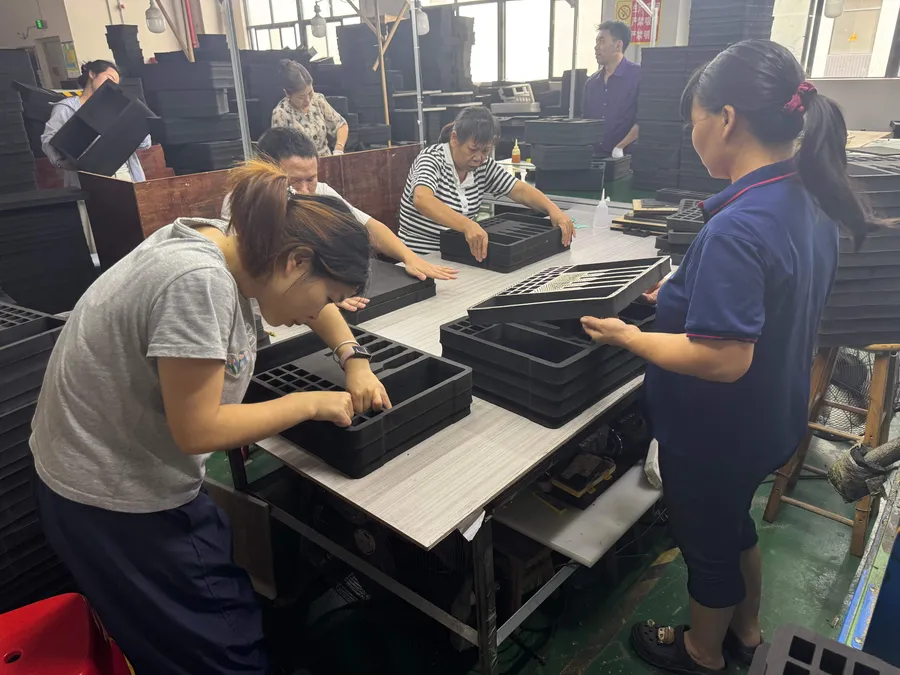
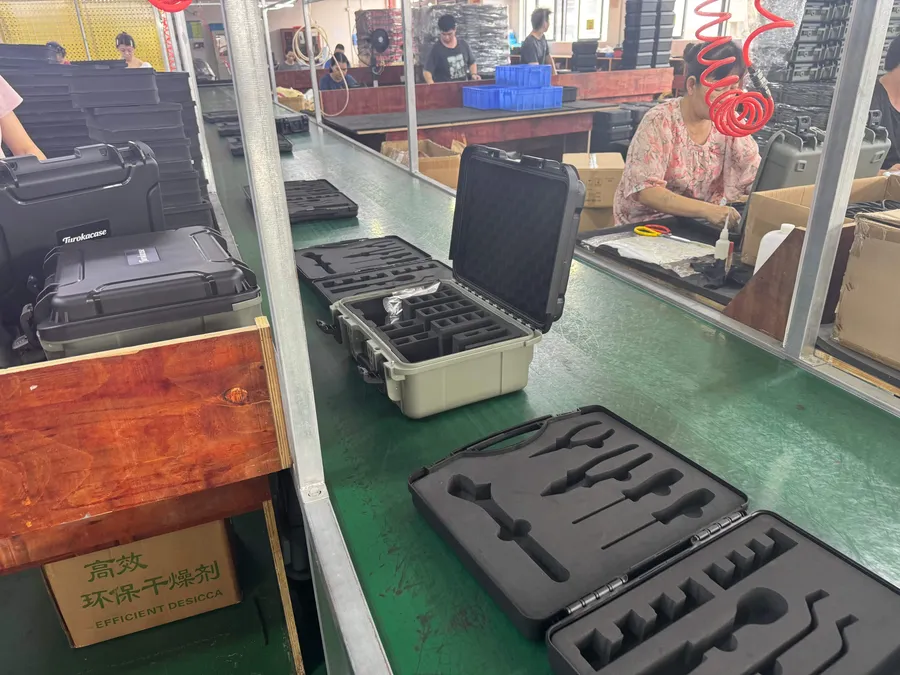
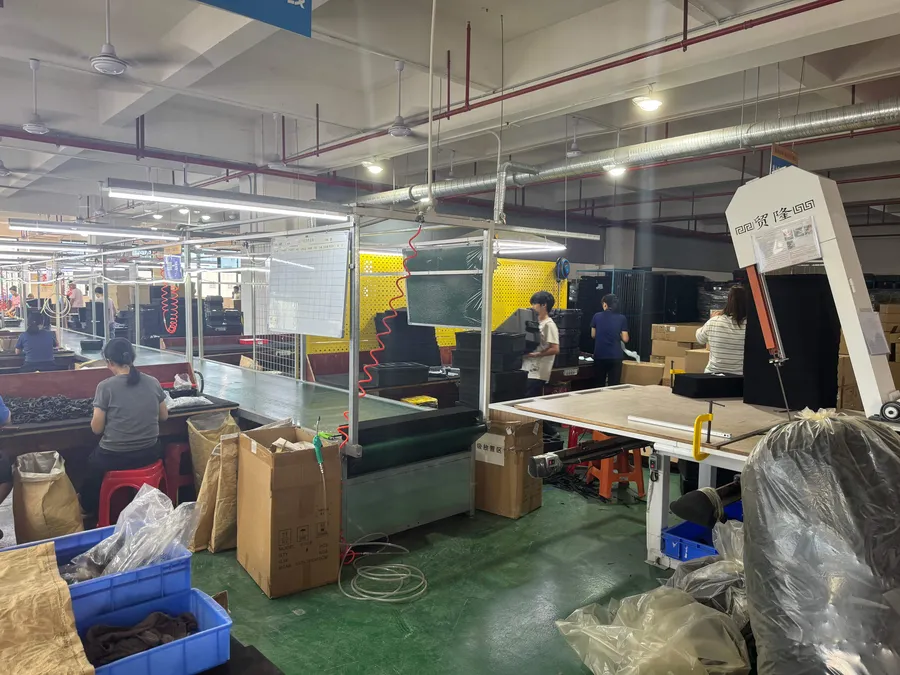
Customisation
Everything described above is configurable on a standard shell: interior layout (pick-and-pluck, die-cut or CNC-cut), foam grade and thickness, colour, logo method, latch and lock count, pressure-equalisation valve, cable ports, document holder and identification plate. A bespoke exterior geometry requires a new mould — 125 days, from 3,000 units per moulded component.
Procurement considerations
| Question | What to send us |
|---|---|
| Which shell fits? | Equipment L × W × H as packed, plus required clearance per axis |
| What does it cost? | Order quantity and estimated annual quantity — the two drive different answers |
| Is tooling needed? | Whether an existing shell clears the envelope with usable foam depth |
| Lead time? | Your required delivery date, not just the order date |
| Certification? | The exact standard your tender names — we will say whether we can test to it |
| Freight? | Destination and preferred terms; carton and pallet data supplied with the quotation |
Comparison and selection guide
The tables on this page exist because a protective case is chosen by comparing three things: the envelope, the environment and the handling chain. Where no table applies, the rule below is.
| Situation | What To Do |
|---|---|
| Marine or wet | Sealed configuration with a drain-friendly interior and stainless hardware. |
| Dry and dusty | A close-fitting rim and a lid that can be opened one-handed without spilling contents. |
| Carried far | Under 10 kg packed, with a padded handle or shoulder webbing. |
- Size on internal dimensions plus clearance, never on a product name.
- Choose the carrying method before the shell: it changes the series, not just the price.
- Specify the interior last, and decide up front whether the end user will reconfigure it.
What case size is suitable for camping equipment? relates to Protective Case Basics. Related families: Outdoor Protective Cases / Custom Protective Cases / Camera & Photography Cases / Tool Cases / Drone & UAV Cases / Long Equipment Cases / Waterproof Cases / Ammunition Storage & Transport Boxes. Related sectors: field and industrial equipment. Continue in the Protective Case Basics cluster.
This page is written from our own production data. If your requirement differs, send the dimensions and we will tell you which of the 155 models fits, or whether a custom route is needed.