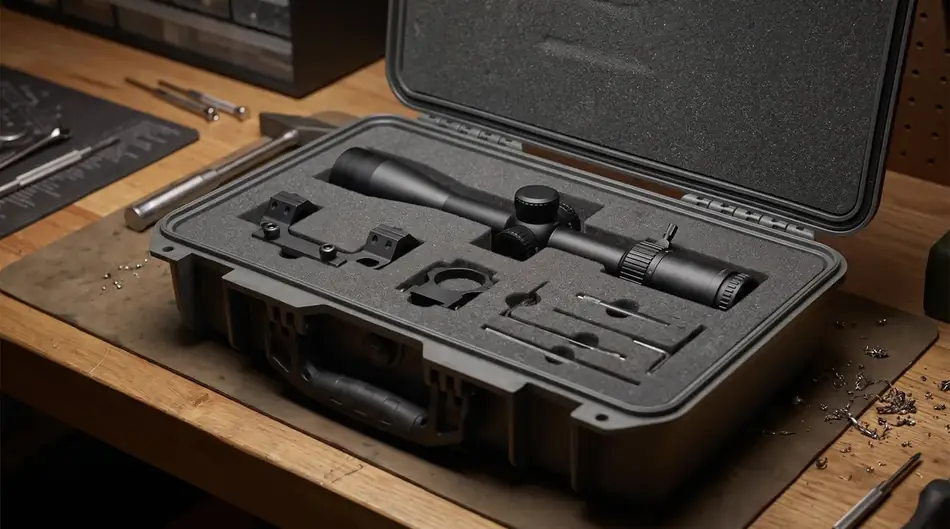
Protective Cases for Battery Packs, Power Supplies & Energy Equipment
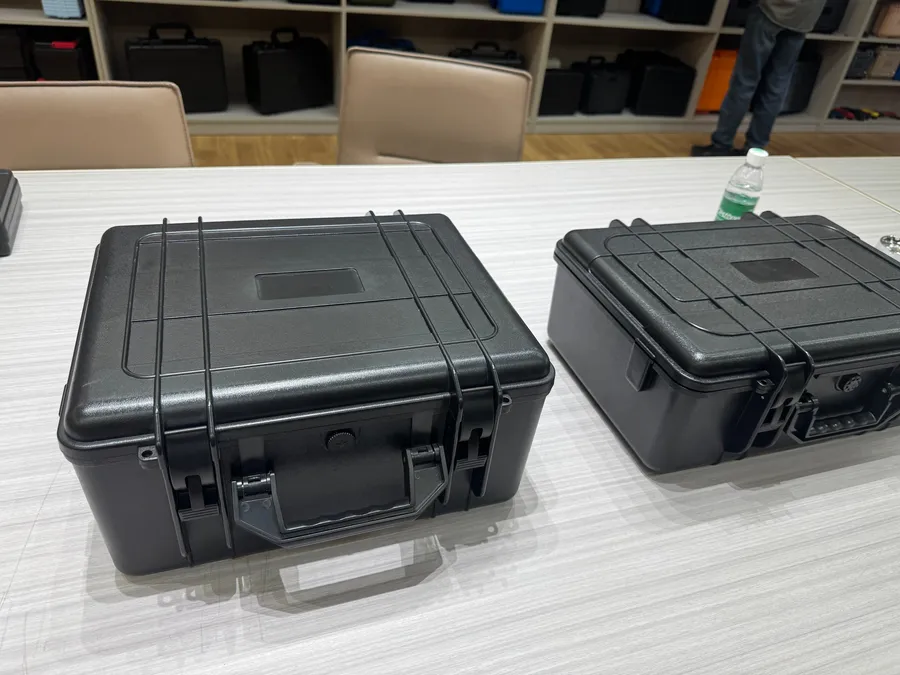
Short answer: energy-sector kit is specified as mass, length and closure line rather than as a rating. KeXin New Materials (Guangdong) Co., Ltd. moulds 155 thermoplastic shells and publishes internal and external dimensions and usable interior volume for every one, wall thickness for 148 from 2.0 mm to 6.0 mm, the lid-over-base depth split for 100, empty mass for 93, and a compressible gasket in a moulded channel on 124. Battery packs, bench and field power supplies, EV charging hardware, inverters, generators and wind-turbine tooling all reduce to the same four published questions: does the cavity take the packed footprint, does the base depth carry the mass below the closure line, does the wall stiffen the box for how it is handled, and can one person move it - because 136 of the 155 shells are carried and only 19 are published with wheels. Two things we do not claim, stated plainly: no dielectric or voltage-withstand figure is published for any shell, so an insulated-tool box is a carrier and not a protective barrier, and no model is offered as regulated lithium battery transport packaging, since packing, marking and documentation follow the applicable dangerous-goods rules for the pack and the carrier.
Key points
- Put mass below the closure line: a 38/140 mm or 43/149 mm lid-over-base split behaves very differently from 140/25 mm at a similar total depth.
- Wall thickness is published per model from 2.0 mm to 6.0 mm on 148 shells, and only three reach 5.5 mm or more - KX-5321, KX-6621 and KX-97227.
- 19 of the 155 shells publish wheels and all 19 publish as non-stackable, with empty mass from about 4,912 g to about 15,320 g.
- No dielectric strength, voltage-withstand or arc-flash figure is published for any shell; an insulated-tool case is a carrier, never a protective barrier.
- Lithium pack transport is governed by the applicable dangerous-goods rules for the pack and carrier, not by the box, and no model is offered as regulated packaging.
- Load capacity and stack load are recorded as not measured for all 155 models, so pallet columns are built from carton size on 64 models and pieces per carton on 58.
EV Charger Maintenance Tool Case: Charge Cable, Connector And Torque Kit Are Three Loads
A wall-box or charging-post service kit is heavier and stiffer than it looks, because three of its parts refuse to bend: the type 2 or CCS connector with its latch, the coiled cable at its minimum radius, and the torque wrench that has to lie straight. Build the case as one main pocket for the instrument or controller, a routed channel that takes the connector without the lid pressing on its latch, a standing groove for the coiled cable, and a shallow accessory layer for crimpers, terminals, seals and the torque set. For a single-technician kit, KX-84113 publishes 380 x 267 x 115 mm internal on a 3.4 mm polypropylene wall with 10.1 litres usable and a gasket in a moulded channel; KX-84116 is 385 x 313 x 145 mm on 3.7 mm with 15.0 litres; KX-84416 is 395 x 295 x 135 mm on a 4.2 mm wall with a published 90 mm lid over a 45 mm base and 12.6 litres. Where the technician also carries a small analyzer or insulation tester, KX-84818 at 437 x 308 x 164 mm on a 4.5 mm engineering-polypropylene wall with 17.7 litres, or KX-85017 at 463 x 338 x 156 mm with 19.5 litres, keeps everything in one box without burying the display under a deep lid. If the kit is rolled across a car park rather than carried, KX-85021 publishes the same 437 x 308 x 164 mm cavity with wheels and a fixed handle at about 4,912 g empty, and KX-85022 is 437 x 308 x 180 mm at about 5,012 g.
Electric Vehicle Repair Tool Case: Specify The Lift Before The Layout
EV workshop tooling is the load that ends arguments, because a full battery-service set - torque, insulated spanners, lifting straps, module extraction tools, insulation gloves, a low-voltage work light and the service manuals - weighs more than a technician is willing to carry twice a day. Two published numbers decide it. Empty mass: the heaviest non-wheeled shell in the library is KX-6621 at about 6,420 g, and the 19 wheeled models run from about 4,912 g on KX-85021 to about 15,320 g on KX-88442, so a loaded case in this class is a wheel-or-two-people decision. Cavity: KX-86220 publishes 538 x 408 x 180 mm internal on a 5.0 mm wall with a 135 mm lid over a 45 mm base and 31.6 litres; KX-86224 is the same footprint at 538 x 408 x 220 mm with a 175/45 mm split and 38.6 litres; KX-85827 gives 500 x 400 x 220 mm with wheels, a published 295 mm telescopic height and about 7,800 g empty; KX-86136 gives 530 x 360 x 304 mm with a 260/44 mm split, about 8,500 g and 46.4 litres. For the largest sets KX-88434 publishes 740 x 518 x 284 mm with 87.1 litres usable and KX-88442 publishes 740 x 518 x 364 mm with 111.6 litres, both on 5.0 mm walls with wheels. Note that every one of those 19 rolling shells is published as non-stackable, which is the fleet-storage trade-off buyers most often discover after delivery.
Electrical Maintenance Tool Case: A Repeatable Outline Beats A Deep Hole
Routine plant electrical work runs on a fixed set - screwdrivers, strippers, crimpers, a multimeter, an insulation tester, terminal blocks, heat-shrink, a torque driver and a lockout set - and the failure mode is not damage, it is time lost searching and equipment left inside a previous panel. The answer is a routed outline per item so a missing tool shows as an empty shape at issue and at recovery, with the meter and insulation tester potted separately from the hand tools so their probes and test leads get their own channel. KX-83715 publishes 340 x 220 x 135 mm internal with a 100 mm lid over a 35 mm base on a 3.3 mm wall and 8.7 litres usable, which suits a one-person daily set; KX-83719 is the same footprint at 340 x 220 x 175 mm with a 140/35 mm split and 11.3 litres when a portable meter and printer travel together. Two-item kits go to KX-84114 at 385 x 313 x 120 mm on a 3.7 mm wall with 12.5 litres, or KX-84120 at 385 x 313 x 180 mm with 18.7 litres. Where the case lives on a service van shelf, use the published footprint rather than the volume: KX-4012 gives 380 x 305 x 110 mm with a 85/25 mm split on a 3.5 mm wall at about 1,480 g, with carton figures of 725 x 420 x 580 mm for 10 pieces, and KX-3315 gives 303 x 224 x 135 mm on a 4.1 mm wall at about 1,670 g.
Electrician And Plumber Portable Plastic Tool Box: Depth Is The Trade Argument
The combined electrician-and-plumber box is the most over-filled case in this category, because press tools, bending springs, pipe cutters, drain-test equipment and a heavy hammer all want to be in the same box as the electrical set. Read internal height and the lid split before anything else. The flat-lid formats KX-64114 (378 x 307 x 120 mm internal, ABS on a 4.0 mm wall, about 2,100 g empty, 11.1 litres) and KX-64117 (393 x 280 x 156 mm ABS, about 2,100 g, 14.8 litres) suit a tray-and-tool layout; KX-64120 is the same ABS footprint at 378 x 307 x 187 mm with 17.4 litres; KX-64618 publishes a deliberately thin 140 mm lid over a 25 mm base at 430 x 290 x 165 mm on a 4.7 mm wall for tools that stand in a rack; and KX-64819 gives 454 x 325 x 173 mm on a 3.5 mm ABS wall at about 2,800 g with 21.9 litres. The polypropylene equivalents come from the 8-series, where 58 of 62 shells record a gasket in a moulded channel: KX-84816 at 410 x 360 x 140 mm with a 100/40 mm split and 16.6 litres, KX-84821 at 410 x 360 x 190 mm with a 150/40 mm split and 22.4 litres, and KX-84825 at 410 x 360 x 240 mm with a 200/40 mm split and 28.3 litres - usually the last size one person is willing to lift from a van floor. Where the box is carried rather than rolled, all of these are published with a fixed folding handle and as stackable.
Heavy Generator Maintenance Tool Hard Box: Thick Wall And A Deep Base
Standby-generator and genset service work is a torque-tool and consumable problem: long barrows, a filter wrench set, oil and coolant sample bottles, insulation test gear, hand tools and the small spare parts that get bought at the site. It is also the roughest handling in the sector - a box dropped on a plant yard, driven over, or loaded into a rack at height. Buy stiffness and a low centre of mass. Only three shells in the library publish a wall of 5.5 mm or more: KX-5321 at 481 x 373 x 192 mm internal on a 5.8 mm wall, with a 43 mm lid over a 149 mm base, about 4,810 g empty and 27.5 litres usable; KX-6621 at 587 x 434 x 192 mm on the catalogue-thickest 6.0 mm wall with the same 43/149 mm split, about 6,420 g and 39.1 litres, carton 665 x 500 x 650 mm for 3 pieces; and KX-97227 at 590 x 435 x 210 mm on 6.0 mm, 42/168 mm lid-and-base, about 10,000 g, wheels and a published 485 mm telescopic height. Wider sets go to KX-87319 (650 x 430 x 170 mm, 5.0 mm, 120/50 mm split, 38.0 litres) or KX-87323 (650 x 430 x 210 mm, 160/50 mm split, 47.0 litres), and the flat ABS trolley KX-66232 publishes 507 x 385 x 290 mm on a 5.3 mm wall at about 7,940 g with 45.3 litres. Note the pattern: mass in the deep base, thin lid on top, so the box cannot tip when stood open on a gradient.
Industrial Inverter Commissioning Tool Box: Laptop, Analyzer And Leads In Layers
A variable-frequency-drive or inverter commissioning kit is the most fragile load in this category, because it mixes a notebook, a three-phase analyzer, high-impedance test leads, current clamps, a burden box and a bag of adapters - all of which are ruined by pressure rather than by impact. The layout is layered by stiffness, not by size: notebook in its own relieved pocket under the lid so nothing bears on the screen; analyzer potted in a firm carrier in the base; leads and clamps in routed channels that prevent a plug from being pushed into a socket; adapters in standing pockets. KX-85023 publishes 463 x 338 x 211 mm internal on a 4.5 mm engineering-polypropylene wall with 26.4 litres; KX-85025 is the same footprint at 463 x 338 x 231 mm with 29.0 litres; KX-85221 gives 483 x 363 x 195 mm with a published 150 mm lid over a 45 mm base and 27.4 litres; and KX-85224 reaches 483 x 363 x 220 mm with 30.9 litres. Where a stiffer shell is wanted around glass and connector panels, the ABS KX-65522 publishes 507 x 385 x 190 mm on a 5.3 mm wall at about 4,860 g with 29.7 litres usable. For a kit that is walked across a substation yard, KX-96027 publishes 502 x 337 x 214 mm with a 170/44 mm split, wheels, about 6,110 g empty and 29.0 litres, with a 580 x 250 x 415 mm carton for one piece; KX-96127 gives a squarer 545 x 545 x 210 mm rolling cavity with 49.9 litres. Commissioning software keys, dongles and the arc-flash labelling of the site belong in a document holder, which is quoted as a per-configuration option rather than a fixed feature.
Portable Power Tool Plastic Latch Case: Batteries And Charger Want A Deep Base
Cordless tool sets - drill, impact driver, reciprocating saw, work light, two or four battery bricks and a charger - are the highest-volume case type we make, and they fail in a specific way: the bricks are the heaviest items and buyers put them in the lid. Specify a deep base with a thin lid and standing pockets, so the mass sits low and the bricks cannot roll into the closure line. Two published splits do exactly that: KX-4318 at 407 x 187 x 178 mm internal with a 38 mm lid over a 140 mm base on a 3.0 mm engineering-polypropylene wall, about 1,970 g empty and 11.6 litres, and KX-4321 at 411 x 208 x 202 mm with a 164 mm lid over a 38 mm base, about 2,330 g and 14.9 litres, with a 885 x 515 x 650 mm carton for 12 pieces. A compact single-tool set suits KX-93221 at 300 x 200 x 200 mm internal on a 5.0 mm wall with a 165/35 mm split, about 1,230 g and 9.6 litres, or the smaller KX-2811 at 253 x 180 x 98 mm with a 71/27 mm split on a 5.0 mm wall at about 890 g. Multi-tool fleets go to KX-83612 (330 x 260 x 103 mm, 75/28 mm split, 7.6 litres), KX-83620 (290 x 220 x 185 mm, 135/50 mm split, 10.1 litres) or KX-84430 (395 x 295 x 275 mm, a 230 mm lid over a 45 mm base, 25.6 litres). On the closure itself: every one of the 155 models publishes a latch body that accepts a standard padlock, and latch count is set per configuration - a two-latch shell on a long body flexes at the middle, so latch number is a stiffness decision as well as a security one.
Power Construction High-Voltage Insulated Tool Box: A Carrier, Not A Barrier
This is the page where we have to be bluntest, because a wrong assumption here is a personal-injury risk rather than a broken tool. Live-working and near-live work is controlled by the permit-to-work system, the approach distances, the tool maker's own insulation rating and the site's personal protective equipment. Our shells contribute none of that. No dielectric strength, voltage-withstand, arc-flash or insulation-resistance figure is published for any of the 155 models; waterproof and dust resistance are recorded as not measured across the whole library; and thermoplastic construction is not offered as an electrical protective barrier for any configuration. What we can specify is how insulated tools are physically protected, because a cracked or abraded sleeve on a 1,000 V tool destroys the tool's own rating: individual pockets so no two tools rub, end relief so the handle is never point-loaded, a lid layer that touches but does not press, and long straight pockets for hot sticks and barrow-length tools. On internal length that means KX-86216 at 582 x 300 x 130 mm with a 100/30 mm split on a 3.3 mm wall and 19.5 litres, KX-88015 at 725 x 350 x 140 mm on a 5.0 mm wall with 28.4 litres, KX-87926 at 737 x 257 x 240 mm with a 175/65 mm split and 36.4 litres, KX-89616 at 880 x 350 x 140 mm with 34.5 litres, and KX-814641 at the catalogue-longest 1,280 x 350 x 140 mm with 50.2 litres. None of those long shells is one of the 19 wheeled models, so plan them as hand-carry items and check the wall against a tool load that is genuinely heavy.
Wind Power Maintenance Engineer Tool Box: The Climb Decides The Carry Format
A turbine service kit is the hardest specification in energy work, because it has to be carried up a tower ladder or hoisted through a hatch, and every gram is paid for twice. Two published figures dominate. First empty mass and the carry: 11 shells publish a telescopic height, from 240 mm on KX-87336 and KX-88337 to 485 mm on KX-97227, and rolling models run from about 4,912 g to about 15,320 g empty, so the wheel option is bought on a documented mass rather than on a word. Second is the cavity depth against the blade-repair kit, hydraulic torque tools, pitch-bearing grease, a borescope, spare bolts and PPE. A per-engineer set usually lands on KX-85835 at 500 x 400 x 305 mm internal with a 260 mm lid over a 45 mm base on a 5.0 mm wall, wheels, a published 295 mm telescopic height, about 8,520 g empty and 48.8 litres. Two-person or blade-repair loads go to KX-86830 (595 x 460 x 255 mm, 210/45 mm split, about 10,160 g, 55.8 litres), KX-86836 (595 x 460 x 315 mm, 270/45 mm split, about 10,600 g, 69.0 litres), KX-87336 (650 x 430 x 310 mm, 260/50 mm split, about 10,660 g, 69.3 litres) or KX-88337 (723 x 368 x 329 mm, 280/49 mm split, about 10,866 g, 70.0 litres). For tower work, weight also decides the cut: use a firm carrier with printed outlines rather than a block of soft pluck, since foam adds mass that has to be climbed with, and ask for a lift-out tray so the light half of the kit can go up while the heavy half stays at the base.
Buyer Search Phrase Mapped To The Published Figure That Decides It
Each entry above names a published specification for one model, not a performance rating, and it is only useful against your own measured packed weight and the person who has to move it. Where a purchasing document asks for a dielectric figure, a load rating, a stack load or an ingress code, our datasheet records those fields as not measured for all 155 shells and we will say so in the quotation.
| Buyer Search | Deciding Published Figure | Published Example |
|---|---|---|
| EV charger maintenance tool case | Connector-channel relief and a mid cavity with gasket recorded; rolling variant if it is wheeled across a car park | KX-84116: 385 x 313 x 145 mm PP, 3.7 mm, 15.0 L; KX-85021: 437 x 308 x 164 mm, wheels, about 4,912 g |
| electric vehicle repair tool case | Loaded mass against the carry, then the lid-over-base split for tool height | KX-86224: 538 x 408 x 220 mm, 5.0 mm, 175/45 mm, 38.6 L; KX-88442: 740 x 518 x 364 mm, wheels, about 15,320 g, 111.6 L |
| electrical maintenance tool case | Routed outline per tool and a cavity that fits a van shelf footprint | KX-83719: 340 x 220 x 175 mm, 140/35 mm, 11.3 L; KX-4012: 380 x 305 x 110 mm, about 1,480 g, carton 725 x 420 x 580 mm for 10 |
| electrician/plumber portable plastic tool box | Internal height plus published lid depth, and lift limit for one person | KX-84821: 410 x 360 x 190 mm, 150/40 mm, 22.4 L; KX-64819: 454 x 325 x 173 mm ABS, 3.5 mm, about 2,800 g |
| heavy generator maintenance tool hard box | Thickest published wall and a deep base, so mass sits below the closure line | KX-6621: 587 x 434 x 192 mm, 6.0 mm wall, 43/149 mm, about 6,420 g, 39.1 L; KX-87323: 650 x 430 x 210 mm, 47.0 L |
| industrial inverter commissioning tool box | Layered stiffness for notebook and analyzer, and relief so no lid loads a screen | KX-85221: 483 x 363 x 195 mm, 150/45 mm, 27.4 L; KX-65522: 507 x 385 x 190 mm ABS, 5.3 mm, about 4,860 g |
| portable power tool plastic latch case | Deep base with thin lid for battery bricks; padlockable latch body on all 155, latch count per configuration | KX-4318: 407 x 187 x 178 mm, 38/140 mm, about 1,970 g, 11.6 L; KX-93221: 300 x 200 x 200 mm, 165/35 mm, about 1,230 g |
| power construction high voltage insulated tool box | Individual pockets and end relief to protect the tool's own insulation; no dielectric figure is published for any shell | KX-87926: 737 x 257 x 240 mm, 175/65 mm, 36.4 L; KX-814641: 1,280 x 350 x 140 mm, 5.0 mm, 50.2 L |
| wind power maintenance engineer tool box | Published empty mass and telescopic height, then cavity depth for torque tooling and PPE | KX-85835: 500 x 400 x 305 mm, 260/45 mm, 295 mm handle, about 8,520 g; KX-97227: 590 x 435 x 210 mm, 6.0 mm, 485 mm handle |
| battery pack and power supply transit case | Standing pockets below the closure line, plus the dangerous-goods caveat on the consignment rather than the box | KX-4321: 411 x 208 x 202 mm, 164/38 mm, about 2,330 g; KX-4821: 447 x 312 x 194 mm, 144/50 mm, about 3,670 g, 21.7 L |
Selection Guidance: Four Checks That Reach A Model Number
First, weigh the kit before you size it. Add the tools, the cells, the charger and the case itself: published empty mass in this library runs from about 100 g on KX-1204 to about 6,420 g on the non-wheeled KX-6621, and the 19 rolling shells publish empty mass from about 4,912 g on KX-85021 to about 15,320 g on KX-88442, so the wheel decision is arithmetic rather than preference. Second, read the lid-over-base split as a design instruction. A deep base with a thin lid - 38/140 mm on KX-4318, 43/149 mm on KX-5321 and KX-6621, 42/168 mm on KX-97227 - is what keeps battery bricks, hydraulic tools and barrow-length steel below the closure line; a deep lid suits layered accessory work but raises the centre of mass. Third, decide the wall on handling rather than on prestige: 148 of the 155 models publish a wall from 2.0 mm to 6.0 mm, and only three reach 5.5 mm and above, so a plant-floor box and a shelf box are legitimately different shells. Fourth, fix the interior and the closure on the nominated datasheet - carrier density, pocket outlines, relief under connectors, standing battery grooves, gasket presence (recorded on 124 shells and absent on 31, including several of the lightest shallow formats), latch count and padlock provision. If your document names a dimension, a wall, a mass or a volume, we answer it today. If it names a rating - dielectric, ingress, load or free-fall - budget accredited testing as a separate line item on the exact build.
Where These Cases Are Used
Charging-network operators and their subcontractors issue a per-vehicle kit for wall-box installation and fault work, and need the interior drawing to become the reorder standard so a crew in a second region gets the same layout. EV dealers and fleet workshops build battery-service and drive-train sets that stay in a bay between jobs, where outline marking matters more than lightness. Electrical contractors and facilities-maintenance teams run a rolling library of trade sets, each issued and recovered weekly. Plant and data-centre engineers carry generator, UPS and switchgear service sets into noisy, oily environments where the box is put down on concrete. Inverter, drive and power-quality manufacturers ship a commissioning kit as one issuable package with a notebook inside it, which makes the cut a packaging-engineering deliverable rather than an accessory. Utility and power-construction crews carry insulated hand tools as a protected set whose condition has to be provable. Wind-service companies specify per-engineer kits that are climbed with or hoisted, then palletised at the base. Battery pack assemblers and energy-storage integrators use our shells as in-plant handling and transit containers between stations. All of these draw on the same 155 shells and differ mainly in cavity depth, carrier density, carry format, gasket and marking.
Customisation: Interior, Hardware, Marking And Tooling
Interior work is the fast path and it starts at one unit. We cut cross-linked PE, EVA or EPE die-cut or CNC-cut, in layered builds with a firm carrier under tool and cell mass, a softer face against a display or connector panel, lift-out trays, standing grooves for battery bricks, routed channels so a test lead cannot push its plug into a socket, and printed or routed outlines so a missing tool shows as an empty shape at issue. A drawing, a photograph of the packed kit or a physical sample is enough to start, and none of this needs new tooling on an existing shell. Hardware is specified the same way: latch count, hinge and stay arrangement, handle, document holder, shoulder strap and a pressure-equalisation option are manufacturer options quoted per configuration, and all 155 models publish a latch body that accepts a standard padlock. Wheels and a telescopic handle exist on 19 shells, and 11 of those publish a telescopic height figure. Colour, logo, identification markings and buyer-branded packaging begin at about 300 units - which is how a fleet distinguishes its insulated-tool box from its general service box without a sticker. Only a change to the shell itself needs a mould, at roughly 3,000 units per component and about 125 days from approved drawings, while an OEM first sample on an approved existing shell takes about 45 days. In this category most programmes stop at the cavity and the cut, because the published range already brackets the tool set.
Procurement Notes: Wholesale Terms, Battery Rules And What We Will Not Claim
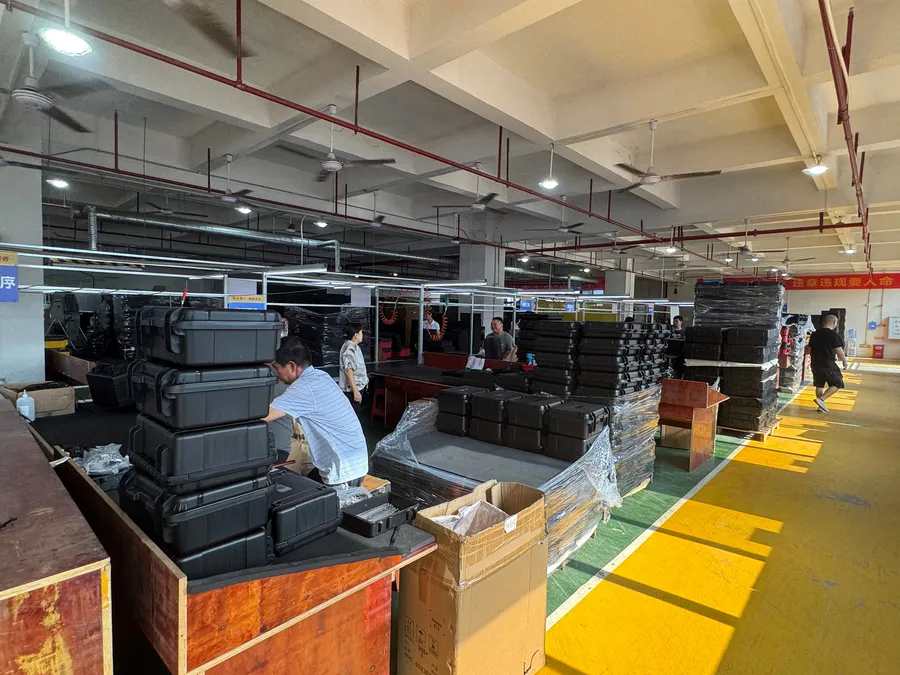
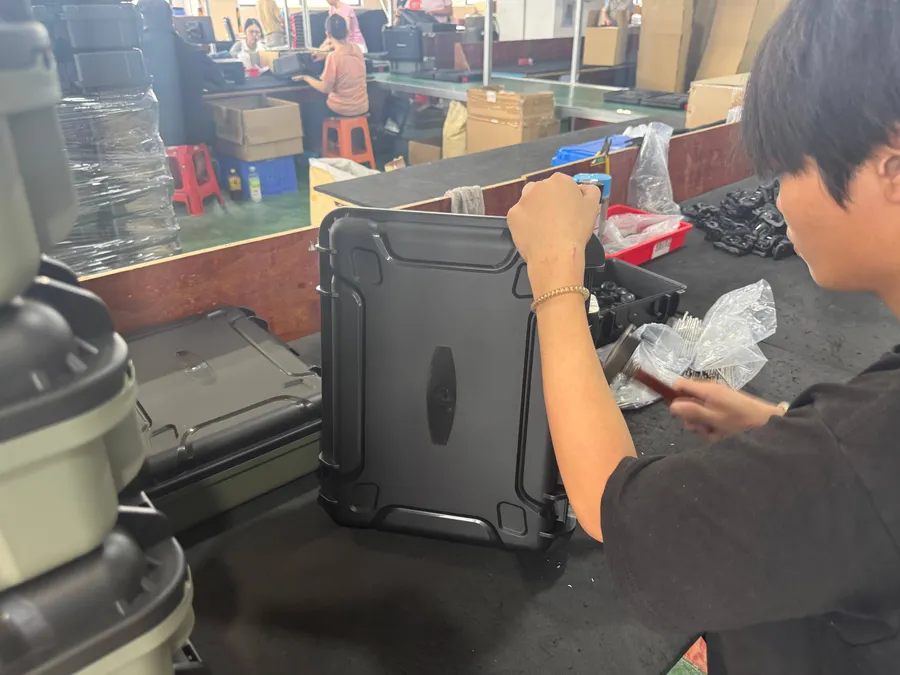
KeXin New Materials (Guangdong) Co., Ltd. is the manufacturer of these shells and works wholesale, OEM and ODM only, on EXW or FOB terms. There is no retail channel, no delivered-duty-paid quotation and no overseas warehouse stock, so build landed cost from an FOB figure plus your own freight and clearance. We publish no pallet loading or container figure for any model - those come with the quotation - but carton size is published on 64 models and pieces per carton on 58, so pallet columns can be worked from the datasheet. Payment is a 30 per cent deposit with the balance after inspection, and third-party factory inspection before goods leave is welcome. Now the two limits, repeated deliberately. Battery movement: packing, marking, state-of-charge limits and documentation for lithium cells and packs are governed by the applicable dangerous-goods rules for that pack and that carrier, and no shell or foam in this catalogue is offered as regulated battery transport packaging; raise your cell configuration at quotation so the interior is cut correctly and so you are not left assuming the box does something it cannot do. Electrical work: no dielectric, voltage-withstand or arc-flash figure is published for any shell, and a case never substitutes for the tool's own insulation rating or the site's permit-to-work controls. Corrosion resistance is the one protection field recorded as measured across all 155 shells, on the plain grounds that a thermoplastic shell has no ferrous corrosion path; waterproof, dust, protection rating, UV, temperature range, stack load and load capacity are recorded as not measured, and we will not borrow a label to fill that gap. Send your packed dimensions and weight through the RFQ page and we will propose shells rather than promise ratings.
Two more buyer search phrases, answered from the figures we publish per model
These two phrases describe opposite load shapes, so they are answered on opposite rows rather than in one paragraph about power kit in general. An accessory assortment for distribution work is many small hard parts plus one or two tall items, and it is limited by what will fit under a closed lid. A battery set is the reverse: few items, badly concentrated mass, and a layout that fails when that mass is put in the lid where the closure line is.
Both rows are answered from the same library used everywhere on this page: 155 active thermoplastic shells with internal and external dimensions and usable interior volume published on every model, lid-over-base depth published on 100, wall thickness on 148, empty mass on 93, carton data on 64, and the foam cut options we quote against a drawing. Properties that have never been measured on these shells are written as not measured instead of being inferred from a resin name.
| Search | What We Publish |
|---|---|
| power distribution equipment accessories case | Distribution accessory kits are lugs, glands, terminal blocks, heat-shrink, a torque driver, a lockout set and a meter, so the lid is usually the working volume. Lid depth is published on 100 of the 155 models and runs from 16 to 320 mm, and 50 of those models publish a lid of 100 mm or more, which is the range where a small-parts assortment sits below the closure line; only 5 publish a base of 100 mm or more. The published extreme is KX-8-6136 at 530 by 360 by 304 mm internal with a 260 mm lid over a 44 mm base, a 5.0 mm wall, 8,500 g empty and 46.4 litres usable, on wheels; the page's own mid-size example KX-83719 gives 340 by 220 by 175 mm internal with a 140 mm lid over a 35 mm base and 11.3 litres. Divider cells are cut foam quoted from 1 unit on a stock shell. No dielectric strength or voltage-withstand figure is published for any of the 155 shells, so insulated hand tools travel in this case as a carried load and the tool maker's own insulation specification remains the protective element, not the box. |
| battery pack equipment transport case | Cells, bricks and chargers are the heaviest items in the kit and belong below the closure line, which is a base-depth decision. Base depth is published on the same 100 models from 15 to 168 mm, and the deepest published bases are KX-4318 and KX-4319 at 140 mm over a 38 mm lid in a 407 by 187 by 178 mm cavity with a 3.0 mm wall, 11.6 litres usable and 1,970 g or 1,587 g empty; KX-5321 reaches 149 mm over 43 mm at 481 by 373 by 192 mm with a 5.8 mm wall and 4,810 g, and KX-9-7227 reaches 168 mm over 42 mm at 590 by 435 by 210 mm with a 6.0 mm wall, 10,000 g empty and 43.1 litres usable. Standing grooves and a firm carrier under the mass are cut from your drawing, packed-kit photograph or a sample, from 1 unit. On cells we state three limits plainly: no model here is offered as regulated dangerous-goods transport packaging, water and dust performance is recorded as not measured on all 155 shells, and a pressure relief valve is listed as a configuration option rather than a fitted feature, while 24 models publish an empty mass of 4,000 g or more. |
The published figures that decide either layout
What we leave unclaimed on this page
Neither row carries an electrical or mechanical performance number, because we do not have one to publish. Load capacity and stack load are recorded as not measured on all 155 models, so no figure in this article should be read as how much a shelf or a vehicle rack will take. We publish no fall height, no ingress code, no dielectric strength and no arc-related value for any shell, and we do not generalise one model's cavity across the range. Where a purchasing document asks for one of those values, the honest route is a measured datasheet for the exact SKU plus accredited third-party testing against the standard your project names, quoted and scheduled separately.
Terms behind both answers
KeXin New Materials (Guangdong) Co., Ltd. moulds and supplies these shells on wholesale and OEM or ODM terms only, quoted EXW or FOB, with no retail sales, no delivered-duty-paid quotation and no overseas warehouse stock, so landed cost is built from the FOB figure plus your own freight and clearance. Minimum order follows what you change: standard shells from 1 unit and a custom foam or divider layout from 1 unit, colour, logo, identification marking and OEM hardware from 300 units per SKU, and a bespoke shell geometry from a new mould at 3,000 units per component. An OEM first sample on an approved existing mould is quoted at 45 days and a new mould at 125 days, on a 30 percent deposit with the balance after inspection before container loading. Send the cell and charger list with packed weights, or the accessory bill for the distribution kit, and the shortlist comes back with the published lid and base depths, internal cavity, wall thickness and empty mass against each candidate model.
Customisation
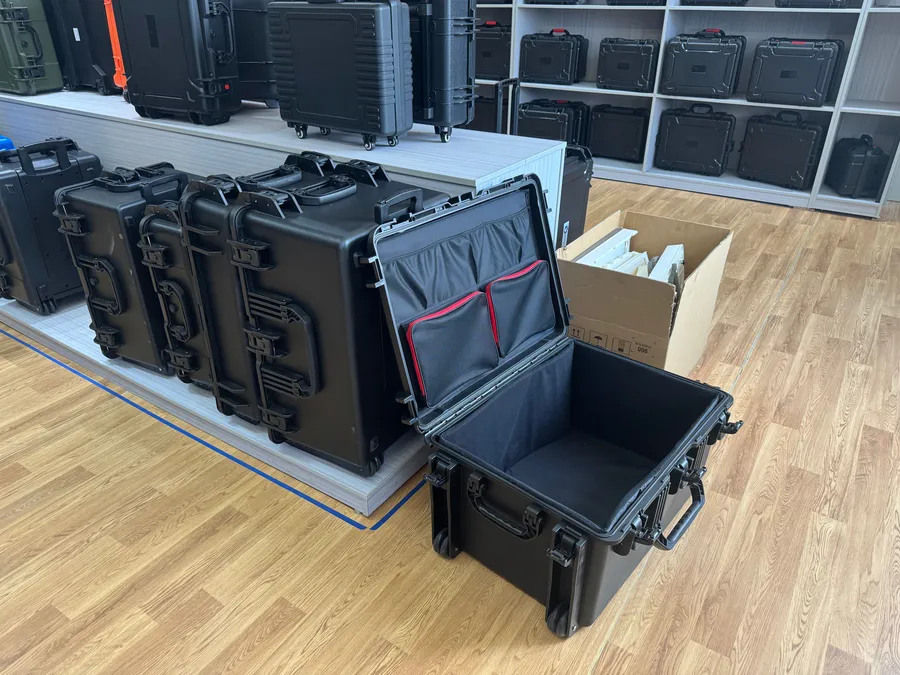
Everything described above is configurable on a standard shell: interior layout (pick-and-pluck, die-cut or CNC-cut), foam grade and thickness, colour, logo method, latch and lock count, pressure-equalisation valve, cable ports, document holder and identification plate. A bespoke exterior geometry requires a new mould — 125 days, from 3,000 units per moulded component.
Procurement considerations
| Question | What to send us |
|---|---|
| Which shell fits? | Equipment L × W × H as packed, plus required clearance per axis |
| What does it cost? | Order quantity and estimated annual quantity — the two drive different answers |
| Is tooling needed? | Whether an existing shell clears the envelope with usable foam depth |
| Lead time? | Your required delivery date, not just the order date |
| Certification? | The exact standard your tender names — we will say whether we can test to it |
| Freight? | Destination and preferred terms; carton and pallet data supplied with the quotation |
Comparison and selection guide
The tables on this page exist because a protective case is chosen by comparing three things: the envelope, the environment and the handling chain. Where no table applies, the rule below is.
| Situation | What To Do |
|---|---|
| Fixed inventory | CNC or die-cut silhouette with part numbers printed on the foam. |
| Variable kit | Pluck foam plus a loose tray. |
| Bench work | Removable trays that lift out square so the case doubles as a stand. |
- Size on internal dimensions plus clearance, never on a product name.
- Choose the carrying method before the shell: it changes the series, not just the price.
- Specify the interior last, and decide up front whether the end user will reconfigure it.
Protective Cases for Battery Packs, Power Supplies & Energy Equipment relates to Protective Case Basics. Related families: Tool Cases / Equipment Transport Cases / Field Equipment Cases / Electronics Cases / Rolling Cases / Long Equipment Cases / Custom Protective Cases / Outdoor Protective Cases / Military Protective Cases / Waterproof Cases. Related sectors: field and industrial equipment. Continue in the Protective Case Basics cluster.
This page is written from our own production data. If your requirement differs, send the dimensions and we will tell you which of the 155 models fits, or whether a custom route is needed.