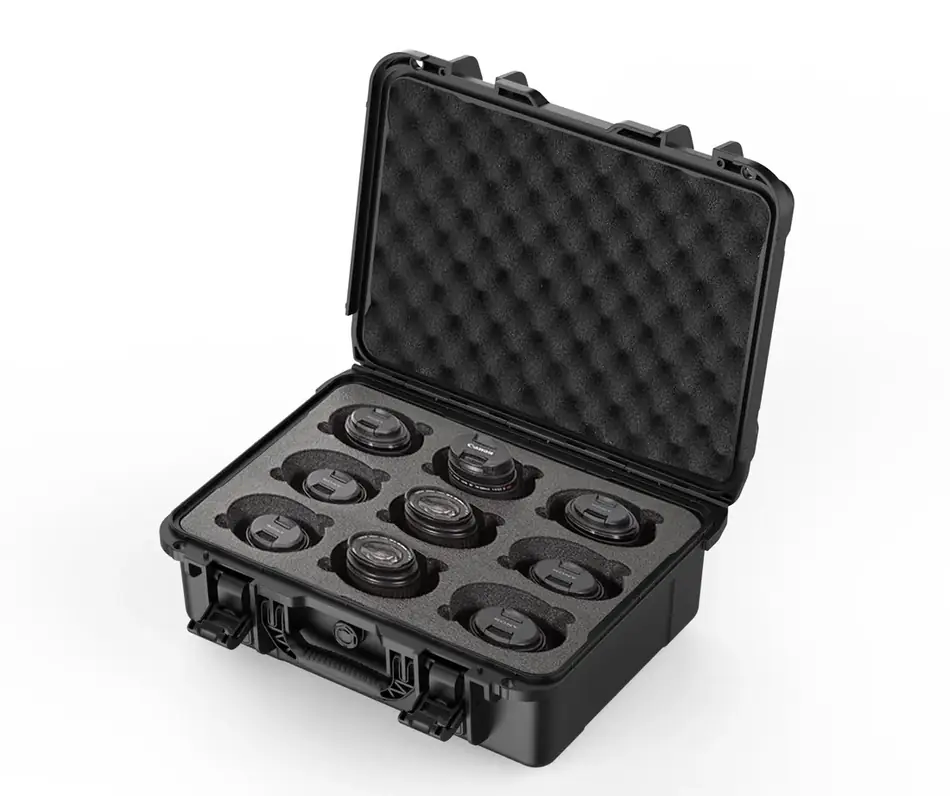
What is an outdoor protective case?
An outdoor protective case is a reusable hard shell - normally injection-moulded polypropylene - specified for duty away from buildings: rain and spray, dust and grit, sunlight and temperature swings, wet hands, and the rough handling of a vehicle bed, a boat deck or a pack. It is defined by four published numbers - the internal envelope your kit must fit, the wall thickness that carries stacking and point loads, the closure, meaning whether the shell offers a gasket seal, and the empty mass that decides whether it is carried or wheeled. On our sheet, 145 of the 155 published models carry the outdoor tag, with internal volumes from 0.3 to 58.7 litres, published wall thickness from 2.0 to 6.0 mm, and 114 of the 145 offering a compressible gasket while 31 are plain unsealed shells. What the sheet does not state is a weather rating: water and dust are recorded as not measured on every model, so an outdoor case is chosen on construction and closure, not on a code.
Key points
- An outdoor case is a construction claim, not a weather rating: our sheets record water and dust as not measured on every model.
- 145 of our 155 published models carry the outdoor tag, with internal volumes from 0.3 to 58.7 litres.
- 114 of the 145 outdoor-tagged shells publish a compressible gasket; 31 publish no seal option, so read the closure column per model.
- All ten shells in our dedicated outdoor series are plain unsealed utility cases - sealed duty needs the wider outdoor-tagged range.
- Published wall thickness across the outdoor-tagged range runs from 2.0 to 6.0 mm, and 134 of the 145 are listed stackable.
- Wheels are published on only 11 of the 145, so most outdoor cases are a hand-carry decision made on empty mass.
- Size it on the packed kit, add clearance, then match the closure to the exposure - not the other way round.
The definition in practice
The phrase covers a family, not a single product. At one end it is a shallow moulded box that rides in a rucksack lid and holds a GPS, a headtorch and a power bank; at the other it is a deep shell that lives in the back of a vehicle and carries a survey kit, a drone, or two weeks of expedition electronics. What unites them is that the case, not a soft bag, is the load path: a rigid shell in compression, an interior that holds the contents in defined positions, and a closure chosen for the exposure the case will actually meet.
Outdoor duty also changes the failure list. Indoors, the enemy is a knock against a bench; outside, it is rain finding a seam during a night of shower, grit worn into a latch by wind, a shell left in the sun while the crew works, and items migrating inside a case that is opened with cold hands. An outdoor case is specified against that list: resin and wall for the knocks and the sun, interior for the migration, closure for the weather.
What outdoor duty loads onto a case
Four exposures dominate. Water, arriving as rain, spray or a dropped landing in a wet field. Dust and grit, which work into hinges and latches long before they reach the contents. Sunlight and heat, which age a plastic shell and pressure-cycle the air inside it. And handling, which for an outdoor case includes being loaded by someone standing in mud at the end of a long day. Each maps to a part of the construction: the shell answers the knocks and the sun, the foam interior answers the migration and the vibration, and the lid rim, gasket and latches answer the water and the dust.
We publish what we can measure and mark the rest honestly. On every one of the 155 models on our sheet, waterproof, dust, ultraviolet, temperature range, stack load and load capacity are recorded as not measured, and shock and impact are recorded as a manufacturer option rather than a figure; there is no ingress code stated on any model. Corrosion resistance is the exception, recorded as measured on all 155 on the simple basis that a thermoplastic shell has no ferrous corrosion path. If your programme needs a weather qualification, accredited testing can be commissioned as a separate work package on the exact configuration you order.
Sealed shells and plain shells
Among the 145 outdoor-tagged models, 114 publish a sealing option, described on the sheet as a compressible gasket in a continuous moulded channel, with the seal material listed as EPDM or an equivalent compressible gasket. The remaining 31 publish no seal offered on the shell. Both are legitimate outdoor cases; they answer different duties. The sealed group is the shortlist for rain, spray, boat decks, desert dust and air-hold luggage. The plain group is for kit that gets opened constantly in weather that is merely inconvenient - a dry-climate site, a vehicle-based day, a case that lives in a tent porch rather than on a deck.
Sealing also brings a maintenance item that outdoor use makes unavoidable: a gasket that is dried, nicked or left resting on grit stops sealing, so it should be wiped and checked at every kit-out. A pressure-equalisation valve is published as a manufacturer option across the range and is not fitted as standard on any model, so if the case will fly or see altitude changes, ask for it at quotation stage. One nuance worth stating plainly: our ten dedicated outdoor-series shells, listed in the table below, all publish no sealing option. They are plain utility cases by design, and sealed outdoor duty should shortlist from the wider outdoor-tagged range instead.
The published outdoor series
Eight shells straight from the published sheet, from a 3.6-litre pocket box to a 9.2-litre deep-body case. All are injection-moulded polypropylene or engineering PP, all are listed stackable, and none offers a sealing option - read the last column with the duty in mind.
Two things to read out of the table. First, the shallow row - KX-701 to KX-3308 at 76 mm of internal height - is a laid-down layout for flat kit: devices, documents, a compact camera set. Second, the deep pair puts most of its depth in the lid: KX-2813 gives 92 mm of lid over a 25 mm base, the layout that lets tall items stand in the lid and be lifted out without digging sideways through a bed. Note the empty masses too: 350 g to 1,060 g is hand-carry territory, and none of these ten is published with wheels.
| Model | External Mm | Internal Mm | Lid Base Mm | Wall Mm | Net G | Sealing Option |
|---|---|---|---|---|---|---|
| KX-701 | 265 x 210 x 80 | 260 x 180 x 76 | 38 / 38 | 2.1 | 350 | No |
| KX-2808 | 275 x 230 x 82 | 265 x 190 x 76 | 38 / 38 | 2.2 | 430 | No |
| KX-2808-2 | 280 x 230 x 82 | 272 x 193 x 76 | 38 / 38 | 2.2 | 527 | No |
| KX-3308 | 330 x 272 x 82 | 325 x 236 x 76 | 38 / 38 | 2.3 | 575 | No |
| KX-2614 | 255 x 245 x 135 | 240 x 200 x 120 | 60 / 60 | 2.2 | 460 | No |
| KX-3114 | 305 x 260 x 140 | 290 x 220 x 126 | 63 / 63 | 2.2 | 675 | No |
| KX-2813 | 280 x 240 x 130 | 260 x 200 x 117 | 92 / 25 | 2.8 | 800 | No |
| KX-3113 | 313 x 282 x 129 | 296 x 258 x 121 | 83 / 38 | 2.9 | 1,060 | No |
How to choose one, step by step
Measure the kit in the configuration it travels in - antennas folded, straps coiled, batteries fitted - and record the bounding box and mass of each sub-assembly. Add clearance on each axis so the foam carries the load instead of the shell wall. Then match the closure to the exposure: if the case will sit in rain, spray or blowing dust, shortlist the 114 outdoor-tagged shells that publish a gasket; if it opens hourly in a dry field, a plain shell from the series table above is lighter and cheaper.
Carry method follows mass. Net weight is published for 85 of the 145 outdoor-tagged models, from 100 g shells to a 10,000 g trolley class, and only 11 of the 145 publish wheels - so most of the range is a hand-carry decision, and the honest question is how far the case travels between vehicles. If it will be stacked in a load area or a depot, note that 134 of the 145 are listed stackable, and check wall thickness per model rather than assuming the family shares one structure: published walls run from 2.0 to 6.0 mm across the outdoor-tagged range. Finally, verify the external envelope against the space it must travel in - a roofbox, a pannier, an aircraft hold - using the published external dimensions, not a photograph.
Where outdoor cases are used
The clearest duties are the ones the enquiries keep returning to. Field photography and survey payloads, where bodies, lenses and recorders ride in cut foam and the case is opened on tripods in the rain - that duty shares a specification with our photography case guide. Expedition and vehicle-based electronics, where batteries, navigation and comms travel together and the case doubles as a drawer in the load area. Fishing and waterside kit, where spray rather than immersion drives the closure choice and the sealed group is the shortlist.
The same shells cover hunting-season storage, where a plain shell that opens cleanly with gloved hands is worth more than a gasket nobody maintains; event and broadcast support, where cable sets and rigging hardware live in keyed foam beds and get checked in and out daily; and research or environmental monitoring in the field, where instruments return wet and the interior must wipe down. If your duty matches one of these, tell us which, and we will shortlist from the 145 outdoor-tagged models instead of sending you a catalogue.
Customising an outdoor case
The interior is where customisation pays, and it needs no tooling. Beds are cut from a drawing, a photograph of the packed kit or a physical sample, in pick-and-pluck, die-cut or CNC-cut construction with EVA, PE or EPE grades, built as top foam, base foam, egg-crate or layered. Custom foam starts at one set with no minimum beyond the case order, and custom thickness and custom shape are recorded on all 155 models. A keyed bed also does duty as a checklist: on an outdoor kit that is packed in a hurry, a shaped hole with nothing in it is the fastest inventory audit there is.
Shell-side options are priced on tooling reality. Logo and colour are published at 300 pieces minimum, as is OEM work generally, with a first sample on existing moulds planned at 45 days and a 30 percent deposit; a genuinely new size is a mould programme at 125 days from 3,000 pieces per component. Hardware choices sit between those poles: padlockable latches, a pressure-equalisation valve, a document holder and strap points are configuration options on shells already moulded, which is why most outdoor programmes land on an existing shell with a specified interior rather than a bespoke mould.
Before you order
Send the bounding dimensions and mass of each sub-assembly as it will actually be packed, say whether the shell must seal, describe how the case travels - carried, stacked, strapped, checked - and give the quantity per delivery. We return candidate models with their published internal and external dimensions, lid-to-base split, wall thickness, closure state and net mass where recorded, plus a layout drawing for the interior before anything is cut.
Two cautions worth more than they cost. Do not assume an outdoor case is a sealed case: 31 of the 145 outdoor-tagged shells publish no sealing option at all, including the entire dedicated outdoor series, and the water and dust fields read untested on every model we publish. And do not read one model's wall thickness or mass as a family capability - the published range spans 2.0 to 6.0 mm and 100 g to 10 kg. We manufacture for wholesale and OEM buyers on EXW or FOB terms only: no retail, no DDP and no overseas warehouse, so your own forwarder arranges the freight, and third-party inspection of finished goods is welcome before shipment.
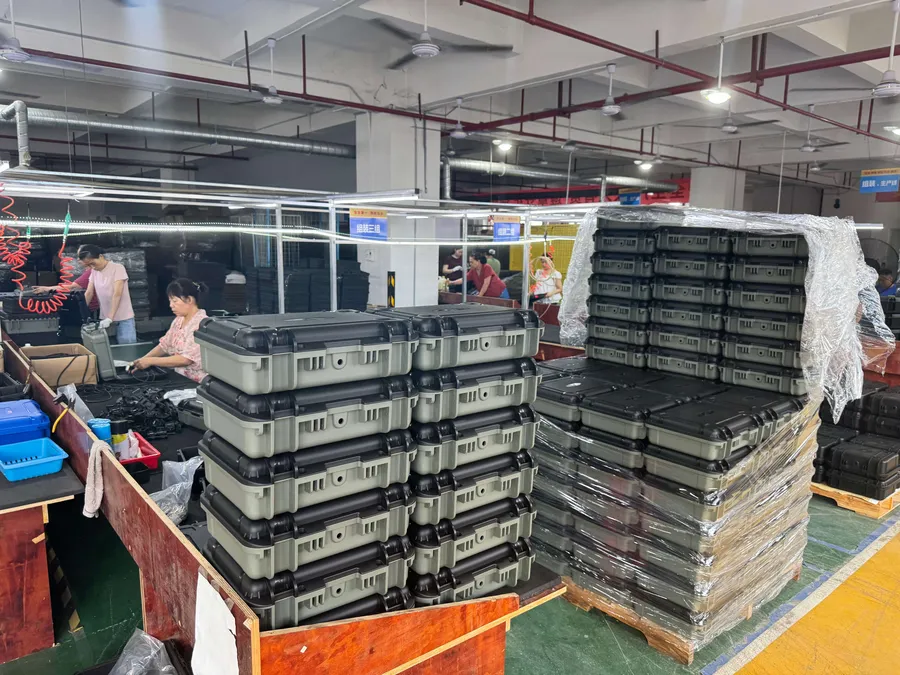
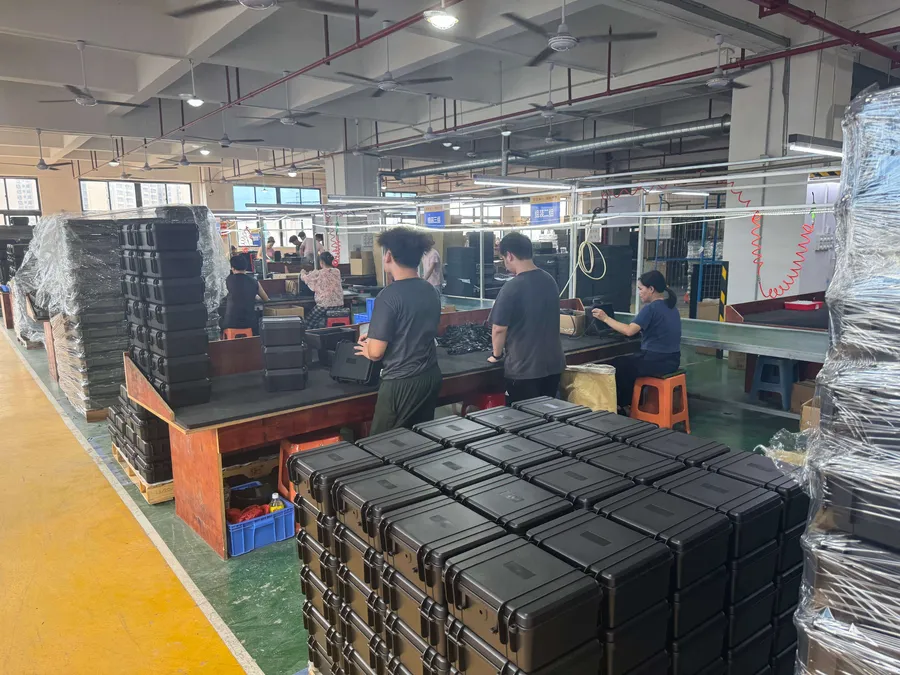
Applications
This matters most where the case is part of a movement chain rather than shelf packaging. In outdoor & recreation and field & deployment and electronics & instruments the same shell is specified differently because the handling, the environment and the verification requirement differ.
- Outdoor & Recreation — Consumer and professional outdoor brands buy cases as a component of their product. That means c…
- Field & Deployment — Field deployment removes every assumption a depot specification makes: no forklift, no dry stora…
- Electronics & Instruments — Electronic assemblies rarely fail from a single large impact. They fail from repeated small shoc…
- Military — Military equipment moves through a chain of handlers, none of whom own the equipment and all of …
- Law Enforcement — A police or rescue kit is opened at an incident, in poor light, often while wearing gloves, and …
Customisation
Everything described above is configurable on a standard shell: interior layout (pick-and-pluck, die-cut or CNC-cut), foam grade and thickness, colour, logo method, latch and lock count, pressure-equalisation valve, cable ports, document holder and identification plate. A bespoke exterior geometry requires a new mould — 125 days, from 3,000 units per moulded component.
Procurement considerations
| Question | What to send us |
|---|---|
| Which shell fits? | Equipment L × W × H as packed, plus required clearance per axis |
| What does it cost? | Order quantity and estimated annual quantity — the two drive different answers |
| Is tooling needed? | Whether an existing shell clears the envelope with usable foam depth |
| Lead time? | Your required delivery date, not just the order date |
| Certification? | The exact standard your tender names — we will say whether we can test to it |
| Freight? | Destination and preferred terms; carton and pallet data supplied with the quotation |
Comparison and selection guide
The tables on this page exist because a protective case is chosen by comparing three things: the envelope, the environment and the handling chain. Where no table applies, the rule below is.
| Situation | What To Do |
|---|---|
| Marine or wet | Sealed configuration with a drain-friendly interior and stainless hardware. |
| Dry and dusty | A close-fitting rim and a lid that can be opened one-handed without spilling contents. |
| Carried far | Under 10 kg packed, with a padded handle or shoulder webbing. |
- Size on internal dimensions plus clearance, never on a product name.
- Choose the carrying method before the shell: it changes the series, not just the price.
- Specify the interior last, and decide up front whether the end user will reconfigure it.
What is an outdoor protective case? relates to Protective Case Basics. Related families: Outdoor Protective Cases / Custom Protective Cases / Camera & Photography Cases / Equipment Transport Cases / Field Equipment Cases / Tool Cases. Related sectors: Outdoor & Recreation / Field & Deployment / Electronics & Instruments / Military / Law Enforcement. Continue in the Protective Case Basics cluster.
This page is written from our own production data. If your requirement differs, send the dimensions and we will tell you which of the 155 models fits, or whether a custom route is needed.