What protective case is suitable for scientific instruments?
A protective case suitable for scientific instruments is decided by four published checks, not by appearance. First, the internal envelope must take the instrument in its packed state - feet, connectors and cables fitted - plus about 20 mm of clearance per axis. Second, the wall thickness must match how the case will be stacked and handled; published shells in the instrument-relevant range run from about 2.5 mm on medium engineering-PP families up to 5.8 mm on large models. Third, the interior must locate the instrument, which in practice means CNC-cut cutouts for irregular shapes and layered foam for accessories. Fourth, the model data sheet must state seal, weight and packing facts per model, and where a property has not been measured the sheet does not claim it. KeXin supplies these cases wholesale and on OEM terms, quoted EXW or FOB.
Key points
- Size on the instrument in its packed state: feet, connectors and cables fitted, plus about 20 mm of clearance per axis.
- Wall thickness decides stacking behaviour: published shells run from 2.5 mm on medium families to 5.8 mm on large models.
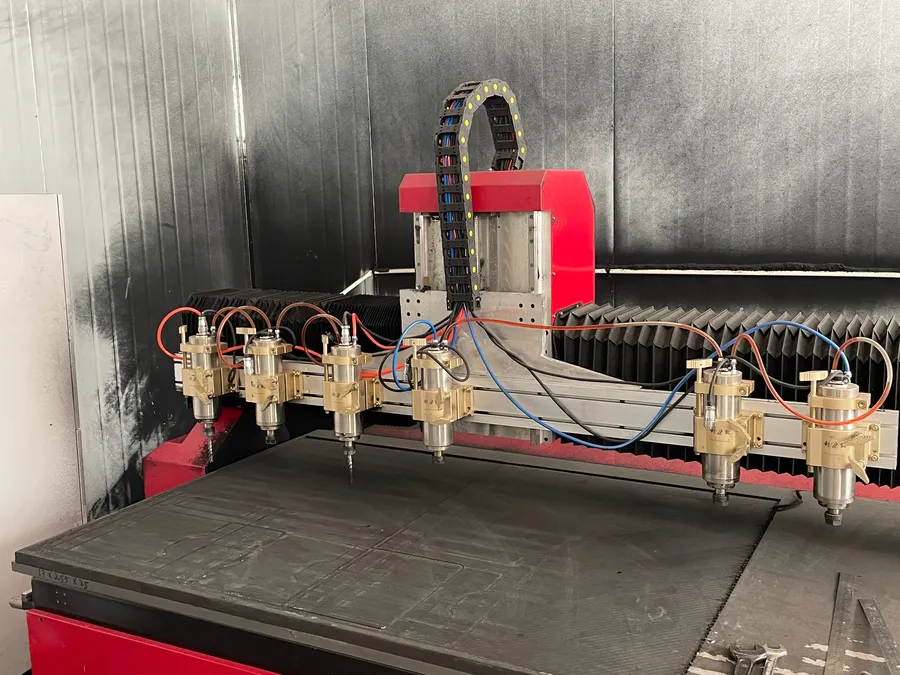
- Irregular instruments need CNC-cut cutouts; a generic foam block is how knobs, probes and connectors get knocked.
- Usable litres sit below gross internal litres on every published model, so compare interiors on usable litres.
- Ask for the per-model data sheet: seal, net weight, wall thickness and packing quantities belong in writing.
- Field moves favour one graduated family in two heights, so accessory layers stay identical between kits.
Start with the instrument envelope, then add clearance
Scientific instruments are rarely simple boxes: they arrive with feet, handles, protruding connectors, sampling probes and cables that must stay fitted. Measure the instrument in its packed state and measure the accessories that share the case, then add clearance - about 20 mm per axis is the working rule used across the site's measuring guides. Height is the axis buyers underestimate most, because it includes rubber feet, antenna stubs and the bend radius of the cable that stays attached. Write the three axes down for every item; the case is chosen against that table, not against a product photograph, and the internal-versus-external dimensions guide explains why the two numbers never match.
What suitable means: four checks on published data
A case is suitable when four things hold, and all four are checkable before money moves. The internal envelope covers the packed kit with clearance. The wall thickness matches the handling: a case that rides alone in a vehicle can be lighter than one that stacks in a storeroom. The interior locates every item, which for instruments almost always means cut foam rather than an empty shell. And the data sheet states what the model does and does not declare - seal availability, net shell weight, wall thickness and packing quantities. KeXin publishes these values per model; where a property has not been measured, the sheet does not claim it, and a defined configuration can be sent to a recognized laboratory at the buyer's request.
Shell material and wall thickness for instrument loads
Three shell materials cover most instrument work. Polypropylene is the light general-purpose shell for smaller instruments. Engineering PP raises stiffness on mid-size families such as WL4710, WL4713 and WL4716 and on the trolley models. ABS carries thick published walls - 4.7 mm on WL6-4618 and 5.3 mm on WL6-5522 - for cases that stack or take hard transport, while the engineering-PP WL5321 reaches 5.8 mm, the thickest value in this selection. Wall thickness, not the material name alone, is what the stacking guide tells you to compare: it sets how a loaded case carries the weight of the cases stacked on top of it, and it is published for every model in the range.
Graduated instrument families, compared on published numbers
The table below lists published values for the shells instrument buyers use most, drawn from the product database. Usable litres exclude wall and lid overlaps and are the figure to compare layouts against; gross internal litres are shown beside them. The WL4710/4713/4716 trio keeps one 466 x 387 mm footprint and graduates interior height from 90 to 150 mm, which is what makes it convenient for mixed instrument sets.
| Model | Internal Mm | Wall Mm | Lid Base Mm | Net G | Gross Usable L | Material | Gasket |
|---|---|---|---|---|---|---|---|
| WL4710 | 458 x 345 x 90 | 2.5 | 45 / 45 | 1370 | 14.2 / 12.2 | Engineering PP | no |
| WL4713 | 458 x 345 x 120 | 2.5 | 75 / 45 | 1420 | 19.0 / 16.3 | Engineering PP | no |
| WL4716 | 458 x 345 x 150 | 2.5 | 75 / 75 | 1680 | 23.7 / 20.4 | Engineering PP | no |
| WL6-4618 | 430 x 290 x 165 | 4.7 | 140 / 25 | 2775 | 20.6 / 16.5 | ABS | yes |
| WL5021 | 465 x 315 x 196 | 3.7 | 134 / 62 | 3430 | 28.7 / 24.7 | ABS | yes |
| WL5321 | 481 x 373 x 192 | 5.8 | 43 / 149 | 4810 | 34.4 / 27.5 | Engineering PP | yes |
| WL6-5522 | 507 x 385 x 190 | 5.3 | not published | 4860 | 37.1 / 29.7 | ABS | yes |
Interiors: cut foam, layers and instrument-specific details
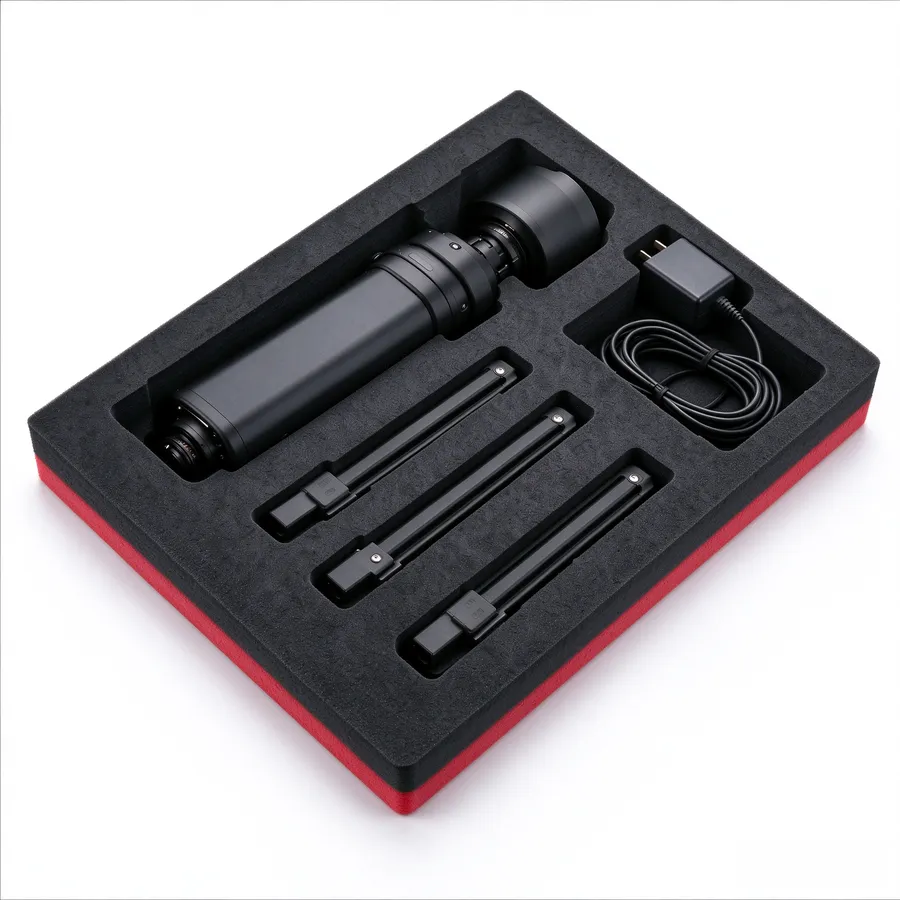
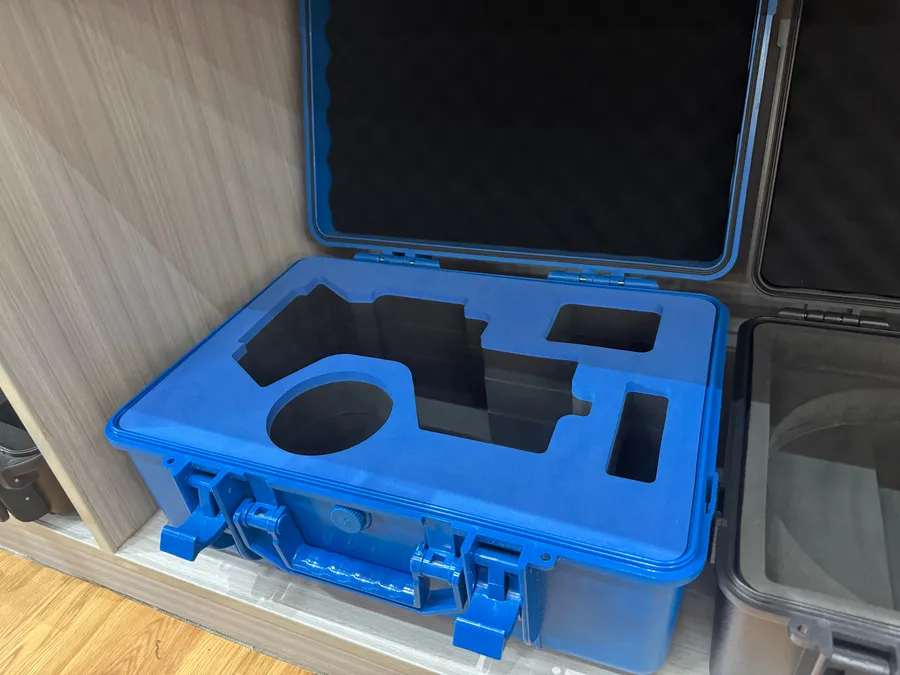
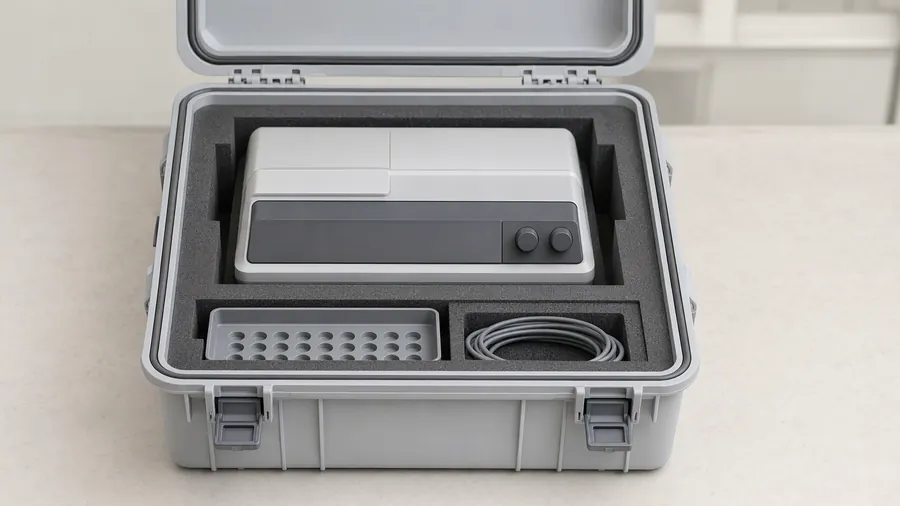
Instruments reward interior precision. A CNC-cut cutout supports the housing at its strong points, leaves connectors and switches free, and adds finger notches so the instrument lifts out without levers. Around the cutout, layered foam takes the accessories: probes in one layer, cables and power in another, manuals and calibration certificates flat on top. The foam-thickness guide explains how layer thickness is chosen; for instruments the practical version is that the cutout layer follows the instrument's height and the lid layer stays thin enough not to press. If the instruments are static-sensitive, raise ESD-safe foam options with the factory at the drawing stage rather than after the foam has been cut, and confirm the final material in writing on the order.
Seals, dust and what we do not claim
Several published models carry a gasket seal - WL5021, WL6-4618, WL5321 and WL6-5522 among them - which reduces dust and moisture entry around the lid line when the case is closed and the latches are engaged evenly. What the factory does not do is generalize a rating: ingress performance is stated per model with its own published test record, and where a model has no record the data sheet does not declare one. Buyers who need a documented figure for a tender should say so at quotation stage so the defined configuration can be tested by a recognized laboratory. The waterproof and dustproof guide explains how seals work and what an ingress rating does and does not tell you.
Field deployment, lab-to-site moves and long instruments
Field work changes the priorities: the case may be carried across ground, lifted into a vehicle and opened on uneven surfaces, which is where the outdoor protective range earns its place. For heavier instrument kits the published trolley models take the weight off the crew - WL8-5021 Trolley carries an interior of 437 x 308 x 164 mm on wheels with a telescopic handle, and WL8-5726 Trolley gives 520 x 296 x 210 mm. Long and slim instruments such as tripods, reference rods and sampling poles fit the long profiles: WL8-8015 takes 725 x 350 x 140 mm internally and WL8-9616 takes 880 x 350 x 140 mm, both with 5.0 mm walls. The outdoor applications page collects how these shells behave outside the lab.
Ordering: terms, drawings and lead times
KeXin New Materials (Guangdong) Co., Ltd. sells wholesale and on OEM programmes; quotations are EXW or FOB, and the company does not retail, ship DDP or hold overseas warehouses. A stock-shell order with custom foam starts from the published MOQ; a first sample takes about 45 days and a new mould about 125 days, with a 30% deposit to open production. Send the packed-dimension table, the instrument mass and the reach priority - which item must come out first - and ask for the per-model data sheet with the quotation so wall thickness, net weight and packing quantities are agreed in writing. The procurement checklist and the RFQ guide list the remaining questions, and the palletization guide helps plan the storeroom and the shipment together.

Customisation
Everything described above is configurable on a standard shell: interior layout (pick-and-pluck, die-cut or CNC-cut), foam grade and thickness, colour, logo method, latch and lock count, pressure-equalisation valve, cable ports, document holder and identification plate. A bespoke exterior geometry requires a new mould — 125 days, from 3,000 units per moulded component.
Procurement considerations
| Question | What to send us |
|---|---|
| Which shell fits? | Equipment L × W × H as packed, plus required clearance per axis |
| What does it cost? | Order quantity and estimated annual quantity — the two drive different answers |
| Is tooling needed? | Whether an existing shell clears the envelope with usable foam depth |
| Lead time? | Your required delivery date, not just the order date |
| Certification? | The exact standard your tender names — we will say whether we can test to it |
| Freight? | Destination and preferred terms; carton and pallet data supplied with the quotation |
Comparison and selection guide
The tables on this page exist because a protective case is chosen by comparing three things: the envelope, the environment and the handling chain. Where no table applies, the rule below is.
| Situation | What To Do |
|---|---|
| Benchtop mass | Firm base carrier, 50 mm minimum, with a soft contact layer. |
| Optical head | Suspend the body and clear the lenses entirely; never let foam touch a coated surface under load. |
| Field kit | CNC base for the instrument, pluck-foam top for probes and consumables. |
- Size on internal dimensions plus clearance, never on a product name.
- Choose the carrying method before the shell: it changes the series, not just the price.
- Specify the interior last, and decide up front whether the end user will reconfigure it.
What protective case is suitable for scientific instruments? relates to Protective Case Basics. Related families: Instrument & Equipment Cases / Military Protective Cases / Outdoor Protective Cases / Custom Protective Cases / Field Equipment Cases. Related sectors: field and industrial equipment. Continue in the Protective Case Basics cluster.
This page is written from our own production data. If your requirement differs, send the dimensions and we will tell you which of the 155 models fits, or whether a custom route is needed.


