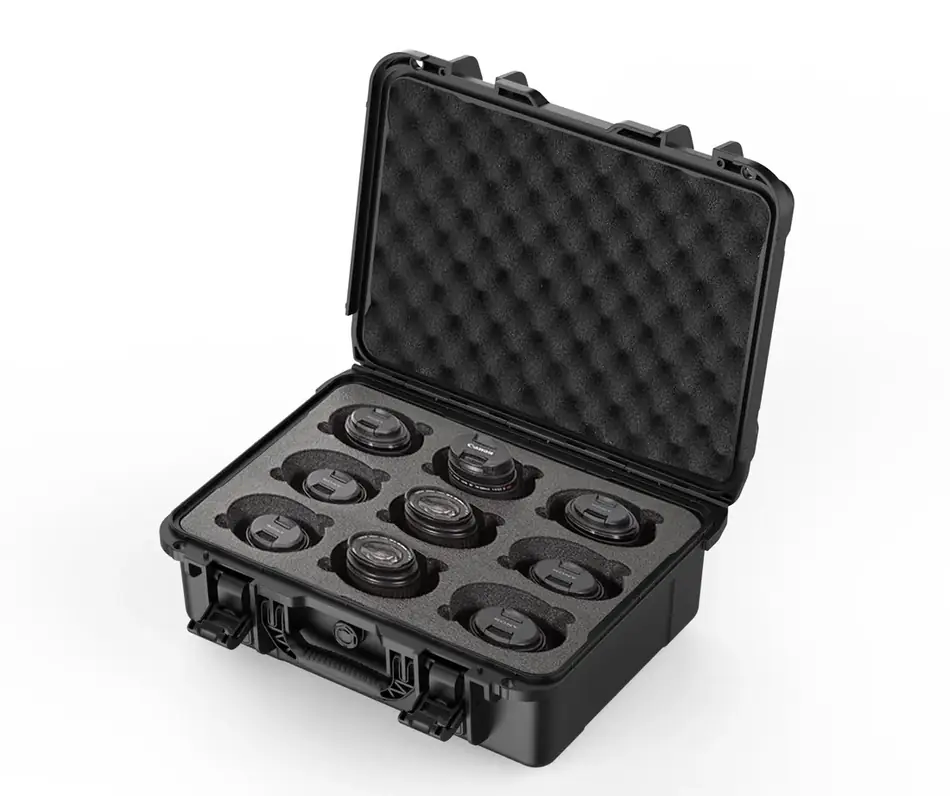
Camera Equipment Case Interior Layout?
Short answer: a camera case interior layout works when it does three jobs at once - it immobilises every item on its strongest face, it separates hard metal from finished surfaces, and it keeps the closure line away from anything that stands above the shell floor. The layout is constrained by published geometry before it is constrained by foam: internal dimensions, the lid-to-base split - published separately on 48 of the 85 camera-tagged shells in our library - and the narrow internal width, published on 23 of them. KeXin cuts die-cut, CNC-cut and pick-and-pluck interiors in PE, EVA and EPE, including layered builds and egg-crate lid profiles, starting at one unit on an existing shell, so a working layout can be proven before a fleet order. No model publishes a shock, free-fall or ingress figure; what protects glass here is the pocket wall, the relief under every standing control and the gasket channel on 70 of those 85 shells - specified and documented, never an adjective.
Key points
- Fix the geometry before the foam: internal dimensions, the lid-to-base split and the narrow internal width decide what a layout can hold.
- 48 of the 85 camera-tagged shells publish lid and base depth separately; a 165/35 mm split carries a standing body, a 38/140 mm split a lens column.
- Give every cut about 20 mm of clearance per axis, and check the 23 camera-tagged models that publish a narrow internal width before machining a tray.
- Face finished bodies with closed-cell EVA so a wet hand wipes off; carry mass on a firmer PE layer; use EPE where weight, not stiffness, decides.
- Custom cut foam starts at one unit on an existing shell - send a drawing, a scale photograph of the packed kit, or the items themselves.
- Relieve every connector, hot-shoe and filter thread: a plug that can travel into a socket is a layout fault, not a user error.
- No shock, free-fall or ingress figure is published for any shell; the pocket wall and the gasket channel on 70 of 85 camera-tagged models are what we document.
What A Camera Case Interior Layout Has To Do
An interior layout is the part of the case that actually touches the equipment, and it has three jobs that fail in visible ways when they are skipped. The first is immobilisation: a camera body or a lens that can migrate inside a cavity becomes a hammer, and the damage is a bent filter thread, a cracked grip or a disconnected ribbon - so every item rests in a pocket sized to its footprint, carried on its strongest section, with the glass face away from a wall. The second is separation: bodies, lenses, chargers, cards and metal plates must not share one cavity, because two hard objects in the same space meet sooner or later; the layout gives each object its own pocket and puts small high-value items in the lid or a dedicated tray. The third is closure-line discipline: the line where lid meets base is a load path, and anything that stands above the shell floor - a hot-shoe, a cage handle, a mic, a folded gimbal arm - must sit where the closure crosses empty relief, not under the seam. Notice that only part of this is foam. Shell height, the split between lid and base, and the plan dimensions decide what the layout can hold before a single millimetre of foam is specified, which is why the published figures come first in this article.
Start From The Published Envelope, Not From The Foam
Our library tags 85 shells as camera-equipment cases, and three published figures do the constraining. The lid-to-base split is published separately on 48 of them, and it is the figure that decides where each item lives. On the same 308 x 230 mm plan, KX-3213 gives 118 mm of internal height as an 86 mm lid over a 32 mm base - a folded gimbal or a standing body rides in the lid - while KX-3218 gives 172 mm as an equal 86/86 mm two-layer split for a drone-style kit with a transmitter and batteries in separate layers. At the deep-lid end, KX-93221 gives 300 x 200 x 200 mm as a 165/35 mm split at about 1,230 g for a cine body standing with its cage, and KX-92817 gives 253 x 180 x 152 mm as a 125/27 mm split at about 940 g for a compact kit with a proud viewfinder. At the deep-base end, the narrow 407 x 187 mm formats KX-4318 and KX-4319 publish a 38/140 mm split with 11.6 usable litres - a lens column standing on its collar - and KX-4321 reverses it to 164/38 mm on a 411 x 208 mm plan at about 2,330 g. The second figure is the narrow internal width, published on 23 of the 85: KX-4312, for example, records 236 mm against a nominal 260 mm, and a machined tray that clears the wide section will bind there. The third is usable volume, which runs from 5.0 to 21.2 litres across the tag - and published empty mass from 460 g on KX-2614 to about 5,012 g on the wheeled KX-85022.
Foam Types And When Each One Is The Right Answer
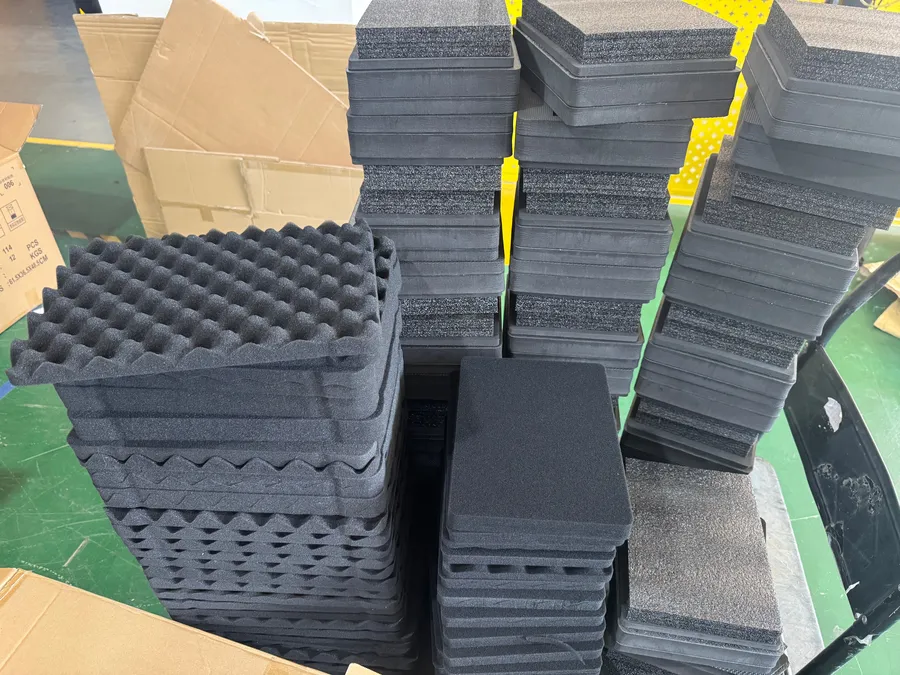
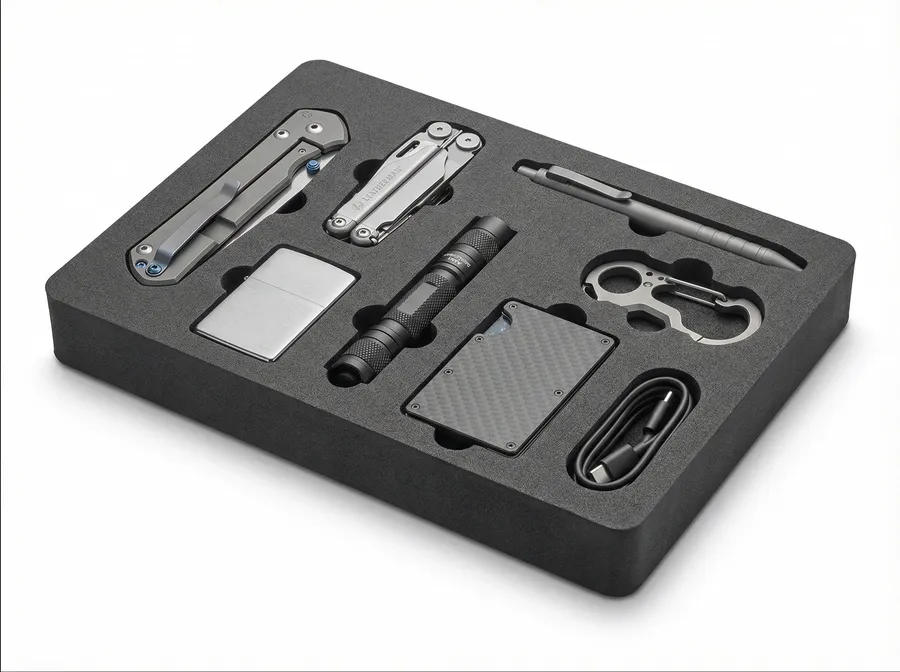
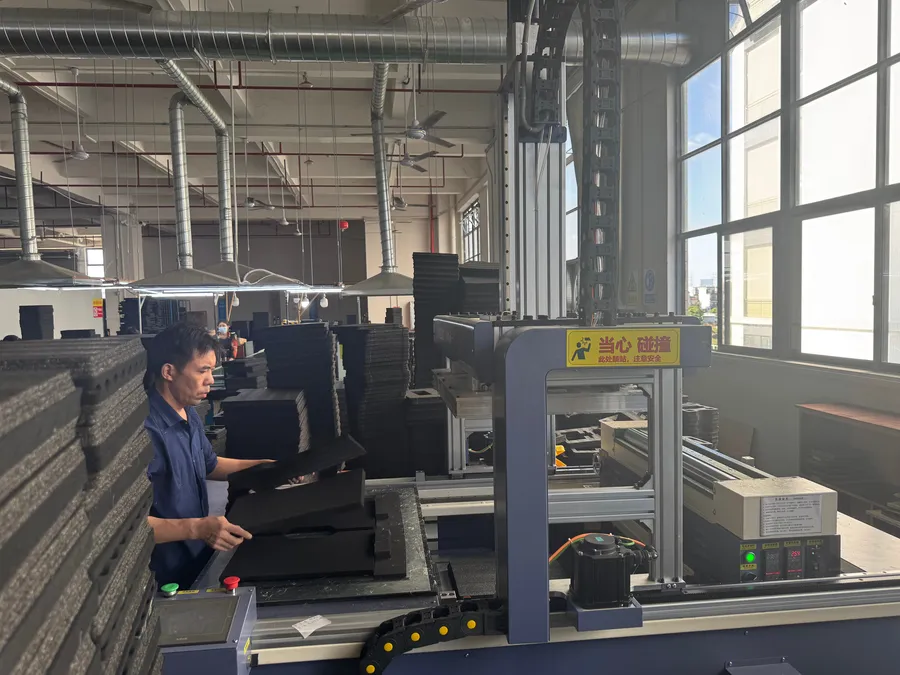
The published foam range covers PE, EVA and EPE, cut as die-cut, CNC-cut or pick-and-pluck, in top and base layers that include egg-crate lid profiles, and the choice is easier if you think in roles rather than names. PE is the carrier: firm enough to take the mass of a cine body or a full lens set without crushing, so it goes under the load. EVA is the face: closed-cell, so a wet hand, rain or a spilled drink wipes off instead of soaking in, which is why it usually forms the layer that touches finished surfaces. EPE is the weight saver: lighter per layer, right where mass matters more than stiffness, such as a lid tray for filters and cards. Die-cut earns its cost where one layout repeats across a fleet - the same kit issued to every operator - and CNC-cut earns it where a pocket wall must hold tolerance around a connector, a lens collar or a cage arm. Pick-and-pluck is the honest answer where the kit genuinely changes between shoots, and a fixed base with a pluck lid is the usual compromise for a rental house. Two refinements matter on real jobs: a layered build - firm carrier under mass, softer face against the body - behaves better than a single slab, and anti-static or conductive lining is a separate material specification evidenced on the batch, not an attribute of the shell. All of it starts at one unit on an existing shell; no new tooling is needed to prove a layout.
Layout Patterns By Kit Type, With Named Shells
The table maps the kit types we are asked about most often onto a repeatable pattern and named published shells. Read the split column first: it tells you which half carries the load, and every dimension in the examples is a published specification of that model.
| Kit Type | Layout Pattern | Published Shells |
|---|---|---|
| Two-body mirrorless kit with lenses and chargers | Bodies in the base on their strongest face with lenses capped in their own slots; cards, batteries and cables in the lid tray | KX-4012: 380 x 305 x 110 mm internal, 85/25 mm split, about 1,480 g, 10.9 usable litres; KX-64114: 378 x 307 x 120 mm, 4.0 mm wall, about 2,100 g |
| Cine or documentary body standing with cage and monitor | Deep lid carries the standing rig with every proud bracket relieved; base takes wedges, plates and leads | KX-93221: 300 x 200 x 200 mm, 165/35 mm split, 5.0 mm wall, about 1,230 g, 9.6 litres; KX-84419: 395 x 295 x 165 mm, 120/45 mm, 4.2 mm wall |
| Gimbal or stabiliser travelling half-assembled | Folded arms ride in the deep lid, grip and controls in the base, nothing resting on a motor yoke | KX-3213: 308 x 230 x 118 mm, 86/32 mm split, about 860 g, 7.2 litres; KX-83620: 290 x 220 x 185 mm, 135/50 mm, 10.1 litres |
| Drone combo with transmitter, batteries and props | Two equal layers: airframe on the base layer, transmitter and batteries separated in the second layer, props flat in the lid | KX-3218: 308 x 230 x 172 mm, 86/86 mm split, about 900 g, 10.5 usable litres, gasket recorded |
| Audio field kit: recorder, mics, looms | Firm base carrier for the recorder with the connector edge over an open relief; shallow lid tray for mics, adapters and coiled leads | KX-3315: 303 x 224 x 135 mm, 100/35 mm split, 4.1 mm wall, about 1,670 g, 7.4 litres; KX-83715: 340 x 220 x 135 mm, 100/35 mm, 8.7 litres |
| Tripod legs, sliders and light stands | One channel per member, base plank firm, nothing stacked on the shell in transit | KX-86216: 582 x 300 x 130 mm internal, 100/30 mm split, 3.3 mm wall, 19.5 usable litres |
| Monitor or LED panel lying flat | Equal thin split, panel carried on its face protection in both halves | KX-4610: 455 x 338 x 84 mm internal, 42/42 mm split, 3.0 mm wall, about 1,115 g, 11.1 litres; KX-4613: 74/42 mm, 15.3 litres |
| Lens column: long glass standing on its collar | Deep base split holds the lens standing with the collar unloaded; desiccant and caps in the lid | KX-4318: 407 x 187 x 178 mm, 38/140 mm split, about 1,970 g, 11.6 usable litres; KX-4321: 411 x 208 x 202 mm, 164/38 mm, about 2,330 g |
Worked Layouts On Named Shells
Three examples show how the figures turn into a layout. A two-body documentary kit in the KX-4012 uses the 85 mm lid and 25 mm base the way the split suggests: the 25 mm base layer carries a foam-lined riser with both bodies lying flat, lenses detached and capped in their own slots beside them, while the 85 mm lid holds the working tray - cards in a marked block, batteries in pairs, filters flat, a short lead channel per cable so no plug can travel into a socket. A cine build in the KX-84419 puts the body standing in the 120 mm lid with the top handle and any cage bracket sitting over routed relief, base plate and rods in the 45 mm base, and the monitor carried face-down in its own pocket with the glass over open space, never against a wall. A drone combo in the KX-3218 uses the equal 86/86 split as two floors: airframe down on the lower deck with propellers removed into a flat slot, transmitter and batteries isolated on the upper deck so a loose cell cannot meet the airframe, and the gasket channel that this model publishes doing quiet work around a sandy landing site. In every layout the same checks repeat: nothing under the closure line, nothing hard within reach of glass, and every small item visible the moment the lid opens, because an outline that shows a missing adapter saves more kits than any thickness figure.
How To Brief A Layout: What We Need From You
A layout is quoted from one of three inputs, in order of usefulness: a drawing with dimensions, a scale photograph of the kit packed the way it travels, or the items themselves. Alongside them, five decisions turn a sketch into a cut file. One: the travel configuration - what is fitted and what is stripped - because a body that travels with its cage needs the height with the cage, not the catalogue height. Two: the footprint and the tallest standing dimension of every item, which we convert to internal sizes with roughly 20 mm of working clearance per axis; more clearance than that lets items migrate, less makes the cut unforgiving. Three: the closure-line map - anything that stands above the shell floor is placed where the lid meets empty relief, which is why we ask for the tallest standing dimension separately. Four: the connector and glass map - every socket, hot-shoe, filter thread and lens face is marked for relief so load never lands on it. Five: the accessories rule - where cards, batteries, cables and desiccant live, and whether the kit is one operator's or shared, because a shared kit wants printed outlines and colour-coded zones so a missing item is visible at once. Lead channels are drawn in at the same time, sized by length, in the lid or a base layer; on a CNC layout this costs nothing and it is the single change that most reduces returned connectors.
What We Do Not Claim About Interior Protection
The interior is where overstatement spreads fastest, so our record is deliberately plain. The product library records shock, free-fall height and ingress as not measured across all 155 models, and no camera-tagged shell publishes a rating for what the foam achieves. What we document instead is the construction you can verify before purchase: wall thickness published on 83 of the 85 camera-tagged shells between 2.1 and 5.0 mm, a compressible gasket in a continuous moulded channel on 70 of them with 15 recorded without one - including the thin-wall KX-704, KX-705 and KX-706 at 2.1 mm and the 2.5 mm KX-707, and the flat KX-4710 series - and latch hardware specified per configuration rather than inherited from a series. A pocket wall of a given thickness is a description, not a laboratory result, and we would rather a director of photography heard that before a tender than after a claim. Where a broadcaster, a rental house or an insurer requires a documented figure, we quote accredited third-party testing of the exact ordered build - shell, gasket, latch and foam layout together - as a separate work package, so the report covers the case that ships, not a family average. Until that report exists, the honest description of protection is the layout itself: immobilised items, separated surfaces, relieved controls, and a closure line that crosses nothing.
Customisation, OEM And Fleet Marking
Custom work divides into published tiers. A cut interior starts at one unit on an existing shell with no new tooling - the practical way to prove a layout before ordering a fleet - and identical repeats quote per unit from the cut file. Shell colour, logo and OEM hardware begin near 300 units, which is where a rental house or a broadcaster usually brands a fleet; buyer-branded packaging is quoted in the same band. A change to the shell itself needs a mould at near 3,000 units per component and about 125 days from approved drawings, while an OEM first sample on approved existing tooling takes about 45 days. Two boundaries are worth stating: a colour change does not alter the published wall thickness, and it does not add or remove a gasket channel - the 15 camera-tagged shells recorded without one stay without one in any colour. Marking is the quiet workhorse of a fleet: printed or routed outlines per pocket, colour-coded layers per department, and a document holder inside the lid for the kit list, all quoted as configuration items on the named model. Anti-static or conductive lining for electronic accessories is a separate material specification evidenced on the batch, and latch bodies on every model accept a standard padlock where a kit must be secured between shifts.
Procurement Notes: Terms, Verification And Contact
KeXin New Materials (Guangdong) Co., Ltd. moulds the shells and cuts the interiors, and supplies wholesale and OEM or ODM buyers on EXW or FOB terms only - no retail channel, no delivered-duty-paid quotation, no overseas warehouse stock - so a landed cost is the quoted term plus your own freight and clearance. Minimum order is one unit on a standard shell and one unit on a custom foam layout; near 300 units for colour, logo or OEM hardware; near 3,000 units per component for a dedicated mould. Payment is a 30 per cent deposit with the balance after inspection, and a third-party factory inspection before shipment is welcome. When you compare quotations, keep them on the same three axes as this article: the published internal dimensions and split on the named model, the foam specification in writing - material, layer build, cut method, clearances - and the verification plan, meaning which fields stay recorded as not measured and whether a commissioned test is required. Carton size and pieces per carton are published on 64 of the 155 models and pallet and container figures are supplied with the quotation per model, which is what makes a fleet order predictable. Enquiries go to Fred Zhao or the KeXin Sales Team, WhatsApp +86 135 3588 0002.
Customisation
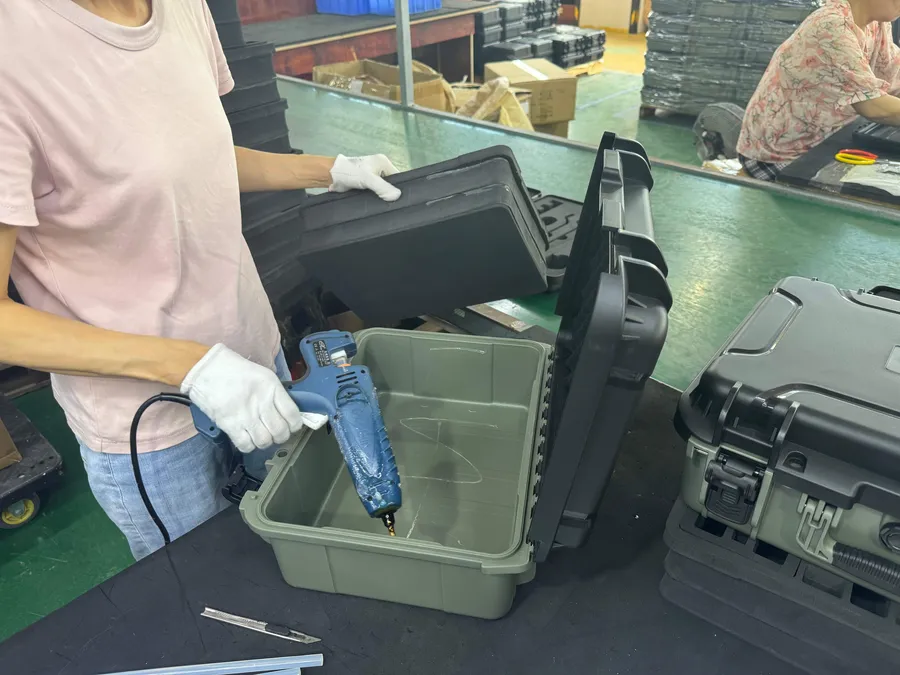
Everything described above is configurable on a standard shell: interior layout (pick-and-pluck, die-cut or CNC-cut), foam grade and thickness, colour, logo method, latch and lock count, pressure-equalisation valve, cable ports, document holder and identification plate. A bespoke exterior geometry requires a new mould — 125 days, from 3,000 units per moulded component.
Procurement considerations
| Question | What to send us |
|---|---|
| Which shell fits? | Equipment L × W × H as packed, plus required clearance per axis |
| What does it cost? | Order quantity and estimated annual quantity — the two drive different answers |
| Is tooling needed? | Whether an existing shell clears the envelope with usable foam depth |
| Lead time? | Your required delivery date, not just the order date |
| Certification? | The exact standard your tender names — we will say whether we can test to it |
| Freight? | Destination and preferred terms; carton and pallet data supplied with the quotation |
Comparison and selection guide
The tables on this page exist because a protective case is chosen by comparing three things: the envelope, the environment and the handling chain. Where no table applies, the rule below is.
| Situation | What To Do |
|---|---|
| Changing kits | Layered pluck foam, rebuilt by hand. |
| Fixed rental fleet | CNC silhouette with serial pockets and an inventory list. |
| Harsh locations | Sealed shell plus desiccant provision in the lid. |
- Size on internal dimensions plus clearance, never on a product name.
- Choose the carrying method before the shell: it changes the series, not just the price.
- Specify the interior last, and decide up front whether the end user will reconfigure it.
Camera Equipment Case Interior Layout? relates to Foam Insert Guide. Related families: Camera & Photography Cases / Custom Protective Cases / Outdoor Protective Cases / Waterproof Cases / Equipment Transport Cases / Optical Equipment Cases / Electronics Cases. Related sectors: field and industrial equipment. Continue in the Foam Insert Guide cluster.
This page is written from our own production data. If your requirement differs, send the dimensions and we will tell you which of the 155 models fits, or whether a custom route is needed.