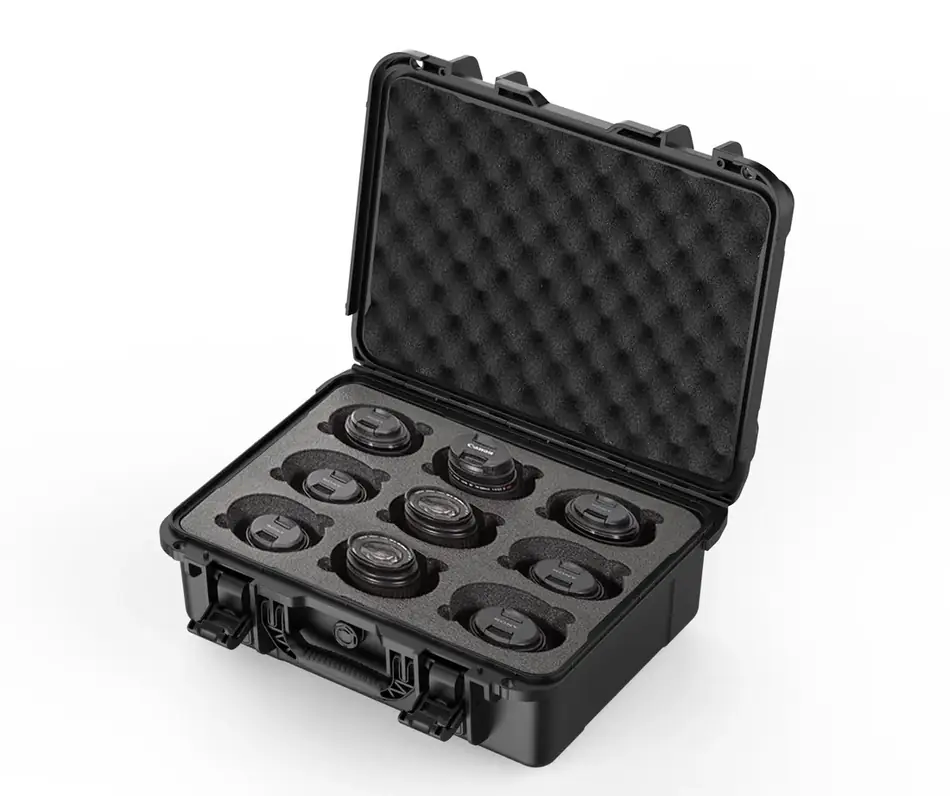
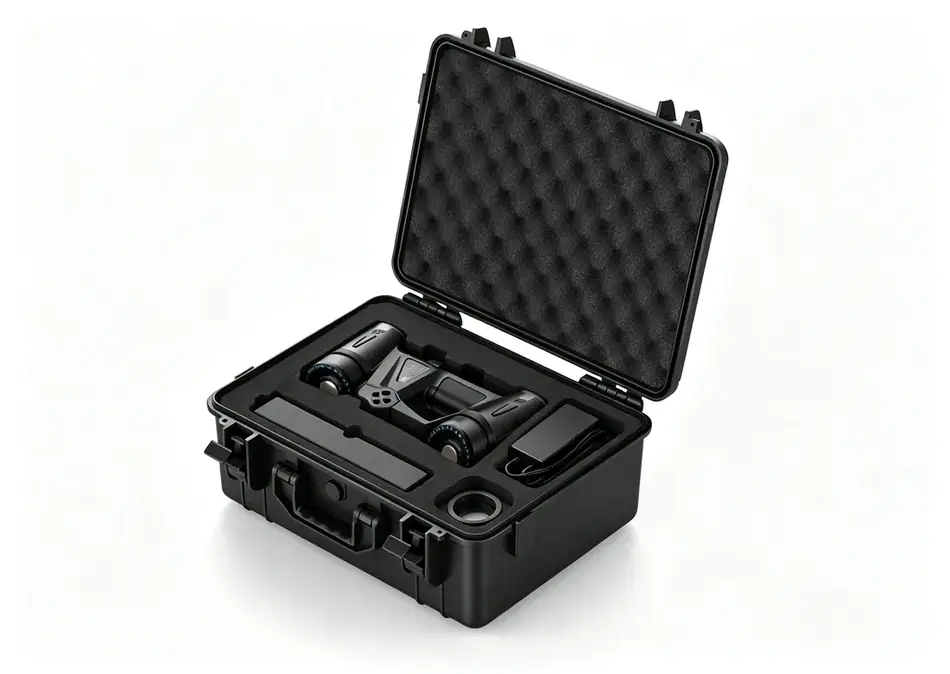
What type of foam is suitable for camera equipment?
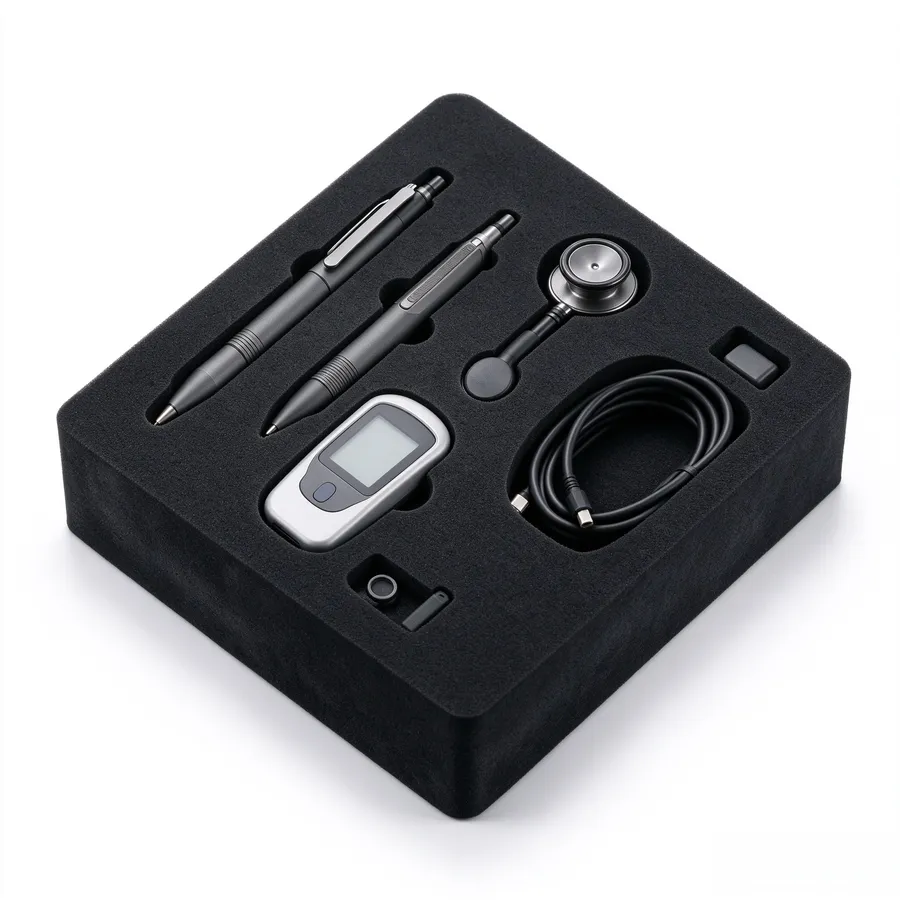
A suitable interior for camera equipment is a layered one, cut as pockets rather than torn by hand: a firm closed-cell polyethylene (PE) carrier that holds each body and lens in one position, an ethylene-vinyl acetate (EVA) face where the foam actually touches barrels, mounts and coated glass, an economical beaded polyethylene (EPE) bed where depth is needed more than surface quality, and pick-and-pluck only where the person packing is the person who re-cuts the layout. Then choose the build type before the material: CNC-cut from a drawing for a fixed kit, die-cut for one repeatable layout at volume, layered base-plus-top for mixed heights, pluck foam for a kit that changes every trip. Camera gear is a mixed payload rather than one instrument, so the right answer is a set of zones, and the depth available to each zone is set by the published internal height and lid-to-base split of the specific shell you are buying.
Key points
- Immobilise first, cushion second: a lens that can rotate in its pocket takes a fresh knock at every jolt of the journey.
- Use a firm PE carrier under the mass and a smooth EVA face at the contact surface; keep crumb-shedding torn cubes away from glass.
- Build type matters more than material: CNC-cut for a fixed kit, die-cut at volume, layered for mixed heights, pluck foam for a moving list.
- Depth comes from the shell, not from the foam: WL9-3221 publishes 165 mm of lid over 35 mm of base, WL4318 is the mirror at 38 and 140.
- Plan against usable volume: across our 85 camera-tagged models the usable figure is 13 to 20 percent below the published internal volume.
- We publish no foam density, firmness or rebound figure, because those follow the drawing cut for one kit inside one shell.
What a camera kit asks an interior to do
A camera load is not one object, it is eight to fifteen objects of different shapes, masses and surface sensitivities travelling in one box: bodies with grips fitted, zooms and primes, a pair of binoculars or a monocular, a tripod head, batteries, media, cards, filters in wallets, a small light, cables, and usually something soft. Three demands follow from that. First, nothing may move relative to anything else, because a lens that can rotate in its pocket is presented to each new shock from a different angle, and the mount face or a filter thread is where the damage lands. Second, the surface touching the item has to be clean and stable, because coated glass and an abrasive film of foam crumbs plus one wipe is how a lens is ruined; that is the argument against a torn interior as the only layer in a camera case. Third, the layout has to survive repacking, because camera kit changes with the assignment. A single-material answer fails at least one of those three, which is why we cut camera interiors as zones with different grades in each zone, sized against the published geometry of the shell you are buying rather than against a generic rule.
The four grades we cut camera interiors from
Our specification sheet lists six foam options against every model - pick-and-pluck, die-cut, CNC-cut, EVA, PE and EPE - and records the material as cross-linked PE, EVA and EPS by zone. In camera work they divide the jobs like this. Cross-linked polyethylene is the load-bearing grade: firm for its weight, low water absorption, cleanly machined, and stable enough that a milled pocket keeps its shape after hundreds of pack and unpack cycles, so it goes under the mass and forms the walls between adjacent items. EVA is the face grade: tougher and smoother than a beaded foam, and it holds a crisp cut edge, so it lines the pocket where a barrel, a mount flange or a viewfinder actually sits and where the item is handled every week. EPE, the beaded structure, is the volume grade: it buys thickness per unit of cost better than a firm grade does, so it fills a deep lid cavity, beds a soft item, or packs the space behind a moulded tray where nothing needs to be gripped. Firmer EPS carriers are used under heavy modules where the job is carrying load rather than cushioning it. What none of these grades comes with, on our sheet or in our drawings, is a published density, firmness or rebound figure, because those properties belong to the sheet selected for one layout, not to a catalogue line.
Build type decides the fit more than material does
Two camera cases with identical foam can behave completely differently because of how the interior was produced. A CNC-cut interior is machined from a digital outline of each item, so every body and lens has its own pocket with a real wall of foam between neighbours, and the same drawing reproduces the same layout on every unit of the run; this is what we recommend for a fixed kit with a defined list, and it is the only build where a lens can be held by its own silhouette instead of by compression. A die-cut interior uses a die to cut a frozen layout repeatedly, which costs less per set once the list stops changing and suits rental fleets, production houses and bundled retail kits. A layered build is a base layer plus a top layer, often with a convoluted or egg-crate face on the top layer, and it is the practical answer when heights in the kit vary a lot and you want to add or remove a second layer of foam instead of re-cutting everything. Pick-and-pluck is a pre-cubed layer the user tears to shape; it is genuinely right when the kit changes in the field and nobody has a drawing, and it is the wrong choice as the only interior for expensive glass, because torn faces shed particles, the fit depends on who tore it, and the walls left between hand-torn cubes are thin.
Depth comes from the shell: reading the lid and base split first
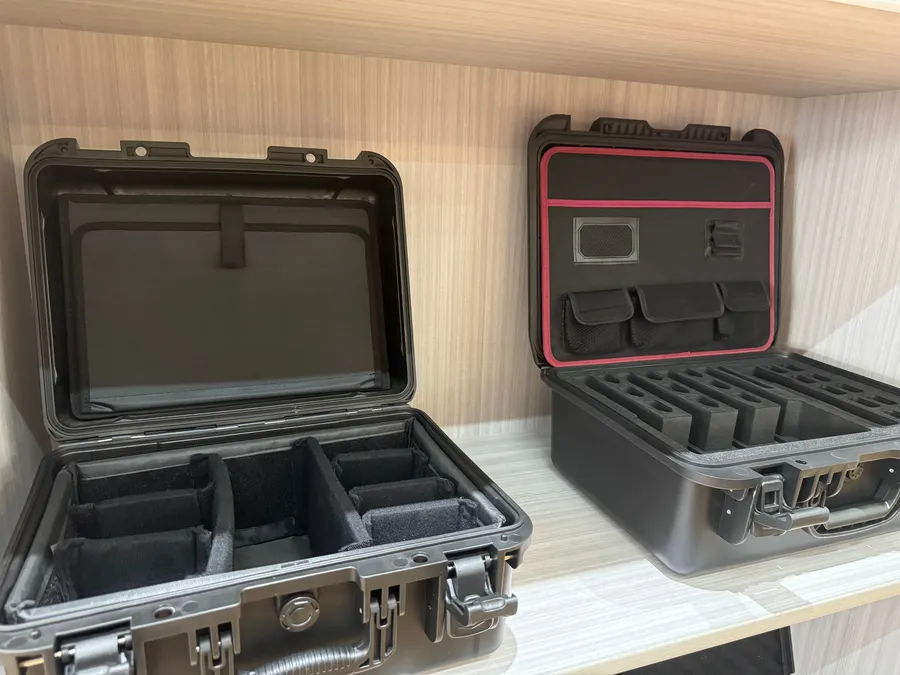
The most common camera-case mistake is choosing foam before reading the published envelope. Interior height is shared between the item, the carrier under it and the face above it, and the split between lid and base decides which half of that budget you can actually use. WL9-3221 publishes 300 by 200 by 200 mm internal with 165 mm of lid depth against 35 mm of base, so an item that stands 150 mm tall is a lid item bedded on a thin carrier, not a base item. WL4318 is the mirror image at 38 mm of lid and 140 mm of base over 407 by 187 by 178 mm internal, which is the right shape for one deep primary assembly with a flat plane above it. WL3218 splits evenly at 86 and 86 mm inside 308 by 230 by 172 mm, and that symmetry is the most forgiving for a mixed body-and-lens set. WL3308 is deliberately flat at 76 mm internal with 38 and 38, which suits bodies and short lenses laid down and is the wrong shell for a standing teleconverter stack. WL2813 puts 92 mm in the lid over 25 mm of base. Then subtract foam honestly: our camera-tagged models publish internal volume and usable interior volume as a pair, and across the 85 of them the usable figure is 13.3 percent to 20.3 percent lower, so WL9-2817 goes from 6.9 to 5.5 litres and WL8-4122 from 24.7 to 21.2 litres. A layout planned against the gross number is a layout that will not close evenly across the rim.
Published camera-class shells and the interior each one suits
| Model | Internal Mm | Lid Base Mm | Wall Mm | Net G | Internal Usable L | Sealing | Interior Fit |
|---|---|---|---|---|---|---|---|
| WL3308 | 325 x 236 x 76 (narrow 217) | 38 / 38 | 2.3 | 575 | 5.8 / 5.0 | Not offered | Laid-down bodies and short lenses in one plane; PE base with EVA face |
| WL2614 | 240 x 200 x 120 (narrow 180) | 60 / 60 | 2.2 | 460 | 5.8 / 5.0 | Not offered | Small carry set: one body, two primes, cards and batteries in a grid |
| WL712 | 308 x 250 x 96 (narrow 220) | 54 / 42 | 2.8 | 710 | 7.4 / 6.4 | Not offered | Wide floor for CNC pockets; shallow lid plane for media and filters |
| WL2813 | 260 x 200 x 117 | 92 / 25 | 2.8 | 800 | 6.1 / 5.2 | Not offered | Lid-held items on a thin carrier; EPE fill behind the tray |
| WL3218 | 308 x 230 x 172 (narrow 205) | 86 / 86 | 3.0 | 900 | 12.2 / 10.5 | Yes | Balanced mixed kit; layered base and top with convoluted face |
| WL9-3221 | 300 x 200 x 200 | 165 / 35 | 5.0 | 1230 | 12.0 / 9.6 | Yes | Tall standing items held in the lid; stiff thick wall for a loaded case |
| WL4318 | 407 x 187 x 178 | 38 / 140 | 3.0 | 1970 | 13.5 / 11.6 | Yes | One deep primary assembly bedded in the base, flat plane above |
| WL8-6216 | 582 x 300 x 130 | 100 / 30 | 3.3 | Not published | 22.7 / 19.5 | Yes | Long loads: rig, rails or a long lens carried horizontally |
| WL6-4618 | 430 x 290 x 165 | 140 / 25 | 4.7 | 2775 | 20.6 / 16.5 | Yes | Deep lid cavity for a full kit; ABS shell, machined PE base |
Selection guide: match the interior to how the kit is actually used
Start from the repack frequency, then the geometry, then the material. A photographer with a fixed list who wants the case back in the same configuration every week is a CNC-cut job: firm PE carrier, EVA face liners in the pockets, a separate shallow field for cards, batteries and lens caps so a missing item is visible when the lid closes. A kit that changes per assignment is a layered job - a die-cut or CNC base plus an egg-crate or convoluted top layer, which lets you add or remove thickness without re-cutting the whole bed. A dealer bundling a standard camera case for retail is a die-cut job, because once the layout is frozen the per-set cost drops and the layout stops drifting. A video or rig load, where the item is asymmetric and has protruding rods, handles and monitors, needs the protrusions machined into the base layer rather than a rectangular pocket that leaves them unsupported. Mixed-height photo sets are where a lid-dominant shell earns its place: with 165 mm of lid on WL9-3221 or 140 mm on WL6-4618 you can hold a standing zoom in the lid while the base carries the flat tray. And where the load includes electronics that you want protected against static discharge, the foam is specified as a conductive or anti-static material grade rather than a coated one; we treat that as a material substitution quoted per order and publish no electrical performance figure for it.
Where camera interiors like these are used
The obvious use is a working photographer's kit carried between locations by hand or vehicle, and the same interior logic covers the less glamorous enquiries we handle most often: aerial mapping and survey payloads, where a camera and its mount travel in a bed cut around the receiver and battery set; wildlife and sports loads, where a long lens drives the internal length and the shell spends the day outdoors; production and rental houses, where a cut bed doubles as an inventory checklist; live streaming and broadcast crews, where bodies, audio and stage gear travel as one mixed set; and drone operators, where the aircraft, controller, batteries and ND filters need five separate pockets rather than one cavity. Of the 155 models on our sheet, 85 carry the camera-equipment designation, and 70 of those publish a sealing option described as a compressible gasket in a moulded channel while 15 publish no seal offered on the shell; the sealed group is the one to shortlist for rain, spray, sand, snow and aircraft-hold duty, because it is the gasket and latch compression doing that work and not the resin. For wholesale and OEM programmes we quote these as drawing-controlled interiors on published shells on EXW or FOB terms; we do not sell as a retail single-unit channel, do not quote DDP landed prices and hold no overseas warehouse, so replenishment is planned on manufacturing lead time rather than on shelf stock.
Customising a camera interior
Interior work is the part of a camera order that pays, and it is not a special project at our end. Every model lists custom foam, custom thickness and custom shape as available, with CNC machining and die cutting both offered, and the build starts from one of three inputs: a drawing, a photograph of the packed kit, or a physical sample. Minimum order follows the kind of change rather than the size of the box - a custom foam interior starts from a single unit, while a moulded-in logo, a custom colour or an OEM programme begins at 300 pieces, and a bespoke mould begins at 3,000 pieces per component with about 125 days of tooling. An OEM build on an existing mould, interior included, is planned at about 45 days to first sample, and production orders carry a 30 percent deposit. On the shell side, camera-class hardware is published as a folding handle, hinges, moulded feet and lockable latch bodies that accept a standard padlock - two of the camera-tagged models add a telescopic handle - with latch count, a pressure-management valve, a document holder and a shoulder strap offered as configuration options. Send the item list with the tallest standing height and the longest single dimension, say whether the kit changes trip to trip, and we return the shell and the zone layout that fits those two numbers.
Buying notes, and the limits of what we publish
Read an interior as a configuration, never as a rating. On our model pages shock and impact protection are recorded as construction options that depend on the foam layout you specify, and we do not publish a drop height for them; waterproof, dust resistance, UV resistance, temperature range, stack load and load capacity are recorded as not measured where no test record exists, and no ingress code is stated on any of the 155 models. Corrosion resistance is the exception, recorded as measured because these are thermoplastic shells with no ferrous corrosion path. If a specification needs a figure we do not hold, accredited third-party testing can be commissioned as a separate work package on the exact SKU and configuration. Two commercial cautions save most of the arguments later. First, a photography case is not automatically a sealed case, since 15 of the 85 camera-tagged shells publish no sealing option at all, and the ten shells in our outdoor line are in that unsealed group. Second, a foam thickness that works in one model does not transfer to another, because the internal height, the rim depth and the lid-to-base split all change: WL3308 gives you 76 mm of internal height and WL9-3221 gives you 200 mm, and those are different interiors, not one interior in two boxes. Buy on your own measurements, confirm the closure, and ask for the drawing with a revision number so the next order gets the same camera case you approved.
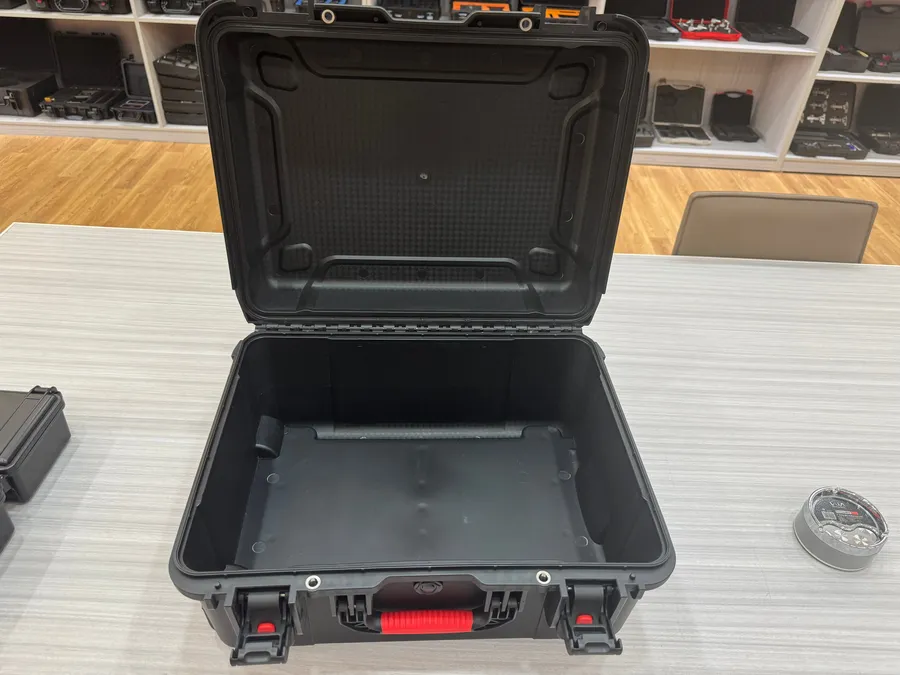
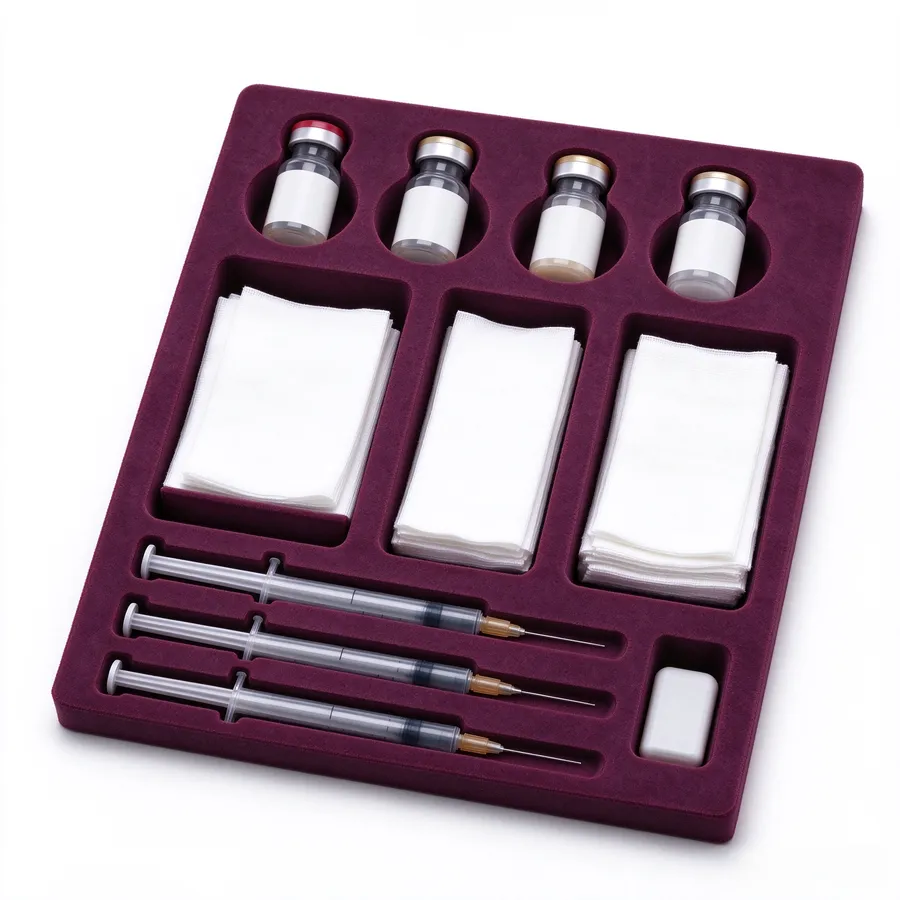
Customisation
Everything described above is configurable on a standard shell: interior layout (pick-and-pluck, die-cut or CNC-cut), foam grade and thickness, colour, logo method, latch and lock count, pressure-equalisation valve, cable ports, document holder and identification plate. A bespoke exterior geometry requires a new mould — 125 days, from 3,000 units per moulded component.
Procurement considerations
| Question | What to send us |
|---|---|
| Which shell fits? | Equipment L × W × H as packed, plus required clearance per axis |
| What does it cost? | Order quantity and estimated annual quantity — the two drive different answers |
| Is tooling needed? | Whether an existing shell clears the envelope with usable foam depth |
| Lead time? | Your required delivery date, not just the order date |
| Certification? | The exact standard your tender names — we will say whether we can test to it |
| Freight? | Destination and preferred terms; carton and pallet data supplied with the quotation |
Comparison and selection guide
The tables on this page exist because a protective case is chosen by comparing three things: the envelope, the environment and the handling chain. Where no table applies, the rule below is.
| Situation | What To Do |
|---|---|
| Changing kits | Layered pluck foam, rebuilt by hand. |
| Fixed rental fleet | CNC silhouette with serial pockets and an inventory list. |
| Harsh locations | Sealed shell plus desiccant provision in the lid. |
- Size on internal dimensions plus clearance, never on a product name.
- Choose the carrying method before the shell: it changes the series, not just the price.
- Specify the interior last, and decide up front whether the end user will reconfigure it.
What type of foam is suitable for camera equipment? relates to Foam Insert Guide. Related families: Camera & Photography Cases / Optical Equipment Cases / Electronics Cases / Outdoor Protective Cases / Custom Protective Cases / Instrument & Equipment Cases. Related sectors: field and industrial equipment. Continue in the Foam Insert Guide cluster.
This page is written from our own production data. If your requirement differs, send the dimensions and we will tell you which of the 155 models fits, or whether a custom route is needed.