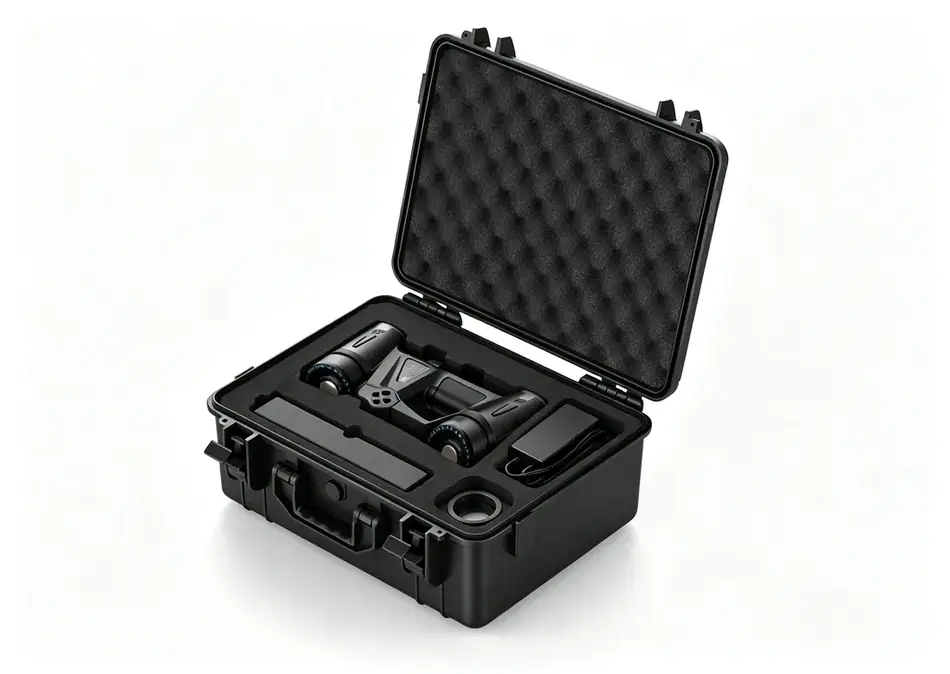
Why is custom foam important for precision equipment?
Custom foam matters for precision equipment because generic padding protects the box while the instrument still moves inside it. A precision item is only safe when every component sits in its own pocket, restrained on all six faces, so the foam becomes the load path and the item never hits the shell wall or another part. That is the whole argument: a moulded shell spreads an impact over a hard structure, but a keyed insert decides how far the fragile element travels and how fast it stops. Off-the-shelf cube foam can be re-packed wrong, compresses unevenly, and leaves air gaps that let a lens or a sensor rotate. Custom foam is cut to one layout, so the protection is repeatable on unit one and unit one thousand, and it separates dense parts from brittle ones instead of letting them share a cavity.
Key points
- A keyed insert makes foam the load path so the item never reaches the shell wall.
- Restrained on six faces beats thick padding on two or three faces.
- Custom foam is repeatable; re-packed cube foam is a different protection every time.
- Separate dense parts from brittle ones so a battery cannot travel inside a drop.
- For most precision gear, greater thickness protects more than a harder foam does.
- Specify the insert from a real sample so the closing load falls on foam, not on a knob.
Precision equipment fails by transmission, not by contact
A rugged tool survives a knock because its housing is its structure. A precision instrument fails for a different reason: the shock is not stopped at the outer case but travels through whatever sits between the impact and the sensitive element. A collimated optic loses calibration when the mount sees a sharp jolt; a MEMS sensor cracks when a rigid connector is loaded sideways; a machined gauge reads wrong after its reference face takes a point load. None of that requires the outer box to look damaged. The damage is a function of the peak force that reaches the delicate part and the direction it arrives from. Custom foam matters because it is the only element in the system that is designed specifically to manage that force, and it can only do so if it is cut to the geometry of the part it protects.
What a keyed insert actually changes in a drop
A drop is an energy problem. The impact carries a fixed amount of energy into the case, and the only way to lower the peak force delivered to the instrument is to lengthen the distance and time over which it decelerates. A moulded plastic shell is stiff: it barely moves, so anything resting against it decelerates almost instantly and sees a high peak. A properly cut foam insert compresses in a controlled way, spreading the same stop over a longer distance. When we key a pocket on all six faces, the item is suspended in foam rather than resting on a hard floor, and the foam becomes the load path. That is why a generic lid of cube foam leaves a precision instrument unprotected: the cubes are only restrained on the surfaces where someone happened to press them, and a gap on one face is a hinge the instrument can pivot around.
Six-face restraint and the float principle
The rule that separates a protective insert from a packing afterthought is that the fragile element is surrounded on all six faces and does not touch the shell wall anywhere. In practice that means the base foam, the item, and the top foam together must exceed the internal depth of the case, so the insert compresses against the lid rather than the lid pressing on the item. For a deeper instrument, choose a shell with enough internal height to hold the foam budget: an internal 507 by 385 by 190 mm in our ABS WL6-5522, or a taller 395 by 295 by 275 mm in WL8-4430, are examples of interiors that leave room for a real cushioning budget around a bulky precision body. A shallow instrument tray, on the other hand, can work in a slim interior like our WL3308 at 325 by 236 by 76 mm. These are published per-model figures, so always size against the datasheet for the exact SKU.
Compare the cutting methods before choosing one
| Method | Best For | Tooling | Precision Fit | Repeatability |
|---|---|---|---|---|
| Pick and pluck | mixed kits, changing contents | none / low | moderate | medium |
| Die-cut | high-volume fixed layout | die | high | high |
| CNC-cut | tight pockets, complex shapes, low to mid volume | none / digital | very high | high |
| Layered / laminated | stepped depths, mixed component heights | none | high | high |
| Egg-crate / convoluted | surface-contact cushioning over parts | none | low | medium |
Why thickness protects more than density for precision gear
Buyers often ask for a firmer foam when the better answer is a thicker one. Peak force falls as the stopping distance grows, so adding cushioning depth around a fragile element does more for survival than switching to a denser, harder block, which can raise the transmitted force by resisting compression. Density still matters in its place: a firmer layer under a heavy component stops that component from sinking through soft foam and touching the wall, which is exactly what a layered or laminated insert handles. The practical pattern is a graduated stack, softest nearest the sensitive part, firmer at the base under the mass, so each layer does the job its grade is suited to. Our inserts are built from PE, EPE and EVA grades in base, top and layered configurations, and the choice of grade and thickness follows from the mass and fragility of the item, not from a default.
How a custom insert is specified from a sample
A good insert cannot be drawn from a photograph; it comes from the real object and a real packed layout. Send a representative unit or a dimensioned sketch showing each component in transport configuration, plus how the kit is opened in the field: does the operator need to see at a glance that a part is missing, or handle it with gloves, or carry it into a clean environment. Those answers set pocket orientation, the pull-tab or finger relief, and whether a part is captured fully or partially. Custom foam is one of our lowest-friction OEM steps: it can start at a single piece and can be keyed to your exact layout, which is why most precision equipment ships in our cases with a bespoke insert rather than a generic one. We do not fabricate test numbers for an insert; where a measured value matters, we publish it per model.
Fit tolerance, dust, and the closing-load problem
Precision parts are unforgiving of a sloppy pocket. Too loose and the item tilts and concentrates the load on one corner; too tight and the lid springs back or the item is stressed every time it is removed. The tolerance is set by the foam grade and the cut, not by stuffing gaps, because compressed foam slowly takes a set and loses the restraint that mattered. Dust is the other silent failure: a fine abrasive grain under a keyed pocket can scratch an optical surface during transit vibration, so the shell closes on the foam and the insert keeps debris away from the sensitive faces. As with any case, the seal only works if the lid is pulled evenly, which is a latch-count question; we provide measured values per model and do not attach a rating a specific unit has not been tested to. For lens and gauge work, pair a snug insert with a case that lists a seal option.
Where custom foam earns its cost
The inserts that justify bespoke tooling are the ones where a single damaged unit costs more than the foam decision. Optical instruments and surveying heads, calibrated measurement and gauge equipment, medical diagnostic modules, laboratory analyzers, camera and imaging systems, drone payloads and datalink units, and defense electronics all share the same profile: brittle internals, tight tolerances, and a high replacement or recalibration cost. What differs is only the pocket geometry and the cushioning budget, which is why a manufacturer can reuse the method across those fields while cutting each layout fresh. The insert is quoted as part of the case on wholesale and OEM terms, not as an accessory sold loose, and it is what turns a generic container into a protective system for that exact instrument.
Custom and OEM options for precision inserts
We produce keyed foam to a supplied sample or layout, with grade, thickness and pocket geometry chosen for the component masses and fragilities in the kit. The business parameters follow our published terms: an OEM first sample on an existing case is about 45 days, a new tool is about 125 days, and orders carry a 30 percent deposit, while custom foam itself can start from a single piece so you can validate the fit before committing to volume. We work wholesale and OEM on EXW or FOB terms, do not sell retail singles as a distribution channel, do not quote DDP, and hold no overseas warehouse. Send one instrument and its packed layout and we will return a shell-and-foam proposal sized to those two facts.
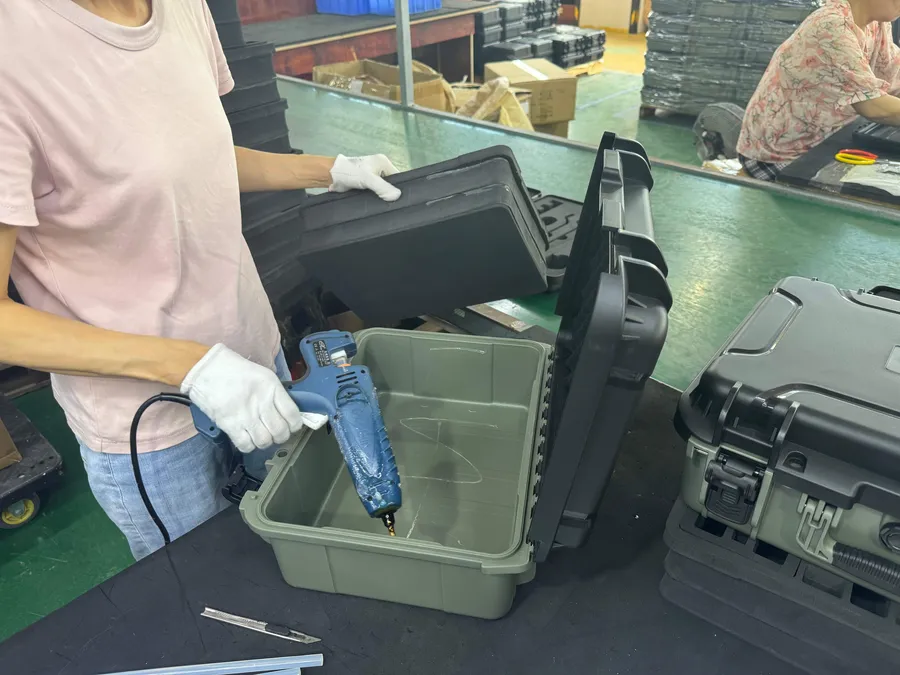
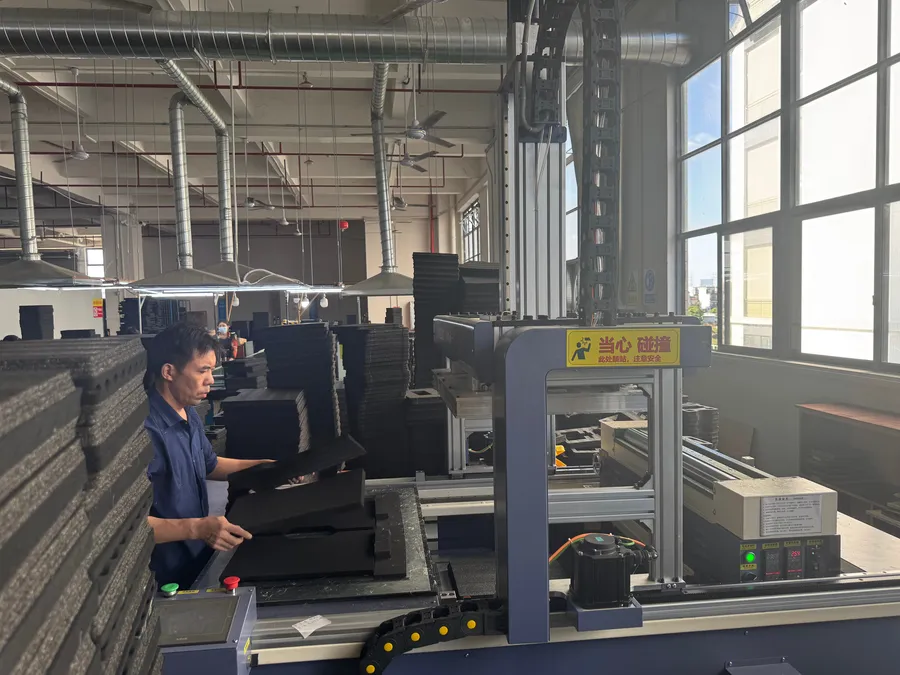
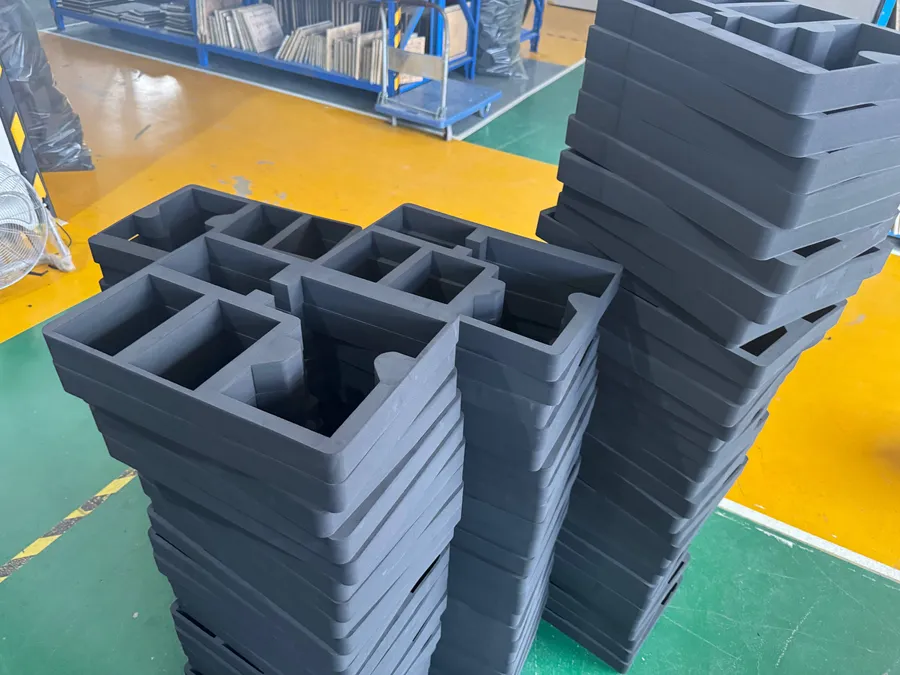
Customisation
Everything described above is configurable on a standard shell: interior layout (pick-and-pluck, die-cut or CNC-cut), foam grade and thickness, colour, logo method, latch and lock count, pressure-equalisation valve, cable ports, document holder and identification plate. A bespoke exterior geometry requires a new mould — 125 days, from 3,000 units per moulded component.
Procurement considerations
| Question | What to send us |
|---|---|
| Which shell fits? | Equipment L × W × H as packed, plus required clearance per axis |
| What does it cost? | Order quantity and estimated annual quantity — the two drive different answers |
| Is tooling needed? | Whether an existing shell clears the envelope with usable foam depth |
| Lead time? | Your required delivery date, not just the order date |
| Certification? | The exact standard your tender names — we will say whether we can test to it |
| Freight? | Destination and preferred terms; carton and pallet data supplied with the quotation |
Comparison and selection guide
The tables on this page exist because a protective case is chosen by comparing three things: the envelope, the environment and the handling chain. Where no table applies, the rule below is.
| Situation | What To Do |
|---|---|
| Fastest | Standard shell plus CNC foam — typically 45 days from approved drawing. |
| Branded | Standard shell plus custom colour and logo — MOQ applies to the resin colour. |
| Bespoke geometry | New mould — 125 days, MOQ from 3,000 units per component. |
- Size on internal dimensions plus clearance, never on a product name.
- Choose the carrying method before the shell: it changes the series, not just the price.
- Specify the interior last, and decide up front whether the end user will reconfigure it.
Why is custom foam important for precision equipment? relates to Foam Insert Guide. Related families: Custom Protective Cases / Optical Equipment Cases / Instrument & Equipment Cases. Related sectors: field and industrial equipment. Continue in the Foam Insert Guide cluster.
This page is written from our own production data. If your requirement differs, send the dimensions and we will tell you which of the 155 models fits, or whether a custom route is needed.