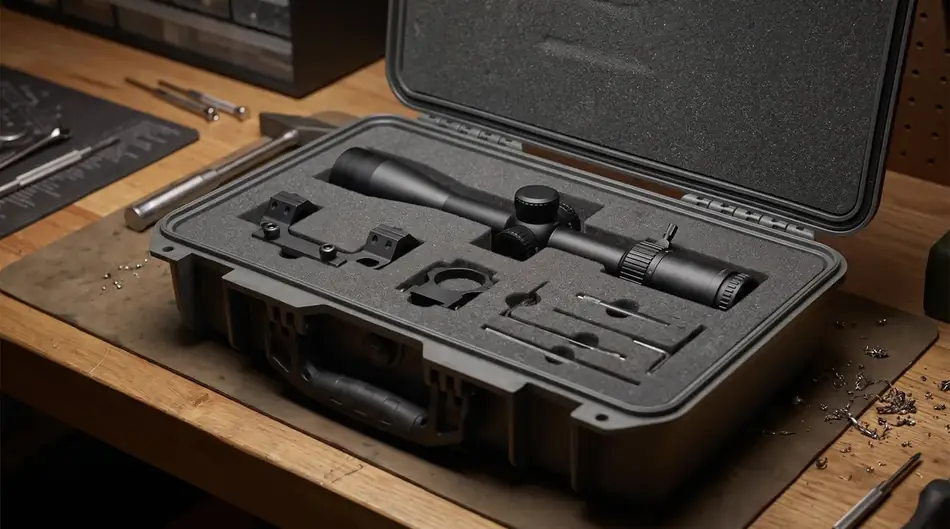
Modular Storage for Engineering Cases: One Footprint, Many Depths, Interiors You Can Revise
Modular storage in a hard-shell case library means three specific things, not a marketing word: one external footprint offered at several internal depths, an interior that can be revised without tooling, and a carry option that is chosen per shell rather than per range. Our 155 active mouldings are built that way. The 437 x 308 mm internal cavity is published in eight heights, from 129 mm on KX-84814 to 230 mm on KX-84824, so one shelf, one carton plan and one pallet footprint serve a family of kits; the 380 x 267 mm cavity appears in seven heights from 115 to 215 mm on one constant 405 x 325 mm external shell; the 483 x 363 mm cavity in six; the 500 x 400 mm cavity in four. Interiors are cut in pick and pluck, die-cut, CNC-cut, EVA, PE or EPE and arranged as top foam, base foam, egg-crate, layered or custom cut, quoted from one unit with no tooling, which is what makes a kit revision cheap. Carry hardware is a per-model field: 136 mouldings are listed with a fixed folding handle and a stacking foot, and 19 are listed with a telescopic handle in addition to that fixed handle plus two wheels, published at 240, 295, 310, 385 and 485 mm of extended height on the 11 models that record the figure. What we publish nowhere: a stack load, a load capacity, a water or dust class or a fixed pallet count, because none of those is measured for any model.
Key points
- Choose a footprint first and a depth second; a kit that grows should move up a height step, not into a different store layout.
- The 437 x 308 mm internal family runs in eight heights from 129 to 230 mm; the 380 x 267 mm family runs in seven with one constant external shell.
- Custom foam starts at one unit with no tooling, so a revised kit list is a new cut rather than a new mould.
- Stackability is a moulding feature on 136 of 155 models; we publish no stack load or load capacity for any model, so racking stays your engineering decision.
- On the 19 wheeled shells the telescopic handle is fitted in addition to a fixed folding handle, and those 19 are the ones listed as not stackable.
- Carton data is published on 64 models and the stepped families share one carton footprint, which is where the freight saving in modular sizing actually appears.
- Colour, logo and OEM hardware start at 300 units and a new exterior mould at 3,000 units and 125 days; terms are EXW or FOB, wholesale and OEM only.
Modular Storage for Engineering Cases: What The Word Modular Actually Buys
In a moulded case library, modular is a statement about the moulding programme and not about clip-on accessories. Three things make it real. First, size families: a single external footprint repeated at several internal depths, so depth is the variable you buy and length and width stay fixed for the shelf, the van bay, the rack pitch and the pallet pattern. Second, revise-able interiors: the foam is cut per configuration from one unit with no tooling, so when a kit gains a torque wrench or loses a spare module, the case does not become obsolete. Third, hardware as a field rather than a claim: handle type, wheels, latch count, feet, lock body and the optional pressure valve, shoulder strap or document holder are recorded model by model or stated as configuration options.
What modular does not buy is a rating. Nothing in a family ladder creates a water class, a dust class, a free-fall figure or a stack load, and we record those fields as not measured on all 155 mouldings. A deeper shell in the same family is not stronger than a shallow one; wall thickness is its own published figure and it varies inside families, which is why we answer strength questions with the wall number and the moulding, not with the series name.
One Footprint, Many Depths: The Published Size Families
The table is taken from the internal dimensions recorded for each model. Where an external figure is given it is the figure for that SKU, and where two shells share a cavity but differ in carry, that difference is stated rather than averaged into a range. This is the part of the catalogue that a store layout is built on: pick a row and the whole kit ladder lives in the same footprint.
| Internal Footprint | Published Depths | Models In Family | What Changes |
|---|---|---|---|
| 437 x 308 mm | 129, 145, 164, 164, 180, 180, 214, 230 mm | KX-84814, KX-84815, KX-84818, KX-85021, KX-84820, KX-85022, KX-84823, KX-84824 | Depth, gasket and carry: KX-84818 stacks with a gasket; KX-85021 and KX-85022 keep the same cavity with wheels and a telescopic handle and are not stackable |
| 380 x 267 mm | 115, 140, 140, 165, 170, 195, 215 mm | KX-84113, KX-84115, KX-84116-2, KX-84117, KX-84119, KX-84121, KX-84123 | Depth only: all seven are published on a 3.4 mm wall with a gasket recorded, as stackable, on one constant 405 x 325 mm external shell |
| 483 x 363 mm | 140, 165, 190, 195, 220, 220 mm | KX-85215, KX-85218, KX-85424, KX-85221, KX-85224, KX-85427 | Depth and carry: the four 517 x 430 mm shells stack; KX-85424 and KX-85427 are the wheeled T Series versions of the same cavity at 6,000 g and 6,100 g empty |
| 500 x 400 mm | 165, 210, 220, 305 mm | KX-85819, KX-85823, KX-85827, KX-85835 | Depth, then carry: KX-85819 and KX-85823 stack on a 4.75 mm wall; KX-85827 and KX-85835 are 5.0 mm wheeled shells with a published 295 mm handle height |
| 385 x 313 mm | 120, 145, 180, 205 mm | KX-84114, KX-84116, KX-84120, KX-84122 | Depth only, one of the mid-size ladders used for instrument and spares kits |
| 308 x 230 mm | 64, 118, 172 mm | KX-3207, KX-3213, KX-3218 | Depth and lid split: 32/32, 86/32 and 86/86 mm lid over base, all on a 3.0 mm wall with a gasket, 570 g to 900 g empty |
| 355 x 280 mm | 60, 70, 80 mm | KX-3607, KX-3608, KX-3609 | Depth on a constant 360 x 310 mm external shell, 3.0 mm wall, gasket recorded, 800 g to 900 g |
| 455 x 338 mm | 84, 116, 148 mm | KX-4610, KX-4613, KX-4616 | Depth and lid split: KX-4610 is 42/42 mm at 1,115 g, KX-4613 is 74/42 mm at 1,370 g on a 3.0 mm wall |
| 290 x 220 mm | 126, 135, 185 mm | KX-3114, KX-83615, KX-83620 | Depth and wall: KX-3114 at 2.2 mm and 675 g, KX-83615 and KX-83620 at 3.3 mm with a gasket recorded |
Interiors: Layered Foam, Trays And The Revision That Costs Nothing
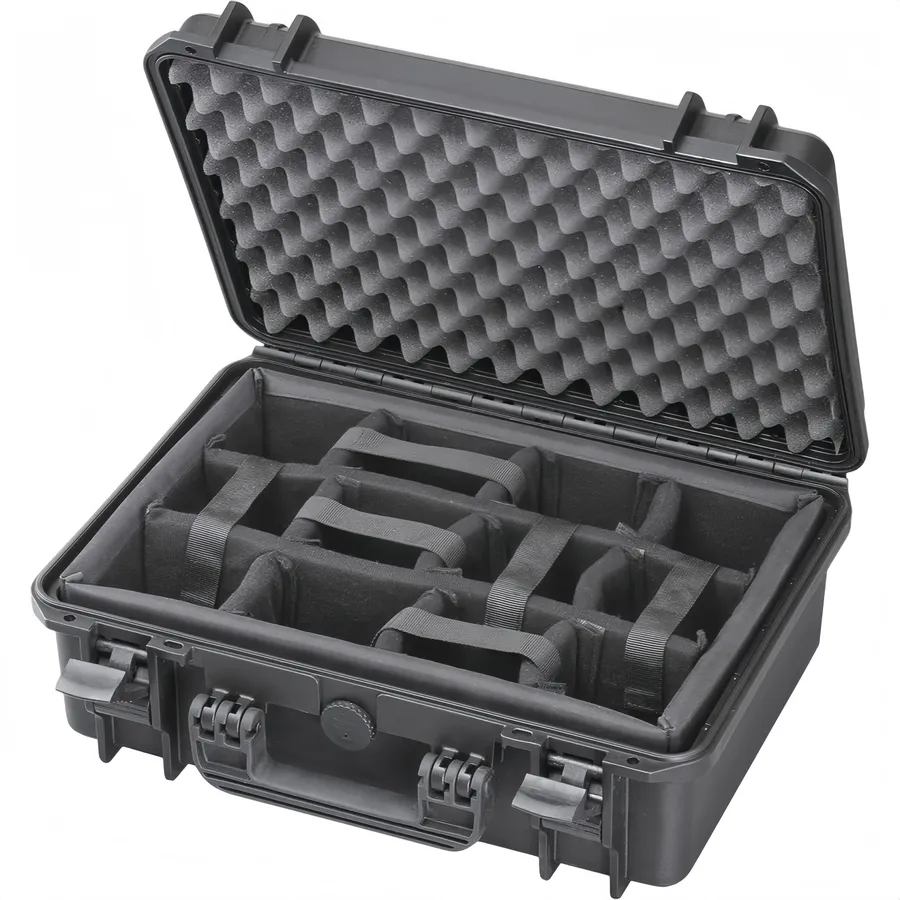
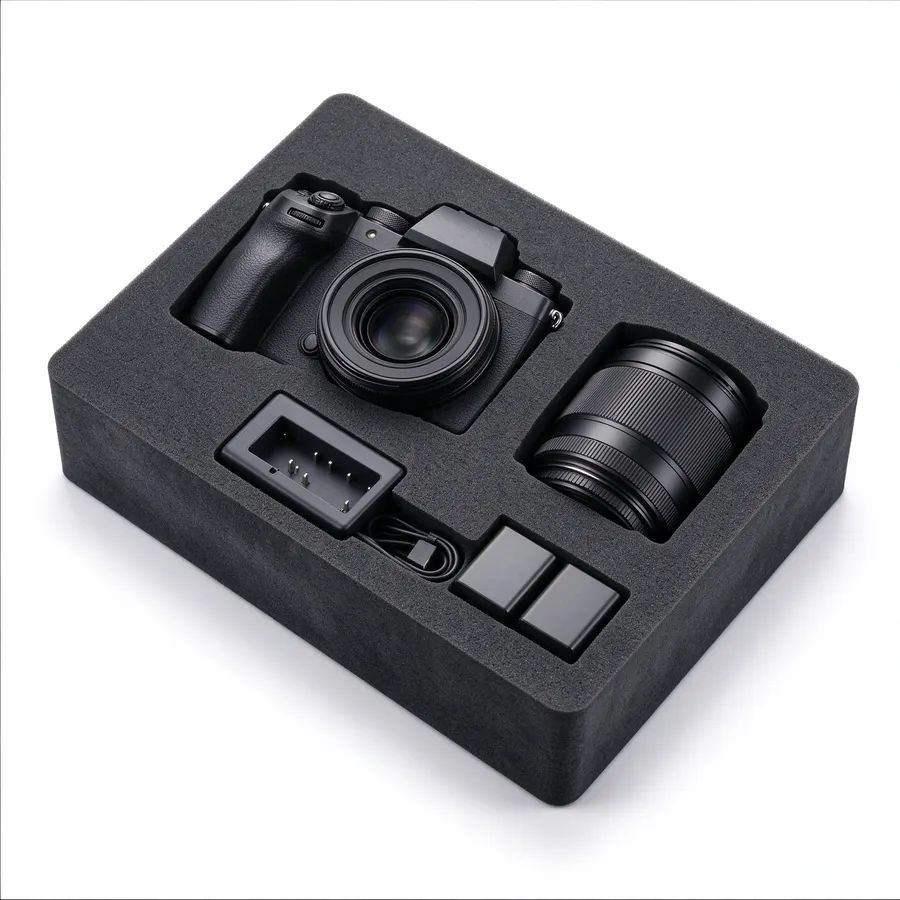
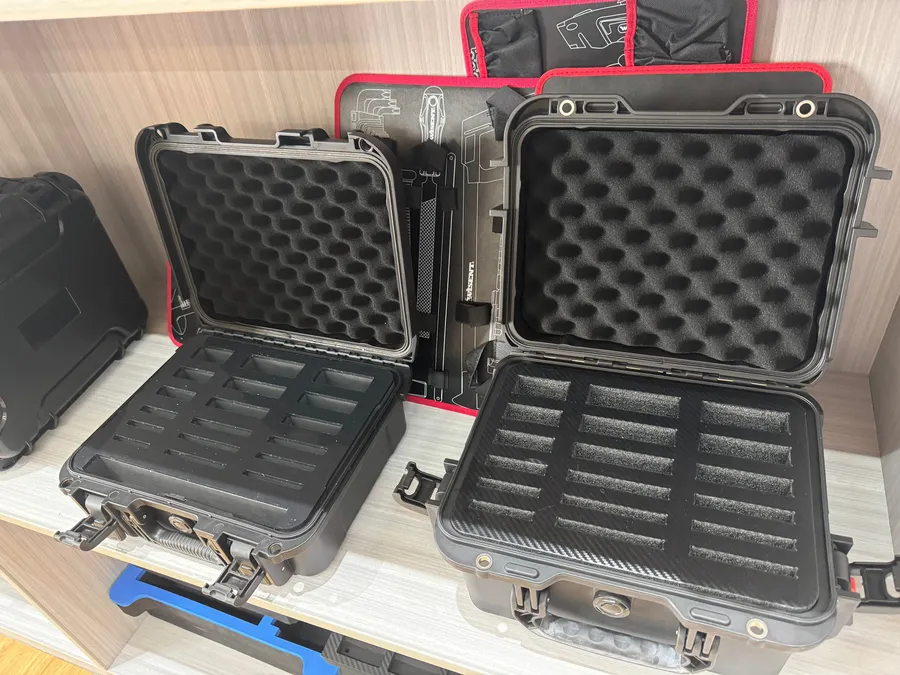
The interior is where modularity is decided in practice, and every moulding in the library is published with custom foam available and with the drawing requirement recorded as the packed equipment, a drawing of it, or a physical sample. Our published foam types are pick and pluck, die-cut, CNC-cut, EVA, PE and EPE, and the published structures are top foam, base foam, egg-crate or convoluted, layered, and custom cut, in cross-linked PE, EVA or EPS by zone. The practical reading is that a two-layer arrangement, a shallow parts tray under the lid and a full-depth pocket for the main unit are all available on the same shell, and the choice is made from the kit list rather than from the catalogue page.
Pick and pluck is the revision-friendly option: a kit that changes between jobs can be re-plucked in the field without a new order, at the cost of repeatability when someone audits the bay count against a sheet. Die-cut and CNC-cut layouts are the option where the kit is fixed, because the bay count is machined and a missing item is visible at a glance; a CNC cut also carries relief under handles, connector hoods and terminals, which is where a hand-torn pocket presses on a part. Layered structures with a separate top foam are how one shell serves two different kits on two different weeks, which is the cheapest form of modular storage in the whole programme.
One boundary belongs here rather than in a footnote. Foam is a construction option and not a rating: the shell alone carries no shock figure in our data, and where a tender asks for a documented impact result, that result belongs to the assembled configuration, shell plus gasket plus the named foam build, and we quote accredited laboratory testing of that build as a separate work package. The wall thickness that is published on 148 of 155 mouldings, from 2.0 mm to 6.0 mm, is a structural figure about the moulding, not about the packed kit.
Stacking, Racking And The Figures We Do Not Publish
Stackability is published as a moulding feature on 136 of the 155 models: a base shaped to sit on the lid of the model below. It is not a permitted weight. We publish no stack load and no load capacity for any model, in any family, so a racked store, a mezzanine line or a vertical pallet pattern is an engineering decision made outside our catalogue, using your shelf, your floor loading and your contents. What we do publish is the inputs to that decision: internal and external dimensions, wall thickness on 148 models from 2.0 to 6.0 mm, lid depth from 16 mm to 320 mm and base depth from 15 mm to 168 mm on the 100 mouldings that record them, usable volume from 0.3 to 111.6 litres, net weight on 93 models from 100 g to 15,320 g, gasket presence on 124, and carton dimensions with pieces per carton on 64.
The 19 models that are not listed as stackable are exactly the 19 fitted with wheels and a telescopic handle, and that is the design trade stated plainly: a shell built to be rolled is built with a wheel housing and a handle channel in the base, and it is a floor-moving tool rather than a shelf unit. A mixed store therefore splits into two populations, the stackable family ladder on one side and the wheeled shells on the other, and the same cavity can appear on both sides, as the 437 x 308 mm internal does on KX-84818 and again on KX-85021.
Telescopic Handle Design for Outdoor Cases
Outdoor and field-service buyers ask about the handle because the trip ends with a person and a kerb rather than a fork truck. In our library the telescopic handle is not a substitute for the carry handle: all 155 mouldings are published with a fixed folding handle, and the 19 shells that also record a telescopic handle are recorded with the handle style as telescopic plus fixed folding, which is what lets a loaded case be lifted over an obstacle instead of being dragged by a handle that is not designed for that. Extended height is published per model on 11 of the 19, at 240, 295, 310, 385 and 485 mm, and we publish it as a number for that SKU rather than as an adjustment range for the series.
Wheels are recorded on the same 19 shells, as two wheels each, and against the published empty weight the choice becomes arithmetic rather than preference. KX-85726 gives 520 x 296 x 210 mm internal, 32.3 litres (25.8 usable) on a 4.2 mm wall at 5,600 g empty with a published 385 mm handle. KX-87336 gives 650 x 430 x 310 mm internal, 86.6 litres (69.3 usable) on a 5.0 mm wall at 10,660 g with a 240 mm handle. KX-97227 gives 590 x 435 x 210 mm internal on a 6.0 mm wall, 53.9 litres (43.1 usable), 10,000 g empty and a 485 mm handle, and ships one piece in a 715 x 515 x 280 mm carton. At the top of the ladder KX-88442 is published at 740 x 518 x 364 mm internal, 139.5 litres (111.6 usable), 15,320 g empty and a 295 mm handle.
Two of those figures explain why the shell and the route have to be chosen together. A 485 mm extended handle on a 10,000 g empty shell is a trolley for smooth yard surface; a 240 mm handle on a 10,660 g shell is a kerb aid rather than a long-distance carry. And on the outdoor-listed group specifically, 11 of 145 mouldings carry wheels and a telescopic handle while 134 are listed as stackable, so the outdoor range is overwhelmingly a stacking family, and a wheeled shell is a deliberate exception inside it rather than the default. Seals follow the same per-model discipline: 114 of the 145 outdoor-listed shells record a compressible gasket in a continuous moulded channel and the rest record none offered, and no water or dust figure exists for any of them.
Carton And Freight Arithmetic That Comes Out Of Stepped Footprints
Modular sizing pays in freight as well as in storage, and the evidence is in the carton field rather than in a promise. KX-3207, KX-3213 and KX-3218 share a 308 x 230 mm internal cavity at three depths, and all three are published in one 645 x 530 mm carton footprint whose height grows from 430 to 520 to 550 mm while the count drops from 24 pieces to 16 to 12. That is what a pallet pattern looks like when it is planned across a family: one deck area, one stack height allowance, three kit sizes. KX-3508 ships 20 pieces in a 730 x 615 x 428 mm carton and KX-4010 ships 10 in a 710 x 410 x 500 mm carton, which is how the same order can be split between a mixed pallet and a single-depth pallet.
The wheeled shells ship differently, and the published figures say so: KX-85022 one piece in 495 x 375 x 245 mm, KX-5126 one in 520 x 405 x 270 mm, KX-96027 one in 580 x 250 x 415 mm, KX-96127 one in 640 x 625 x 280 mm, KX-66232 one in 620 x 465 x 355 mm and KX-97227 one in 715 x 515 x 280 mm. We publish no fixed pallet count for any model, because pallet quantity is calculated from the carton footprint against your pallet standard, and we publish no 20GP, 40GP or 40HQ figure either; both are returned with the quotation once you send the standard you use and the quantity you plan.
Applications: Where A Family Ladder Beats A One-Off Box
A plant room or workshop store is the clearest case. Kits differ mainly in how much stuff is in them, so one footprint with a depth ladder gives a shelf plan that survives product changes: the 380 x 267 mm family in seven heights covers most instrument-and-spares kits, and the 437 x 308 mm family in eight covers the same kits once a laptop, a charger brick and a consumables tray are added. Where the same team runs both a fixed shop store and a mobile van kit, the shared cavity is what lets the van load be lifted from the shelf without re-planning either.
Field service, survey, instrumentation commissioning, plant shutdown crews, rental fleets and third-party repair depots all have the same requirement in different clothes: a container set that can be re-issued when the kit list changes. For outdoor work specifically the library publishes 145 mouldings with internal longest side from 115 mm to 880 mm, usable volume from 0.3 to 47.0 litres, wall thickness on 138 of them from 2.0 to 6.0 mm, net weight on 85 from 100 g to 10,000 g and carton data on 63, in PP, engineering PP and ABS shells. Where the crew moves long items, a separate long-shell ladder exists in the same programme and is covered on its own page rather than being folded into this footprint discussion.
Customisation And The Order Path
Custom foam starts at one unit with no tooling, and that is the entry point for a modular programme: the first kit list becomes a cut, the pilot run proves the pocket, and the shelf plan is set afterwards. Colour, logo and OEM hardware start at 300 units; OEM work on an existing mould is quoted at 45 days from first sample; a new moulded exterior starts at 3,000 units per moulded component and 125 days, which is the number to plan against when a footprint family has to be added to the programme rather than re-arranged inside it. Handle, latch count, feet, hinge and a lock body that accepts a standard padlock are recorded as fields per model; pressure valve, shoulder strap and document holder are published as configuration options.
KeXin New Materials (Guangdong) Co., Ltd. supplies wholesale, OEM and ODM only, on EXW or FOB terms. We do not sell retail, do not quote delivered-duty-paid prices and keep no overseas warehouse stock. Payment is a 30 per cent deposit with the balance after inspection before shipment. Send the kit list or the packed equipment, the depths you expect to need, the quantity in the first order and the annual estimate, and we return the family or families that cover the ladder, the published carton data for those models, and a written statement of which requested figures we can measure and which we cannot.
What We Publish And What We Leave Blank
Published per model: internal and external dimensions, wall thickness on 148 of 155 mouldings from 2.0 to 6.0 mm, lid and base depth on 100, internal volume up to 139.5 litres and usable volume from 0.3 to 111.6 litres, net weight on 93 models from 100 g to 15,320 g, shell material across PP, engineering PP and ABS, gasket presence on 124, stackability on 136, wheels and telescopic handle on 19 with extended height on the 11 models that record it, and carton dimensions with pieces per carton on 64. The series labels in the library are 0, 1, 6, 7, 8, 9 and T, and the T Series is the 19-moulding wheeled group.
Recorded as not measured and left blank for every model: any water or dust class, any impact or free-fall figure, any stack load, any load capacity, any temperature range, ultraviolet exposure, a fixed pallet quantity, container loading figures and a CAD file. Where a specification names one of those, we quote accredited laboratory testing of the exact shell, gasket and foam build as a separate work package, and we say in the same reply which measurements already exist for the model you shortlisted. Buying a modular programme on a series name rather than on those per-model fields is the failure mode we see most often, and it is the reason this page states the counts as counts.
Customisation
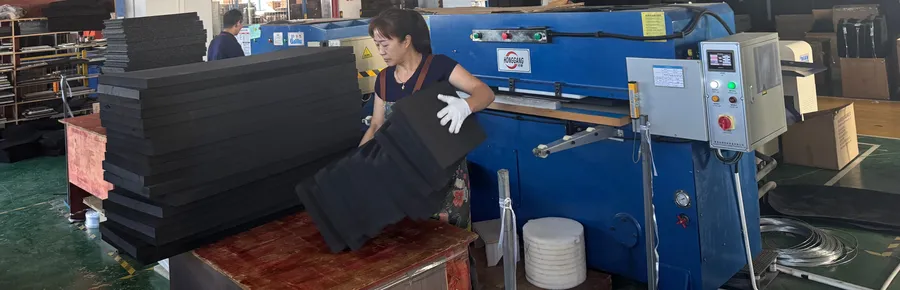
Everything described above is configurable on a standard shell: interior layout (pick-and-pluck, die-cut or CNC-cut), foam grade and thickness, colour, logo method, latch and lock count, pressure-equalisation valve, cable ports, document holder and identification plate. A bespoke exterior geometry requires a new mould — 125 days, from 3,000 units per moulded component.
Procurement considerations
| Question | What to send us |
|---|---|
| Which shell fits? | Equipment L × W × H as packed, plus required clearance per axis |
| What does it cost? | Order quantity and estimated annual quantity — the two drive different answers |
| Is tooling needed? | Whether an existing shell clears the envelope with usable foam depth |
| Lead time? | Your required delivery date, not just the order date |
| Certification? | The exact standard your tender names — we will say whether we can test to it |
| Freight? | Destination and preferred terms; carton and pallet data supplied with the quotation |
Comparison and selection guide
The tables on this page exist because a protective case is chosen by comparing three things: the envelope, the environment and the handling chain. Where no table applies, the rule below is.
| Situation | What To Do |
|---|---|
| Marine or wet | Sealed configuration with a drain-friendly interior and stainless hardware. |
| Dry and dusty | A close-fitting rim and a lid that can be opened one-handed without spilling contents. |
| Carried far | Under 10 kg packed, with a padded handle or shoulder webbing. |
- Size on internal dimensions plus clearance, never on a product name.
- Choose the carrying method before the shell: it changes the series, not just the price.
- Specify the interior last, and decide up front whether the end user will reconfigure it.
Modular Storage for Engineering Cases: One Footprint, Many Depths, Interiors You Can Revise relates to Foam Insert Guide. Related families: Outdoor Protective Cases / Tool Cases / Equipment Transport Cases / Custom Protective Cases / Rolling Cases. Related sectors: field and industrial equipment. Continue in the Foam Insert Guide cluster.
This page is written from our own production data. If your requirement differs, send the dimensions and we will tell you which of the 155 models fits, or whether a custom route is needed.