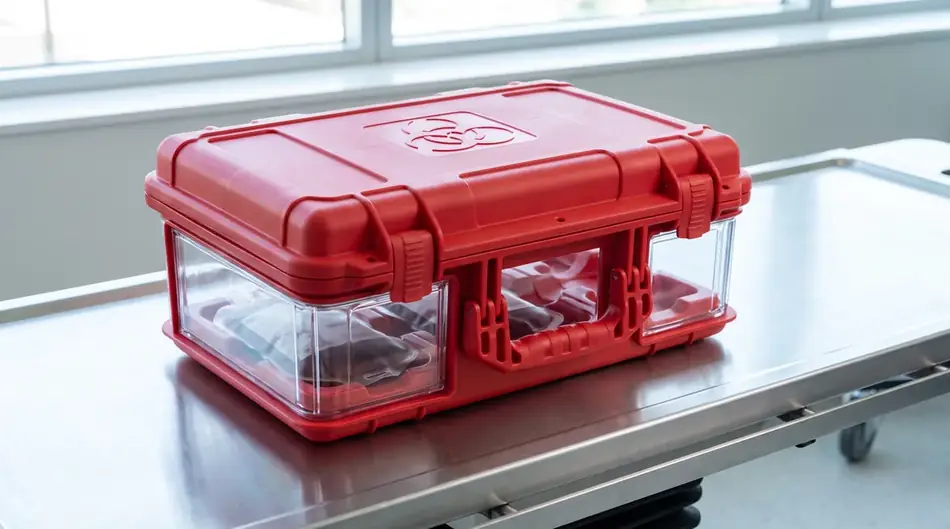
Forensic detection equipment box with custom foam cutouts?
A forensic detection equipment box with custom foam cutouts is specified from the inside, because the cut method, the material of each layer and the lid-to-base depth split decide whether a kit arrives ready to use, while the shell only decides whether it fits. On our sheet all 155 models offer pick and pluck, die-cut and CNC-cut interiors, custom foam is quoted from one unit, and 100 models publish a lid depth and a base depth that add exactly to the internal cavity height. Our catalogue has no forensic tag; the 110 models indexed for law-enforcement duty are the working starting point, and water and dust performance are recorded as not measured on every model, so nothing here is an ingress or decontamination claim.
Key points
- Custom foam is quoted from one unit on all 155 models, so a scene kit layout can be proved before any tooling spend.
- To price an interior we need a drawing, a photograph of the packed kit or a physical sample, never a model number alone.
- Lid and base depths are published on 100 of 155 models and always add to the internal cavity height on those pages.
- Two shells of similar height can put depth on opposite sides: 165 mm lid with 35 mm base, or 38 mm lid with 140 mm base.
- Pick and pluck is reconfigurable but imprecise; CNC-cut gives a verifiable silhouette and cannot be changed by the user.
- Closed-cell cross-linked PE and EVA can be wiped; open-cell foam cannot be cleaned and should not be specified for clinical use.
- Water, dust, temperature and stack load are recorded as not measured on all 155 models, so no ingress figure is stated here.
Forensic Detection Equipment Box With Custom Foam Cutouts: The Interior Is The Product
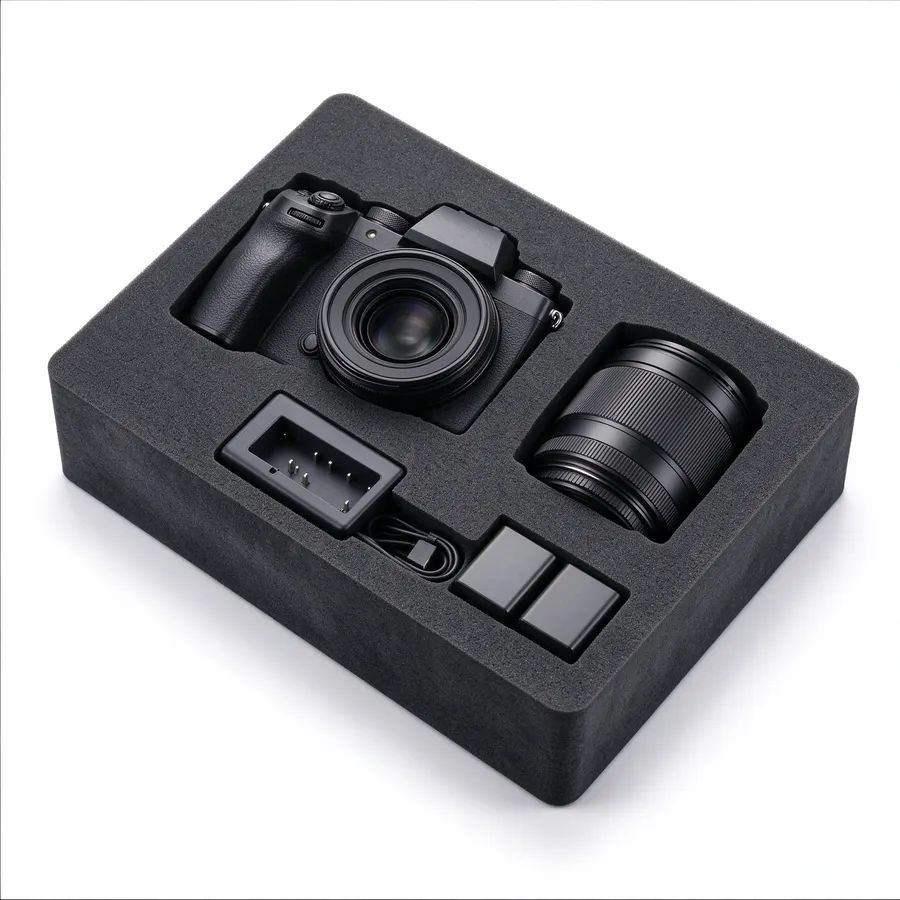
A detection kit is a mixed load in a way that a single instrument is not. One box carries a handheld unit with a probe, a lamp or light source with its charger, a camera with a lens and a filter set, consumables in sealed sleeves, a measuring tape, markers, gloves and a tablet for scene capture. Those items differ in mass, in fragility, in what has to be wiped and in what must be visibly missing the moment the lid opens. A generic pluck layout treats them as one volume. A cut layout treats them as a list, and the list is what a forensic buyer actually owns.
That is why the specification work runs inside out. The cut method decides whether a pocket survives daily re-packing. The material of each layer decides whether the surface can be wiped and whether foam dust settles on evidence packaging. The lid-to-base split decides whether the tallest item sits supported in the base or bridges the two halves and takes the closing load on a lens barrel or an antenna. Only after those three does the shell size become a real question, and it is the last one to argue about.
What buyers ask, answered line by line
Questions about this class of box reach us in the wording of a search box or a tender line rather than as an engineering brief. The table below repeats each phrase and answers it from the columns our product sheet actually publishes, with a plain note where the sheet holds no recorded result. Nothing in the last column is a euphemism: if a figure is not measured, we say it is not measured and quote a test as separate work.
| Buyer Phrase | What Our Published Data Says | What We Do Not State |
|---|---|---|
| Buyer phrase | What our published data says | What we do not state |
| Forensic detection equipment box with custom foam cutouts | Offered on all 155 models as pick and pluck, die-cut or CNC-cut, with top and base layers, an egg-crate or convoluted option and layered zones, quoted from one unit against a drawing, a photograph of the packed kit or a physical sample. | We do not hold a forensic line, a validation of any decontamination routine, or a documented bioburden result; none of those columns exist in our sheet. |
| foam insert box for portable analyzers and light sources | Instrument cavities on the sheet run from a 355x280x60 mm shallow box at 5.2 usable litres to a 500x340x211 mm shell at 28.7 usable litres, and 124 of 155 models offer a compressible gasket in a continuous moulded channel. | We do not publish a vibration or shock figure for a packed instrument; shock protection is recorded as dependent on a specified foam layout. |
| evidence collection kit case with labelled cutouts | A CNC-cut silhouette makes an absent item obvious by shape, and label or colour work is an OEM option quoted from about 300 units. A document holder is recorded as a configuration option on all 155 models, and every latch body is recorded as accepting a standard padlock. | Printed labels, tag pockets and padlock provision are hardware and artwork choices, not a custody system; the log itself stays with the user. |
| wipeable foam for crime scene and laboratory cases | Cross-linked PE is recorded in our material guide as soft, closed-cell, cleanable and low shedding, EVA as firm and close-cut, and the standard build is a firm carrier with a closed-cell contact layer where a case is wiped down. | We do not claim a disinfection validation, and open-cell foam cannot be cleaned and should not be specified where wiping is the routine. |
| rugged box for field forensic detection gear | Shell materials are polypropylene, engineering polypropylene and ABS with wall thickness recorded on 148 of 155 models, 136 models listed as stackable and 19 built as rolling cases with two wheels and a telescopic handle. | No drop height, stack load or working load figure is claimed on any model without a test, and those columns are recorded as not measured. |
Cut methods compared for a kit that changes between callouts
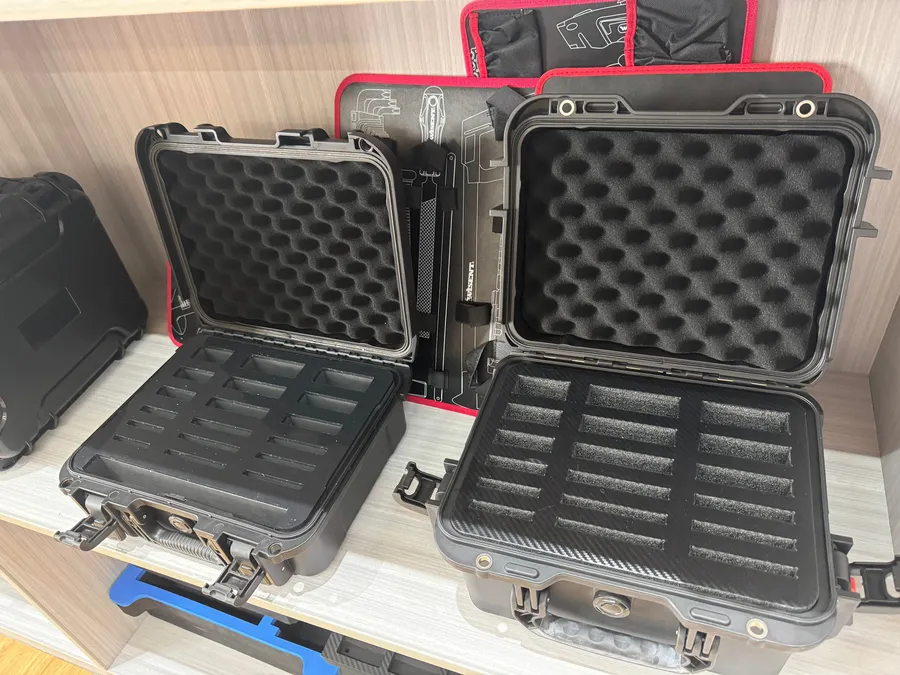
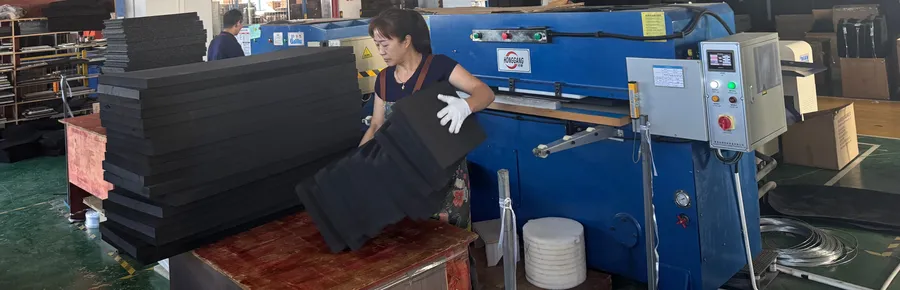
The three methods on our sheet trade precision against reconfigurability, and a forensic buyer usually wants both until they see the price of the compromise. Pick and pluck is a layered grid of small cubes that the user pulls out by hand: it needs no drawing, it can be changed on a bench at midnight, and it will never hold a probe in exactly the same place twice. Die-cut is stamped to a pattern, is precise and economical at volume, and cannot be changed when the kit list grows a new item. CNC-cut is milled from a drawing, gives the sharpest silhouette and the best tool-control behaviour, and is fixed once cut.
| Method | Precision | Can The User Change It | Detection Duty It Suits |
|---|---|---|---|
| Method | Precision | Can the user change it | Detection duty it suits |
| Pick and pluck | Low | Yes, by hand | A shared pool box whose contents differ at every callout. |
| Die-cut | High | No | A repeatable consumables tray ordered in quantity for a team. |
| CNC-cut | Very high | No, needs a revised drawing | A fixed, high-value instrument kit where tool control matters. |
| Layered build | Set per layer | Partly, in the top layer | A fixed carrier for the analyser plus a pluck top for what changes. |
| Egg-crate or convoluted lid | Not positional | Yes | Protecting a screen or filter stack under the lid without a fixed pocket. |
Foam materials, and why the contact layer is a separate decision
A single foam grade is a compromise, so the layout we build by default is a firm carrier that takes the mass, a soft contact layer that isolates the finished surface, and a loose or convoluted layer in the lid for consumables. Our sheet records the foam as cross-linked PE, EVA or EPS by zone, which is the mechanism that lets one box hold a heavy handheld unit and a set of glass filters without either of them compromising the other. Where a case is wiped down between uses, the contact layer is the closed-cell one, because a cell structure that absorbs liquid cannot be dried from the inside.
| Material | Behaviour On Our Guide | Where It Belongs In A Detection Kit |
|---|---|---|
| Material | Behaviour on our guide | Where it belongs in a detection kit |
| Cross-linked PE | Soft, closed-cell, cleanable, low shedding | Contact layer against optics, screens and any item that gets wiped. |
| EVA | Firm, close-cut, heavy for its volume | Carrier under a handheld analyser, a lamp body or a metal tool set. |
| EPE | Low cost, flexible, poor load bearing | Wrapping and void fill around sealed consumable sleeves. |
| EPS | Rigid moulded carrier, excellent for mass | Base carrier when one item carries almost the whole packed weight. |
Lid and base depth: the figure that decides whether the kit bridges the halves
Two shells with a similar internal height can behave completely differently, because what matters is where the depth sits. Our sheet publishes a lid depth and a base depth on 100 of the 155 models, and on every one of those 100 the two figures add exactly to the internal cavity height. Take two published instrument shells: the KX-93221 has 200 mm of internal height as 165 mm of lid and 35 mm of base, so a probe-standing unit is held mostly by the top and the base is a shallow tray. The KX-4318 has 178 mm as 38 mm of lid and 140 mm of base, so the same item sits in the base and the lid only closes over it. Neither is better in the abstract; one is a deep-lid box and the other is a deep-base box, and the item decides which.
This is the column buyers most often ignore and most often regret. An item that bridges the parting line gets the closing load from the latches, and in a shallow-lid shell that load arrives on whatever stands tallest, which in a detection kit is usually an antenna, a lens hood or a handle. When you read the table below, read the last two columns before you read the litres.
Published instrument cavities that suit detection kit
Every figure in this table is read from the product sheet, per model, and is not a family capability. External dimensions are the outside envelope, internal dimensions are the clear cavity, usable litres are the smaller of the two volume figures because ribs and hinge mouldings take space, and net weight is the empty shell with no foam in it. All eleven models are listed as stackable, which is the practical difference between these and our rolling range.
| Model | Shell | External Mm | Internal Mm | Lid Mm | Base Mm | Wall Mm | Net G | Usable L |
|---|---|---|---|---|---|---|---|---|
| Model | Shell | External mm | Internal mm | Lid mm | Base mm | Wall mm | Net g | Usable L |
| KX-3607 | PP | 360x310x70 | 355x280x60 | 30 | 30 | 3.0 | 800 | 5.2 |
| KX-3508 | Engineering PP | 350x300x79 | 344x268x72 | 36 | 36 | 3.0 | 995 | 5.7 |
| KX-92817 | Engineering PP | 280x225x165 | 253x180x152 | 125 | 27 | 5.0 | 940 | 5.5 |
| KX-3315 | Engineering PP | 334x287x150 | 303x224x135 | 100 | 35 | 4.1 | 1670 | 7.4 |
| KX-3609 | PP | 360x310x90 | 355x280x80 | 40 | 40 | 3.0 | 900 | 6.9 |
| KX-4010 | PP | 400x360x100 | 390x315x88 | 44 | 44 | 3.0 | 1015 | 9.3 |
| KX-93221 | Engineering PP | 323x243x212 | 300x200x200 | 165 | 35 | 5.0 | 1230 | 9.6 |
| KX-4318 | Engineering PP | 432x240x186 | 407x187x178 | 38 | 140 | 3.0 | 1970 | 11.6 |
| KX-4613 | PP | 460x367x126 | 455x338x116 | 74 | 42 | 3.0 | 1370 | 15.3 |
| KX-4821 | Engineering PP | 475x363x210 | 447x312x194 | 144 | 50 | 4.5 | 3670 | 21.7 |
| KX-5723 | Engineering PP | 572x405x227 | 500x340x211 | 169 | 42 | 5.0 | 4680 | 28.7 |
Wiping a box down, and what we decline to state about it
A detection case gets wiped more than almost any other box we make, and the honest engineering answer is about cell structure rather than about chemistry. Closed-cell foam does not take liquid into its body, so a wiped surface dries and low shedding means it does not add debris to the items resting on it; that is why our guide puts cross-linked PE in the contact layer where the case enters a clinical or laboratory space. Open-cell foam does the opposite: it absorbs what is poured on it and cannot be dried from the inside, so it should not be specified where wiping is the routine.
What we do not do is extend that into a claim we have not tested. Water and dust performance are recorded as not measured on all 155 models, as are temperature range and stack load, so no ingress figure appears on this page and no decontamination protocol is described as validated. Where a laboratory or a procurement authority needs a stated result, we quote accredited third-party testing on the specific model, gasket state, valve state and interior layout that will be supplied, and the resulting report describes that assembly only.
Tool control, labelling and closing hardware
The reason a CNC silhouette earns its extra cost in this sector is not tidiness. A kit that is checked in twenty seconds at the back of a vehicle needs the absence of an item to be visible as a gap, and a pluck layout that has been re-cut twice a year will not give that. Cutting a name or a reference beside each pocket is an artwork option; colour-coded layers, a custom shell colour and private label are all recorded as available on every model and quoted from about 300 units, which is where a batch, a fixture or a print run begins to make sense.
For the closure itself, the sheet records a measured note across all 155 models: the latch body accepts a standard padlock. A document holder is recorded as a configuration option rather than a standard fitting, so a pocket for a manifest or a scene sheet is something to specify at quotation instead of assuming. Neither of those statements is a security claim; they describe what the moulding provides, and what a programme does with it is a separate decision that belongs to the buyer.
How to send us a kit we can actually cut for
Six items of information let us quote an interior properly, and a model number is not one of them. Our sheet records the requirement plainly: a drawing, a photograph of the packed kit or a physical sample. Everything else follows from the way the kit is used rather than from the way it is listed on a purchase order, and a buyer who supplies these six points usually gets a cheaper answer than one who asks for the next size up.
Customisation, MOQ and the terms we sell on
Custom foam is the cheapest change in this whole category and the fastest to prove: a cut layout is quoted from one unit, and 45 days is the lead time we give an OEM build on an existing mould from approved drawing and deposit. A logo, a colour or an OEM marking begins at about 300 units. A shell geometry that does not exist yet, including a cavity that no stock shell provides, is a moulding project of about 3,000 units per moulded component and 125 days. The standard commercial term is a 30 percent deposit with the balance settled after inspection and before shipment, and third-party inspection and factory audit by appointment are welcome.
We supply wholesale and OEM buyers only, which in this sector means equipment brands, distributors, laboratory suppliers and programme contractors, on EXW or FOB terms from Guangdong. We do not sell to individual practitioners, we do not quote DDP, and we hold no overseas warehouse, so freight and clearance sit with the buyer. Carton dimensions are recorded where the sheet carries them, and container loading for 20GP, 40GP and 40HQ is supplied with the quotation rather than printed as a catalogue figure.
What this page does not claim
There is no forensic line in our catalogue and no claim on this page that a box preserves the integrity of evidence: what we publish is cavity geometry, wall thickness, empty weight, foam options and hardware state, all recorded per model. Foam is offered in six named types across five structural arrangements, and thickness, density and zone layout are agreed against a drawing rather than taken from a standard. Impact performance carries the sheet note that no drop height is claimed without a test, and shock protection is recorded as requiring a specified foam layout, because the shell alone is not a shock rating. Where an authority needs a number we do not print, ask us for it as a test scope and we will quote the work.
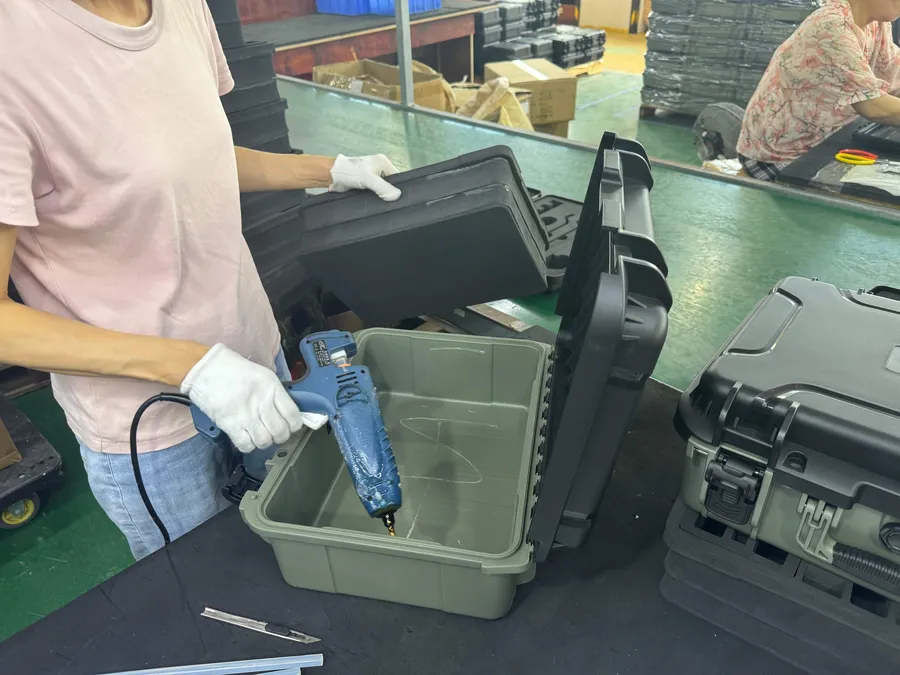
Customisation
Everything described above is configurable on a standard shell: interior layout (pick-and-pluck, die-cut or CNC-cut), foam grade and thickness, colour, logo method, latch and lock count, pressure-equalisation valve, cable ports, document holder and identification plate. A bespoke exterior geometry requires a new mould — 125 days, from 3,000 units per moulded component.
Procurement considerations
| Question | What to send us |
|---|---|
| Which shell fits? | Equipment L × W × H as packed, plus required clearance per axis |
| What does it cost? | Order quantity and estimated annual quantity — the two drive different answers |
| Is tooling needed? | Whether an existing shell clears the envelope with usable foam depth |
| Lead time? | Your required delivery date, not just the order date |
| Certification? | The exact standard your tender names — we will say whether we can test to it |
| Freight? | Destination and preferred terms; carton and pallet data supplied with the quotation |
Comparison and selection guide
The tables on this page exist because a protective case is chosen by comparing three things: the envelope, the environment and the handling chain. Where no table applies, the rule below is.
| Situation | What To Do |
|---|---|
| Benchtop mass | Firm base carrier, 50 mm minimum, with a soft contact layer. |
| Optical head | Suspend the body and clear the lenses entirely; never let foam touch a coated surface under load. |
| Field kit | CNC base for the instrument, pluck-foam top for probes and consumables. |
- Size on internal dimensions plus clearance, never on a product name.
- Choose the carrying method before the shell: it changes the series, not just the price.
- Specify the interior last, and decide up front whether the end user will reconfigure it.
Forensic detection equipment box with custom foam cutouts? relates to Foam Insert Guide. Related families: Instrument & Equipment Cases / Custom Protective Cases / Medical Equipment Cases / Electronics Cases / Equipment Transport Cases / Military Protective Cases. Related sectors: field and industrial equipment. Continue in the Foam Insert Guide cluster.
This page is written from our own production data. If your requirement differs, send the dimensions and we will tell you which of the 155 models fits, or whether a custom route is needed.