How should foam thickness be selected?
Select foam thickness by subtraction, not by choosing a number from a swatch. Every model we publish states an internal depth, and on the 100 listings where lid depth and base depth are both recorded the two figures add back to that internal depth exactly: KX-1204 is 16 mm plus 16 mm against a 32 mm interior, KX-92817 is 125 mm plus 27 mm against 152 mm, and KX-88442 is 320 mm plus 44 mm against 364 mm. Foam can only be cut from what the shell leaves, so the depth budget is the first constraint and the hazard list is the second: order the exposures your item actually meets and spend the remaining millimetres where first contact happens. Across our sheet only four models are 40 mm deep or shallower inside, 90 sit in the 101 to 200 mm band and 35 are deeper than 200 mm, so the same rule produces very different layouts. Where a specification genuinely needs a thicker bed than the shell allows, the answer is a deeper model or a new mould, never a compressed claim.
Key points
- Internal depth is the budget: on all 100 listings that publish both figures, lid depth plus base depth equals the stated internal depth exactly.
- Read the split before the total: 65 of those 100 are lid-dominant, 29 are an even split and only 6 are base-dominant, which decides where foam can sit.
- Depth bands on our 155 models: 4 at 40 mm or under, 5 from 41 to 60, 21 from 61 to 100, 90 from 101 to 200 and 35 over 200 mm.
- Plan cavities on the narrow internal width where it is published, on 36 listings, because a tapered shell cannot hold a rectangular cavity at full width.
- Foam is a construction option, not a rating: shock protection is recorded as dependent on a specified layout and 55 listings publish no lid-to-base split at all.
- Usable interior volume is below the theoretical length times width times height figure on 154 of 155 models, so the packed item must be measured, not estimated.
- Custom foam, custom thickness and custom shape are offered on all 155 listings from one piece, with a drawing, a photograph of the packed kit or a physical sample.
The budget comes from the shell, not from the foam
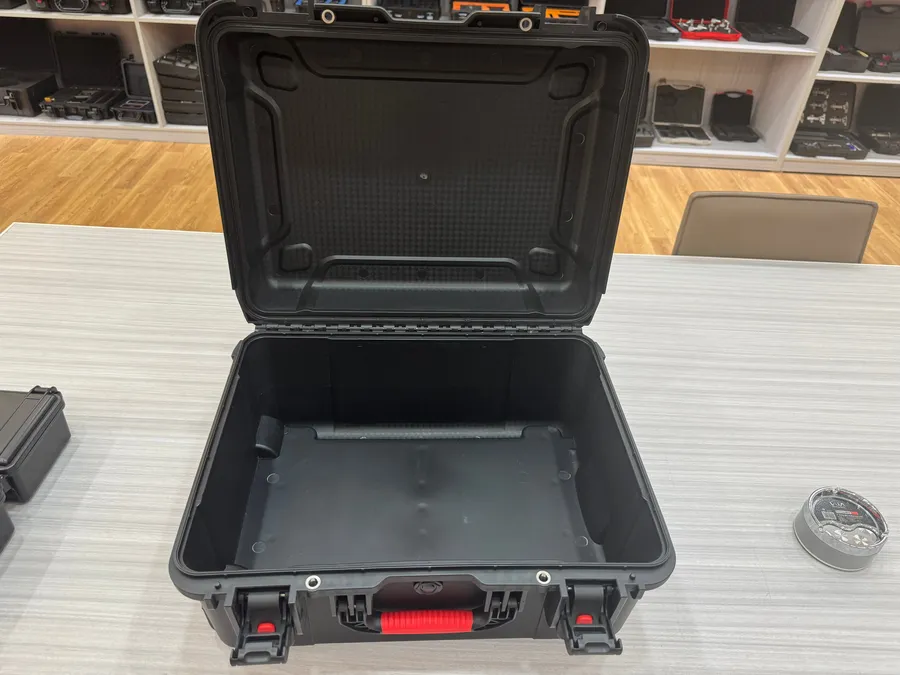
A foam thickness question is really a subtraction question. Each listing in our catalogue states an internal depth as part of the internal envelope, and on the 100 models where we also record the lid and base depths separately, those two numbers add back to the internal depth without rounding: KX-1204 at 16 plus 16 against 32 mm, KX-2005 at 20 plus 20 against 40 mm, KX-705 at 56 plus 56 against 112 mm, KX-6621 at 43 plus 149 against 192 mm, and KX-88442 at 320 plus 44 against 364 mm. Once the item, the cable looms and any case dividers have taken their height, the millimetres that remain are what foam can occupy. That is why a thickness chart copied from another supplier is useless: it assumes a depth budget your shell may not have.
The second input is the hazard list, and it works as a ranking rather than as a number. Lifting and setting down, a sideways knock while the case is still in a vehicle, a static load from something stacked on top, and re-packing in poor light are four different problems, and they ask for foam in different places. Thickness governs how far the contents travel before the shell stops them; the foam family governs how sharply the force arrives. Our data sheet records shock protection as a construction option that depends on a specified foam layout, and it says explicitly that the shell on its own is not a shock rating, so a thickness conversation without a hazard list is decoration.
Read the lid-to-base split before you read the total
Of the 100 listings that publish both halves of the depth, 65 put more material in the lid than in the base, 29 split the depth evenly and only 6 are base-dominant. That distribution changes what a thickness decision means in practice. In a lid-dominant box such as KX-92817, where a 253 x 180 x 152 mm interior is divided 125 mm above and 27 mm below, the base can only be a shallow locating tray and almost the whole bed sits over the contents. In a base-dominant shell such as KX-6621, where a 587 x 434 x 192 mm interior is divided 43 mm and 149 mm, the item sits deep in the body and the lid contributes very little cushioning. Buy the same 20 mm bed for those two geometries and you get two different products.
Two further fields decide whether a planned cavity can actually be cut. Usable interior volume is stated lower than the theoretical length-times-width-times-height figure on 154 of our 155 models, because corner radii, the seal channel and the hardware all take space that a rectangular pocket cannot occupy; KX-88442 publishes 139.5 litres theoretical against 111.6 litres usable, and KX-6621 publishes 48.9 against 39.1. Separately, 36 listings record a narrow internal width, and where that figure exists it is the one to design to: KX-1204 gives 78 mm internal width but a 70 mm narrow width, KX-2005 gives 135 mm against 127 mm, and KX-2305 gives 150 mm against 135 mm. A pocket planned on the wider number will bind at the taper.
Four geometries, four thickness answers
Read the worked-budget column as arithmetic on published envelopes, not as a foam specification we quote. The bed thicknesses we actually cut come from your layout and your hazard list, because custom thickness is recorded as a construction option on every listing and the resulting figure depends on the configuration ordered. What the table fixes is the shape of the argument: in a 32 mm interior the debate is about locating an item, in a 364 mm interior it is about how much bed you can afford to leave in the lid so that a second kit can travel above it.
| Shell You Are Buying | Published Interior | Where The Foam Can Sit | Worked Budget | Check Before Ordering |
|---|---|---|---|---|
| Shallow 0 Series minis | KX-1204 115 x 78 x 32 mm, split 16 and 16 mm; KX-2005 190 x 135 x 40 mm, split 20 and 20 mm | A thin base tray that locates the item, a thin lid bed that retains it | Item 18 mm tall leaves 14 mm to distribute as around 10 mm under and 4 mm over, not 10 mm under and 10 mm over | Closure clearance: 55 listings publish no split at all, so ask for it |
| Even-split equipment shells | KX-705 420 x 270 x 112 mm, split 56 and 56 mm; KX-2813 260 x 200 x 117 mm, split 92 and 25 mm | Symmetrical beds top and base when the split is even; a deep lid bed when it is not | On KX-705 a 20 mm base bed plus a 15 mm lid bed leaves 77 mm for the item and its cabling | Whether the shell carries a seal option, published on 124 of 155 listings |
| Lid-dominant 9 Series boxes | KX-92817 253 x 180 x 152 mm, split 125 and 27 mm | Most of the bed is above the contents; the base is a locating tray | A 27 mm base allows roughly 12 mm of tray plus 15 mm of item height before the lid has to bridge | That a tall lid bed does not lift the packed centre of gravity when the case stands up |
| Deep-body and T Series shells | KX-6621 587 x 434 x 192 mm, split 43 and 149 mm; KX-88442 740 x 518 x 364 mm, split 320 and 44 mm | Base-dominant bodies cradle heavy items low; lid-dominant rollers hold tall kits upright | 364 mm of depth allows a 40 mm base bed, a 100 mm lid bed and slack for a handle boss | Empty mass where published: 93 of 155 listings state it, KX-88442 at 15,320 g |
How the depth bands on our sheet decide the layout
The distribution itself is the useful part: 90 of 155 models land between 101 and 200 mm of internal depth and 35 exceed 200 mm, so on our sheet the common case is a shell with enough budget for a layered interior rather than a single bed. The extreme ends are small but real. At the shallow end sit KX-1204 at 32 mm, and KX-1905, KX-2005 and KX-2305 all at 40 mm. At the deep end KX-88442 gives 364 mm and KX-87336 gives 310 mm, both in the T Series rolling group, which is where tall kits and mixed accessory loads belong.
One band deserves a warning because buyers keep mis-sizing it. Shallow shells of 40 mm or less look generous in photographs of their footprint: KX-2305 offers 225 x 150 mm of internal floor, which is a genuinely useful area for a handset, a small radio or a set of tools. The 40 mm of height, however, is divided 20 and 20 between lid and base, and the usable volume we publish is 1.2 litres against 1.4 litres theoretical. Treat those shells as plates with a lid, plan a tray rather than a bed, and confirm the packed height of the tallest item before the cavity is cut.
| Internal Depth | Listings | What The Budget Allows | Typical Failure |
|---|---|---|---|
| 40 mm or under | 4 | A locating tray in the base and a retaining bed in the lid, nothing else | Ordering a 15 mm bed all round and finding the lid will not pull down |
| 41 to 60 mm | 5 | A real base bed with a shallow lid cover, or a two-item flat layout | Putting the cushioning in the lid so the item rests on the shell floor |
| 61 to 100 mm | 21 | Base bed, lid bed and a side margin, or one deep cavity with a pick face | Leaving no margin beside a connector that is loaded sideways |
| 101 to 200 mm | 90 | Layered layouts: a cut base, an accessory layer, a lid bed that closes on nothing | Building one thick bed instead of two thin ones that each do a job |
| Over 200 mm | 35 | Upright carrying, deep cradles, spare cavities for kit that has not been bought yet | Letting a tall light item top out inside a bed that was cut for a heavy one |
Thickness is not the same subject as wall, mass or closure
The most frequent confusion in a thickness conversation is between the foam budget and the shell. Wall thickness is published on 148 of 155 listings and runs from 2.0 mm, recorded on six 0 Series minis including KX-2005 and KX-2305, to 6.0 mm on KX-6621 and KX-97227. Seven listings carry no wall figure at all: KX-84814, KX-84815, KX-84823, KX-84824, KX-95419, KX-6922 and KX-5126. None of those numbers tells you anything about how much foam fits, and adding millimetres of wall does not add millimetres of bed unless the external size is allowed to grow with it. Where a specification needs both a deeper bed and a thicker wall, that is a new tool rather than a packing decision, and we price it that way.
Mass and closure behave the same way: they are separate fields that change what a layout can hold. Empty mass is published on 93 listings, gross mass on none, so a loaded weight must be calculated from your own contents. A compressible gasket in a moulded channel is offered on 124 of 155 models and not on the other 31, including KX-1204, KX-705 and KX-2813, and a sealed shell closes differently from an unsealed one because the gasket has to be compressed by the lid rather than by the foam. If your interior plan relies on the lid pressing into a deep bed, check the seal field first, because on a gasketed shell the compression budget is already committed.
A selection order that changes the number five times
Work through the questions in this order and the thickness answers itself. First, what has to close: the tallest single item plus its permanently attached cables, because that sets the item height and everything else is residue. Second, how does the item travel: flat, on its edge, or upright, which decides whether the cushion goes under it, behind it or around it, and in a lid-dominant box the answer may be forced by the split rather than by preference. Third, where is first contact: a shell that is set down on one corner repeatedly needs bed at that corner, not a uniform blanket. Fourth, what else shares the volume: accessories, spare cells, a charger, a manual, because an accessory layer taken from the lid bed is the usual reason a main cavity ends up thin. Fifth, how often is it re-packed: a layout that is correct only when every item is present is a layout that will be cut around once, so spare cavities and a pick face belong in the plan.
Two habits waste the budget. The first is buying thickness where the item is supported anyway: a deep soft bed under an item that rests on its own base adds nothing and lets the load sink until it touches the shell floor. The second is skimping on the margin around anything that protrudes - a lens hood, an antenna boss, a connector, a handle - because those are the first points of contact and the cheapest millimetres to protect. Where the item is heavy relative to the shell, more bed is not automatically better, since the load can bottom out a soft layer; a firmer locating tray with a softer face is usually the right build, which is why our sheet records the interior as cross-linked polyethylene, EVA or EPS by zone rather than as one material everywhere.
Where the same arithmetic lands in different uses
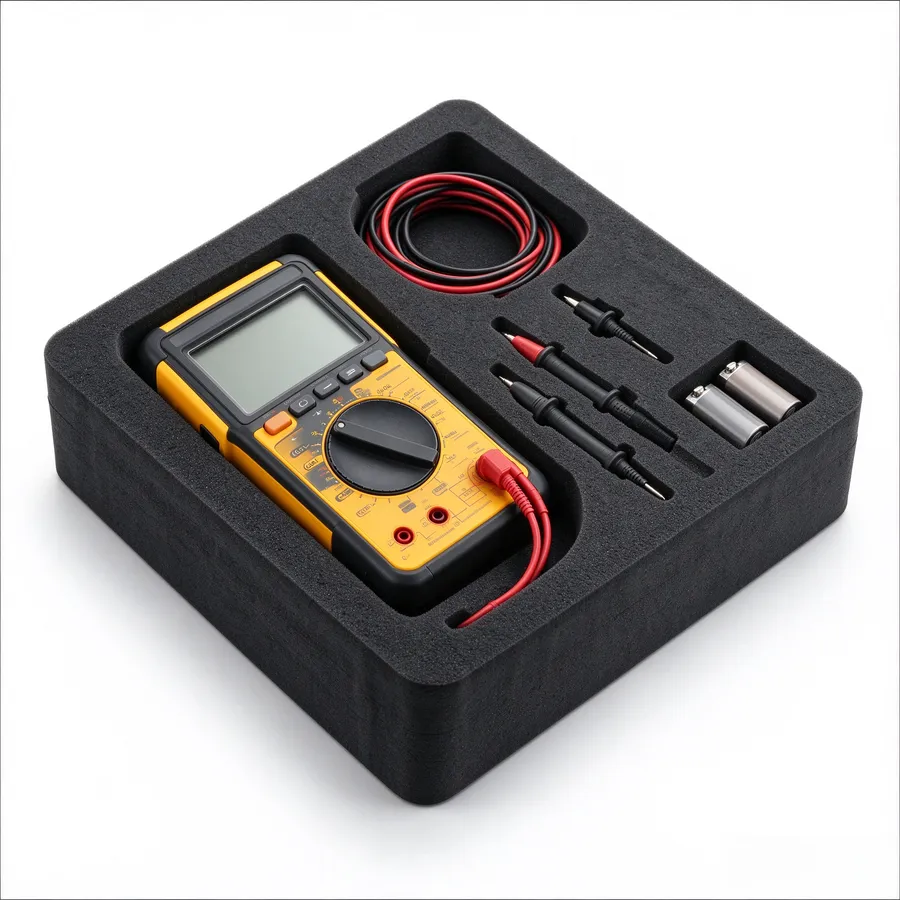
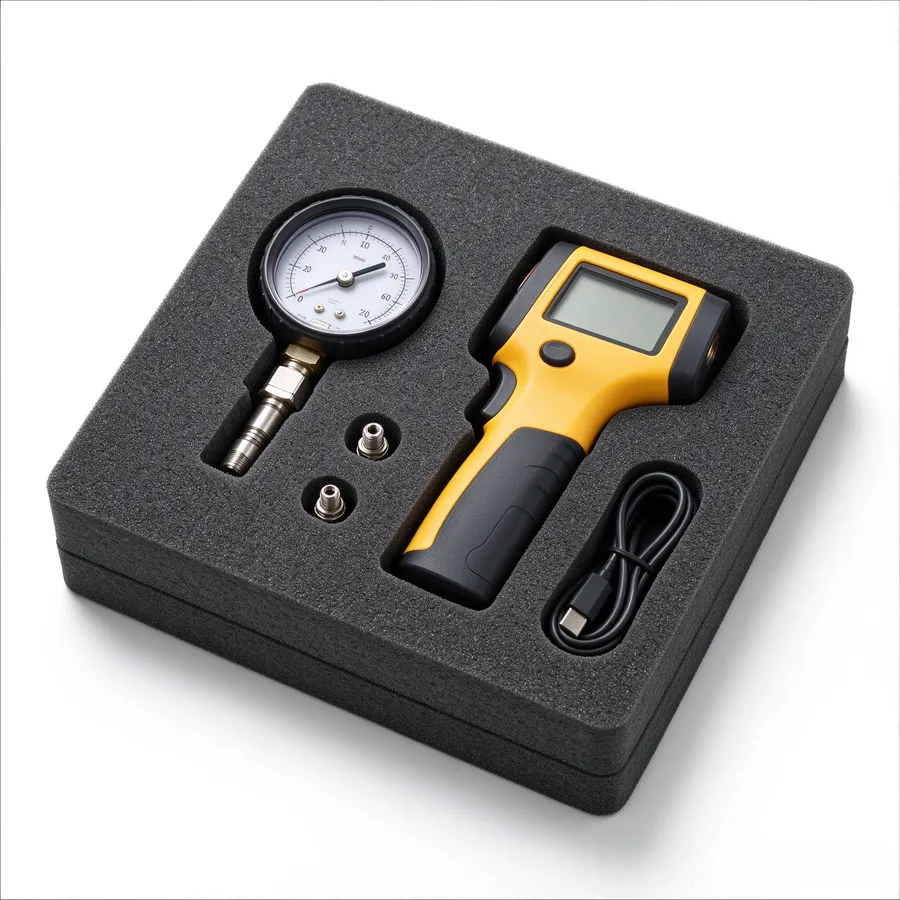
For small electronics and instruments, most of the work happens in the shallow and mid bands and the deciding number is packed height rather than area. KX-1905 gives 180 x 160 x 40 mm of interior with a 25 plus 15 mm split, which suits a handset or a meter lying flat with a thin retaining bed over it; KX-62109 gives 195 x 128 x 81 mm and publishes no split, so the lid-to-base allocation has to be confirmed before a cavity is drawn. In both, the connector edge is the risk, and a 10 mm margin there costs nothing if the item body is not the tallest point in the box.
For field and outdoor kits the budget is usually generous and the problem is mixed geometry rather than depth: 125 of our 155 listings publish an internal depth of 101 mm or more, 90 of them between 101 and 200 mm and 35 above it, which is enough for a cut base plus an accessory layer plus a lid bed. Long, low loads are the exception worth planning carefully. KX-89616 publishes an 880 x 350 x 140 mm interior: the depth budget is only 140 mm but the length is 880 mm, so a single deep cavity is the wrong shape and a pair of cradles along the length with a shallow bed between them uses the volume properly. Ammunition, transport storage and drone groups follow the same rule with different contents.
Specifying the interior on an order
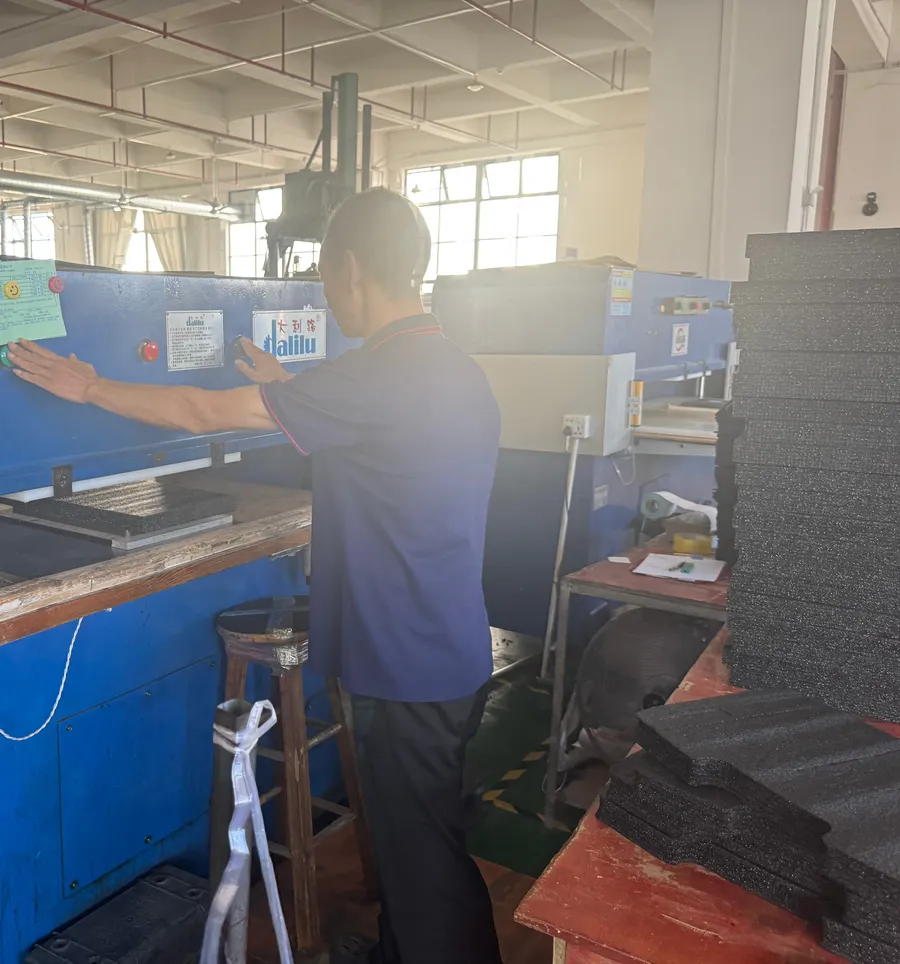
Every listing on our sheet records the interior as configurable: pick-and-pluck, die-cut, CNC-cut, EVA, PE and EPE construction options, and top, base, egg-crate, custom-cut and layered arrangements, with custom thickness and custom shape marked available on all 155 models. What we need from you is one of three inputs, recorded as the drawing requirement on every listing: a drawing of the packed kit, a photograph of it laid out, or a physical sample of the item. From that we return a cavity layout against the published internal envelope, and if the layout cannot fit the depth budget we say so and propose the next model up rather than shaving the bed and hoping.
The commercial frame is fixed and identical whatever thickness you choose. Stock models start at one piece and custom foam starts at one piece with no separate interior minimum. Logo, colour and OEM work on an existing mould start at 300 pieces with first samples planned at 45 days on a 30 percent deposit. A new size or a modified sealing rim is mould work at 3,000 pieces per component and 125 days. We sell wholesale and OEM only, EXW or FOB, with no retail orders, no DDP quotations and no overseas warehouse stock, so freight is handled by your own forwarder.
Procurement notes, and what this page deliberately does not claim
Send four things with the enquiry and you will get a thickness recommendation back rather than a set of questions: the packed dimensions of the item in the configuration it actually travels in, including cables and mounts; the orientation you want it to sit in; the empty and loaded mass; and a hazard list in the order you expect to meet it. We answer with candidate models and their published internal and external envelopes, the lid-to-base split where it is recorded, the narrow internal width where it is recorded, the seal state, the empty mass where published, and carton and pallet figures calculated against your pallet size.
What we do not do is convert a foam layout into a performance promise. Waterproof, dust resistance, UV exposure, service temperature range, stack load, load capacity and any protection rating are recorded as not measured on all 155 models, no IP code is printed on our listings, and no drop height is stated for any configuration, because a figure without a test record behind it is marketing rather than data. Accredited testing can be commissioned for a named configuration as a separate work package, and shock and impact protection are described as construction options that require a specified foam layout. Signed: KeXin New Materials (Guangdong) Co., Ltd.
Customisation
Everything described above is configurable on a standard shell: interior layout (pick-and-pluck, die-cut or CNC-cut), foam grade and thickness, colour, logo method, latch and lock count, pressure-equalisation valve, cable ports, document holder and identification plate. A bespoke exterior geometry requires a new mould — 125 days, from 3,000 units per moulded component.
Procurement considerations
| Question | What to send us |
|---|---|
| Which shell fits? | Equipment L × W × H as packed, plus required clearance per axis |
| What does it cost? | Order quantity and estimated annual quantity — the two drive different answers |
| Is tooling needed? | Whether an existing shell clears the envelope with usable foam depth |
| Lead time? | Your required delivery date, not just the order date |
| Certification? | The exact standard your tender names — we will say whether we can test to it |
| Freight? | Destination and preferred terms; carton and pallet data supplied with the quotation |
Comparison and selection guide
The tables on this page exist because a protective case is chosen by comparing three things: the envelope, the environment and the handling chain. Where no table applies, the rule below is.
| Situation | What To Do |
|---|---|
| Fastest | Standard shell plus CNC foam — typically 45 days from approved drawing. |
| Branded | Standard shell plus custom colour and logo — MOQ applies to the resin colour. |
| Bespoke geometry | New mould — 125 days, MOQ from 3,000 units per component. |
- Size on internal dimensions plus clearance, never on a product name.
- Choose the carrying method before the shell: it changes the series, not just the price.
- Specify the interior last, and decide up front whether the end user will reconfigure it.
How should foam thickness be selected? relates to Foam Insert Guide. Related families: Custom Protective Cases / Electronics Cases / Instrument & Equipment Cases / Outdoor Protective Cases / Tactical Equipment Cases. Related sectors: field and industrial equipment. Continue in the Foam Insert Guide cluster.
This page is written from our own production data. If your requirement differs, send the dimensions and we will tell you which of the 155 models fits, or whether a custom route is needed.


