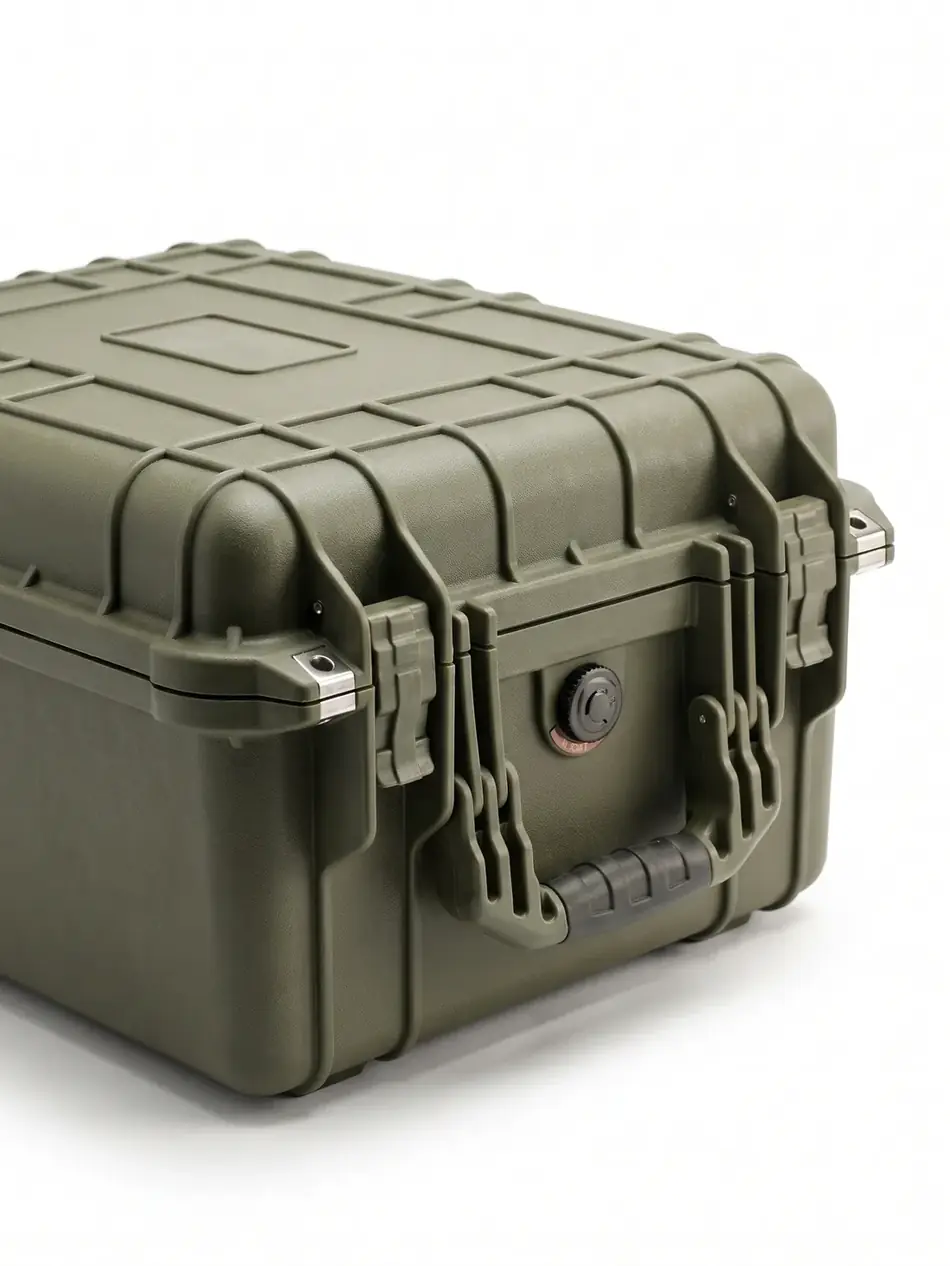
How does custom foam improve equipment organization?
Custom foam turns an empty rectangular shell into a fixed address book for your kit: every firearm, optic, tool, probe, cable and magazine gets its own cavity, so parts cannot migrate, collide or hide at the bottom of the case. It improves organisation in four concrete ways. First, part-specific pockets stop loose items rattling and putting scratches or dents on the sensitive surfaces. Second, layered top and base layouts let small accessories live above the main body without bearing weight on it. Third, an obvious empty slot shows instantly what is missing before you close the lid, which is a checklist built into the packaging. Fourth, because a foam layout is cut to a drawing rather than guessed, the same case can be reproduced identically across a batch or fleet, so every operator packs the same way.
Key points
- Fixed cavities are the difference between a case that carries gear and one that organises it; a loose part is an unprotected part.
- A visible empty slot in a die-cut layout acts as a packing checklist and a loss-prevention cue.
- Layered top and base foam keeps accessories off the main body instead of stacking weight onto it.
- Pick-and-pluck is the right starting point for a changing kit; die-cut or CNC-cut is the right answer once the contents are stable.
- Because a layout is cut to a buyer drawing, the same organisation can be reproduced across a whole fleet or batch.
- Foam changes do not need a new shell mould, so organisation improvements turn around on the standard OEM sample window.
The core problem: an empty shell is a moving box
A hard shell with nothing inside protects the outside of the case, not the contents, because every item is free to slide until something stops it. In transit the load path is a combination of vertical vibration, side-to-side sway and the occasional dropped edge, and loose items experience all three at once. A firearm rolling against the latch side of a sealed case will wear the case lining and the finish on the receiver. A caliper or laser module tossed on top of a data logger risks the display or lens. Custom foam converts that free volume into a set of constrained seats, and the constraint is exactly what both protects the item and tells you where each part belongs.
Part-specific pockets: cut to a real drawing
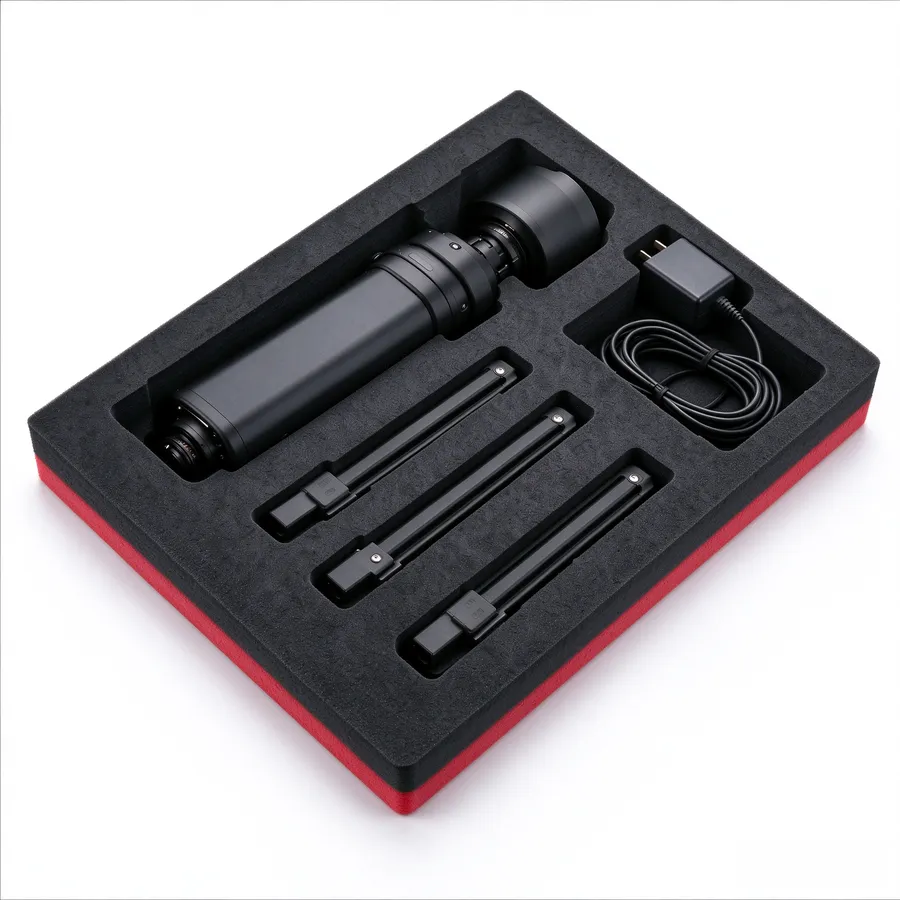
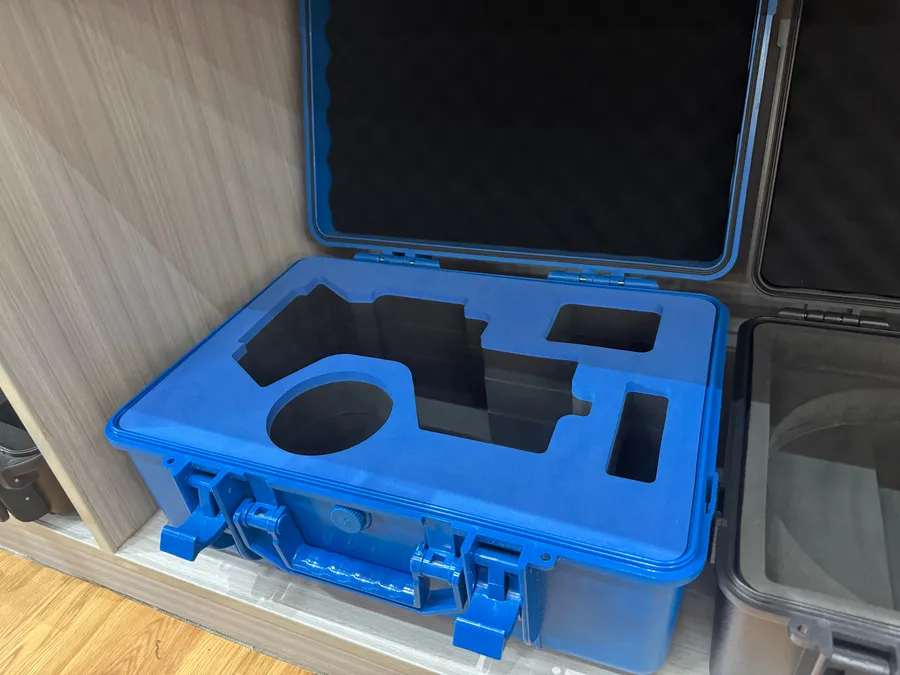
The most organised layout is a die-cut or CNC-cut cavity that mirrors the actual part lines of each item. KeXin works from a technical drawing, a photograph of the packed kit, or a physical sample, and produces a foam cut that isolates the action, the barrel, the optic, the magazine, the suppressor mount or the instrument head as separate shapes. Where a part has a fragile protrusion such as an antenna, an eyepiece, a connector or a sighting head, the cut adds a relief pocket under that feature so nothing bears on it. Once every cavity has a clear occupant, the layout itself becomes the packing instruction.
Layered structures for accessories
Two-layer and three-layer stacks let a case organise a mixed kit without turning it into a rattle of parts. The base layer carries the main item and any weight-bearing accessories; a middle layer holds cables, spare batteries, chargers, small tools and paperwork; a top layer of egg-crate or convoluted foam keeps everything pressed lightly against the middle so the load does not shift when the case is opened vertically. Layered layouts are also practical in service: if a small part of the accessory list changes, only that layer needs a replacement sheet, not the whole insert.
Pluck, die-cut and CNC-cut compared
| Foam Type | Best For | Precision | Lead Time Signal |
|---|---|---|---|
| Pick-and-pluck | A kit that changes between deployments | Good, user-adjustable | Available on standard OEM foam band |
| Die-cut | A stable production pack-out | High, cut to a buyer drawing | Standard OEM sample window |
| CNC-cut | Mixed kit with tight pockets and reliefs | Very high, no cutting die tooling | Standard OEM sample window |
| Egg-crate or convoluted top | Resting accessories on a stable base | General-purpose | Layered inside existing layouts |
| Layered top plus base | A full system with cables, tools, spares | Configurable per layer | Reproduced from signed layout |
Choosing the layout by how the kit behaves
If the contents are stable and the same on every unit, a die-cut or CNC-cut insert with dedicated pockets and reliefs gives the highest level of organisation, and because the layout is drawn to the actual parts, it can be reproduced identically across a production run or a whole fleet. If the contents change from one job to the next, pick-and-pluck gives users the ability to reconfigure the cavity themselves without a new cut. If the kit is a mixed system with cables, spares and a tool roll, layered top plus base is the practical answer because each layer can be swapped when a subset changes. For a fleet, one of the most valuable benefits is that a signed layout becomes the reference for reorders, so a case bought eighteen months later matches the case bought today.
Typical organisation scenarios
| Scenario | Solution |
|---|---|
| Dealer rifle with optic and spare magazine | Die-cut base with receiver and barrel channels plus top pluck for magazine and paperwork |
| Pistol kit with cleaning tools and holster | CNC-cut single layer with a tool tray and a lock-off tab pocket |
| Long gun broken down with tripod and spare parts | Layered top plus base in an 880 x 350 x 140 mm interior (KX-89616) |
| Handheld measurement instrument with probes and cable | CNC-cut with a connector relief and a cable channel in a 587 x 434 x 192 mm interior (KX-6621) |
| Mixed field kit reconfigured between deployments | Pick-and-pluck top over a die-cut base in a 650 x 430 x 170 mm interior (KX-87319) |
How custom foam fits the OEM programme
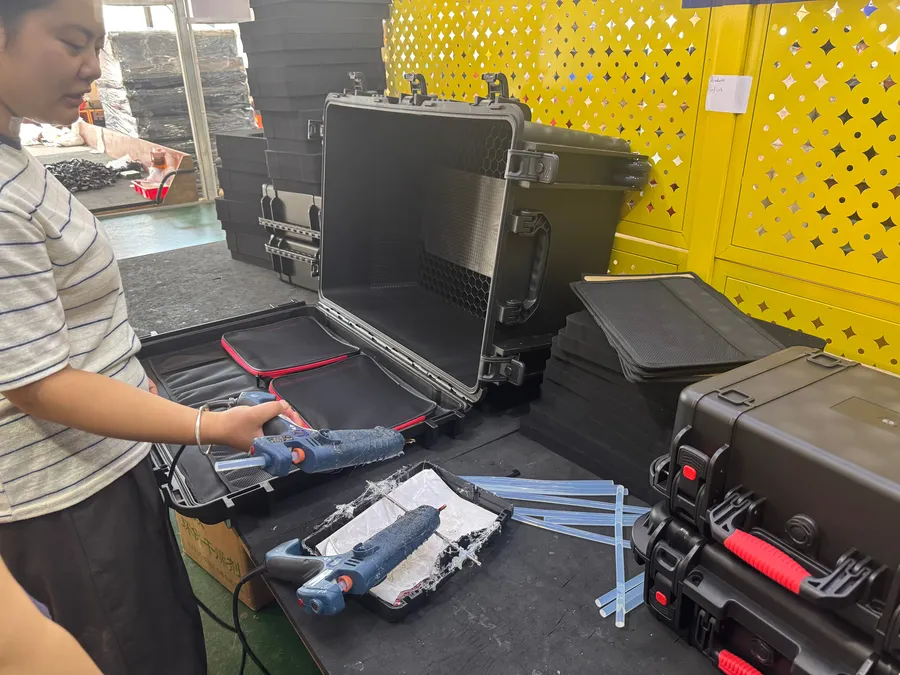
Foam is one of the fastest OEM changes on offer because it is cut to a buyer drawing on an existing shell; no new mould is required for a layout revision. The standard OEM quantity band applies, and a first sample follows the standing 45-day sample window. Buyers who also want a printed logo on the case lid, a colour match to a fleet scheme, or private-label packaging can add those to the same order at the standard logo and colour MOQ. Only the shell geometry itself needs a new mould, which starts at a much higher quantity band; almost every organisation improvement described on this page lives inside the foam layer and does not touch the mould.
Procurement notes for custom foam
Send a real reference for the parts. A drawing, an exploded view, a photograph of the packed kit, or a physical sample lets the factory cut to the actual part line rather than to an approximation. Confirm the case SKU first, so the cut is aligned to the published internal dimensions and the usable interior after foam. Ask for the layered structure that matches how the kit is repacked, not just a single die-cut, when accessories change between jobs. Once a layout is signed, keep it as the reorder reference so a repeat batch matches the first one. Orders run wholesale and OEM on EXW or FOB terms with a 30 percent deposit against the proforma; there is no retail, DDP or overseas-warehouse arrangement.

Customisation
Everything described above is configurable on a standard shell: interior layout (pick-and-pluck, die-cut or CNC-cut), foam grade and thickness, colour, logo method, latch and lock count, pressure-equalisation valve, cable ports, document holder and identification plate. A bespoke exterior geometry requires a new mould — 125 days, from 3,000 units per moulded component.
Procurement considerations
| Question | What to send us |
|---|---|
| Which shell fits? | Equipment L × W × H as packed, plus required clearance per axis |
| What does it cost? | Order quantity and estimated annual quantity — the two drive different answers |
| Is tooling needed? | Whether an existing shell clears the envelope with usable foam depth |
| Lead time? | Your required delivery date, not just the order date |
| Certification? | The exact standard your tender names — we will say whether we can test to it |
| Freight? | Destination and preferred terms; carton and pallet data supplied with the quotation |
Comparison and selection guide
The tables on this page exist because a protective case is chosen by comparing three things: the envelope, the environment and the handling chain. Where no table applies, the rule below is.
| Situation | What To Do |
|---|---|
| Length | Allow at least 25 mm at each end beyond the equipment so the foam can absorb end impact rather than the shell. |
| Depth split | A deeper base carries the mass; a shallow lid retains it. We normally recommend a 60/40 or 70/30 base-to-lid split. |
| Closure | Latches on the long edge give better sealing on a flexing shell; latches on the short edge are faster to open. |
- Size on internal dimensions plus clearance, never on a product name.
- Choose the carrying method before the shell: it changes the series, not just the price.
- Specify the interior last, and decide up front whether the end user will reconfigure it.
How does custom foam improve equipment organization? relates to Foam Insert Guide. Related families: Firearm Transport Cases / Custom Protective Cases / Tactical Equipment Cases / Equipment Transport Cases. Related sectors: field and industrial equipment. Continue in the Foam Insert Guide cluster.
This page is written from our own production data. If your requirement differs, send the dimensions and we will tell you which of the 155 models fits, or whether a custom route is needed.