What type of foam is suitable for professional tools?
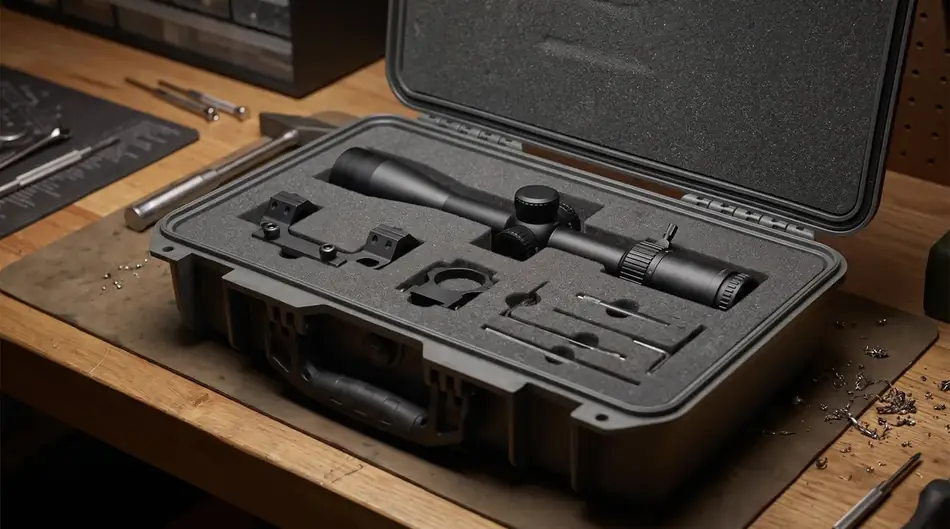
Use a layered interior: a firm, close-celled grade as the carrier that carries the weight of steel without permanent squash, a slightly softer grade as the contact face that protects finishes and edges, and fixed cut pockets that locate every tool in its own shape. For professional kits the deciding factors are load, edge damage and accountability, not softness. Dense EVA or a firm cross-linked polyethylene carries heavy spanners, hammers and power tools without bottoming out; die-cut or CNC-cut foam holds each item in a named outline so a missing tool is obvious at a glance; pick-and-pluck only suits kits whose contents genuinely change between jobs. Avoid open-cell and cheap loose filler: they absorb oil and hand cleaner, shed, and let a heavy tool settle onto the base. Match the grade to the load and let the interior depth you choose decide how thick each layer can be.
Key points
- Professional tools are heavy, hard and sharp, so the carrier layer must be a firm grade such as dense EVA or close-celled polyethylene rather than a soft cushioning foam.
- Two layers beat one: a firm base that carries the weight and a softer contact face that protects finishes, edges and machined surfaces from marking.
- Fixed die-cut or CNC pockets give tool control as well as protection, because a missing or misplaced tool is visible in seconds on a named outline.
- Pick-and-pluck only earns its place when the kit changes between jobs; for a repeatable professional set it is a poorer fit than a machined layout.
- Choose closed-cell grades for tool kits: open-cell and bead foams soak up oil, penetrating fluid and hand cleaner, then hold the solvent against the steel.
- Cut resistance matters more than thickness near edges; thin soft foam over a heavy spanner will be sliced open by the corners of the tool it is meant to protect.
- Budget the interior height first: usable volumes across our published models run from 0.3 to 111.6 litres and internal depths from 32 to 364 mm, which decides layer thickness.
- Send a drawing, a photograph of the packed kit or the physical tools themselves; we cut to a real reference instead of guessing pocket shapes.
Why tool kits are a different problem from instrument cases
Most protective packaging is designed around objects that are light relative to their fragility. Tools invert that relationship. A hammer head or a large adjustable spanner is dense steel with hard machined corners and a small contact area, which means it produces very high local pressure on whatever lies beneath it, and it does that continuously while the case is being carried, not only during an impact. At the same time the parts you care about, the ground edge of a chisel, the jaws of pliers, the finish on a torque wrench, the calibration of a measuring tool, are damaged by contact with other steel rather than by the case wall. A soft foam that would protect a circuit board lets a heavy tool sink through it until the tool rests on the base of the case, at which point the foam has stopped being protection and become a spacer. Professional foam is therefore chosen for load-bearing and separation first, and cushioning second.
The carrier layer: firm grades that do not bottom out
Every tool insert has a layer that carries the weight, and that layer must be a firm grade. Dense EVA is the usual choice for professional kits because it resists permanent set: compress it under a heavy steel head for weeks in a hot vehicle and it recovers, whereas a soft polyethylene keeps the dent and stops locating anything. Firm cross-linked polyethylene is the lighter alternative and is often enough for hand-tool sets that are not dominated by mass. The property you are testing for is compression resistance at the load you actually carry. If the tool sinks until it touches the base, the layer is too soft or too thin regardless of what it is called. This is also where shell depth is relevant: our published models list lid and base depth individually, on some models 86 millimetres in the lid against 32 in the base, which tells you where the compressible thickness can realistically go.
The contact layer: protection against marking and edge damage
Directly against the tool, a slightly softer layer does two jobs the carrier cannot. It protects polished, plated and anodised finishes from being scuffed by the foam itself, and it conforms to irregular shapes so that load is spread over a face instead of a corner. It also keeps dissimilar metals from meeting: a chrome spanner resting against a steel socket will mark the chrome even without a drop. Use convoluted or egg-crate foam as the top layer where contents vary in height, because the protrusions press each item down without needing a perfectly matched profile. The important limit is that the contact layer never carries the weight alone. A thin soft layer over a firm carrier works; a thick soft layer over nothing works for a weekend and then the tools have settled into the base of the case.
Closed cells, oil and the solvents that live in a tool case
Tool cases are chemically hostile in a way instrument cases rarely are. Penetrating fluid, grease, hand cleaner, cutting oil and wet rags all travel with the kit. Closed-cell grades such as cross-linked polyethylene and EVA do not take liquid into their structure, so a spill stays on the surface where it can be wiped off. Open-cell and bead-structured foams act as a sponge: they absorb the solvent, swell, shed particles, and then hold a reservoir of oil against the steel you were trying to keep clean. That is also a hygiene and inspection issue, because a soaked insert hides rust and makes a tool count unreliable. For any kit that sees lubricants, specify a closed-cell grade and treat a soiled insert as a consumable part you replace, not something to wash out. Where a spill is likely, a wiped-clear tray cut with a small drainage flat is easier to keep clean than a deep pocket.
Tool control: fixed pockets as an accountability tool
For professional work the insert is also a checking system. A die-cut or CNC-cut layout gives every tool its own named outline, so a five-second glance confirms the set is complete before you close the lid and again before you leave site. That matters for tool-control regimes in plant, rail, aviation maintenance and contractor work, where a tool left inside equipment is an incident, and it matters commercially, because a lost torque wrench has to be replaced and recalibrated. Pick-and-pluck foam cannot do this: pulled cube outlines vary between packs, nothing shows what is supposed to be there, and a tool can sit in the wrong pocket unnoticed. The trade-off is that fixed layouts demand discipline from you as well. The kit must stay standardised, and any tool added to the set eventually needs the layout revised, which is why we ask for a drawing, a photograph of the packed kit or a physical sample before cutting.
Foam grades compared for professional tool kits
| Grade | Best For | Strength | Watch Out |
|---|---|---|---|
| Dense EVA | Carrier layer under heavy steel, power tools, hammer heads | High compression resistance, recovers from permanent load | Too firm to use alone against delicate finishes |
| Cross-linked PE | General hand-tool carrier and a soft contact face | Light, closed-cell, resists oil and water uptake | Softer grades let heavy items sink onto the base |
| Die-cut foam | Standardised professional sets packed the same way every time | Exact outlines, instant tool accountability | A layout change needs a new tool or a revised cut |
| CNC-cut foam | Mixed kits with irregular or high-value items in their own pockets | Machined from a digital outline, no tooling stage | Only as accurate as the drawing or sample supplied |
| Pick-and-pluck | Shared kits whose contents change between jobs | Adjustable by hand, no preparation needed | No fixed outline, so a missing tool is easy to miss |
| Egg-crate / convoluted | Top layer where contents differ in height | Presses items down and spreads clamping force | Never the load-bearing layer on its own |
| EPE filler | Wrap and void fill between firmer, specified layers | Low cost and resilient | Structurally weak; not a carrier for steel tools |
Choosing the layout by the kind of professional kit
Decide the layout from how the kit behaves between uses, not from what looks tidy in a photograph. A standardised technician set, the same tools every day, should be CNC or die-cut so each item is located and auditable, with dense EVA as the carrier where mass concentrates. A shared vehicle box that several trades load differently needs pick-and-pluck or a modular tray system, accepting weaker accountability in exchange for flexibility. A precision measuring or torque tool deserves its own machined pocket, isolated from general steel, because its jaws and graduations are the vulnerable part and contact with another tool is the failure mode. A power tool with a battery sits best in a firm cut base with a convoluted top layer so the pack cannot lever its own pocket wider. Then size the shell from the interior depth the layout requires: across our published models usable volume ranges from 0.3 to 111.6 litres and internal depth from 32 to 364 millimetres, so the case is chosen last, from the insert.
Typical interior sizes matched to tool sets
| Model | Series | Internal Mm | Usable Volume L | Wall Mm | Net Weight | Suits |
|---|---|---|---|---|---|---|
| KX-1905 | 0 Series | 180 x 160 x 40 | 1.0 | 3.0 | 250 g | Small specialist set, keys, bits, measuring accessories |
| KX-2406 | 0 Series | 230 x 155 x 50 | 1.5 | 2.0 | 330 g | Hand-tool pouch with a firm cut carrier |
| KX-3213 | 0 Series | 308 x 230 x 118 | 7.2 | 3.0 | 860 g | Full spanner and socket set, 86 mm lid depth |
| KX-4613 | 0 Series | 455 x 338 x 116 | 15.3 | 3.0 | 1370 g | Mixed trade kit with two-layer graded foam |
| KX-64114 | 6 Series | 378 x 307 x 120 | 11.1 | 4.0 | 2100 g | Heavier steel kits needing a stiffer shell |
| KX-4616 | 0 Series | 455 x 338 x 148 | 19.6 | 3.0 | 1395 g | Power tool plus accessories in a cut base |
| KX-64819 | 6 Series | 454 x 325 x 173 | 21.9 | 3.5 | 2800 g | Large trade set with isolated precision items |
| KX-66232 | T Series | 507 x 385 x 290 | 45.3 | 5.3 | 7940 g | Wheeled mobile tool store, deep cut carrier |
Applications where the foam choice decides whether the kit works
Field service and maintenance crews carry the heaviest and most mixed loads, moving between sites daily, so vibration plus repeated lid access plus real mass make a graded two-layer cut the baseline. Industrial and plant work adds tool-control obligations and exposure to lubricants, which pushes the choice towards closed-cell grades and fixed outlines that make an audit instant. Trade contractors share boxes between people and jobs, which is the one honest argument for pick-and-pluck or modular trays. Calibration and measurement tools need separation more than padding, since a scratched graduation or a nicked jaw fails inspection, and they belong in their own machined pocket away from general steel. Fleet and workshop trolley loads are dominated by mass concentration, where a firm carrier over a thick base layer protects the shell floor as well as the tools. You can review the ranges we build tool interiors for in our tool and tactical equipment case categories.
Customising a tool interior and what we do not claim
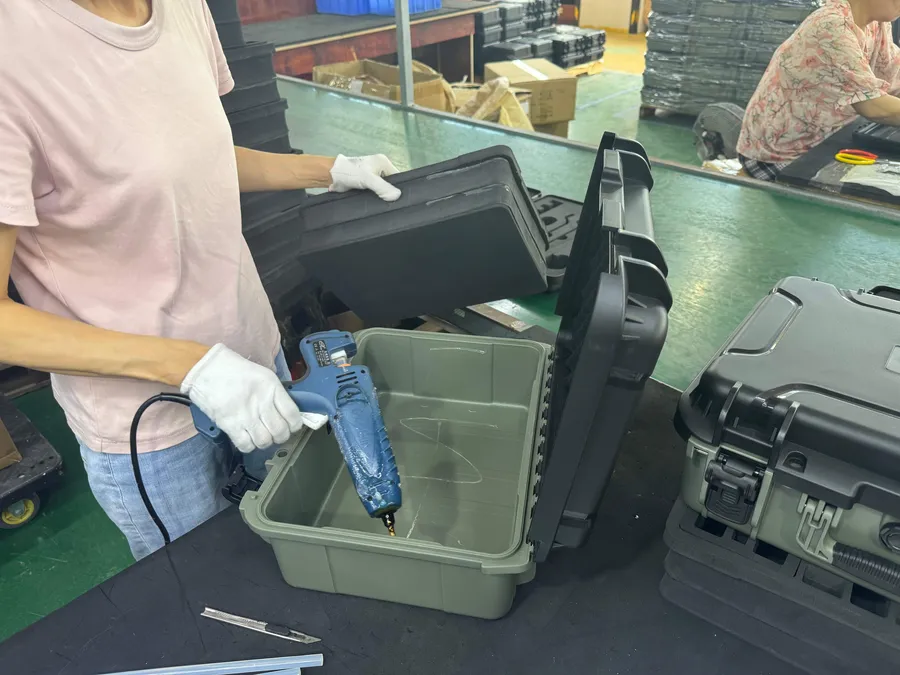
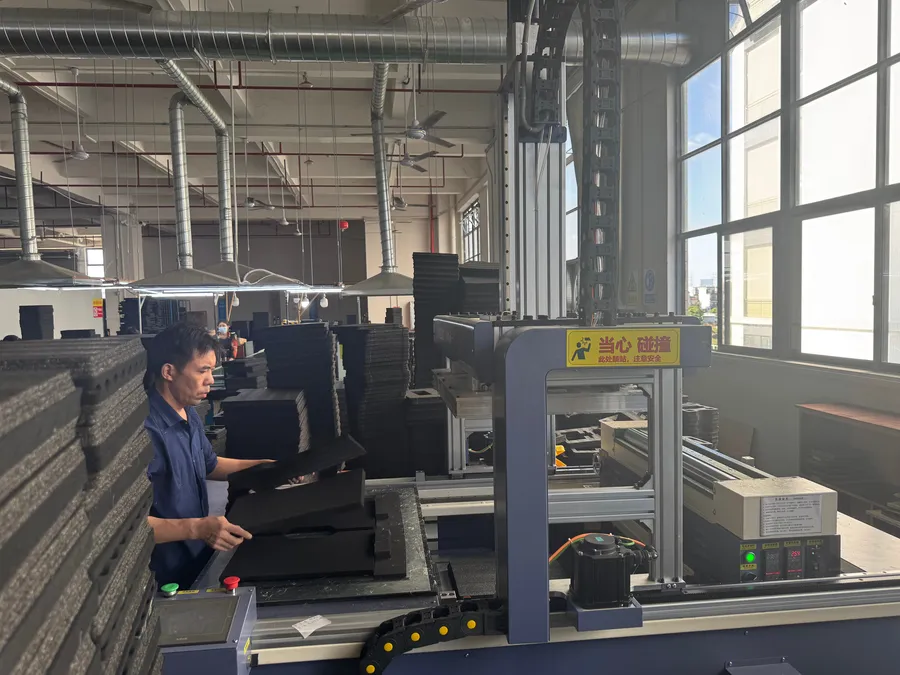
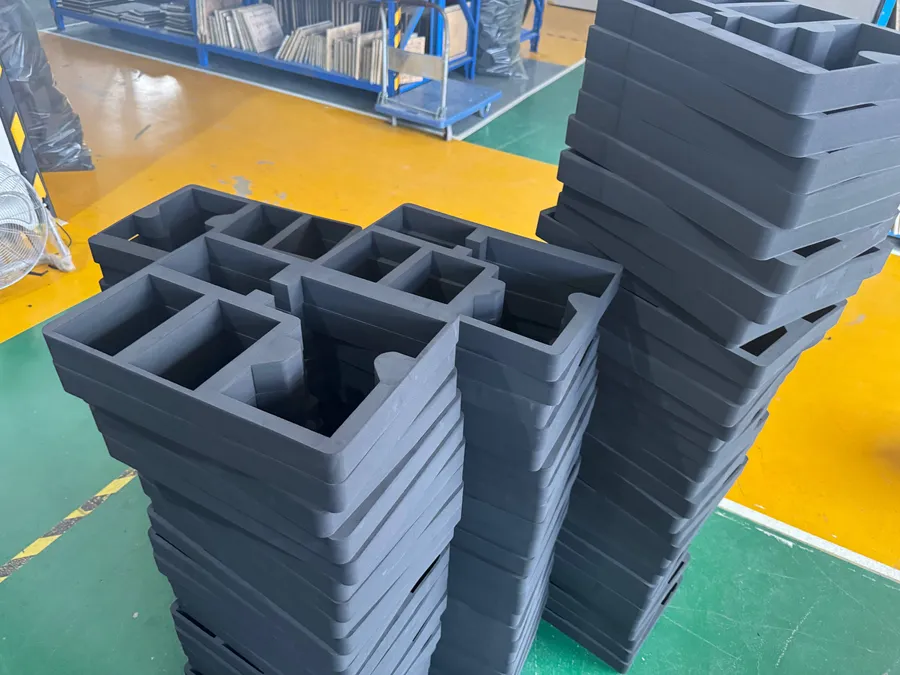
We cut to a reference. Send a drawing with dimensions, a photograph of the kit packed as it travels, or the tools themselves, and we will lay out pocket geometry, choose grade by zone and confirm it fits the published internal dimensions of the model you order. Available constructions include top foam, base foam, egg-crate or convoluted, custom cut and layered assemblies, in cross-linked PE, EVA and EPS selected by zone, with custom thickness and shape. Custom foam is available from a single unit on an existing shell; logo, colour and packaging start around 300 units; a new mould is roughly 125 days with MOQ from 3,000 per component, and OEM work on an existing mould runs about 45 days to first sample on a 30 percent deposit. We supply wholesale and OEM on EXW or FOB terms, not retail, not DDP, with no overseas warehouse stock. What we will not do is state a performance figure with no test record behind it: where a model has no measurement we mark it unmeasured, and accredited testing can be commissioned as a separate work package.
Notes before you order foam for a tool case
Weigh your heaviest single item and judge the carrier layer against that, not against the average. Specify closed-cell grades wherever lubricants travel with the kit, and treat the insert as a replaceable consumable once it is saturated. Do not buy a shell first and try to fit foam into whatever depth is left; internal lid and base depths are published per model and they cap what a graded layout can achieve. Expect a fixed cut to demand that the kit stays standardised, and budget a layout revision when tools are added. Ask for one sample packed with your real tools and carried for a week before committing to a mould or a volume run. Confirm the model by SKU and its published material and wall thickness, since figures vary across the range and are not interchangeable. If a specification sheet demands a number we have not measured on that model, say so early rather than letting an assumption travel into a tender document.
Customisation
Everything described above is configurable on a standard shell: interior layout (pick-and-pluck, die-cut or CNC-cut), foam grade and thickness, colour, logo method, latch and lock count, pressure-equalisation valve, cable ports, document holder and identification plate. A bespoke exterior geometry requires a new mould — 125 days, from 3,000 units per moulded component.
Procurement considerations
| Question | What to send us |
|---|---|
| Which shell fits? | Equipment L × W × H as packed, plus required clearance per axis |
| What does it cost? | Order quantity and estimated annual quantity — the two drive different answers |
| Is tooling needed? | Whether an existing shell clears the envelope with usable foam depth |
| Lead time? | Your required delivery date, not just the order date |
| Certification? | The exact standard your tender names — we will say whether we can test to it |
| Freight? | Destination and preferred terms; carton and pallet data supplied with the quotation |
Comparison and selection guide
The tables on this page exist because a protective case is chosen by comparing three things: the envelope, the environment and the handling chain. Where no table applies, the rule below is.
| Situation | What To Do |
|---|---|
| Fixed inventory | CNC or die-cut silhouette with part numbers printed on the foam. |
| Variable kit | Pluck foam plus a loose tray. |
| Bench work | Removable trays that lift out square so the case doubles as a stand. |
- Size on internal dimensions plus clearance, never on a product name.
- Choose the carrying method before the shell: it changes the series, not just the price.
- Specify the interior last, and decide up front whether the end user will reconfigure it.
What type of foam is suitable for professional tools? relates to Foam Insert Guide. Related families: Tool Cases / Military Protective Cases / Tactical Equipment Cases / Electronics Cases / Custom Protective Cases / Field Equipment Cases. Related sectors: field and industrial equipment. Continue in the Foam Insert Guide cluster.
This page is written from our own production data. If your requirement differs, send the dimensions and we will tell you which of the 155 models fits, or whether a custom route is needed.