What type of foam is suitable for optical equipment?
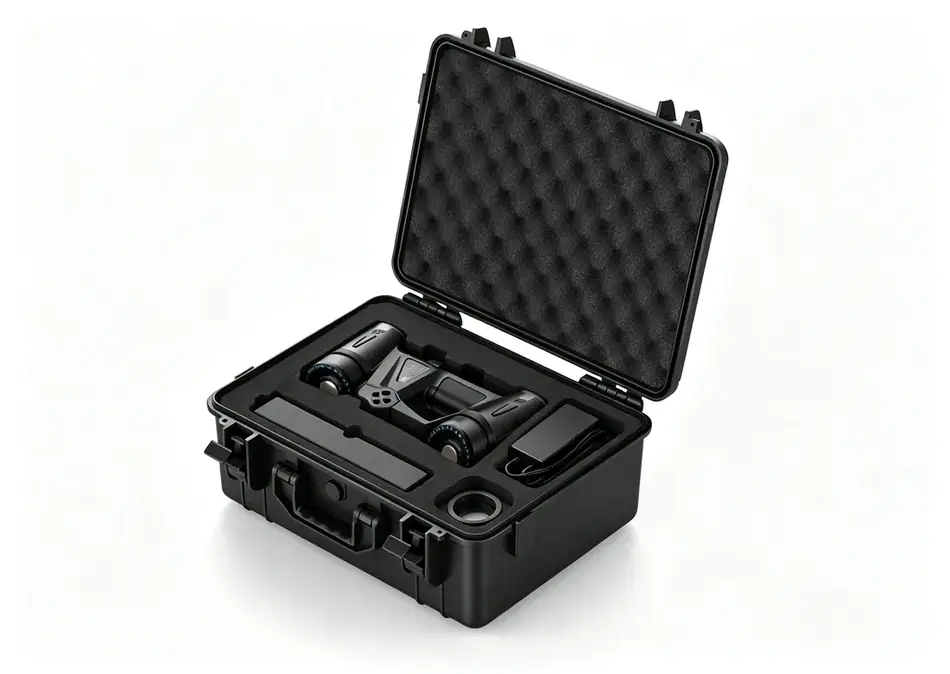
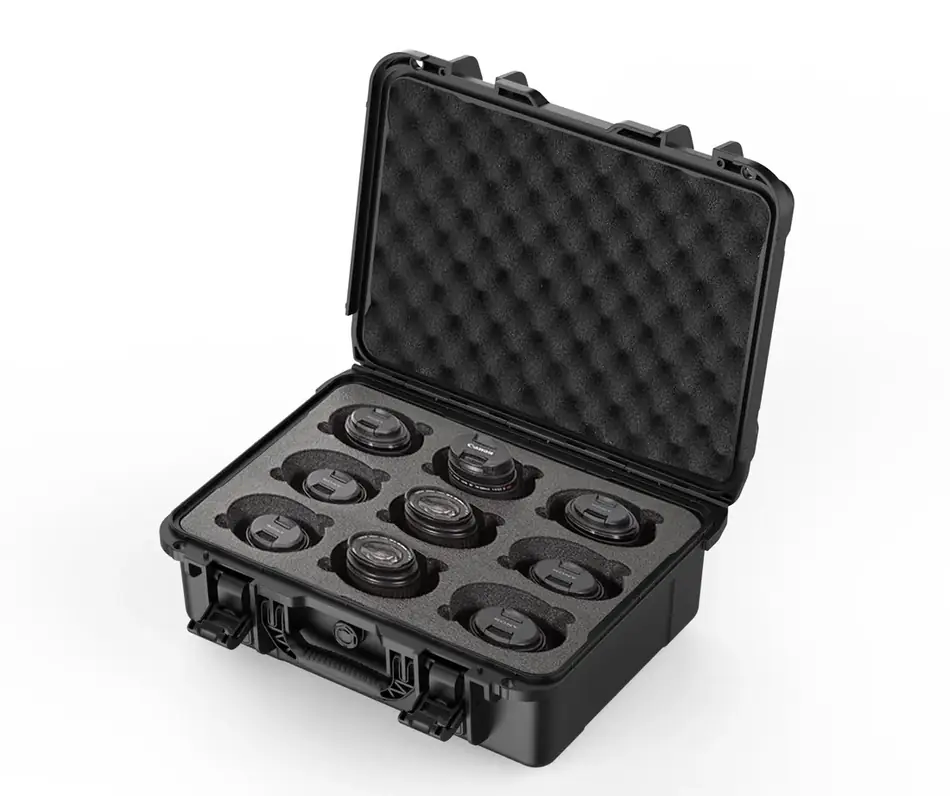
A suitable interior for optical equipment is a layered one: a firm closed-cell PE or EPE base layer that carries the instrument and holds it in a single position, a smoother or convoluted face where the foam actually touches lenses, coatings and machined surfaces, and pockets produced by CNC machining from an outline of your instrument rather than cubes torn out by hand. If we had to reduce it to one rule, it is this: immobilise the instrument first, cushion second. A loose optic inside a rigid shell takes a fresh impact at every knock, and the foam that stops the movement is more valuable than the foam that absorbs the shock. The one build we steer optics away from is a crumb-shedding torn interior, because loose particles are an abrasive on coated glass.
Key points
- Immobilise before you cushion: the pocket follows the outline of the instrument, so nothing shifts when the case is set down or bumped.
- Split the interior into a firm PE or EPE load-bearing layer and a smoother contact face, instead of one foam used everywhere at one hardness.
- Choose CNC-cut pockets for a fixed, high-value layout and keep pick-and-pluck for kits that genuinely have to be re-laid out in the field.
- All 155 model pages in our catalogue list the same interior vocabulary: PE, EPE and EVA, built as pick-and-pluck, die-cut or CNC-cut.
- Size the foam out of published geometry: KX-814641 gives 140 mm of internal height to share between the instrument and every foam layer.
- Foam is not a sealing system. Of the 45 models tagged for optical equipment, 41 list a compressible gasket as a separate feature.
Three jobs the interior has to do
A hard shell does one thing: it keeps sharp objects and most of the rain away from what is inside. Everything else that protects an optical instrument is done by the interior, and the interior has three separate jobs that pull in different directions. The first is location. The instrument must be held in one position relative to the case walls so that a knock on the shell becomes a small, spread-out load instead of a collision between the instrument and the inside of the lid. The second is load spreading, which matters most on the objective cell, the eyepiece and any threaded mounting ring, because those are where a point load turns into a crack or a shifted alignment.
The third job is contamination control, and it is the one buyers forget. Foam that shreds, crumbles or sheds beads puts particulate where it will be ground into a coating by the next vibration. A coated lens with a thin film of foam dust and a wipe at the wrong moment is a damaged lens. The three jobs are why we almost never specify a single foam for an optical case: the layer under the mass wants to be firm and close-celled, the face touching the glass wants to be clean, smooth and non-abrasive, and the walls between adjacent pockets want to be stiff enough not to fold under stacking.
Why optics are a different problem from tools or radios
Optical instruments share three characteristics that change the interior specification. They are brittle in places, because cemented doublets, prism assemblies and thin glass elements do not tolerate point loads the way a machined steel housing does. They are alignment-critical, because an impact that would merely dent a tool can move a mechanical zero or decenter an element, and the damage only shows up when the instrument is used. And their outer surfaces are the working parts: a scratched lens or a marred coating is a permanent loss of performance, not a cosmetic issue.
Geometry adds a fourth wrinkle. Most optics are long, round and irregular at the same time: a monocular body, a spotting scope tube, a set of objectives with different lengths, a surveying instrument with a triad base. A flat rectangular cut does not locate a cylinder, and a cylinder that is only supported at two points becomes a lever. That is why our optical recommendations lean on shaped pockets, cradles and lid pressure rather than on thickness alone, and why we ask for a drawing or a physical sample before we quote an interior for a lens set.
The material families we cut
Our catalogue lists three material families for interiors, and each earns its place in a different layer. Polyethylene foam (PE) is the workhorse for load-bearing layers: firm for its weight, low water absorption, cleanly cut, and stable enough that a milled pocket keeps its shape over repeated use. Expanded polyethylene (EPE), the beaded structure, is the more economical option where a thicker layer is needed and the finish can be coarser; the bead surface is acceptable in a base layer but is not where we want a coated lens resting. Ethylene-vinyl acetate (EVA) is the smoother, tougher and more durable face material: it takes fine machining detail, resists tearing at pocket edges, and gives a cleaner contact surface, which is why we specify it at the interface with optics and on frequently handled kits. None of these families is sold by us as a protection rating; they are construction options listed per model page, and the finished interior depends on the configuration you order.
Build types: machined, die-cut and torn by hand
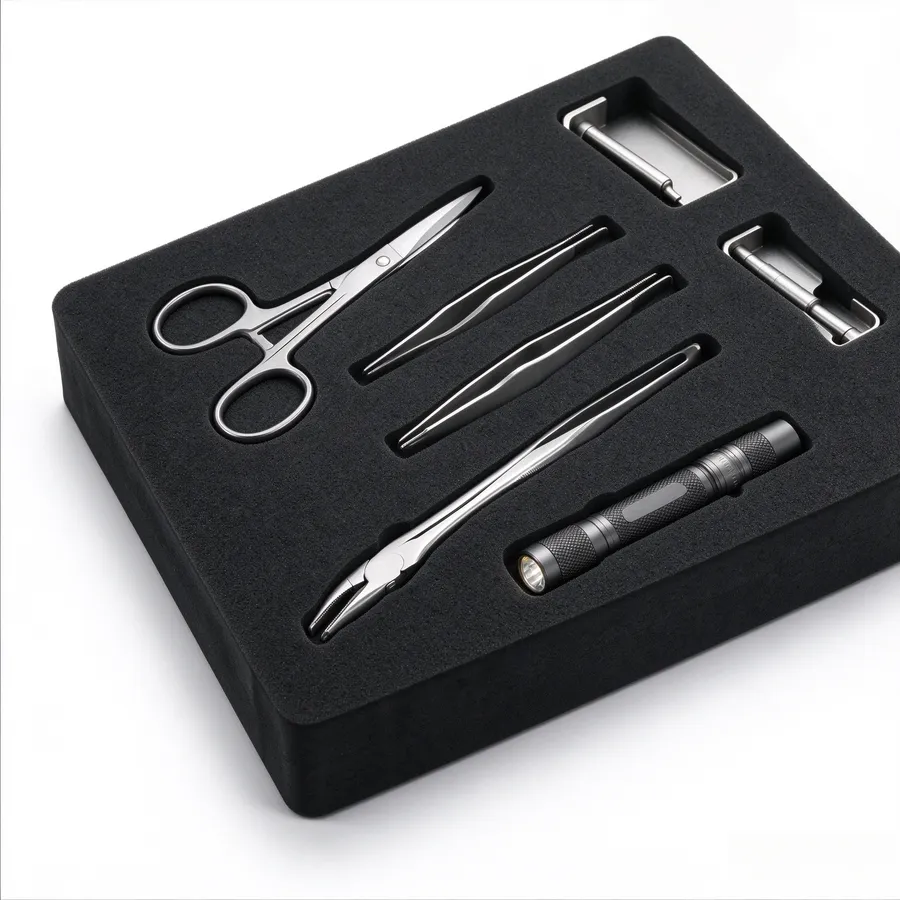
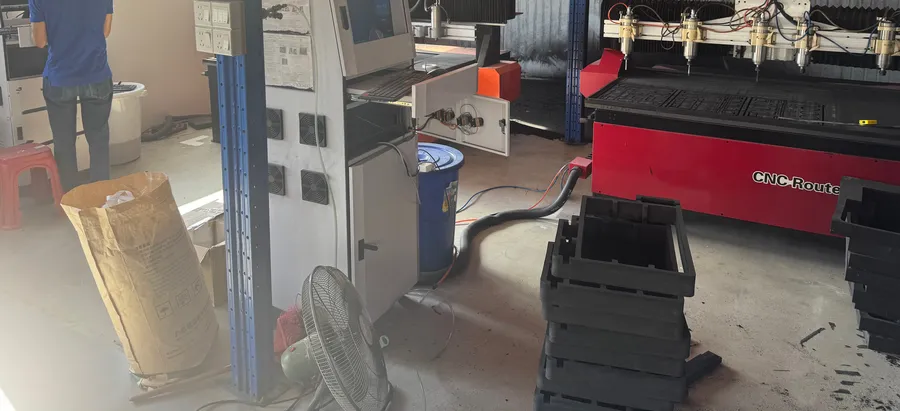
Build type is a separate decision from material. A CNC-cut interior is machined from a digital outline of each item, so every instrument has its own pocket with real walls of foam between them, and the same drawing reproduces the same layout on every unit in the run. This is what we recommend for optical equipment with a fixed kit list, because the location job is done by geometry rather than by luck. A die-cut interior is punched from sheet foam with a steel rule or a press die, which is the economical route once a layout is fixed and the order quantity justifies tooling; the achievable detail is coarser than machined foam.
Pick-and-pluck is a pre-cubed layer that the end user tears out to fit the item. It is genuinely useful where the kit changes in the field and nobody has a drawing, and it is genuinely unsuitable as the only interior for a valuable optic: torn faces shed particles, the fit depends on who tore it, and the walls left between hand-torn cubes are thin. Where buyers want flexibility and a clean interior at the same time, our usual answer is a hybrid: a machined or die-cut base layer that carries the mass, plus a removable convoluted or layered top face, so the lid presses the kit down without needing a perfectly cut pocket on every component.
Comparison: interior build against the risk it handles
The table reads across the same four questions we ask on every optical enquiry: does this build stop the instrument moving, is the surface touching the glass clean, what happens when the kit list changes, and what does it cost per set. Note that the last column is a recommendation from our own production practice, not a measured performance claim; we publish measured figures only where a test record exists for that model and configuration.
| Interior Build | Best For | Holds Position | Surface Contact | Layout Change | Our Note |
|---|---|---|---|---|---|
| CNC-cut PE base with EVA face layer | Scopes, monoculars, surveying instruments, lens sets | Yes, by shaped pocket | Smooth, non-shedding | Needs a new drawing | Default recommendation for high-value optics |
| Die-cut EPE base, custom cut | One repeatable kit at volume | Yes | Beaded surface, use a face layer | New die | Lower unit cost once the layout is frozen |
| Pick-and-pluck layered | Mixed or changing field kits | Depends on who cut it | Sheds particles when new | By the end user | Acceptable as a top face, not as the only interior |
| Egg-crate convoluted top over firm base | Loose accessories, eyepieces, filters | Moderate, by lid pressure | Clean and forgiving | Tolerant | Often the right answer for a small optic in a deep case |
Sizing the interior from published case geometry
The thickness available to you is not free: it is whatever the internal height allows after the instrument is in the box. Take KX-814641, one of the longest shells in the catalogue at 1280 x 350 x 140 mm internal with 5.0 mm walls and a stackable 8 Series body. With 140 mm of internal height, a 90 mm instrument on a 25 mm base layer leaves about 25 mm for the top face, which is enough for a convoluted layer but not for a deep wrapped pocket. KX-84430 turns the same problem upside down: 395 x 295 x 275 mm internal, with only 45 mm of that depth below the rim and 230 mm in the lid, so a tall body stands proud of the base well and is located by raised foam walls and lid pressure rather than by a milled pocket in a deep block.
Wall thickness is the other number worth reading carefully, because it decides how much external footprint you pay for in freight and stacking. The 45 models we tag for optical equipment publish wall thicknesses from 3.3 mm on KX-4822 to 6.0 mm on KX-97227. Thicker walls mean a heavier, stiffer shell: KX-97227 at 6.0 mm and 10.0 kg empty puts 590 x 435 x 210 mm of internal space on a wheeled T Series body with a 168 mm deep base and a shallow 42 mm lid, which suits a heavy instrument you want to keep low in the box. KX-65522 shows what a thinner option buys: 507 x 385 x 190 mm internal, 5.3 mm walls, 4.86 kg empty, ABS shell, stackable, no wheels.
Selection guide: matching the interior to the payload
Work down the payload, not down the catalogue. A single hand-held optic such as a monocular or thermal imaging unit is usually best served by a compact stackable shell with a machined base pocket and a convoluted top face, because the mass is low and the failure risk is a knock on the objective. A matched set of objectives, filters and extension tubes wants separate pockets with real walls between them, so one item cannot lever against another. A long tube or a paired set of binoculars in the same box wants the length supported continuously rather than at two ends, which is the argument for shells like KX-814641 with a shallow but long interior.
Instruments with a tripod mounting foot, a rangefinder body, or any asymmetric protrusion are the group that most often comes back wrong, because a rectangular pocket leaves the protrusion unsupported. For those, the practical answer is a custom-cut base layer with the protrusion machined into it, which our interior pages list as a standard option on every model rather than a special project. Weight matters too: if the instrument itself is heavy, put the thickness under it and keep the top face thin, since the top layer mainly controls movement, not load.
Where these interiors are used
The optical interiors described here go into cases for defence and survey use, where the equipment is repeatedly loaded into a vehicle and unloaded on uneven ground, and into the hunting and outdoor trade, where a spotting scope or binocular set spends its life in a rucksack. They are equally common in the camera and photography channel, where a lens set is a classic multi-item payload with mixed shapes, and in laboratory and metrology use, where an instrument is moved between benches and its calibration is the thing being protected. Our 45 optical-tagged models split across the same body styles: 32 polypropylene shells, 10 engineering polypropylene, 2 ABS and 1 combination shell, with 17 of them offering wheels and 28 published as stackable.
Custom interiors and what we need from you
Custom foam is not a special order at our end. Every model page lists custom foam, custom thickness and custom shape as available, with CNC machining and die cutting both offered, and the minimum order for a custom interior is 1 set, against 300 pieces for a custom logo or a custom colour and 3000 pieces per component for a new mould. What we ask for before quoting an interior is one of three things and we treat them as equivalent: a drawing with the outline and mass of each item, a photograph of the packed kit, or a physical sample. A sample is the fastest route when the kit has irregular protrusions, because we can copy the layout instead of guessing tolerances.
On timing, an OEM build on an existing mould runs to a 45-day lead time, including the interior; a new mould is a 125-day programme from approval, and that is the route only when the geometry of the shell itself has to change. Most optical customers never need a new mould, because 155 published models cover internal volumes from 0.3 to 111.6 litres and a machined interior does the rest. Tell us the instrument dimensions with caps and hoods fitted, the total mass, how many items share the box, and whether the lid must press the kit down or a clearance is needed for a delicate eyepiece.
Purchasing notes and the limits of our claims
Read the interior as a configuration, not as a rating. On our model pages, shock and impact protection are listed as construction options that depend on the foam you specify, and we do not publish a drop height for them. Waterproofing, dust resistance, UV resistance, temperature range and stack load are recorded as not measured for configurations without a test record, and we will state a value only where our own production or incoming-material data supports it; accredited testing can be commissioned as a separate work package if your tender requires one.
Two commercial points avoid most of the arguments later. First, we work wholesale and OEM on EXW or FOB terms: we do not sell single units at retail, do not quote DDP landed prices, and do not hold overseas warehouse stock, so plan your freight and customs around that. Second, foam thickness quoted for one model does not transfer to another model, because the internal height, the rim depth and the lid depth differ; the figures above are published per model, and if you change shell size the pocket drawing has to be re-cut. Send us the payload list and we will return the layout with the case recommendation attached, not the other way around.
Related reading on this site
For the general material question across all equipment types see our guide to which foam suits an equipment case; for the arithmetic of layer thickness see how foam thickness is chosen; and for the transport failure modes that the interior has to survive see how optical equipment should be protected during transport. The machining routes are covered separately under CNC-cut foam, pick-and-pluck foam and foam-padded protection, and the sizing side under internal versus external dimensions and how to measure equipment for a case.
Customisation
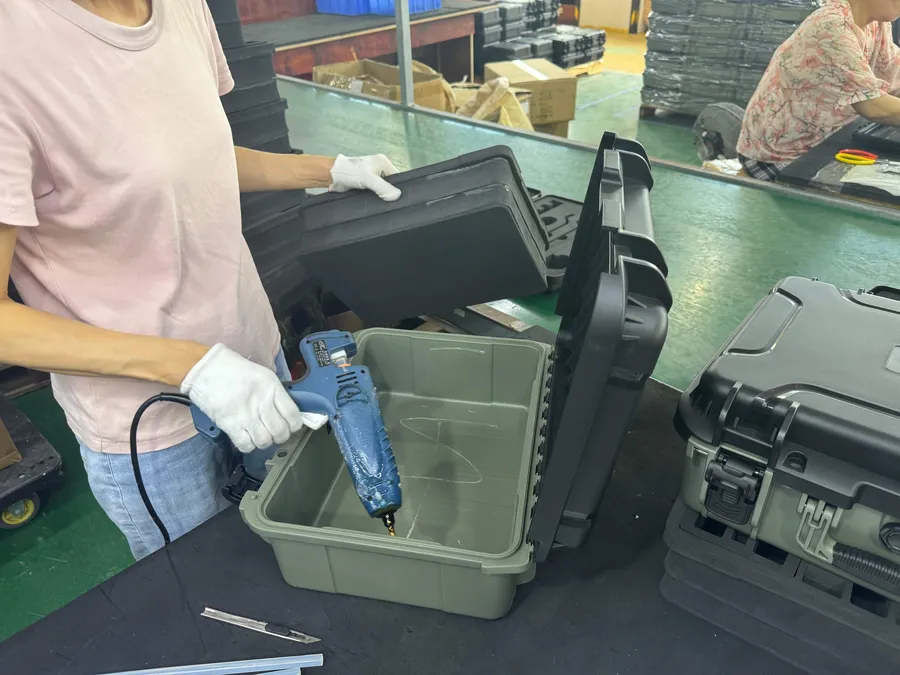
Everything described above is configurable on a standard shell: interior layout (pick-and-pluck, die-cut or CNC-cut), foam grade and thickness, colour, logo method, latch and lock count, pressure-equalisation valve, cable ports, document holder and identification plate. A bespoke exterior geometry requires a new mould — 125 days, from 3,000 units per moulded component.
Procurement considerations
| Question | What to send us |
|---|---|
| Which shell fits? | Equipment L × W × H as packed, plus required clearance per axis |
| What does it cost? | Order quantity and estimated annual quantity — the two drive different answers |
| Is tooling needed? | Whether an existing shell clears the envelope with usable foam depth |
| Lead time? | Your required delivery date, not just the order date |
| Certification? | The exact standard your tender names — we will say whether we can test to it |
| Freight? | Destination and preferred terms; carton and pallet data supplied with the quotation |
Comparison and selection guide
The tables on this page exist because a protective case is chosen by comparing three things: the envelope, the environment and the handling chain. Where no table applies, the rule below is.
| Situation | What To Do |
|---|---|
| Bare optic | Suspended body, both ends clear, soft contact layer. |
| Mounted system | Carrier under the mount, optic unloaded, tripod in a separate channel. |
| Night operations | Silent foam surface and a layout that can be opened without looking. |
- Size on internal dimensions plus clearance, never on a product name.
- Choose the carrying method before the shell: it changes the series, not just the price.
- Specify the interior last, and decide up front whether the end user will reconfigure it.
What type of foam is suitable for optical equipment? relates to Foam Insert Guide. Related families: Optical Equipment Cases / Camera & Photography Cases / Instrument & Equipment Cases / Custom Protective Cases / Military Protective Cases. Related sectors: field and industrial equipment. Continue in the Foam Insert Guide cluster.
This page is written from our own production data. If your requirement differs, send the dimensions and we will tell you which of the 155 models fits, or whether a custom route is needed.