Why are foam inserts used in protective cases?
Because a moulded shell has flat walls and two rims, and the equipment inside it does not. An insert removes the free travel between the two, so a knock arrives at a supported surface instead of at whatever point happens to strike first; it also lengthens the time over which the item stops, which is the only variable inside a closed case that changes the force reaching the payload without changing the shell. On our published sheet this is treated as construction, not as an accessory: custom foam, custom thickness and custom shape are recorded on all 155 active models, six cut families and five layer structures appear on all 155, and shock protection is recorded on all 155 as a manufacturer option with the note that it requires a specified foam layout because the shell alone is not a shock rating.
Key points
- A shell protects by spanning and bending; only an insert can match an irregular outline and hold it in position.
- Foam sets the stopping distance, so peak force at the payload is a layout decision rather than a resin decision.
- Shock protection is recorded on all 155 models as conditional on a specified foam layout, not on the shell.
- Usable interior volume is published below theoretical volume on 154 of 155 models; design the bed against the usable figure.
- Custom foam carries no minimum beyond the case itself - MOQ is 1 on all 155 models, so a bed is a drawing, not a tooling programme.
- Pick-and-pluck is the reversible family; die-cut and CNC-cut beds are permanent and have to be decided with the case, not after it.
- Material families and process families are different axes: EVA, PE and EPE describe the foam, die-cut and CNC-cut describe how the cavity is produced.
What an insert does that the shell cannot
A protective case shell is a moulded box: two rims, four walls, corner radii, a parting line and bosses for the latch and hinge. Equipment is not a moulded box. It has a lens barrel, a handset, an antenna, a connector that projects from one face, a strap that has to stay reachable, and a centre of mass that usually sits nowhere near the middle of the cavity. Leave that item in an empty shell and every handling event becomes a short free fall that ends when the item meets a wall or a rim at a point nobody designed.
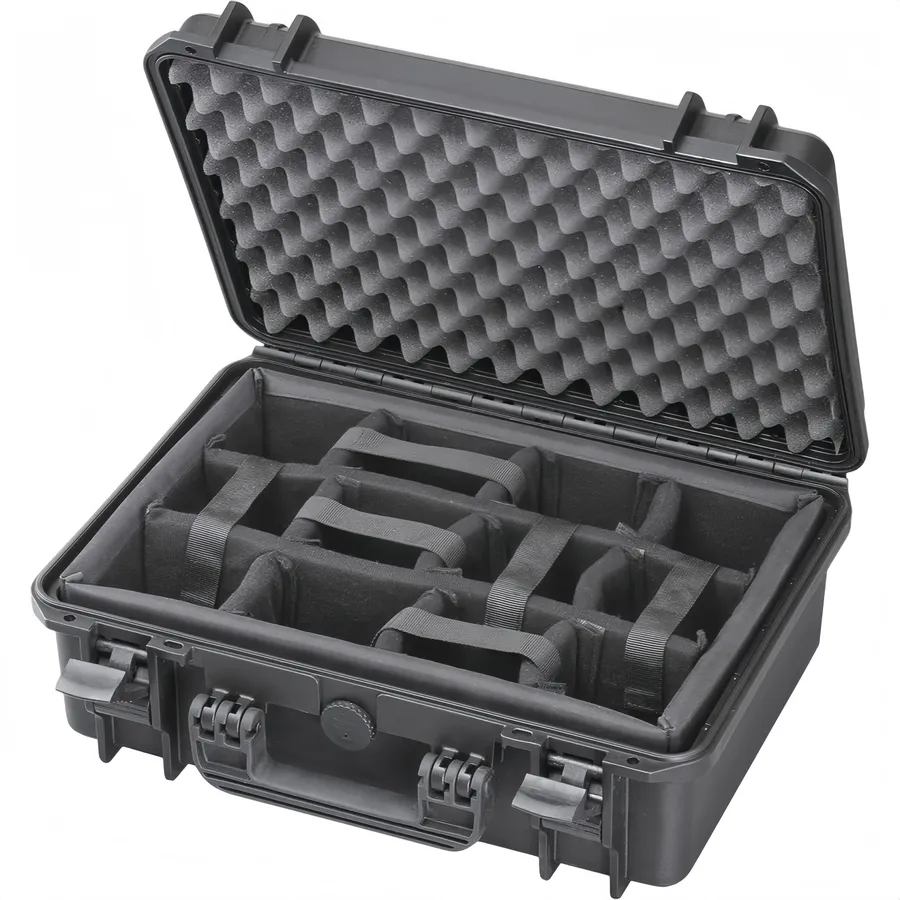
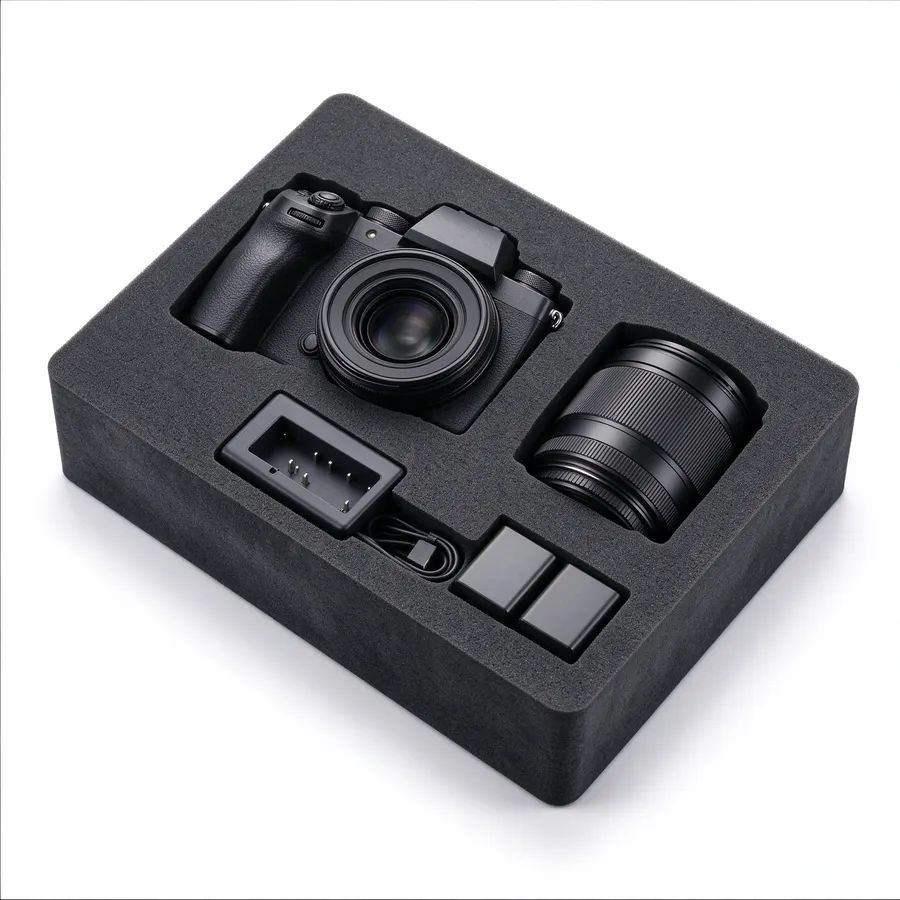
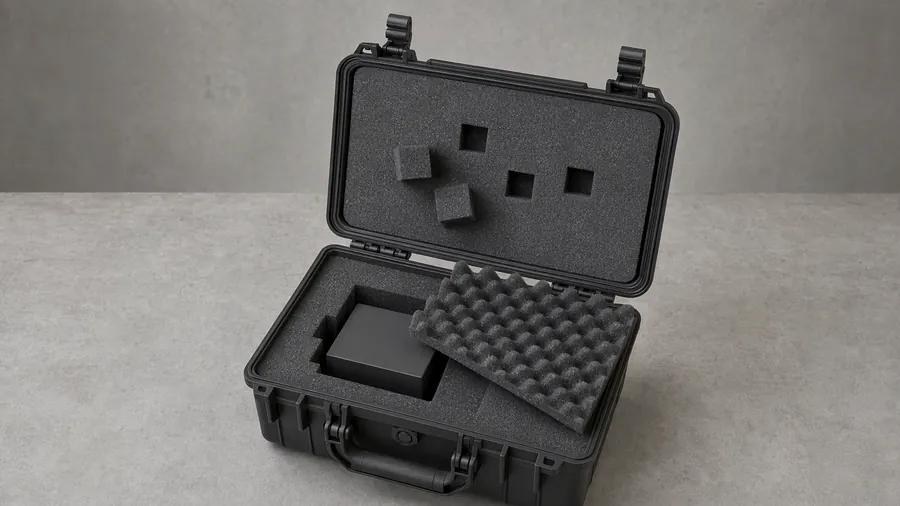
The insert exists to remove that free travel. It fills the space around the item so the load is carried along surfaces the product already has, and four separate jobs follow from that. Restraint: an item that cannot translate cannot accumulate damage from a long series of small hits, which is the normal way field kit fails in service. Load spreading: a bed that contacts a wide face puts a knock into the structure of the product instead of into a connector or a bezel. Energy management: the foam deforms and lengthens the time over which the item stops, and that stopping time is the variable that decides what the payload sees. Separation: in a multi-item case the beds keep instruments, spares and cables from becoming each other's hazard.
The volume an insert occupies is already published
Buyers normally size a case from the internal envelope and then discover that the fitted interior does not behave as expected. Our sheet publishes three related figures for every model: the internal dimensions, an internal volume in litres, and a separate usable interior volume. Across the 155 active models the internal volume runs from 0.3 litres to 139.5 litres with a median of 17.5 litres, and the usable interior volume runs from 0.3 litres to 111.6 litres with a median of 15.0 litres. On 154 of the 155 models the usable figure is lower than the theoretical one; the difference reaches 27.9 litres on the largest shell and its median is 2.8 litres.
That difference is where an insert lives, although the sheet does not attribute it to foam alone - a gasket channel, a latch boss, a hinge line or a parting rib takes space in exactly the same way. The practical consequence is that a bed should be designed against the usable figure rather than the box interior, and a layout that sits close to the limit should be proved on a physical trial before the production cut is released. Where the gap between the two published volumes is large, a dense payload and a full-depth bed may simply not be compatible in that shell, and that is a conversation to have at quotation stage rather than after a cutting file exists.
The six foam families, and what each one gives up
All six appear in the foam types field on all 155 active models, and all five structures - top foam, base foam, egg-crate or convoluted, custom cut, layered - are recorded on all 155 as well. That is why we treat this page as a specification discussion rather than a catalogue: the choice is not between a good foam and a bad foam. Two of the six names describe how the cavity is produced and three describe what the cavity is made of, which is exactly where buyer briefs go wrong. A purchase order that says only CNC-cut foam does not tell us what material will be under the instrument, and an order that says PE foam does not tell us whether the outline is a pluck grid or a cut pocket.
| Foam Family On The Sheet | Chosen For | What It Asks Of You | What You Give Up |
|---|---|---|---|
| Pick & Pluck | Interiors that change; shared fleets; kits with variable accessory counts. | Nothing fixed - the grid is decided at the case, not on a drawing. | Precision. A finger-cut outline is a compromise around the true shape. |
| Die-Cut | Repeatable outlines in production quantities, plugs and pockets cut consistently. | A settled outline per item, supplied as a drawing or a sample. | Flexibility. A die is spent on one layout. |
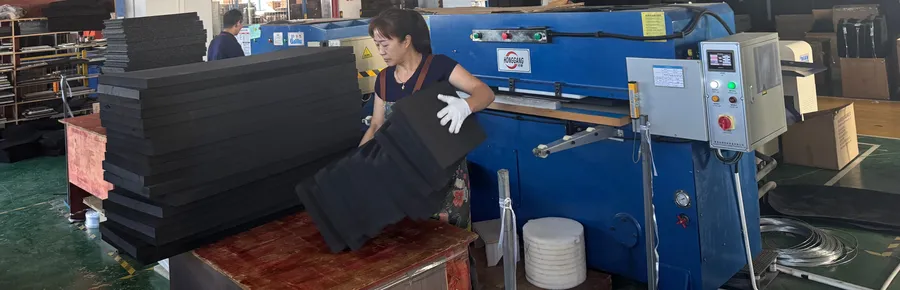
| CNC-Cut | Complex cavities, deep pockets, step changes, fast layout revision. | A digital file from a drawing, a photograph of the packed kit or a measured sample. | Nothing structural; the trade is programming time against tooling cost. |
| EVA | Firm, close-tolerance beds and lid liners where surface print or laminate is wanted. | Acceptance that a firmer foam transmits more, not less, if it is under-sized. | Compressibility for a given thickness. |
| PE | General-purpose base and top layers across most of the size range. | A thickness decided against payload mass rather than copied from an old case. | Fine surface detail compared with EVA. |
| EPE | Light, closed-cell layers and interleaves where mass matters. | Layering - an EPE interleaf alone is rarely the whole answer. | Load-bearing depth per millimetre. |
Layer structures: where the thickness actually goes
Depth is not free on any of these. Lid and base depths are published on 100 models, with lids from 16 mm to 320 mm and bases from 15 mm to 168 mm, and on 65 of those 100 the lid is the deeper half. A bed that puts most of its thickness above the item needs a case built that way; the same layout inside a shell whose depth sits in the base is a different problem and a different quotation. Where the model publishes no lid or base figure, we ask for the physical case or we work from the internal dimension and say so plainly rather than assuming a split.
| Structure | What It Carries | Decide It By | Watch For |
|---|---|---|---|
| Base foam | Static load and the vertical component of a knock. | Mass per seat and the depth left under the item. | A dense payload in a shallow base compresses fully and stops working. |
| Top foam | Restraint from above; keeps items seated when the case is inverted or lifted. | Lid depth published for the model and the closure compression. | A lid that will not close on a nominal bed once cables are fitted. |
| Egg-crate / convoluted | Distributed surface contact and cheap repeated use. | How many items share one cavity and how often they move. | Point loads concentrating on the pyramid peaks. |
| Custom cut | A defined outline per item, including cut-outs for connectors and handles. | A drawing, a photograph of the packed kit or a physical sample. | Outlines copied from an item at its service temperature fitted at the factory. |
| Layered | Two different duties in one bed - a firm locating layer over a soft carrying layer. | Which layer locates and which layer absorbs; then bond order. | Layers with the same stiffness, which behave as one thick layer. |
Published structure across the range
Seven shells taken straight from the published sheet. KX-1204 publishes the same figure for theoretical and usable volume because there is almost nothing to lose in a 115 x 78 x 32 mm cavity; a bed in that box is a few millimetres of material and the item is held largely by contact rather than by depth. At the other end, KX-88442 publishes 139.5 litres theoretical and 111.6 litres usable - the largest gap in the range - and a 320 mm lid over a 44 mm base, which means almost all of the working depth is above the item rather than under it.
KX-6621 and KX-97227 show the same point from the opposite direction: 149 mm and 168 mm of base against 43 mm and 42 mm of lid. A dense instrument package seats into the base of those shells and the lid contributes restraint, not carrying depth. Every figure in the table is published per model; wall thickness is recorded on 148 of 155 models and net mass on 93 of 155, and we do not extend one model's number across a series. The narrow internal width, which is the dimension a long item actually has to fit through, is published on 36 models and ranges from 70 mm to 308 mm.
| Model | Series | Shell | Wall Mm | Internal Mm | Volume Theo / Usable L | Net G | Lid / Base Mm |
|---|---|---|---|---|---|---|---|
| KX-1204 | 0 | PP | 2.6 | 115 x 78 x 32 | 0.3 / 0.3 | 100 | 16 / 16 |
| KX-2005 | 0 | PP | 2.0 | 190 x 135 x 40 | 1.0 / 0.9 | 175 | 20 / 20 |
| KX-4613 | 0 | PP | 3.0 | 455 x 338 x 116 | 17.8 / 15.3 | 1,370 | 74 / 42 |
| KX-4616 | 0 | PP | 3.0 | 455 x 338 x 148 | 22.8 / 19.6 | 1,395 | 74 / 74 |
| KX-6621 | 9 | Engineering PP | 6.0 | 587 x 434 x 192 | 48.9 / 39.1 | 6,420 | 43 / 149 |
| KX-97227 | T | Engineering PP | 6.0 | 590 x 435 x 210 | 53.9 / 43.1 | 10,000 | 42 / 168 |
| KX-88442 | T | PP | 5.0 | 740 x 518 x 364 | 139.5 / 111.6 | 15,320 | 320 / 44 |
How the layout is decided for a real load
Start with mass per seat, not with the whole case. A bed sized on total payload mass is the most common failure we see in a re-cut: two kilograms of handheld meter and forty kilograms of the same meter on a pallet share nothing. Then count the items and decide whether the layout is fixed or expected to change, because that single answer separates pick-and-pluck from die-cut and CNC-cut; a fleet that reconfigures between jobs is not a candidate for a die. Then look at the item itself and restrain the body, not the accessories - a bed that carries an instrument by its lens hood or its handle is applying force where the product is weakest, however well the cavity looks.
Next come the things buyers leave out. Leave access to connectors and to any control that has to be reachable without unpacking. Keep a route for the cable that will actually ship with the item, not the one in the brochure. If the case closes on a compressible gasket - recorded as measured on 124 models, with 31 publishing no seal offered - then the bed occupies space the closure was dimensioned around, and a top layer that is too thick shows up as a lid that will not latch. And if the item is calibrated on a mount, decide whether the mount ships attached; a bed that supports the mount and leaves the instrument free is worse than no bed at all.
Where this profile is specified
The enquiries that begin with a foam question come mostly from mixed loads rather than from single objects: instrument sets with probes and cables, survey and outdoor kits whose contents change between trips, communications sets carried by more than one crew, optical and camera payloads with removable components, and medical or laboratory loads where the contents are both fragile and regulated. On our own tag data, 127 of 155 models are listed under electronics cases, 120 under tool cases, 115 under instrument cases, 98 under firearm transport, 85 under camera equipment, 71 under medical equipment and 59 under drone cases; 155 carry the field-equipment and industrial-equipment application tags, 148 also carry outdoor and 140 carry electronics. A bed is the cheapest change available inside that whole population, which is why it is usually the right one.
Customising the insert
An insert is the part of a case order that needs no tooling. Custom foam is recorded on all 155 models with a minimum order quantity of 1 - the same as the case itself - and custom thickness and custom shape are recorded the same way, so a layout change between two deliveries is not a programme and not a new cost centre. What a bed does need is input: our sheet records, as measured data on all 155 models, that the required input is a drawing, a photograph of the packed kit, or a physical sample. Any one of the three is enough to start; a sample is the best of them because it carries the tolerances nobody drew.
Everything that does need tooling is on the shell side, and the two timeframes are fixed in our published data: first samples on an existing mould are planned at 45 days, logo, colour and OEM work on an existing mould are published at 300 pieces, and a new mould is a 125-day programme with a minimum of 3,000 pieces per component. If your brief changes the wall, the rim or the rib pattern, it changes the structure the bed is designed against, and the quotation has to be rebuilt rather than amended.
Before you order
Three cautions. Do not read one model's figures as a family capability - wall thickness on our sheet runs from 2 mm to 6 mm across the 148 models that publish it, and net mass from 100 g to 15,320 g across the 93 that publish it. Do not copy a bed from a case you already own without checking which published volume it was designed against. And do not treat the absence of a printed performance number as an absence of engineering: shock protection on all 155 models is recorded as a manufacturer option conditional on a specified foam layout, and no ingress code, drop height or stack load is stated for any model, because we do not hold a record for it.
Where a qualification number is genuinely required for a tender, accredited testing is commissioned as a separate work package on the exact model, closure state, bed layout and marking you are ordering, and the report is issued to you. We will not attach an existing result to a different configuration to make a quotation look better. Commercial terms are unchanged by any of this: we manufacture for wholesale and OEM buyers on EXW or FOB terms only - no retail, no DDP and no overseas warehouse, so your own forwarder arranges freight. Carton data is published on 64 models and pieces per carton on 58; pallet and container figures are calculated against your pallet size and supplied with the quotation.
Buyer searches for inserts by case type, answered from published model records
The five phrases below are what buyers type when they are sourcing an insert for one particular kind of case, and each is answered here from the product database rather than from a generic description of foam. The published base is the same for all five: 155 active models, with custom foam, custom thickness and custom shape recorded on all 155, six foam types and five layer structures recorded on all 155, and a minimum order of 1 unit printed against the custom foam line. What is deliberately absent is a performance code: water ingress, dust ingress and the protection rating field are recorded as not measured on every model, so every number below is a dimension, a wall or lid depth, a mass, a volume, an order quantity or a lead time.
| Search | What We Publish |
|---|---|
| custom foam inserts for instrument cases | Instrument formats are the widest part of the middle of the sheet: 115 models carry the instrument listing, from WL3308 at internal 325 x 236 x 76 mm (5.8 L internal, 5.0 L usable) with a 2.3 mm wall and 575 g, through WL9-3221 at internal 300 x 200 x 200 mm (12.0 L / 9.6 L usable) with a 5.0 mm wall, to WL8-5827 on wheels at internal 500 x 400 x 220 mm (44.0 L / 35.2 L usable). Gauges, handheld meters and probe sets are cut as separate pockets from a CNC file, and the accepted input published on every model is a drawing, a photograph of the packed kit, or a physical sample. The impact behaviour of a foamed instrument interior is not measured, so no drop height is claimed for it. |
| custom foam inserts for outdoor cases | 145 of the 155 models carry the outdoor listing, and the insert question out there is a depth budget rather than a shape. The small end publishes WL1204 at internal 115 x 78 x 32 mm, 0.3 L internal and 0.3 L usable, 100 g, 2.6 mm wall, 16 mm lid depth over a 16 mm base; the large end publishes WL8-7323 at internal 650 x 430 x 210 mm, 58.7 L internal but 47.0 L usable, with a 5.0 mm wall and a 160 mm lid depth over a 50 mm base. Lid depth is published on 100 models from 16 mm to 320 mm, and the gap between internal volume (median 17.5 L) and usable interior (median 15.0 L) is the room a bed actually has once rims, latch bosses and gasket channel are accounted for. Ingress on these shells is recorded as not measured, so rain exposure is settled by the gasket and rim construction, not by a code. |
| custom foam inserts for medical cases | 71 models are listed under medical equipment and they sit at the large end of the sheet: internal volume runs from 20.2 L to 139.5 L with a median of 34.4 L, usable interior from 16.5 L to 111.6 L. WL707 publishes internal 465 x 310 x 140 mm (20.2 L internal, 17.4 L usable) at 1360 g with a 2.5 mm wall, and WL8-8442 on wheels publishes internal 740 x 518 x 364 mm (139.5 L / 111.6 L usable) at 15320 g with a 5.0 mm wall. Analyzer housings, probe sets and battery packs are bedded in layered builds recorded on all 155 models: base foam cut to each body, egg-crate or convoluted top foam over it, custom thickness set per zone. We publish no sterilisation, biocompatibility or device-registration data for these interiors; those fields are not measured in our records, and a buyer who needs them commissions testing for the configured item. |
| foam insert solutions for industrial cases | Industrial equipment is a published application on all 155 models, and the working categories are tool cases (120 models) and equipment transport cases (71 models). Three solutions recur. Die-cut outlines suit one settled kit repeated in quantity. CNC-cut pockets suit mixed sets such as WL5321, which publishes internal 481 x 373 x 192 mm (34.4 L internal, 27.5 L usable) with a 5.8 mm wall at 4810 g, or WL4319 at internal 407 x 187 x 178 mm (13.5 L / 11.6 L usable) with a 3.0 mm wall at 1587 g. Pick-and-pluck grids suit contents that change between deployments. Wall thickness across the sheet is published from 2.0 mm to 6.0 mm on the 148 models that carry the field and 136 models are published as stackable, but stacking load in kilograms is recorded as not measured, so pallet and stack figures come from the pack data on each model page rather than from a rating. |
| custom foam inserts for photography cases | 85 models are listed for camera and optical kit, sized from WL3308 at internal 325 x 236 x 76 mm (5.8 L / 5.0 L usable), which takes a body with one lens lying flat, through WL4318 at internal 407 x 187 x 178 mm (13.5 L / 11.6 L usable) at 1970 g with a 3.0 mm wall, to WL8-4122 at internal 385 x 313 x 205 mm (24.7 L / 21.2 L usable) with a 3.7 mm wall. Wall thickness on this group is published from 2.1 mm to 5.0 mm. Lens sets are cut as individual pockets, and the divider and pocket wall thickness is fixed in the cutting file for each layout; that thickness is not published as a catalogue figure, so it is agreed on the drawing before cutting. Shock attenuation for optics is not measured on our records, so no drop height and no peak-G figure is claimed. |
The six published foam families, matched to those case types
The families below are the ones printed in the foam types and structure fields of the model records; they are not a separate catalogue. Two of the six names describe how the cavity is produced, and the structures are what usually decides the outcome in a real kit.
| Foam Family | What It Is Published As |
|---|---|
| Pick and pluck grid | One of the six types recorded on all 155 models, ordered with custom thickness at the case rather than on a drawing, and priced on the same minimum order of 1 unit that the custom foam line carries. It costs accuracy: a finger-cut outline is a compromise around the true shape. |
| Die-cut outline | A cut process rather than a material, recorded on all 155 models. It suits one settled outline repeated in quantity, and it locks that outline in. First samples on an existing mould are planned at 45 days, which is where a repeating kit is proved before tooling is committed. |
| CNC-cut cavity | Cut from a file, so mixed kits keep separate pockets. It is the family used for the instrument and industrial formats quoted above, including WL5321 at 34.4 L internal against 27.5 L usable, where bosses and ribs eat part of the box. |
| EVA, PE and EPE grades | Three of the six published types, recorded on all 155 models, and the shell-side material field lists cross-linked PE, EVA or EPS by zone. Material grade is a construction decision, not a performance certificate: none of these carries a published impact figure. |
| Layered and egg-crate builds | One of the five structures recorded on all 155 models alongside top foam, base foam and custom cut. The depth check before ordering is arithmetic: lid depth is published on 100 models from 16 mm on WL1204 to 320 mm on WL8-8442, and base plus bed plus lid has to stay inside the internal height or the rim will not close. |
What this appendix adds, and what it does not
It adds search-language answered with published numbers. It adds no test result. Across the 155 model records the water ingress, dust ingress, ultraviolet, temperature range, stacking load and load capacity fields are recorded as not measured, and shock protection and impact resistance are recorded as manufacturer construction options that require a specified foam layout because the shell alone is not a shock rating. Where a tender genuinely needs a qualification number, accredited third-party testing is commissioned as a separate work package against the exact model, closure state, bed layout and marking being ordered, and the report is issued to the buyer rather than reused from another configuration.
Customisation
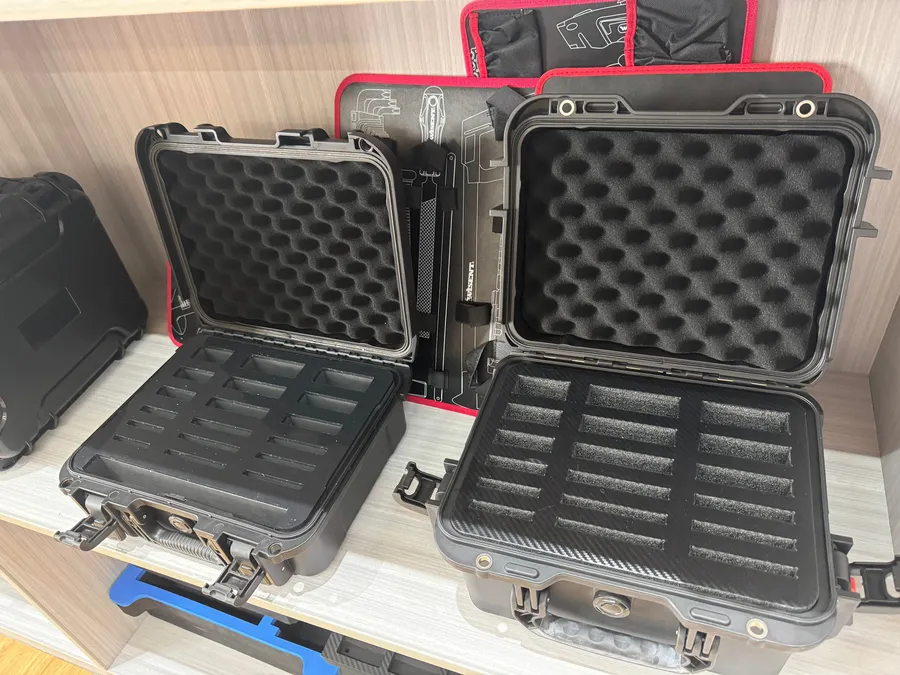
Everything described above is configurable on a standard shell: interior layout (pick-and-pluck, die-cut or CNC-cut), foam grade and thickness, colour, logo method, latch and lock count, pressure-equalisation valve, cable ports, document holder and identification plate. A bespoke exterior geometry requires a new mould — 125 days, from 3,000 units per moulded component.
Procurement considerations
| Question | What to send us |
|---|---|
| Which shell fits? | Equipment L × W × H as packed, plus required clearance per axis |
| What does it cost? | Order quantity and estimated annual quantity — the two drive different answers |
| Is tooling needed? | Whether an existing shell clears the envelope with usable foam depth |
| Lead time? | Your required delivery date, not just the order date |
| Certification? | The exact standard your tender names — we will say whether we can test to it |
| Freight? | Destination and preferred terms; carton and pallet data supplied with the quotation |
Comparison and selection guide
The tables on this page exist because a protective case is chosen by comparing three things: the envelope, the environment and the handling chain. Where no table applies, the rule below is.
| Situation | What To Do |
|---|---|
| Fastest | Standard shell plus CNC foam — typically 45 days from approved drawing. |
| Branded | Standard shell plus custom colour and logo — MOQ applies to the resin colour. |
| Bespoke geometry | New mould — 125 days, MOQ from 3,000 units per component. |
- Size on internal dimensions plus clearance, never on a product name.
- Choose the carrying method before the shell: it changes the series, not just the price.
- Specify the interior last, and decide up front whether the end user will reconfigure it.
Why are foam inserts used in protective cases? relates to Foam Insert Guide. Related families: Custom Protective Cases / Electronics Cases / Instrument & Equipment Cases / Tool Cases / Camera & Photography Cases / Outdoor Protective Cases. Related sectors: field and industrial equipment. Continue in the Foam Insert Guide cluster.
This page is written from our own production data. If your requirement differs, send the dimensions and we will tell you which of the 155 models fits, or whether a custom route is needed.


