Can ABS protective cases be OEM customized?
Yes, and the useful answer is that ABS cases customise in three tiers that cost very different amounts. Interior layout, colour, logo, identification and most hardware changes run on the moulding we already have, with an OEM minimum order of 300 pieces and a first sample in 45 days. Any change to the envelope, the wall thickness, the stacking rims or the gasket channel is a new mould: 3,000 pieces per component and 125 days. What you cannot customise at all, on ABS or on any other shell in our list, is a performance claim, because we publish geometry and configuration rather than test ratings.
Key points
- Interior, colour, logo and hardware changes need no new tooling; geometry changes always do.
- Every one of our 22 published ABS models is offered with a gasket in a moulded channel.
- OEM order minimum is 300 pieces; a new mould starts at 3,000 pieces per component.
- First sample on an existing mould is 45 days; a new mould is 125 days.
- Latch count, valve fitment and padlock provision are configuration choices, not moulding changes.
- ABS UV, temperature and dust behaviour are recorded as not measured, so no OEM programme changes that.
Three tiers of change, and where the tooling line falls
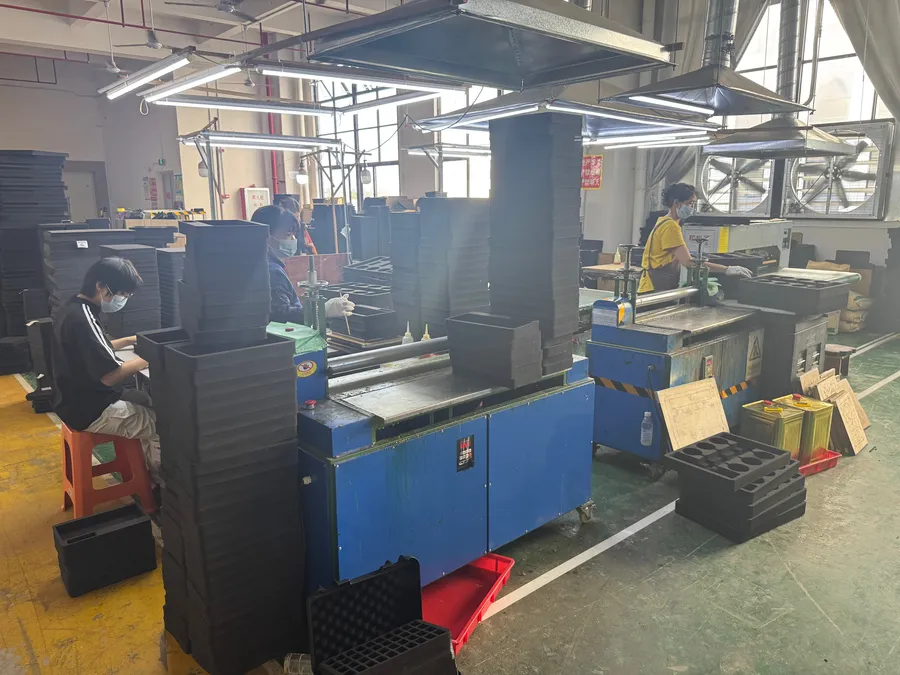
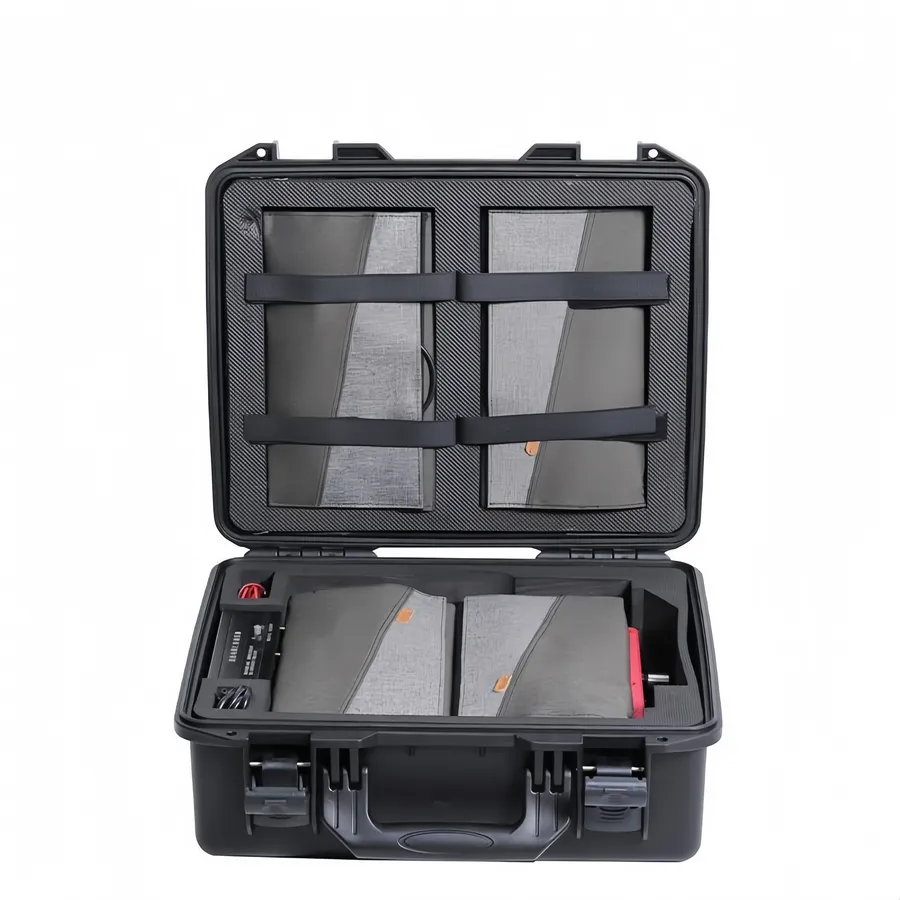
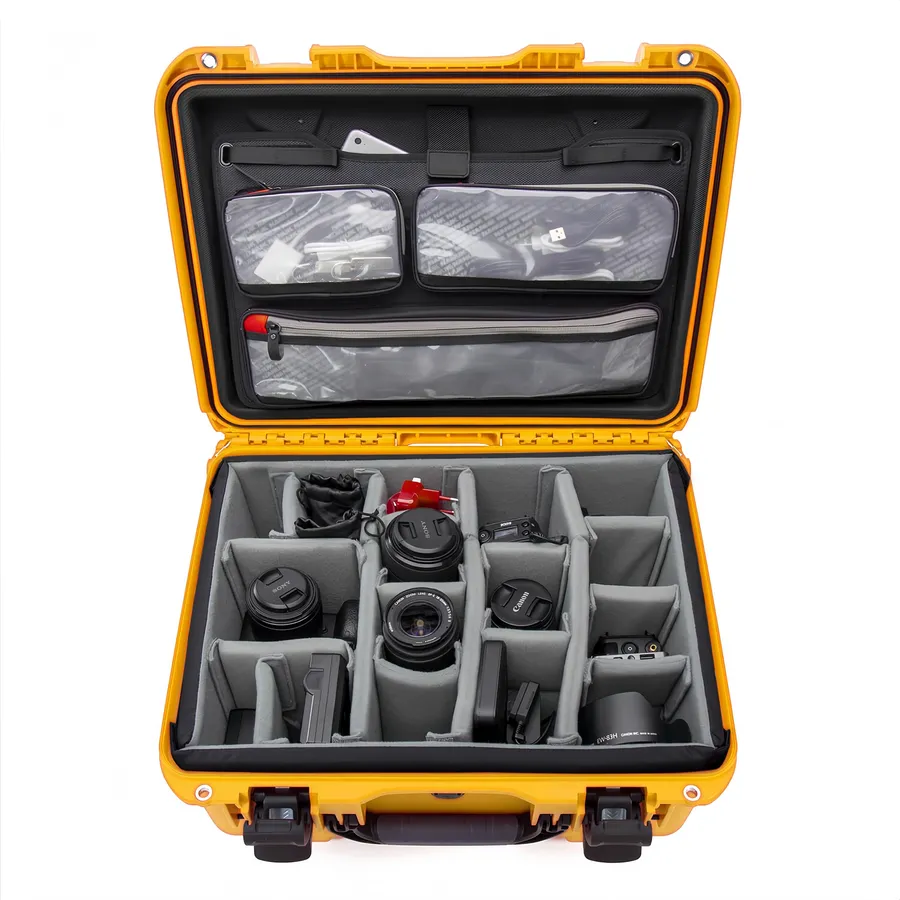
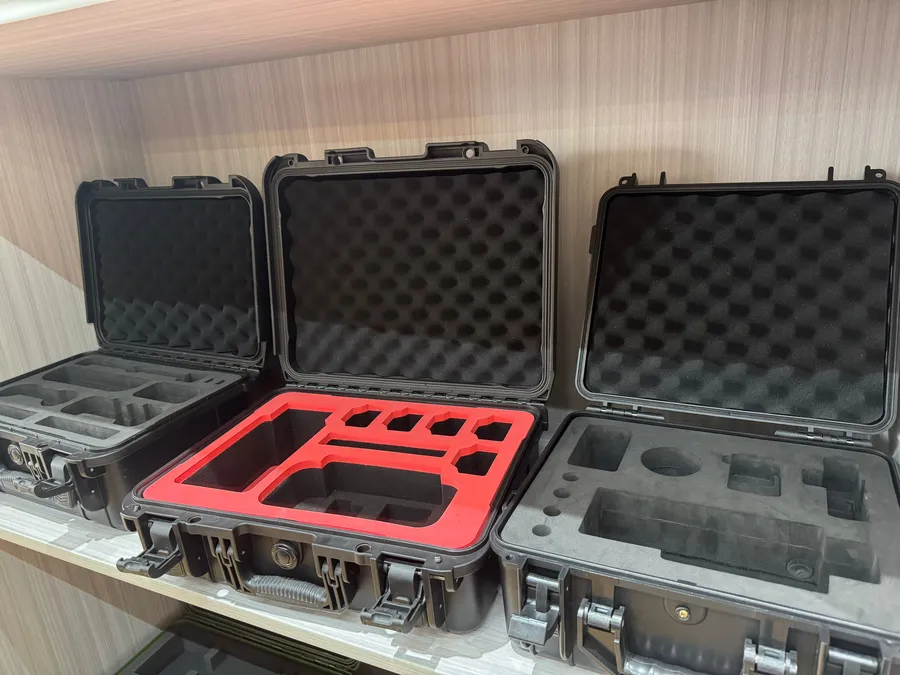
The first tier is everything that sits inside the shell or on its surface. Foam layout, foam grade, foam thickness, colour, logo, identification plate, document pocket, latch count, lock type, handle choice, feet, pressure-equalisation valve and cable ports all belong here. None of them moves a mating surface, so none of them requires a new mould, and they can be quoted against an ABS shell that is already in production.
The second tier is a modification to the existing tool. Moving a latch boss a few millimetres, adding a coring for a pass-through port, changing the depth of the foam rebate, or adding a padlock shroud are all steel changes rather than new steel. They are still tooling work, with tooling time and a tooling cost, and the practical outcome is the same as the third tier for scheduling purposes even though the bill is smaller.
The third tier is a new mould. Internal dimensions, external dimensions, wall thickness, lid and base depth split, the geometry of the stacking rims and the shape of the gasket channel are all fixed by the tool. If your equipment falls between two published ABS sizes, the honest options are to pack it into the larger one with a tailored interior, or to open new tooling and accept the volume commitment that goes with it.
What the ABS group in our published list actually is
ABS is the smallest of the shell materials we publish: 22 of the 155 models. Twenty sit in the 6 Series, one in the 9 Series and one in the T Series. Across that group the published external footprint runs from 211 x 128 x 50 mm on the KX-62205 to 615 x 440 x 320 mm on the KX-66232, internal volume runs from 0.8 litres to 56.6 litres, and listed net weights run from 310 g to 7,940 g. Wall thickness values stated on the ABS sheets are 3.0, 3.5, 3.7, 3.8, 4.0, 4.7, 4.8 and 5.3 mm.
Two facts about the ABS group matter more than the size spread. First, all 22 ABS models are offered with a compressible gasket seated in a continuous moulded channel, so unlike the PP group there is no unsealed ABS shell in the list to be mistaken for a sealed one. Second, 21 of the 22 stack and only one carries wheels and a telescopic handle, which is the T Series KX-66232. An OEM programme that needs a rolling ABS case therefore starts from one tool, not from a choice of them.
The 6 Series is where an ABS enquiry usually lands: shallow to medium depth boxes between roughly 211 mm and 545 mm long, several of which are catalogued under ammunition storage and tactical equipment as well as general protective use. Fourteen of the 22 ABS models are filed primarily under military protective cases, five under ammunition storage boxes and three under tactical equipment cases.
What you can change on an ABS case without new tooling
Interior. Every shell in the list, ABS included, takes a configured interior: pick-and-pluck, die-cut or CNC-cut, in cross-linked PE, EVA or EPS by zone, as top foam, base foam, convoluted, layered or a custom cut. The only input we need is a drawing, a photograph of the packed kit, or the physical sample itself. Interior work carries no minimum beyond one piece, which is why a tailored foam layout is almost always cheaper than a new mould.
Colour and appearance. Colour is a moulding compound choice, quoted at 300 pieces, and is matched against a reference you supply rather than against a swatch we pick. Logo is quoted at the same 300-piece minimum. What a logo must not do is bridge the sealing rim or cover a gasket seating surface, and identification plates should not be positioned where they lift the lid off its stops when stacked.
Hardware and closure. Latch count is stated per configuration on all 155 models, because the number needed depends on lid span and stiffness rather than on the polymer. The latch body accepts a standard padlock. Handle is fixed folding on 21 of the 22 ABS shells and telescopic plus folding on the one wheeled model. Feet are moulded. A pressure-equalisation valve is a manufacturer option across the whole list, so it can be added on request.
Packaging and branding outside the product. Carton marking, pack quantity and private-label presentation are OEM options on every model. Pallet quantity and container loading are not fixed in the catalogue: they are calculated from the carton footprint against your pallet size, and the 20 ft, 40 ft and 40 ft high-cube figures come with the quotation.
Customisation options and what each one costs you
The table below uses the commercial parameters that are stated on the product sheets. It is worth reading as a set of decision gates: if the change you want is in the top half, it is a configuration order; if it is in the bottom row, it is a tooling project and the volume commitment changes the business case.
| Oem Change | New Tooling Needed | Published Minimum | Lead Time | What Must Not Silently Change |
|---|---|---|---|---|
| Foam interior layout and grade | No | 1 piece | 45 days for an OEM first sample | Lid and base foam depth against the published interior height |
| Shell colour | No | 300 pieces | 45 days for an OEM first sample | Contrast between shell and gasket, which is what an operator inspects |
| Logo, identification plate, private label | No | 300 pieces | 45 days for an OEM first sample | Clearance over the sealing rim and the stacking contact faces |
| Latch count, lock, valve, ports, document holder | No, where the mould already carries the bosses | 300 pieces | 45 days for an OEM first sample | Even gasket compression along the longest unsupported lid span |
| Carton, pack quantity, pallet pattern | No | Per order | With production | The stack height the receiving site can actually handle |
| Envelope, wall thickness, channel or stacking geometry | Yes, a new mould | 3,000 pieces per component | 125 days | Nothing; this is the change that resets the datasheet |
The ABS shells published today, as starting points
These are the extremes and the useful middle of the ABS group, taken from the published sheets. Use them to see how far apart the options are before deciding whether your dimension really needs new steel.
| Model | Series | External Mm | Wall Mm | Net Weight G | Internal Litres | Gasket Offered |
|---|---|---|---|---|---|---|
| KX-62205 | 6 Series | 222 x 128 x 50 | 3.5 | 310 | 0.8 | Yes |
| KX-62810 | 6 Series | 275 x 226 x 100 | 4.0 | 900 | 4.0 | Yes |
| KX-64120 | 6 Series | 405 x 362 x 195 | 4.0 | 2,640 | 21.7 | Yes |
| KX-64819 | 6 Series | 475 x 383 x 188 | 3.5 | 2,800 | 25.5 | Yes |
| KX-65522 | 6 Series | 545 x 440 x 215 | 5.3 | 4,860 | 37.1 | Yes |
| KX-5021 | 9 Series | 495 x 374 x 206 | 3.7 | 3,430 | 28.7 | Yes |
| KX-66232 | T Series | 615 x 440 x 320 | 5.3 | 7,940 | 56.6 | Yes |
What an OEM programme does not buy you
It does not buy a test result. On every product sheet in the list, water resistance, dust resistance, ultraviolet resistance and service temperature range are recorded as not measured, and no ingress-protection code is stated. Customising the colour of an ABS lid does not change that, and neither does quoting a wall thickness of 5.3 mm as though it were a crush figure. Accredited testing is quoted separately, per configuration, at the buyer's cost.
It does not buy a shock rating either. The published note on the ABS sheets is explicit that shock protection depends on a specified foam layout and that the shell alone is not a shock rating. An interior change is therefore the part of an OEM programme that most affects how the case performs, which is a reason to treat the foam drawing as a controlled document rather than as packaging detail.
It also does not change the commercial frame. We sell wholesale and OEM, quote EXW or FOB, do not sell retail, do not quote delivered-duty-paid terms and hold no overseas warehouse stock. A 300-piece logo order and a 3,000-piece mould order leave on the same terms.
How an ABS OEM order actually runs
It starts with the packed kit rather than with a case size. Send the drawing, the photograph or the sample, together with the environment the case will be opened in and how often, and the shortlist usually reduces to two or three of the 22 ABS models on interior height alone. Confirming the lid and base foam split against the published internal depth at this stage is what prevents a sample round from being wasted.
A first OEM sample on an existing mould is 45 days, and a 30 percent deposit starts it. Where a new mould is needed, tooling is 125 days before production parts, with the commitment set at 3,000 pieces per component. Approval should be signed against a physical sample and a dated datasheet revision that carries the latch count, valve fitment, colour reference and foam drawing, because a repeat order placed against an undated sheet is how a sealed configuration quietly becomes an unsealed one.
Applications
This matters most where the case is part of a movement chain rather than shelf packaging. In electronics & instruments and field & deployment and outdoor & recreation the same shell is specified differently because the handling, the environment and the verification requirement differ.
- Electronics & Instruments — Electronic assemblies rarely fail from a single large impact. They fail from repeated small shoc…
- Field & Deployment — Field deployment removes every assumption a depot specification makes: no forklift, no dry stora…
- Outdoor & Recreation — Consumer and professional outdoor brands buy cases as a component of their product. That means c…
Customisation
Everything described above is configurable on a standard shell: interior layout (pick-and-pluck, die-cut or CNC-cut), foam grade and thickness, colour, logo method, latch and lock count, pressure-equalisation valve, cable ports, document holder and identification plate. A bespoke exterior geometry requires a new mould — 125 days, from 3,000 units per moulded component.
Procurement considerations
| Question | What to send us |
|---|---|
| Which shell fits? | Equipment L × W × H as packed, plus required clearance per axis |
| What does it cost? | Order quantity and estimated annual quantity — the two drive different answers |
| Is tooling needed? | Whether an existing shell clears the envelope with usable foam depth |
| Lead time? | Your required delivery date, not just the order date |
| Certification? | The exact standard your tender names — we will say whether we can test to it |
| Freight? | Destination and preferred terms; carton and pallet data supplied with the quotation |
Comparison and selection guide
The tables on this page exist because a protective case is chosen by comparing three things: the envelope, the environment and the handling chain. Where no table applies, the rule below is.
| Situation | What To Do |
|---|---|
| Fastest | Standard shell plus CNC foam — typically 45 days from approved drawing. |
| Branded | Standard shell plus custom colour and logo — MOQ applies to the resin colour. |
| Bespoke geometry | New mould — 125 days, MOQ from 3,000 units per component. |
- Size on internal dimensions plus clearance, never on a product name.
- Choose the carrying method before the shell: it changes the series, not just the price.
- Specify the interior last, and decide up front whether the end user will reconfigure it.
Can ABS protective cases be OEM customized? relates to Material Guide. Related families: Custom Protective Cases / Military Protective Cases / Waterproof Cases / Electronics Cases. Related sectors: Electronics & Instruments / Field & Deployment / Outdoor & Recreation. Continue in the Material Guide cluster.
This page is written from our own production data. If your requirement differs, send the dimensions and we will tell you which of the 155 models fits, or whether a custom route is needed.




