How does PP compare with other plastics?
Polypropylene wins the low-temperature and chemical-resistance half of the comparison and loses the stiffness-and-finish half, and that split is the only honest summary. Against ABS it keeps its toughness in the cold, shrugs off fuels and most solvents, flexes and recovers under a local load, and takes a lower-cost moulding; ABS holds its shape better under a fixed lid load, is attacked by some solvents, stiffens in cold weather and prints or embosses better. Against the plastics we do not mould as shell resin - high-density polyethylene, polycarbonate, nylon - PP sits between them: more stiff and dimensionally stable than HDPE, cheaper and more chemically relaxed than polycarbonate, less abrasion-happy than nylon. On our own sheet the comparison is narrower than it looks, because 132 of 155 published models are polypropylene in one of two grades, 22 are ABS and one is listed for both, and published wall thickness overlaps across the resins from 2.0 mm to 6.0 mm, so resin never predicts structure.
Key points
- Polypropylene is chosen for cold toughness and resistance to fuels and solvents; ABS is chosen for panel stiffness and printed finish.
- 132 of our 155 published models are polypropylene, 94 plain PP and 38 engineering PP, so the catalogue is a PP catalogue first.
- Published wall thickness overlaps resins: PP 2.0-5.0 mm, engineering PP 2.1-6.0 mm, ABS 3.0-5.3 mm, so resin does not predict strength.
- A gasket option is published on 75 of 94 PP models and 27 of 38 engineering PP models, against 22 of 22 ABS models.
- PP carries both extremes of our range, from a 120 mm mini shell to a 1,356 mm long shell and a 139.5 litre deep-body case.
- ABS stops at 615 mm external length on our sheet, so oversized or very small envelopes are polypropylene tooling by default.
- Waterproof, dust, UV, service temperature, stack load and protection rating are recorded as not measured on all 155 models.
The comparison in one paragraph, then in one table
Comparing polypropylene with other plastics is only useful if the comparison is tied to an exposure, because the resins differ in opposite directions. PP is a semi-crystalline thermoplastic that stays tough when it is cold, is largely indifferent to fuels, oils and most cleaning solvents, and flexes under a point load and springs back. Its trade-offs are lower panel stiffness, more creep under a long-standing load, and a surface that takes printing and embossing less readily. ABS is an amorphous styrene copolymer: stiffer panels, better dimensional holding under a fixed lid load, a cleaner printed finish, but it stiffens further and becomes more brittle below cool temperatures and some solvents attack it.
The practical consequence is that a PP case and an ABS case of the same external size are not better or worse, they are different instruments. Where the case is opened outdoors in winter, wiped with solvent, or dropped on a hard surface, the polypropylene answer is the one that keeps working. Where the case is a product the customer holds in a shop, carries a printed logo and lid-mounted hardware, and lives indoors, ABS is the one that looks and feels right. Our material pages put it the same way and deliberately stop short of ranking the resins, because a ranking needs a test and we publish tests only where they were actually run.
What the other plastics in the category actually do
Beyond PP and ABS, buyers ask about three families. High-density polyethylene is tougher in cold impact than PP and highly chemical-resistant, but softer, more prone to creep and harder to hold square in a large shell, which is why it is usual for rotomoulded tanks rather than for precision instrument cases. Polycarbonate is the stiffest and toughest of the common shell plastics and takes clear lids, but it is heavier for the same volume, costs more per kilogram, needs stress-relief and coating work to survive some solvents and prolonged sunlight, and demands a stiffer mould and slower cycle. Nylon absorbs moisture, is excellent against abrasion and hinge wear, and is rarely chosen for a full case body for that reason.
We mould our shells in polypropylene, engineering polypropylene and ABS, and we do not publish models in HDPE, polycarbonate or nylon, so those three stay as qualitative context rather than as something we can quote you a dimension for. What we can quote is the behaviour our own tooling produces: 132 polypropylene models covering 0.3 litre to 139.5 litre interiors and 120 mm to 1,356 mm external lengths, and 22 ABS models confined to the 211 mm to 615 mm mid-size band. If a specification genuinely needs polycarbonate stiffness or an HDPE cold-impact profile, that is a different supplier conversation and we say so rather than substituting a resin and hoping.
How the published range splits by resin
Read this as a map of tooling, not as a league table. Polypropylene carries 132 of the 155 models once engineering PP is added, and it owns both ends of the size range: the smallest published shell is KX-1204 at 120 x 90 x 40 mm external with a 115 x 78 x 32 mm interior, 2.6 mm wall and 100 g empty, and the longest is KX-814641 at 1,356 mm external with a 1,280 x 350 x 140 mm interior and a 5.0 mm wall. The largest single interior we publish is KX-88442, a T Series rolling case at 740 x 518 x 364 mm internal, 139.5 litres and 15,320 g empty.
ABS is a focused alternative rather than a parallel range. Its 22 models run from KX-62109 at 211 mm external and 470 g to KX-66232 at 615 mm external, 56.6 litres and 7,940 g empty, and 20 of them sit in the 6 Series mid-size equipment band. That distribution has a sourcing consequence buyers should note before they argue about resins: if the envelope you need is under 211 mm or over 615 mm external length, the resin decision has already been taken by the catalogue.
| Resin Group On The Sheet | Models | Published Wall Mm | Published Net Mass | Internal Volume | Gasket Offered | Where The Tooling Sits |
|---|---|---|---|---|---|---|
| PP | 94 | 2.0-5.0, recorded on 88 of 94 | 100-15,320 g, recorded on 41 of 94 | 0.3-139.5 litres | 75 of 94 | 0 Series minis, 8 Series heavy-duty large shells, most T Series rolling cases |
| Engineering PP | 38 | 2.1-6.0, recorded on all 38 | 350-10,000 g, recorded on 29 of 38 | 3.6-53.9 litres | 27 of 38 | 7 Series large, 9 Series deep-body, part of the T Series |
| ABS | 22 | 3.0-5.3, recorded on all 22 | 310-7,940 g, recorded on all 22 | 0.8-56.6 litres | 22 of 22 | 20 of 22 in the 6 Series mid-size band, one 9 Series shell, one T Series case |
| PP / ABS | 1 | not published | 3,600 g | 35.7 litres | not offered on this listing | a single 9 Series shell listed under both resins |
Structure beats resin in the published numbers
The most common error in a plastic comparison is to treat the resin as a proxy for toughness, and our own data shows why. Wall thickness is published from 2.0 mm to 5.0 mm on 88 of the 94 PP models, from 2.1 mm to 6.0 mm on all 38 engineering PP models, and from 3.0 mm to 5.3 mm on all 22 ABS models. The thickest wall on the whole sheet belongs to KX-6621, a 6.0 mm engineering PP deep-body shell at 587 x 434 x 192 mm internal and 6,420 g empty, while a thin engineering PP shell such as KX-705 is recorded at 2.1 mm with a 420 x 270 x 112 mm interior and only 830 g. A thick ABS box and a thin PP box are both ordinary products here, and neither tells you anything about the other resin.
Mass behaves the same way, and so does closure. Empty mass published on PP spans 100 g to 15,320 g, on engineering PP 350 g to 10,000 g and on ABS 310 g to 7,940 g, but those bands are driven by size and wall, not by density: the two resins are close enough in mass per unit volume that geometry dominates. On the closure side a compressible gasket in a moulded channel is offered on 22 of 22 ABS models against 75 of 94 PP and 27 of 38 engineering PP, and across the sheet 124 models publish a seal option while 31 do not. KX-1204, KX-705 and KX-2813 are all polypropylene shells with no seal option at all, which is exactly the kind of per-model detail a resin debate hides.
A behaviour matrix for the four plastics a buyer usually means
Every cell in the two right-hand columns of this matrix describes behaviour we state on our material pages; every cell in the last column describes general polymer behaviour offered as context, without dimensions, because we publish no models in those resins and will not invent them. That is the discipline a comparison table needs: it should separate what is measured and published from what is merely known about the material.
The row that decides most purchases is the second one. If the case meets petrol, diesel, hydraulic fluid, degreaser or alcohol wipes on a normal working day, polypropylene ends the debate. If it meets nothing harsher than a damp cloth and a printed logo has to survive a retail counter, ABS starts a short conversation about lid load and finish.
| Question Asked | Pp | Engineering Pp | Abs | Plastics We Do Not Mould |
|---|---|---|---|---|
| Behaviour in the cold | Retains toughness; our stated reason outdoor and field cases are mostly PP | Same family, grade held to a stated stiffness and toughness window | Stiffens and becomes more brittle; our 22 ABS models are indoor and bag cases | HDPE is cold-tough and soft; polycarbonate stays tough but needs annealing |
| Fuels and solvents | Very good resistance; the reason tool and vehicle cases are polypropylene | Same chemical behaviour as PP | Attacked by some solvents; cleaning regime matters | HDPE excellent, nylon good but moisture-sensitive, polycarbonate weak against some agents |
| Panel stiffness and creep | Flexes and recovers; creeps under a long static load | Modified grade raises stiffness and cuts creep, at some loss of elongation | Holds shape better under a fixed lid load | Polycarbonate stiffest and heaviest per volume; HDPE softest |
| Finish and branding | Takes texture well, printing needs surface treatment | Same, with a more consistent moulded surface on filled grades | Prints and embosses best; the shop-floor choice | Polycarbonate takes a clear lid; nylon is usually left unpainted |
| Impact path | Absorbs a knock by flexing; wall, ribs and foam do the work | Same mechanism, thicker walls available up to 6.0 mm published | Stiffer transfer of a point load into the interior | No published models, so no quoted dimensions or masses |
Choosing between them: a decision path
Start from exposure, not preference. Outdoor, vehicle, winter, fuel and solvent: choose polypropylene, plain grade on 94 models or engineering grade on 38, and pick the wall and seal you need. Indoor, brand-facing, printed finish, fixed lid hardware: shortlist ABS from the 22 models. Deep body, racking, heavy contents or a trolley: look at engineering PP first, because that is where our thick-wall and 9 Series tooling sits, with KX-6621 at 6.0 mm and KX-92817 at 5.0 mm published beside smaller shells at 2.8 mm.
Then apply two filters buyers leave to the end. The first is closure: if the shell must seal, the ABS group passes automatically and the PP groups need a per-model check, since 19 PP and 11 engineering PP listings publish no seal option. The second is data quality, which affects how quickly you can finish a specification: every ABS model publishes a wall figure and a net mass, while 6 PP models carry no wall figure and 53 publish no net mass, and lid-to-base depth splits are published on 70 of 94 PP and 28 of 38 engineering PP shells but on only 2 of 22 ABS shells, where we give KX-64618 at 140 / 25 mm and KX-5021 at 134 / 62 mm.
Where each plastic ends up in service
Electronics and instrument work is the biggest single use on our sheet, and all three resin groups appear there: 20 of the 22 ABS models are tagged as electronics cases and 17 as instrument cases, while the polypropylene range covers the tiny and the enormous. For a board, a handset, a survey set or a radio head the deciding numbers are internal envelope, lid-to-base split and whether a gasket is offered, because the hazards are condensation, dust in a rack and a knock during loading - and none of those is answered by the resin alone.
Outdoor, field and tool use is where polypropylene dominates, which is unsurprising given that cold handling, fuel and solvent contact are exactly the exposures PP is good against; ammunition and transport storage uses both, with 14 of the ABS models tagged to ammunition boxes and the long and deep polypropylene shells carrying the bulk loads. Drone, camera and communications loads land in the same mid-size band where ABS is concentrated, with 9, 14 and 13 of the 22 ABS models tagged to those groups, so they are the one family where a genuine resin choice usually exists at a comparable footprint rather than being decided by size.
Customising whichever plastic you land on
The interior and hardware work is the same across resins, and this is where protection is actually bought: foam cut from a drawing, a photograph of the packed kit or a physical sample, in pick-and-pluck, die-cut, CNC-cut, EVA, PE or EPE, built as top, base, egg-crate or layered beds; gasket specification and latch count; pressure-equalisation valve; feet, hinges and padlockable latches; wheels with a matching telescopic pull, published on 14 PP, 4 engineering PP and 1 ABS model.
Shell-side changes come in two prices, and resin is not one of them. Colour and logo on an existing mould are 300-piece orders with first samples planned at 45 days on a 30 percent deposit. A new size, a new rib pattern or a modified sealing rim is mould work at 3,000 pieces per component and 125 days, and that threshold is identical whether the shell is PP, engineering PP or ABS. Where a resin swap can be made on existing tooling it is a grade-and-colour decision; where it cannot, the constraint is the mould, not the plastic.
Procurement notes before you commit
Send the packed dimensions in the configuration the item travels in, the empty and loaded mass, the exposure list (cold, solvents, sunlight, sealing), the quantity per delivery and the destination. We return candidate models with the published internal and external dimensions, the wall figure where one is recorded, the lid-to-base split where published, the closure state, the net mass where recorded and the carton data - available on 20 of the 22 ABS models, ranging from one piece per carton on KX-66232 to 20 pieces on KX-62109 and KX-62205.
Terms are fixed and the same whichever plastic you choose: wholesale and OEM production only, sold EXW or FOB, no retail orders, no DDP quotations and no overseas warehouse stock, so your own forwarder handles the freight. What we do not do is convert a material into a performance promise. Waterproof, dust, UV, service temperature range, stack load, load capacity and any protection rating are recorded as not measured on all 155 models in every resin group, and accredited testing can be commissioned per configuration as a separate work package rather than assumed from a resin name. Signed: KeXin New Materials (Guangdong) Co., Ltd.
What this comparison deliberately does not claim
It does not claim that any resin is tougher, safer or longer-lived than another, and it does not attach a standard, a rating or a test result to a shell. Those would need measurements, and the measurements we hold are dimensional and mass data published per model: internal and external size, narrow internal width where published on 25 PP and 11 engineering PP models, wall, lid and base depth, empty mass, carton quantity and pallet figures calculated against your pallet size.
It also does not pretend that the other plastics are unavailable or inferior. A polycarbonate shell, a rotomoulded HDPE box or a nylon hinge component can be the right answer in a specification we do not serve, and saying so protects both sides of the order. Where the exposure is cold, chemical, knocked or dragged across a yard, our published tooling says polypropylene 132 times and ABS 22 times, and that is the comparison worth making.
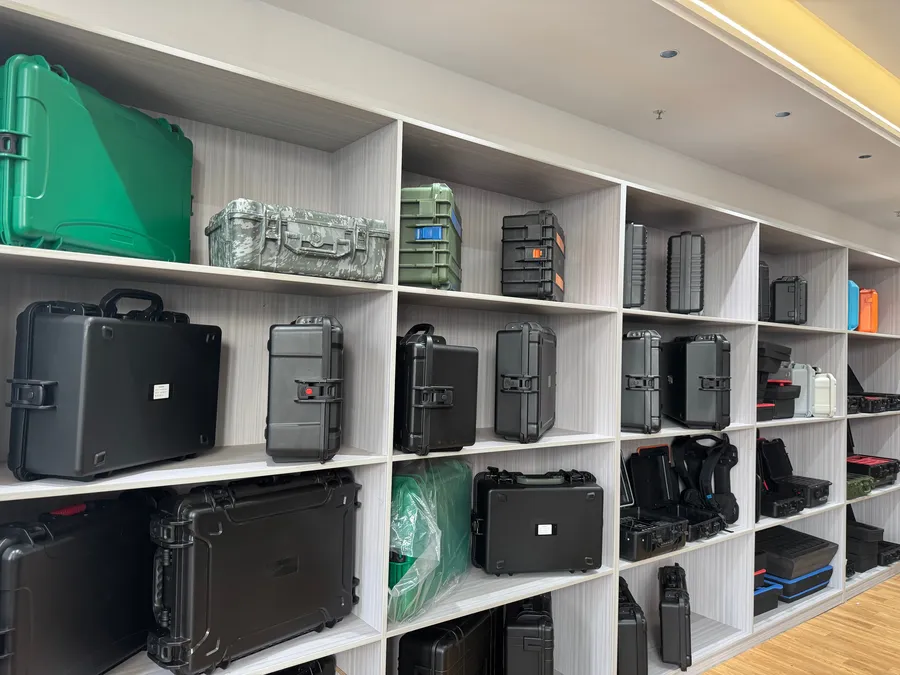
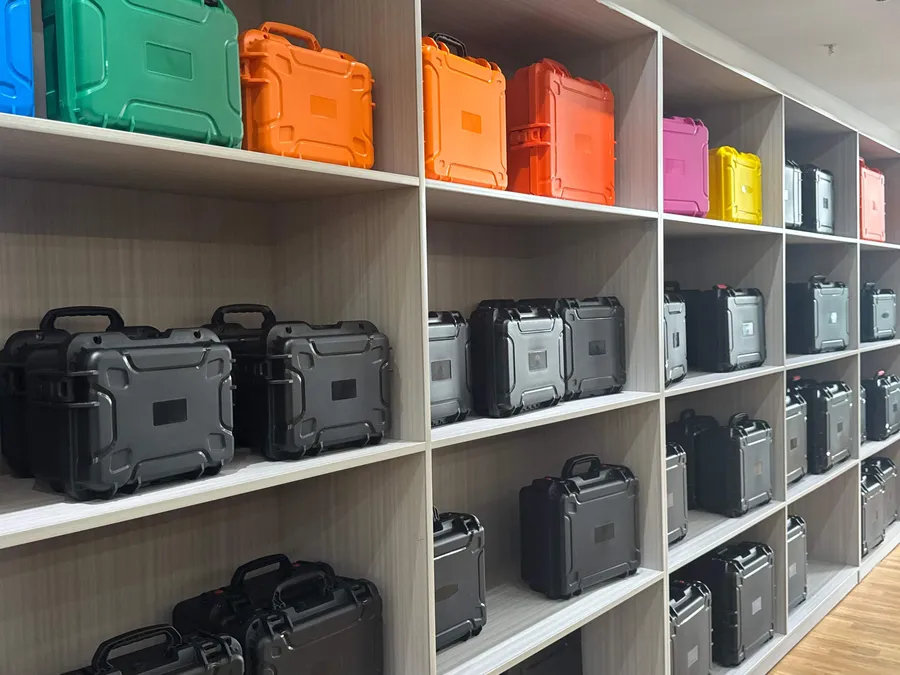
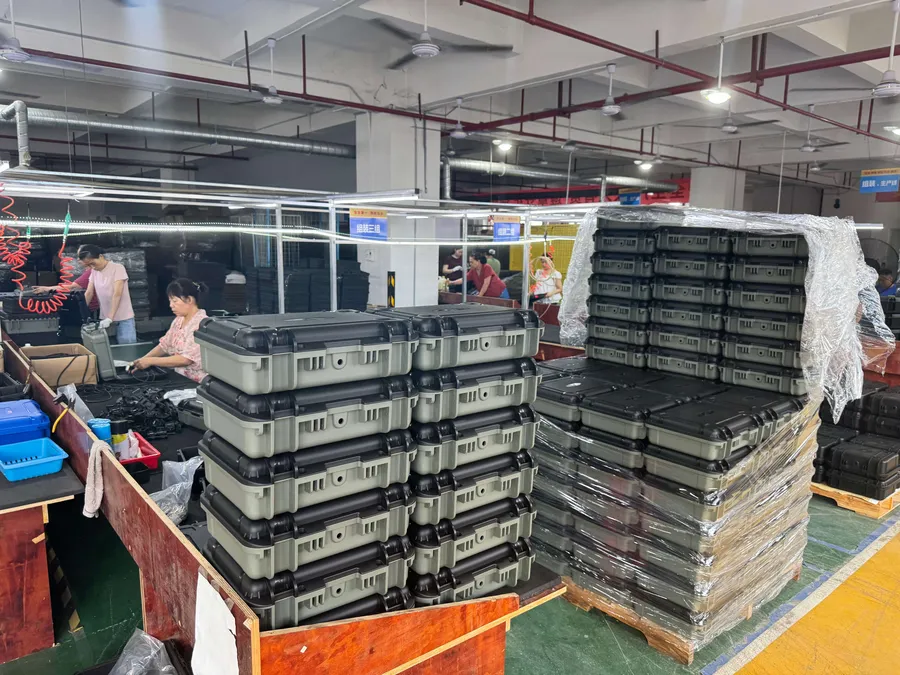
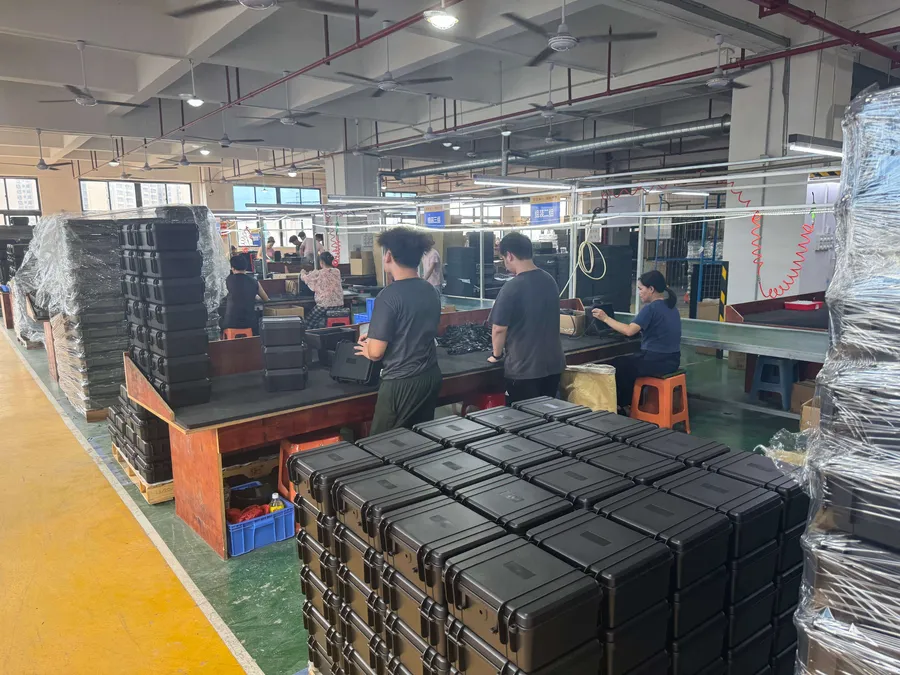
Customisation
Everything described above is configurable on a standard shell: interior layout (pick-and-pluck, die-cut or CNC-cut), foam grade and thickness, colour, logo method, latch and lock count, pressure-equalisation valve, cable ports, document holder and identification plate. A bespoke exterior geometry requires a new mould — 125 days, from 3,000 units per moulded component.
Procurement considerations
| Question | What to send us |
|---|---|
| Which shell fits? | Equipment L × W × H as packed, plus required clearance per axis |
| What does it cost? | Order quantity and estimated annual quantity — the two drive different answers |
| Is tooling needed? | Whether an existing shell clears the envelope with usable foam depth |
| Lead time? | Your required delivery date, not just the order date |
| Certification? | The exact standard your tender names — we will say whether we can test to it |
| Freight? | Destination and preferred terms; carton and pallet data supplied with the quotation |
Comparison and selection guide
The tables on this page exist because a protective case is chosen by comparing three things: the envelope, the environment and the handling chain. Where no table applies, the rule below is.
| Situation | What To Do |
|---|---|
| Fastest | Standard shell plus CNC foam — typically 45 days from approved drawing. |
| Branded | Standard shell plus custom colour and logo — MOQ applies to the resin colour. |
| Bespoke geometry | New mould — 125 days, MOQ from 3,000 units per component. |
- Size on internal dimensions plus clearance, never on a product name.
- Choose the carrying method before the shell: it changes the series, not just the price.
- Specify the interior last, and decide up front whether the end user will reconfigure it.
How does PP compare with other plastics? relates to Material Guide. Related families: Custom Protective Cases / Electronics Cases / Instrument & Equipment Cases / Outdoor Protective Cases / Tool Cases / Ammunition Storage & Transport Boxes. Related sectors: field and industrial equipment. Continue in the Material Guide cluster.
This page is written from our own production data. If your requirement differs, send the dimensions and we will tell you which of the 155 models fits, or whether a custom route is needed.


