When should buyers consider ABS cases?
Consider an ABS case when one of five things is true: the case is a brand-facing product that must carry a printed or embossed finish; the load sits under a fixed lid pressure or rigid internal mountings and the panel must not flex; the equipment falls in the mid-size band where our ABS tooling actually exists, roughly 211 mm to 615 mm external length; a sealed shell is a requirement, because a compressible gasket is published on all 22 ABS models; or you need a shortlist you can specify from published data alone, since ABS is the only group on our sheet where every model records wall thickness and net mass. Do not choose ABS because it feels tougher: on our published walls, ABS runs 3.0 mm to 5.3 mm while engineering polypropylene reaches 6.0 mm, and cold-weather or solvent exposure points at polypropylene, in one of its two grades, on 132 of the 155 models we list.
Key points
- Consider ABS on five triggers: printed or embossed finish, a fixed lid load, a mid-size envelope, a sealed shell and a shortlist that needs complete published data.
- 22 of our 155 models are ABS, and 20 of them sit in the 6 Series mid-size equipment band between 211 mm and 615 mm external length.
- Every ABS model publishes a wall figure of 3.0-5.3 mm, a net mass of 310-7,940 g and a gasket option, which no other resin group on our sheet does.
- ABS is the wrong answer for winter outdoor service, solvent and fuel contact, envelopes under 211 mm or over 615 mm, and racked deep loads needing a lid split.
- Internal volume runs 0.8 to 56.6 litres: only one ABS model is under one litre and only two are above 30 litres.
- Lid-to-base depth is published on just 2 of the 22 ABS models, and narrow internal width on none, so confirm those on the drawing before racking.
- Minimums and tooling are identical to PP: logo, colour and OEM at 300 pieces with 45-day samples, new mould at 3,000 pieces per component over 125 days.
Five triggers that put ABS on the shortlist
Trigger one is finish. ABS takes printing, embossing and a consistent moulded surface better than polypropylene, so when the case is a product a customer picks up on a counter - a camera set, a measurement instrument, a demo kit - the resin is doing marketing work as well as protection work. Trigger two is panel behaviour: ABS holds its shape better under a local or fixed load, which matters when lid-mounted hardware, a bracket or a clamp reacts against the shell, because a polypropylene lid flexes and recovers where an ABS lid stays put.
Trigger three is envelope, and it is the one buyers forget: a material choice is only real if the catalogue has a shell that fits, and our ABS tooling is concentrated in one band. Trigger four is closure - all 22 ABS models publish a gasket option, so if sealing is a requirement the ABS group never fails that filter while 30 polypropylene listings do. Trigger five is specification speed: ABS is the only resin group here where every model carries both a wall figure and an empty mass, which removes the round trip of asking for data that is missing.
What ABS brings that a polypropylene shell does not
Our material pages describe ABS as an amorphous styrene copolymer with stiffer panels and better dimensional holding, and polypropylene as the semi-crystalline resin that keeps its toughness in the cold and resists fuels and most solvents. Those are opposite strengths, and they are the whole argument. Where a case is opened at a workbench, carries a logo, and holds electronics that must not shift against a mounted bracket, the ABS behaviour is the one you are paying for. Where the same box would live in an unheated vehicle, be wiped with degreaser or be dropped on frost, the polypropylene behaviour wins and the ABS choice should be dropped.
Stiffness is not the same as impact survival, and buyers should keep the two apart. A stiff panel transfers a point load into the interior instead of deforming around it, which is good for mounted hardware and bad for an unsupported item; the shock path in either case is decided by foam thickness, density and the layout of the cut, not by the resin. Every model on our sheet carries the same note on that point: shock protection requires a specified foam layout, and the shell alone is not a shock rating.
The 22 ABS models, with the numbers we publish
Twenty of the 22 sit in the 6 Series mid-size equipment band. One is a 9 Series deep-body shell, KX-5021, and one is a T Series rolling case, KX-66232, which is also the only ABS model we publish on wheels and the only ABS model not tagged as stackable. Walls run 3.0 mm to 5.3 mm with a median of 3.9 mm, empty mass from 310 g to 7,940 g with a median near 1,815 g, and internal volume from 0.8 litres to 56.6 litres.
Shape matters as much as size in this list. The shallowest interior is KX-62205 at 41 mm deep and the tallest is KX-66232 at 290 mm; the narrowest interior is 98 mm and the widest 385 mm. Two of the models - KX-64618 and KX-5021 - are the only ABS listings that publish a lid-to-base split, at 140 / 25 mm and 134 / 62 mm, and both put most of the depth in the lid, which is a useful pattern when the item sits in the base and the lid only has to close over foam.
| Model | Series | External Mm | Internal Mm | Wall Mm | Net G | Litres | Pieces Per Carton |
|---|---|---|---|---|---|---|---|
| KX-62109 | 6 | 211 x 165 x 93 | 195 x 128 x 81 | 3.0 | 470 | 2.0 | 20 |
| KX-62205 | 6 | 222 x 128 x 50 | 200 x 98 x 41 | 3.5 | 310 | 0.8 | 20 |
| KX-62209 | 6 | 222 x 128 x 87 | 200 x 98 x 78 | 3.5 | 410 | 1.5 | 20 |
| KX-62810 | 6 | 275 x 226 x 100 | 253 x 182 x 86 | 4.0 | 900 | 4.0 | 10 |
| KX-63317 | 6 | 328 x 232 x 167 | 300 x 178 x 152 | 4.0 | 1,370 | 8.1 | 8 |
| KX-63413 | 6 | 339 x 310 x 125 | 310 x 255 x 106 | 4.8 | 1,680 | 8.4 | 10 |
| KX-63416 | 6 | 339 x 310 x 155 | 310 x 255 x 138 | 4.8 | 1,800 | 10.9 | 8 |
| KX-63612 | 6 | 356 x 267 x 120 | 333 x 217 x 114 | 3.5 | 1,300 | 8.2 | 8 |
| KX-63619 | 6 | 356 x 267 x 190 | 333 x 217 x 175 | 3.5 | 1,660 | 12.6 | 6 |
| KX-63912 | 6 | 389 x 295 x 120 | 360 x 240 x 104 | 3.8 | 1,600 | 9.0 | 10 |
| KX-63917 | 6 | 389 x 295 x 165 | 360 x 240 x 150 | 3.8 | 1,810 | 13.0 | 8 |
| KX-64112 | 6 | 413 x 336 x 123 | 393 x 280 x 112 | 3.8 | 1,820 | 12.3 | 10 |
| KX-64114 | 6 | 405 x 362 x 135 | 378 x 307 x 120 | 4.0 | 2,100 | 13.9 | 8 |
| KX-64117 | 6 | 413 x 336 x 168 | 393 x 280 x 156 | 3.8 | 2,100 | 17.2 | 8 |
| KX-64120 | 6 | 405 x 362 x 195 | 378 x 307 x 187 | 4.0 | 2,640 | 21.7 | 6 |
| KX-64618 | 6 | 450 x 305 x 176 | 430 x 290 x 165 | 4.7 | 2,775 | 20.6 | not published |
| KX-64619 | 6 | 456 x 340 x 186 | 430 x 288 x 166 | 4.7 | 2,840 | 20.6 | 6 |
| KX-64621 | 6 | 456 x 340 x 210 | 430 x 288 x 186 | 4.7 | 3,000 | 23.0 | 6 |
| KX-64819 | 6 | 475 x 383 x 188 | 454 x 325 x 173 | 3.5 | 2,800 | 25.5 | not published |
| KX-5021 | 9 | 495 x 374 x 206 | 465 x 315 x 196 | 3.7 | 3,430 | 28.7 | 6 |
| KX-65522 | 6 | 545 x 440 x 215 | 507 x 385 x 190 | 5.3 | 4,860 | 37.1 | 3 |
| KX-66232 | T | 615 x 440 x 320 | 507 x 385 x 290 | 5.3 | 7,940 | 56.6 | 1 |
The envelope test: does ABS tooling even exist for your load?
Before any material debate, check that the size you need is inside the band. Our ABS models run 211 mm to 615 mm in external length, 128 mm to 440 mm in external width and 50 mm to 320 mm in external height, with internal lengths from 195 mm to 507 mm. A handheld module, a radio, a camera body with a lens, a set of measuring instruments or a small drone payload all land in that window. Anything smaller or larger leaves the ABS group immediately: the mini shells at 120 mm, 190 mm and 195 mm external are polypropylene, and so are the long and deep cases at 843 mm and 1,356 mm.
The same test cuts the other way. If the load needs a single interior above 30 litres, only two ABS models qualify, KX-65522 at 37.1 litres and KX-66232 at 56.6 litres, while the polypropylene side of the sheet reaches 139.5 litres in KX-88442. If the load is under one litre, exactly one ABS shell is published - KX-62205 at 0.8 litres and 310 g. That is why we tell buyers to filter on the internal envelope first and let the resin break the tie afterwards; on most enquiries the envelope has already chosen the material.
When to walk away from an ABS case
Four exposures argue against ABS, and they are all about service rather than quality. Cold: ABS stiffens and becomes more brittle at low temperature where polypropylene keeps its toughness, so an unheated vehicle, a winter field kit or a store below freezing points at the PP group. Fuel and solvent: petrol, diesel, hydraulic fluid, degreaser and some cleaning agents attack ABS and leave polypropylene largely unaffected. Very small or very large envelopes: they are polypropylene tooling by default, as above. Racked deep loads where the lid-to-base split decides whether the item sits in the base or bridges the halves: ABS publishes that split on only 2 of 22 models, so the confirmation has to come from the drawing or a sample.
Two more reasons are commercial rather than technical. If the specification calls for a trolleyed case, there is one ABS candidate on wheels, and fourteen polypropylene and four engineering polypropylene models carry the same feature, so ABS will not give you a size range there. If the specification calls for a stated protection rating, no resin group on our sheet provides one: waterproof, dust, UV, service temperature range, stack load and load capacity are recorded as not measured on all 155 models, and an ABS shell does not change that.
Sealing, latches and what a gasket option does not prove
A compressible gasket in a moulded channel is offered on all 22 ABS models, against 75 of 94 plain PP and 27 of 38 engineering PP listings; across the whole sheet 124 models publish a seal option and 31 do not. If sealing is a hard requirement, that is the strongest single argument for staying in the ABS group, because it removes the per-model exception check entirely. A pressure-equalisation valve is a configuration option rather than a stock feature, and latch count, hinge type, feet and padlockable latches are specified per order.
What a gasket option does not do is prove a rating. None of our ABS models is listed in the waterproof category on our own sheet, and no IP code or equivalent is stated anywhere in the catalogue, because we have not run that testing. What we do publish per model is dimensional and mass data, the closure state and the wall figure, and where an accredited test is genuinely required it can be commissioned per configuration as a separate work package.
Where ABS cases are used, in the numbers we already have
The ABS group is tagged to more uses than its size suggests: 22 of 22 models are listed for custom protective work and outdoor use, 20 as electronics cases and 20 as tool cases, 17 as instrument cases, and 14 each for ammunition storage, camera equipment and military protective cases, with 13 for communications equipment, 12 for field equipment cases and 9 each for drones and firearm transport. On the application side, all 22 carry field-equipment, industrial-equipment, medical, military and outdoor tags, and 21 carry aerospace, electronics, telecommunications and defense.
That distribution tells you what ABS is bought for: a mid-size, handled, presented load that has to keep its shape and its print. It also warns against reading the tags as test results - a category tag says the shell is dimensionally and commercially suitable for that market, not that the case has been tested for it. For medical and laboratory work, for example, the real questions are the interior material, the cleanability of the foam and the closure, all of which are configuration decisions rather than resin decisions.
Customising an ABS order
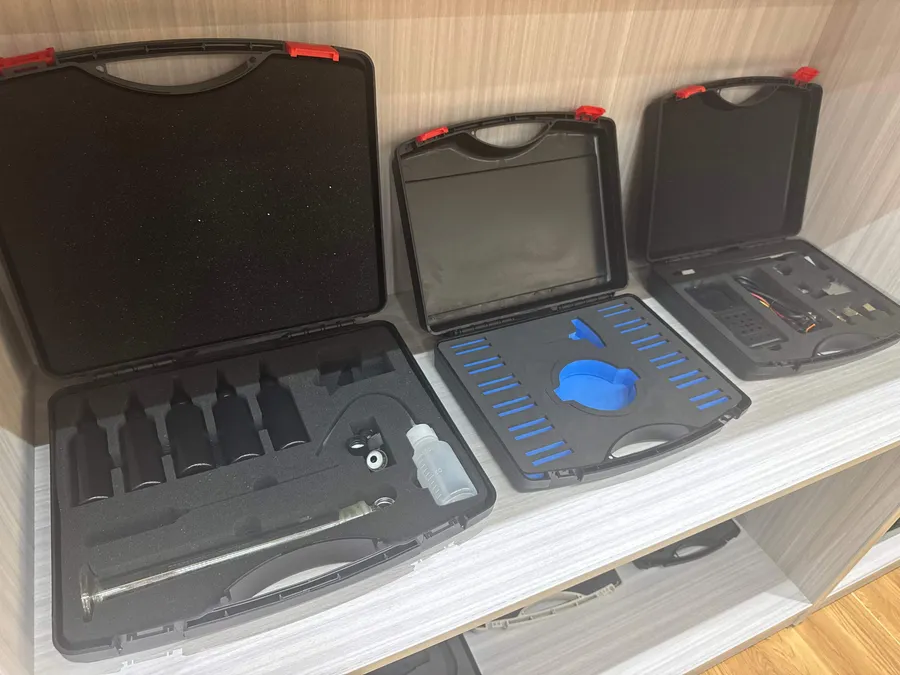
Interior and hardware work is identical across resins, and this is where most of the protection is bought: foam cut from a drawing, a photograph of the packed kit or a physical sample, in pick-and-pluck, die-cut, CNC-cut, EVA, PE or EPE, as top, base, egg-crate or layered beds; gasket and latch specification; valve; identification and document provisions; colour and logo. Every ABS model publishes a fixed handle, and one carries wheels with a telescopic pull, so the carry decision inside this group is a single binary rather than a spectrum.
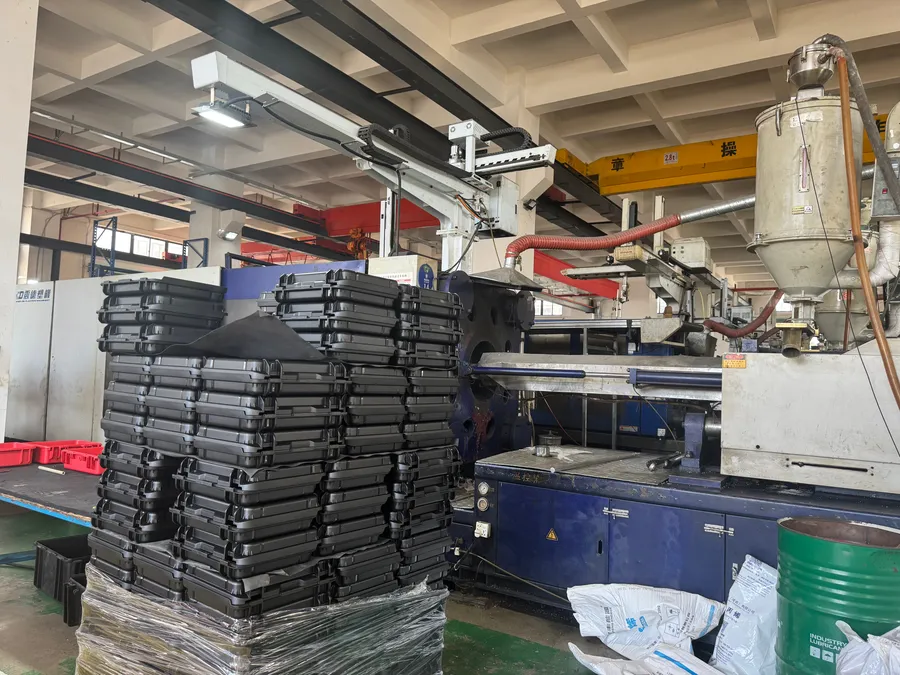
Shell-side changes are where resin and tooling get confused. Colour and logo on an existing mould are 300-piece orders with first samples planned at 45 days on a 30 percent deposit, and the same 300-piece threshold applies to OEM work. A new size, a new rib pattern or a modified sealing rim is mould work at 3,000 pieces per component and 125 days. If a supplier tells you an ABS size is impossible below a large quantity, ask whether the constraint is the resin or the mould, because for us the threshold is the mould whichever resin you choose.
Logistics: what the ABS group ships like
Carton data is published for 20 of the 22 ABS models, and it is the fastest way to sanity-check a landed cost. The small shells pack twenty to a carton - KX-62109 in a 470 x 365 x 560 mm carton, KX-62205 in 475 x 285 x 320 mm and KX-62209 in 475 x 285 x 495 mm - while the mid-size band goes eight to ten to a carton, KX-63612 at eight in 585 x 385 x 560 mm and KX-63912 at ten in 625 x 405 x 635 mm. The big end drops quickly: KX-65522 ships three to a carton and KX-66232 one.
Gross mass per carton is not published on any ABS model, and pallet quantities are calculated from the carton footprint against your pallet size rather than fixed in the catalogue, so we supply 20 GP, 40 GP and 40 HQ loading figures with the quotation instead of quoting them as facts. Empty masses are the reliable number here: they are recorded on all 22 ABS models, from 310 g to 7,940 g, which is one reason this group is easier to specify quickly than the polypropylene side, where 53 of 94 models publish no net mass.
How to place the order: what we need and what comes back
Send the packed dimensions in the configuration the item travels in, the loaded mass, the exposure list (indoor or outdoor, cold, solvents, whether it must seal), whether the case is brand-facing, the quantity per delivery and the destination. We return the ABS candidates that fit with their published internal and external dimensions, wall, net mass, closure state and carton data, plus the polypropylene equivalents if any trigger above points away from ABS, so the comparison is made on named models rather than on materials in the abstract.
Terms are fixed: wholesale and OEM production only, sold EXW or FOB. We do not take retail orders, do not quote DDP and hold no overseas warehouse, so your own forwarder arranges freight and we supply carton and loading figures to plan it with. We will not attach a performance figure to a resin: where the catalogue records a value as not measured, it stays not measured until a test is commissioned for that configuration. Signed: KeXin New Materials (Guangdong) Co., Ltd.

Customisation
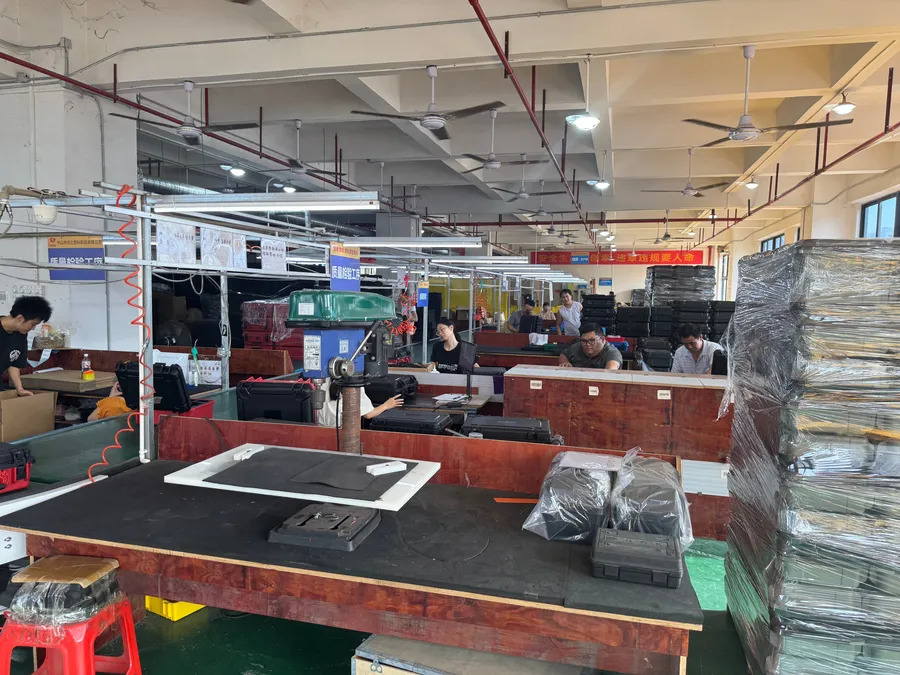
Everything described above is configurable on a standard shell: interior layout (pick-and-pluck, die-cut or CNC-cut), foam grade and thickness, colour, logo method, latch and lock count, pressure-equalisation valve, cable ports, document holder and identification plate. A bespoke exterior geometry requires a new mould — 125 days, from 3,000 units per moulded component.
Procurement considerations
| Question | What to send us |
|---|---|
| Which shell fits? | Equipment L × W × H as packed, plus required clearance per axis |
| What does it cost? | Order quantity and estimated annual quantity — the two drive different answers |
| Is tooling needed? | Whether an existing shell clears the envelope with usable foam depth |
| Lead time? | Your required delivery date, not just the order date |
| Certification? | The exact standard your tender names — we will say whether we can test to it |
| Freight? | Destination and preferred terms; carton and pallet data supplied with the quotation |
Comparison and selection guide
The tables on this page exist because a protective case is chosen by comparing three things: the envelope, the environment and the handling chain. Where no table applies, the rule below is.
| Situation | What To Do |
|---|---|
| Fastest | Standard shell plus CNC foam — typically 45 days from approved drawing. |
| Branded | Standard shell plus custom colour and logo — MOQ applies to the resin colour. |
| Bespoke geometry | New mould — 125 days, MOQ from 3,000 units per component. |
- Size on internal dimensions plus clearance, never on a product name.
- Choose the carrying method before the shell: it changes the series, not just the price.
- Specify the interior last, and decide up front whether the end user will reconfigure it.
When should buyers consider ABS cases? relates to Material Guide. Related families: Custom Protective Cases / Electronics Cases / Instrument & Equipment Cases / Camera & Photography Cases / Tool Cases / Outdoor Protective Cases. Related sectors: field and industrial equipment. Continue in the Material Guide cluster.
This page is written from our own production data. If your requirement differs, send the dimensions and we will tell you which of the 155 models fits, or whether a custom route is needed.


