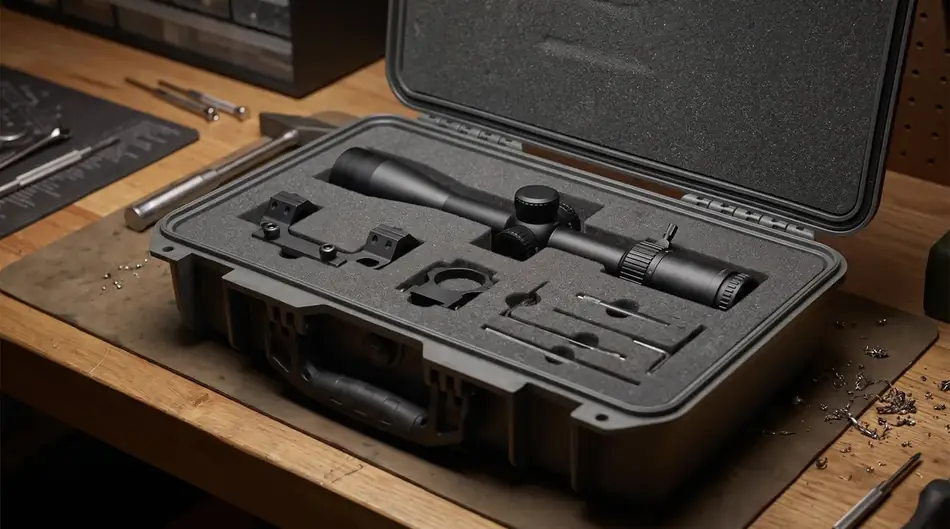
What is EVA foam?
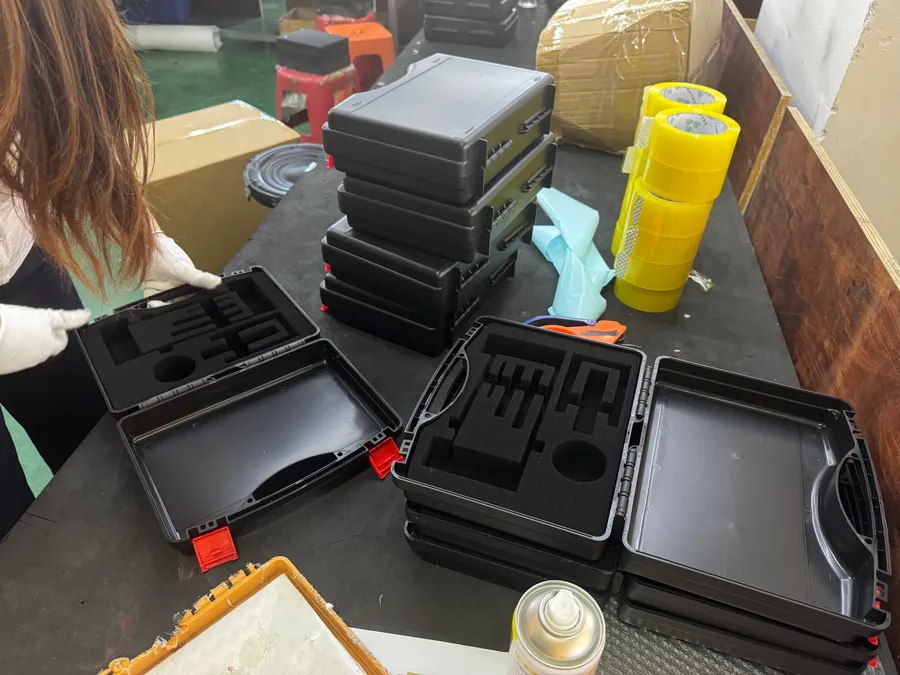
EVA foam is closed-cell foam made from ethylene-vinyl acetate - a copolymer of ethylene with vinyl acetate, which is what gives the material its toughness, its smooth cut face and its ability to hold a crisp edge under a cutting tool. In a protective case it is a firm grade: it carries less cushioning volume per gram than a cross-linked polyethylene, so it is used where the foam itself is handled - the face of a pocket, the wall between two tools, the layer that gets packed and unpacked every week - rather than as the thick soft bed under a heavy item. In our published data EVA is one of six foam options listed on all 155 models, alongside pick-and-pluck, die-cut and CNC-cut construction and PE and EPE grades, and it is specified by zone within a layout rather than as a whole-interior default. What our data does not record for EVA, or for any other grade, is a density, a firmness or a rebound figure, because those follow the layout we draw for your kit.
Key points
- EVA is an ethylene-vinyl acetate closed-cell foam: firm, tough, with a smooth face that holds a sharp cut edge.
- It is one of six foam options published on all 155 of our models, listed as a material alongside die-cut and CNC-cut routes.
- Our material record names EVA as a zone choice: cross-linked PE, EVA and EPS by zone, not one grade through the whole insert.
- EVA earns its place where the foam is handled - pocket walls, tool edges, faces that must stay clean - not as bulk cushioning volume.
- No density, firmness, rebound or thermal figure is published for EVA in our data; grade is set against the load and drawn.
- Custom EVA costs nothing in tooling: custom foam starts at one set, with no new mould required on any of the 155 shells.
What the material is
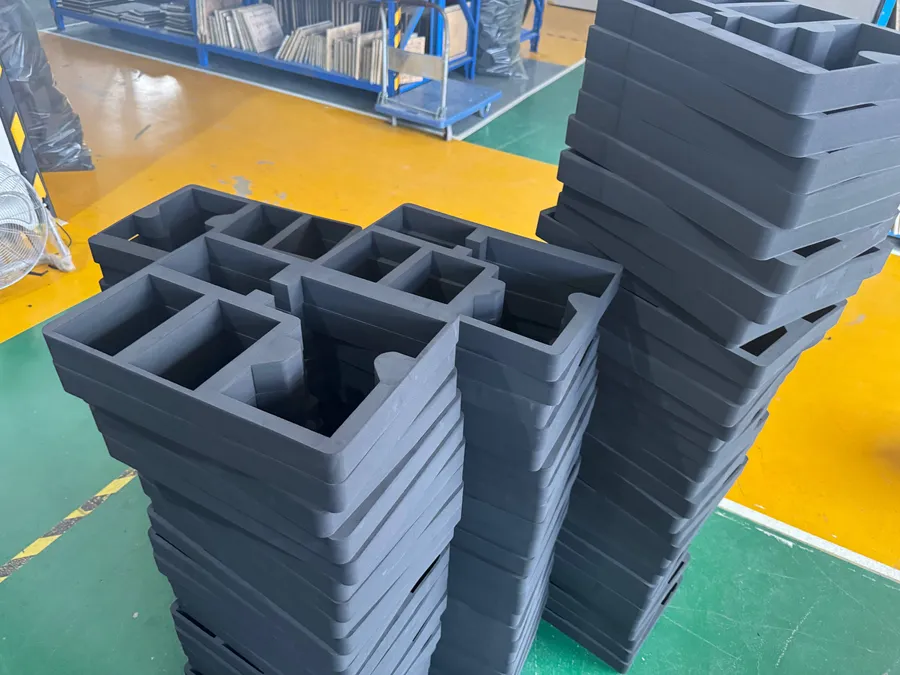
EVA stands for ethylene-vinyl acetate. It is a copolymer: polyethylene with a share of vinyl acetate mixed into the chain, and that second monomer is what changes the character of the plastic. Ordinary polyethylene is waxy and stiff; add vinyl acetate and the structure becomes tougher, more flexible at the surface, and far more willing to hold a shape that has been cut into it. As a case foam it is supplied as block moulded stock or as sheet, expanded to a closed-cell structure, and then converted by cutting.
Closed cell matters twice. Each cell is sealed, so the material does not soak up water the way an open-cell upholstery foam does, and it can be wiped and left to dry; and the sealed cells give the sheet a springy resistance to being crushed flat, which is what lets a thin EVA wall keep its shape under an item that is repeatedly lifted in and out of a pocket.
The comparison that matters in a case is not EVA against foam in general but EVA against the polyethylene grades used for interiors. A cross-linked polyethylene is softer and lighter for the same thickness and takes up very little moisture; EPE is beaded, cheap in bulk and good for filling volume; EPS is rigid moulded beads used as a carrier under mass. EVA sits firmer and tougher than all three per millimetre of thickness, and that is both its reason for existing and its limitation.
Where EVA sits in our published foam programme
Across all 155 models in our specification data the foam programme lists six options: pick-and-pluck, die-cut and CNC-cut construction, and EVA, PE and EPE as materials. The structural options are top foam, base foam, egg-crate or convoluted, custom cut and layered, and custom thickness and custom shape are recorded as available on every model. EVA is therefore never a shell feature - it is a line on a layout drawing.
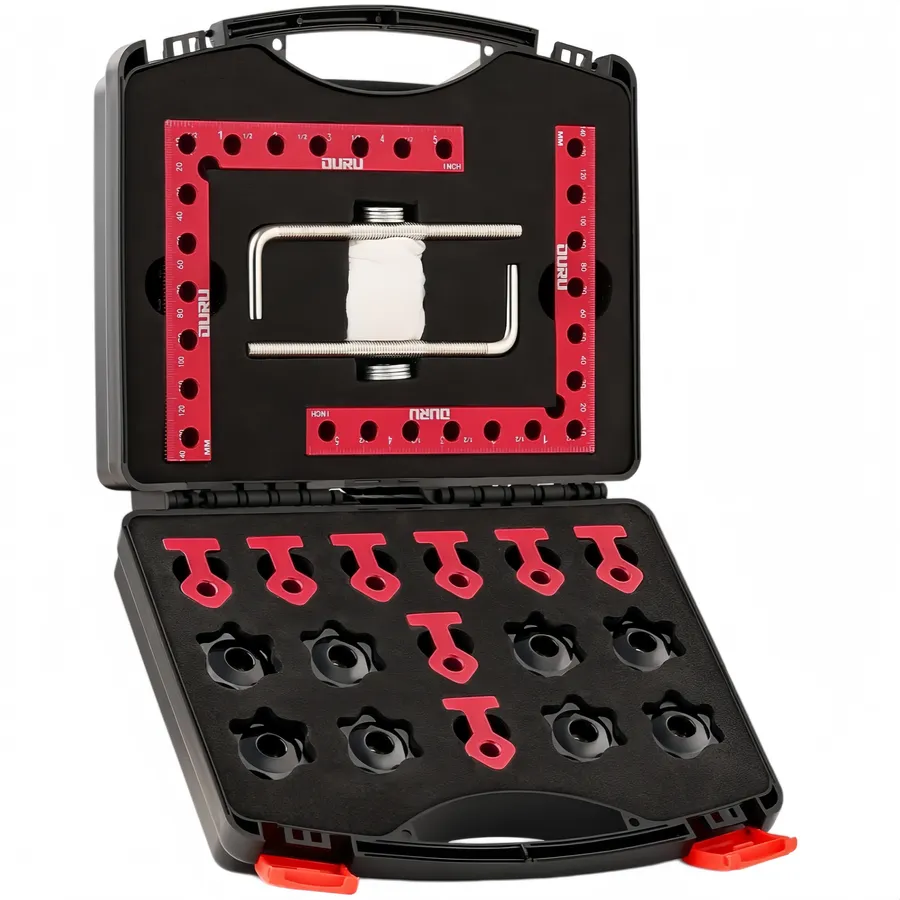
The material record itself is more specific than the option list, and it is the honest way to describe a real interior: our published field reads cross-linked PE, EVA and EPS by zone. That phrasing is deliberate. A single grade through the whole block is a compromise, so a layout normally puts a firmer carrier where the mass sits, a softer contact face where a finish or a lens must be isolated, and a light press layer in the lid. EVA takes the zones where edges must hold and where the foam is touched - the wall of a pocket, the face of a tool cradle, the divider between two instruments.
One nuance in our own data is worth stating, because it confuses buyers: EPS appears in the material string as a zone option but not in the six-item type list, which names EVA, PE and EPE. Read the two together and the practical position is that the grades we quote are configuration choices made per layout, recorded as an option rather than as a standard fitting on a model.
EVA compared zone by zone
The table below is not a material-versus-material ranking - those comparisons are on our dedicated foam selection pages - but a description of what EVA is asked to do in each part of an insert, and what to check before specifying it there. Nothing in it is a measured figure, because none exists in our published data for any grade.
| Zone | What Eva Does There | What To Check First | Where A Different Grade Fits |
|---|---|---|---|
| Pocket wall in a cut cradle | Holds a sharp, true edge where a die or a router has cut it, so the item locates the same way each time | Whether the layout is fixed; a changing kit should be a pluck layer, not a cut contour | A softer face over the same carrier where a finish must not be marked |
| Face layer under frequent handling | Resists tearing and surface wear where hands, gloves and straps pass repeatedly | How often the case is opened, and by whom | Cross-linked polyethylene where weight per litre matters more than abrasion |
| Divider between two items | Stays thin while stopping contact, so two hard objects cannot chip each other in transit | Whether the divider has to be captive when the lid opens | EPE where the priority is cheap bulk fill rather than a thin wall |
| Base carrier under mass | Supports a heavy item without slumping at the corners of the cut | Published base depth for the shell - median 44 mm across the 100 models that record the split | A moulded rigid carrier where the mass is concentrated at one end |
| Lid press layer | Keeps items from lifting when the case is turned, with a clean edge at the parting line | Whether closing the lid needs force - if it does, the press layer is too thick | Convoluted or egg-crate foam over uneven shapes |
| Coloured or branded surface | Takes a moulded colour and a clean printed or embossed identification area better than beaded grades | Whether the identification is on the foam or on the shell hardware | The shell itself, where a logo or plate is the requirement |
What EVA is chosen for, and what it is not
It is chosen where precision of the cut and durability of the surface are the requirement. A cavity that must locate an item identically every time - a surgical set, an instrument kit, a matched optic and its filters, a service engineer's tools - is an EVA job, because the material holds the geometry the tool produced. It is also chosen where the case is a product the customer sees: the face is smooth, the edges read as machined rather than torn, and a colour can be specified.
It is not chosen where the job is to absorb a lot of energy from a small mass, because there the same thickness of a softer grade gives more stopping distance and weighs less. Packing a heavy item in EVA alone tends to produce one of two failures: a cavity that transmits too much of the impact because the material is too firm to travel, or a wall that is too thick because the only way to get movement out of a firm grade is to add depth. Neither is a defect in EVA; both are a grade used in the wrong zone.
The same logic applies to cost. A whole insert milled from firm sheet is more expensive than a layered build with a soft face, and heavier than an EPE-filled equivalent. Where a buyer specifies EVA throughout simply because it feels solid, the result is a case that is dearer, heavier and, for a fragile item, sometimes worse.
How to decide: five checks before you name a grade
Check one is mass per item, not total mass. A 4 kg instrument concentrated in one pocket needs a carrier under it; four 300 g accessories scattered across a tray need walls between them. EVA answers the second problem more cheaply than the first. Check two: does the layout change? If it does, no cut grade is the right answer, and a pluck layer over a firmer base is.
Check three is depth available, which is a shell figure rather than a foam figure. Internal height across our range runs from 32 mm to 364 mm, and on the 100 models that publish the split, lid depth reaches 320 mm while base depth reaches 168 mm. A firm grade can be thinner for the same edge definition, which is an advantage precisely where depth is short. Check four: how much of the foam will be touched by hand, and how often.
Check five is cleanability. A closed-cell face can be wiped; a torn pluck surface cannot. A kit that goes into a clinical space, a workshop or a marine environment should have its contact surfaces in a grade and a form that can be cleaned, and that decision usually settles the grade before any cushioning calculation starts. Only then does thickness get set against the item, and it is set per zone rather than copied across a catalogue.
Where EVA is specified
In practice, EVA shows up where the contents are hard-edged, valuable or repeatedly handled. Professional tool sets are the clearest case: cut pockets that hold a wrench or a caliper by its own profile, with a face that survives being unpacked on a job site every morning. Instrument and optical kits use it the same way, with a softer contact layer over the firm carrier so nothing is marked at the contact face.
Electronics and communications kits use it for walls between modules and for the pocket that keeps a handset from travelling, while the bulk of the bed is a lighter grade. Medical and field-medical interiors use a cleanable closed face over a load-bearing base. Defence and field logistics kits use it where a fleet must be verifiable at a glance: a keyed face makes a missing item obvious before the convoy moves.
Drone, camera and survey kits are where the mixed-build logic is most visible: a machined base for the airframe or body, an EVA face at the parts that rub, a pluck or convoluted lid layer for batteries, filters and cables that change between flights. Nobody buying that combination is choosing a single material; they are choosing zones.
Customising an EVA interior
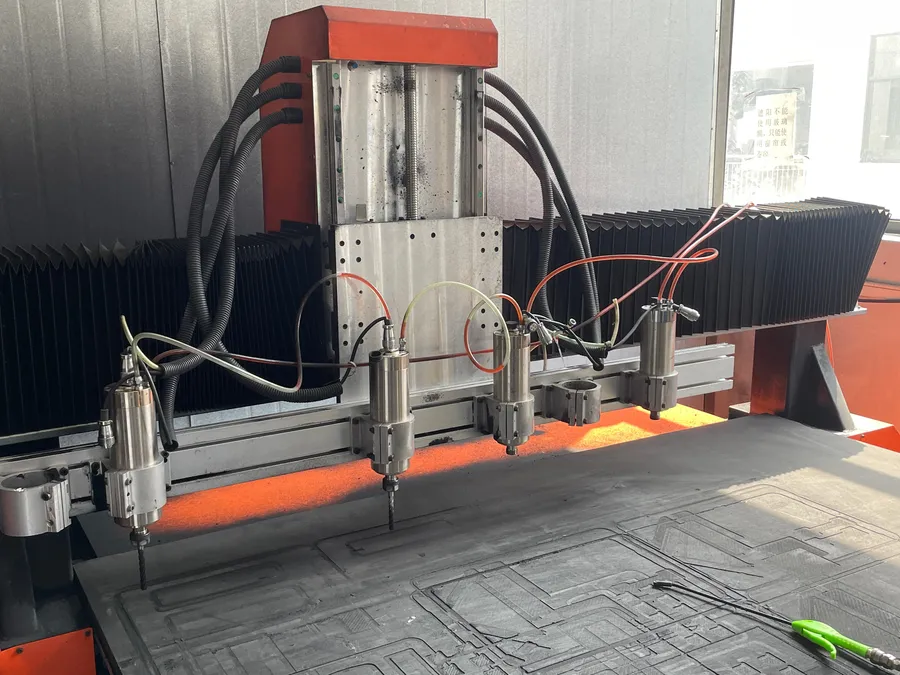
A bespoke EVA layout is the cheapest customisation on our range and needs no new tooling. Custom foam starts at one set; custom thickness and custom shape are recorded against all 155 models; die-cut and CNC-cut are both listed on all 155, which means a firm grade can be pressed from a die at volume or routed from a drawing at short run. Laminating two grades into one panel - a firm face over a softer carrier - is a normal build rather than a special request.
What we need to start is the input our data records as measured on every model: a drawing, a photograph of the packed kit, or a physical sample. A sample is the most reliable, because it shows where an item rocks and where a hand reaches. Colour and logo work sit at 300 pieces, OEM on existing mouldings runs to a first sample at 45 days with a 30 per cent deposit, and a new mould - needed only when the shell geometry itself changes - is 125 days from 3,000 pieces per moulded component.
For a fleet, the signed layout drawing is the control document. It fixes the zones, the grades, the thicknesses and the parting line, so the second and fifth order reproduce the first instead of being interpreted again by a cutting bench.
What we do not publish about EVA
Our specification data records no density, no firmness or hardness value, no rebound percentage and no thermal or ultraviolet figure for EVA or for any other foam grade. The reason is that those properties belong to the sheet we buy for a given layout, and the layout is a per-configuration drawing rather than a model attribute. Quoting one density across a catalogue would describe a material we do not necessarily use for your kit, so we state the options and set the grade against the load.
The same limit applies to protection claims, and it is worth reading carefully in a tender. A hard shell is not a shock rating on its own; impact and shock resistance are recorded on all 155 models as a construction option with no drop height stated. Water, dust, ultraviolet and service-temperature fields read untested across the whole range. An EVA pocket changes what the contents experience and how the kit looks and audits; it does not create a rating, and it says nothing about sealing.
Where a specification requires numbers, the route is a test of the configuration rather than a line on our datasheet: accredited testing of a named shell, a named layout and a named load can be commissioned as a separate work package, and the report describes the article that was in the chamber.
Procurement notes
Send the item, not an adjective. A request that says EVA insert tells us a material; a request that says which items must not touch, which faces must wipe clean, how heavy the concentrated mass is and whether the layout changes tells us the zones, the grades and the thicknesses. Attach the packed dimensions and the internal envelope you are working to, and expect a layout drawing back rather than a price for a block of foam.
Confirm the shell figures before the foam is cut: usable interior volume is published against nominal on all 155 models, and on 154 of them the usable figure is smaller - the ratio runs from 0.797 to 1.0 with a median of 0.85. A firm grade lets you recover some of that difference because it can be thinner for the same wall strength, but it does not cancel it.
Commercially we supply wholesale and OEM volume on EXW or FOB terms only. There is no retail channel, no delivered-duty-paid quotation and no overseas warehouse stock, so a foam programme is scheduled with the production batch it belongs to and planned into your own inbound freight. Third-party inspection of finished goods is welcome, and a sample shell with its layout is the fastest way to close a specification before a fleet order.
Applications
This matters most where the case is part of a movement chain rather than shelf packaging. In electronics & instruments and industrial equipment and medical & laboratory the same shell is specified differently because the handling, the environment and the verification requirement differ.
- Electronics & Instruments — Electronic assemblies rarely fail from a single large impact. They fail from repeated small shoc…
- Industrial Equipment — In an industrial setting the case is a working surface as much as a container, and its interior …
- Medical & Laboratory — Medical cases are audited. Whatever goes inside has to be verifiable at a glance, cleanable, and…
- Field & Deployment — Field deployment removes every assumption a depot specification makes: no forklift, no dry stora…
- Military — Military equipment moves through a chain of handlers, none of whom own the equipment and all of …
- Drone & UAV Operations — A drone kit is three different protection problems in one box: a light awkward airframe, heavy b…
Customisation
Everything described above is configurable on a standard shell: interior layout (pick-and-pluck, die-cut or CNC-cut), foam grade and thickness, colour, logo method, latch and lock count, pressure-equalisation valve, cable ports, document holder and identification plate. A bespoke exterior geometry requires a new mould — 125 days, from 3,000 units per moulded component.
Procurement considerations
| Question | What to send us |
|---|---|
| Which shell fits? | Equipment L × W × H as packed, plus required clearance per axis |
| What does it cost? | Order quantity and estimated annual quantity — the two drive different answers |
| Is tooling needed? | Whether an existing shell clears the envelope with usable foam depth |
| Lead time? | Your required delivery date, not just the order date |
| Certification? | The exact standard your tender names — we will say whether we can test to it |
| Freight? | Destination and preferred terms; carton and pallet data supplied with the quotation |
Comparison and selection guide
The tables on this page exist because a protective case is chosen by comparing three things: the envelope, the environment and the handling chain. Where no table applies, the rule below is.
| Situation | What To Do |
|---|---|
| Fastest | Standard shell plus CNC foam — typically 45 days from approved drawing. |
| Branded | Standard shell plus custom colour and logo — MOQ applies to the resin colour. |
| Bespoke geometry | New mould — 125 days, MOQ from 3,000 units per component. |
- Size on internal dimensions plus clearance, never on a product name.
- Choose the carrying method before the shell: it changes the series, not just the price.
- Specify the interior last, and decide up front whether the end user will reconfigure it.
What is EVA foam? relates to Material Guide. Related families: Custom Protective Cases / Electronics Cases / Instrument & Equipment Cases / Tool Cases / Camera & Photography Cases / Medical Equipment Cases. Related sectors: Electronics & Instruments / Industrial Equipment / Medical & Laboratory / Field & Deployment / Military / Drone & UAV Operations. Continue in the Material Guide cluster.
This page is written from our own production data. If your requirement differs, send the dimensions and we will tell you which of the 155 models fits, or whether a custom route is needed.