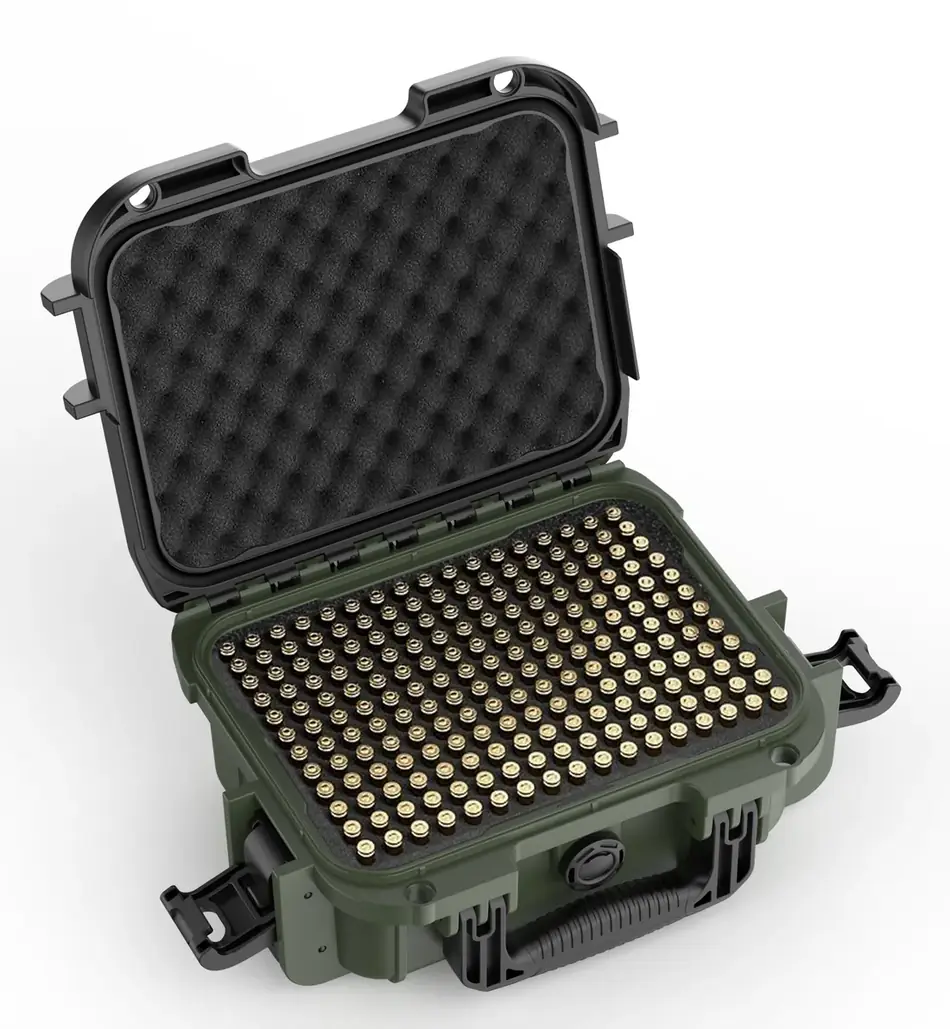
What applications are suitable for PP protective cases?
Short answer: PP protective cases suit six load families - small instruments and electronics, outdoor and field kits, stackable storage and ammunition boxes, tactical and military transport, long rigid equipment, and wheeled site-to-site logistics. Polypropylene is the material behind most of this catalogue: 132 of the 155 shells we mould are polypropylene-family, recorded as 94 PP and 38 engineering polypropylene, against 22 ABS and one mixed model. The published PP range runs from the KX-1204 mini shell at 115 x 78 x 32 mm internal on a 2.6 mm wall and about 100 g empty to the KX-88442 wheeled platform at 740 x 518 x 364 mm internal, a 5.0 mm wall and about 15,320 g, with usable interior volumes from 0.3 to 111.6 litres. Wall thickness is published on 88 of the 94 PP models between 2.0 and 5.0 mm, and a gasket channel is recorded on 75 of them with 19 recording none, so sealing is a per-datasheet check rather than a material promise. What polypropylene does not give is ABS-class stiffness per millimetre, and what no model publishes is an ingress code, a free-fall height or a temperature range - those are commissioned as accredited testing on the ordered build when a buyer needs a document.
Key points
- 132 of the 155 shells in this catalogue are polypropylene-family - 94 recorded as PP and 38 as engineering polypropylene - so most equipment loads shortlist a PP shell first.
- PP wall thickness publishes between 2.0 and 5.0 mm on 88 of the 94 PP models; 75 record a moulded gasket channel and 19 record none, so sealing is checked per datasheet.
- Small sealed instrument work starts at KX-1905: 180 x 160 x 40 mm internal, 3.0 mm wall, about 250 g empty, gasket recorded.
- Long rigid loads stay in carried PP shells: KX-89616 at 880 mm and KX-814641 at 1,280 mm internal, both on 5.0 mm walls - no wheeled cavity in the catalogue exceeds 740 mm.
- All 14 wheeled PP shells are recorded non-stackable, so stacking fleets stay on carried formats such as KX-4613 at 455 x 338 x 116 mm.
- Where stiffness per millimetre beats empty mass, the 22 ABS shells publish 3.0-5.3 mm walls and a gasket channel on every model, up to 507 mm internal length.
- No ingress code, free-fall height or temperature range is published for any model; performance figures come from accredited testing of the exact ordered build.
Why Polypropylene Carries Most Of This Catalogue
Polypropylene is the default shell material here because the numbers say so: 132 of the 155 shells are polypropylene-family - 94 recorded as PP and 38 as engineering polypropylene - while 22 are ABS and one model combines the two. The published PP record stretches from the KX-1204 mini shell at 115 x 78 x 32 mm internal on a 2.6 mm wall and about 100 g empty to the KX-88442 wheeled platform at 740 x 518 x 364 mm internal on a 5.0 mm wall and about 15,320 g, a usable-volume span of 0.3 to 111.6 litres. Wall thickness is published on 88 of the 94 PP models between 2.0 and 5.0 mm, and a compressible gasket in a continuous moulded channel is recorded on 75 of them, with 19 shells - mostly the thinnest minis and a few flat formats - recording none. Carry hardware follows the same per-model discipline: every one of the 155 shells publishes a fixed folding handle, and remaining hardware is metal or polymer by configuration rather than assumed. What polypropylene does not deliver is ABS-class stiffness at equal wall thickness, which is why the dense-electronics and precision-instrument loads below are pointed at the ABS family where that trade matters.
Applications Suitable For PP Protective Cases, Mapped To Six Load Families
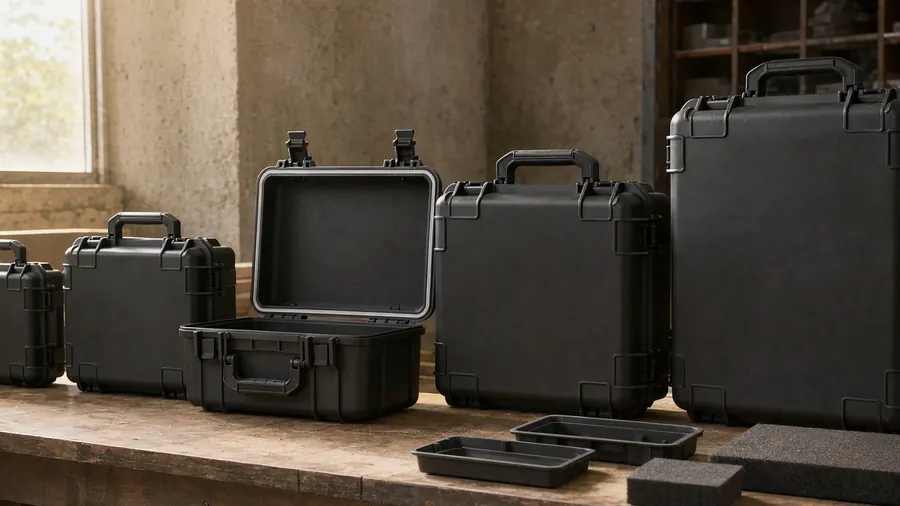
The direct way to answer this question is to name the load families the catalogue is actually shaped around, and to anchor each to a published shell. Small instruments and electronics - meters, testers, radios, camera bodies, portable medical devices - live in the mini and compact PP formats from KX-1204 upward, where a 2.0 to 3.0 mm wall plus a specified foam layout does the work. Outdoor and field kits - camping cook systems, survey gear, drone remotes, first-aid sets - sit in the 2.1 to 2.3 mm outdoor formats around KX-2614 and KX-3114. Stackable storage and ammunition-box duty runs on the 3.0 to 3.7 mm gasketed boxes around KX-3207, KX-3213 and KX-83015, where 80 of the 94 PP shells are recorded stackable. Tactical, military and defence transport uses the 3.5 to 5.0 mm deep-base shells around KX-3218, KX-84416 and KX-86122. Long rigid equipment - levels, tripods, booms, rifle-length assemblies - belongs in the carried long shells up to the 1,280 mm KX-814641. Wheeled site-to-site logistics takes the 14 wheeled PP platforms up to KX-88442. Each family is detailed in its own section below, with the published figures a buyer checks first.
Small Instrument And Electronics Loads
Electronics fail through connector damage and through objects migrating inside a cavity, and the shell's job at this scale is to supply a stiff-enough rim, a defined closure and a wall the foam can be anchored to. The published mini and compact PP shells: KX-1204 at 115 x 78 x 32 mm internal on a 2.6 mm wall, about 100 g, with a narrow internal width of 70 mm recorded; KX-2005 at 190 x 135 x 40 mm on a 2.0 mm wall, about 175 g and 0.9 usable litres; KX-2305 at 225 x 150 x 40 mm, about 240 g and 1.2 litres; KX-2405 and KX-2406 at roughly 220 x 162 x 49 mm and 230 x 155 x 50 mm, both on 2.0 mm walls, about 293 g and 330 g; KX-2507 and KX-2508 sharing a 245 x 175 mm plan at 64 and 68 mm high, about 340 and 338 g; and KX-2805 at 270 x 190 x 46 mm on a 2.1 mm wall, about 340 g. For a load that also wants a gasket channel, KX-1905 is the sealed small option at 180 x 160 x 40 mm internal, 3.0 mm wall, about 250 g and 1.0 litre. None of these figures describes protection performance - the impact field states a wall thickness and nothing else - so the protection is the specified interior: one pocket per device, connector ends unloaded, relief under anything that stands proud of the body.
Outdoor, Field And Camping Kits
Field kits fail from grit on the closure line and from internal movement, and the outdoor formats are built around those two facts rather than around a rating. The published PP outdoor shells: KX-2614 at 240 x 200 x 120 mm internal on a 2.2 mm wall, about 460 g and 5.0 usable litres; KX-2808 at 265 x 190 x 76 mm, about 430 g and 3.3 litres, with a same-plan variant KX-2808-2 at 272 x 193 x 76 mm and about 527 g; KX-3114 at 290 x 220 x 126 mm, about 675 g and 6.9 litres; and KX-3308 at 325 x 236 x 76 mm on a 2.3 mm wall, about 575 g and 5.0 litres. One honesty check matters more than any adjective here: several of these outdoor-format shells record no gasket channel at all, and where a buyer needs a sealed closure the correct move is to step to a gasket-recorded model such as KX-1905 or the 308 x 230 mm KX-3213 family rather than assume the shell has one. Dust and splash behaviour on this site is described by rim geometry, gasket record and latch count per configuration; waterproof and dust-resistant fields are recorded as not measured, with no ingress code published for any model, and accredited third-party testing of a specific build is quoted as a separate work package when a specification demands a document.
Stackable Storage, Ammunition Boxes And Restock Arithmetic
Storage boxes earn their keep in the storeroom, not on a single journey, so the deciding figures are stacking record, carton packing and a gasket that keeps dust off boxed inventory. The published PP storage formats: KX-3207 at 308 x 230 x 64 mm internal on a 3.0 mm wall, about 570 g, gasket recorded; KX-3213 on the same 308 x 230 mm plan at 118 mm high, about 860 g and 7.2 litres; KX-82812 at 219 x 160 x 100 mm on a 3.4 mm wall and 3.0 litres; KX-83015 at 245 x 190 x 140 mm on a 3.7 mm wall and 5.6 litres; KX-83615 at 290 x 220 x 135 mm and 7.4 litres; and the 355 x 280 mm trio KX-3607, KX-3608 and KX-3609 at 60, 70 and 80 mm internal on 3.0 mm walls, about 800, 870 and 900 g, all with gaskets recorded and a 255 mm narrow width published. Eighty of the 94 PP shells are recorded stackable. For restock arithmetic, 24 of the PP models publish carton data: KX-2005 lists a 410 x 360 x 495 mm carton of 40, KX-2305 a 480 x 370 x 470 mm carton of 40, KX-2406 a 490 x 410 x 290 mm carton of 20 and KX-2507 a 505 x 430 x 360 mm carton of 20 - which is what a purchasing department needs to price shelf slots and container fill without asking for samples.
Tactical, Military And Defence Transport
Defence and tactical loads are specified against wall, split and cavity - not against a standard-body claim, because none is published. The published PP transport shells: KX-3218 at 308 x 230 x 172 mm internal on a 3.0 mm wall with an 86/86 mm lid-to-base split, about 900 g and 10.5 usable litres; KX-4312 at 420 x 260 x 104 mm on a 3.5 mm wall with a 52/52 mm split, about 1,170 g and 9.8 litres, with a 236 mm narrow internal width recorded; the 395 x 295 mm family KX-84416, KX-84419 and KX-84430 at 135, 165 and 275 mm high on 4.2 mm walls with 90/45, 120/45 and 230/45 mm splits and 12.6, 15.4 and 25.6 usable litres; the 500 x 400 mm pair KX-85819 and KX-85823 at 165 and 210 mm high on 4.75 mm walls with 120/45 and 165/45 mm splits and 26.4 and 33.6 litres; and the 530 x 360 mm pair KX-86122 and KX-86127 at 203 and 248 mm high on 5.0 mm walls with 155/48 and 200/48 mm splits and 31.0 and 37.8 litres. In this family the honest definition of heavy duty is the published wall - 2.0 to 5.0 mm on PP, to 6.0 mm on engineering polypropylene - plus the gasket record on 75 of the 94 PP shells, plus latch count specified per configuration. Where a tender or an end-customer specification names a performance figure, we commission accredited third-party testing of that exact shell, gasket, latch and foam configuration rather than generalising from any datasheet.
Long Equipment: Levels, Tripods, Booms And Rifle-Length Loads
Long rigid equipment has one deciding figure - internal length - and the PP catalogue carries it further than the wheeled range does. The published long shells: KX-86216 at 582 x 300 x 130 mm internal on a 3.3 mm wall with a 100/30 mm split and 19.5 usable litres; KX-87926 at 737 x 257 x 240 mm on a 4.0 mm wall with a 175/65 mm split and 36.4 litres; KX-88015 at 725 x 350 x 140 mm on a 5.0 mm wall with a 100/40 mm split and 28.4 litres; KX-89616 at 880 x 350 x 140 mm on the same wall with 34.5 litres; and KX-814641 at 1,280 x 350 x 140 mm, 5.0 mm wall and 50.2 usable litres, the longest cavity published in the catalogue. The constraint worth stating plainly is that the longest wheeled cavity is 740 mm - KX-88434 and KX-88442 - so anything longer rides in a carried shell and the carry plan is decided by who moves it and how far. Inside a long shell the interior is engineered as stations rather than as one full-length bed: support under defined points of the item, relief at mounted optics or handles, and retention so the load cannot slide end-to-end in transit.
Wheeled PP Platforms For Site-To-Site Logistics
Fourteen of the 19 wheeled shells in the catalogue are PP, and ten of them publish a fixed telescopic handle height between 240 and 385 mm, which is the practical definition of a trolley case in this range. The published platforms: KX-85427 at 483 x 363 x 220 mm internal on a 4.5 mm wall with a 150/70 mm split, about 6,100 g and 30.9 usable litres; KX-86136 at 530 x 360 x 304 mm on a 5.0 mm wall, about 8,500 g and 46.4 litres; KX-85835 at 500 x 400 x 305 mm, about 8,520 g and 48.8 litres; the 595 x 460 mm pair KX-86830 and KX-86836 at 255 and 315 mm high on 4.8 mm walls, about 10,160 and 10,600 g, 55.8 and 69.0 litres; KX-87336 at 650 x 430 x 310 mm on a 5.0 mm wall, about 10,660 g and 69.3 litres; KX-88337 at 723 x 368 x 329 mm with a 280/49 mm split, about 10,866 g and 70.0 litres; and the 740 x 518 mm pair KX-88434 and KX-88442 at 284 and 364 mm high, about 14,030 and 15,320 g, 87.1 and 111.6 litres. KX-96127 is the square-plan option at 545 x 545 x 210 mm, 4.8 mm wall, about 8,540 g and 49.9 litres, for loads that stack square rather than rectangular. The trade to record before ordering: every wheeled shell in the library is recorded non-stackable, and empty mass jumps by an order of magnitude, so a trolley is bought where the floor is long and flat, not where a shelf system expects stacking.
PP, Engineering Polypropylene And ABS: Published Differences
Choosing between the three thermoplastic families is easier when the comparison is made on published records only. The table below is built entirely from the model database behind this site - counts, published ranges and recorded options - with no property claimed beyond what a datasheet states.
Read the table as a decision aid, not as a ranking. PP carries the widest size span and the lowest empty masses, which is why it owns the mini, outdoor, storage and long-shell families. Engineering polypropylene carries the deep-base transport shells and the stiffest published walls at 6.0 mm. ABS carries the dense-electronics and precision loads where stiffness per millimetre and a gasket on every model matter more than the 507 mm length cap and the higher mass per litre.
| Published Record | Pp 94 Models | Engineering Pp 38 Models | Abs 22 Models |
|---|---|---|---|
| Models in catalogue | 94 | 38 | 22 |
| Wall thickness published | 88 models, 2.0-5.0 mm | 38 models, 2.1-6.0 mm | 22 models, 3.0-5.3 mm |
| Gasket channel recorded | 75 with, 19 without | 27 with, 11 without | 22 with, 0 without |
| Wheels | 14 | 4 | 1 |
| Empty mass published | 41 models, 100-15,320 g | 29 models, 350-10,000 g | 22 models, 310-7,940 g |
| Usable interior volume | 0.3-111.6 L | 3.1-43.1 L | 0.7-45.3 L |
| Longest internal cavity | 1,280 mm (KX-814641) | 590 mm | 507 mm |
Buyer Phrase Mapped To A Published Record
Two search phrases bring buyers to this page, and both resolve to records in the catalogue rather than to claims. The table maps each phrase to what a buyer can verify on a named datasheet.
| Buyer Phrase | Maps To | Published Record |
|---|---|---|
| applications suitable pp protective | The six load families above, each anchored to named models | 132 of 155 shells polypropylene-family; PP mini cavities from 115 x 78 x 32 mm up to the 1,280 mm KX-814641 and the 111.6 L KX-88442; walls 2.0-5.0 mm on 88 of 94 PP models |
| materials applications suitable pp protective | The material comparison table above | PP 94 models, engineering polypropylene 38, ABS 22, one mixed model; gasket recorded on 75 / 27 / 22 respectively; longest cavities 1,280 / 590 / 507 mm |
Selection Guidance: Six Checks Before Ordering A PP Shell
One: measure the packed item - footprint, height over the tallest standing part, and anything that travels assembled - and add roughly 20 mm per axis for the cut, because the cavity figures above are internal. Two: read the lid-to-base split as two numbers, not one height; a 230/45 mm split in KX-84430 and a 74/42 mm split in KX-4613 put the same total height to different jobs. Three: decide stacking early - 80 of the 94 PP shells record stackable while all 14 wheeled ones record non-stackable, and a storeroom plan that assumes both will fail one of them. Four: check the gasket record on the named datasheet instead of assuming sealing, since 19 PP shells record no channel. Five: put empty mass against the carry plan - published on 41 PP models from about 100 g to 15,320 g, with a fixed folding handle on all 155 and a telescopic handle on 10 of the 14 wheeled PP platforms. Six: standardise on a footprint before ordering a fleet - the 455 x 338 mm plan is published at 84, 116 and 148 mm heights across KX-4610, KX-4613 and KX-4616, and the 395 x 295 mm plan at 135, 165 and 275 mm across KX-84416, KX-84419 and KX-84430, so one tray drawing can serve several shells.
Customisation On A PP Shell
Interior work is quoted from one unit on an existing shell, and it is where a PP case is won or lost: layered plank with a firmer carrier under dense items and a softer face against finished surfaces, through-pockets with connector ends unloaded, relief windows under controls and glass, routed cable channels sized by length, retainers for anything that must not lift when the case is inverted, and printed outlines per position so a missing part shows at a glance. Shell-side options cover colour, printed or in-mould logo, additional latches, an ID window, a shoulder strap, a pressure-equalisation option and buyer-branded packaging - all recorded as manufacturer options across the range, all hardware or cosmetic changes rather than changes to a published wall or gasket record. Colour, logo and OEM hardware begin near 300 units, with an OEM first sample about 45 days on approved existing tooling; a dedicated new shell needs a mould at roughly 3,000 units per component and about 125 days from approved drawings. Send the packed-state dimensions, a scale photograph of the kit or the item itself, and the answer comes back against a named model's datasheet rather than against a generic grade.
Procurement Notes: Wholesale Terms And What We Do Not Claim
KeXin New Materials (Guangdong) Co., Ltd. moulds these shells and works with wholesale and OEM or ODM buyers on EXW or FOB terms only. There is no retail channel, no delivered-duty-paid quotation and no overseas warehouse, so a landed cost is an FOB or EXW figure plus your own freight and clearance; the 24 PP models that publish carton data give the arithmetic a freight forwarder needs, and pallet and container figures are supplied with the quotation. Minimum order is one unit on a stock shell and one unit on a custom foam layout, near 300 units for colour, logo or OEM hardware, and near 3,000 per component for a dedicated mould, with an OEM first sample about 45 days and a new mould about 125 days from approved drawings. Payment is a 30 per cent deposit with the balance after inspection, and third-party inspection before shipment is welcome. Then hold us to the same standard we hold the data to: which accredited report produced a figure, what method and conditions it used, and whether it covers the exact build being bought. Every field our datasheets record as not measured - ingress, free-fall height, shock figure, temperature range, stack load, humidity - is answered as not measured. Enquiries go to Fred Zhao or the KeXin Sales Team, WhatsApp +86 135 3588 0002.
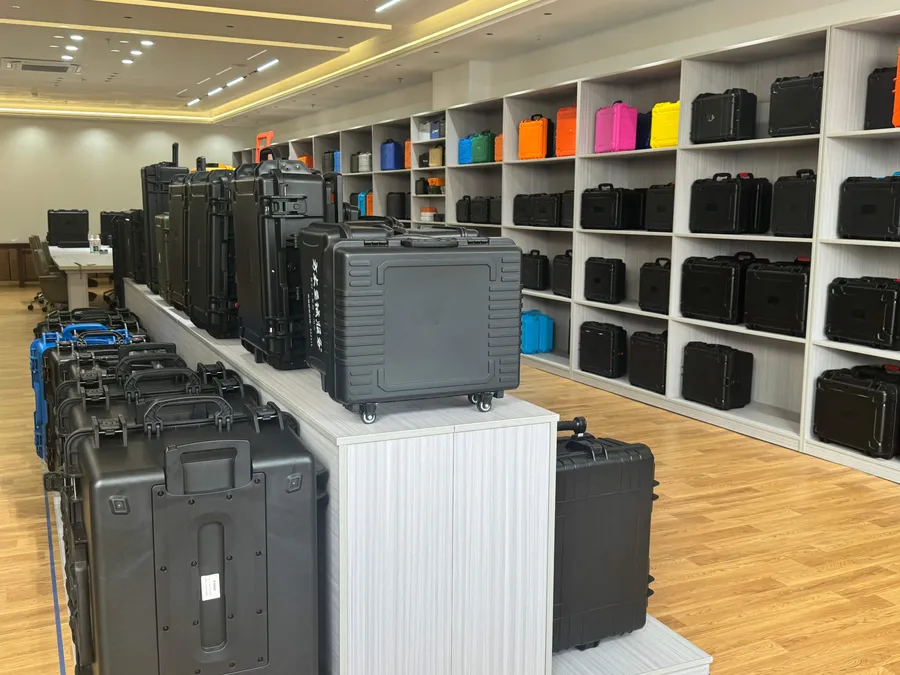

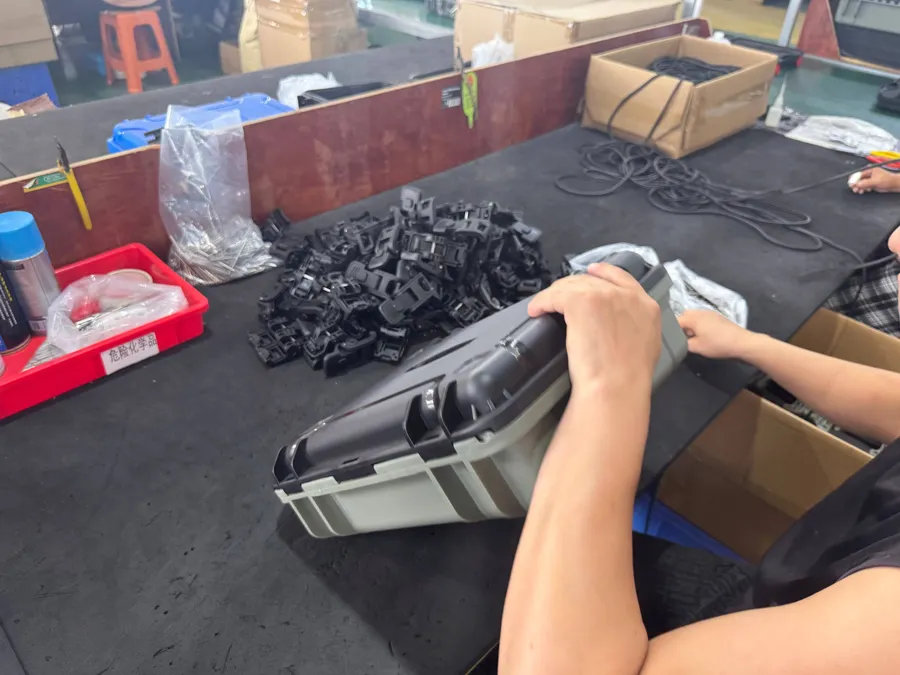
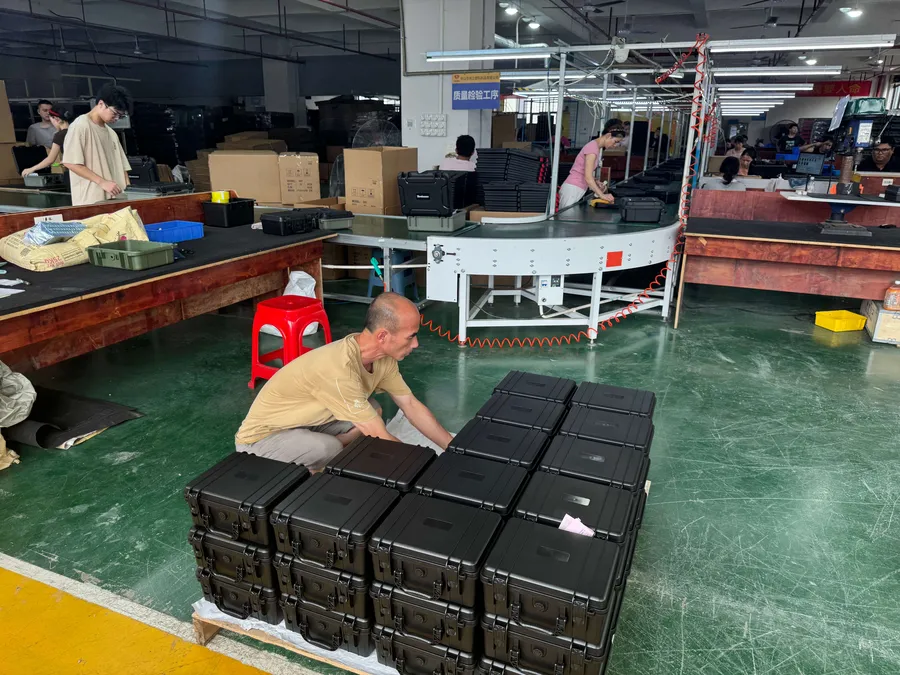
Customisation
Everything described above is configurable on a standard shell: interior layout (pick-and-pluck, die-cut or CNC-cut), foam grade and thickness, colour, logo method, latch and lock count, pressure-equalisation valve, cable ports, document holder and identification plate. A bespoke exterior geometry requires a new mould — 125 days, from 3,000 units per moulded component.
Procurement considerations
| Question | What to send us |
|---|---|
| Which shell fits? | Equipment L × W × H as packed, plus required clearance per axis |
| What does it cost? | Order quantity and estimated annual quantity — the two drive different answers |
| Is tooling needed? | Whether an existing shell clears the envelope with usable foam depth |
| Lead time? | Your required delivery date, not just the order date |
| Certification? | The exact standard your tender names — we will say whether we can test to it |
| Freight? | Destination and preferred terms; carton and pallet data supplied with the quotation |
Comparison and selection guide
The tables on this page exist because a protective case is chosen by comparing three things: the envelope, the environment and the handling chain. Where no table applies, the rule below is.
| Situation | What To Do |
|---|---|
| Shock | Base layer thickness and grade sized to the packed mass. |
| ESD | Anti-static PE, specified by surface resistivity range. |
| Dust | Sealed configuration with a continuous rim. |
- Size on internal dimensions plus clearance, never on a product name.
- Choose the carrying method before the shell: it changes the series, not just the price.
- Specify the interior last, and decide up front whether the end user will reconfigure it.
What applications are suitable for PP protective cases? relates to Material Guide. Related families: Electronics Cases / Outdoor Protective Cases / Ammunition Storage & Transport Boxes / Military Protective Cases / Tactical Equipment Cases / Long Equipment Cases / Equipment Transport Cases / Custom Protective Cases / Rolling Cases / Field Equipment Cases. Related sectors: field and industrial equipment. Continue in the Material Guide cluster.
This page is written from our own production data. If your requirement differs, send the dimensions and we will tell you which of the 155 models fits, or whether a custom route is needed.