How does material affect case weight?
Material affects case weight mainly by changing the wall section a shell has to be moulded at, and only secondarily by the resin name itself. In our own 155-model specification file, where 93 listings publish a net weight, mass per external litre medians at 90.0 g for polypropylene across 41 weighed models, 90.4 g for engineering polypropylene across 29 and 106.2 g for ABS across 22, so the ABS group carries roughly 18 per cent more plastic per enclosed litre than either polypropylene group. The overlap is wider than the gap: polypropylene alone runs from 53.2 g to 250.0 g per external litre, which means the material sets a band and the wall, the footprint and the interior decide where a specific model sits inside it.
Key points
- Compare mass per external litre, not raw grams: our polypropylene listings median 90.0 g per litre, engineering polypropylene 90.4 g and ABS 106.2 g.
- The mechanism is wall section: ABS is moulded no thinner than 3.0 mm in our range, while polypropylene listings go down to 2.0 mm for a comparable job.
- Geometry outranks resin: KX-1204 at 100 g and KX-88442 at 15,320 g are both polypropylene, and the spread inside one material is larger than the gap between materials.
- Weight is published on 93 of 155 models, wall thickness on 148 and gross weight on none, so a supplier comparison needs a carton and packed-weight statement.
- Additions are separate from resin: a gasket appears on 124 models, wheels and a telescopic handle on 19, and a custom interior is quoted per set rather than per shell.
- Most weight is a configuration change: interior, colour, logo and hardware run 45 days to a first sample, while a new shell geometry is a 125-day tool project.
How does material affect case weight?
A shell material changes case weight by changing three things at once: the minimum wall section the part can be moulded at and still hold its shape, the mass of plastic that section implies for a given surface area, and whether the build then needs extra components, such as a gasket, a stiffer rim or a second moulded tray, to behave. The resin name on a specification sheet is a summary of those decisions rather than a cause you can put on a scale by itself, which is why a straight gram-for-gram comparison between two materials is almost always a comparison between two tools of different size.
Because the specification fields are published, the question can be answered with our own numbers instead of adjectives. Net weight appears on 93 of the 155 models in the product database, wall thickness on 148, and external dimensions, internal dimensions and an external volume figure on all 155. Grouping the 93 weighed listings by the shell material recorded in the same file gives three comparable sets - 41 polypropylene models, 29 engineering polypropylene models and 22 ABS models - plus a single listing recorded as PP / ABS, which we treat as one configuration rather than as a material class.
The published numbers: which materials affect case weight and by how much
Normalised to the space each shell encloses, the material groups separate but they also overlap. Across the 41 weighed polypropylene listings the median is 90.0 g per external litre inside a range of 53.2 g to 250.0 g. The 29 weighed engineering polypropylene listings median at 90.4 g per litre in a band from 52.6 g to 127.6 g. The 22 ABS listings median higher at 106.2 g per litre, from 81.9 g to 221.4 g. Read those three medians together and the ABS group carries about 18 per cent more plastic per enclosed litre than either polypropylene group, which is the strongest statement our published data supports about how materials affect case weight.
Read the overlap as carefully as the medians. The heaviest figure per litre in the whole file belongs to KX-1204, a 120 x 90 x 40 mm polypropylene shell with a 2.6 mm wall and 100 g of plastic, which works out at 250.0 g per external litre because hardware, lid line and parting geometry carry a fixed cost that such a small interior cannot amortise. The lightest ABS listing, KX-64819, sits at 81.9 g per litre. Any comparison that stops at the word ABS or the letters PP will put those two shells in the wrong order.
| Shell Material As Published | Models In The File | Listings With A Net Weight | Wall Thickness Stated | Median Mass Per External Litre | Range Per External Litre |
|---|---|---|---|---|---|
| Polypropylene (PP) | 94 | 41 | 2.0 - 5.0 mm on 88 models, median 3.7 mm | 90.0 g | 53.2 - 250.0 g |
| Engineering polypropylene | 38 | 29 | 2.1 - 6.0 mm on all 38 models, median 4.3 mm | 90.4 g | 52.6 - 127.6 g |
| ABS | 22 | 22 | 3.0 - 5.3 mm on all 22 models, median 3.9 mm | 106.2 g | 81.9 - 221.4 g |
| Recorded as PP / ABS | 1 | 1 | No wall figure published on this listing | 78.8 g on KX-95419 | One configuration, not a class |
How wall thickness affects case weight more than the resin does
Wall section is where a material decision turns into grams, and if you want the short mechanical answer to how wall thickness affects case weight, it is section multiplied by surface area. Our polypropylene listings state a wall on 88 of 94 models, running 2.0 mm to 5.0 mm with a median of 3.7 mm. Engineering polypropylene states a wall on all 38 models, from 2.1 mm to 6.0 mm with a median of 4.3 mm, and the two thickest shells we make, KX-6621 and KX-97227, are both in that group at 6.0 mm. ABS states a wall on all 22 models, from 3.0 mm to 5.3 mm with a median of 3.9 mm, and no ABS listing in the file is thinner than 3.0 mm. Seven models publish no wall figure at all, so a section-based comparison is possible on 148 of 155 rather than across the whole range.
The cleanest pair in our own range is a same-size comparison rather than a resin comparison. KX-4010 is a 400 x 360 x 100 mm polypropylene shell with a 3.0 mm wall and a published net weight of 1,015 g. KX-4010-2 is a 400 x 350 x 100 mm engineering polypropylene shell with a 3.4 mm wall and 1,240 g. Four tenths of a millimetre of section plus a heavier build brief accounts for 225 g on almost the same outside box. The counterweight is KX-4616, a 460 x 367 x 155 mm polypropylene shell with a 3.0 mm wall at 1,395 g, which is 53.2 g per external litre, while KX-4716 uses a thinner 2.5 mm wall in engineering polypropylene and still publishes 1,680 g because the box it encloses is larger.
Geometry and footprint: the limits of a material comparison
Within one material the range of mass is enormous, and that is the observation a material-first argument cannot survive. Our lightest and heaviest weighed models are the same resin: KX-1204 at 100 g and KX-88442 at 15,320 g, the latter an 843 x 592 x 415 mm polypropylene shell with a 5.0 mm wall enclosing 207.1 external litres. Across the 93 listings that publish a net weight the median is 1,480 g. Any sentence beginning with the claim that a given plastic weighs a given amount is describing a tooling programme, not a polymer property, and it will not survive contact with a specific model page.
The comparison that does hold is matched envelope. In our file the pairs whose external dimensions sit within 25 mm on every axis include KX-62810, an ABS shell at 275 x 226 x 100 mm with a 4.0 mm wall and 900 g, against KX-701, an engineering polypropylene shell at 265 x 210 x 80 mm with a 2.1 mm wall and 350 g, which is the widest such gap in the range at 2.57 times the mass. KX-64112, ABS at 413 x 336 x 123 mm with a 3.8 mm wall and 1,820 g, sits against KX-705, engineering polypropylene at 425 x 320 x 115 mm with a 2.1 mm wall and 830 g. Run the same test the other way and KX-85021, an engineering polypropylene shell at 495 x 370 x 210 mm with a 4.5 mm wall and 4,912 g, outweighs the ABS KX-64819 at 475 x 383 x 188 mm, 3.5 mm and 2,800 g. Material is a tendency inside a size class; it is not a verdict on a listing.
What else adds weight besides the shell: gasket, hardware and interior
Three additions move weight independently of the shell resin, and each can be looked at separately in our data. A sealing element is published as a seal type on 124 of 155 models - all 22 ABS listings carry one, together with 75 of the 94 polypropylene models and 27 of the 38 engineering polypropylene models - and among the weighed listings those that carry a seal median 93.8 g per external litre across 66 models, against 81.5 g across the 27 weighed listings that publish none. Wheels are rarer and heavier in absolute terms: 19 models publish two wheels and a telescopic handle, and 11 of them state an extended handle height, running from 240 mm on KX-87336 to 485 mm on KX-97227, all of them on large shells.
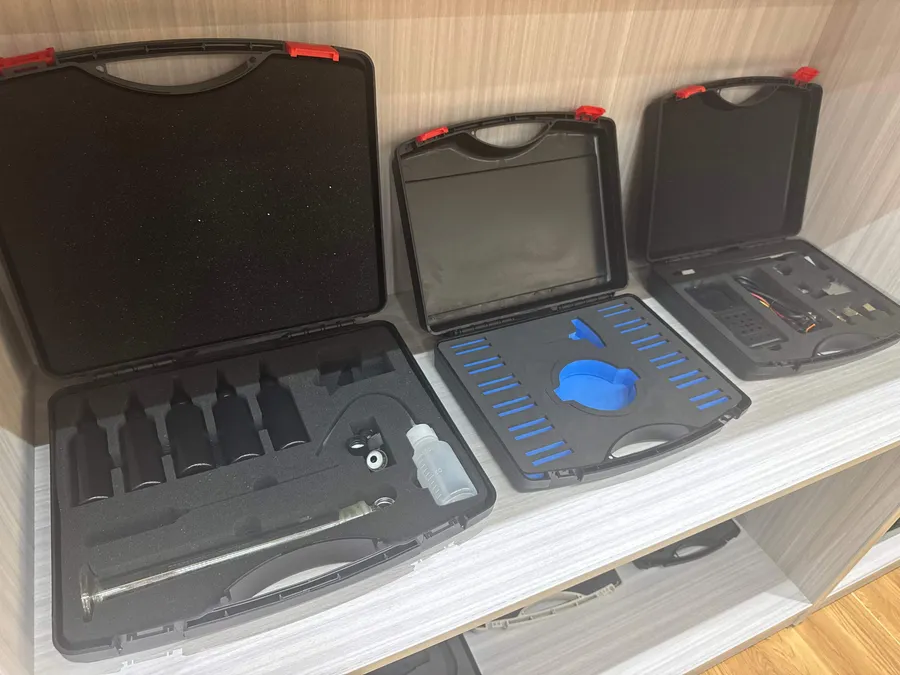
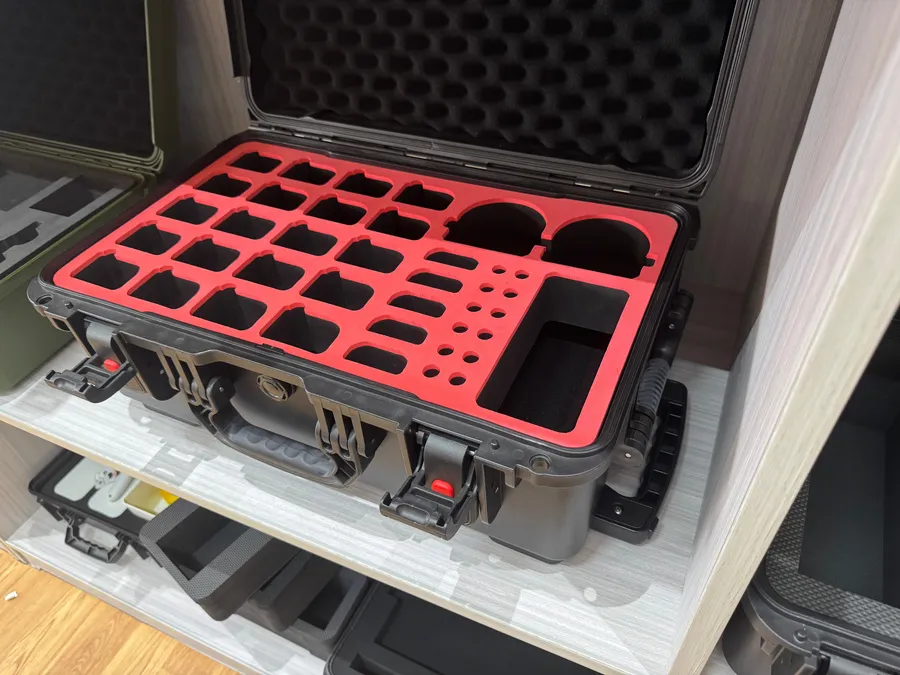
The interior sits outside all of that arithmetic. Our listings record interiors as cross-linked PE, EVA or EPS by zone, in pick-and-pluck, die-cut, CNC-cut, layered and egg-crate forms, specified per set rather than per shell, and we publish no density or mass-per-volume figure for foam. That matters for a weight comparison, because a full-block insert in a 20 litre case can move the packed figure as much as a resin change would. Ask for the packed weight of the exact configuration rather than reasoning from the shell alone.
| What Adds Weight | Where It Is Published | What Our Numbers Show | What Our Numbers Do Not Show |
|---|---|---|---|
| Gasket and sealing rim | A seal type on 124 of 155 models | Weighed listings with a stated seal median 93.8 g per external litre, those without 81.5 g | A measured sealing result for the configuration being quoted |
| Wheels and telescopic handle | 19 models, with extended height stated on 11 | Extended heights from 240 mm to 485 mm, all on larger wheeled shells | The mass of the hardware itself, which is not published as a line |
| Foam interior | Interior options on all 155 models | PE, EVA and EPS by zone, in five structural forms, cut to a drawing | Density or weight per insert, which we do not publish |
| Wall section | 148 of 155 models, 2.0 mm to 6.0 mm | Moving KX-4010 to KX-4010-2 adds 225 g on the same outside box | Whether that section is enough for your load path |
How to compare case weight between suppliers on the same basis
Convert before you compare, because grams alone describe a size rather than a build. Take net weight in grams, divide by the external volume the same sheet states, and record the wall section beside it; that is how you compare case weight between suppliers whose ranges are not the same shape. Ask three questions of every sheet: does the published weight include the interior, is a gasket fitted on the configuration being quoted, and is the wall figure the section on the tool actually run or a nominal from a drawing. Where a sheet gives weight but no wall, or wall but no weight, the comparison stops being possible and the claim becomes unfalsifiable.
We publish the fields and leave the rest open, which is the standard we would ask of anyone else. External and internal dimensions and three volume figures appear on all 155 models, wall thickness on 148, net weight on 93, gross weight on none, and pallet and container totals as calculations against your carton and your order rather than as printed numbers. Impact and shock are recorded as construction options with no drop height stated, and no ingress protection code is printed on our listings, so weight per litre is one of the very few cross-supplier comparisons our own data can actually support.
Where case weight decides the specification
Weight matters unevenly across the ways these cases are used, and the pattern is predictable. In electronics and instrument work the case is walked by one person from a vehicle to a site and back, so a few hundred grams per unit is a real difference in operator load and our lightweight thin-wall shells earn their place there. For drone and payload work the grams come straight out of a lift or endurance budget, where a wheeled or long-format shell is usually the wrong answer whatever it is moulded in. Where the case travels on a pallet and is moved by a team, as in ammunition storage and general equipment transport, the same per-litre comparison usually favours the heavier, stiffer build, because the handling chain is a forklift rather than a back.
How to reduce case weight without losing stiffness
Most of the mass that a buyer can actually take out is configuration, not resin. The levers we can pull on an existing tool are the wall section you specify against the load path, the interior layout - a zoned two-grade panel holds the same kit at a lower mass than a solid block of one firm grade - the presence of a gasket where the exposure does not need one, the choice between a fixed handle and wheels, and the packed quantity you ship. All of that is 45-day first-sample work against a 30 per cent deposit, and a custom interior starts at one set, so a reduce case weight without losing stiffness programme is normally shortlisted in weeks rather than quarters.
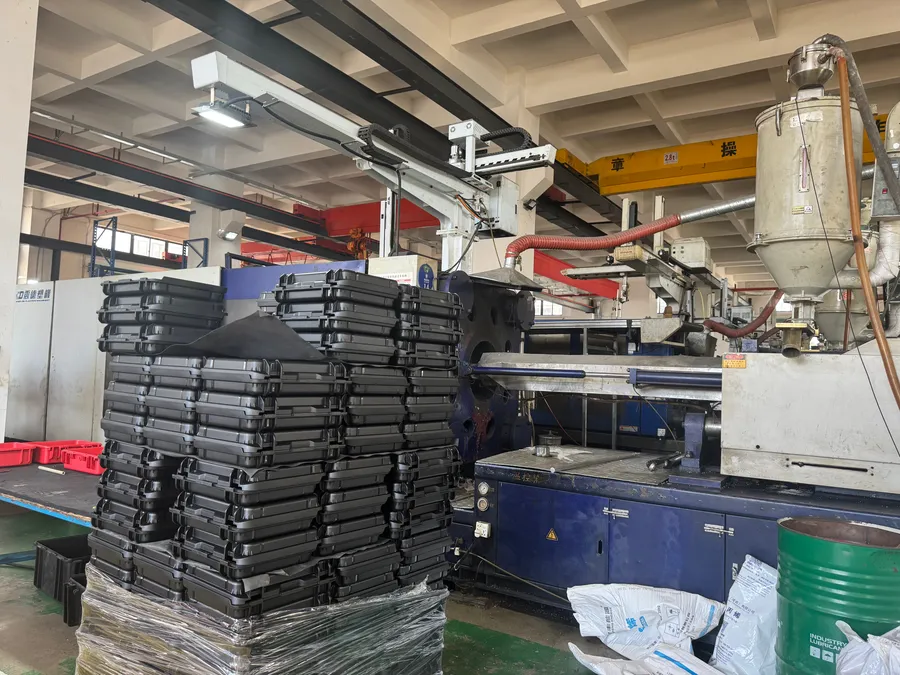
What does reach for new tooling is a new shell geometry or a change of compound, because shrinkage allowance is set for one polymer in the steel. That route runs 125 days and from 3,000 pieces per moulded component. The practical line to plan around is simple: if the outside box stays as it is, the work is configuration; if the outside box changes, it is a tool project. Colour, logo and hardware choices sit at 300 pieces and touch neither.
Procurement notes
Put every shortlisted model into one sheet with six columns: model, external dimensions, external volume, wall thickness, net weight and whether a seal is fitted, then compute grams per external litre yourself rather than accepting a summary line. Mark the rows where a field is blank - in our own file that is 62 listings with no net weight and 7 with no wall figure - and send those blanks back to the supplier as questions, because a missing field is the honest version of a claim you cannot check.
Commercially we work wholesale and OEM on EXW or FOB terms only: no retail channel, no delivered-duty-paid quotation and no overseas warehouse stock. OEM on existing mouldings runs to a first sample at 45 days against a 30 per cent deposit, with the balance paid after inspection; a new mould runs 125 days from 3,000 pieces per moulded component; colour, logo and hardware changes sit at 300 pieces and interiors start at one set. Third-party inspection of finished goods is welcome. Send the envelope, the carry method and the weight ceiling you are working to, and we will mark up which of the 155 published models fits. Fred Zhao, KeXin Sales Team, WhatsApp +86 135 3588 0002.
What we do not claim about weight
No weight is stated for the 62 models that publish no net weight figure, and no material property is generalised from a single listing. We publish no density, no resin grade designation, no melt-flow figure and no recycled-content percentage for shells or interiors, and we do not claim that a lighter shell means a lower level of protection or that a heavier one means a higher level, because the impact, stack, load, temperature and ultraviolet fields on our listings are recorded as untested.
One limit is worth writing into a comparison file: a material name is not a weight specification and a weight is not a performance statement. Two models recorded as the same resin in our own file differ by more than 150 times in moulded mass, and every protection field on both of them reads untested. The comparison that holds is configuration against configuration - shell, wall, gasket, hardware and interior drawn together from the model pages - which is what this page and the 155 model listings are built to support. Published by KeXin New Materials (Guangdong) Co., Ltd.
Customisation
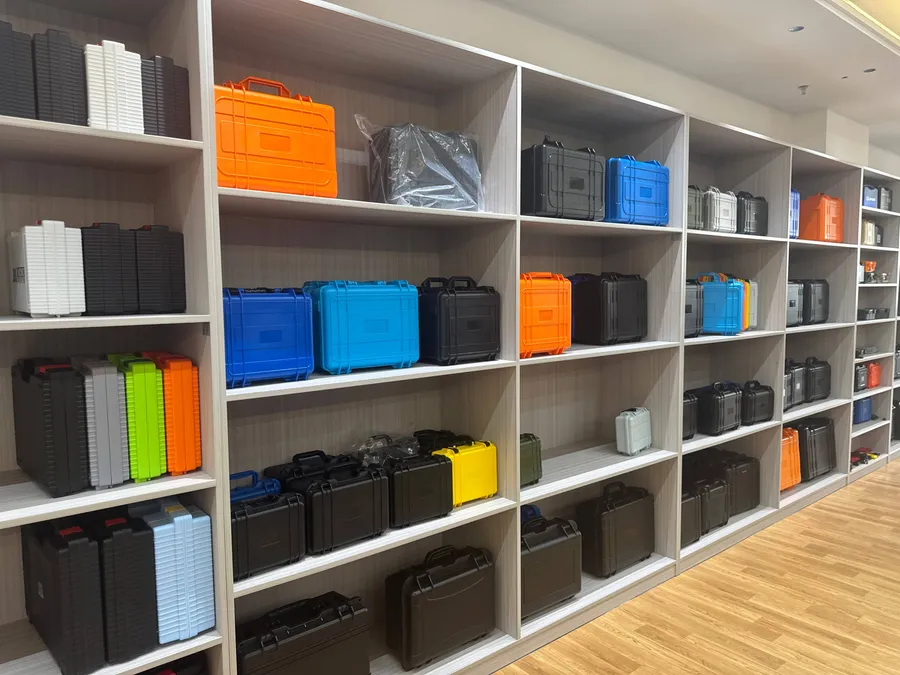
Everything described above is configurable on a standard shell: interior layout (pick-and-pluck, die-cut or CNC-cut), foam grade and thickness, colour, logo method, latch and lock count, pressure-equalisation valve, cable ports, document holder and identification plate. A bespoke exterior geometry requires a new mould — 125 days, from 3,000 units per moulded component.
Procurement considerations
| Question | What to send us |
|---|---|
| Which shell fits? | Equipment L × W × H as packed, plus required clearance per axis |
| What does it cost? | Order quantity and estimated annual quantity — the two drive different answers |
| Is tooling needed? | Whether an existing shell clears the envelope with usable foam depth |
| Lead time? | Your required delivery date, not just the order date |
| Certification? | The exact standard your tender names — we will say whether we can test to it |
| Freight? | Destination and preferred terms; carton and pallet data supplied with the quotation |
Comparison and selection guide
The tables on this page exist because a protective case is chosen by comparing three things: the envelope, the environment and the handling chain. Where no table applies, the rule below is.
| Situation | What To Do |
|---|---|
| Fastest | Standard shell plus CNC foam — typically 45 days from approved drawing. |
| Branded | Standard shell plus custom colour and logo — MOQ applies to the resin colour. |
| Bespoke geometry | New mould — 125 days, MOQ from 3,000 units per component. |
- Size on internal dimensions plus clearance, never on a product name.
- Choose the carrying method before the shell: it changes the series, not just the price.
- Specify the interior last, and decide up front whether the end user will reconfigure it.
How does material affect case weight? relates to Material Guide. Related families: Custom Protective Cases / Electronics Cases / Military Protective Cases / Outdoor Protective Cases / Tactical Equipment Cases / Ammunition Storage & Transport Boxes. Related sectors: field and industrial equipment. Continue in the Material Guide cluster.
This page is written from our own production data. If your requirement differs, send the dimensions and we will tell you which of the 155 models fits, or whether a custom route is needed.


