How should buyers compare PP and ABS cases?
Compare PP and ABS cases in the same order you would compare any two shells: settle the envelope first (internal length, width and depth, and the lid-to-base split), then the closure (whether a gasket is offered and how many latches compress it), then the mass and logistics data, and only then let the resin break the tie. That order matters because on our 155 published models the resin does not predict the structure: wall thickness runs 2.0 mm to 5.0 mm across 94 PP shells, 2.1 mm to 6.0 mm across 38 engineering PP shells and 3.0 mm to 5.3 mm across all 22 ABS shells, so a thick ABS case and a thin PP case are both ordinary products here. What the resin genuinely decides is behaviour at low temperature, resistance to fuels and solvents, panel stiffness and surface finish - and none of those four is measured and published per model on our sheet.
Key points
- Settle internal dimensions, closure and mass before resin; on our sheet the material does not predict wall thickness.
- PP covers 94 models, engineering PP 38 and ABS 22, so most of the range is a polypropylene range with ABS as a focused alternative.
- Every one of the 22 ABS shells publishes a gasket option and a net mass; 19 of 94 PP shells publish no seal option at all.
- Published wall thickness overlaps across resins: PP 2.0-5.0 mm, engineering PP 2.1-6.0 mm, ABS 3.0-5.3 mm.
- ABS is concentrated in the 6 Series mid-size equipment cases, while PP carries the smallest and the largest shells we publish.
- The two resins have similar density, so empty mass follows wall thickness and geometry rather than the material choice.
- Waterproof, dust, UV, temperature range, stack load and load capacity are recorded as not measured on all 155 models, in every resin group.
Run the comparison in the right order
Most PP-versus-ABS comparisons fail because they start with the resin. A case is bought to fit a piece of equipment and a way of travelling, and resin is the third or fourth decision. Take the internal envelope first: internal length, width and depth in millimetres, plus the lid-to-base split, since a shell with a shallow lid cannot accept a tall item however deep its total interior is. On our sheet internal length runs from 115 mm to 1,280 mm and internal depth from 32 mm to 364 mm, so the envelope decision removes most candidates before any material question is asked.
Then the closure: whether the shell offers a compressible gasket in a moulded channel, how many latches compress it, and whether a pressure-equalisation valve is fitted or available. Then the mass and the logistics block: empty mass, external footprint against your pallet or rack, carton data. Only when two or three shells survive those filters does the resin question become answerable, and by then you usually know what the case will be exposed to - which is the only thing the material choice turns on.
What the two resins are actually claimed to do
Our material pages state the practical differences plainly. Polypropylene keeps its toughness at low temperature and is very good against fuels and most solvents; ABS stiffens and becomes more brittle in the cold and is attacked by some solvents. ABS holds its shape better under a local load, where PP flexes and recovers, and ABS takes a printed or embossed finish better, which is why it suits a case that is a brand-facing product on a shop floor. The two resins are close in density, so the empty mass of a shell follows its wall thickness and geometry far more than its material.
Engineering-grade PP is a third answer rather than a compromise: a polypropylene formulation modified with a rubber phase, a nucleating agent or a mineral filler so that stiffness, low-temperature toughness and creep resistance are held inside a stated range. Fillers raise stiffness and cut creep but usually reduce elongation, and the evidence for a grade is the certificate of analysis for the resin actually moulded, not a brand name printed on a datasheet.
How the resins are distributed across our published range
Read the group table as a description of how the tooling is laid out, not as a league table. Polypropylene carries 94 models and covers the extremes: the smallest shell on the sheet is a 120 mm external box, and the longest is a 1,356 mm case for long equipment. Engineering PP carries 38 models and clusters in the deep-body and rolling groups. ABS carries 22 models, 20 of them in the 6 Series mid-size equipment cases and 21 of them tagged as thick-wall shells.
The distribution tells you something useful about sourcing: if you need a very small or a very large shell, you will be choosing from PP tooling almost automatically, and the resin decision has already been made for you by the catalogue. If your load sits in the mid-size band where ABS is concentrated, then the comparison is real, and the sensible next step is to line up the specific candidates that fit your dimensions and closure requirements rather than debating resins in the abstract.
| Group On The Sheet | Models | Published Wall Mm | Published Net G | Internal Litres | Gasket Offered | Where It Sits |
|---|---|---|---|---|---|---|
| PP | 94 | 2.0-5.0 (88 of 94 models) | 100-15,320 (41 of 94) | 0.3-139.5 | 75 of 94 | 0 Series minis and 8 Series heavy-duty large shells, plus the long T Series rolling cases |
| Engineering PP | 38 | 2.1-6.0 across all 38 | 350-10,000 (29 of 38) | 3.6-53.9 | 27 of 38 | 7 Series large, 9 Series deep-body and T Series rolling shells |
| ABS | 22 | 3.0-5.3 (all 22) | 310-7,940 across all 22 | 0.8-56.6 | 22 of 22 | 6 Series mid-size equipment cases (20 of 22), one 9 Series deep shell, one T Series |
| PP / ABS | 1 | not published (1 of 1) | 3,600 (1 of 1) | 35.7 | 0 of 1 | A single 9 Series shell, KX-95419, listed for both resins |
Resin does not predict structure
The single most common buyer mistake is to read material as a proxy for toughness. Our published wall figures show why that fails: PP is recorded on 88 of 94 models from 2.0 mm to 5.0 mm with a median of 3.70 mm, engineering PP on all 38 from 2.1 mm to 6.0 mm with a median of 4.30 mm, and ABS on all 22 from 3.0 mm to 5.3 mm with a median of 3.90 mm. The bands overlap almost completely, and one model - the 6.0 mm engineering PP shell KX-6621 - has a thicker wall than any ABS shell we publish.
Mass behaves the same way. 41 of the 94 PP models publish a net mass, spanning 100 g to 15,320 g, while every one of the 22 ABS models publishes one, spanning 310 g to 7,940 g. A buyer comparing a 470 g ABS shell against a 175 g polypropylene box is not comparing resins; they are comparing a 211 mm case with a 195 mm one. Compare like envelopes, then ask what the material does under your specific exposure.
Like-for-like pairs from the published sheet
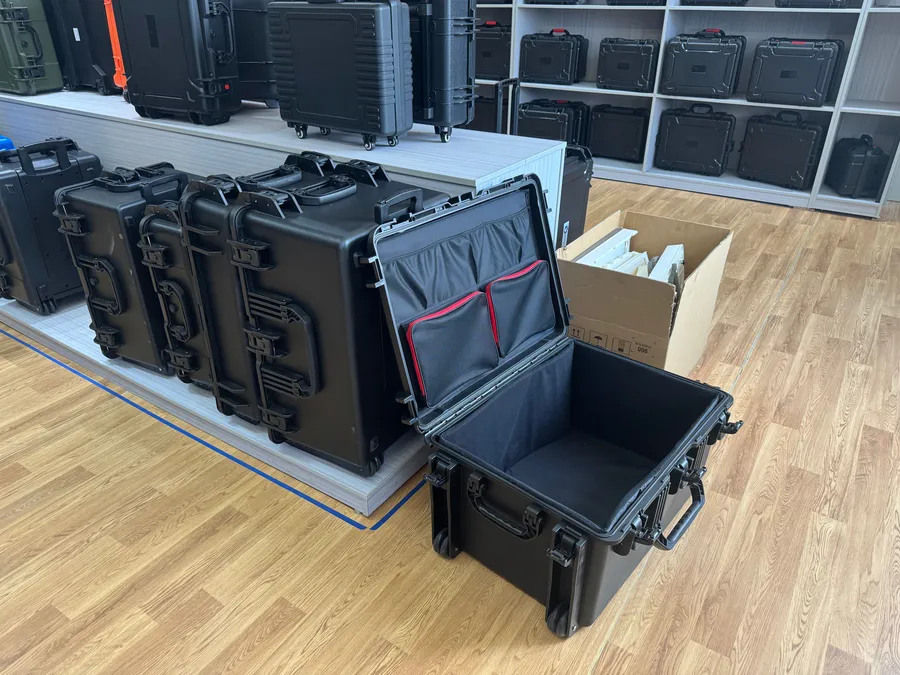
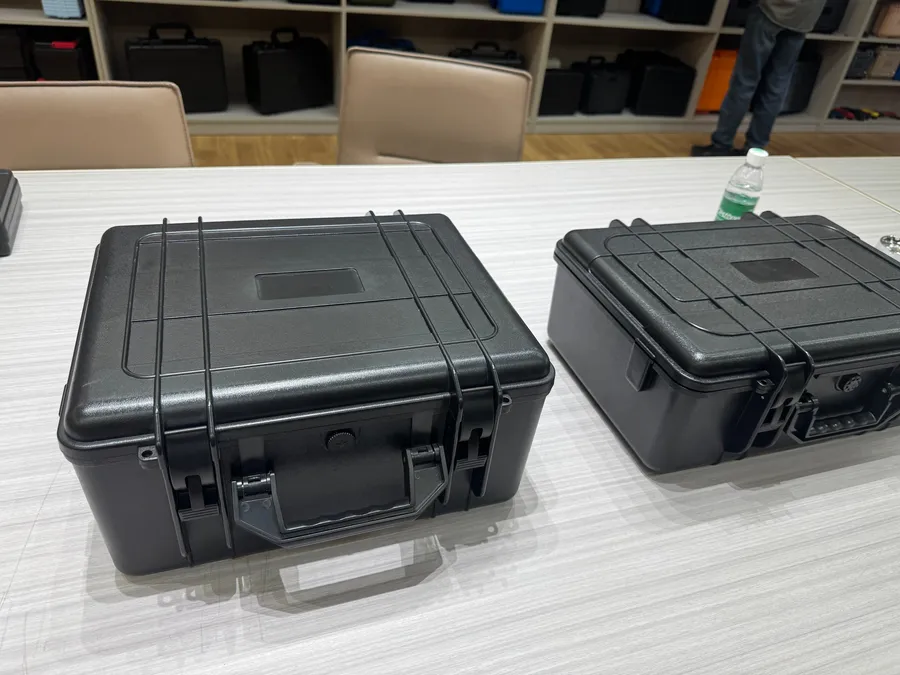
Ten shells from the two size bands where a genuine resin choice exists. In the small band, KX-62810 and KX-63612 are ABS mid-size boxes at 4.0 mm and 3.5 mm wall with a gasket offered; beside them, KX-2813 is an engineering PP shell of similar footprint at 2.8 mm with no seal option, and KX-92817 is an engineering PP shell with a 5.0 mm wall, a gasket and almost all its depth in the lid. The same internal length can therefore be bought in either resin with completely different closure and stiffness behaviour.
In the large band the pairs are closer still: KX-65522 and KX-66232 are ABS shells at 5.3 mm, the second of them the only ABS model we publish on wheels, at 7,940 g empty. Their polypropylene counterparts here are KX-86122 and KX-86224 at 5.0 mm on a common 427 mm external width, and KX-6621 at 6.0 mm, the thickest wall in the catalogue. Nothing in that list ranks one resin above another; it shows that wall, closure and carry method are separate decisions from the material.
| Model | Shell | Series | Internal Mm | Wall Mm | Lid / Base Mm | Net G | Gasket Offered |
|---|---|---|---|---|---|---|---|
| KX-62810 | ABS | 6 Series | 253 x 182 x 86 | 4.0 | not published / not published | 900 | Yes |
| KX-63612 | ABS | 6 Series | 333 x 217 x 114 | 3.5 | not published / not published | 1,300 | Yes |
| KX-2813 | Engineering PP | 9 Series | 260 x 200 x 117 | 2.8 | 92 / 25 | 800 | No |
| KX-92817 | Engineering PP | 9 Series | 253 x 180 x 152 | 5.0 | 125 / 27 | 940 | Yes |
| KX-705 | Engineering PP | 7 Series | 420 x 270 x 112 | 2.1 | 56 / 56 | 830 | No |
| KX-65522 | ABS | 6 Series | 507 x 385 x 190 | 5.3 | not published / not published | 4,860 | Yes |
| KX-66232 | ABS | T Series | 507 x 385 x 290 | 5.3 | not published / not published | 7,940 | Yes |
| KX-86122 | PP | 8 Series | 530 x 360 x 203 | 5.0 | 155 / 48 | not published | Yes |
| KX-86224 | PP | 8 Series | 538 x 408 x 220 | 5.0 | 175 / 45 | not published | Yes |
| KX-6621 | Engineering PP | 9 Series | 587 x 434 x 192 | 6.0 | 43 / 149 | 6,420 | Yes |
A decision path that survives contact with a specification
Start from exposure, not from preference. If the case lives in an unheated vehicle in winter, is opened with gloves, or is wiped down with solvents or fuels on site, polypropylene in one of its two published forms is the answer and the comparison ends there. If the case is a brand-facing product that must hold its shape under a fixed lid load, carry a printed or embossed finish, and stays indoors or in a bag, ABS is the shortlist. If the load is deep, heavy or trolleyed, engineering PP is where our thick-wall tooling clusters.
Then check the two things buyers leave to the end. First, the closure: 22 of 22 ABS shells publish a gasket option against 75 of 94 PP shells, so if a sealed shell is a requirement, the filter is narrower than the resin debate suggests. Second, the published data quality: ABS is the group where net mass is recorded for every model, which is a practical advantage when you are calculating a carry load or a pallet mass, while 6 PP models carry no wall figure and 53 publish no net mass at all.
Cost, minimums and tooling reality
PP is the cheaper resin per kilogram and it moulds faster, but the larger difference between two finished cases is usually size, wall thickness and hardware count rather than the polymer. On the commercial side both resins are treated the same: standard stock orders start at a single piece, custom foam has no minimum beyond the case order, and logo, colour and OEM work on an existing mould are published at 300 pieces with first samples planned at 45 days on a 30 percent deposit.
A genuinely new size is a tooling programme: 3,000 pieces per component and 125 days for a new mould. That threshold is the same whichever resin you choose, so if a buyer is being told that one material is unavailable below a large order, ask whether the constraint is the resin or the mould. Where a resin change is possible on existing tooling, it is a colour-and-grade decision, not a programme.
Where each resin ends up in service
Electronics and instrument loads are the largest single use on our sheet - 127 models are tagged electronics cases and 115 instrument cases, across all three resins - and there the deciding factors are internal envelope, lid-to-base split and whether the shell seals, because the hazard is dust, condensation and a knock in a rack or a vehicle. Outdoor and field kit is where low-temperature toughness and solvent contact start to matter, which is why the outdoor-tagged group (148 models) is mostly polypropylene.
Tool and trade cases take either resin, since the exposure is abrasion, fuel and winter handling; brand-facing retail and demonstration cases are where ABS earns its place, because the finish and the dimensional stability under a fixed lid load are what the buyer is actually paying for. Tell us the duty and we will shortlist from the shells that already fit it rather than from a material preference.
Customising either resin
Both groups accept the same interior and hardware work: foam cut from a drawing, a photograph of the packed kit or a physical sample, in pick-and-pluck, die-cut, CNC-cut, EVA, PE or EPE, built as top, base, egg-crate or layered beds; gasket specification and latch count; pressure valve; identification. Those are the levers that change how a case protects, and none of them depends on which resin was chosen.
Shell-side changes divide into two costs. Colour and logo on an existing mould are 300-piece orders on a 45-day sample plan. A new size, a new rib pattern or a modified sealing rim is mould work at 3,000 pieces per component and 125 days, and it is the same conversation whether the shell is PP, engineering PP or ABS.
Before you order
Send the equipment dimensions in the configuration it travels in, the mass, the exposure (cold, solvents, sunlight, whether it must seal), the quantity per delivery and the destination. We return candidate models with published internal and external dimensions, wall thickness where recorded, lid-to-base split, closure state and net mass where recorded. What we will not do is convert a material into a performance promise: waterproof, dust, UV, temperature range, stack load, load capacity and any protection rating are recorded as not measured on all 155 models in every group, and accredited testing can be commissioned per configuration as a separate work package.
Commercial terms are fixed: wholesale and OEM production only, sold EXW or FOB. We do not retail, do not quote DDP, and hold no overseas warehouse, so your own forwarder arranges the freight. Signed: KeXin New Materials (Guangdong) Co., Ltd..
Customisation
Everything described above is configurable on a standard shell: interior layout (pick-and-pluck, die-cut or CNC-cut), foam grade and thickness, colour, logo method, latch and lock count, pressure-equalisation valve, cable ports, document holder and identification plate. A bespoke exterior geometry requires a new mould — 125 days, from 3,000 units per moulded component.
Procurement considerations
| Question | What to send us |
|---|---|
| Which shell fits? | Equipment L × W × H as packed, plus required clearance per axis |
| What does it cost? | Order quantity and estimated annual quantity — the two drive different answers |
| Is tooling needed? | Whether an existing shell clears the envelope with usable foam depth |
| Lead time? | Your required delivery date, not just the order date |
| Certification? | The exact standard your tender names — we will say whether we can test to it |
| Freight? | Destination and preferred terms; carton and pallet data supplied with the quotation |
Comparison and selection guide
The tables on this page exist because a protective case is chosen by comparing three things: the envelope, the environment and the handling chain. Where no table applies, the rule below is.
| Situation | What To Do |
|---|---|
| Fastest | Standard shell plus CNC foam — typically 45 days from approved drawing. |
| Branded | Standard shell plus custom colour and logo — MOQ applies to the resin colour. |
| Bespoke geometry | New mould — 125 days, MOQ from 3,000 units per component. |
- Size on internal dimensions plus clearance, never on a product name.
- Choose the carrying method before the shell: it changes the series, not just the price.
- Specify the interior last, and decide up front whether the end user will reconfigure it.
How should buyers compare PP and ABS cases? relates to Material Guide. Related families: Custom Protective Cases / Electronics Cases / Instrument & Equipment Cases / Outdoor Protective Cases / Tool Cases / Military Protective Cases. Related sectors: field and industrial equipment. Continue in the Material Guide cluster.
This page is written from our own production data. If your requirement differs, send the dimensions and we will tell you which of the 155 models fits, or whether a custom route is needed.


