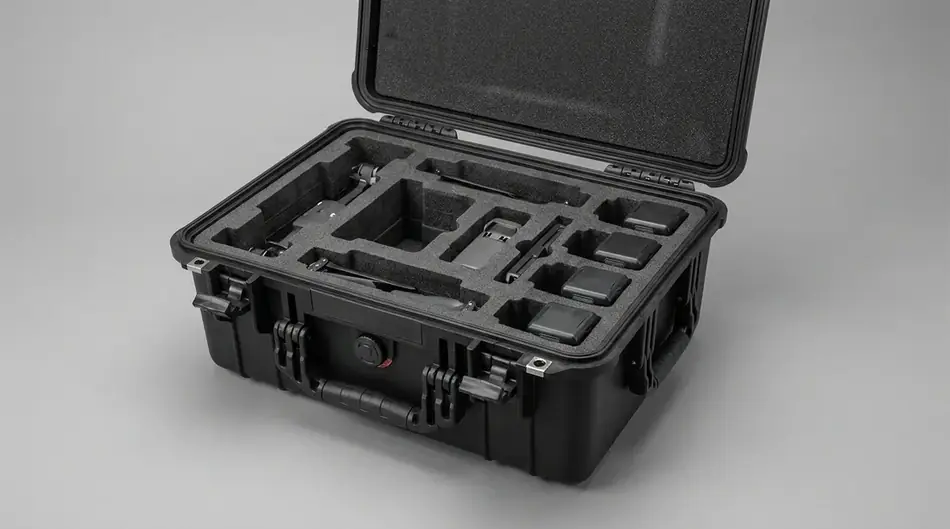
What is a PP protective case?
A PP protective case is a hard-shell container whose lid and base are injection moulded from polypropylene, the thermoplastic most often used for reusable equipment cases because it combines toughness at moderate wall thickness with resistance to water, most household chemicals and fatigue from repeated flexing. On our published sheet, 132 of 155 models carry a polypropylene shell field, listed as PP or Engineering PP, with wall thickness stated per model from 2.0 mm to 6.0 mm. The label tells you what the shell is made of, and nothing else: sealing, hardware, foam and stack behaviour are read model by model, because a PP shell can be sold as a plain carry box or as a gasketed case, and 102 of those 132 polypropylene models list a sealing option while 30 do not.
Key points
- PP means the shell is injection-moulded polypropylene; it does not by itself promise sealing, stacking or impact performance.
- 132 of our 155 published models carry a polypropylene shell, listed as PP (94) or Engineering PP (38), with 22 ABS models alongside them.
- Wall thickness is stated per model and spans 2.0 mm to 6.0 mm across the polypropylene range, which is the number that decides stiffness and stack behaviour.
- 102 of the 132 polypropylene models list a sealing option; the rest are plain carry shells, so read the closure column instead of assuming it.
- The published sheet records no measured waterproof, dust, UV, temperature, stack-load or drop figures for any model, so those are commissioned as tests, not quoted from a brochure.
- Choose PP when the duty is repeated handling, moisture exposure and chemical contact; look elsewhere when you need a hard, scratch-resistant exterior or high continuous temperature.
- A new size means a new tool: first samples on an existing mould are planned at 45 days, a new mould at 125 days, sold wholesale or OEM on EXW or FOB terms.
The definition, stated plainly
PP is the resin code shorthand for polypropylene, a thermoplastic supplied as pellets and formed by injection moulding. A PP protective case is therefore a case whose structural parts, the lid and the base, are moulded from that resin, with the closing rim, latch bosses, hinge mounts and handle fixings either moulded into the same part or fitted to it as hardware. It is a reusable container, not a single-trip shipping box, and its protection comes from the combination of shell geometry, wall thickness, closure and interior packing rather than from the resin alone.
That distinction matters when you read a specification. The letters PP answer one question, what the shell is made of, and leave every other question open: whether the case seals, how thick the wall is, whether it stacks, what foam sits inside and how heavy it is. Our own catalogue states those items as separate fields per model, and where a field has no test record behind it we print it as not measured instead of filling the gap with an assumption.
What polypropylene brings to a moulded shell
Three properties explain why a case manufacturer reaches for this resin. First, PP takes impact without shattering: it deforms and recovers over a wide temperature band, which is what a shell experiences when a loaded case is dropped off a tailgate or crushed between two others in a truck. Second, it has very low water absorption and good resistance to acids, alkalis and alcohols, so rain, condensation, salt spray on the outside and spilled electrolyte or cleaning agents on the inside do not attack the wall the way they attack ferrous hardware. Third, it resists fatigue in flexing, the reason the same resin is used for moulded living hinges in general engineering.
It is also cheap to mould and forgiving in tooling, which is what makes a wide published size ladder possible: 132 polypropylene models in our sheet, from a 115 x 78 x 32 mm interior on KX-1204 to deep boxes with interiors over 200 mm tall. The resin welds and prints well, accepts pigments for colour coding, and takes the inserts and thread-forming that hardware fixings need.
Where a PP case stops
Polypropylene is comparatively soft and flexible. Surface scuffing and gloss loss show earlier than they do on ABS; concentrated static load deflects the wall more, so a PP shell wants ribs, a thicker wall or a supporting stack rather than a point load; and its continuous service temperature ceiling is lower than that of engineering plastics such as polycarbonate. Cold does not make PP brittle the way it makes some plastics, but the impact behaviour at any specific temperature is a test result, not a data-sheet adjective, and we do not quote one we have not run.
The same discipline applies to the environment. On our published sheet, waterproof, dust resistance, UV resistance, temperature range, stack load and load capacity are all marked not measured for every one of the 155 models, and impact and shock are marked as a manufacturer option rather than a figure. That is a deliberate stance: a black shell left in a yard will behave differently from the same shell with a UV-stabilised compound, and the honest answer is to state the resin, the wall and the option set, then commission accredited testing as a separate work package if a buyer's contract requires numbers.
How the shell is actually built
A PP case is two mouldings and a set of fitted parts. The base carries the floor, the side walls and usually the sealing rim; the lid mirrors it. Wall thickness is where the load path lives: our polypropylene models are published from 2.0 mm on the thin KX-2005 to 5.0 mm on boxes such as KX-92817, with engineering PP grades running to 6.0 mm. Latches, hinges, a fixed or folding handle, feet and any pressure-equalisation part are hardware, fitted after moulding and available in metal or polymer by configuration, which is why the same footprint can be ordered at different price points.
Closure is the field that most often gets misread. Some polypropylene shells are moulded with a channel that a compressible gasket sits in, and the sheet lists the seal material on the relevant models as EPDM or an equivalent compressible gasket; other shells have a plain mating rim with no channel at all. Both are PP. Sealed models are the ones to shortlist when contents must survive rain, spray, wash-down or a wet truck floor, and unsealed models are usually the right call for bench storage, indoor organisation or dry-cargo handling where a gasket only adds cost and a maintenance item.
PP against the other shells we mould
ABS is not the better material in the abstract; it is a different trade. It gives a harder, more scratch-resistant and more glossy surface and feels more rigid at a comparable wall, which is why it appears on cases meant to be handled in front of a customer. It is more vulnerable to some solvents and it wants a thicker wall to absorb the same drop energy without cracking, which is the argument for PP on a shell that will be thrown in the back of a vehicle for years. The comparison is written up in full on our PP versus ABS case page, including the surface, chemical and weight consequences of each choice.
| Shell Material (Published Field) | Models On Sheet | Published Wall Range | What It Is Chosen For |
|---|---|---|---|
| PP | 94 | 2.0-5.0 mm | Tough, economical general-purpose shell; good chemical and moisture behaviour |
| Engineering PP | 38 | 2.1-6.0 mm | Higher stiffness and thicker walls for stacking and larger footprints |
| ABS | 22 | 3.0-5.3 mm | Harder, glossier exterior surface and a stiffer feel at the same wall |
| PP / ABS | 1 | not published | Combination build where lid and base use different resins |
Sizes published per model
Six polypropylene shells taken straight from the catalogue, spanning a small parts box to a deep general-purpose case. Read the internal envelope first, because that is what your equipment must fit inside, then the external one, because that is what your shelf, crate or pallet position must accept. On KX-3218 the difference between 315 mm outside and 308 mm inside is the wall plus the sealing rim; on the unsealed KX-1204 the same gap is 5 mm. Net mass is published for 70 of the 132 polypropylene models; where a figure is absent we print not published rather than estimating it, so ask and we will weigh the exact configuration you order.
| Model | External Mm | Internal Mm | Wall Mm | Net G | Sealing Option |
|---|---|---|---|---|---|
| KX-1204 | 120 x 90 x 40 | 115 x 78 x 32 | 2.6 | 100 | No |
| KX-1905 | 190 x 190 x 45 | 180 x 160 x 40 | 3.0 | 250 | Yes |
| KX-2614 | 255 x 245 x 135 | 240 x 200 x 120 | 2.2 | 460 | No |
| KX-3218 | 315 x 260 x 180 | 308 x 230 x 172 | 3.0 | 900 | Yes |
| KX-4312 | 430 x 300 x 115 | 420 x 260 x 104 | 3.5 | 1,170 | Yes |
| KX-83917 | 385 x 295 x 170 | 355 x 240 x 155 | 5.0 | not published | Yes |
How to choose one, in order
Start with the item, not the case. Measure the equipment in the configuration you actually transport, cabling and batteries included, then add clearance: a few millimetres at the sides, more at the corners, and enough lid depth that foam on both faces still closes over the tallest component rather than holding the lid open. Size on the published internal dimensions, then verify the external footprint against the space it must live in. Our guide to measuring equipment for a case covers the clearance rules in detail.
Then set the wall and the closure to the duty. A bench or shelf case can use a thin wall and no gasket. A case that will be stacked, carried through a vehicle bay or left outdoors wants the thicker polypropylene wall, the sealed rim and a published stackable state; 114 of our 132 polypropylene models are listed stackable. Finally pick the interior, because the foam is what decides whether the item survives the journey: pick-and-pluck for changing kits, die-cut or CNC-cut for a fixed load, layered or convoluted foam for irregular shapes, all of which we cut in-house.
Typical duties for a PP shell
The economics favour polypropylene wherever a case is reused many times and handled without ceremony. That covers tools and test sets, camera, optics and instrument boxes, spares and kit organisation, communications and electronics assemblies, field and outdoor loads, and inventory boxes that sit on a rack and are pulled down repeatedly. Corrosion is the quiet advantage: on all 155 models our sheet records corrosion resistance as measured, on the simple basis that a thermoplastic shell has no ferrous corrosion path, which is why PP boxes are specified for marine, agricultural, chemical-store and outdoor duties where a steel or aluminium shell would need maintenance.
Where PP is usually the wrong answer: a product that must present a hard glossy surface to customers day after day, a load that sits near a hot surface for long periods, or a contract that names a specific qualification standard. In those cases we look at the ABS models in the range or, if the duty genuinely sits outside what an off-the-shelf shell can do, at tooling a new one.
Customising a polypropylene case
OEM and ODM work on existing moulds is the normal route. Foam is cut to your kit from a drawing, a photograph of the packed load or a physical sample, with no minimum beyond one set, and lid and base thickness, hardware and gasket are selected per order. Logo and colour are both set at 300 pieces minimum on our published terms; standard catalogue models ship from one piece so a buyer can test a shell before committing to a programme.
A brand-new size is a tooling project, not a colour change: 3,000 pieces minimum per component, first samples on an existing mould planned at 45 days and a new mould at 125 days, on a 30 percent deposit. That is the number that surprises most buyers, and it is the reason a good brief is worth the time: the closer your loadout sits to a shell we already mould, the less of your programme is spent waiting on steel.
Before you order
Send the packed dimensions and mass of the load, whether the case must seal, how it will be stacked or carried, the quantity you need per delivery, and the destination. We return candidate models with their published internal and external dimensions, wall thickness, closure state, stackable state and net mass where one is recorded, and we sell to wholesale and OEM buyers on EXW or FOB terms only: no retail, no DDP and no overseas warehouse, so freight is arranged by your own forwarder.
Two practical cautions. Ask for the material and additive description of the compound in your quote, because PP varies widely between a general-purpose homopolymer, a copolymer grade and a filled or nucleated blend, and only the certificate that ships with the batch ties your cases to one of them. And treat any performance figure you are handed without a test record as a claim, not a specification: on our own sheet the fields we have not tested are printed as not measured, and accredited testing can be commissioned as a separate work package when your contract requires it.
Four buyer searches that end on this page, answered line by line
Nobody arrives at a material guide by typing a resin. They arrive with the device they own: a spectrometer that has to travel between benches, a projector that goes to a different room every week, a camera body and glass packed as one set, or a brand that wants its mark on the lid. This appendix takes those four searches in the buyer's own words and answers each with the fields published in our own model data for the 155 active shells, or says plainly that no figure exists. Every number below belongs to the named model, not to the series around it.
Two reading conventions apply before the first figure. Instrument, projector and camera work is decided on the cavity and the lid, because those are the fields we can measure and publish; water, dust, ultraviolet, temperature range, stack load and drop behaviour are recorded as not measured for all 155 models, so no line here should be read as a rating. Shock and impact appear in our data as manufacturer options that depend on the foam layout you specify, and the shell alone carries no such number. Accredited laboratory work on any property can be commissioned as a separate work package against the configuration you actually order, quoted per build.
| Search Phrase | What We Publish |
|---|---|
| spectrometer protective case | A spectrometer is an instrument, so choose from the instrument fields rather than from the word. Our data carries 115 models tagged as instrument cases: 109 of them publish a wall thickness from 2.1 mm to 5.8 mm, 96 list a gasket option, 67 publish a lid depth from 30 mm to 230 mm, and internal length in that group runs 240 mm to 880 mm. For a benchtop unit travelling with its power lead, sample tray and a spare lamp, KX-86216 publishes an internal 582 x 300 x 130 mm inside a 620 x 360 x 155 mm shell, 3.3 mm wall, a 100 mm lid over a 30 mm base and 19.5 litres of usable interior. KX-89616 publishes 880 x 350 x 140 mm internal at 5.0 mm wall, and an instrument that cannot be broken into two pieces is served by KX-814641 at 1,280 x 350 x 140 mm internal in a 1,356 mm external shell. What protects a grating, a detector or an alignment mirror is the cut, not the resin: a CNC or die-cut interior is quoted from 1 unit against a drawing, a photograph of the packed load or the instrument itself, and 23 of the 115 instrument models also publish a narrow internal width for a tapered body. |
| projector protective case | A projector is heavy for its footprint and its lens sits proud of the body, so the two published fields that decide the purchase are cavity depth and lid depth, not a protection word. KX-85827 lists 500 x 400 x 220 mm internal in a 588 x 475 x 267 mm shell with a 5.0 mm wall, a 175 mm lid over a 45 mm base, 7,800 g empty and 35.2 litres usable; KX-85835 is the same floor plan 85 mm deeper, 500 x 400 x 305 mm internal with a 260 mm lid, 8,520 g and 48.8 litres, which is what you want when the lens shade and the yoke travel together. A portable LED unit is closer to KX-84122 at 385 x 313 x 205 mm internal and a 3.7 mm wall. Lid depth is published on 100 of the 155 models and spans 16 mm to 320 mm, and 124 models list a compressible gasket option. We record no lamp-life, surface-temperature or free-drop figure for any of these shells, because those fields carry no test record in our data. |
| camera protective case supplier | KeXin New Materials (Guangdong) Co., Ltd. supplies wholesale and OEM or ODM only, quoted EXW or FOB Guangdong, with no retail sales, no DDP pricing and no overseas warehouse stock, so inland haulage and destination clearance stay on your side. The camera group in our published data is 85 models: 83 carry a wall thickness field from 2.1 mm to 5.0 mm, 48 publish an empty mass from 460 g to 5,012 g, 70 list a gasket option, 48 publish a lid depth from 30 mm to 165 mm and usable interiors run 5.0 to 21.2 litres. Two real entries show the spread: KX-3308 publishes a 325 x 236 x 76 mm cavity, 2.3 mm wall, 575 g empty, 20 pieces to a 670 x 550 x 425 mm carton and no seal on that shell; KX-3607 publishes 355 x 280 x 60 mm internal, 3.0 mm wall, 800 g and a listed gasket option. Tiers are the same on every model: 1 unit for a catalogue shell or a cut foam interior, 300 units for a logo, a colour change or an OEM build, 3,000 units per moulded component if a new mould must be cut. First OEM samples on an existing mould run 45 days, a new mould about 125 days, on a 30 percent deposit with the balance settled after inspection and before shipment. Your nominated third-party inspection partner is welcome at our facility, and quotations come from Fred Zhao or the KeXin Sales Team on WhatsApp +86 135 3588 0002. |
| logo丝印镭雕定制 / protective case custom color / logo printing | The marking routes we actually publish on our custom logo and identification page are four: screen printing for flat panels clear of ribs, at medium and high volume; pad printing for curved or recessed surfaces and for detailed marks under about 100 mm; embossing moulded into the shell, permanent and with no consumable cost but requiring a mould change; and riveted or adhesive identification plates, which is where an engraved plate for serial numbers, contents lists or calibration status belongs. A laser-marked PP surface is not a specification we publish, so if your brief calls for that process, send the artwork, the panel geometry and the quantity and we assess it as a project instead of quoting it from a catalogue line. A printed logo or a colour change is 300 units minimum in our model data, and that work sits inside the 45-day OEM sample window on an existing mould. Colour is set by pigment masterbatch in the resin at the moulding stage rather than sprayed after it, matched against PMS or RAL references on your drawing, which is why a colour change on a shell we already mould is a compounding decision and not a paint decision. A logo moulded into the lid is tooling: 3,000 units per moulded component and about 125 days. Artwork needs to arrive as vector files with the PMS references, because a raster logo slows the first proof. |
The cavities behind those three device searches, model by model
These are real entries in our published sheet, chosen because each one answers a cavity question a buyer searching a spectrometer, a projector or a camera set ends up asking. Blank fields are printed as not published rather than filled with a group average, and a gasket column records a construction option, not a sealing claim: the water and dust fields for every one of the 155 models are marked not measured. Read the internal envelope first, then the external one, then the lid, then who carries it.
| Model | Internal Mm | External Mm | Wall Mm | Lid Over Base Mm | Empty Mass G | Usable L | Closure And Handling |
|---|---|---|---|---|---|---|---|
| KX-86216, WL8-6216 | 582 x 300 x 130 | 620 x 360 x 155 | 3.3 | 100 over 30 | not published | 19.5 | Gasket option listed, stackable, fixed folding handle, no wheels |
| KX-89616, listed as KX 8-9616 | 880 x 350 x 140 | 956 x 408 x 154 | 5.0 | 100 over 40 | not published | 34.5 | Gasket option listed, stackable, fixed folding handle |
| KX-814641, listed as KX 8-14641 | 1280 x 350 x 140 | 1356 x 154 x 408 | 5.0 | 100 over 40 | not published | 50.2 | Long-format shell, gasket option listed, stackable |
| KX-85827, WL8-5827 trolley | 500 x 400 x 220 | 588 x 475 x 267 | 5.0 | 175 over 45 | 7,800 | 35.2 | Gasket option listed, 2 wheels, telescopic travel 295 mm, not published as stackable |
| KX-85835, WL8-5835 trolley | 500 x 400 x 305 | 588 x 475 x 353 | 5.0 | 260 over 45 | 8,520 | 48.8 | Deep lid for a projector head, wheels, telescopic travel 295 mm |
| KX-84122, WL8-4122 | 385 x 313 x 205 | 410 x 370 x 225 | 3.7 | not published | not published | 21.2 | Camera-tagged shell, gasket option listed, stackable, fixed folding handle |
| KX-3308, WL3308 | 325 x 236 x 76 | 330 x 272 x 82 | 2.3 | 38 over 38 | 575 | 5.0 | No seal offered on this shell, narrow internal width 217 mm, 20 per carton |
| KX-3607, WL3607 | 355 x 280 x 60 | 360 x 310 x 70 | 3.0 | 30 over 30 | 800 | 5.2 | Gasket option listed, narrow internal width 255 mm, flat shallow format for lens sets |
Why the cut decides whether the instrument arrives
A polypropylene shell answers the geometry questions; the interior answers the shock question. Our data records shock protection and impact resistance as manufacturer options on all 155 models, with the note that a specified foam layout is required and that the shell alone is not a shock figure. That is the honest way to read an optics case: a spectrometer detector, a projector lens and a camera body are all point-loaded devices, and what damages them in transit is contact pressure at one support rather than the mass of the box around them. Foam is quoted by zone, in cross-linked PE, EVA, EPS or EPE, from a cutting drawing that states grade and thickness lid-side and base-side; pick-and-pluck, die-cut and CNC-cut layouts are all in the published option list, and the interior starts at 1 unit while the shell around it stays a catalogue model.
Two published fields do most of the work for these three searches. Lid depth appears on 100 of the 155 models and runs from 16 mm to 320 mm, which is what keeps a projecting lens, a viewfinder or a sample stage from holding the lid open when both faces are foamed. Narrow internal width appears on 36 models, from 70 mm upward, and matters when a tapered instrument passes the length check but fails at the widest point of its housing. Add the clearance our own model pages recommend before comparing either figure: 20 mm on each axis, measured with cables coiled, batteries fitted and handles folded.
Branding a moulded shell: what each method costs in units and calendar days
What this appendix does not claim
Turning one of these four searches into a purchase order
Step one is the cavity, and it is a measurement exercise rather than a catalogue exercise: record length, width and height as the item travels, add the 20 mm per axis our model pages recommend, then compare against the internal figures above and check the external footprint against the shelf, crate or pallet position it has to live in. Step two is the closure, which is a construction choice, not a rating: 124 of the 155 shells list a compressible EPDM or equivalent gasket in a continuous moulded channel and 31 do not, and the models that do not, such as KX-3308 and KX-2808, say so on the product page instead of implying otherwise. Step three is the interior drawing, which is where a spectrometer grating or a projector lens is actually protected and where our quotation starts at 1 unit.
Step four is quantity and calendar, because those two fields decide which published tier you are in: 1 unit for a catalogue shell, 1 unit for a cut foam interior, 300 units for a printed logo, a colour change or an OEM build, 3,000 units per moulded component for a new mould, 45 days for first OEM samples on an existing mould and about 125 days for a cut mould, on a 30 percent deposit with the balance after inspection. If your tender names a property we record as not measured, send the clause with the model and quantity and we will quote accredited third-party testing against that configuration as a separate work package rather than print a number we cannot produce. Contact Fred Zhao or the KeXin Sales Team, WhatsApp +86 135 3588 0002.
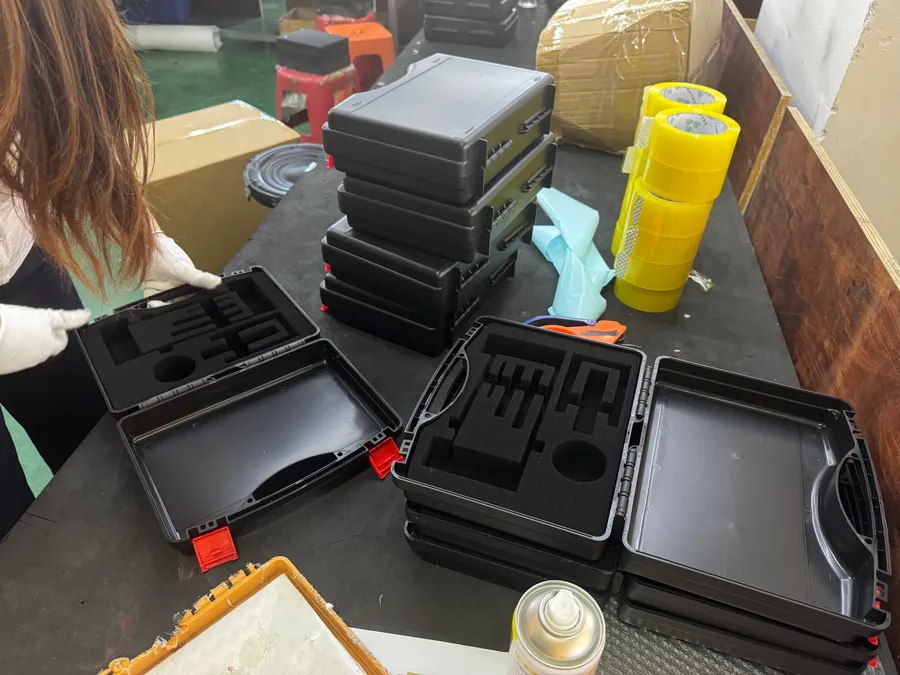
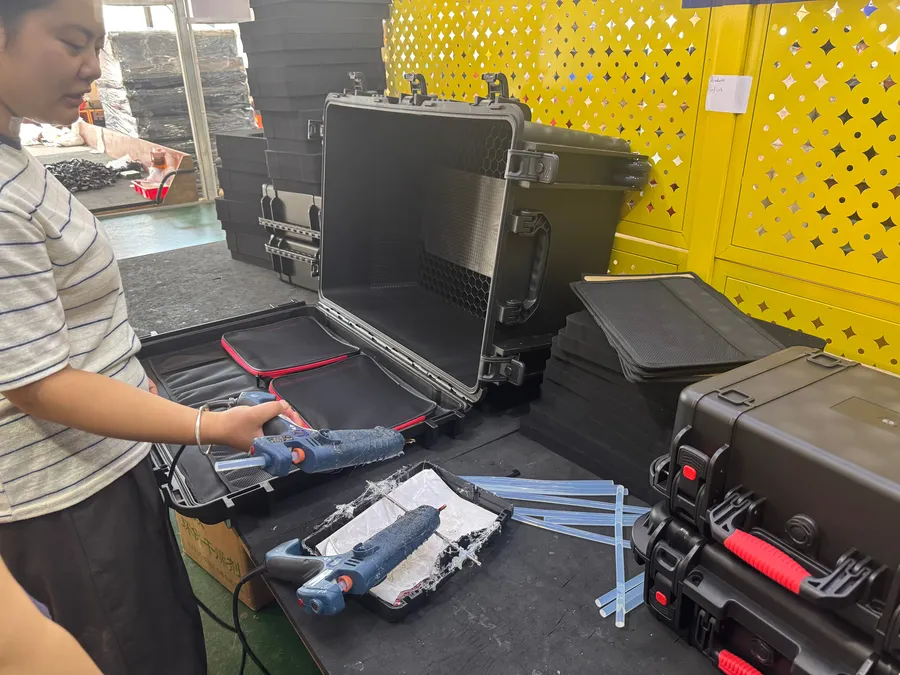
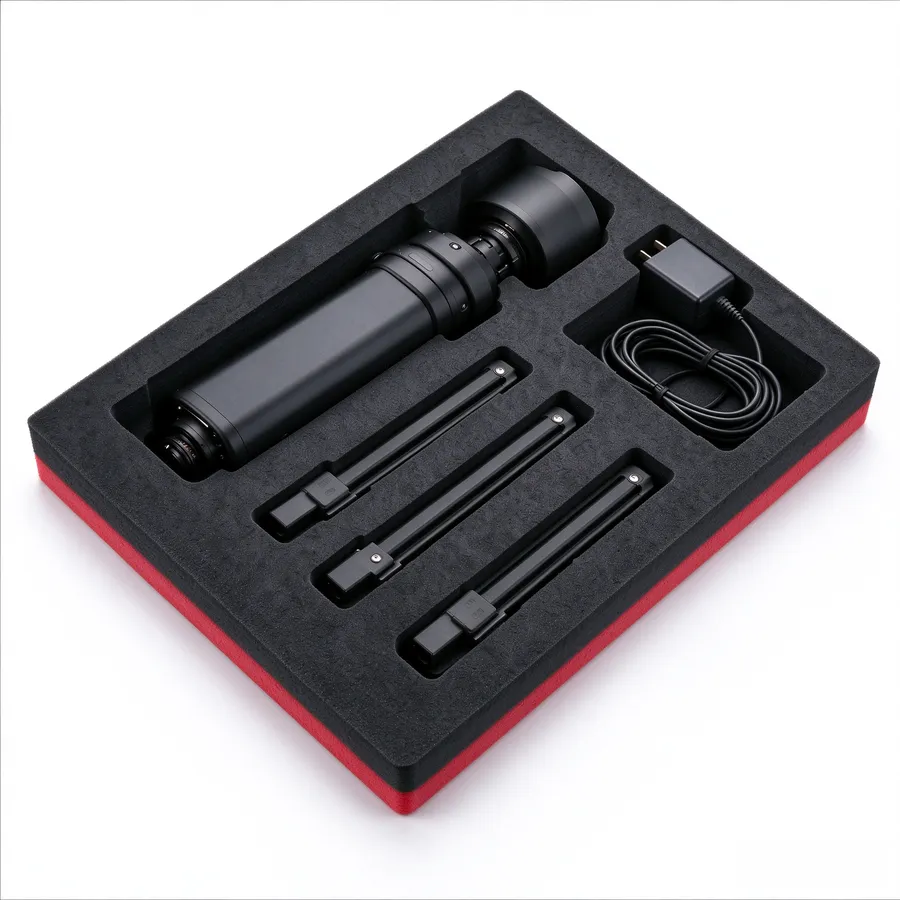
Customisation
Everything described above is configurable on a standard shell: interior layout (pick-and-pluck, die-cut or CNC-cut), foam grade and thickness, colour, logo method, latch and lock count, pressure-equalisation valve, cable ports, document holder and identification plate. A bespoke exterior geometry requires a new mould — 125 days, from 3,000 units per moulded component.
Procurement considerations
| Question | What to send us |
|---|---|
| Which shell fits? | Equipment L × W × H as packed, plus required clearance per axis |
| What does it cost? | Order quantity and estimated annual quantity — the two drive different answers |
| Is tooling needed? | Whether an existing shell clears the envelope with usable foam depth |
| Lead time? | Your required delivery date, not just the order date |
| Certification? | The exact standard your tender names — we will say whether we can test to it |
| Freight? | Destination and preferred terms; carton and pallet data supplied with the quotation |
Comparison and selection guide
The tables on this page exist because a protective case is chosen by comparing three things: the envelope, the environment and the handling chain. Where no table applies, the rule below is.
| Situation | What To Do |
|---|---|
| Fastest | Standard shell plus CNC foam — typically 45 days from approved drawing. |
| Branded | Standard shell plus custom colour and logo — MOQ applies to the resin colour. |
| Bespoke geometry | New mould — 125 days, MOQ from 3,000 units per component. |
- Size on internal dimensions plus clearance, never on a product name.
- Choose the carrying method before the shell: it changes the series, not just the price.
- Specify the interior last, and decide up front whether the end user will reconfigure it.
What is a PP protective case? relates to Material Guide. Related families: Custom Protective Cases / Electronics Cases / Outdoor Protective Cases / Tool Cases / Instrument & Equipment Cases / Ammunition Storage & Transport Boxes / Military Protective Cases. Related sectors: field and industrial equipment. Continue in the Material Guide cluster.
This page is written from our own production data. If your requirement differs, send the dimensions and we will tell you which of the 155 models fits, or whether a custom route is needed.