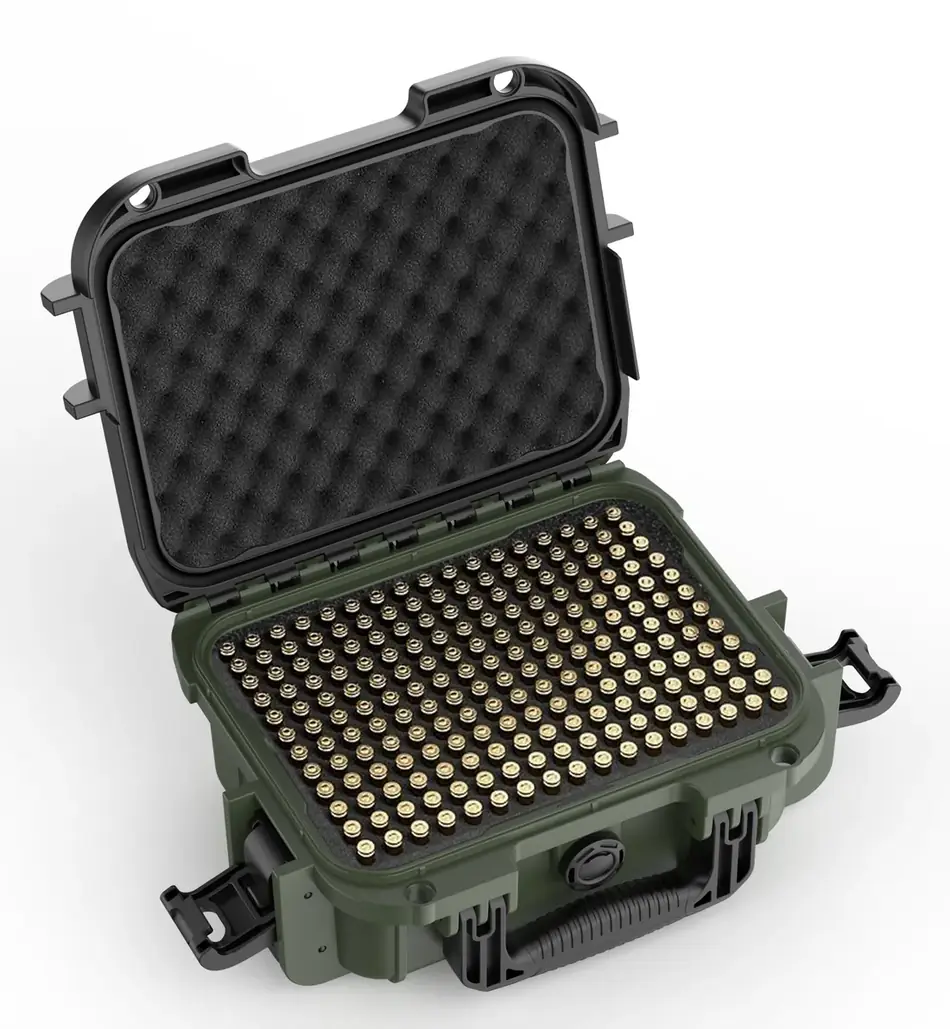
Can PP cases be customized?
Yes, and the practical answer is that a PP shell customises in three tiers that cost very differently. Interior layout, foam grade and thickness, colour, logo, identification, latch count, lock type, handle choice, feet, valve fitment and packaging all change on the moulds we already run, at an OEM minimum of 300 pieces and a first sample in 45 days. Internal and external dimensions, wall thickness, the lid-to-base depth split and the shape of the gasket channel are fixed by the tool: 3,000 pieces per component and 125 days. No tier buys a performance figure, because across the 133 models we label PP, Engineering PP or PP / ABS the sheets publish geometry and configuration rather than test ratings.
Key points
- 133 of our 155 published models carry a polypropylene shell label: 94 PP, 38 Engineering PP and one PP / ABS.
- Interior, colour, logo, hardware and packaging need no new tooling; envelope, wall and channel geometry always do.
- OEM minimum is 300 pieces with a 45-day first sample; a new mould starts at 3,000 pieces per component and 125 days.
- 31 of those 133 shells have no seal option at all, so sealing is a model choice you make before the order, not after.
- Custom foam carries a one-piece minimum, which is why a tailored interior is almost always cheaper than new steel.
- Corrosion resistance is recorded as measured on all 133; water, dust, UV, temperature and stack load are not.
Three tiers of change, and where the tooling line falls
The first tier is everything that sits inside the shell or on its surface. Foam layout, foam grade, foam thickness, shell colour, logo, identification plate, document pocket, latch count, lock type, handle choice, feet, pressure-equalisation valve and cable ports belong here. None of them moves a mating surface, so none of them needs new steel, and all of them can be quoted against a PP shell that is already in production today. This tier is where most PP customisation enquiries should stop, because polypropylene is our most widely tooled material and the existing moulds already cover a very wide footprint range.
The second tier is a modification to existing tooling: moving a latch boss, coring a pass-through port, deepening the foam rebate or adding a padlock shroud. These are steel changes rather than new steel, so the bill is smaller, but they still carry tooling time and a tooling cost. For scheduling purposes the practical outcome is the same as the third tier, and it is worth saying so plainly rather than letting a buyer assume a small tweak is a small order.
The third tier is a new mould. Internal dimensions, external dimensions, wall thickness, the lid-to-base depth split, the stacking rims and the gasket channel are all fixed by the tool. Where your equipment falls between two published PP sizes, the honest options are to pack it into the larger shell with a tailored interior, or to open new tooling and accept the volume commitment that goes with it. A 3,000-piece-per-component commitment is a different business decision from a 300-piece configuration order, and it should be justified by a repeat programme rather than by one prototype.
What the PP group in our published list actually is
Polypropylene is the shell material we tool most. Of the 155 models in the published list, 94 are labelled PP, 38 are labelled Engineering PP and one, KX-95419, is labelled PP / ABS, which makes 133 models with a polypropylene shell. The PP label alone covers the 0 Series (23 models), the 1 Series (2), the 8 Series (53), the 9 Series (2) and the T Series (14). Engineering PP covers the 1 Series (5), the 7 Series (6), the 8 Series (9), the 9 Series (14) and the T Series (4). Two different labels across six series means the first job in a PP customisation enquiry is deciding which of them fits, not which colour to order.
The published size spread inside that group is far wider than the word PP suggests. On the PP label, external footprints run from 120 x 90 x 40 mm on KX-1204 to 1,356 x 154 x 408 mm on KX-814641, internal volume runs from 0.3 litres to 139.5 litres on KX-88442, and listed net masses run from 100 g to 15,320 g. Published wall thickness on PP runs from 2.0 mm to 5.0 mm. Engineering PP runs from 2.1 mm to 6.0 mm, and the thickest wall anywhere in our list, 6.0 mm, sits on Engineering PP parts such as KX-6621 and KX-97227 rather than on any ABS shell.
One caution on mass. The 8 Series PP sheets publish dimensions and volume but no net mass, and 9 of the Engineering PP sheets do the same, so 62 of these 133 models have no published weight. Where a mass figure matters, for freight estimation or for a carried-load ergonomic limit, it has to come from the specific sheets that do state it, or be measured against a physical sample. We do not fill those gaps by scaling a figure from a similar-looking model.
The PP-specific trap: which shells have no seal option at all
This is the single most important thing to check before you specify a customised PP case, and it is a property of the mould rather than of the order. Of the 133 polypropylene models, 102 are offered with a compressible gasket seated in a continuous moulded channel, in EPDM or equivalent. The other 31 carry the entry none offered on this shell: 19 on the PP label, 11 on Engineering PP and KX-95419. On those shells there is no channel to compress into, so no gasket can be added later by configuration, and no amount of latch count will change that.
The unsealed shells are not scattered at random. Eleven of the 23 PP models in the 0 Series have no seal option, all six Engineering PP models in the 7 Series have none, and the small-format 1 Series has five unsealed models across the two labels. At the other end, none of the nine Engineering PP 8 Series shells and none of the four Engineering PP T Series shells are unsealed, so the sealed rolling configurations are available. KX-1204 is the cleanest illustration: a 120 x 90 x 40 mm shell at 100 g with a 2.6 mm wall that is a fine utility box and is not a sealed box.
Sealing is also not the same claim as a test result. A gasket in a moulded channel is a construction we publish and can supply; resistance to water or dust is recorded as not measured on all 133 sheets, and no ingress-protection code is stated anywhere in the list. The correct specification sentence is the one about construction, and the correct procurement action, where a buyer genuinely needs a figure, is to commission accredited testing against a configuration as a separate work package quoted at the buyer's cost.
Customisation options and what each one requires
The table below uses the commercial parameters stated on the product sheets. Read it as a set of decision gates: everything in the upper rows is a configuration order against a PP shell we already mould, and the bottom row is a tooling project with a volume commitment attached.
| Change On A Pp Case | New Tooling | Published Minimum | Lead Time | What To Check First |
|---|---|---|---|---|
| Foam interior layout, grade and thickness | No | 1 piece | 45 days for an OEM first sample | Lid and base foam depth against the published internal height |
| Shell colour, matched to a reference you supply | No | 300 pieces | 45 days for an OEM first sample | Contrast between shell and gasket, which is what an operator inspects |
| Logo, identification plate, private label | No | 300 pieces | 45 days for an OEM first sample | Clearance over the sealing rim and the stacking contact faces |
| Latch count, lock, valve, cable ports, document holder | No, where the mould already carries the bosses | 300 pieces | 45 days for an OEM first sample | Even gasket compression along the longest unsupported lid span |
| Handle, feet, wheels, telescopic pull | No on shells that already carry them | 300 pieces | 45 days for an OEM first sample | Whether the shell is one of the 18 wheeled PP-group models |
| Carton, pack quantity, pallet pattern | No | Per order | With production | Stack height the receiving site can actually handle |
| Envelope, wall thickness, channel or stacking geometry | Yes, a new mould | 3,000 pieces per component | 125 days | Whether a tailored interior in the next published size solves it |
Published PP shells to start from
These are drawn from the sheets that publish the figures, chosen to show how far apart the options are before you decide whether your dimension really needs new steel. Sealed means the gasket option exists on that tool; it is not a test result.
| Model | Label | Series | External Mm | Wall Mm | Net G | Internal L | Gasket Offered |
|---|---|---|---|---|---|---|---|
| KX-1204 | PP | 0 Series | 120 x 90 x 40 | 2.6 | 100 | 0.3 | No |
| KX-3213 | PP | 0 Series | 315 x 260 x 128 | 3.0 | 860 | 8.4 | Yes |
| KX-4010 | PP | 0 Series | 400 x 360 x 100 | 3.0 | 1,015 | 10.8 | Yes |
| KX-4616 | PP | 0 Series | 460 x 367 x 155 | 3.0 | 1,395 | 22.8 | Yes |
| KX-707 | Engineering PP | 7 Series | 470 x 360 x 148 | 2.5 | 1,360 | 20.2 | No |
| KX-4821 | Engineering PP | 9 Series | 475 x 363 x 210 | 4.5 | 3,670 | 27.1 | Yes |
| KX-6621 | Engineering PP | 9 Series | 662 x 495 x 210 | 6.0 | 6,420 | 48.9 | Yes |
| KX-86136 | PP | T Series | 612 x 427 x 355 | 5.0 | 8,500 | 58.0 | Yes |
| KX-88442 | PP | T Series | 843 x 592 x 415 | 5.0 | 15,320 | 139.5 | Yes |
How to choose which PP shell to customise
Start from the kit, not from the material. Send the drawing, a photograph of the packed equipment or the physical sample, and say where the case will be opened and how often. Three filters then reduce 133 models very quickly. The first is internal height: the item has to fit between the base foam and the closed lid, and the lid-to-base depth split is a mould property that no configuration can change. The second is whether that tool offers a gasket at all, which is a yes or no set at the mould and decides whether a sealed configuration is even possible. The third is carried or stacked: 18 of these models are wheeled and are not listed as stackable, while 115 are stackable and carry a fixed folding or telescopic handle arrangement.
Then choose the label rather than assuming PP means one thing. A thin-walled small format, for example KX-2005 at 2.0 mm and 175 g or KX-3114 at 2.2 mm and 675 g, behaves differently in the hand and in a pallet pattern from a deep-body Engineering PP part such as KX-4321 at 3.0 mm and 2,330 g or KX-5321 at 5.8 mm and 4,810 g. Where the enquiry is about stiffness under repeated handling, the useful comparison is published wall thickness and part depth on candidate models, not a resin argument.
Finally, decide what you are willing to commit to. A tailored interior is a one-piece minimum and can be revised as the kit changes, which makes it the right first move on any programme where the equipment is still moving. Colour, logo and hardware are 300-piece orders and are best placed once the shell choice is fixed. New tooling is only worth opening when the dimension, wall or channel genuinely cannot be met by any of the 133 published polypropylene shells, and when the volume behind it is real.
Where customised PP cases go
Most of the polypropylene group is filed for general protective use: 99 of the 133 sit under military protective cases as their primary category, 15 under ammunition storage boxes, 10 under outdoor protective cases and 9 under tactical equipment cases. The same sheets cross-file widely as well: all 133 appear under custom protective cases, 123 under outdoor, 107 under electronics, 100 under tool cases, 98 under instrument cases, 71 under camera cases, 63 under medical and 50 under drone cases. In practice a customised PP shell is ordered for one of four jobs, and the interior does most of the work in all four.
The first is electronics and instrument carriage, where the case is opened on a bench or a tailgate and the contents are the fragile part. That is where a layered interior pays for itself: a firm CNC-cut carrier that fixes where the item stops, with a softer pick-and-pluck or convoluted layer over the accessories. Shock protection on every one of these sheets is recorded as a construction option that requires a specified foam layout, and the shell alone is not a shock figure.
The second is field and outdoor carriage, where the small unsealed shells are genuinely useful because they are light, they vent, and they are opened constantly. KX-2808-2 at 527 g and KX-3113 at 1,060 g are typical: boxes that carry a kit you want to get at immediately, and that should not be sold as sealed. The third is stored carriage, including ammunition storage formats, where the gasket option, latch count and stacking behaviour matter far more than appearance. The fourth is rolling and heavy carriage, where the T Series shells and the deep-body 9 Series parts do the work, and where mass and pack quantity drive the freight bill more than the unit price does.
Across all four, thermoplastic construction gives us one thing we can state directly: corrosion resistance is recorded as measured on all 133 sheets, on the basis that there is no ferrous corrosion path in the shell. Metal frames, hinges and hardware are the parts to ask about when a case will live in a wet environment, and hardware is listed as metal or polymer by configuration rather than as a fixed alloy.
What customisation does not buy you
It does not buy a test result. Water resistance, dust resistance, ultraviolet resistance, service temperature range, stack load and load capacity are recorded as not measured on all 133 polypropylene sheets, and no ingress-protection code is stated anywhere in the list. A colour change does not alter that, and neither does quoting a 5.0 mm wall as though it were a crush figure. Where you need a number, accredited testing is quoted separately, per configuration, at the buyer's cost, and it is a work package rather than a line item on the shell.
It does not buy a shock or impact rating either. Both are recorded as manufacturer options across the group, with the published note that shock protection depends on a specified foam layout and that the shell alone is not a shock figure, and that a stated wall thickness is not a drop height. That is a reason to treat the foam drawing as a controlled document with a revision number, not as packaging detail buried in an annex.
It also does not change the commercial frame. We work wholesale and OEM, we quote EXW or FOB, we do not sell single units at retail, we do not quote delivered-duty-paid terms, and we hold no overseas warehouse stock. A 300-piece logo order and a 3,000-piece mould order leave on the same terms, and pallet quantity and container loading are calculated from the carton footprint against your pallet, with the 20 ft, 40 ft and 40 ft high-cube figures supplied with the quotation rather than printed as catalogue constants.
How a PP OEM order actually runs
It runs in four confirmations. The first is the shell: candidate models shortlisted on internal height, gasket availability and carried or stacked use, checked against the published sheets. The second is the interior: a foam drawing showing pick-and-pluck, die-cut or CNC-cut layout by zone, in cross-linked PE, EVA or EPS, as top foam, base foam, convoluted, layered or custom cut, with the lid and base split confirmed against the published internal depth so that a sample round is not spent discovering a clash. The third is the appearance and hardware: colour matched against a reference you supply rather than a swatch we pick, logo and identification plate positioned clear of the sealing rim and the stacking contact faces, latch count and lock specified per configuration, valve and port fitment stated. The fourth is presentation: carton marking, pack quantity and private-label details.
A 30 percent deposit starts an OEM first sample, which takes 45 days on tooling we already have. Where new moulding is required, tooling takes 125 days before production parts, with the commitment at 3,000 pieces per component. Approval should be signed against a physical sample and a dated datasheet revision that carries the model, the gasket or none-offered entry, the latch count, the valve fitment, the colour reference and the foam drawing. That last point sounds bureaucratic and is the opposite: it is how a repeat order on a PP tool stops quietly becoming an unsealed one because somebody read the wrong line of an undated sheet.
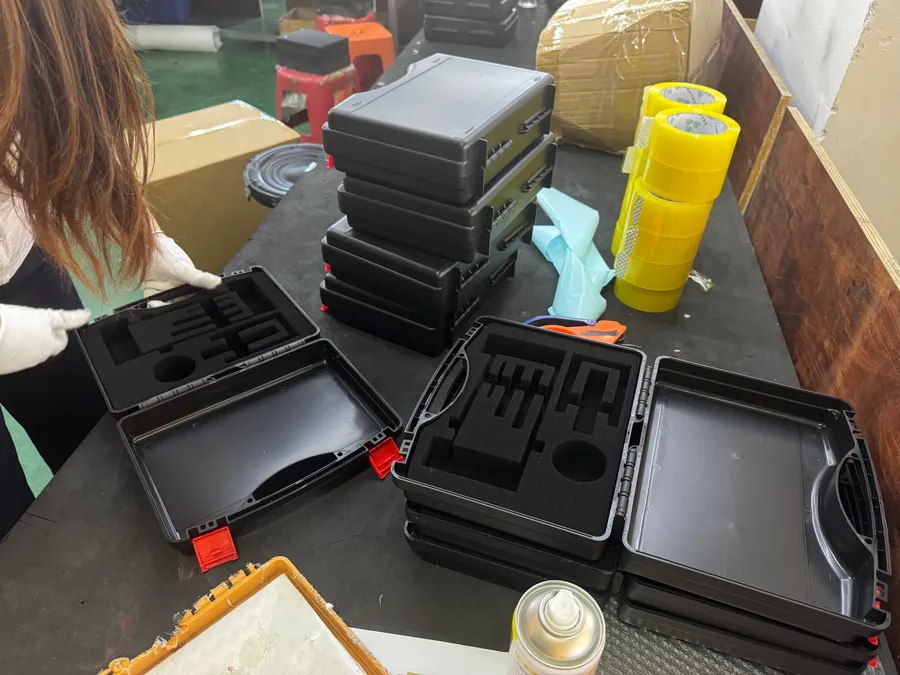
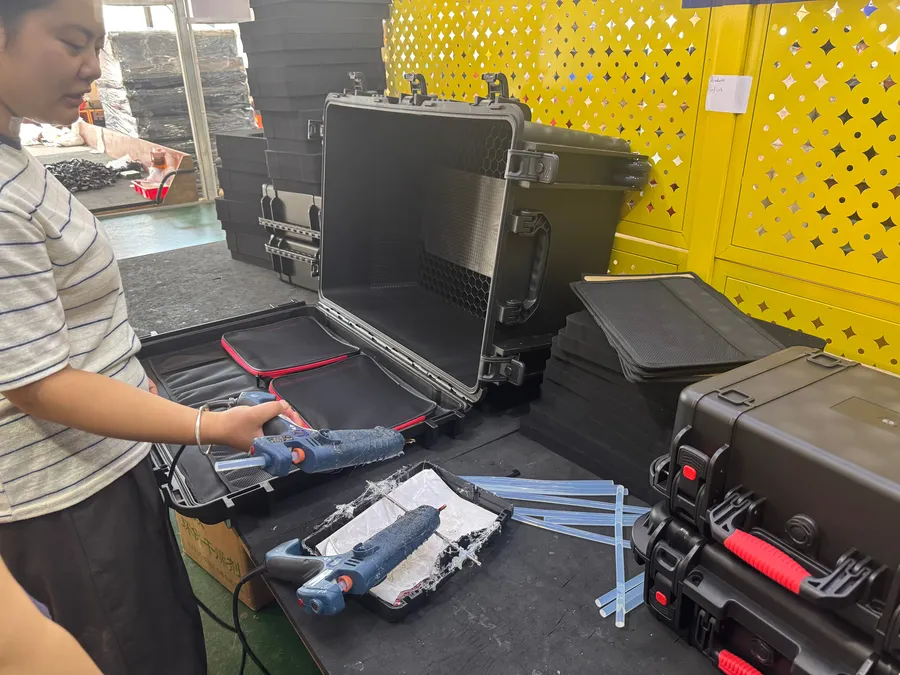
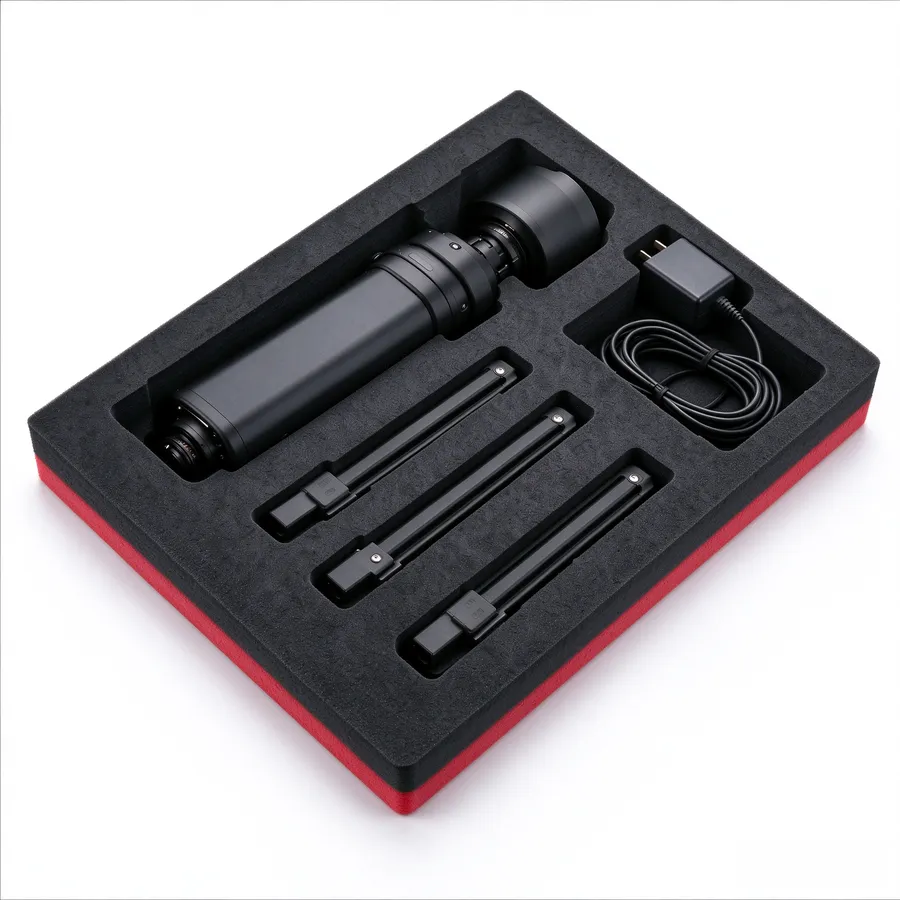
Customisation
Everything described above is configurable on a standard shell: interior layout (pick-and-pluck, die-cut or CNC-cut), foam grade and thickness, colour, logo method, latch and lock count, pressure-equalisation valve, cable ports, document holder and identification plate. A bespoke exterior geometry requires a new mould — 125 days, from 3,000 units per moulded component.
Procurement considerations
| Question | What to send us |
|---|---|
| Which shell fits? | Equipment L × W × H as packed, plus required clearance per axis |
| What does it cost? | Order quantity and estimated annual quantity — the two drive different answers |
| Is tooling needed? | Whether an existing shell clears the envelope with usable foam depth |
| Lead time? | Your required delivery date, not just the order date |
| Certification? | The exact standard your tender names — we will say whether we can test to it |
| Freight? | Destination and preferred terms; carton and pallet data supplied with the quotation |
Comparison and selection guide
The tables on this page exist because a protective case is chosen by comparing three things: the envelope, the environment and the handling chain. Where no table applies, the rule below is.
| Situation | What To Do |
|---|---|
| Fastest | Standard shell plus CNC foam — typically 45 days from approved drawing. |
| Branded | Standard shell plus custom colour and logo — MOQ applies to the resin colour. |
| Bespoke geometry | New mould — 125 days, MOQ from 3,000 units per component. |
- Size on internal dimensions plus clearance, never on a product name.
- Choose the carrying method before the shell: it changes the series, not just the price.
- Specify the interior last, and decide up front whether the end user will reconfigure it.
Can PP cases be customized? relates to Material Guide. Related families: Custom Protective Cases / Military Protective Cases / Ammunition Storage & Transport Boxes / Tactical Equipment Cases / Outdoor Protective Cases / Electronics Cases. Related sectors: field and industrial equipment. Continue in the Material Guide cluster.
This page is written from our own production data. If your requirement differs, send the dimensions and we will tell you which of the 155 models fits, or whether a custom route is needed.