What is EPE foam?
EPE foam is expanded polyethylene in its beaded form: tiny polyethylene beads are pre-expanded and then fused together into a block or sheet, so the finished material is a mass of sealed little bubbles with air trapped inside each one. In a protective case it is the volume grade. It buys you thickness per gram and thickness per unit of cost more cheaply than any firm grade does, which is why it turns up as the bed under an item, the fill behind a moulded tray, the block packed into a deep lid cavity and the loose piece trimmed to a cavity by hand - not as the finished face you handle every week. In our published specification data EPE is one of six foam options listed against all 155 case models, alongside PE and EVA as materials and pick-and-pluck, die-cut and CNC-cut as construction routes. What our data does not record for EPE, or for any other grade, is a density, a firmness, a rebound percentage or a test result, because those belong to the sheet selected for one layout and to the shell envelope you are working inside, not to the catalogue line.
Key points
- EPE is beaded expanded polyethylene: fused expanded beads, closed cell, light for its thickness, with a speckled cut face.
- It is one of six foam options published against all 155 of our models, next to PE, EVA and the pluck, die-cut and CNC routes.
- EPE is bought for volume - the base bed, the lid fill, the trimmed block - not for a crisp pocket wall or a wipeable face.
- Our material record names cross-linked PE, EVA and EPS by zone; EPE sits in the option list, so the grade is set on the drawing.
- No density, firmness, rebound, thermal or ultraviolet figure is published for EPE, and no protection rating is claimed on any model.
- An EPE interior needs no tooling: custom foam starts at one set on all 155 shells, and only a new shell shape is a mould project.
What the material is
EPE stands for expanded polyethylene. The form used in case inserts is beaded: polyethylene beads are expanded first, then moulded or bonded into a block, so the sheet you cut from is a packed mass of small sealed spheres fused where they touch. That structure is what you feel when you press it. It is springy, it returns to thickness, and it weighs almost nothing for the space it occupies. It is also what makes the cut face read speckled rather than smooth, which is the quickest way to separate EPE from a cross-linked polyethylene at a glance on a supplier bench.
The closed cells matter twice over. Because the gas is sealed inside each bead, liquid water does not wick through the material the way it travels through open-cell upholstery foam, so a wet insert can be dried out rather than being thrown away; and because those pockets compress and then recover, a thick bed keeps some stopping distance under an item instead of packing down into a hard shelf once the load sits on it. Neither statement is a rating - it is a description of a material, and the case-level result is a different question that our published data leaves untested.
Do not confuse EPE with the PE entry in our own option list, because both are polyethylene and the difference is how the cells were made. In a cross-linked polyethylene the polymer chains are linked into a network, which gives a finer, firmer, more uniform sheet that machines to a clean edge and holds that edge. EPE is beads fused together: cheaper in bulk, softer per millimetre of thickness, and far less willing to hold a sharp contour. Our published material string says cross-linked PE, EVA and EPS by zone, and that wording is a hint about which grades get drawn as faces and which get used as fill.
Where EPE sits in our published foam programme
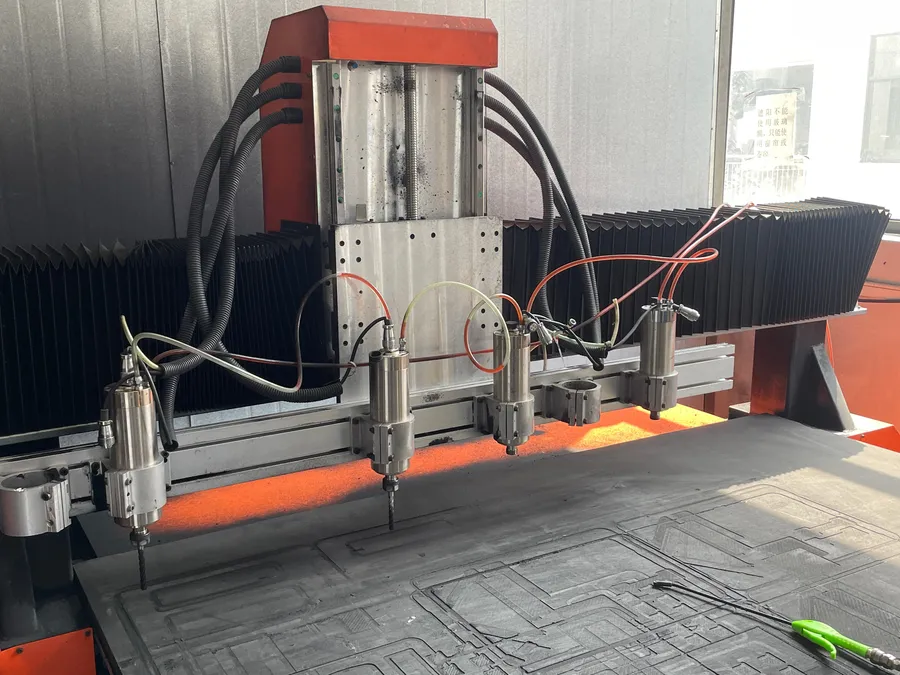
Across all 155 models in our specification data the foam programme records six options: pick-and-pluck, die-cut and CNC-cut construction, and EVA, PE and EPE as materials. The same 155 records five structural options - top foam, base foam, egg-crate or convoluted, custom cut and layered - plus custom thickness and custom shape, and it records die-cut and CNC capability against every model. Custom foam carries a minimum order of one set. So an EPE interior is a drawing and a cutting operation, never a mould, and it is the cheapest structural change you can make to an order.
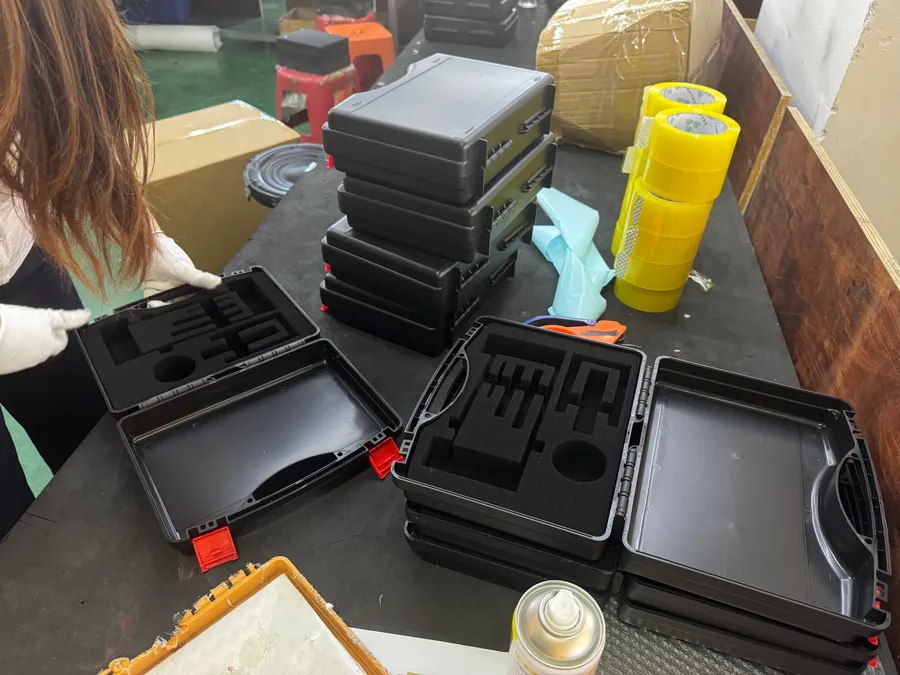
EPE is therefore not a shell feature. It is a line on a layout: the bed under a heavy instrument, the fill behind a tray, the block cut to a cavity, the press layer in a lid that would otherwise be empty. Where our data does describe the shell it describes plastic, wall thickness, hardware and sealing - not foam. A buyer who reads a model datasheet, finds no foam grade named on it, and concludes the interior is configured per order is reading it correctly.
One nuance is worth stating plainly, because it confuses buyers comparing our sheet with a brochure that promises a grade. EPE appears in the six-item option list but not in the material string, which names cross-linked PE, EVA and EPS. Read the two fields together and the honest position is that the grades we quote are configuration choices made against a specific layout and recorded as an option, not a standard fitting bonded into every unit of a model at manufacture.
EPE compared zone by zone
The table below is not a material-versus-material ranking - the dedicated foam selection pages do that head to head - but a description of what EPE is asked to do in each part of an insert, and what to verify before you name it there. Nothing in it is a measured figure, because our published data holds no measured cushioning figure for any grade; the shell numbers it refers to are catalogue values, published per model.
| Zone | What Epe Does There | What To Check First | Where A Different Grade Fits |
|---|---|---|---|
| Base bed under a heavy item | Buys stopping distance across the whole footprint cheaply, so load spreads over an area instead of a point | Published base depth and usable interior height for the shell, not the nominal box size | A firm moulded carrier or layered build where the mass is concentrated at one end |
| Fill in a deep lid cavity | Occupies dead volume so nothing travels, at almost no weight penalty to the carried case | Whether the lid still needs that depth for the items themselves - lid depth runs to 320 mm on the 100 models that publish the split | Convoluted or egg-crate foam over uneven shapes that a flat block bridges |
| Loose block trimmed by the end user | Absorbs a layout that is still changing before a drawing exists | How accurate the pack has to be - a hand-trimmed block is approximate by definition | Pick-and-pluck for repeated re-cutting, CNC-cut once the layout is known and fixed |
| Contact face on a precision item | Not its strength: a beaded face tears at the cut line and sheds specks | Whether the surface must be wiped clean or photographed for an audit | EVA or a cross-linked face laminated over an EPE carrier, so the face is firm and the body is cheap |
| Divider between two hard objects | Stops contact over a large area at the lowest cost per square metre | Whether the divider has to stay captive when the lid is opened in the field | A thin firm cross-linked wall where internal height is short |
| Outbound shipper and return pack | Protects a dispatched assembly without committing a bespoke interior to a one-way trip | Whether the pack is a fleet item that must audit identically or a single shipment | A moulded rigid carrier where a very concentrated mass lands on one corner |
What EPE is chosen for, and what it is not
It is chosen where the requirement is to fill space with protection rather than to define a shape. A field kit whose contents change between trips, a case with a tall lid cavity over a shallow base, a shipment of accessories that must not travel loose - all three are volume problems, and EPE answers them at the lowest weight and the lowest material cost per millimetre. On our sheet the lid is the deeper half on 65 of the 100 models that publish the split, and the two halves are equal on 29, so the asymmetric case - shallow base, deep lid - is a common shape rather than an oddity, and it is exactly the shape that leaves a cavity to fill.
It is not chosen where the cut has to be precise. A pocket wall that locates an optic or a surgical set identically every time needs a material that holds the geometry the tool produced, and a beaded block does not: the edge frays, the contour drifts, and two units cut from the same drawing match less closely than two moulded or machined firm-grade panels. That is why a normal mixed build puts a firm face over a soft carrier instead of asking one material to do both jobs.
The cost logic also has a trap. EPE is cheap per unit of thickness, so the temptation is to buy depth with it, and depth is the one thing a case cannot recover. Usable interior volume is published against the nominal internal volume on all 155 models, on 154 of them the usable figure is smaller, and across the range that ratio runs from 0.797 to 1.0 with a median of 0.85. A thick soft bed consumes envelope that the next order might need, so a specification that reaches for EPE everywhere tends to produce a bigger shell than the equipment actually requires.
How to decide: five checks before you name the grade
Check one is envelope, which is a shell figure. Internal height across our range runs from 32 mm to 364 mm with a median of 155 mm. At the small end, the KX-1204 shell gives 115 by 78 by 32 mm internally and 0.3 litres usable, and there is simply no room for a thick soft bed - a firm thin wall is the only thing that fits. At the other end, the KX-88442 publishes 740 by 518 by 364 mm internally with a 320 mm lid over a 44 mm base and 111.6 litres usable, which is a volume problem in search of a fill material. Check two is mass per item rather than total mass: a 4 kg instrument in one pocket needs a carrier, four 300 g accessories across a tray need walls between them.
Check three is whether the layout changes. If the kit is reconfigured by the end user, no cut grade is the right answer and a pluck or trimmed-block arrangement is. If the kit is identical every trip and valuable, the cut grades and a firm face win, and EPE stays underneath them. Check four is how much of the foam will be touched by hand, and in what conditions - a beaded face in a dusty or clinical setting is a surface you will eventually replace.
Check five is cleanability and audit. A smooth closed face can be wiped and photographed; a torn beaded surface cannot. That single question settles the contact surfaces before any cushioning arithmetic starts, and it is the reason the mixed build - firm face, EPE body - is the default on our drawings rather than a special request. Only after those five do thicknesses get set against the item, and they are set per zone, never copied across a catalogue.
Where EPE is specified
In practice EPE shows up in the fill and bed layers of kits whose contents are numerous, irregular and not always the same. Field and deployment boxes are the clearest example: the radio or instrument sits in a cut or moulded cradle, and everything else - cables, handsets, spares, batteries - needs to be held without chipping the primary item, which is a bulk-fill job. Our catalogue supports that reading: 145 of the 155 models carry the outdoor tag and 155 carry the field-equipment application, so the same shells are configured for both a cut interior and a filled one.
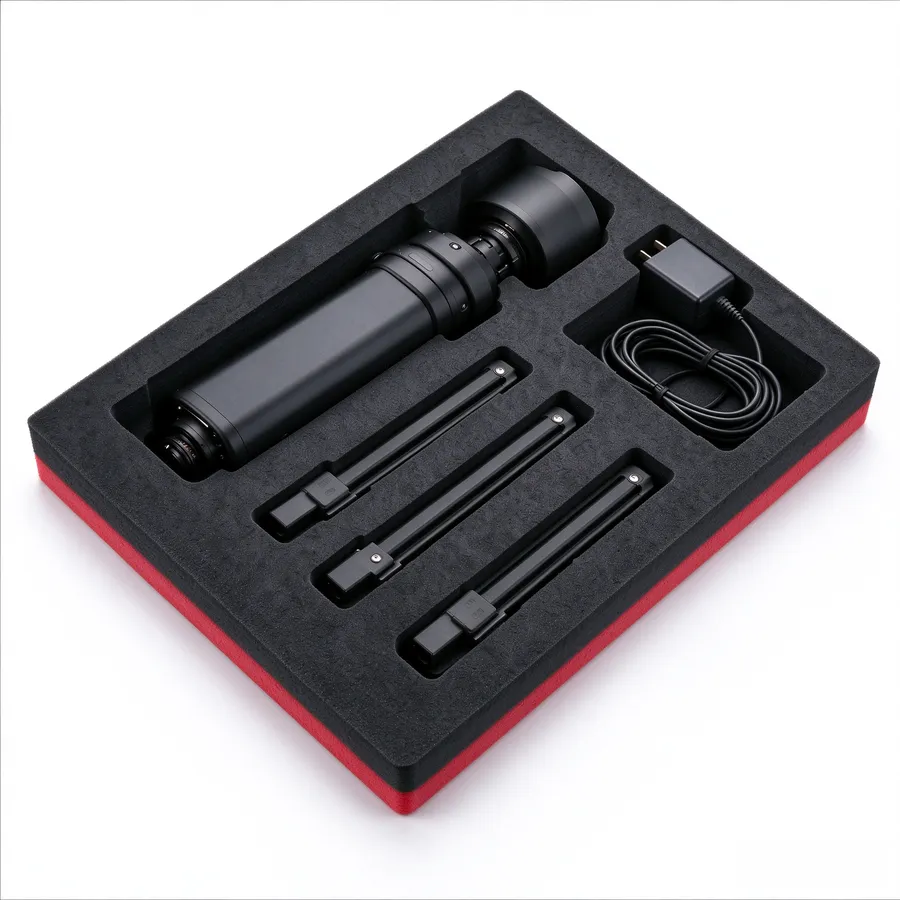
Camera, drone and survey kits use it for the second compartment - the space above and around the body or airframe where a battery and a filter travel - while the load-bearing surface under the optic stays a firmer grade. Electronics and instrument shipments use loose EPE blocks and layered beds when a kit is going out to a site where the receiver will re-pack it on the way back. Tool and service-engineer sets use it as the cheap separator between steel edges, with a firm face where the tool locates.
Medical and laboratory interiors are where the grade is used most carefully: a closed-cell material is easy to dry out, but a beaded surface is not what you want touching an instrument tray, so those builds specify the contact face first and let EPE fill behind it. Defence and public-safety fleets use it where the point is verifiability at speed - a full bed that leaves no loose object to rattle - accepting that the face layer carries the identification.
Customising an EPE interior
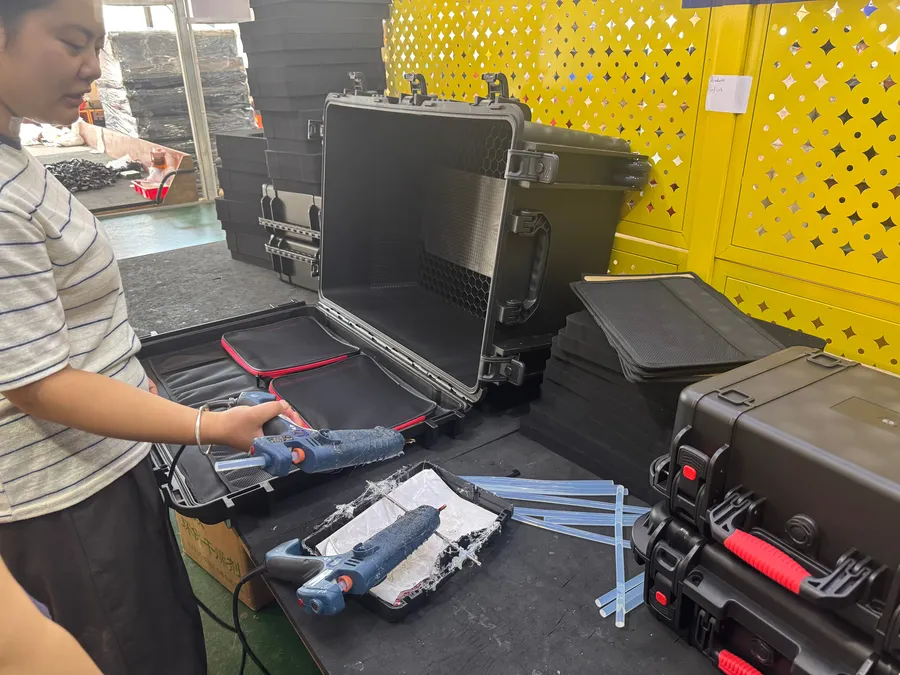
A bespoke EPE layout is the cheapest change on our range and needs no new tooling. Custom foam starts at one set; custom thickness and custom shape are recorded against all 155 models; die-cut and CNC-cut are both listed on all 155, which means a fill layer can be pressed from a die at volume or routed from a drawing at short run. Laminating two grades into one panel - a firm cross-linked or EVA face over an EPE body - is a normal build, and it is the build we draw most often, because it gives a clean contact surface and a cheap bed in one operation.
What we need to start is the input our data records on every model: a drawing, a photograph of the packed kit, or a physical sample. The sample is the most reliable, because it shows where an item rocks, where a hand reaches and which pockets are opened every time. Colour and logo work sit at 300 pieces, OEM on existing mouldings runs to a first sample at 45 days with a 30 per cent deposit, and a new mould - required only when the shell geometry itself changes - is 125 days from 3,000 pieces per moulded component.
For a fleet, the signed layout drawing is the control document rather than the material name. It fixes the zones, the grades, the thicknesses and the parting line between lid and base, so the second and fifth order reproduce the first instead of being re-interpreted at a cutting bench. Ask for an interior by performance and let the grade come out of the drawing; ask for it by material name and you get a block of whatever was specified.
What we do not publish about EPE
Our specification data records no density, no firmness or indentation value, no rebound percentage and no thermal or ultraviolet figure for EPE or for any other foam grade. Those properties belong to the sheet bought for a given layout, and the layout is a per-configuration drawing rather than a model attribute. Printing one density across a catalogue would describe a material we might not use for your kit, so we state the options and set the grade against the load.
The same limit applies to protection claims, and it is worth reading carefully before a tender. Water, dust, ultraviolet and service-temperature fields are recorded as untested across all 155 models, as are stack load, live load capacity and any protection rating. Impact and shock resistance are recorded as a construction option with no drop height stated, and the notes on those fields say the same thing on every model: the shell alone is not a shock rating and a shock claim requires a specified foam layout. Within our protection block the one field recorded as measured on all 155 models is corrosion resistance, and it is a property of the thermoplastic shell rather than of anything inside it.
Where a specification genuinely needs numbers, the route is a test of the configuration rather than a line on our datasheet. Accredited testing of a named shell, a named layout and a named load can be commissioned as a separate work package, and the report describes the article that was actually put in the chamber - not a grade name and not a catalogue.
Procurement notes
Send the item and the envelope, not an adjective. A request that says EPE insert tells us a material; a request that says which items must not touch, how heavy the concentrated mass is, how deep the lid cavity is, whether the layout changes between trips and whether the face has to be wipeable tells us the zones, the grades and the thicknesses. Attach packed dimensions and the internal envelope you are working to, and expect a layout drawing back rather than a price for a block of foam.
Confirm the shell figures before the foam is cut. Usable interior volume is published against nominal on all 155 models and is smaller on 154 of them, with a median ratio of 0.85; published wall thickness runs from 2.0 mm to 6.0 mm across the 148 models that record it, and published empty mass runs from 100 g to 15,320 g across the 93 models that record it. A soft thick bed costs you envelope, so decide what you are willing to give up before you decide how deep the bed is.
Commercially we supply wholesale and OEM volume on EXW or FOB terms only. There is no retail channel, no delivered-duty-paid quotation and no overseas warehouse stock, so a foam programme is scheduled with the production batch it belongs to and planned into your own inbound freight. Third-party inspection of finished goods is welcome, and a sample shell with its layout is the fastest way to close a specification before a fleet order.
Customisation
Everything described above is configurable on a standard shell: interior layout (pick-and-pluck, die-cut or CNC-cut), foam grade and thickness, colour, logo method, latch and lock count, pressure-equalisation valve, cable ports, document holder and identification plate. A bespoke exterior geometry requires a new mould — 125 days, from 3,000 units per moulded component.
Procurement considerations
| Question | What to send us |
|---|---|
| Which shell fits? | Equipment L × W × H as packed, plus required clearance per axis |
| What does it cost? | Order quantity and estimated annual quantity — the two drive different answers |
| Is tooling needed? | Whether an existing shell clears the envelope with usable foam depth |
| Lead time? | Your required delivery date, not just the order date |
| Certification? | The exact standard your tender names — we will say whether we can test to it |
| Freight? | Destination and preferred terms; carton and pallet data supplied with the quotation |
Comparison and selection guide
The tables on this page exist because a protective case is chosen by comparing three things: the envelope, the environment and the handling chain. Where no table applies, the rule below is.
| Situation | What To Do |
|---|---|
| Fastest | Standard shell plus CNC foam — typically 45 days from approved drawing. |
| Branded | Standard shell plus custom colour and logo — MOQ applies to the resin colour. |
| Bespoke geometry | New mould — 125 days, MOQ from 3,000 units per component. |
- Size on internal dimensions plus clearance, never on a product name.
- Choose the carrying method before the shell: it changes the series, not just the price.
- Specify the interior last, and decide up front whether the end user will reconfigure it.
What is EPE foam? relates to Material Guide. Related families: Custom Protective Cases / Electronics Cases / Instrument & Equipment Cases / Tool Cases / Camera & Photography Cases / Medical Equipment Cases. Related sectors: field and industrial equipment. Continue in the Material Guide cluster.
This page is written from our own production data. If your requirement differs, send the dimensions and we will tell you which of the 155 models fits, or whether a custom route is needed.


