How to choose a case for long-term sun exposure?
Choose for the exposure pattern first and the material second. A case that stands in open sun all season is a different specification from one that travels in a roof box or waits in a shaded rack, and the decisions that change the outcome are where the shell sits, how thick its published wall is, whether that shell offers a gasket at all, what colour and pigment package it is moulded in, and how the lid and latches are loaded between uses. Be clear about one thing before comparing anything: we publish 155 active models and ultraviolet resistance is recorded as not measured on all 155 of them, alongside temperature range, waterproofing, dust resistance, stack load and load capacity, so nobody in this factory will sell you a weathering figure for a stock shell. What we can do is show you the geometry and material fields that are measured per model, tell you which configuration levers are real, and quote accredited third-party testing of a finished assembly as a separate work package when your contract needs a number.
Key points
- Decide the mounting before the resin: sun on a deck, in a yard rack or behind a shaded bulkhead changes the specification more than any material name on this page does.
- No ultraviolet, temperature, water, dust or stack-load figure is published on any of our 155 models, so weathering is a test to commission rather than a brochure line.
- Wall thickness is measured and published for 148 of 155 models and runs 2 to 6 mm, which makes it the real number to compare between shells.
- 124 of 155 models publish a compressible gasket in a moulded channel and the rest state none on that shell, and that single field decides rain and hose behaviour.
- In the 145 models tagged for outdoor use the resins we mould are PP (84), engineering PP (38) and ABS (22), so the material question is a short list, not an open one.
- Colour is a configuration choice available on every model from an order quantity of 300 pieces, the same threshold as a custom logo, and the one sun lever you can fix at order stage.
- Store the case out of direct light when it is idle and keep a gasketed lid slightly ajar, so the seal does not take a permanent set under a static load in heat.
What long-term sun exposure actually does to a case
Ultraviolet energy works from the outside in and it starts at the surface. On a polypropylene shell the first visible consequence of sustained exposure is chalking - a dry, dull layer where the gloss used to be - together with a shift in colour, and only later does the surface become rough enough to matter at an edge, a latch seat or a hinge pin. That sequence is why we treat weathering as a specification conversation rather than an adjective: the resin family, the wall thickness, the pigment loading and any additive package are the levers, and a case inspected once a season behaves differently from one bolted to a deck and forgotten for two years. Heat arrives with the same exposure and does different work. It softens a closed-cell foam enough that a heavy item standing in one pocket can press a permanent dent into it, it drives expansion and contraction across whatever closure path exists, and on a sealed shell with no vent it moves air and moisture through the only route available. Our published data records a temperature range on none of the 155 models, so the honest engineering answer is to control the mounting rather than to quote a limit.
Start from the placement, not from the material
Before comparing resins, write down where the case will physically sit, because that single answer eliminates most of the option list. A case racked indoors and carried out occasionally needs nothing beyond a standard shell. A case that lives under a canopy but is opened in open sun needs attention to the lid seam and to grit in the gasket channel. A case bolted to a boat deck, a yard rack or a roof enclosure sees continuous ultraviolet, salt or industrial air, and an interior that no shaded case ever reaches; there the specification has to include the gasket decision, a deliberate colour and a hardware choice rather than leaving both as defaults. Two placement questions matter more than most buyers think. Is the shell loaded vertically in a stack - our data marks stack load as not measured on all 155 models, so a stacking plan is an engineering decision, not a catalogue filter. And is it closed under load, because a compressed gasket left in the heat for a season is the usual reason a shell stops sealing on return.
What our published per-model data does and does not settle
This is the table we ask buyers to work from, because the split is not the one a marketing page would choose. Everything on the left is geometry and configuration we measure and publish per model. Everything on the right is a performance statement that would require a test we have not commissioned, and we leave those fields as not measured rather than infer them from a material name. Read the two tables together with the model sheet you are quoting.
| Field | Published | Settles |
|---|---|---|
| External dimensions | 155 of 155 models | Stowage envelope, freight cube and rack fit |
| Internal dimensions | 155 of 155 models | Whether the packed kit fits at all |
| Wall thickness | 148 of 155 models, 2 to 6 mm | Shell family and stiffness within a size class |
| Gasket availability | 124 of 155 models state a compressible gasket in a moulded channel | Whether rain and hose spray have a path to work through |
| Stackable | 134 of 145 outdoor-tagged models | Whether the rack layout is allowed, not what a stack may carry |
| Ultraviolet resistance | Not measured on 155 of 155 models | Nothing - commission an accredited weathering test if you need a figure |
| Temperature range | Not measured on 155 of 155 models | Nothing - interior heat in a closed shell is a mounting problem to design out |
| Waterproof, dust, stack load, load capacity | Not measured on 155, 155, 155 and 155 models | Nothing - all four are tests, and we quote them per configuration |
| Impact and shock | Manufacturer option on 155 of 155 models | That the foam layout is the variable, since no drop height is claimed without a test |
Comparing the shell options for a sun-exposed service life
The comparison below is deliberately about behaviour in service and about what you can verify on a sheet, because none of these resins carries a published weathering figure in our data. Read it together with the wall thickness published for the size you need: across the 145 models tagged for outdoor use the wall runs 2 to 6 mm with a median of 3.7 mm, and on a hot, loaded lid that spread does more than any material name.
| Option | Wins In Sun | Watch For | Gasket Logic |
|---|---|---|---|
| PP shell - 84 of 145 outdoor-tagged models | Lowest empty weight per litre, no ferrous corrosion path in the body | Surface chalking and colour shift appear first; name the pigment package on the order | Published per model as gasket or none on that shell |
| Engineering PP - 38 models | More stiffness in the same size class, which is what a hot lid under load needs | Still a polypropylene surface, so the same colour and inspection logic applies | Used on the heavier outdoor shells, where the channel is published per model |
| ABS - 22 models, plus 1 listed as PP and ABS | Smoother, print-friendly face where identification and labelling must stay legible | Compare cold behaviour and stiffness before choosing it for a winter-trip shell | Published per model on the same basis |
| A shell with a gasket - 124 of 155 models | Keeps driven rain and hose spray out of a shell that stands outside | A compressed seal left closed in heat is the failure mode; store it ajar | EPDM or equivalent compressible gasket, listed as a configuration option |
| A shell with no gasket - 31 of 155 models | Simple face to clean, no channel to fill with wind-driven grit | Not a wet-environment answer; move family if the kit sees water | The sheet states none offered on that shell |
Published sizes of the outdoor shells we catalogue directly
These 10 shells are the models catalogued under our outdoor product family, each with its own published sheet, and every figure in the table comes from that sheet rather than from a range average. Note the last column: on this particular group every sheet states that no gasket is offered on the shell, which is exactly the fact that should be read before a sun-exposed specification is argued about.
| Model | Internal | Wall | Lid Base | Net | Volume | Resin | Gasket |
|---|---|---|---|---|---|---|---|
| KX-2808 | 265x190x76 mm | 2.2 mm | 38 / 38 mm | 430 g | 3.8 L | PP | None offered on this shell |
| KX-2808-2 | 272x193x76 mm | 2.2 mm | 38 / 38 mm | 527 g | 4 L | PP | None offered on this shell |
| KX-3308 | 325x236x76 mm | 2.3 mm | 38 / 38 mm | 575 g | 5.8 L | PP | None offered on this shell |
| KX-701 | 260x180x76 mm | 2.1 mm | 38 / 38 mm | 350 g | 3.6 L | Engineering PP | None offered on this shell |
| KX-704 | 350x220x80 mm | 2.1 mm | 40 / 40 mm | 630 g | 6.2 L | Engineering PP | None offered on this shell |
| KX-712 | 308x250x96 mm | 2.8 mm | 54 / 42 mm | 710 g | 7.4 L | Engineering PP | None offered on this shell |
| KX-2813 | 260x200x117 mm | 2.8 mm | 92 / 25 mm | 800 g | 6.1 L | Engineering PP | None offered on this shell |
| KX-2614 | 240x200x120 mm | 2.2 mm | 60 / 60 mm | 460 g | 5.8 L | PP | None offered on this shell |
| KX-3113 | 296x258x121 mm | 2.9 mm | 83 / 38 mm | 1,060 g | 9.2 L | Engineering PP | None offered on this shell |
| KX-3114 | 290x220x126 mm | 2.2 mm | 63 / 63 mm | 675 g | 8 L | PP | None offered on this shell |
Colour, pigment and what to specify instead of a rating
Colour is the one sun-related variable a buyer can genuinely control at order stage, and on our terms it is a configuration choice rather than a favour: custom colour is listed as available on all 155 models, starting from an order quantity of 300 pieces - the same threshold as a custom logo - with OEM production also at 300 pieces and first samples on an existing mould planned at 45 days. What we ask to have written on the configuration sheet is the pigment and additive package you want named, because that is the part of a weathering answer a factory can actually control at the compound stage. What we will not do is convert a colour into a performance claim. Dark and light shells age visibly differently, but no colour option in our range carries a published weathering figure, so the specification that survives an audit is resin family, wall thickness, named pigment package, gasket decision, and a test commissioned on a finished assembly.
Selection guide: four exposure patterns and what each one needs
Take the published figures with you and work through the pattern that matches your reality. These four cover most of the enquiries we receive for sun-exposed kit, and in each case the deciding fields are the ones we can measure: internal and external geometry on all 155 models, wall thickness on 138 of 145 outdoor-tagged models, lid and base depth on 90 of them, gasket availability and net weight.
Interior, foam and hardware decisions that sun changes
Sun does not stop at the shell. A closed case in continuous light runs hot inside, and that changes what the interior should be. Our published material data lists the interior as cross-linked PE, EVA and EPE by zone, with EPS where rigid support is wanted, and the guidance we give is to bed heavy items on a firm carrier layer rather than a soft face layer, because a hot pocket under a static load is how a permanent dent appears. The lid and base split is the other pair of numbers to respect: 90 of the 145 outdoor-tagged models publish both depths, and on every one of those the two figures sum to the stated internal height, so loading past the base depth on a hot day is how a case stops closing square. Hardware ages as well. The latch body on these shells accepts a standard padlock, feet and hinges are published per model, and grit worked into a sealing face by wind and sun is the most common reason a gasketed case begins leaking in its third season.
Procurement notes: buying this without an unverifiable promise
Write the exposure into the enquiry in one sentence: where it stands, for how long, what touches it and what has to survive inside. Ask for the published sheet of the specific model you are considering and check six fields on it - internal dimensions, external dimensions, lid and base depth, wall thickness, gasket availability and net weight. Order one configured sample before the batch; on our terms standard and custom-foam quantities start at 1 piece, so a sample is a normal first order. If your contract needs a weathering number, ask for it as a named work package: accredited third-party testing on a finished assembly, quoted per configuration, with shell, colour and interior fixed before test pieces are made. We supply wholesale and OEM only, EXW or FOB from Guangdong, with no retail quantities, no DDP and no overseas warehouse stock; lead times are 45 days for first samples on an existing mould and 125 days for a new mould.
Customisation
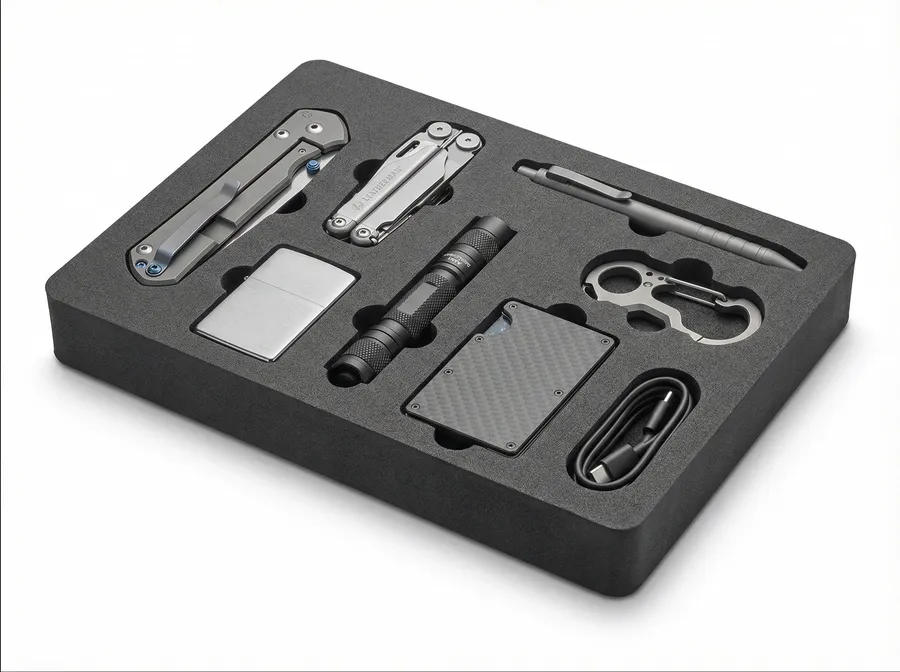
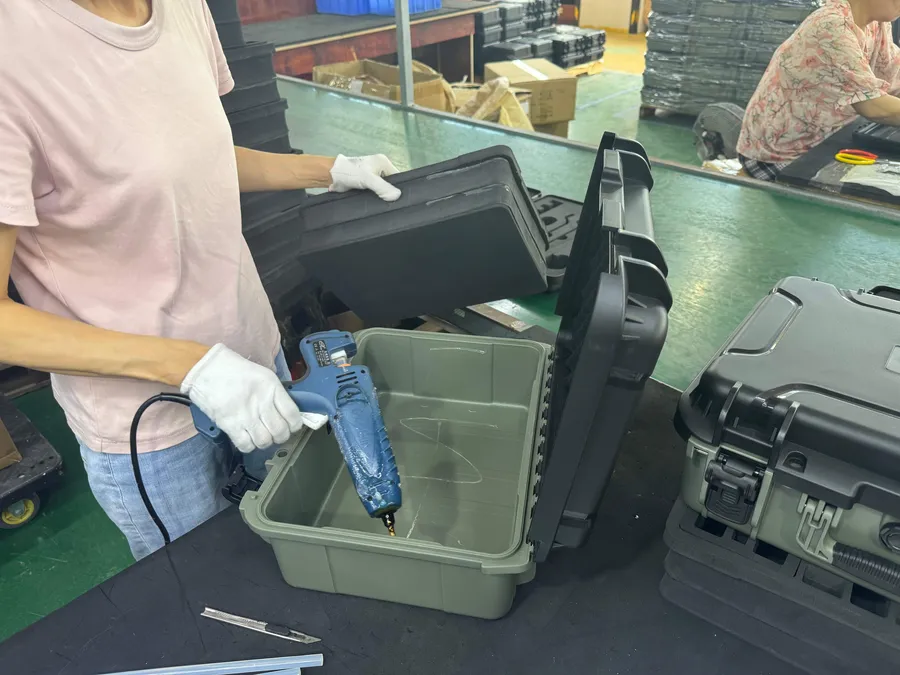
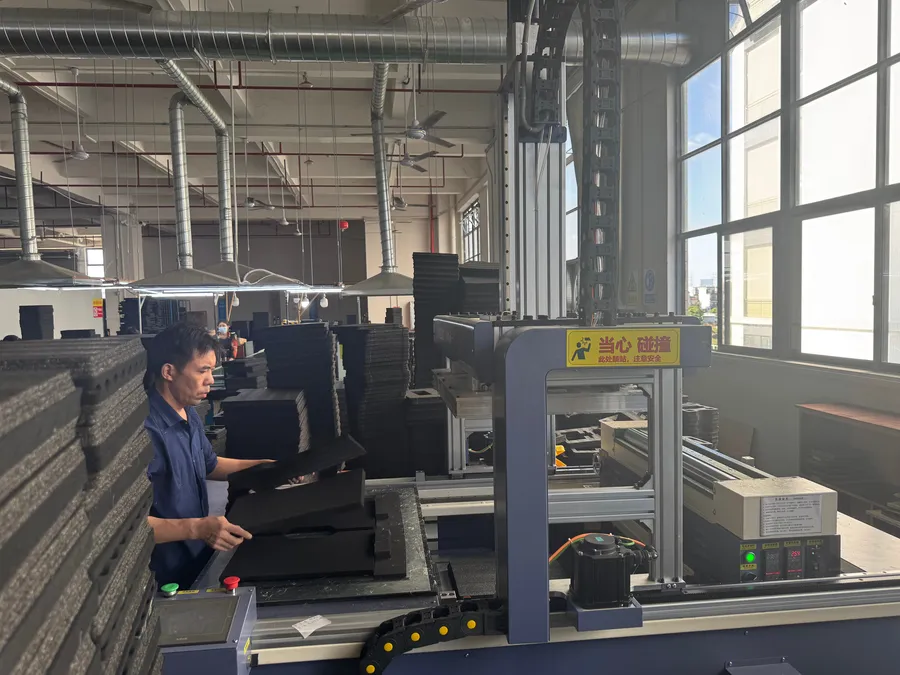
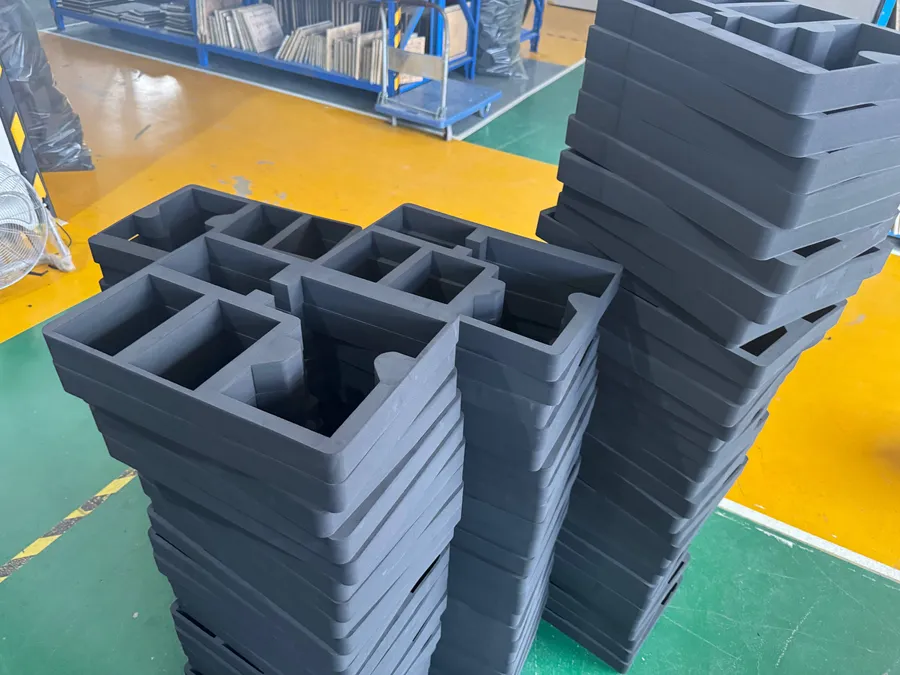
Everything described above is configurable on a standard shell: interior layout (pick-and-pluck, die-cut or CNC-cut), foam grade and thickness, colour, logo method, latch and lock count, pressure-equalisation valve, cable ports, document holder and identification plate. A bespoke exterior geometry requires a new mould — 125 days, from 3,000 units per moulded component.
Procurement considerations
| Question | What to send us |
|---|---|
| Which shell fits? | Equipment L × W × H as packed, plus required clearance per axis |
| What does it cost? | Order quantity and estimated annual quantity — the two drive different answers |
| Is tooling needed? | Whether an existing shell clears the envelope with usable foam depth |
| Lead time? | Your required delivery date, not just the order date |
| Certification? | The exact standard your tender names — we will say whether we can test to it |
| Freight? | Destination and preferred terms; carton and pallet data supplied with the quotation |
Comparison and selection guide
The tables on this page exist because a protective case is chosen by comparing three things: the envelope, the environment and the handling chain. Where no table applies, the rule below is.
| Situation | What To Do |
|---|---|
| Marine or wet | Sealed configuration with a drain-friendly interior and stainless hardware. |
| Dry and dusty | A close-fitting rim and a lid that can be opened one-handed without spilling contents. |
| Carried far | Under 10 kg packed, with a padded handle or shoulder webbing. |
- Size on internal dimensions plus clearance, never on a product name.
- Choose the carrying method before the shell: it changes the series, not just the price.
- Specify the interior last, and decide up front whether the end user will reconfigure it.
How to choose a case for long-term sun exposure? relates to Material Guide. Related families: Outdoor Protective Cases / Waterproof Cases / Field Equipment Cases / Military Protective Cases / Custom Protective Cases / Tool Cases. Related sectors: field and industrial equipment. Continue in the Material Guide cluster.
This page is written from our own production data. If your requirement differs, send the dimensions and we will tell you which of the 155 models fits, or whether a custom route is needed.


