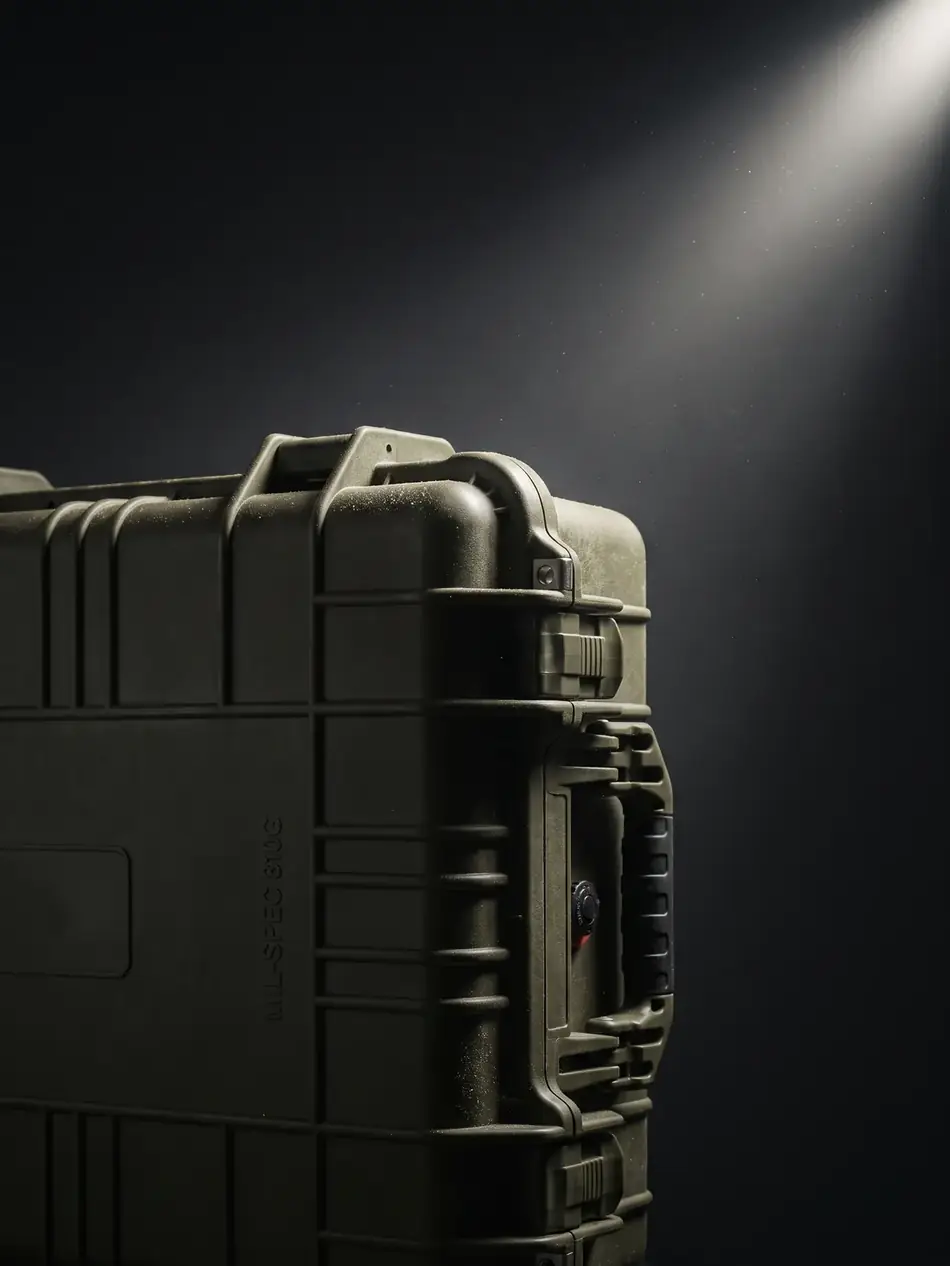
Military Case Material Comparison?
Compare the resins by the figures recorded for each model, because in our own data the material label predicts very little on its own. KeXin New Materials (Guangdong) Co., Ltd. lists 155 active mouldings across three shell materials: polypropylene on 94, an engineering polypropylene on 38, acrylonitrile butadiene styrene on 22 and one hybrid body, and 113 of those models sit in the military protective cases group. Published wall thickness runs 2.0 to 5.0 mm on the polypropylene group, 2.1 to 6.0 mm on the engineering group and 3.0 to 5.3 mm on the acrylonitrile butadiene styrene group, while empty mass per litre of internal cavity overlaps across all three, at a median of 127 g for polypropylene, 118 g for engineering polypropylene and 144 g for acrylonitrile butadiene styrene. The comparison that decides a build is therefore size reach, wall section, seal option and handling hardware per named model, not a resin name. We publish no ingress, impact, temperature or ultraviolet figure for any of the 155, and none of the three materials carries a rating from us.
Key points
- 113 of our 155 active models sit in the military protective cases group: 68 polypropylene, 30 engineering polypropylene, 14 ABS and one hybrid body.
- Resin does not predict weight: published mass per internal litre overlaps across all three groups, at medians of 127, 118 and 144 g.
- Size reach is the hardest constraint: polypropylene spans 120 to 1,356 mm on the longest external axis, ABS only 211 to 615 mm.
- Every one of our 22 ABS listings records a wall thickness and a gasket option; on the 94 polypropylene models a gasket is recorded on 75.
- The thickest sections we mould are engineering polypropylene: KX-6621 and KX-97227 both publish a 6.0 mm wall.
- Wheels are not a resin decision: of our 19 wheeled bodies, 14 are polypropylene, four are engineering polypropylene and one is ABS, and all 19 are recorded as not stackable.
- A thicker wall is not a stronger claim: it buys rim depth for a gasket channel and hardware seats, and no impact figure is printed for any model.
- Send the exposure and the packed envelope rather than a resin preference, and the shortlist comes from the 155 published model records.
What a military case material comparison can honestly be settled on
Most conversations about shell material end in a sentence that sounds technical and cannot be checked: one resin is tougher, another is stiffer, one is for the field and one is for the showroom. None of that is useful in a purchase file, because a military case is not bought on a polymer datasheet. It is bought on whether a named cavity clears a named packed envelope, whether the rim that carries a gasket exists on that moulding, whether the empty shell mass fits a manual-handling limit, whether the body stacks in a vehicle bay, and whether the outside length exists at all in that material. Every one of those is a recorded field on a model page rather than an argument about chemistry.
So this comparison uses only fields we publish. Across our 155 active models, shell_material takes four values, wall thickness is recorded on 148 of them, net weight on 93, internal and external dimensions and internal volume on all 155, a gasket option on 124 and a lid or base depth on 100. Gross weight is published on none, and the water, dust, ultraviolet, service temperature, stack load and load capacity fields read not measured throughout. What follows is therefore a comparison of geometry, mass and build options by resin group, and a clear statement of the columns that stay empty.
How the military listings split across the three resins
The military protective cases group is 113 models, and its distribution is not the same shape as the whole catalogue. Polypropylene covers 68 of those listings, engineering polypropylene 30, acrylonitrile butadiene styrene 14 and the hybrid body one. Within the group, a wall thickness is published on 106, a net weight on 57, a lid or base depth on 69, an outer carton footprint on 35 and a gasket option on 100. Internal volume spans 10.1 to 139.5 litres and the longest external axis spans 315 mm to 1,356 mm. Those counts matter when you read a specification: a field that is blank on a quote is blank because we do not record it for that model, not because the property is absent from the part.
The three groups also differ in how far they reach. Polypropylene is the only material in our list that goes both genuinely small and genuinely large: it starts at the 120 by 90 by 40 mm KX-1204, which weighs 100 g, and ends at the 1,356 by 154 by 408 mm KX-814641 with 1,280 mm of internal length. Engineering polypropylene occupies 265 to 720 mm on the longest external axis and is where the heaviest published sections sit. ABS occupies 211 to 615 mm and stops there, so a requirement above roughly 615 mm on the long axis is not an ABS question in our catalogue at all, and a requirement below 211 mm is not either.
Matched-size comparison: the same cavity in three materials
The cleanest way to see what the resin actually changes is to compare models whose internal cavities are close, and to read the wall, the empty mass and the seal option beside them. The rows below are copied from the model pages rather than averaged across a family. Look first at the pair KX-707 and KX-64120: 20.2 litres of engineering polypropylene on a 2.5 mm wall at 1,360 g against 21.7 litres of acrylonitrile butadiene styrene on a 4.0 mm wall at 2,640 g. Nearly double the empty mass for a slightly larger cavity, and that difference is the load a soldier carries every day. Then look at KX-4821 against KX-5021 and the pattern reverses: 3,670 g of engineering polypropylene at 135 g per litre against 3,430 g of acrylonitrile butadiene styrene at 120 g per litre. A resin name did not predict either answer; the mould did.
| Model | Group | Internal Mm | Wall Mm | Net G | Volume L | G Per L | Gasket | Stackable |
|---|---|---|---|---|---|---|---|---|
| KX-707 | Engineering PP | 465 x 310 x 140 | 2.5 | 1360 | 20.2 | 67 | not offered | yes |
| KX-64120 | ABS | 378 x 307 x 187 | 4.0 | 2640 | 21.7 | 122 | offered | yes |
| KX-4616 | PP | 455 x 338 x 148 | 3.0 | 1395 | 22.8 | 61 | offered | yes |
| KX-4821 | Engineering PP | 447 x 312 x 194 | 4.5 | 3670 | 27.1 | 135 | offered | yes |
| KX-5021 | ABS | 465 x 315 x 196 | 3.7 | 3430 | 28.7 | 120 | offered | yes |
| KX-5321 | Engineering PP | 481 x 373 x 192 | 5.8 | 4810 | 34.4 | 140 | offered | yes |
| KX-65522 | ABS | 507 x 385 x 190 | 5.3 | 4860 | 37.1 | 131 | offered | yes |
| KX-88442 | PP | 740 x 518 x 364 | 5.0 | 15320 | 139.5 | 110 | offered | no, wheeled |
The three shell groups side by side, field by field
Counts describe what we currently list, not what a polymer can theoretically do. A dash means the field is not recorded widely enough in that group for a range to be worth printing. The purpose of this table is to show which questions a material choice actually answers, and it answers four of them: how thick a section is available, how far the size range reaches, how often a gasket exists on the moulding, and how the empty mass is distributed per litre of usable cavity.
| Field | Pp | Engineering Pp | Abs | What It Means |
|---|---|---|---|---|
| Models listed | 94 | 38 | 22 | Where the buying choice is actually available in each resin |
| Wall thickness published | 2.0 to 5.0 mm, median 3.7 | 2.1 to 6.0 mm, median 4.3 | 3.0 to 5.3 mm, median 3.9 | Engineering PP is the heavy-section end of the same polymer family, ABS never goes below 3.0 mm in our list |
| Mass per internal litre | 61 to 333 g, median 127 | 65 to 222 g, median 118 | 110 to 388 g, median 144 | The distributions overlap, so resin does not predict empty weight at a given cavity size |
| Longest external axis | 120 to 1,356 mm | 265 to 720 mm | 211 to 615 mm | Oversized and pocket-size envelopes are polypropylene questions in our catalogue |
| Largest internal cavity | 139.5 L | 53.9 L | 56.6 L | A system case above roughly 60 litres is a polypropylene body in our range |
| Gasket option recorded | 75 of 94 | 27 of 38 | 22 of 22 | If a continuous sealing rim is a requirement, ABS is the only group where it is universal in our data |
| Recorded stackable | 80 of 94 | 34 of 38 | 21 of 22 | Stackability tracks the base and rim design of a moulding, not the resin |
| Wheels and pull fitted | 14 models | 4 models | 1 model | All 19 wheeled bodies in our file are recorded as not stackable |
How to choose between the three for a military load
Work through the constraints in this order, and the resin usually selects itself. First, size reach: if the packed envelope needs more than about 615 mm on the long axis, or more than roughly 60 litres of cavity, the answer is a polypropylene body because nothing else in our list is moulded that large. Second, whether a continuous sealing rim has to exist. If it does, an acrylonitrile butadiene styrene shell is the group where a gasket is recorded on every listing, and 100 of our 113 military models overall carry the option, so the check is per model row rather than per resin. Third, empty mass against a handling limit, which is where the matched table above earns its keep: 1,360 g against 2,640 g on almost the same cavity is a real difference over a march, and it is a published number rather than an estimate.
Where each material ends up being specified
Polypropylene covers the widest span because it is the widest moulded range: the small utility and component bodies used for spares and kit, the mid-size communication and instrument shells, and the largest field cases that carry a system with its accessories as one unit. It is a semi-crystalline thermoplastic, which is why it is chosen where a shell sees repeated flexing at a hinge line or a corner, and where a case meets oils, greases and cleaning agents. Our own corrosion note for every model in the file says the same thing in one line: a thermoplastic shell has no ferrous corrosion path, which is a property of the material class rather than of one resin.
Engineering polypropylene is where the same family is pushed at the section rather than at the chemistry. It occupies the mid-to-large military envelopes and holds our two thickest published walls, KX-6621 at 6.0 mm with 587 by 434 by 192 mm internal and 6,420 g, and the wheeled KX-97227 at 6.0 mm with 590 by 435 by 210 mm internal and 10,000 g. Acrylonitrile butadiene styrene is an amorphous copolymer chosen where faces need to mould flat and hold a print or a label, which is why it appears on the camera, optics and instrument envelopes in our list, from the 200 by 98 by 41 mm KX-62205 to the wheeled 507 by 385 by 290 mm KX-66232 at 56.6 litres.
Customising by material, and where the thresholds change
Material choice meets the tooling conversation at the mould, so the commercial ladder is worth stating exactly. A standard order starts at one piece and custom foam starts at one set, which means an interior can be cut against a device on a single sample regardless of resin. Colour work, a printed or moulded logo and an OEM build against existing mouldings start at 300 pieces and are quoted at 45 days to first sample, with a 30 percent deposit. A new external envelope is 125 days and from 3,000 pieces per moulded component. Those figures are the same whichever of the three resins you specify, because they describe our moulding capacity rather than the polymer.
What does change with the material is which envelope is available to customise inside. An acrylonitrile butadiene styrene shell gives you a flat, dimensionally stable face that takes a print, which suits a labelled instrument kit within 615 mm of length. A polypropylene shell gives you the widest size range and the deepest pool of existing mouldings to reuse, which is usually the cheaper route because you are buying an interior rather than a tool. An engineering polypropylene body lets a buyer who has outgrown a section stay in an envelope that already works, moving the wall from 3.0 mm to 4.5 or 5.8 mm instead of redrawing the outline.
Procurement notes and the columns that stay empty
The missing columns are the part of this comparison that most often causes a dispute after delivery, so name them in the purchase file. For all 155 models we record water, dust, ultraviolet, service temperature, stack load and load capacity as not measured, and no ingress code is printed for any shell. Impact and shock are recorded as a construction option, with the note that a specified foam layout is required, because a rigid shell alone is not a shock rating. No dimensional tolerance band is published on any model listing either, so a fit that hangs on one millimetre is settled on a sample of the named model rather than on a datasheet.
On the commercial side our terms are fixed: wholesale and OEM only, EXW or FOB, no retail channel, no DDP quotation and no overseas warehouse stock. Payment is a 30 percent deposit with the balance after inspection, and third-party factory inspection is welcome. If a tender names a procedure, tell us which one and against what method, and we will quote accredited third-party work for the named configuration as a separate priced package. A request that sends the packed envelope on named axes, the exposure the case will actually see, the stacking requirement and the quantity band can be answered with a model number and an honest list of what remains unmeasured.
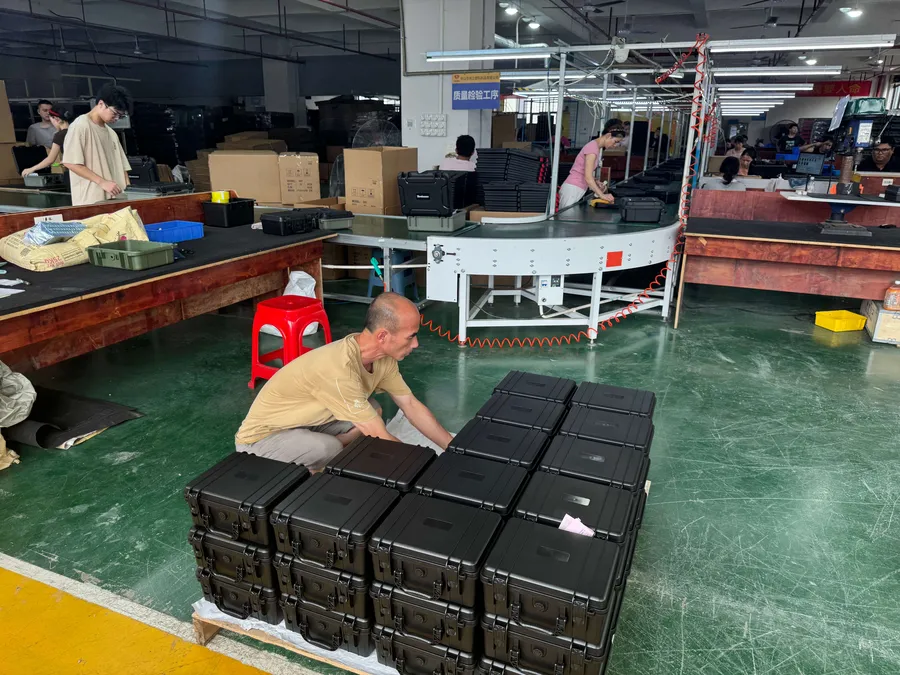
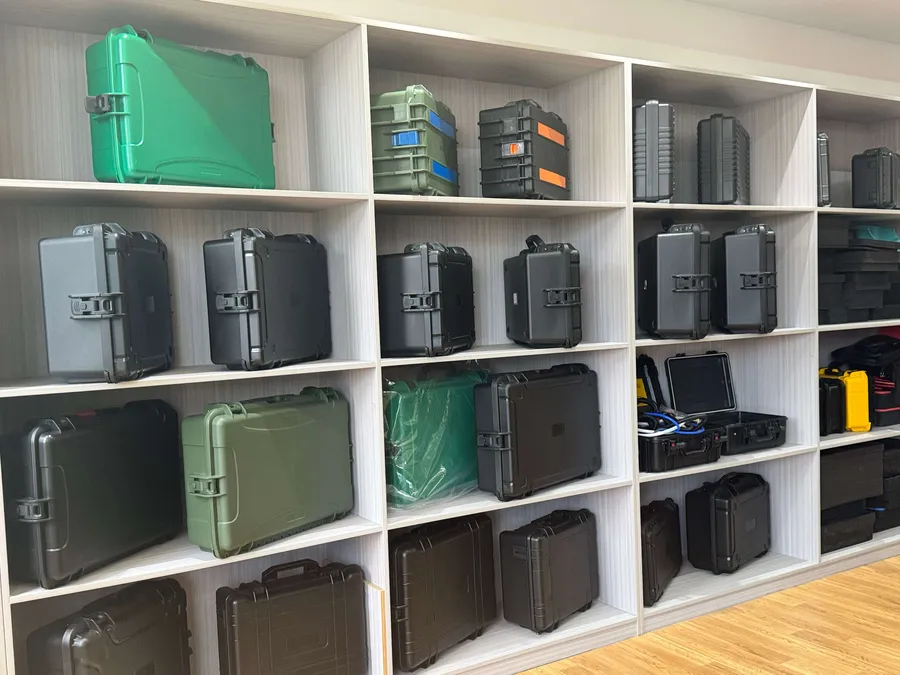

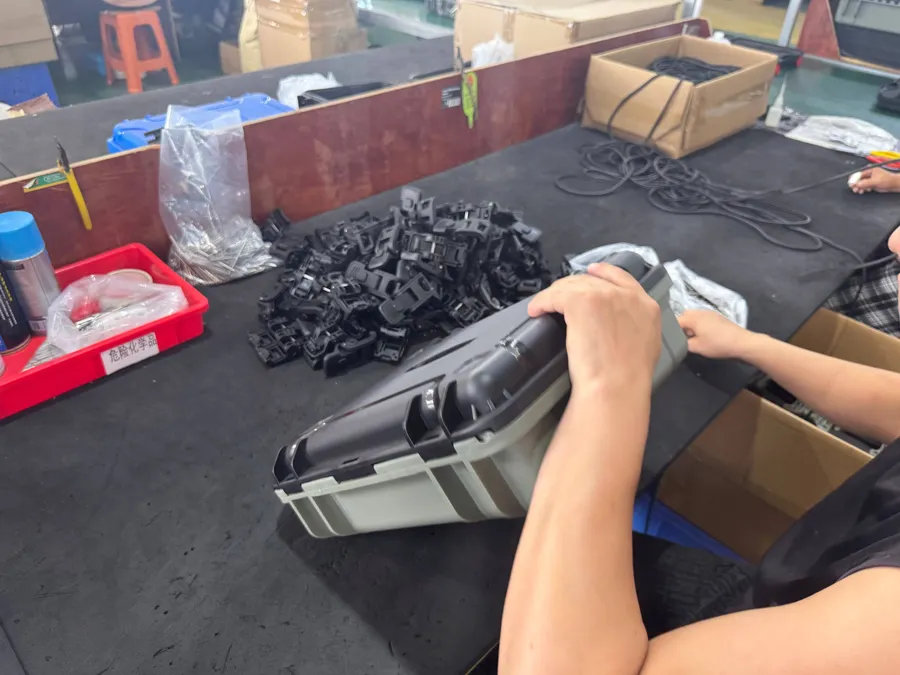
Customisation
Everything described above is configurable on a standard shell: interior layout (pick-and-pluck, die-cut or CNC-cut), foam grade and thickness, colour, logo method, latch and lock count, pressure-equalisation valve, cable ports, document holder and identification plate. A bespoke exterior geometry requires a new mould — 125 days, from 3,000 units per moulded component.
Procurement considerations
| Question | What to send us |
|---|---|
| Which shell fits? | Equipment L × W × H as packed, plus required clearance per axis |
| What does it cost? | Order quantity and estimated annual quantity — the two drive different answers |
| Is tooling needed? | Whether an existing shell clears the envelope with usable foam depth |
| Lead time? | Your required delivery date, not just the order date |
| Certification? | The exact standard your tender names — we will say whether we can test to it |
| Freight? | Destination and preferred terms; carton and pallet data supplied with the quotation |
Comparison and selection guide
The tables on this page exist because a protective case is chosen by comparing three things: the envelope, the environment and the handling chain. Where no table applies, the rule below is.
| Situation | What To Do |
|---|---|
| Start from the equipment, not the case | Measure the tallest, widest and longest points of the packed equipment including antennas, handles and connectors. Add 20 mm minimum clearance per axis before selecting a shell. |
| Then choose the carrying method | Under 8 kg, a fixed handle is lighter and cheaper. Over 12 kg or any journey over 30 m, specify the T series with telescopic handle and wheels. |
| Then decide the interior | Pick-and-pluck for kits that change. Die-cut or CNC-cut for fixed layouts that must be auditable at a glance. |
- Size on internal dimensions plus clearance, never on a product name.
- Choose the carrying method before the shell: it changes the series, not just the price.
- Specify the interior last, and decide up front whether the end user will reconfigure it.
Military Case Material Comparison? relates to Material Guide. Related families: Military Protective Cases / Defense Equipment Cases / Field Equipment Cases / Instrument & Equipment Cases / Rolling Cases / Custom Protective Cases. Related sectors: field and industrial equipment. Continue in the Material Guide cluster.
This page is written from our own production data. If your requirement differs, send the dimensions and we will tell you which of the 155 models fits, or whether a custom route is needed.