Battery Module Tester Explosion-Proof Safety Box: What the Term Requires
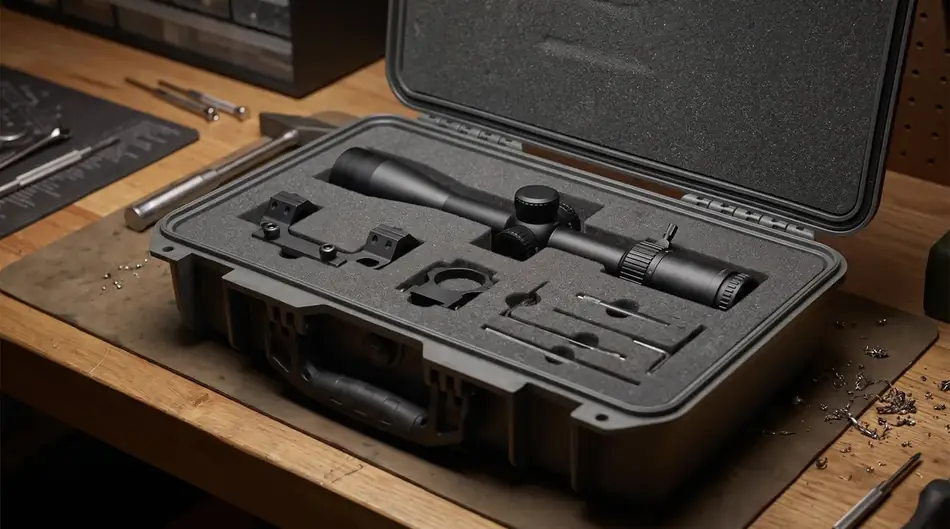
No moulded case is inherently explosion-proof, and that is the first thing to settle about a battery module tester explosion-proof safety box. Explosion protection is a property of a defined enclosure under a defined hazardous-area classification: a zone, a gas or dust group, a temperature class, and a test report that states the result. What we manufacture is a hard thermoplastic shell that protects the tester mechanically, holds it in a fixed layout, and keeps its leads and connectors organised. We publish 155 active models with internal and external dimensions, usable litres, wall thickness on 148 of them, and whether a compressible gasket is offered; we publish no containment rating, no ingress code and no hazardous-area test result on any model. So the useful answer is a split one: buy the shell for the instrument, and commission the hazardous-area evidence as a separate work package if your site requires it.
Key points
- Explosion protection is a classification with a zone, a gas group and a temperature class, so it belongs in the tender document, not in a product name.
- We publish 155 shell records: wall thickness on 148 models from 2.0 to 6.0 mm, a gasket offered on 124, and no containment or ingress rating on any model.
- Size the tester by connector height and lead bend radius: KX-4616 gives 455 x 338 x 148 mm inside and 22.8 litres internal at a 3.0 mm wall.
- A moulded PP or ABS shell is not a pressure vessel; we will not describe it as one, and no page on this site states a containment or venting result.
- Separate the instrument from the module: the tester travels in a fitted shell, the module in its own tray with the terminals covered.
- MOQ is one piece on a standard shell; logo, colour and OEM marking start at 300, and a new mould at 3,000 per component over 125 days.
- A gasket is a construction option, not a rating: 124 models list one and 31 list none, and neither figure implies a water or dust result.
What a battery module tester explosion-proof safety box has to do
Three separate jobs get bundled into that phrase, and only two of them are ours. The first job is mechanical: a bench instrument that measures cell and module resistance, insulation or capacity is a dense, connector-heavy object, and it has to survive being carried to a pack assembly line, set down on a steel bench, and carried back. The second job is electrical housekeeping: the Kelvin clips, the sense leads and the temperature probes have to leave the shell without being crushed at the closure line, and the module under test has to sit somewhere that is not the lid of the tester. The third job is hazardous-area containment, and that is a certification regime rather than a moulding. It is defined by where the equipment is installed, what gas or dust is present, and what temperature the surface can reach under fault. A hard shell contributes to that argument as a housing, but it does not create the argument.
The practical consequence for a buyer is that the enquiry has to be split. Your site electrical engineer decides whether the tester needs a hazardous-area classification at all, and if so which zone and which gas group. We then supply the shell that holds the instrument, sized from the instrument drawing, with the interior cut so leads sit in a fixed position. If the classification is real, the evidence that satisfies it is produced by a test house against the assembled unit, not by the case supplier alone, and it is quoted as a separate work package with its own schedule. Writing that split into the purchase order at the start avoids the most common dead end in this product category: a tender that asks for a box described as explosion-proof as if the adjective were a finish option.
What we publish per model, and what is recorded as not measured
Our catalogue is a shell record, not a compliance file. Every model carries the same published fields, and the field list is short enough to check against your drawing line by line. Internal and external dimensions are published for all 155 models; internal volume runs from 0.3 litres on KX-1204 to 139.5 litres on KX-88442, with usable interior volume published per model (0.3 litres on KX-1204, 111.6 litres on KX-88442); wall thickness is published on 148 models and ranges from 2.0 mm to 6.0 mm; net weight is published on 93 models and ranges from 100 g to 15,320 g; lid and base depth are both published on 100 models. The gasket field is a yes or no construction option, recorded on all 155 models: 124 list one and 31 list none. Stackability is recorded per model, and 136 are stackable. Wheels and a telescopic handle are published together on 19 models.
What is not in that list matters just as much. There is no ingress code anywhere in our data, no immersion depth or time, no drop height, no vibration spectrum, no load rating and no hazardous-area classification. Those fields are recorded as not measured for every model, and we do not substitute a marketing phrase for a missing number. A buyer comparing three quotations should ask each supplier the same question about the same field, and should treat a supplier who answers an unmeasured field with an adjective as the risk in the comparison rather than the bargain in it.
| Published Field | Coverage | What It Decides |
|---|---|---|
| Internal dimensions | 155 of 155 models | Whether the tester and its connectors fit with foam and clearance |
| Wall thickness | 148 of 155, 2.0 to 6.0 mm | Stiffness under a lid load and resistance to point pressure |
| Gasket offered | 124 yes, 31 no | Whether the closure line can be sealed at all, not how well |
| Lid and base depth | 100 of 155 models | How a tall instrument or a connector block sits across the split |
| Net weight | 93 of 155, 100 to 15,320 g | Carry method, bench handling and freight cost per unit |
| Ingress, drop, containment, hazardous-area result | 0 of 155, recorded as not measured | Whether a test has to be commissioned before the tender closes |
Sizing a tester from the connector, not from the litre figure
A battery module tester is not a bulky instrument, so it is tempting to size the shell by litres and be done. That is the wrong order. Start with the tallest point on the tester with its leads fitted, then add the foam thickness you intend above and below, then check that the lid depth clears the connector housing when the lid closes. Only after those three numbers is the litre figure useful, and even then it is a cross-check rather than a decision. The models below are the ones a bench tester usually lands on, with the figures exactly as published for each model.
Two details decide the choice between them. The first is the lid-to-base split: KX-3218 splits 86 mm and 86 mm, KX-5321 splits 43 mm and 149 mm, and a tester with a tall rear connector housing sits very differently in those two shells even where the total internal height is similar. The second is the gasket, because a gasket is a construction option and not a rating. A buyer who needs the closure line sealed for dust on a workshop floor should order the gasket, and a buyer who needs a stated ingress result should plan a test, because no model on this site carries one.
| Model | Internal (Mm) | External (Mm) | Usable Volume | Wall | Gasket | Net Weight |
|---|---|---|---|---|---|---|
| KX-3218 | 308 x 230 x 172 | 315 x 260 x 180 | 10.5 L | 3.0 mm PP | offered | 900 g |
| KX-4616 | 455 x 338 x 148 | 460 x 367 x 155 | 19.6 L | 3.0 mm PP | offered | 1,395 g |
| KX-64120 | 378 x 307 x 187 | 405 x 362 x 195 | 17.4 L | 4.0 mm ABS | offered | 2,640 g |
| KX-5321 | 481 x 373 x 192 | 525 x 434 x 214 | 27.5 L | 5.8 mm engineering PP | offered | 4,810 g |
| KX-6621 | 587 x 434 x 192 | 662 x 495 x 210 | 39.1 L | 6.0 mm engineering PP | offered | 6,420 g |
| KX-93221 | 300 x 200 x 200 | 323 x 243 x 212 | 9.6 L | 5.0 mm engineering PP | offered | 1,230 g |
Explosion-proof in buyer language: four documents to ask for
In European practice, a hazardous-area classification is expressed as a zone, a group and a temperature class, and in North American practice as a class and division with a group letter. Neither expression is a product adjective. Both are conclusions that follow from an assessment of the installation and are evidenced by a test report on the assembled equipment, a marking plate that reproduces the classification, and an instruction that states the conditions under which the marking stays valid. If a tender uses the phrase explosion-proof, the four documents below are what actually carries the claim, and a supplier who cannot produce them is describing an intention rather than a result.
Our position is stated plainly because buyers deserve it before they spend time on drawings. We do not hold a hazardous-area test report for any shell, we do not print a classification plate, and no paragraph on this site presents a moulded case as a containment device. A thermoplastic shell has a real role in that discussion, as the housing that holds the instrument and its terminations, but the classification belongs to the assembled unit and to the authority that tests it. If your project needs it, we will quote the shell to the drawing and work alongside the test house you appoint, and the test itself is scoped, quoted and scheduled separately.
| Document | What It Tells You |
|---|---|
| Installation classification | The zone, group and temperature class the site requires, and therefore the target the design must reach |
| Test report on the assembled unit | Which enclosure, terminals and accessories were assessed together, and under what conditions |
| Marking plate and nameplate text | The exact classification reproduced on the equipment, which must match the report rather than the brochure |
| Conditions of use and maintenance schedule | What invalidates the marking, such as an unapproved cable gland or a replaced latch |
Bench tester, module carrier and field insulation tester compared
The same family of shells serves four different pieces of battery work, and they are not interchangeable even when the instruments look similar in a photograph. A bench module tester lives in one place and wants a flat, wide floor with the lid opening clear of the bench edge. A module carrier moves modules between stations and wants a deep base with the load sitting low. A field insulation tester travels to a service vehicle and wants a compact shell that one person carries with a shoulder strap. A lab fixture with a fixed harness wants a shell that can stay open on the bench as a working tray. Sorting the use case first removes most of the shortlist before any dimension is read.
The table below is a starting point rather than a specification. Each row names a published shell that fits the use case in the first column, and the figures are the published figures for that model, not a general capability of the range.
| Use Case | What Decides The Shell | Starting Model |
|---|---|---|
| Bench module tester with leads stored | Internal floor area plus lid depth, with the foam cut around the connector housing | KX-4616, 455 x 338 x 148 mm inside |
| Heavy module handling between stations | Base depth and wall thickness, because the load sits low and the base takes the bearing | KX-5321, 149 mm base depth at a 5.8 mm wall |
| Field insulation or resistance testing | Carried weight and external footprint; net weight is published per model | KX-3218, 900 g net at 10.5 litres usable |
| Tall instrument with rear connectors | Internal height in one piece, so the connector block does not land on the split | KX-93221, 200 mm internal height at a 5.0 mm wall |
| Lab fixture that doubles as a bench tray | Lid that opens flat and a base that holds the fixture without rocking | KX-64120, 378 x 307 x 187 mm inside |
| Large charger or multi-channel analyser | Overall length and the strength of the mid-span under a lid load | KX-6621, 587 x 434 x 192 mm inside |
Selection guidance: five checks that end at a model number
A short sequence settles the shell faster than a catalogue browse. Measure the tester with the leads attached and the connector caps on, because that is the object that travels. Add the clearance you want above and below, with 10 mm as a working minimum for a padded interior. Check the lid-to-base split against the tallest feature, since a split that lands mid-connector forces the foam to carry the load instead of the shell. Confirm the carry method, because wheels and a telescopic handle are published on 19 models and they change the series rather than the price. Finally confirm what your own quality procedure will require in writing, so that the gap between our published data and your tender is identified now rather than at goods-in.
If a check fails at the last step, the answer is not a stronger adjective in the quotation. It is a test scope, a drawing change, or a second shell for the module as distinct from the instrument. Buyers who start from that position usually end up with two smaller cases rather than one large one, and they spend less on foam because each cut is simpler.
| Check | How To Apply It | Example Outcome |
|---|---|---|
| Measure the travelling object | Tester with leads, clips and caps fitted, plus 10 mm clearance per face | A 460 mm wide bench unit lands on KX-4616 rather than a 400 mm shell |
| Read the split, not the total | Compare the tallest feature against lid depth and base depth separately | A 150 mm connector housing needs a base-deep shell such as KX-5321 |
| Decide carry method early | One-person carry, two-person lift, or trolley from a vehicle to a bench | Wheeled models are published with wheels and handle together on 19 models |
| Separate module from instrument | Two envelopes: the tester, and the module with terminals covered | A 12 litre shell for modules and a 20 litre shell for the tester |
| Name the evidence you need | List the test reports your procedure requires and ask which are in scope | An unmeasured field becomes a quoted test, not an assumption |
Flaw detector portable shockproof protection latch box and water quality tester anti-corrosion plastic hard box
The same reasoning applies to two neighbouring instrument families that buyers often search for at the same time. A flaw detector portable shockproof protection latch box is chosen on the probe and cable layout first, because an ultrasonic or eddy-current set travels with transducers that are more fragile than the instrument body, and the latch has to stay closed when the box is carried by the handle with the probes hanging inside. In our range the latch body accepts a standard padlock where that hardware is fitted, and the number and position of latches is a configuration item confirmed on the drawing rather than a catalogue description. Shock is not a published field, so a buyer who needs a stated shock result should plan a test rather than read a phrase.
A water quality tester anti-corrosion plastic hard box is a different problem again, because the instrument lives near reagents and rinse water rather than near a battery. Thermoplastic PP and ABS shells carry no ferrous corrosion path, which is recorded on all 155 models, and that is the property that matters for a case that gets wiped down at the end of a shift. It is not the same as a sealed enclosure. If the site washes the box down with a hose, the gasket is the field to specify and a stated ingress result is still a test to commission, because no model here carries one. The honest shortlist for both families is the same as for the battery tester: internal dimensions from the drawing, split depth from the tallest feature, gasket as an option, and every unmeasured field written into the test scope.
Where these cases are used
Battery module testers with their shipping shells turn up in four places. The first is pack assembly, where the tester moves between stations and the shell has to survive being set down on a steel bench several times a shift. The second is service and repair, where a technician carries the tester to a vehicle and needs the module and the instrument separated so that neither the clips nor the module terminals are loose in the same cavity. The third is incoming inspection, where the tester stays in one place and the shell becomes a storage tray that keeps the leads coiled the same way every time. The fourth is second-life grading, where modules of different shapes arrive and the shell is chosen for the largest module in the batch rather than the average one.
In all four, the case is doing organisational work as much as protective work. A tester that lives in a fitted shell is calibrated, returned and found again; a tester that lives in a cardboard box is a tester with a missing lead. That is a management argument rather than a technical one, and it is usually the argument that gets the purchase approved, so it is worth stating in the internal request alongside the dimensions.
Customisation: interior, hardware, marking and tooling
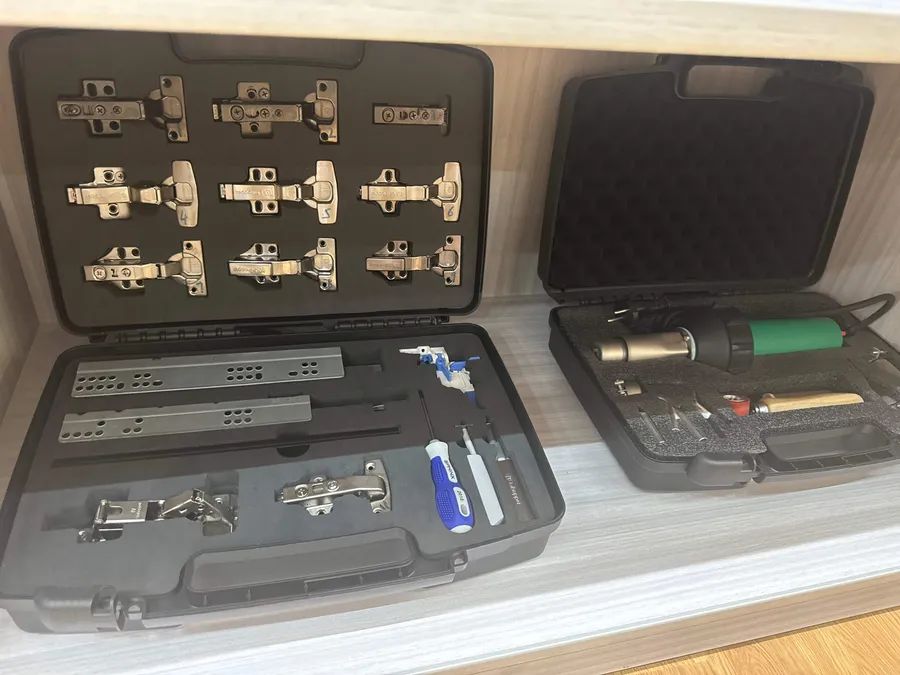
Everything that touches the instrument is configurable on a standard shell: the interior layout as pick-and-pluck, die-cut or CNC-cut foam; the foam grade and thickness; the colour; the logo method; the latch and lock count; a pressure-equalisation valve where the shell design allows it; cable ports; a document holder; and an identification plate. The foam cut is made from a drawing of the tester footprint plus the lead radius, and we ask for a photograph of the instrument with its leads attached because that single image resolves most of the layout questions before a drawing is issued. If the tester is used in a cleanroom or an electronics area, state that at enquiry stage, because an interior treatment is a specification to be agreed and tested, not a catalogue option.
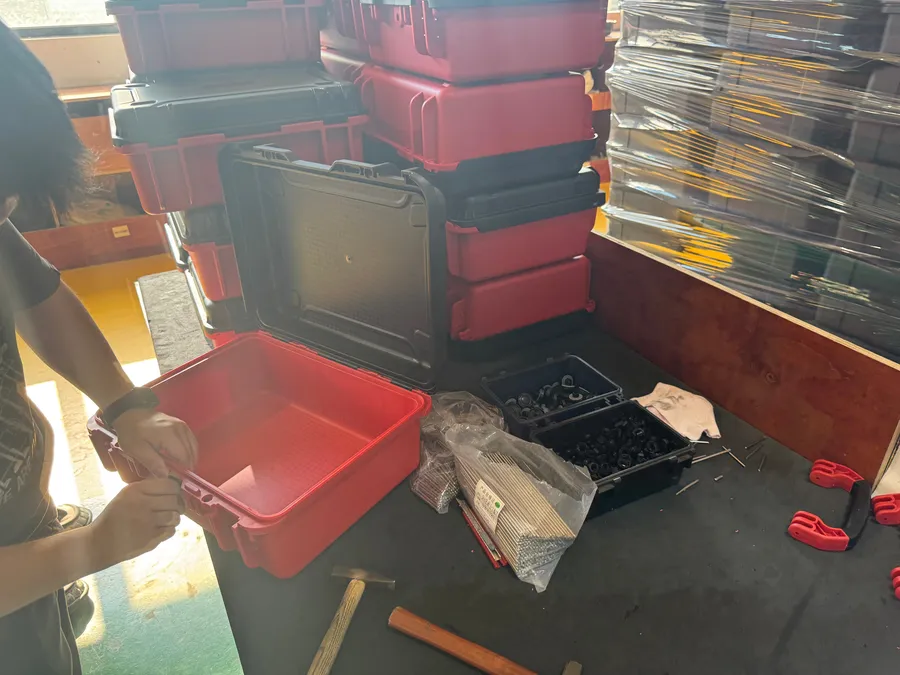
A bespoke exterior geometry is a different order of work. It requires a new mould, which is quoted at 125 days from tool approval and from 3,000 units per moulded component. Most instrument buyers do not need that, and the reason to say so plainly is that a new mould is often proposed when an existing shell with a custom interior would do the job for a fraction of the tooling cost and a much shorter first-article date.
Procurement notes: wholesale terms, verification and what we will not claim
We supply wholesale and OEM only. Terms are EXW or FOB, we do not sell retail, we do not quote DDP, and we hold no overseas warehouse. The standard shell has an MOQ of one piece; logo, colour and OEM marking start at 300 units; a new mould starts at 3,000 units per moulded component. OEM first samples take 45 days and a new mould takes 125 days, with a 30 percent deposit on order. Carton and pallet quantities are published per model and are supplied with the quotation rather than estimated, because a shell that packs 40 per carton and one that packs 20 change the landed cost per unit at the same unit price.
On verification, the position is the one stated throughout this page. We will confirm every dimension on the drawing against the published record for the model you choose, we will agree a first-article inspection with you, and we will state which fields are not measured rather than let a comparator fill them in. We do not describe any shell as explosion-proof, we do not issue a classification plate, and we do not present a test result we do not hold. If a tender requires one, we will help you scope it with the test house you appoint and quote the shell work separately. That is a slower conversation at the quotation stage and a much faster one at goods-in.
Applications
This matters most where the case is part of a movement chain rather than shelf packaging. In electronics & instruments and industrial equipment and medical & laboratory the same shell is specified differently because the handling, the environment and the verification requirement differ.
- Electronics & Instruments — Electronic assemblies rarely fail from a single large impact. They fail from repeated small shoc…
- Industrial Equipment — In an industrial setting the case is a working surface as much as a container, and its interior …
- Medical & Laboratory — Medical cases are audited. Whatever goes inside has to be verifiable at a glance, cleanable, and…
- Field & Deployment — Field deployment removes every assumption a depot specification makes: no forklift, no dry stora…
Customisation
Everything described above is configurable on a standard shell: interior layout (pick-and-pluck, die-cut or CNC-cut), foam grade and thickness, colour, logo method, latch and lock count, pressure-equalisation valve, cable ports, document holder and identification plate. A bespoke exterior geometry requires a new mould — 125 days, from 3,000 units per moulded component.
Procurement considerations
| Question | What to send us |
|---|---|
| Which shell fits? | Equipment L × W × H as packed, plus required clearance per axis |
| What does it cost? | Order quantity and estimated annual quantity — the two drive different answers |
| Is tooling needed? | Whether an existing shell clears the envelope with usable foam depth |
| Lead time? | Your required delivery date, not just the order date |
| Certification? | The exact standard your tender names — we will say whether we can test to it |
| Freight? | Destination and preferred terms; carton and pallet data supplied with the quotation |
Comparison and selection guide
The tables on this page exist because a protective case is chosen by comparing three things: the envelope, the environment and the handling chain. Where no table applies, the rule below is.
| Situation | What To Do |
|---|---|
| Benchtop mass | Firm base carrier, 50 mm minimum, with a soft contact layer. |
| Optical head | Suspend the body and clear the lenses entirely; never let foam touch a coated surface under load. |
| Field kit | CNC base for the instrument, pluck-foam top for probes and consumables. |
- Size on internal dimensions plus clearance, never on a product name.
- Choose the carrying method before the shell: it changes the series, not just the price.
- Specify the interior last, and decide up front whether the end user will reconfigure it.
Battery Module Tester Explosion-Proof Safety Box: What the Term Requires relates to Procurement Guide. Related families: Instrument & Equipment Cases / Electronics Cases / Equipment Transport Cases / Custom Protective Cases / Tactical Equipment Cases. Related sectors: Electronics & Instruments / Industrial Equipment / Medical & Laboratory / Field & Deployment. Continue in the Procurement Guide cluster.
This page is written from our own production data. If your requirement differs, send the dimensions and we will tell you which of the 155 models fits, or whether a custom route is needed.