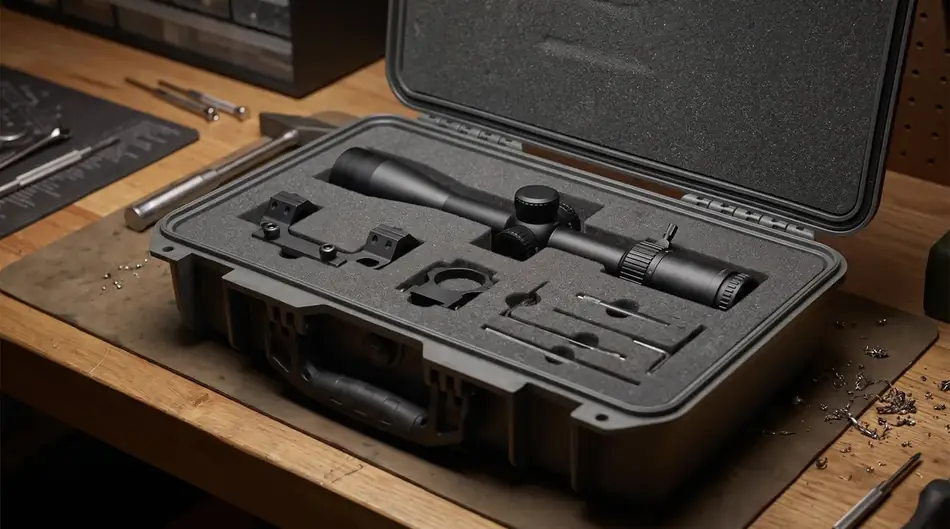
Explosion-proof hard safety box export factory?
An explosion-proof hard safety box export factory is a search phrase with two different suppliers hiding inside it. The explosion-proof part is a qualification issued against an item of electrical apparatus by a certification body, and it travels with that apparatus; the hard shell that carries the apparatus, the tools or the hazardous consumables is a mechanical product, and we make mechanical products. What we publish for the 155 active models in our file is geometry, wall thickness, latch and hardware detail, packing data and commercial terms, and what we leave blank is every performance figure we have not measured. In the 120 models that list the tool category, published walls run from 2.0 mm to 5.8 mm on the 115 models that state one, net weights run from 100 g to 6,000 g on the 74 that state one, and 91 of the 120 offer a compressible gasket. A drop height, an operating temperature range and a protection rating are recorded as not measured on all 155, so ask the factory for drawings, measurements and inspection records, and ask an accredited laboratory for the test result.
Key points
- A hazardous-area qualification is issued against the electrical apparatus, not against the shell that carries it.
- 120 of our 155 models list the tool category, with published walls from 2.0 mm to 5.8 mm on the 115 that state one.
- Every model's impact note states its wall thickness and claims no drop height without a test.
- The latch body on all 155 models accepts a standard padlock, which is the safety-box feature you can inspect.
- Stack load and load capacity are recorded as not measured, so stacking rules follow geometry rather than a rating.
- Terms are EXW or FOB, with MOQ from 1 stocked unit, 45 days on an existing mould and 125 days for a new mould.
The short answer: two suppliers, one search phrase
Read the phrase in three pieces and the sourcing problem becomes ordinary. Explosion-proof describes a qualification: a body that is competent to assess electrical apparatus issues a document against that apparatus, its type designation, its enclosure, its internal temperature rise and its wiring, for a named hazardous area classification. That document belongs to the apparatus. A hard safety box describes a mechanical article: a moulded thermoplastic shell, a gasket channel, foam, a latch, a handle, feet and a lid. Export factory describes who you are dealing with: a plant that owns the moulds, the resin intake and the inspection step, rather than a desk that re-sells somebody else's catalogue.
The practical consequence is that a single enquiry has two addressees. Ask the equipment manufacturer for the qualification that covers its own apparatus, and ask the case factory for the things a case factory can genuinely sign for: internal and external dimensions measured against a drawing, wall thickness, shell material, seal material, hardware, net weight, packing data, and the inspection record of the production run you bought. Anyone who offers to solve the first question with the second product is selling you a word, and that word will not survive a safety audit, a customer complaint or an incident review.
What an export factory can honestly put in a document pack
A factory that owns tooling can produce a drawing package with the tolerances it actually moulds to, a dimension report measured on the first article and on the production lot, material data for the shell, the gasket and the foam, a hardware specification for latches, hinges, handles and feet, a packing list showing cartons and quantities, and a production inspection record from the shift that made your order. It can also let you stand in the plant. We welcome a third-party inspection arranged by your agent and an on-site factory audit by appointment, because on a case the things that matter, the gasket channel, the foam cut, the latch alignment, are all visible on a sample.
What the same factory cannot put in that pack is a performance result that was never run. Our data file is written with a claim policy attached to every field: a value recorded as measured comes from our own production or incoming-material data; a value recorded as a manufacturer option is a construction we can supply, and the figure depends on the configuration you order; a field recorded as not measured means no test record exists for that model and configuration, we will not state a value, and an accredited test can be commissioned as a separate work package. That is the honest shape of a case supplier's document pack, and it is the one we will send you.
Hard safety box: the three features you can actually inspect
A lockable, robust, sealable box is what most buyers mean by a hard safety box, and each of those three words maps onto a field in our file that you can check on a sample or in a receiving inspection. Kit control is a latch question: our file records, on all 155 models, that the latch body accepts a standard padlock. Moisture and dust resistance are a channel question: 124 of the 155 models list a compressible gasket in a continuous moulded channel in EPDM or an equivalent, and 31 list no seal offered on the shell, so the sealed build has to be named on the order line. Load and stacking are a geometry question, and here the file is blunt: stack load and load capacity are recorded as not measured on every model.
| Feature A Buyer Asks For | What Our Published File Says | How To Inspect It | What It Is Not |
|---|---|---|---|
| Lockable for kit control | Latch body accepts a standard padlock, recorded as measured on all 155 models | Fit your padlock shackle to the hasp on the sample and close the lid under load | Not a lock, not a tamper-evident seal and not a security rating |
| Sealed against dust and splash | Compressible gasket in a continuous moulded channel on 124 models; 31 models list none | Look for an unbroken channel and a gasket that stands above the seating face | Not a rating; no protection rating is stated for any model in the file |
| Stackable in a store or vehicle | 136 models marked stackable, 19 marked with wheels; stack load recorded as not measured | Stack your own loaded cases to the height you intend and check the lid alignment | Not a load figure; we will not publish a stacking height you cannot verify |
| Holds heavy tools without deforming | Wall thickness published per model, 30 models at 5.0 mm or more across the file | Compare the wall on the drawing with a cut section on the first article | Not a strength claim; wall thickness is a construction fact, not a result |
Heavy duty tool box drop test certified factory: what a drop report contains
Buyers type this phrase because somebody on their side has been told that a case must pass a drop, and the useful thing to do with it is to ask what a real report looks like. A report you can rely on names the method and the issue of that method, states the article and its serial or build lot, gives the mass at which the article was tested, lists the orientations and the number of drops, states the height, states the target surface, states any conditioning the article went through before the drop, records the pass criteria and how they were assessed, and is signed by a laboratory with an accreditation that covers that method. Read those fields in a document and the marketing language falls away. If a supplier offers a result without a height, an orientation list and a named laboratory, there is no result.
Our position is in the data file rather than in a brochure. Each model's impact note states the wall thickness of that model and records that no drop height is claimed without a test; each model's shock note states that a specified foam layout is required and that the shell on its own is not a shock rating. Across the file, 30 of the 155 models publish a wall of 5.0 mm or thicker and 56 publish 4.5 mm or more, while 24 publish under 3.0 mm, which tells you where a heavy-duty build starts in our catalogue, and nothing more. Where a programme genuinely needs a drop result, the practical route is to name the method, the mass and the orientations you require, commission a test at an accredited laboratory against one configuration, and treat the drawing we supply as the input to that test rather than as a substitute for it.
Published numbers for the heavy band
The four models below are taken from the file to show the spread a heavy-duty enquiry actually moves in. Two are thick-walled mid-size shells with a published net weight and a seal offered, which is where most tool control and instrument kits land. One is the thickest-walled model in the tool category, quoted for a maintenance kit with a heavy base plate. The last is the opposite end of the file, shown deliberately, because a lot of what buyers call heavy duty is really a small case with dense contents, and 0.3 L of usable interior at 100 g of shell is a perfectly good answer to that brief.
| Model | Published External | Published Internal | Wall | Net Weight | Usable Volume | Seal | Stackable | Performance Fields |
|---|---|---|---|---|---|---|---|---|
| KX 63413 | 339 x 310 x 125 mm | 310 x 255 x 106 mm | 4.8 mm | 1,680 g | 6.7 L | Compressible gasket offered | Yes | Temperature range, stack load and drop height all recorded as not measured |
| KX 64621 | 456 x 340 x 210 mm | 430 x 288 x 186 mm | 4.7 mm | 3,000 g | 18.4 L | Compressible gasket offered | Yes | UV resistance recorded as not measured; no protection rating stated |
| KX 5321 | 525 x 434 x 214 mm | 481 x 373 x 192 mm | 5.8 mm | 4,810 g | 27.5 L | Compressible gasket offered | Yes | Load capacity recorded as not measured; wall is the published fact |
| KX 1204 | 120 x 90 x 40 mm | 115 x 78 x 32 mm | 2.6 mm | 100 g | 0.3 L | No seal offered on this shell | Yes | Small, dense loads are a foam question rather than a wall question |
Where our file stays blank on purpose
It is worth listing the blanks, because a buyer comparing two suppliers will find that one of them has no blanks at all, and that is the finding. On every one of the 155 models in our file, the temperature operating range is recorded as not measured, ultraviolet resistance is recorded as not measured, stack load is recorded as not measured, load capacity is recorded as not measured, and no protection rating is stated, with accredited testing available to commission per configuration. Net weight is published on 93 models and left blank on 62; the tool category publishes it on 74 of 120. Gross weight is blank on most models. CAD files are recorded as not measured, so drawings are issued instead of a model file.
The reason we keep the blanks visible is that a fabricated number is expensive for the buyer, not just for us. A specification that names a height, an energy figure or a rating will be quoted to by somebody, and then the goods will arrive and the audit will find no report behind the sentence. If your tender requires a measured result, the correct two steps are to ask us for the geometry and construction you need and to place the test with a laboratory that issues a report with a method, a specimen, a height and an accreditation behind it. We will quote for the packaging of that configuration, and we will not quote for the outcome.
Selection guidance: seven steps from requirement to order line
This is the sequence we run on an industrial or safety-box enquiry. It keeps the mechanical brief and the qualification brief apart long enough that neither gets sold to you by mistake, and every step produces something you can put in a purchase document.
Where these boxes are used
The same shell family turns up in quite different stores. Factory maintenance departments lock a calibrated tool set in a case that sits on a trolley and travels between lines, and there the padlock hasp and the wall section decide the model. Energy and utility crews carry metering and test gear into substations and along lines, where the requirement people write down is lockable, clean and robust, and the requirement they cannot get from a case is an area qualification for the instrument inside it. Calibration houses and metrology labs move reference artefacts between sites and care far more about the foam and the internal height than about any rating.
Laboratories storing small quantities of hazardous reagents, workshops holding pyrotechnic or blasting accessories away from the general tool store, and range or security kit-control rooms all arrive at the same shelf for different reasons, and a distributor consolidating a mixed export order lands there for a sixth reason. In every one of those settings the honest division of work holds: the box is a mechanical article with inspectable properties, and the qualification of anything electrical, or the safety rule for anything hazardous, is written somewhere else by somebody with the authority to write it.
Customisation, MOQ and lead time
Custom foam carries a minimum order of 1 unit, which makes it the cheapest way to prove a layout in a real workshop before anything is committed. Custom colour and a custom logo both start at 300 units, and an OEM build on an existing mould starts at 300 units. A new mould starts at 3,000 units per moulded component. Six foam types are published, from pick and pluck through die-cut and CNC-cut to EVA, PE and EPE, in five structures including top, base, egg-crate, custom cut and layered, with a custom thickness that is set by the layout rather than by a default. Hardware, seal and foam materials are all recorded in the file as configuration choices.
On timing, an OEM run on an existing mould takes 45 days from the confirmed drawing and the deposit, and a new mould takes 125 days. What customisation does not buy is a test result. Cutting a thicker wall, changing the resin or adding a gasket changes what the case is, not what has been proven about it, and the blank fields stay blank until a laboratory fills one in. That is the sentence we would like every buyer to keep in front of a supplier comparison, because it is the difference between a configuration decision and a documented claim.
Export terms, packing and inspection
We take wholesale and OEM orders only, on EXW or FOB terms. We do not sell retail, we do not quote DDP and we do not operate an overseas warehouse, so your forwarder owns the route and the import leg and our quotation stays a manufacturing quotation. Payment is a 30% deposit, with the balance settled after inspection and before shipment. Third-party inspection by your agent is welcome, an on-site factory audit by appointment is welcome, and the first article is where the latch alignment, the gasket channel and the foam cut are agreed. Orders are issued by KeXin New Materials (Guangdong) Co., Ltd.; the sales contact is Fred Zhao or the KeXin Sales Team, WhatsApp +86 135 3588 0002.
Packing arithmetic is the part of an export quotation most often guessed. 64 of the 155 models publish carton data and 58 publish a quantity per carton, from 1 to 40 pieces; two small-model examples from the file are a carton of 410 x 360 x 495 mm holding 40 pieces, and a carton of 490 x 410 x 290 mm holding 20 pieces. Pallet quantity is recorded as not measured and is calculated from the carton footprint against your pallet size, and the 20GP, 40GP and 40HQ figures are supplied with the quotation rather than printed as a standing claim. Ask for the carton drawing before you budget the freight, and treat any supplier who quotes you a container count without one as guessing.
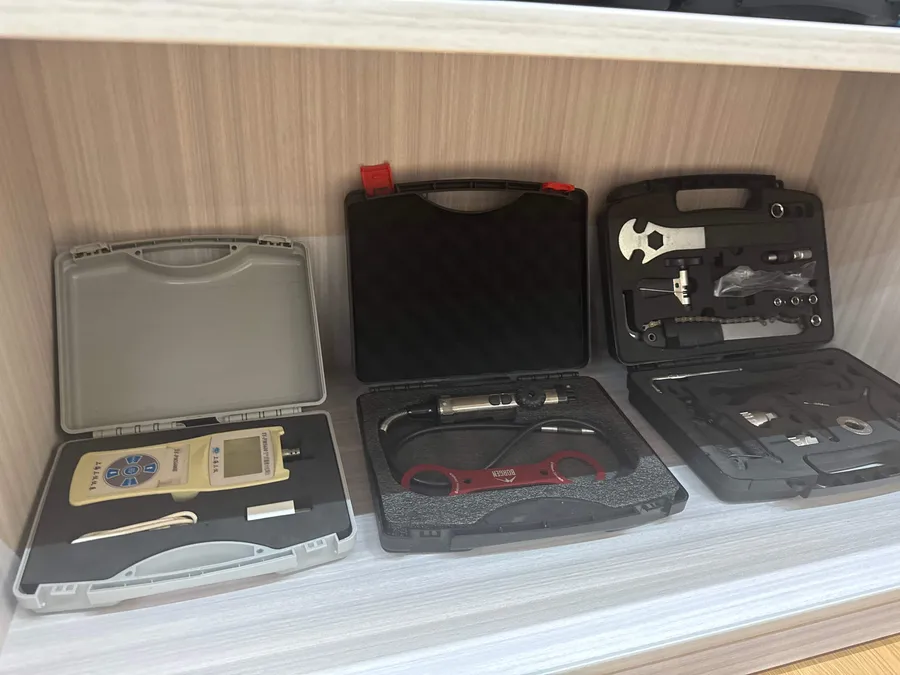
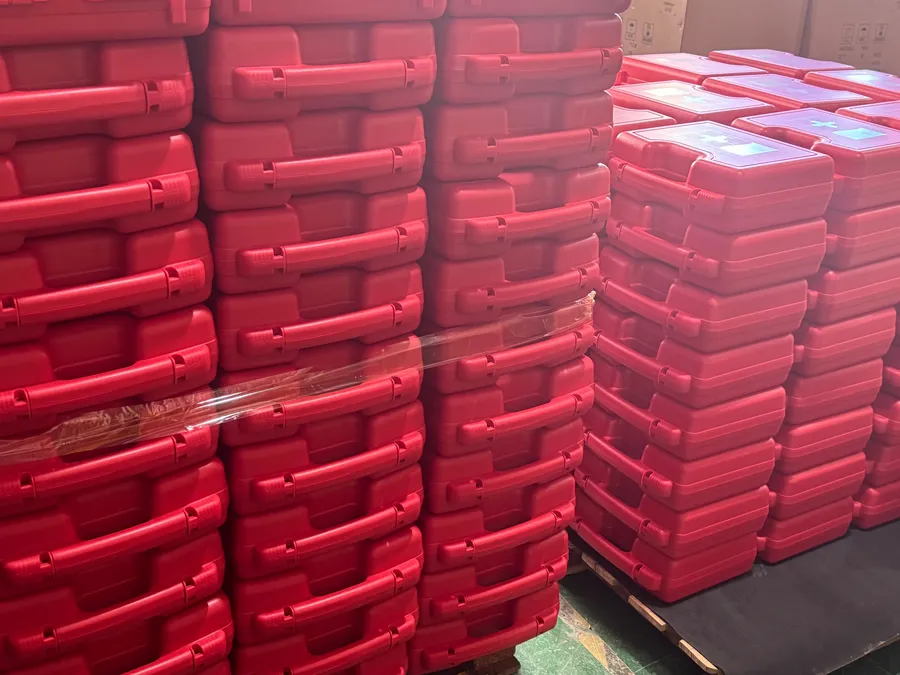
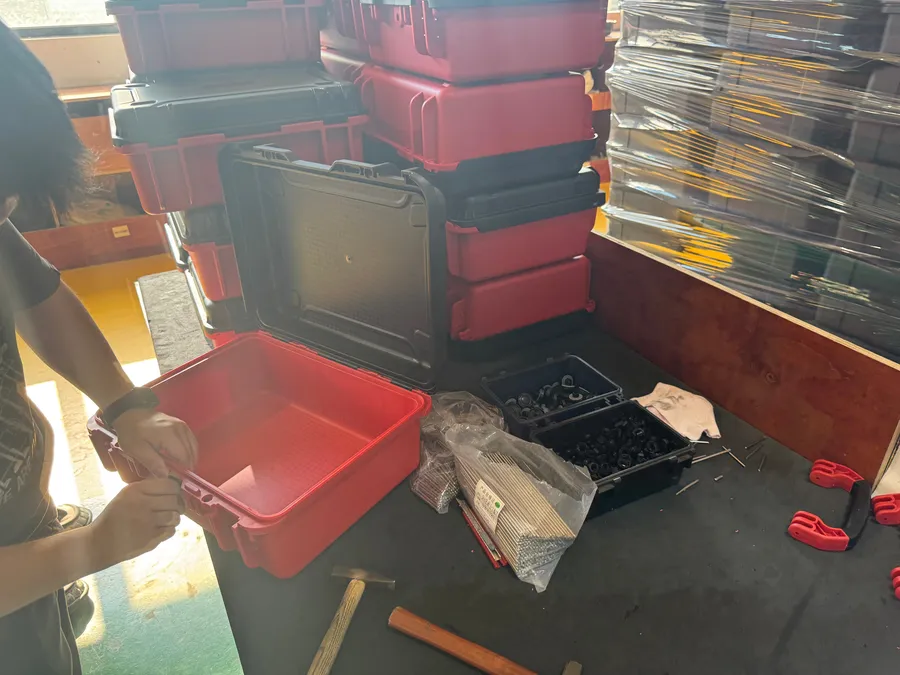
Customisation
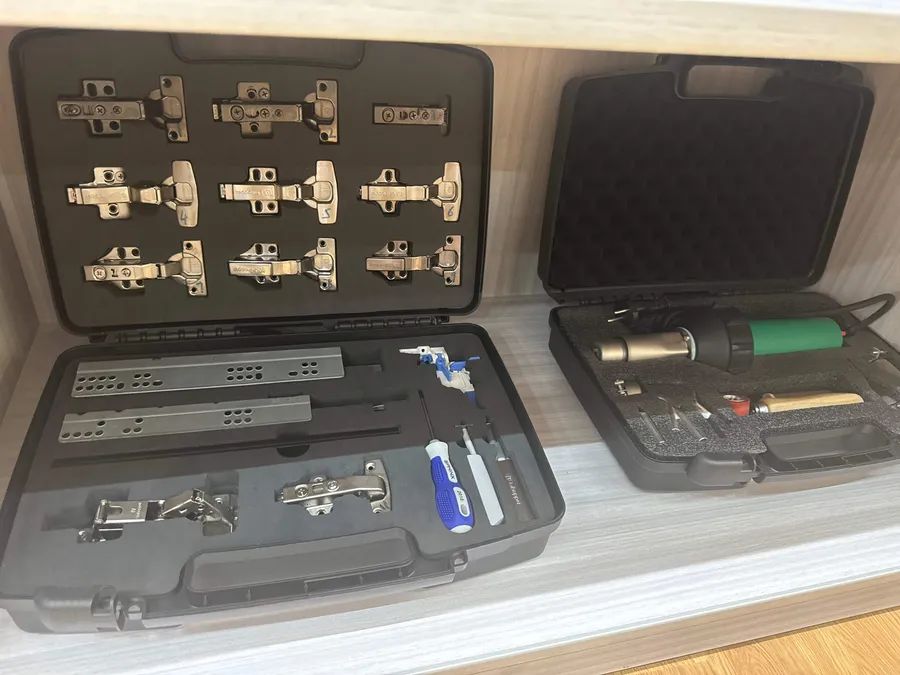
Everything described above is configurable on a standard shell: interior layout (pick-and-pluck, die-cut or CNC-cut), foam grade and thickness, colour, logo method, latch and lock count, pressure-equalisation valve, cable ports, document holder and identification plate. A bespoke exterior geometry requires a new mould — 125 days, from 3,000 units per moulded component.
Procurement considerations
| Question | What to send us |
|---|---|
| Which shell fits? | Equipment L × W × H as packed, plus required clearance per axis |
| What does it cost? | Order quantity and estimated annual quantity — the two drive different answers |
| Is tooling needed? | Whether an existing shell clears the envelope with usable foam depth |
| Lead time? | Your required delivery date, not just the order date |
| Certification? | The exact standard your tender names — we will say whether we can test to it |
| Freight? | Destination and preferred terms; carton and pallet data supplied with the quotation |
Comparison and selection guide
The tables on this page exist because a protective case is chosen by comparing three things: the envelope, the environment and the handling chain. Where no table applies, the rule below is.
| Situation | What To Do |
|---|---|
| Fixed inventory | CNC or die-cut silhouette with part numbers printed on the foam. |
| Variable kit | Pluck foam plus a loose tray. |
| Bench work | Removable trays that lift out square so the case doubles as a stand. |
- Size on internal dimensions plus clearance, never on a product name.
- Choose the carrying method before the shell: it changes the series, not just the price.
- Specify the interior last, and decide up front whether the end user will reconfigure it.
Explosion-proof hard safety box export factory? relates to Procurement Guide. Related families: Tool Cases / Instrument & Equipment Cases / Equipment Transport Cases / Custom Protective Cases / Military Protective Cases. Related sectors: field and industrial equipment. Continue in the Procurement Guide cluster.
This page is written from our own production data. If your requirement differs, send the dimensions and we will tell you which of the 155 models fits, or whether a custom route is needed.