How do buyers compare internal vs external dimensions across protective case suppliers?
Compare them as two independent published figures per axis, never as one derived from the other. A supplier that gives only an external size has told you about freight, not about fit; a supplier that gives only an internal size has told you about fit, but not about the carton, the pallet footprint or the volumetric weight you will be charged. The reliable test is arithmetic: for every model, subtract the internal length, width and height from the external length, width and height, halve each difference, and ask what that number is. On our own catalogue of 155 models, 148 of which publish external dimensions, internal dimensions and a wall thickness together, none of them resolves to the published wall thickness on all three axes, because the difference also carries the lid and base geometry, the taper of the side walls, the latch and hinge bosses and the wheel housings. So a quote that lets you compute one dimension set from the other is a quote that has not measured the case.
Key points
- Ask for internal and external length, width and height as separate published numbers, per axis, never as a single size.
- Halve the external minus internal difference on each axis and check it against the stated wall figure; they rarely match.
- Confirm the narrow internal width as well as the mouth width, because tapered shells are 0.81 to 0.94 narrower at the base.
- Ask for the lid and base depth split, not only total internal height, since tall connectors usually sit in the lid.
- Request the carton size and pieces per carton, which is the external figure your freight and storage plan is billed on.
- Treat any supplier who cannot produce both dimension sets per model as a fit risk, not a paperwork inconvenience.
Why the two dimension sets answer different questions
Internal dimensions answer a single question and they answer it completely: will the equipment, in the form you actually carry it, fit inside and will the lid close. External dimensions answer a different set of questions: what the case occupies on a shelf, in a vehicle, in a rack, in a carton and on a freight schedule. A buyer who compares suppliers on one number and ignores the other is comparing either fit or logistics, and getting a free pass on whichever one was not checked.
The reason the comparison gets awkward between suppliers is that the two figures are produced by different habits. One supplier measures a moulded shell with a rule through the opening and publishes that as internal. Another publishes the outer box size taken from the mould drawing, where the nominal size is a rounded family name rather than a measurement. Neither is dishonest, but they are not the same document, and lining them up column by column only works once you know which of the two numbers you are looking at.
The arithmetic that exposes a missing measurement
Take any model and compute half of external minus internal for each axis. If wall thickness were the whole story, all three results would equal the published wall figure. In our catalogue they do not, and the pattern is consistent enough to be a rule. On KX-1204 the external size is 120 by 90 by 40 millimetres against an internal 115 by 78 by 32, with a published wall of 2.6 millimetres, so the half-differences come out at 2.5, 6.0 and 4.0 millimetres, and only the length axis is anywhere near the wall figure.
On a larger shell the divergence is far wider, because more geometry sits between the inner face and the outer face. KX-6621 lists an external 662 by 495 by 210 millimetres against an internal 587 by 434 by 192 and a wall of 6.0 millimetres, which gives half-differences of 37.5, 30.5 and 9.0 millimetres. The long axes are carrying the rake of the side walls and the reinforcement ribs, not just plastic. A buyer who had sized the interior as external minus twice the wall would have overestimated the internal length by more than 60 millimetres.
That single calculation is the fastest supplier comparison there is, because it costs nothing and it is impossible to bluff. A datasheet where the two dimension sets reconcile on every axis has almost certainly had one of them filled in from the other.
What the difference is actually made of
Four things sit between the internal face and the external face. Wall thickness is only one of them. The second is taper: most moulded shells are narrower at the bottom of the base than at the mouth, which is why we publish a separate narrow internal width for 36 models, running from 70 to 308 millimetres and sitting between 0.81 and 0.94 of the quoted internal width. On KX-3308 that is 217 millimetres at the base against 236 at the mouth, a 19 millimetre difference that a rigid instrument with square corners will feel.
The third is the lid and base split. Total internal height is not one cavity, it is two, and which side the equipment sits on decides whether it clears. We publish lid depth and base depth separately for 100 models. KX-4613 is 74 millimetres of lid against 42 millimetres of base, while KX-6621 inverts it to 43 millimetres of lid against 149 millimetres of base. The fourth is hardware: latches, hinge barrels, feet, valve bodies and wheel housings all push the outside face outward without touching the inside at all, which is exactly why a trolley case such as KX-85021 shows half-differences of 29, 31 and 23 millimetres against a 4.5 millimetre wall.
A side by side reading of published figures
| Model | External Mm | Internal Mm | Published Wall Mm | Half Gap Per Axis Mm | Narrow Internal Width Mm |
|---|---|---|---|---|---|
| KX-1204 | 120 x 90 x 40 | 115 x 78 x 32 | 2.6 | 2.5 / 6.0 / 4.0 | 70 |
| KX-2005 | 195 x 170 x 46 | 190 x 135 x 40 | 2.0 | 2.5 / 17.5 / 3.0 | 127 |
| KX-3308 | 330 x 272 x 82 | 325 x 236 x 76 | 2.3 | 2.5 / 18.0 / 3.0 | 217 |
| KX-706 | 450 x 330 x 132 | 443 x 285 x 126 | 2.1 | 3.5 / 22.5 / 3.0 | 263 |
| KX-4613 | 460 x 367 x 126 | 455 x 338 x 116 | 3.0 | 2.5 / 14.5 / 5.0 | 302 |
| KX-6621 | 662 x 495 x 210 | 587 x 434 x 192 | 6.0 | 37.5 / 30.5 / 9.0 | not published |
| KX-85021 | 495 x 370 x 210 | 437 x 308 x 164 | 4.5 | 29.0 / 31.0 / 23.0 | not published |
| KX-88442 | 843 x 592 x 415 | 740 x 518 x 364 | 5.0 | 51.5 / 37.0 / 25.5 | not published |
How to normalise three supplier quotes on one sheet
Put the six numbers in the same units and the same axis convention before you compare anything. Length is the longest horizontal dimension, width is the shorter horizontal one, height is the closing direction. Ask each supplier to restate their figures in that convention, because a long or narrow body can be quoted with two axes transposed and then look like a completely different product, and the family name in a catalogue is not always the orientation the shell ships in. Our longest internal envelope, KX-814641 at 1280 by 350 by 140 millimetres, is the kind of shape where that mistake is easy to make.
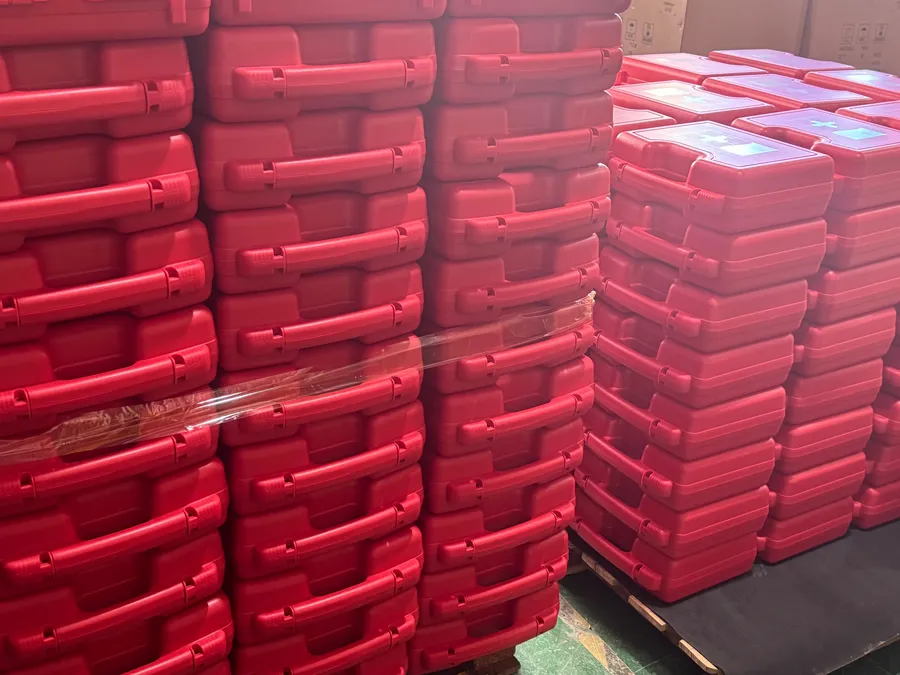
Then add three columns of derived numbers and treat them as sanity checks rather than as specifications. Internal volume tells you whether two quotes of similar external size are actually the same capacity, and we publish internal and external volume in litres for all 155 models, so KX-706 at 15.9 litres internal against 19.6 litres external can be compared directly with KX-4613 at 17.8 against 21.3. Clearance tells you whether the internal figures leave room for foam, since a fitted cut needs roughly 20 millimetres per axis beyond the equipment envelope. Carton tells you the number that reaches your warehouse, and we publish carton dimensions for 64 models with pieces per carton for 58 of them, ranging from one to forty units in cartons whose longest side runs between 410 and 885 millimetres.
Where a dimension mismatch actually bites
Electronics and instrumentation are where the error shows up first, because the equipment is rectangular, the connectors are rigid and the tolerance stack is small. A communications module that needs an internal bay of 440 by 280 by 120 millimetres is comfortable in KX-706 at 443 by 285 by 126 and not comfortable in a shell that only clears it on two axes. The narrow internal width matters again here, because a bracket or a heat sink sits low in the base where the shell is narrowest.
Field and defence loads fail differently, usually on height rather than on plan area, because the lid and the base are not equal cavities. A case listed with a 192 millimetre internal height can be 43 millimetres of lid plus 149 millimetres of base, which is fine for a flat radio and useless for an assembly with a raised connector. Long equipment has the same problem stretched out: for a rifle, an optical column or a tripod, internal length is only half the question, and internal width plus wall is what decides whether a bipod or a sight clears when the lid comes down.
Sizing guidance for a bespoke interior
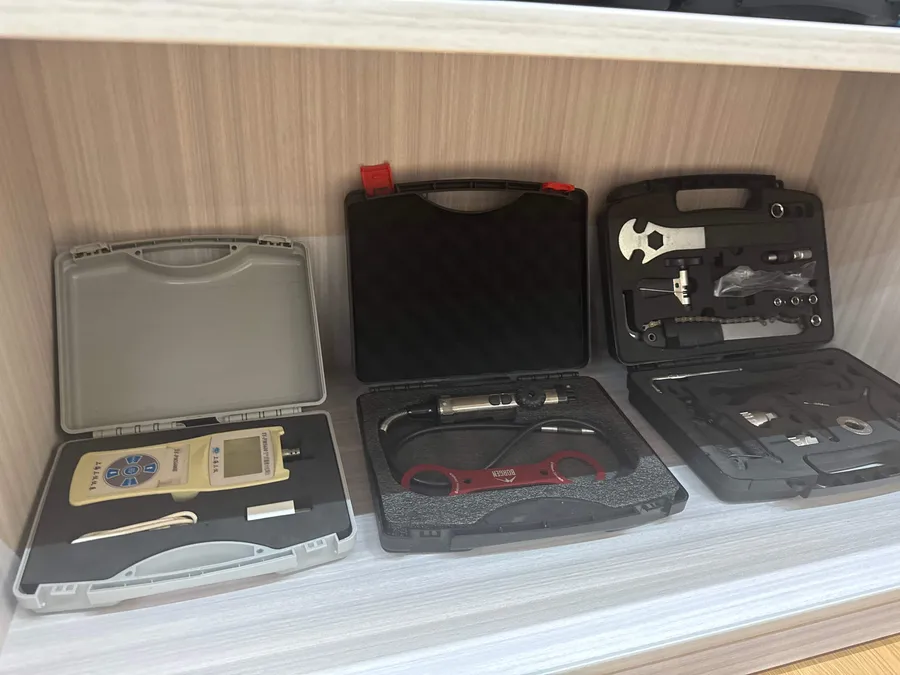
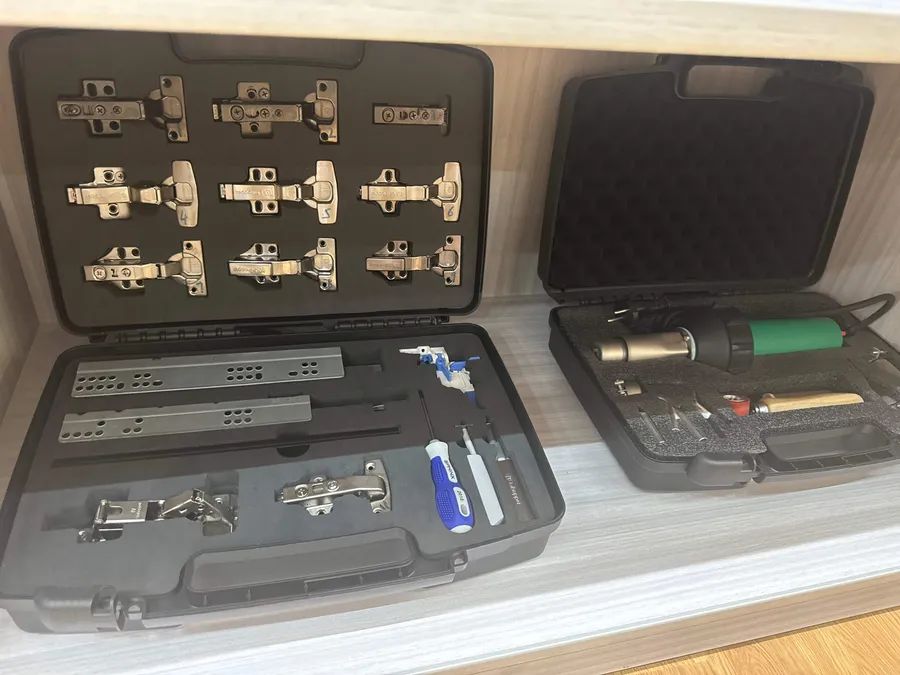
Where nothing published clears the envelope, the shell is cut for the equipment instead of the equipment being cut for the shell. Send the packed dimensions and the mass, and we return the closest published internal envelopes first; internal lengths across the catalogue run from 115 to 1280 millimetres, internal widths from 78 to 545 millimetres and internal heights from 32 to 364 millimetres, so most enquiries land on an existing body with a new foam cut. A custom interior on an existing shell carries a minimum of one unit for the foam itself, while a logo or a colour change begins at 300 units.
If the envelope genuinely falls outside every shell, a new mould is the only answer, and that is where the dimension conversation becomes contractual. New tooling runs up to about 125 days and begins at 3000 units, against about 45 days for a first sample on an existing tool. Because the numbers have to survive that lead time, we agree the internal envelope, the narrow internal width, the lid and base split and the external outline on a drawing before any steel is cut, and the approved first sample is the reference the shipment is measured against.
Purchasing notes and the limits of our own figures
We work on wholesale and OEM terms only, quoted EXW or FOB with a 30 percent deposit. We do not sell at retail, we do not quote DDP, and we hold no overseas warehouse stock, so the external dimensions and carton figures on a quote are the numbers your forwarder will price, not a delivered-to-door service we manage.
Two honest gaps are worth stating plainly. Our catalogue does not publish pallet quantities or container loading figures for these models, so a pallet plan has to be worked from the published external dimensions and carton sizes for the specific order, and we will not extend one model's logistics arithmetic across the range. And we do not state protection ratings or environmental performance for a model unless that figure has been measured for it; internal and external dimensions, wall thickness, lid and base depth and net weight are published per model as measured, and an ingress or impact claim is a separate document you should request rather than infer from a wall thickness.
Customisation
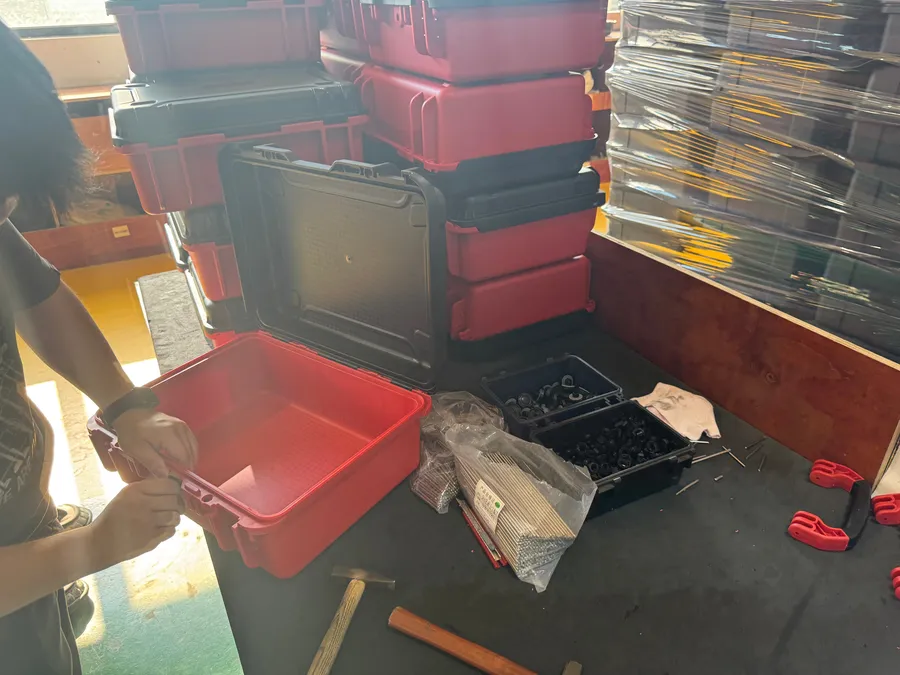
Everything described above is configurable on a standard shell: interior layout (pick-and-pluck, die-cut or CNC-cut), foam grade and thickness, colour, logo method, latch and lock count, pressure-equalisation valve, cable ports, document holder and identification plate. A bespoke exterior geometry requires a new mould — 125 days, from 3,000 units per moulded component.
Procurement considerations
| Question | What to send us |
|---|---|
| Which shell fits? | Equipment L × W × H as packed, plus required clearance per axis |
| What does it cost? | Order quantity and estimated annual quantity — the two drive different answers |
| Is tooling needed? | Whether an existing shell clears the envelope with usable foam depth |
| Lead time? | Your required delivery date, not just the order date |
| Certification? | The exact standard your tender names — we will say whether we can test to it |
| Freight? | Destination and preferred terms; carton and pallet data supplied with the quotation |
Comparison and selection guide
The tables on this page exist because a protective case is chosen by comparing three things: the envelope, the environment and the handling chain. Where no table applies, the rule below is.
| Situation | What To Do |
|---|---|
| Fastest | Standard shell plus CNC foam — typically 45 days from approved drawing. |
| Branded | Standard shell plus custom colour and logo — MOQ applies to the resin colour. |
| Bespoke geometry | New mould — 125 days, MOQ from 3,000 units per component. |
- Size on internal dimensions plus clearance, never on a product name.
- Choose the carrying method before the shell: it changes the series, not just the price.
- Specify the interior last, and decide up front whether the end user will reconfigure it.
How do buyers compare internal vs external dimensions across protective case suppliers? relates to Procurement Guide. Related families: Custom Protective Cases / Instrument & Equipment Cases / Electronics Cases / Equipment Transport Cases / Military Protective Cases. Related sectors: field and industrial equipment. Continue in the Procurement Guide cluster.
This page is written from our own production data. If your requirement differs, send the dimensions and we will tell you which of the 155 models fits, or whether a custom route is needed.


