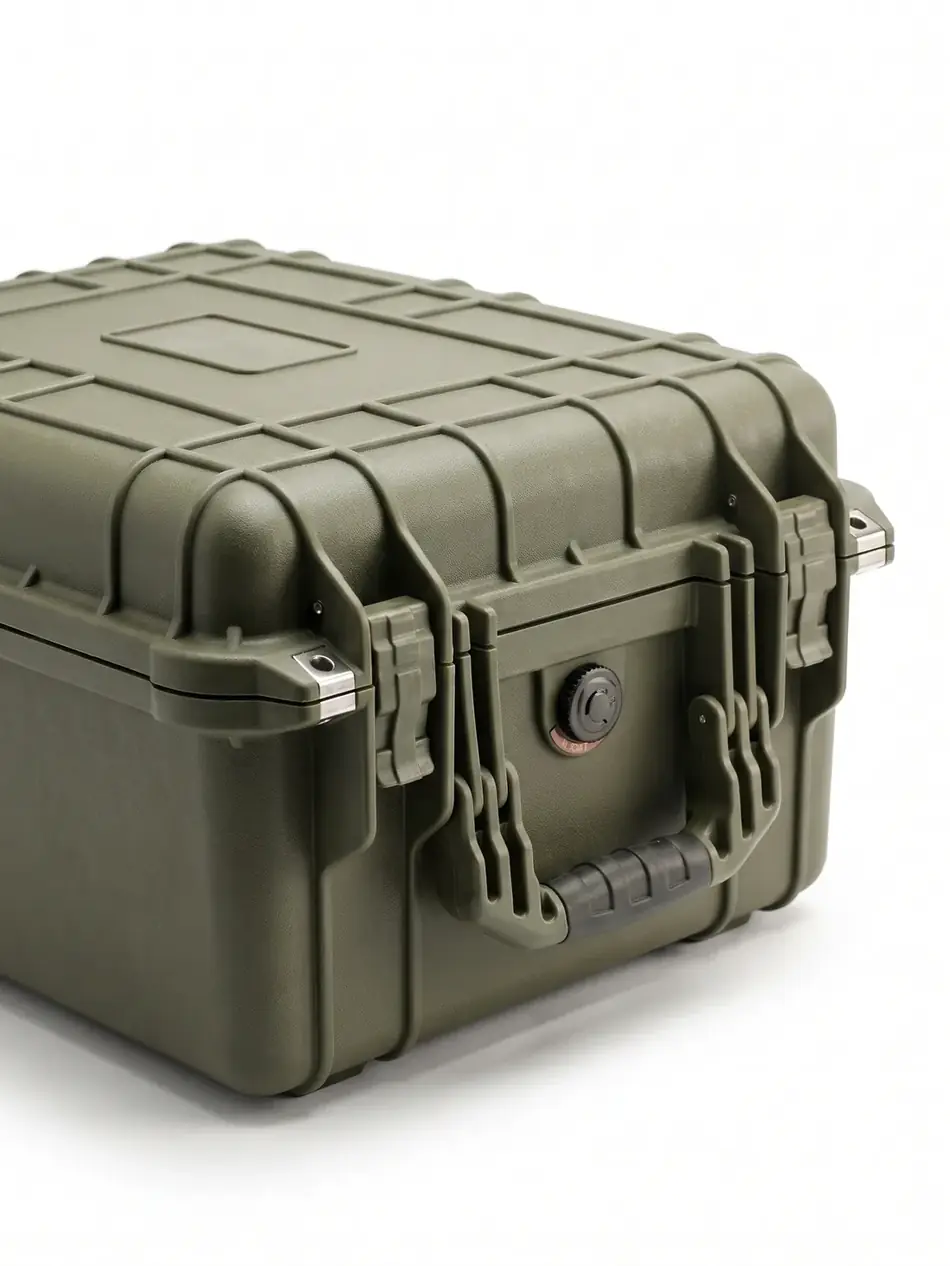
What should international buyers ask a protective case manufacturer?
International buyers should ask a protective case manufacturer five groups of question before a cross-border order, and expect measurable answers rather than adjectives. First, whether the factory actually owns the mould behind the model or only resells it. Second, the published internal and external dimensions, wall thickness and net mass for the exact part number you are quoting. Third, which minimum-order tier your request falls into, because stock units and a custom foam insert begin at one unit while colour, logo and an OEM build begin near three hundred and a dedicated new tool begins near three thousand. Fourth, how quality is verified at distance through a first-article sample, a written inspection chain and third-party checks. Fifth, the commercial frame: KeXin sells wholesale and OEM only on EXW or FOB terms with a thirty percent deposit, and does not quote DDP landed prices or hold overseas warehouse stock.
Key points
- Ask which mould number the model comes from and whether the factory can show the tool; owning the mould governs lead time, spare parts and change orders.
- Request internal and external dimensions, wall thickness and net mass for the exact part number, not one value applied across the whole catalogue.
- Confirm the MOQ tier before comparing prices: stock and custom foam start at one unit, colour, logo and OEM near three hundred, a new tool near three thousand.
- Set the quality gate in writing: a first-article sample, an inspection checklist and a named party for third-party checks, because distance removes the walk-down.
- Lock the trade terms early: wholesale and OEM only, EXW or FOB, a thirty percent deposit and a stated lead time for the tier you actually need.
Confirm you are talking to the manufacturer, not a reseller
The first question an international buyer cannot outsource is whether the supplier controls the tool. A reseller and a factory can quote the same photograph and the same price, and the difference only shows up later: when you need a spare latch, a change to the interior, a re-run after a gap, or a component that matches your original exactly. Ask which mould number the model is produced from, whether that tool is in the same building as the injection machines, and what happens to your interior design and any tool you funded if you stop ordering. A real injection-moulding factory answers with numbers and a schedule; a middleman answers with adjectives.
Then test whether the published catalogue is genuine rather than copied. KeXin lists 155 models with per-model external and internal dimensions, wall thickness, net mass, shell material and whether a seal is offered. A buyer who is shown a spreadsheet of part-level figures, and who can match those figures to a named product page, is dealing with a party that actually produces the parts. Ask for a machine list, the clamping tonnage range and the mould store, and treat a refusal to share them as an answer in itself.
Ask for the numbers that already exist on the model page
Most procurement mistakes happen because a buyer quotes a picture instead of a dimension. Every relevant figure is published per model and should be pulled into your own comparison sheet rather than paraphrased. A firearm-length example, KX-814641, is listed at 1356 millimetres outside and 1280 by 350 by 140 millimetres inside with a 5.0 millimetre wall, while an ABS-bodied KX-63413 ammunition box shows 339 by 310 by 125 millimetres outside and a 4.8 millimetre wall at 1680 grams. These are design points on different tools, so a taller wall on one model says nothing about another; ask for the exact figure for the part you intend to buy.
Read the specification for what it does not cover as carefully as for what it does. KeXin publishes measured dimensions and mass model by model and states plainly where a value was not measured. If a supplier offers you a protection code, a drop height or a stacking load that appears without a measurement on that exact model, that is an open question to send back, not a line to copy into your own specification. The right ask is a signed dimensional sheet for the specific model you are evaluating, plus the packing list format the goods will actually ship under.
Tie MOQ, tooling and lead time to the same question
Buyers usually ask these three separately and then receive a unit price that quietly assumes the smallest change. The tiers are simple: standard stock and a custom-cut foam interior begin at one unit because the insert is cut from board rather than moulded; a printed logo, a body colour change and an OEM build begin around three hundred units; and a dedicated custom mould begins around three thousand units per component. Lead time follows the same ladder. An OEM build on an existing mould is planned at about forty-five days to first sample, while a new mould is planned at about one hundred and twenty-five days. Ask which tier your request falls into before you compare any price, because a unit figure only means something at the quantity that unlocks it.
For a firearm, defence or ammunition programme the question that matters is whether your requirement fits an existing tool. A buyer who can live inside a published external footprint customises the interior and the print, keeps the schedule in weeks and avoids the three-thousand-unit commitment. A buyer who genuinely needs new outside dimensions budgets the new-mould path and its longer clock. Confirm which of these two you are on at the quotation stage, not at the sample stage.
How quality travels across a border
Distance removes the informal checks an on-site buyer takes for granted, so replace them with paper and a sample. Ask for a first-article sample of the exact configuration and approve it against your own internal envelope before tooling is committed or a bulk run is released. Then agree the inspection chain in writing: which dimensions are checked on production units, what the acceptable tolerance is on wall and lid fit, how latch count and seal compression are verified, and who performs the pre-shipment inspection. A third-party inspection house is welcome precisely because the numbers on the model pages are published per model and can be measured against.
Ask what is held as a serviceable spare part after the order. Hardware such as latches, hinges, handles and wheels are the components most likely to need replacement during a product's life, and a factory that already runs them as standard spare items protects your resale or your fleet. Put the spare-part list and its lead time in the same agreement as the main order.
Verification matrix: what to ask and the evidence to expect
| Topic | Ask The Manufacturer | Evidence To Expect |
|---|---|---|
| Tool ownership | Mould number and tool location | Mould store, machine list, tonnage |
| Fit | Internal and external mm for the exact model | Per-model published spec, signed dimensional sheet |
| Mass and wall | Net mass and wall for that part number | Model-level figures, not a range average |
| MOQ and lead time | Which tier unlocks my unit price | 1 / ~300 / ~3000 tiers, 45 or 125 days |
| Trade terms | Delivery basis and deposit | EXW or FOB, thirty percent deposit, no DDP |
| Packing | Carton and pallet plan for the quantity | Carton footprint against your pallet size |
How to prioritise the questions by buyer situation
A first-time importer should lead with fit and terms: get the internal envelope for two or three candidate models, run one as a sample, and confirm EXW or FOB and the deposit before anything else. A reseller building a repeatable line should lead with tool ownership and spare parts, because their risk is not the first shipment but the fifth one that has to match the first. A defence or programme buyer should lead with the inspection chain and configuration control, since traceability of wall, seal and hardware across batches is what survives an audit.
Where the same case platform serves several products, a modular interior with interchangeable foam layers is usually a better opening question than a bespoke cut, because you revise a tray rather than re-tool a shell. Where the box will live stacked in a rack or on a pallet, prioritise the rim and wall specification over cosmetics, since those govern whether the stack holds.
Where these questions matter most
Cross-border diligence pays off most where a single wrong number is expensive: firearm and long-equipment transport, where a published case up to 1356 millimetres outside has to clear a specific internal length; ammunition and component storage, where located separation and a per-model seal change the interior design; and field, defence and optics programmes, where the payload is fixed and the case has to be specified around it rather than the other way round. In each the same short list of measured, verifiable answers protects the order.
Procurement notes: terms, packing and paperwork
Close with the commercial frame in the same email as the technical questions. KeXin, trading as KeXin New Materials (Guangdong) Co., Ltd., works wholesale and OEM only, quoted EXW or FOB, with a thirty percent deposit; there is no retail, no DDP landed quotation and no overseas warehouse, so plan your own freight from the shipping port. Ask how the order is cartoned and palletised, since pallet counts are calculated from the carton footprint against your pallet size rather than copied from a generic figure, and confirm the shipping marks and the paperwork set your customs broker needs. A buyer who confirms the manufacturer, the published specs, the MOQ tier, the inspection chain and the packing plan in one pass gets an accurate quote; one who asks only for a price per unit usually gets a number that changes at the sample stage.
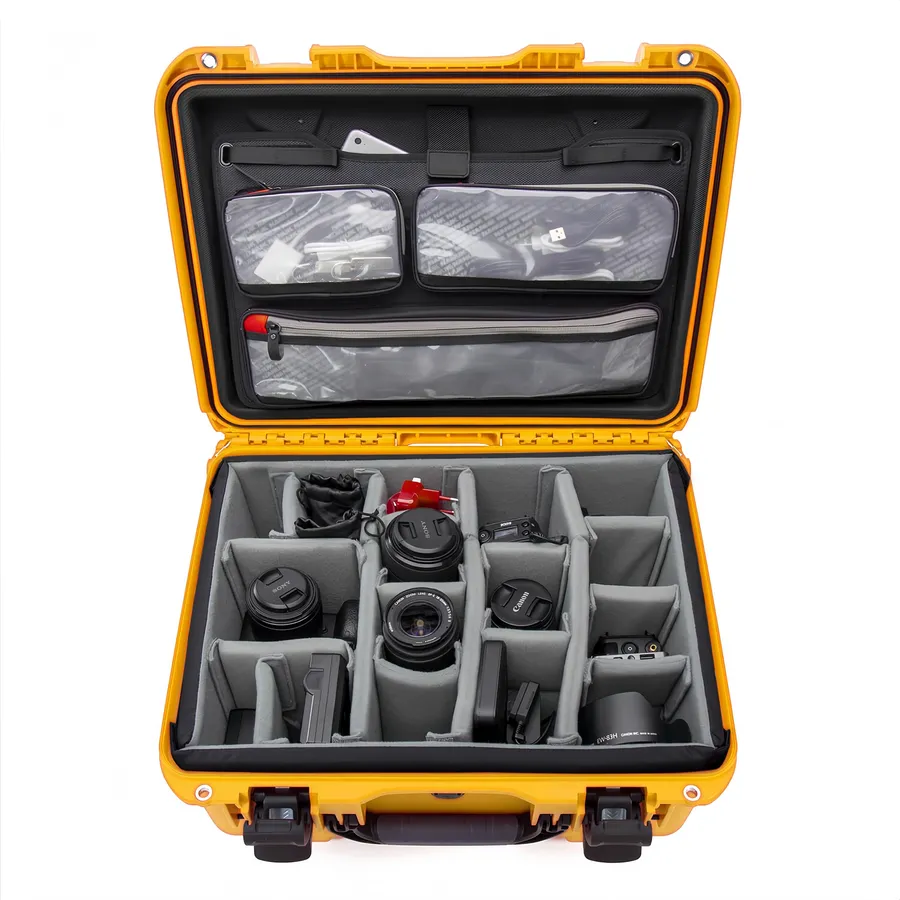
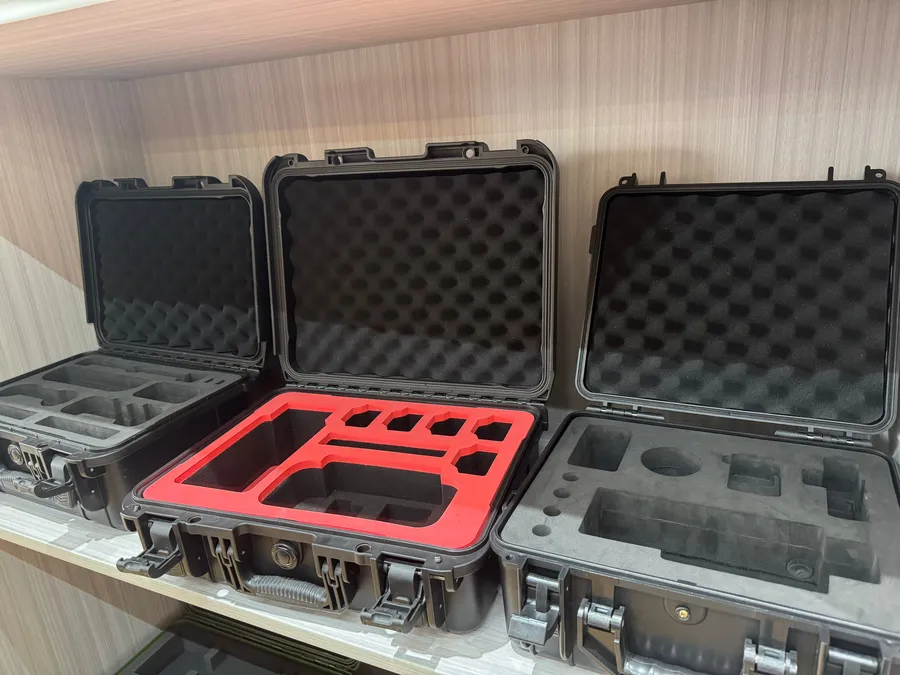
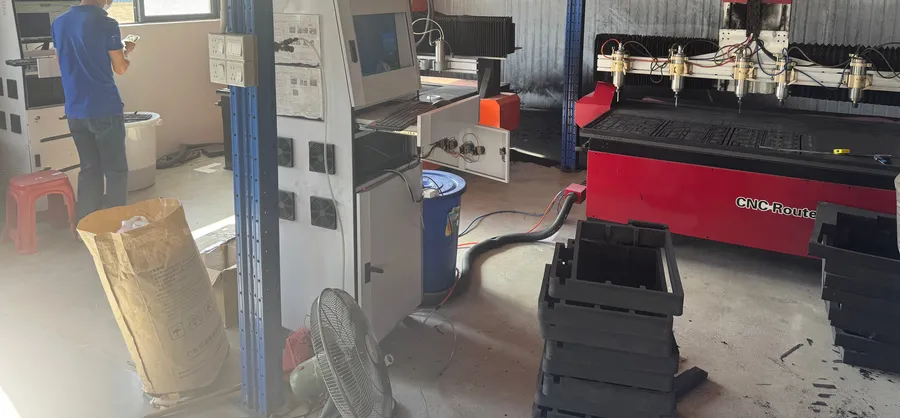
Customisation
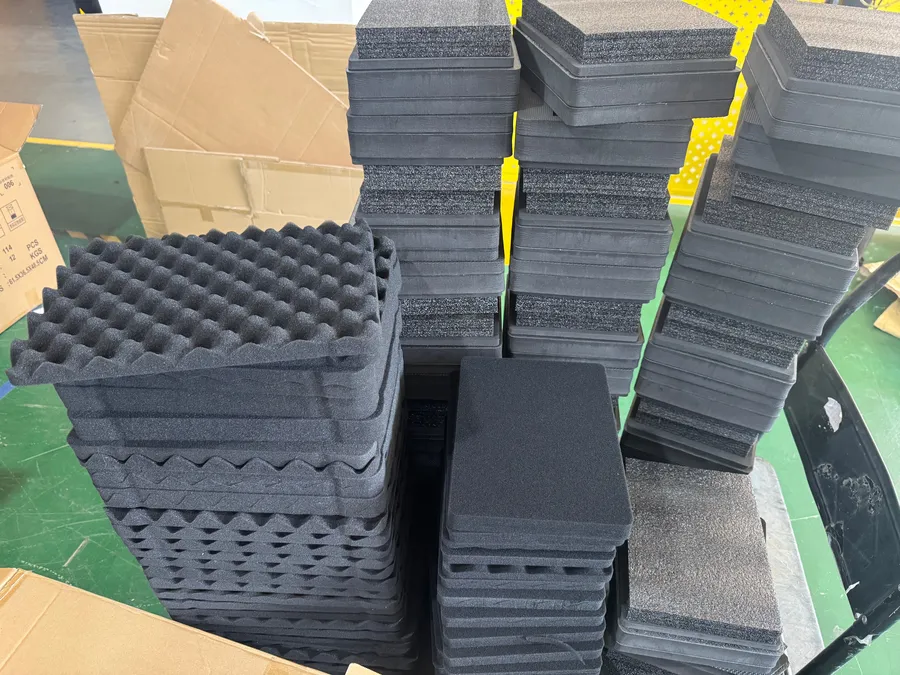
Everything described above is configurable on a standard shell: interior layout (pick-and-pluck, die-cut or CNC-cut), foam grade and thickness, colour, logo method, latch and lock count, pressure-equalisation valve, cable ports, document holder and identification plate. A bespoke exterior geometry requires a new mould — 125 days, from 3,000 units per moulded component.
Procurement considerations
| Question | What to send us |
|---|---|
| Which shell fits? | Equipment L × W × H as packed, plus required clearance per axis |
| What does it cost? | Order quantity and estimated annual quantity — the two drive different answers |
| Is tooling needed? | Whether an existing shell clears the envelope with usable foam depth |
| Lead time? | Your required delivery date, not just the order date |
| Certification? | The exact standard your tender names — we will say whether we can test to it |
| Freight? | Destination and preferred terms; carton and pallet data supplied with the quotation |
Comparison and selection guide
The tables on this page exist because a protective case is chosen by comparing three things: the envelope, the environment and the handling chain. Where no table applies, the rule below is.
| Situation | What To Do |
|---|---|
| Length | Allow at least 25 mm at each end beyond the equipment so the foam can absorb end impact rather than the shell. |
| Depth split | A deeper base carries the mass; a shallow lid retains it. We normally recommend a 60/40 or 70/30 base-to-lid split. |
| Closure | Latches on the long edge give better sealing on a flexing shell; latches on the short edge are faster to open. |
- Size on internal dimensions plus clearance, never on a product name.
- Choose the carrying method before the shell: it changes the series, not just the price.
- Specify the interior last, and decide up front whether the end user will reconfigure it.
What should international buyers ask a protective case manufacturer? relates to Procurement Guide. Related families: Firearm Transport Cases / Custom Protective Cases / Military Protective Cases. Related sectors: field and industrial equipment. Continue in the Procurement Guide cluster.
This page is written from our own production data. If your requirement differs, send the dimensions and we will tell you which of the 155 models fits, or whether a custom route is needed.