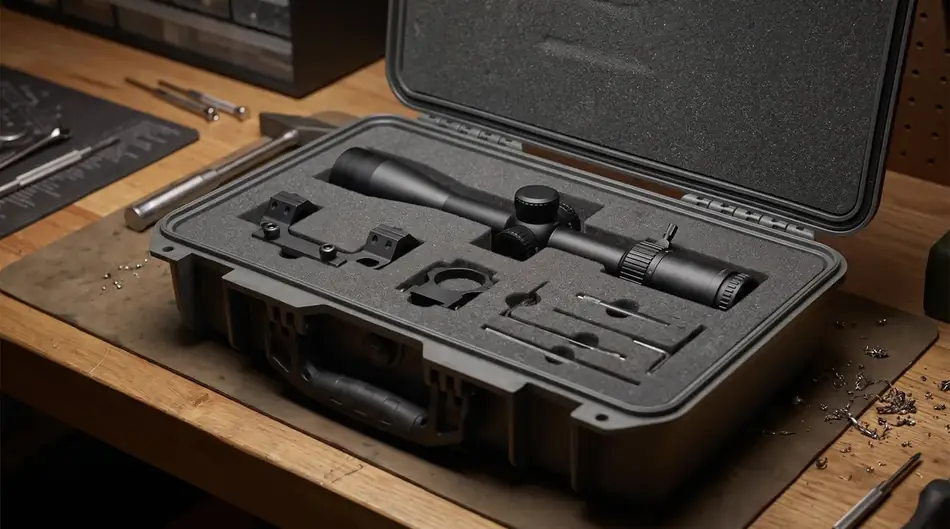
Industrial Pressure Test Pump Matching Box: Sized To The Kit You Already Have
Match the case to the packed pump kit, not to the pump. A pressure test pump goes into a gasketed polypropylene or ABS hard shell chosen against published internal length, width, height and lid depth per model, with a cut plank over the fittings and a firm base under the pump body: the common workhorse is a box of about 300 by 200 by 200 mm internal on a 5.0 mm wall such as the KX-93221, a kit with its hose, reservoir and gauge set moves up to the 481 by 373 by 192 mm cavity of the KX-5321 or the 587 by 434 by 192 mm KX-6621 on a 6.0 mm wall, and a fitting or adapter set that travels inside a larger export carton starts from the 253 by 180 mm footprints of the KX-92817 and KX-2811. KeXin publishes internal and external dimensions, wall thickness, usable volume, net weight and carton packing model by model across 155 mouldings, and leaves a field blank when it has not been measured on that model rather than filling it with a catalogue average. Where a purchaser, a tender or an outage contract asks for an ingress protection class, a recorded drop height or an impact value, we say plainly whether that measurement exists for the configuration you order and, if it does not, quote it as accredited laboratory testing on that exact build instead of printing a claim we cannot evidence. The pump itself, its pressure rating and its calibration record are the instrument maker's data and the test laboratory's responsibility; the case is specified against the volume, mass and protrusions of the assembled kit.
Key points
- Size the box from the packed kit: pump body, bleed valve, gauge, coiled hose, reservoir and fittings measured together, with about ten millimetres per side.
- Test pumps fail a lid line rather than a footprint, so read lid depth and base depth separately from total internal height before you commit to a moulding.
- A 5.0 to 6.0 mm wall and a firmer base plank carry the pump mass; published wall thickness runs 2.0 to 6.0 mm across 148 of our 155 models.
- Small bore fittings, adapters and spare seal kits are what go missing, so they belong in a cut plank above the pump rather than loose against the gauge glass.
- Carton packing is published on 64 models at one to forty pieces; pallet and container figures are calculated against your pallet size and quoted, not assumed.
- An ingress class or an impact figure belongs to a named test report and a named sample, so ask any supplier for both before you accept the adjective.
- KeXin is wholesale and OEM or ODM only on EXW or FOB terms: first article near 45 days, a new mould near 125 days, 30 per cent deposit.
Start From The Assembled Kit, Not From The Pump Model
A pressure test pump is sold as an instrument and bought as a packing problem. The pump body is a block of machined metal with a lever, a bleed valve and a threaded outlet that all stick out; the gauge is glass-fronted and expensive; the hose wants to be coiled rather than bent; the reservoir or water tray is bulky, empty-looking and impossible to squash; and the adapters, nipples, spare washers and seal kits are small enough to travel in a lapel pocket and get lost forever. One cavity answers all five badly, which is why professional buyers shortlist by published internal length, width, height and lid depth first, then by appearance. KeXin lists internal and external dimensions, wall thickness, lid and base depth, internal volume, usable volume, net weight and carton packing model by model across 155 mouldings, so specifying a matching box becomes arithmetic against the kit that already exists in the service van. Measure the kit as it is actually carried, with the hose coiled and the reservoir in place, add about ten millimetres per side for the cut walls and five to ten millimetres at the closing line, and compare that against the published internal figures rather than against a photograph of an open box.
Industrial Pressure Test Pump Matching Box
The phrase industrial pressure test pump matching box means a case selected to fit one named pump kit, and the first figure to check is whether the pump stands on its base or lies on its side. A hand-operated pump standing upright needs internal height, not just length: the engineering-polypropylene KX-93221 lists 300 by 200 by 200 mm internal with a 165 mm lid over a 35 mm base on a 5.0 mm wall, about 9.6 litres usable at 323 by 243 by 212 mm external and about 1,230 g empty, which takes a compact bench pump with its gauge and a short hose. Where the crew carries the pump with its reservoir and a longer lead, the KX-3218 gives 308 by 230 by 172 mm internal with an 86 mm lid over an 86 mm base on a 3.0 mm wall at about 10.5 litres and about 900 g, and the ABS KX-63416 gives 310 by 255 by 138 mm on a 4.8 mm wall with about 8.7 litres at about 1,800 g for a stiffer, more scratch-resistant shell around gauges. For a motorised unit with its charger, hose reel and calibration record folder, step up to the KX-5321 at 481 by 373 by 192 mm internal on a 5.8 mm wall with about 27.5 litres and about 4,810 g, or the KX-6621 at 587 by 434 by 192 mm on a 6.0 mm wall with about 39.1 litres and about 6,420 g. Thirty-seven of our 155 models publish internal height at 200 mm or more, which is the shortlist for kits that must stay upright. A coiled hose and a reservoir ride with the pump in the same cavity when the depth allows it, and in a separate shallow tray above when it does not, which is the choice the published lid and base figures let you make.
Heavy Duty Impact-Resistant Mechanical Parts Box
Buyers who search for a heavy duty impact-resistant mechanical parts box are almost always holding a parts list rather than a specification: steel adapters, reaction blocks, test tees, manifolds and spare valve bodies that have no business travelling loose against a gauge. Two published construction facts do the work. Wall thickness is listed per model and runs from 2.0 mm to 6.0 mm across 148 of our 155 mouldings, with 91 models tagged in our thick-wall family, so a box that carries several kilograms of steel is chosen from that end of the table: the KX-5321 at 5.8 mm, the KX-6621 at 6.0 mm, the KX-65522 at 5.3 mm in ABS. Base depth decides what the mass actually lands on: the KX-5321 and KX-6621 both list a 149 mm base under a 43 mm lid, which puts the steel low and leaves the lid free for the fragile layer. The word impact-resistant is where a specification normally slips, because it is used for three different things in procurement documents: the shell material's own toughness, a free-fall height a finished case was taken to by a laboratory, and a stacking load in a warehouse rack. Those are different tests with different samples. We publish the wall figure and the construction, we describe shock and impact protection as a configuration that depends on the foam layout you specify, and we do not attach a drop height or an impact value to a moulding unless that measurement exists for the build you order.
Industrial Export Kit Custom Plastic Outer Box
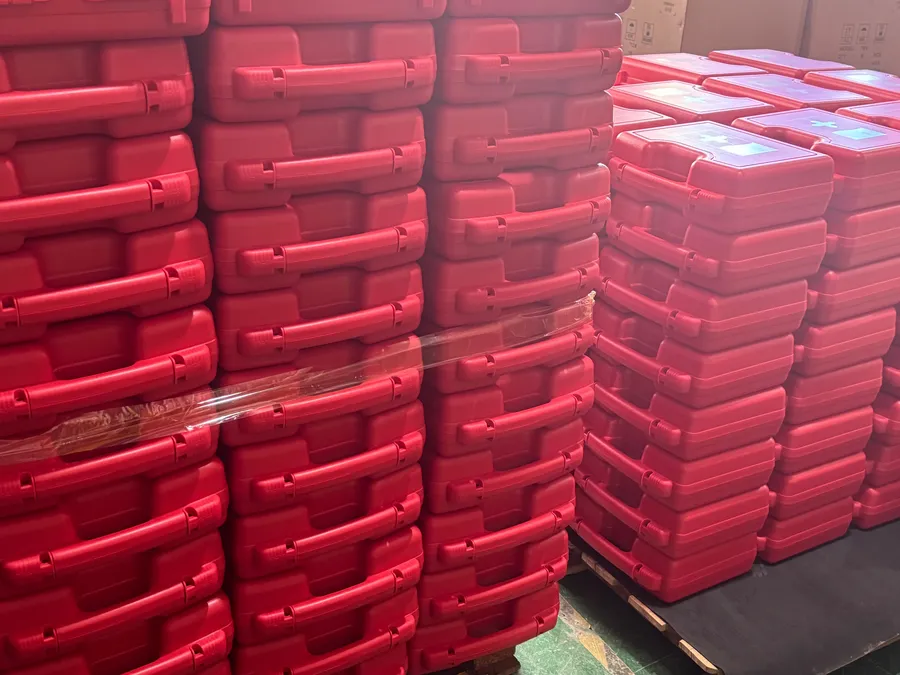
An industrial export kit is a different buyer with a different document: the pump kits have already been accepted, and now somebody has to pack forty or five hundred of them into containers and land them without a scratched gauge. That is a custom plastic outer box conversation, and it is decided by the carton rather than the case. KeXin publishes carton dimensions and pieces per carton on 64 models, ranging from one to forty pieces per carton, which is what makes a freight quote comparable between suppliers: the KX-3218 ships twelve pieces in a 645 by 530 by 550 mm carton, the KX-3213 sixteen in 645 by 530 by 520 mm, the KX-63416 eight in 675 by 365 by 360 mm, the KX-2813 twenty in 560 by 490 by 665 mm, and the larger KX-5321, KX-65522, KX-6621 and KX-96127 one to three pieces per carton at roughly their own external footprint. Where a pallet figure would be more useful than a carton figure, we say what it is: our pallet loading is recorded as not measured for the catalogue and is calculated from the carton footprint against your pallet size, and 20GP, 40GP and 40HQ container figures are supplied with the quotation once the ordered quantity is known. OEM changes to the outer box are quoted per project because the tooling path differs: colour, a moulded logo, a marking band, a printed kit list in the lid and a printed carton label are all routine; a new outer moulding is a 3,000-piece custom mould project at about 125 days.
Published Sizes: Pump Kit Item To The Figure You Should Check
| Kit Item | Figure To Check | Published Example | Long Tail This Answers |
|---|---|---|---|
| Compact hand pump, gauge and short hose | Internal height at the lever plus lid clearance | KX-93221: 300 x 200 x 200 mm internal, 165/35 mm lid/base, 5.0 mm wall, PP engineered, gasket, about 9.6 L, 1,230 g | Industrial pressure test pump matching box |
| Pump with reservoir, coil and fitting tray | Footprint plus usable volume at a shallow lid | KX-3218: 308 x 230 x 172 mm internal, 86/86 mm lid/base, 3.0 mm wall, gasket, about 10.5 L, 900 g, 12 pcs per carton | Industrial pressure test pump matching box |
| Gauge and calibration accessories layer | Stiffer shell, internal height under the dial | KX-63416: 310 x 255 x 138 mm internal, ABS, 4.8 mm wall, gasket, about 8.7 L, 1,800 g, 8 pcs per carton | Heavy duty impact-resistant mechanical parts box |
| Steel adapters, tees and spare valve bodies | Wall thickness and base depth, since mass lands low | KX-5321: 481 x 373 x 192 mm internal, 43/149 mm lid/base, 5.8 mm wall, about 27.5 L, 4,810 g, 3 pcs per carton | Heavy duty impact-resistant mechanical parts box |
| Motorised pump, charger and hose reel | Internal length of the assembled kit, two-person lift | KX-6621: 587 x 434 x 192 mm internal, 43/149 mm lid/base, 6.0 mm wall, about 39.1 L, 6,420 g, stackable | Heavy duty impact-resistant mechanical parts box |
| Small station box for one crew's fittings | Depth per layer and a readable interior | KX-2811: 253 x 180 x 98 mm internal, 71/27 mm lid/base, 5.0 mm wall, gasket, about 3.6 L, 890 g | Industrial pressure test pump matching box |
| Bulk order shipped as an export kit | Carton footprint and pieces per carton | KX-2813: 260 x 200 x 117 mm internal, 20 pcs in 560 x 490 x 665 mm carton, 2.8 mm wall, plain rim without a gasket | Industrial export kit custom plastic outer box |
| Mixed kit racked on a service cart | One footprint in several published depths | KX-3213 at 308 x 230 x 118 mm and KX-3218 at 308 x 230 x 172 mm, both 3.0 mm wall, gasket, 16 and 12 pcs per carton | Industrial export kit custom plastic outer box |
| Crew outfit that is lifted rather than rolled | Empty mass against the carry, then wheels if the route is long | KX-65522: 507 x 385 x 190 mm internal, ABS, 5.3 mm wall, about 29.7 L, 4,860 g; 19 of our 155 models publish wheels and a telescopic handle | Heavy duty impact-resistant mechanical parts box |
What We Publish And What We Leave Blank
Pressure testing is a documentation-heavy trade, so buyers arrive with a specification written in words no case catalogue should be answering. Here is our own line. Published and measured for each model: internal and external dimensions, wall thickness on 148 mouldings, lid and base depth, internal and usable volume across a range of 0.3 to 139.5 litres and 0.3 to 111.6 litres, net weight on 93 models from 100 g to 15,320 g, shell material, gasket availability, stackability, wheels and carton packing. Recorded as not measured and therefore left blank: an ingress protection class, a recorded free-fall height, a stacking load figure, a salt-spray duration, a temperature range and a pallet quantity. On the 124 models we list a compressible gasket running in a continuous moulded channel, and on the other 31 we list a plain rim and say so; a gasket is a mechanical fit detail that keeps grit and splash out of the lid line, and it is not, by itself, evidence for a protection class. If your outage contract, your customer or your own quality plan names a class or a load, we treat it as a separate test work package on the configuration you order, carried out at an independent laboratory, and we tell you in the same sentence which figures already exist.
The Interior Does Most Of The Work
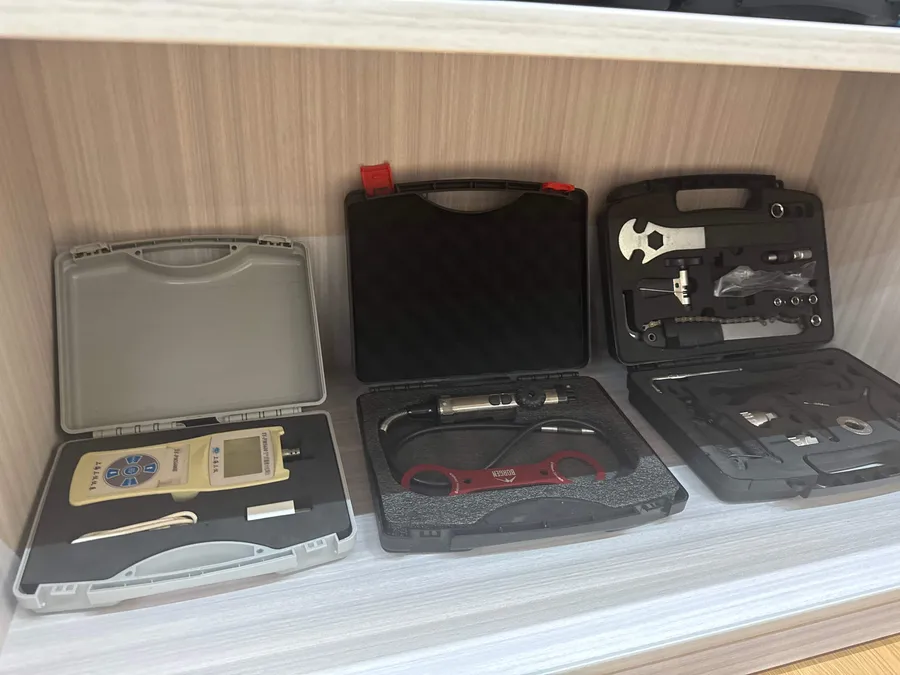
Most damage in a test pump kit is not the shell being hit, it is the contents moving inside a shell that was closed too quickly. The layout we cut most often for these kits is three layers. The base layer is a firmer plank with a pocket for the pump body machined to its own outline, positioned over the base rather than the lid line so the mass travels through the deepest part of the moulding, and a separate well for the reservoir so it cannot lean on the gauge. The middle layer is a cut plank for the fittings: one pocket per adapter size, a deeper well for the gauge with a soft face against the dial, a channel for the hose so it is coiled rather than kinked, and a small tray for spare washers, o-rings and seal kits. The top layer is a document pocket in the lid for the instrument's own calibration record and the kit list. Cross-linked PE, EVA and EPE plank are all available, die-cut or CNC-cut, and a shadow outline with an item number per pocket is what shows a missing fitting in seconds rather than at the next job. Custom foam is quoted from a single piece on existing mouldings, and we ask for a drawing, a photograph of the packed kit or a physical sample before we cut, because a pump lever that was not photographed is a lever that arrives through a wall.
Selection Guidance: Six Checks Before You Commit
First, orientation: does the pump travel upright or flat, because that decides whether you need internal height or internal length, and 37 of our 155 models publish internal height at 200 mm or more. Second, lid line: read lid depth and base depth separately, since a gauge with a protruding dial or a lever that will not fold is a lid problem, not a footprint problem. Third, mass: which layer carries the pump, because 3.0 mm wall mouldings are perfectly correct for a kit of brass fittings and wrong for a motorised unit sitting on a soft plank. Fourth, closing behaviour: a kit packed in a hurry bulks up, and a lid that needs a knee lifts its gasket and then lets in water and grit, so size for the worst-packed day. Fifth, the envelope: external dimensions against the van shelf, the rack, the trolley bay or the carton stack, not just the internal cavity. Sixth, the document: what your purchaser actually has to see, since a box for a workshop store is a different build from one written into a tender. Where a figure is blank in our published table we say so, and where your specification needs it we quote the measurement on the ordered configuration rather than assuming it.
Where These Boxes Are Used
The same mouldings turn up in pipe and boiler pressure-testing contractors, plumbing and heating service fleets, fire-sprinkler and hydrant commissioning crews, water utility and gas network maintenance, chiller and HVAC commissioning, refrigeration engineers, plant rooms and mechanical maintenance departments, valve workshops and actuator test benches, instrument and calibration houses that case a reference set, petrochemical and industrial maintenance shutdown crews, municipal and highways depots, and the service vans of pump and compressor manufacturers who ship a matching box with each unit. The overlap is deliberate: an industrial pressure test pump matching box for a sprinkler crew, a heavy duty impact-resistant mechanical parts box for a valve workshop and an industrial export kit custom plastic outer box for a manufacturer shipping five hundred units often share one moulding and differ only in the cut, the gasket, the marking and the carton. Buyers who specify by the item that has to arrive working, then build the interior around it, stop paying for volume they cannot fill.
Customising The Shell For A Test Kit
Interior work is routine. Shell work is a project, and the two have very different lead times, so it is worth separating them in your enquiry. Changes we handle as OEM or ODM on request: shell colour, a moulded or pad-printed logo, a marking band, additional latches, a padlockable hasp, an added handle, a document holder in the lid, a breather position for kits that fly or change altitude, a tether or lanyard eye for work at height, and a dividers-only interior for crews who re-pack every week. On a static-sensitive payload, a conductive or dissipative liner is quoted as its own configuration with its own measurement, because a surface-resistance figure belongs to the liner material and the finished assembly, not to the moulding, and we will not print one for a shell we have not measured. Electronic control units, digital gauges and dataloggers that ride inside a pump kit are the buyer's own instruments and carry the maker's documentation; the case is specified for what has to survive being closed, lifted and shipped.
Procurement Notes: Wholesale Terms, MOQ And Lead Time
KeXin New Materials (Guangdong) Co., Ltd. sells to wholesale and OEM or ODM buyers on EXW or FOB terms only. There is no retail channel, no delivered-duty-paid quotation and no overseas warehouse, so freight is arranged by the buyer or quoted separately as logistics rather than folded into a unit price. On existing mouldings the standard MOQ starts at a single piece and custom foam is likewise quoted from one, which lets a service company trial one matching box against a pump it already owns before fitting out a fleet; logo, colour and OEM production begin near 300 pieces and a custom mould near 3,000 pieces per component. A first OEM article on existing tooling runs about 45 days and a new mould about 125 days, with a 30 per cent deposit and the balance paid after inspection and before shipment. Third-party inspection at our facility is welcome before goods leave. Send the packed dimensions of the kit, a photograph, the quantity and the figure your purchaser has to see to Fred Zhao or the KeXin Sales Team, WhatsApp +86 135 3588 0002, and the answer comes back as a named model with its published numbers, or as a statement of what has not been measured and what it costs to measure it.
Customisation
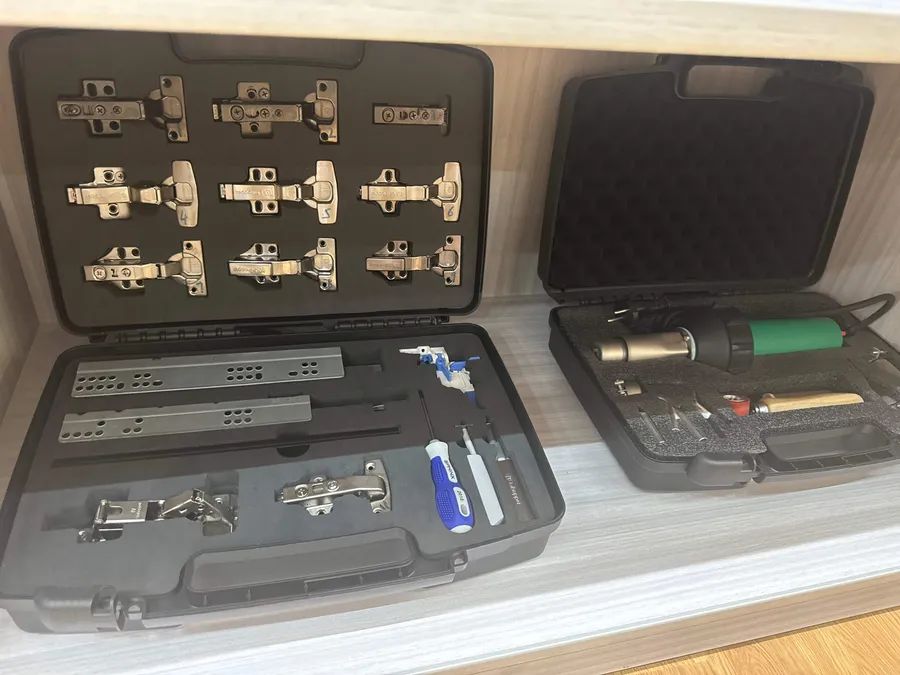
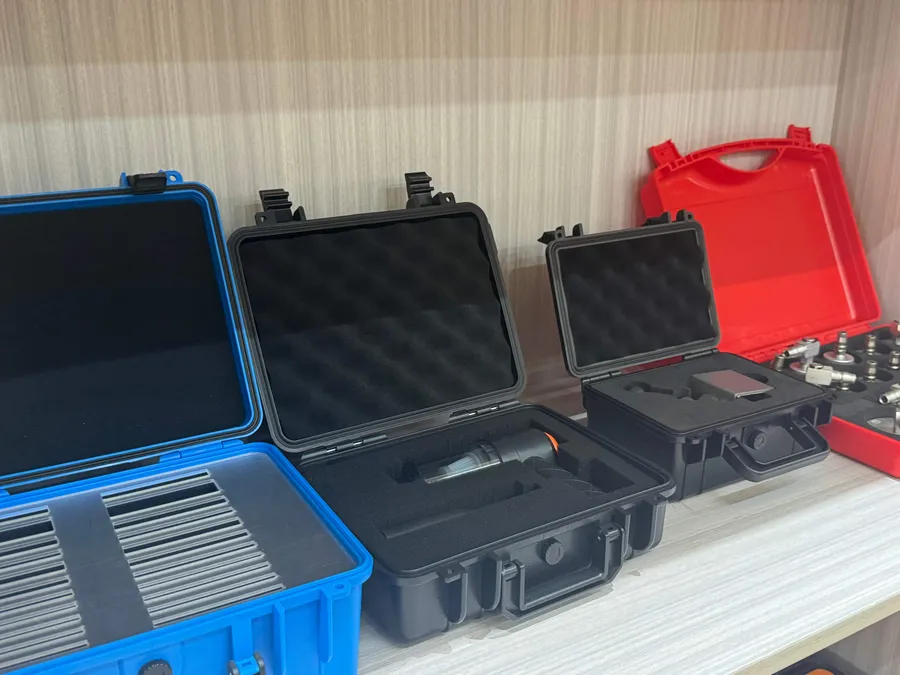
Everything described above is configurable on a standard shell: interior layout (pick-and-pluck, die-cut or CNC-cut), foam grade and thickness, colour, logo method, latch and lock count, pressure-equalisation valve, cable ports, document holder and identification plate. A bespoke exterior geometry requires a new mould — 125 days, from 3,000 units per moulded component.
Procurement considerations
| Question | What to send us |
|---|---|
| Which shell fits? | Equipment L × W × H as packed, plus required clearance per axis |
| What does it cost? | Order quantity and estimated annual quantity — the two drive different answers |
| Is tooling needed? | Whether an existing shell clears the envelope with usable foam depth |
| Lead time? | Your required delivery date, not just the order date |
| Certification? | The exact standard your tender names — we will say whether we can test to it |
| Freight? | Destination and preferred terms; carton and pallet data supplied with the quotation |
Comparison and selection guide
The tables on this page exist because a protective case is chosen by comparing three things: the envelope, the environment and the handling chain. Where no table applies, the rule below is.
| Situation | What To Do |
|---|---|
| Fixed inventory | CNC or die-cut silhouette with part numbers printed on the foam. |
| Variable kit | Pluck foam plus a loose tray. |
| Bench work | Removable trays that lift out square so the case doubles as a stand. |
- Size on internal dimensions plus clearance, never on a product name.
- Choose the carrying method before the shell: it changes the series, not just the price.
- Specify the interior last, and decide up front whether the end user will reconfigure it.
Industrial Pressure Test Pump Matching Box: Sized To The Kit You Already Have relates to Procurement Guide. Related families: Tool Cases / Instrument & Equipment Cases / Electronics Cases / Custom Protective Cases / Equipment Transport Cases / Field Equipment Cases / Ammunition Storage & Transport Boxes. Related sectors: field and industrial equipment. Continue in the Procurement Guide cluster.
This page is written from our own production data. If your requirement differs, send the dimensions and we will tell you which of the 155 models fits, or whether a custom route is needed.