How do buyers compare case locks across protective case suppliers?
Buyers compare case locks by asking which closure facts a supplier actually states per model, because the lock is the field a catalogue is most likely to leave blank. On our own file of 155 models the picture is unusually flat and unusually narrow: 155 of 155 listings state that the latch body accepts a standard padlock, 155 of 155 state a hinge and 155 of 155 state feet, but 0 of 155 publish a latch count - every listing instead records that the count is specified per configuration. Lock and latch material is not published either: all 155 listings give hardware material as metal or polymer by configuration. The consequence is that a lock comparison across suppliers is really a comparison of three separate things - whether a padlock loop exists, how many closure points compress the lid, and whether that lid carries a gasket at all, which 124 of our 155 listings say it does and 31 say it does not. Compare stated fields, and put the fields no catalogue carries into the order text.
Key points
- Padlock readiness is the one lock field we can compare across the whole range: 155 of 155 listings state that the latch body accepts a standard padlock.
- Latch count is published nowhere - 0 of 155 listings state the count per configuration, so put the number of closure points in the order text rather than reading it off a page.
- A lock is a seal component before it is a security component: 124 of 155 listings publish a gasket and 31 state none on that shell, so latch count and gasket must be quoted together.
- The parting line decides what a latch can do: 100 of 155 listings publish a lid and base depth split, with lid depths from 16 mm to 320 mm.
- Lock material is a configuration answer, not a datasheet answer: all 155 listings state hardware as metal or polymer by configuration and none states a hasp dimension.
- Changing a lock is cheap until it moves the load path: custom hardware exists on 155 of 155 listings, OEM sampling runs 45 days from 300 pieces, a new mould 125 days from 3,000 pieces.
What buyers are actually comparing when they compare case locks
A lock on a moulded protective case is not one component, and that is why lock comparisons go wrong. It is a closure point that compresses the lid, a hasp or loop that a padlock can pass through, and an alignment device that keeps the shell square on its base - three jobs, three failure modes, and only one of them is about keeping people out. When buyers compare case locks across protective case suppliers they usually compare the third job and ignore the first, which is how a batch arrives with a padlock through every latch and a lid that no longer seals in the middle of the long edge.
The comparison that works is a statement count. For each supplier, record how many of their listed models state a padlock-ready closure, how many state a latch count, how many state a gasket, how many state the lid and base depth at the parting line, and how many state the hardware material. Our own file answers two of those five across all 155 models and three of them per configuration, and saying so is more useful to a buyer than a lock photograph.
The lock fields our own file publishes, and their publication rates
These are the real rates from the same 155-model file the product pages are built from. Read them as a benchmark for what is reasonable to demand from anyone: the fields at 155 of 155 are the fields a supplier cannot excuse themselves for missing, and the fields at 0 of 155 are the ones that have to be settled in the order text because no catalogue carries them.
| Lock-Related Field | Published On Our Listings | What It Decides | Ask Every Supplier |
|---|---|---|---|
| Padlock-ready latch body | 155 of 155, stated as measured | Whether a standard padlock shackle can pass without an added hasp | Is the padlock loop moulded into the latch body or bolted to the shell? |
| Number of latches per model | 0 of 155 - 155 record it as specified per configuration | Compression along the long edge, and therefore whether the seal works in the middle | For a shell 1,356 mm on the long edge, how many closure points and at what spacing? |
| Hinge present | 155 of 155, stated as measured | Which edge the lid rotates about, and where the latch side is | Continuous or discrete, and is the pin replaceable? |
| Lock and latch material | 0 of 155; 155 listings state hardware as metal or polymer by configuration | Corrosion path and wear at the pivot | Which metal or which polymer on the batch you ship? |
| Pressure equalisation provision | 0 of 155 publish a valve value; 155 record it as a manufacturer option | Whether the lid can be re-opened after altitude or temperature change | Is the valve fitted in a moulded boss, and does it sit inside the seal line? |
| Gasket on the sealing rim | 124 of 155 publish a gasket, 31 state none offered | Whether latch compression is doing sealing work or only holding the lid down | Seal material, and the compression the latch actually produces? |
Padlock readiness: the one lock claim that holds across the range
There is exactly one lock statement we can make about every model in the file: 155 of 155 listings record, as a measured fact, that the latch body accepts a standard padlock. That is a real comparison advantage, because the alternative answer - an added hasp screwed on after moulding - changes both the external envelope and the number of parts that can be lost in service. Note what the statement does not cover: it says nothing about shackle diameter, nothing about resistance to any particular attack method, and nothing about whether a padlock can be fitted at every latch or only at the ones positioned to accept one.
We state readiness rather than security because readiness is what the moulding delivers. If a buyer needs a lock performance claim for a procedure, the honest route is to name the test and let an accredited third-party laboratory work on the configuration that ships, quoted as a separate work package. A page that implies security by describing a hasp is the most common way a lock comparison misleads.
Latch count: the field no catalogue publishes, and why it decides the seal
The number of closure points is the single most consequential lock figure in a moulded case and the one published least. In our file it is published never: 0 of 155 listings carry the text that the count is specified per configuration, recorded as a manufacturer option rather than a measurement. The reason is mechanical rather than evasive. A latch is a compression device, and what matters is the compression at the middle of the longest edge relative to the compression at the corners; that ratio depends on shell geometry, on the sealing rim, and on how many bosses the mould has, so a responsible count is quoted against a drawing, not asserted against a series.
For a buyer this converts into one question to put in writing: state the number of latches and their positions for the exact shell and lid combination being ordered. Suppliers who answer with a fixed number for every size are describing a marketing photograph, because a shell whose lid depth alone reaches 320 mm and one whose total depth is 364 mm cannot share a sensible latch pattern. The comparison is not who has more latches; it is who will commit to a spacing on the drawing.
The parting line: lid and base depth is a lock question, not only a size question
Latch count only means something once you know where the lid ends. 100 of our 155 listings publish a lid depth and a base depth, and the split is not uniform: lid depth runs from 16 mm to 320 mm with a median of 100.0 mm, the combined depth runs from 32 mm to 364.0 mm, and on 65 listings the lid is the deeper half while on 6 the base is and 29 are split evenly. On 29 listings the lid alone is 150 mm or deeper - shells where the latches grip mostly lid material, which is exactly where a closure point needs support behind the moulding.
This is the paragraph that makes a lock comparison cross over into a dimensions comparison. A supplier who quotes three external numbers, a latch count and no lid depth has not told you whether those latches are on the lid, on the base, or split across the seal line - and split-across-the-line is the arrangement that compresses a gasket, which is why our gasket note reads as a compressible seal in a continuous moulded channel on the 124 listings that publish one.
Hinges, feet and the load path a lock shares with them
Hinges and feet are published as present on all 155 listings and recorded as measured, which makes them the second flat field in the file after padlock readiness. What is not published is hinge type, pin replaceability or hinge material - the three things that decide whether a latch keeps aligning a lid after a few hundred open-close cycles. A latch that has to do the alignment work of a worn hinge is a latch that eventually crushes the gasket unevenly, so a lock specification without a hinge question is incomplete.
Feet matter to the same comparison for a duller reason: they set the height of the sealing rim off the ground. Where a shell sits on feet, grit stays out of the channel a latch has to close; where it sits on a moulded rim, the rim takes the abrasion. All 155 listings publish feet as measured and none publishes a rim wear figure, so ask which of the two is on the drawing you are approving.
Pressure valves and the re-opening problem nobody calls a lock issue
A sealed case with a latch across the lid is a closed volume, and a closed volume with a temperature history is a lid that will not lift. Our file publishes no valve value on any listing - 0 of 155 - while recording it as a manufacturer option on 155, and 124 listings publish a gasket that makes the question real. The comparison to run against a supplier is not whether a valve is available but whether it is fitted in a moulded boss inside or outside the seal line, because a valve added through the sealing rim competes with the gasket the latches are trying to compress.
Buyers who ship by air or move cases between conditioned storage and cold fields should treat the valve as part of the closure specification and put it in the same order line as the latch count. It is the cheapest closure decision on the page and the most frequently forgotten.
A lock comparison sheet you can send to every supplier
Send the identical sheet and compare the returned counts. Nine lines: padlock-ready per model, latch count and position on the ordered shell, latch type, hinge type and pin replaceability, gasket material and whether a gasket exists on that shell at all, lid and base depth at the parting line, pressure valve provision, hardware material, and what is replaceable without a tool. Our own file fills lines one, three and eight with a uniform statement, lines two, four and six with per-configuration answers, and line five on 100 of 155 listings.
| Sheet Line | Our File | Strong Supplier Answer | Weak Supplier Answer |
|---|---|---|---|
| Padlock ready | 155 of 155 | Names the latch body that takes the shackle | Photographs a padlock that is not supplied |
| Latch count and positions | 0 of 155 - per configuration | Gives a spacing drawing for the exact shell | Quotes the count of the smallest model |
| Gasket on this shell | 124 of 155 publish one | States seal material and where it sits in the rim | Describes the series rather than the SKU |
| Lid and base depth | 100 of 155 | Says whether latches grip lid, base or both | One total depth only |
| Hardware material | 0 of 155 per model | Names the metal or polymer on the shipping batch | Treats the question as a marketing choice |
| Replaceability | Stated per configuration, spares supplied with the batch | Offers a spares kit in the order line | Has no serviceable-part list |
Where the lock comparison decides the choice
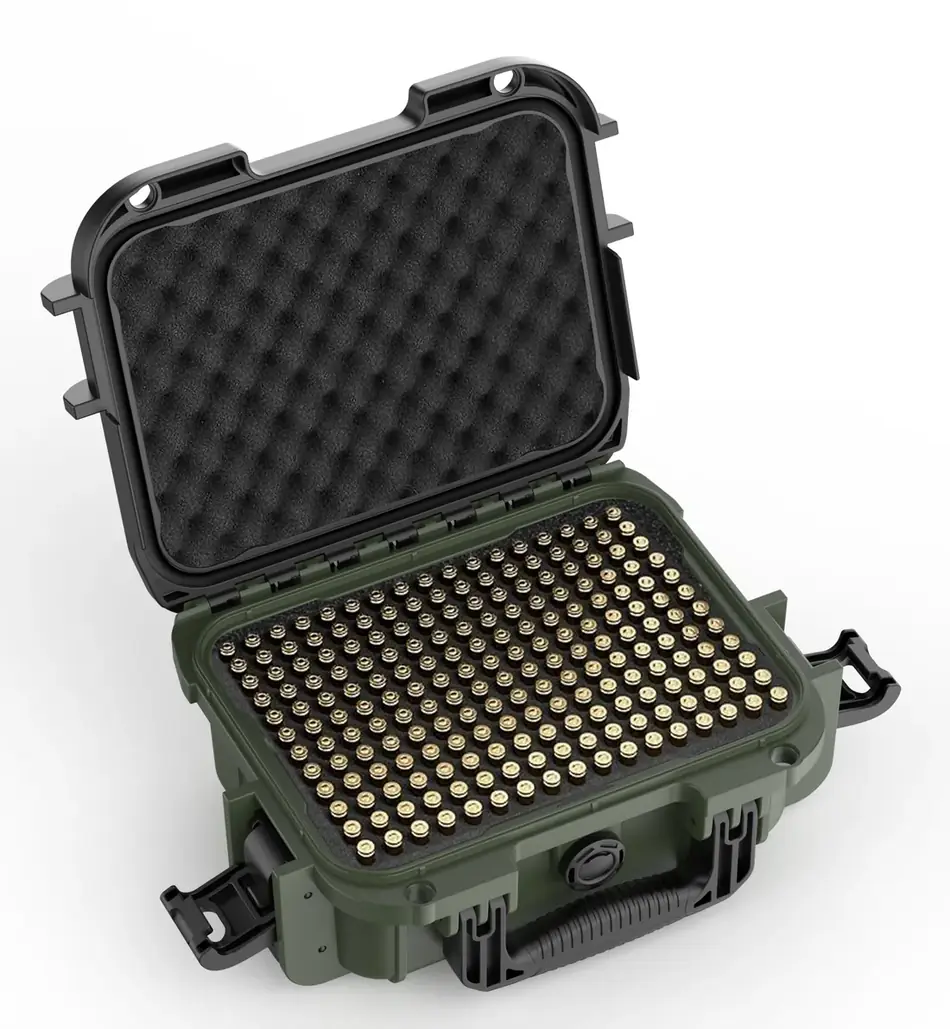
Ammunition and inventory storage boxes are the segment where a padlock loop stops being a convenience: 20 of our listings sit in that category as their primary category and all of them carry the padlock-ready statement, while gasket availability is what actually varies model by model. Electronics and instrument kits are the opposite case - the closure is there to hold compression on a gasket, so latch count and lid depth outrank the hasp. Field and military transport adds the glove question and the vehicle-rack question, which are about latch reach and proud hardware rather than about locking at all.
By material the pattern is legible: every ABS listing in our file publishes a gasket (22 of 22), while polypropylene shells split - 75 of 94 on standard PP and 27 of 38 on the engineering grade. A buyer comparing two suppliers who both say sealed should still ask which shells carry it, because a lock specification written for a gasketed rim and delivered on an un-gasketed one is a closure that simply clamps a lid down on air.
Customising locks: what changes on an existing mould and what needs a new one
Custom hardware is available on 155 of 155 listings, and the changes that do not move a load path or breach the sealing rim are configuration work: latch colour, an added padlock hasp sitting in an existing boss, bolt-on hardware fitted to moulded inserts, a different latch type on the same fixing geometry, and the choice of metal or polymer hardware. Those are what an OEM order at 300 pieces with a 45-day sample lead time buys on an existing tool.
What needs a new mould is anything that relocates a boss or moves the seal face: a different number of closure points than the tool supports, a latch that has to carry the seal rather than press the lid, or a valve boss where the rim currently runs uninterrupted. That is 125 days and a MOQ from 3,000 pieces per component, quoted against a drawing rather than a wish. Terms are wholesale and OEM only, EXW or FOB, with a 30 deposit; we do not sell retail, do not quote DDP and hold no overseas warehouse.
Procurement notes on case locks
Put the closure specification on the purchase order line: latch count and position for the exact shell, gasket or no gasket, hardware material, and whether a pressure valve is fitted. Order a spares kit with the production batch rather than after the first failure, because latches, hinge pins and gaskets are the serviceable parts of a case and a grounded case costs more than a bag of hardware. At receiving inspection, close every lid on the sample quantity and check that the latch engages without lifting the rim - the failure to look for is a latch that seals by force rather than by geometry.
Two clauses are worth adding because they settle disputes before they start: that stored cases are stored with the latches released, and that any change to latch count after first-article approval restarts the sample clock. The first protects the gasket; a case stored closed and latched for a year lets the seal take a permanent set. The second protects you from a supplier quietly trading two closure points for three to meet a delivery date.
What we do not publish about locks
No listing carries a latch count, a latch cycle figure, a hasp dimension, a torque value, a pick-resistance figure or a lock material, and the source specification sheets behind the file recorded no lock or latch detail at all - 0 of 155 model pages carry one in the raw parameter text. Net weight is published on 93 listings and gross weight on 0, and pallet and container figures are marked as calculated or supplied with a quotation on every listing rather than measured (0 and 0 measured respectively). Where a buyer needs one of those numbers for a compliance file, we quote accredited third-party testing against the standard you name for the configuration you order, and the result belongs to that build.
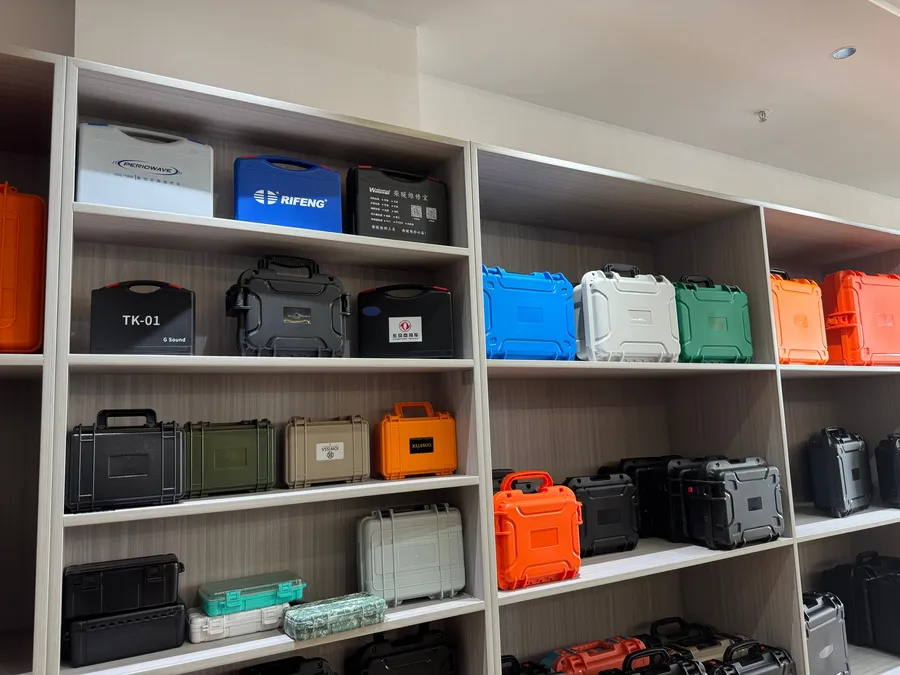
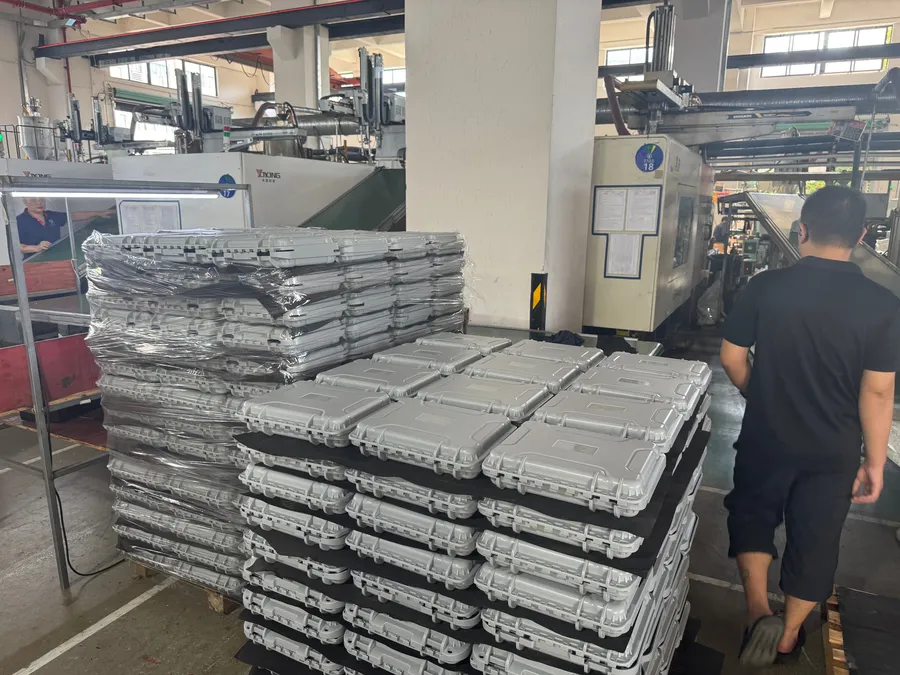
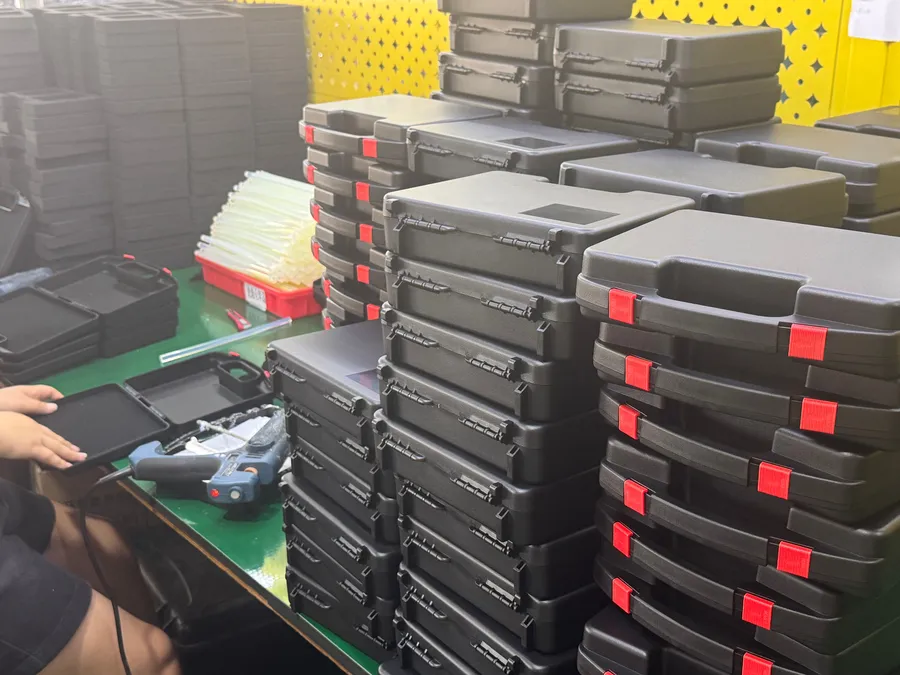
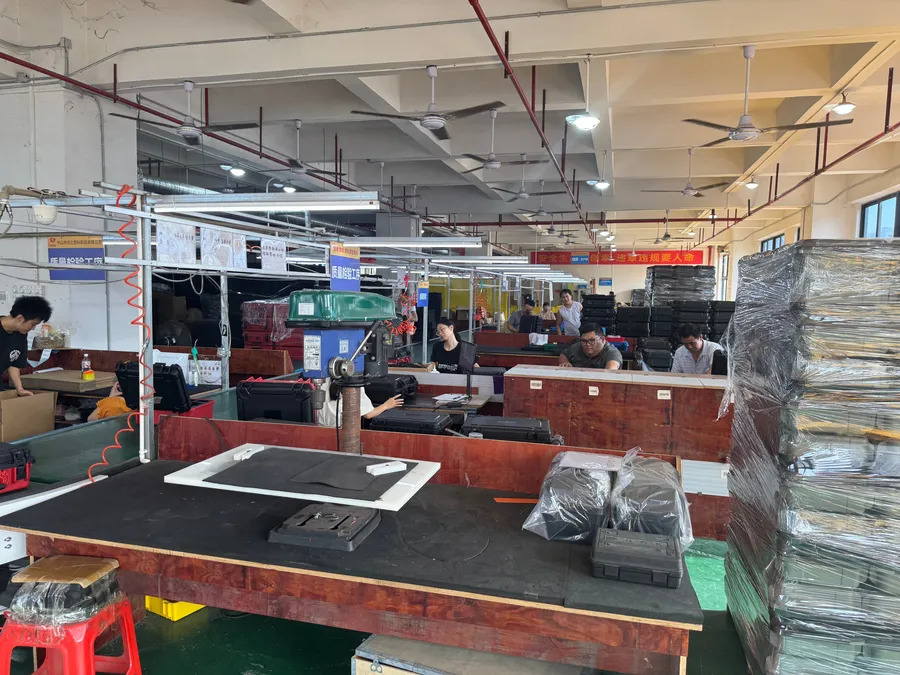
Customisation
Everything described above is configurable on a standard shell: interior layout (pick-and-pluck, die-cut or CNC-cut), foam grade and thickness, colour, logo method, latch and lock count, pressure-equalisation valve, cable ports, document holder and identification plate. A bespoke exterior geometry requires a new mould — 125 days, from 3,000 units per moulded component.
Procurement considerations
| Question | What to send us |
|---|---|
| Which shell fits? | Equipment L × W × H as packed, plus required clearance per axis |
| What does it cost? | Order quantity and estimated annual quantity — the two drive different answers |
| Is tooling needed? | Whether an existing shell clears the envelope with usable foam depth |
| Lead time? | Your required delivery date, not just the order date |
| Certification? | The exact standard your tender names — we will say whether we can test to it |
| Freight? | Destination and preferred terms; carton and pallet data supplied with the quotation |
Comparison and selection guide
The tables on this page exist because a protective case is chosen by comparing three things: the envelope, the environment and the handling chain. Where no table applies, the rule below is.
| Situation | What To Do |
|---|---|
| Fastest | Standard shell plus CNC foam — typically 45 days from approved drawing. |
| Branded | Standard shell plus custom colour and logo — MOQ applies to the resin colour. |
| Bespoke geometry | New mould — 125 days, MOQ from 3,000 units per component. |
- Size on internal dimensions plus clearance, never on a product name.
- Choose the carrying method before the shell: it changes the series, not just the price.
- Specify the interior last, and decide up front whether the end user will reconfigure it.
How do buyers compare case locks across protective case suppliers? relates to Procurement Guide. Related families: Custom Protective Cases / Ammunition Storage & Transport Boxes / Electronics Cases / Military Protective Cases / Waterproof Cases / Tool Cases. Related sectors: field and industrial equipment. Continue in the Procurement Guide cluster.
This page is written from our own production data. If your requirement differs, send the dimensions and we will tell you which of the 155 models fits, or whether a custom route is needed.