What information should be provided about case weight before a quotation?
Before a supplier can put a defensible mass on a protective case quotation, seven inputs have to come from you: the payload weight as it will actually travel, who lifts the case and how often, the freight basis your forwarder prices on, the pallet or rack it is stored on, the interior you intend to buy, the hardware you want fitted, and the first-order quantity the packing plan is built around. Give only a size and an equipment name and the figure that comes back is whatever the tool happens to produce, which is why two quotations for the same case can differ by kilograms. Our own file shows the scale of the gap: a net weight is recorded on 93 of 155 listings, from 100 g on KX-1204 to 15,320 g on the KX-88442 trolley, and on all 58 listings where both a carton footprint and a pieces-per-carton figure exist, the carton cube outweighs the summed net weight on a common courier divisor.
Key points
- A supplier can state a mass only for a configuration, and the configuration is your input rather than their assumption.
- Send the payload weight as packed - device, cables, charger, magazines, stand - not the nameplate figure from the instrument.
- Name the handler: one person, two people, a shelf edge, an aircraft seat. Each one picks a different ceiling.
- Give the freight basis your forwarder actually uses; on our 58 checkable cartons the cube outweighed the goods every time.
- Declare the interior and hardware you want, because foam, gasket, wheels and padlockable latches all reach the scales.
- State your pallet size and first-order quantity: pallet mass is recorded as not measured on all 155 listings.
- Ask for the source of every figure - production record, measured sample, or an estimate carried over from a similar shell.
A size does not carry a mass into the room
The most common expectation failure in a weight conversation is the belief that quoting a case size also quotes a case weight. It does not. Mass is the consequence of five decisions - which shell family, which wall section, which resin, which hardware list, which interior - and a supplier who receives only a size makes all five of them on your behalf, usually on cost. Our catalogue is the proof: published net weights run from 100 g on KX-1204, a 120 x 90 x 40 mm shell, to 15,320 g on the KX-88442 trolley at 843 x 592 x 415 mm, and normalised by enclosed space the same range covers 52.6 g per external litre on KX-706 to 250.0 g per litre on KX-1204. Three designs of the same nominal purpose can therefore differ by a factor of nearly five on plastic per litre.
What the seven inputs below do is hand those five decisions back to you in a form a manufacturer can price. Payload mass and handling ceiling decide the interior and the hardware. Freight basis and pallet size decide the packing plan, which is where most of the delivered number lives. Interior and hardware choice decide how much of the case mass is shell and how much is fitting. Quantity decides whether a packing plan is worth engineering at all. Send them together and a quotation arrives with a mass you can use; send them one at a time in email follow-ups and you will pay for the revisions. This is the case weight information before a quotation becomes a number rather than a hope.
The seven inputs, and what each one decides
Put these on one page, in this order, at the front of the enquiry, and keep the page under a revision number so a change is visible rather than conversational: it is the information a supplier needs to quote case weight, and the only version that keeps four bids answering one question. The middle column is what to actually write; the right column is the decision it drives, which is also the decision a supplier will otherwise make for you. Nothing here asks you to know anything about injection moulding - it asks you to state your own operating facts, which is the only information the manufacturer cannot supply.
Two lines are worth more precision than the rest, because they are the two buyers most often leave blank: the payload mass as packed, and the freight basis. The first controls whether the interior and the case are engineered for the load that actually travels; the second controls whether the number you quoted was ever going to be the number you paid.
| Input | What To Send | What It Decides |
|---|---|---|
| 1. Payload mass as packed | Weigh the kit as it travels, with cables, charger, accessories and any stand | Interior type and thickness, and whether the shell can be the light option |
| 2. Handling ceiling | Who lifts it, how often, alone or in pairs, and from what height | Maximum per-case mass, handle type, and whether wheels are needed |
| 3. Freight basis | Courier, air or sea, and the chargeable-mass divisor your forwarder uses | Whether to engineer for grams or for carton cube and nesting |
| 4. Storage geometry | Pallet size, rack or shelf depth, and the stack height you intend | Carton plan and pieces per carton, hence the delivered mass figures |
| 5. Interior decision | Stock pluck foam, die-cut, CNC-cut, or a drawing of the cavity | Added mass, usable volume, and the minimum order path |
| 6. Hardware list | Wheels, telescopic handle, seal, padlockable latches, feet, strap | Kilograms on a large shell, and whether the case stacks at all |
| 7. Quantity and schedule | First order, twelve-month estimate, and the date the mass must be fixed | Whether a measured first-article figure is available before production |
Send the payload mass as packed, not as published
An instrument datasheet gives you the mass of the instrument. The case has to carry the instrument plus whatever the user actually puts in the box: the lead set, the charger, a spare battery, the manual, a cleaning cloth, the stand, and in field use a magazine or two. Those additions are never zero, and on a full kit they can exceed the instrument itself. Weigh the packed configuration once, on your own scale, and write that number in the enquiry - it is the fastest way to stop a supplier designing an interior for a load that does not exist, and the payload weight as packed for a case quotation is the figure the cavity, the foam and the case mass are all finally engineered against.
Where the mass sits matters as much as how much of it there is. A 2 kg item spread across a base tray behaves differently from a 2 kg item balanced on a narrow foot, and differently again from two items whose masses fall at opposite ends of the cavity. Send the centre of gravity if you know it, and say which faces the item is allowed to be laid on. Our listings record that an interior is specified from a drawing, a photograph of the packed kit, or a physical sample - a drawing is the only one of the three that survives a change of personnel, so if the payload figure and the cavity drawing reference each other, the quotation and the production order describe the same object.
State the handling ceiling before the mass ceiling
Buyers normally start with a target weight, but the useful first number is the handling rule that produces it: who lifts this case, how often, alone or in a pair, from a vehicle floor or a shelf edge, and whether the same person carries it and a second load. Your own safety policy already holds the figure - the maximum carry weight for a protective case in the hands that actually lift it - and the enquiry only has to transmit it. Written the other way round - a target mass with no stated handling case - the number arrives without a reason, and reasons are what get traded away when a wall section or a hardware item has to be defended in a value-engineering meeting.
The published range shows how different the answers can be for one product family. Of the 93 listings carrying a net weight, 32 are below 1 kg and 25 more sit between 1 kg and 2 kg, so the light end of the catalogue answers a single-person carry without discussion. Sixteen sit between 2 kg and 5 kg, thirteen between 5 kg and 10 kg, and the seven above 10 kg are all wheeled shells, from the KX-97227 trolley at 10,000 g to the KX-88442 trolley at 15,320 g. That last group is also where the hardware trade-off becomes visible in the data: every listing above 10 kg publishes wheels, and a telescopic handle extended height is recorded on 11 listings.
| Published Net Weight Band | Listings With A Figure | Typical Handling Answer |
|---|---|---|
| Under 1 kg | 32 | One person, one hand, frequent carry |
| 1 kg to 2 kg | 25 | One person, two hands, regular carry |
| 2 kg to 5 kg | 16 | One person, both hands, planned lifts |
| 5 kg to 10 kg | 13 | Two people or a handle-and-wheel combination |
| 10 kg and above | 7 | Trolley movement; these listings all publish wheels |
The freight basis usually outweighs the case
Here is the input most often missing, and the one that changes the delivered number most. The distinction to hold on to is chargeable weight versus net weight per case: couriers and air carriers price a shipment on chargeable mass, which is the greater of what the goods actually weigh and what their volume weighs under the divisor that carrier applies. Empty shells are a worst case for that arithmetic: they enclose a lot of air. Worked on the divisor of 5,000 that is common in courier tariff sheets - your forwarder will give you theirs, and it may be 6,000 - the carton cube exceeds the summed net weight of the contents on all 58 of our listings where both a carton footprint and a pieces-per-carton figure are published. The median factor is about 2.3.
The rows below are arithmetic on published figures only: carton dimensions as recorded, converted to a cube, divided by 5,000, set against pieces per carton multiplied by the published net weight. They are not shipping quotes and they exclude carton tare, which our file does not publish. Their purpose is to show what you should ask your supplier to return - the carton cube in cubic centimetres alongside the case mass - because a quotation that gives you only the second number cannot be costed against your own freight contract.
| Model | Carton Mm | Carton Cube Cm3 | Mass At Divisor 5,000 | Summed Published Net Weight | Factor |
|---|---|---|---|---|---|
| KX-95419 | 550 x 485 x 755 | 201,396 | 40.28 kg | 3.60 kg for 1 piece | 11.2 |
| KX-2405 | 475 x 415 x 280 | 55,195 | 11.04 kg | 5.86 kg for 20 pieces | 1.9 |
| KX-2805 | 570 x 470 x 435 | 116,536 | 23.31 kg | 10.88 kg for 32 pieces | 2.1 |
| KX-707 | 735 x 480 x 595 | 209,916 | 41.98 kg | 10.88 kg for 8 pieces | 3.9 |
| KX-6621 | 665 x 500 x 650 | 216,125 | 43.23 kg | 19.26 kg for 3 pieces | 2.2 |
| KX-4321 | 885 x 515 x 650 | 296,254 | 59.25 kg | 27.96 kg for 12 pieces | 2.1 |
Storage geometry is the input only you possess
Pallet and container masses are the figures buyers most often expect to read off a datasheet, and they are exactly the ones a manufacturer cannot state honestly without your warehouse. In our file, pallet quantity is recorded as not measured on all 155 listings, with the note that it is calculated from the carton footprint against the buyer's pallet size, and container loading for 20 ft, 40 ft and 40 ft high-cube is likewise recorded as figures supplied with the quotation. Send the pallet dimension you actually use - 1200 x 1000 mm and 1200 x 800 mm are not interchangeable for a carton footprint - together with your first-order quantity, and ask for the stack to be calculated against both.
Then add the column. A storage question about mass is never one case: it is per-case mass multiplied by the number of tiers, on a shelf or in a stacked column, and the two published fields that interact with it are stackability and the carton footprint. 136 of our 155 listings publish as stackable; the 19 that do not are precisely the listings that publish wheels, which is the same fact stated twice rather than a contradiction. No stack load or load capacity figure is published for any model, so a racked or tall-column plan needs your own safety factor applied to your own contents mass - and that calculation is worth doing before the quotation, not after the racking is loaded.
Hand over the build data that narrows the answer
If you already know something about how the case should be built, say so, because those preferences are what convert a size into a mass. Shell material and wall section are the two levers published in our file, and their aggregate behaviour is worth knowing before you argue about grams: normalised by external volume, the polypropylene group medians at 90.0 g per litre across 41 weighed listings, engineering polypropylene at 90.4 g per litre across 29, and ABS at 106.2 g per litre across 22, against a whole-file median of 92.0 g per litre. The overlap between groups is wider than the gap between them, which is why a material preference should be written as a preference and a mass ceiling written as a number.
The table sets the published position for each material group in our catalogue. Use it the way an engineer uses a band rather than a point: if your mass requirement implies 150 g per external litre, that figure exists in our file on small thick-walled shells and not on large thin ones, and the enquiry should ask the supplier to name the shell family that gets closest rather than asking them to promise a weight out of nothing.
| Shell Material Group | Listings | With A Published Net Weight | Median Published Wall | Median Grams Per External Litre |
|---|---|---|---|---|
| PP | 94 | 41 | 3.7 mm | 90.0 g |
| Engineering PP | 38 | 29 | 4.3 mm | 90.4 g |
| ABS | 22 | 22 | 3.9 mm | 106.2 g |
| PP / ABS | 1 | 1 | not stated | 78.8 g on that single listing |
What each missing input costs you in the reply
Missing inputs do not produce questions; they produce answers. No payload mass and you get a catalogue cavity that fits the instrument and not the kit. No handling ceiling and the hardware list stays empty until a user buys wheels as an accessory at a worse price. No freight basis and the quotation carries a net weight you will never pay freight on. No pallet size and pieces per carton is chosen to suit the packing room rather than your racks. No quantity and no schedule, and there is no point in the programme at which a measured first-article mass is recorded, so the figure you approved was an estimate from a similar shell.
The cheap habit is to make the source of every number explicit on the page. Ask the supplier to mark each mass as one of three things: a record from production or incoming-material data for the exact configuration quoted, a figure measured on a sample they will name, or an estimate carried across from a similar model. Those three are not interchangeable, and a comparison of four bids becomes possible the moment you can see which of the three each bidder used. Where a supplier will not state the source, the correct reading is that the number is a target rather than a finding - which is fine, provided your own document says so too.
How the list changes by buyer and by programme stage
A distributor stocking catalogue sizes sends the list in reverse: the published envelope and published net weight are the inputs, and the question is which carton plan and pallet give the best freight per unit. On our file 64 listings publish a carton footprint and 58 publish pieces per carton, ranging from one large shell to 40 pieces of the smallest models, so the arithmetic is available before an enquiry is ever raised, and the useful line to add is the order quantity that fills a container.
An OEM or private-label programme sends the list as requirements with headroom, because the equipment is still moving: a maximum per-case mass, a payload envelope rather than a point weight, and a stated date by which the mass must be fixed. The commercial ladder follows the levers you pull - custom interiors are quoted from one piece against an existing shell, colour or logo from 300 pieces, an OEM or private-label programme from 300, and a new mould from 3,000 pieces per component, with a 45-day first-sample path on existing tooling against 125 days for a new tool. A buyer replacing a case that failed in service should send one more input than the others: the mass and dimensions of the kit today, including everything bought since the case was specified.
What we do not publish, and the terms on which we quote
Be clear about what no quotation from us will contain by default. We publish no gross weight for any model, so a gross figure is calculated per configuration from carton footprint and pieces per carton, and it excludes nothing silently. Pallet quantity and container loading are recorded as not measured and are supplied against your pallet and your order quantity. We publish no ingress-protection code for any model, and stack load, load capacity and protection ratings are recorded as not measured, with accredited testing against a named procedure available as a separate work package quoted per configuration; impact is stated only as a published wall thickness, with no drop height claimed without a test. Weight figures are model-level records, not certificates issued with each carton, so if acceptance depends on per-lot weighing, write it into the enquiry as a priced line.
Commercially we work wholesale and OEM only, on EXW or FOB terms. We do not sell retail, we do not quote DDP, and we hold no overseas warehouse, so the freight leg, import clearance and onward delivery remain yours or your forwarder's - which is precisely why the chargeable-mass and storage inputs above belong in your document rather than in a supplier's assumption. Send the seven inputs with the packed configuration attached and you will get a mass figure you can compare line by line against the next bid. For a quotation review, contact Fred Zhao or the KeXin Sales Team, or reach us on WhatsApp +86 135 3588 0002. KeXin New Materials (Guangdong) Co., Ltd.

Customisation
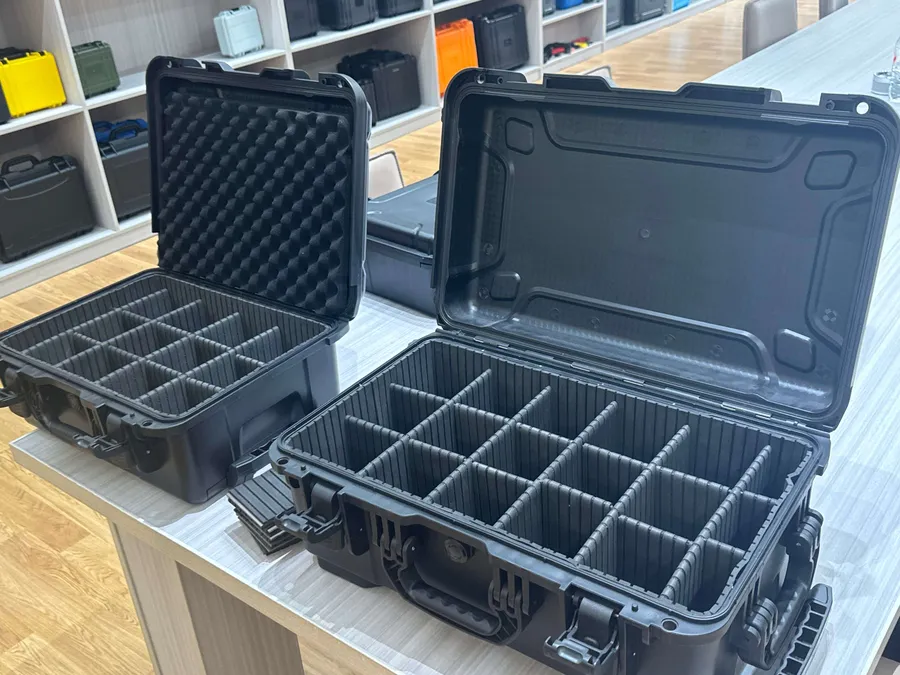
Everything described above is configurable on a standard shell: interior layout (pick-and-pluck, die-cut or CNC-cut), foam grade and thickness, colour, logo method, latch and lock count, pressure-equalisation valve, cable ports, document holder and identification plate. A bespoke exterior geometry requires a new mould — 125 days, from 3,000 units per moulded component.
Procurement considerations
| Question | What to send us |
|---|---|
| Which shell fits? | Equipment L × W × H as packed, plus required clearance per axis |
| What does it cost? | Order quantity and estimated annual quantity — the two drive different answers |
| Is tooling needed? | Whether an existing shell clears the envelope with usable foam depth |
| Lead time? | Your required delivery date, not just the order date |
| Certification? | The exact standard your tender names — we will say whether we can test to it |
| Freight? | Destination and preferred terms; carton and pallet data supplied with the quotation |
Comparison and selection guide
The tables on this page exist because a protective case is chosen by comparing three things: the envelope, the environment and the handling chain. Where no table applies, the rule below is.
| Situation | What To Do |
|---|---|
| Fastest | Standard shell plus CNC foam — typically 45 days from approved drawing. |
| Branded | Standard shell plus custom colour and logo — MOQ applies to the resin colour. |
| Bespoke geometry | New mould — 125 days, MOQ from 3,000 units per component. |
- Size on internal dimensions plus clearance, never on a product name.
- Choose the carrying method before the shell: it changes the series, not just the price.
- Specify the interior last, and decide up front whether the end user will reconfigure it.
What information should be provided about case weight before a quotation? relates to Procurement Guide. Related families: Custom Protective Cases / Equipment Transport Cases / Rolling Cases / Instrument & Equipment Cases / Military Protective Cases / Outdoor Protective Cases. Related sectors: field and industrial equipment. Continue in the Procurement Guide cluster.
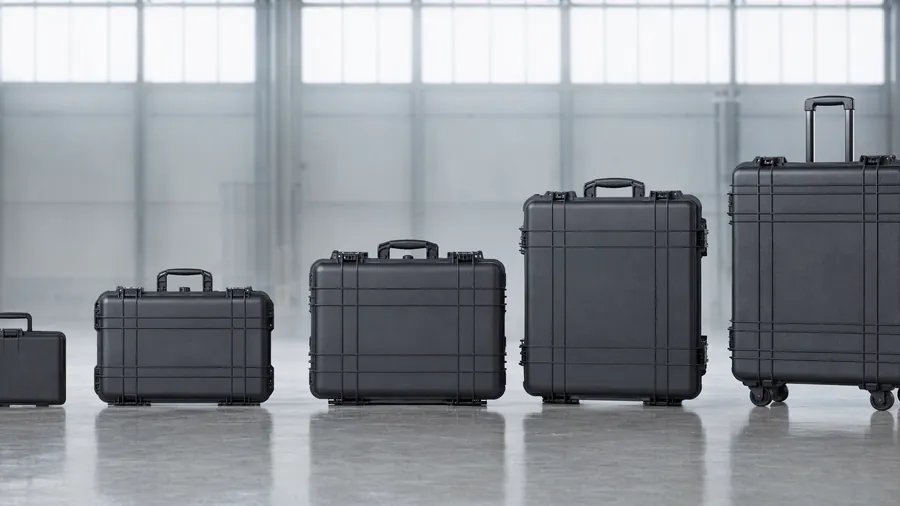
This page is written from our own production data. If your requirement differs, send the dimensions and we will tell you which of the 155 models fits, or whether a custom route is needed.