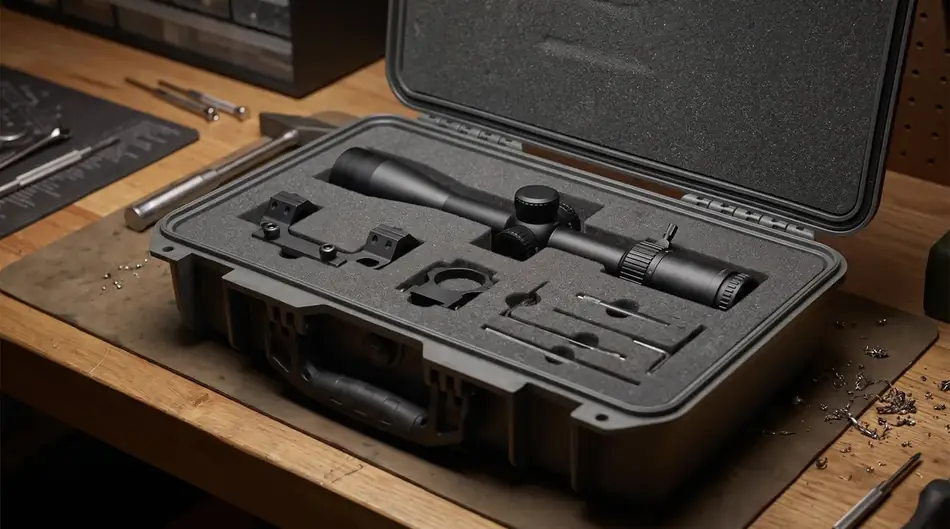
Protective Cases for Machinery, Moulds & Spare Parts for Robots & End Effectors
Short answer: size the case from the packed kit the integrator actually carries, not from the robot model. A two-finger gripper or suction end effector travels with its tool changer, mounting plate and harness; a controller or teach pendant travels with leads and a bracket; a spare-parts kit travels in trays of fasteners, gearheads and cable sets. So the deciding numbers are the published internal cavity, the lid-to-base depth split, the wall thickness and whether the mass needs wheels. KeXin New Materials (Guangdong) Co., Ltd. moulds 155 thermoplastic models on its own production line and publishes internal and external dimensions, wall thickness, net weight, interior volume and carton packing for each one, recording any field we have not measured as not measured instead of estimating it. We state no ingress protection code, no free-fall height and no stack load figure for these shells, because all three depend on the exact shell, gasket, latch and foam you order, and no test report exists for a configuration we have not built.
Key points
- End effectors need footprint plus hardware clearance: KX-64114 publishes 378 x 307 x 120 mm internal at a 4.0 mm ABS wall, 2100 g and 11.1 L usable volume.
- A controller kit needs depth rather than area: KX-3213 splits its 118 mm internal height into a 32 mm base and an 86 mm lid, so leads and a bracket sit under the closure line.
- Mass changes the handling route: 19 of the 155 published models record wheels and a telescopic handle, such as KX-85427 at 6100 g net with 483 x 363 x 220 mm internal.
- Long parts use length, not volume: KX-814641 publishes 1280 x 350 x 140 mm internal with a 40 mm base and 100 mm lid for rails, actuator bodies and extrusions.
- Sealing is per model, not per catalogue: 124 of 155 shells record a compressible gasket and 31 record none, and we print no protection code for either group.
- Only a shell-geometry change needs a tool: foam, dividers, hardware and marking start from one unit, while a new mould runs about 125 days from 3000 units.
What a robot cell kit actually contains
Buyers search by the machine, but the case is sized by the kit. A robot cell that goes out for commissioning or field service usually carries four different mass classes: an end effector or gripper with its change plate and cabling, a controller or pendant with a transformer and lead set, a bag of mechanical spares such as gearheads, brackets, belts and fasteners, and a consumables layer of filters, grease, tape and printed documentation. Each class fails differently. The end effector is precision-machined on one face and soft on the rest, so it must not move against a latch. The controller is electronics in a metal box, so it needs foam around the connectors, not around the enclosure. The spares are steel, and steel scratches and dents whatever it touches.
That is why we ask for a packed-kit list rather than a robot catalogue page. Measure each sub-assembly as it will really travel, with harness coiled and bracket bolted on, then compare the sum against the internal cavity published for a specific model. Our published fields are internal length, width and depth; external length, width and depth; wall thickness; base and lid depth where recorded; net weight; internal and usable volume; and carton packing where a carton exists.
Industrial robot accessories case: grippers, plates and tool changers
An industrial robot accessories case is normally a mid-volume shell with a flat foam bed and one deep pocket. A parallel gripper is typically 150 to 250 mm across the body with fingers that stick out, and a quick-change plate adds 20 to 40 mm of height you cannot compress. So the practical starting points are the rigid small-to-medium bodies rather than the big boxes: KX-62109 publishes 195 x 128 x 81 mm internal in a 3.0 mm ABS shell at 470 g net with a gasket recorded, which suits one compact gripper and its change plate; KX-64114 publishes 378 x 307 x 120 mm internal at a 4.0 mm wall, 2100 g and 11.1 L usable, which suits two end effectors plus cabling. Both are published with 8 to 20 pieces per carton, so a wholesale order multiplies predictably.
Robot accessories transport case: harnesses, sensors and consumables
A robot accessories transport case is a different problem because its contents are mostly long and flexible. Servo cable sets, encoder leads, pneumatic tubing for grippers and a box of fittings want to be coiled, not bent around a corner, and a coiled 5 m cable has a diameter that no shallow tray accepts. Two published shapes work well: KX-3213 at 308 x 230 x 118 mm internal with a 32 mm base and 86 mm lid gives the coil real depth so it can lie flat, and KX-4010 at 390 x 315 x 88 mm with an even 44/44 mm split suits a layout where coils and fittings sit at the same height. Wall thickness is 3.0 mm on both, net weight 860 g and 1015 g, and both record a compressible gasket.
Robot controller portable shockproof hard box
When buyers search for a robot controller portable shockproof hard box they are describing a real packing order: controller or pendant in the middle, bracket behind it, leads and power supply around it, documents on top. The failure to design against is connector shear, not enclosure damage, so the foam has to be cut as a full-depth bed under the unit with a step up around the plug faces. On published geometry, KX-84430 with 395 x 295 x 275 mm internal and an extreme 45/230 mm base-to-lid split behaves like a crate you can stand a controller in upright, and it carries a 4.2 mm wall and a recorded gasket. KX-84121, at 380 x 267 x 195 mm internal and a 3.4 mm wall, is the shallower alternative when the pendant is removed and only the controller travels. We describe shock performance through the foam layout you approve; the shell alone is not a shock rating and we publish no drop height.
Industrial robotic arm parts shockproof box: joints and gearheads
An industrial robotic arm parts shockproof box carries the heaviest items in the kit: harmonic drive units, joint modules, brackets, machined adapters and sometimes a bare arm section. These are dense steel and aluminium with machined faces, and they transfer impact straight to whatever is next to them, so each part needs its own pocket with a wall of foam between pockets, and the mass should sit low. Two published readings matter: wall thickness and usable volume. KX-85835 publishes 500 x 400 x 305 mm internal, a 5.0 mm wall, 8520 g net and 48.8 L usable volume with wheels and a telescopic handle recorded; KX-66232 is the ABS alternative at 507 x 385 x 290 mm internal, 5.3 mm wall and 7940 g. If the load will be walked across a plant floor, the wheeled group is the honest answer, not a padded hand-carry.
Industrial valve & actuator transit protection case
Valves, actuators and manifold sections travel with robot cells in integrated pick-and-place and palletising work, and they break the usual size logic. A rotary actuator is heavy for its volume, often has a protruding shaft or bracket, and its finish is easily marked by another actuator's bracket. The shape that works is a wide footprint with a deep base and a stiff wall: KX-96127 publishes 545 x 545 x 210 mm internal at a 4.8 mm wall, 8540 g, 49.9 L usable, wheels and telescopic handle recorded, with packing published as one piece in a 640 x 625 x 280 mm carton. For smaller valve sets, KX-8-7926 written as KX-87926 publishes 737 x 257 x 240 mm internal with a 65/175 mm base-to-lid split at 4.0 mm, which accepts actuators lying side by side with their shafts pointing into foam.
Industrial spare parts storage case
An industrial spare parts storage case lives on a shelf, not in a vehicle, so the design driver is legibility. Buyers should look for a shallow, even lid-to-base split, a low net weight and a footprint that stacks. KX-2405 publishes 220 x 162 x 49 mm internal with a 31/18 mm split, 2.0 mm wall and 293 g; KX-2507 steps up to 245 x 175 x 64 mm with an even 32/32 mm split at 340 g; KX-2808 reaches 265 x 190 x 76 mm with a 38/38 mm split at 430 g. All three are published with 20 pieces per carton and are recorded as stackable, which is what a stores department actually cares about: the box reads at eye level, and 136 of our 155 models record stacking geometry. Note that none of these three records a gasket, which is a fact to check rather than assume.
Portable studio all-in-one machine case
A portable studio all-in-one machine case is the non-robot item that shows up in the same enquiry, because integrators also deliver camera, lighting and control rigs alongside a cell demo. These are large, low-density and fragile: a screen or optics panel wants a flat bed with no point load, and the whole rig wants wheels because a screen in a hard shell carried by one person is a drop waiting to happen. KX-85427 publishes 483 x 363 x 220 mm internal with a 70/150 mm base-to-lid split at 4.5 mm and 6100 g; KX-88442 is the top of the range at 740 x 518 x 364 mm internal, 5.0 mm wall, 15320 g and 111.6 L usable, with wheels and a telescopic handle recorded and stacking recorded as not applicable for that trolley body.
Rotational molding solutions for industrial cases
Search traffic also asks for rotational molding solutions for industrial cases, so it is worth being precise about what our line does. KeXin is an injection-moulding and thermoplastic shell source: our 155 published models are moulded shells in PP, engineering PP or ABS with wall thickness recorded from 2.0 mm to 6.0 mm across 148 models that publish a value. Rotational moulding produces a different part, a seamless hollow body with thicker, less uniform walls, and we do not publish rotomoulded models in that spec file. If your tender genuinely requires a rotomoulded body rather than an injection-moulded one, say so at enquiry stage and we will tell you plainly whether our line is the right source instead of quietly substituting a process.
注塑安全箱生产线直供 / rotomolding & injection safety case factory supply
The bilingual query 注塑安全箱生产线直供 / rotomolding & injection safety case factory supply mixes two processes in one search string, and the answer is the same discipline in either language: factory-direct supply on our own injection-moulding line for the 155 published models, with wholesale and OEM terms on EXW or FOB. Line-direct means the same tool makes the shell you approved at sample stage, so published internal and external dimensions, wall thickness and net weight stay the reference. Process naming is where buyers get burnt: a rotomoulded safety box and an injection-moulded safety box are not interchangeable for tolerance, wall uniformity or insert fitment, and we will not blur that to fit a search phrase.
Waterproof safety case custom foam insert molding: what we state and what we do not
Waterproof safety case custom foam insert molding is a common request from integrators who want one purchase order for shell, gasket and cut foam. We can do all three in one programme, but the words have to stay honest. A custom die-cut or CNC-cut foam insert is a manufacturing option we quote from a drawing, a photograph of the packed kit or a physical sample, with a first approved sample on an existing shell in about 45 days. Sealing is a per-model field: 124 of 155 shells record a compressible gasket in a continuous moulded channel and 31 record none. A protection code is a test result, not a design intent, so we do not print one for a configuration we have not had tested; where a tender needs documented evidence we quote accredited third-party testing against the specific build as a separate work package.
Comparison table: the robot-kit item, the deciding figure, and published examples
Read the table as a shortlisting method, not as a performance claim. Every figure belongs to the model named, and a comparison is only valid against your own measured packed envelope and the mass your team will actually carry. Where a tender needs documented proof of sealing or impact behaviour, that is a testing work package quoted for the exact configuration, not a number copied from a catalogue page.
| Robot Kit Item | Deciding Published Figure | Published Examples |
|---|---|---|
| Gripper or end effector with change plate | Internal footprint plus hardware height, rigid wall | KX-62109: 195 x 128 x 81 mm, ABS 3.0 mm, 470 g, gasket recorded; KX-64114: 378 x 307 x 120 mm, 4.0 mm, 2100 g, 11.1 L usable |
| Controller or teach pendant with leads | Lid-to-base depth split, usable volume | KX-3213: 118 mm internal, 32 mm base / 86 mm lid, 7.2 L usable; KX-84430: 395 x 295 x 275 mm, 45/230 mm split, 25.6 L usable |
| Joint modules, gearheads, arm parts | Wall thickness plus wheels above about 6000 g | KX-85835: 500 x 400 x 305 mm, 5.0 mm, 8520 g, wheels and telescopic handle; KX-66232: 507 x 385 x 290 mm ABS, 5.3 mm, 7940 g |
| Valves, actuators and manifolds | Wide footprint, deep base, load sits below closure line | KX-96127: 545 x 545 x 210 mm, 4.8 mm, 8540 g, 1 pc in 640 x 625 x 280 mm carton; KX-87926: 737 x 257 x 240 mm, 65/175 mm split |
| Shelf spare-parts kit | Shallow even split, low net weight, stacking geometry | KX-2405: 220 x 162 x 49 mm, 31/18 mm, 293 g; KX-2507: 245 x 175 x 64 mm, 32/32 mm, 340 g; KX-2808: 265 x 190 x 76 mm, 430 g |
| Long rails, extrusions, actuator bodies | Internal length, not volume | KX-814641: 1280 x 350 x 140 mm internal, 5.0 mm, 40/100 mm split, 50.2 L usable; KX-87926: 737 x 257 x 240 mm |
| Studio or demo rig with a screen | Wheels, telescopic height, external size against the vehicle | KX-85427: 483 x 363 x 220 mm, 6100 g; KX-88442: 740 x 518 x 364 mm, 5.0 mm, 15320 g, 111.6 L usable |
| Custom gasket and cut-foam programme | Seal field per model; tooling ladder | 124 of 155 gasketed, 31 none; foam and hardware MOQ from 1 unit; OEM sample on an approved shell about 45 days; new mould about 125 days from 3000 units |
Selection guidance: five questions that collapse 155 models
Question one: what is the single largest rigid item, measured as it travels? Compare its length, width and height against the published internal cavity, and leave at least the foam depth you intend to bury it in. Question two: how heavy is the packed case, and who lifts it? Our shells publish net weight from 100 g to more than 15000 g, so the packed mass can be obvious arithmetic; above roughly six kilograms of empty shell, choose from the 19 models that record wheels and a telescopic handle. Question three: does the load need depth or area? The lid-to-base split decides what physically closes, and an 86 mm lid on KX-3213 accepts more than a deeper-looking box with an even split. Question four: is a gasket required, optional or irrelevant, given 124 of 155 models publish one? Question five: does the kit need a shelf-readable shallow box or a mobile crate, since 136 models record stacking geometry and the trolley bodies record it as not applicable?
Applications: integrator depot, commissioning, field service and export
Four buying situations explain most of the orders in this group. A systems integrator's depot kit is standardised: one shell type per cell type, cut foam repeated across 20 to 200 units, marking with the cell number. Commissioning kits are mixed and change every project, so buyers take a small number of medium shells such as KX-4010 or KX-64114 and configure foam per project from a photograph of the packed kit. Field service kits are the wheeled group, because a technician walking a plant floor with a joint module cannot also carry a pendant. Export orders are carton-driven: the packing fields published for each model decide how many pieces go in a carton and therefore how the order cubes out, while pallet and container figures are supplied with the quotation because they depend on your carton footprint and pallet size.
Customisation: cut foam, dividers, hardware, marking and colour
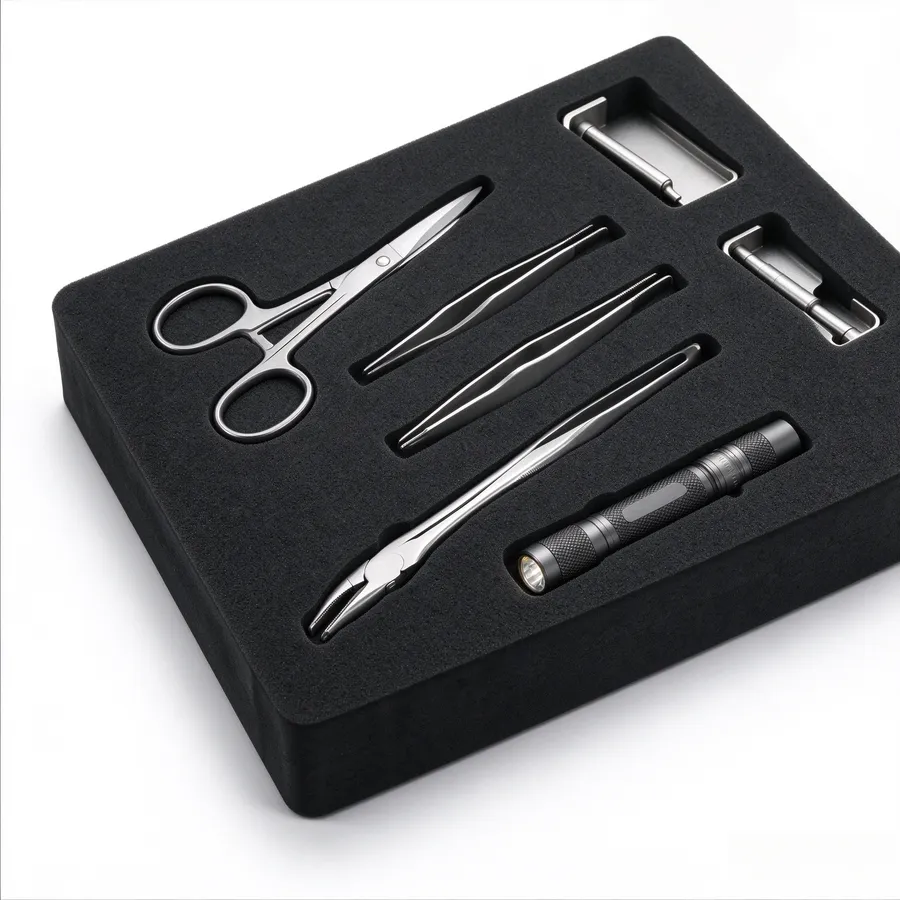
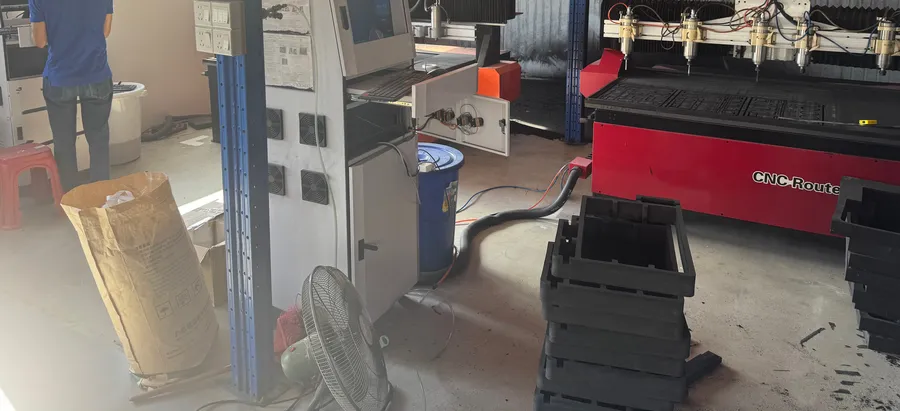
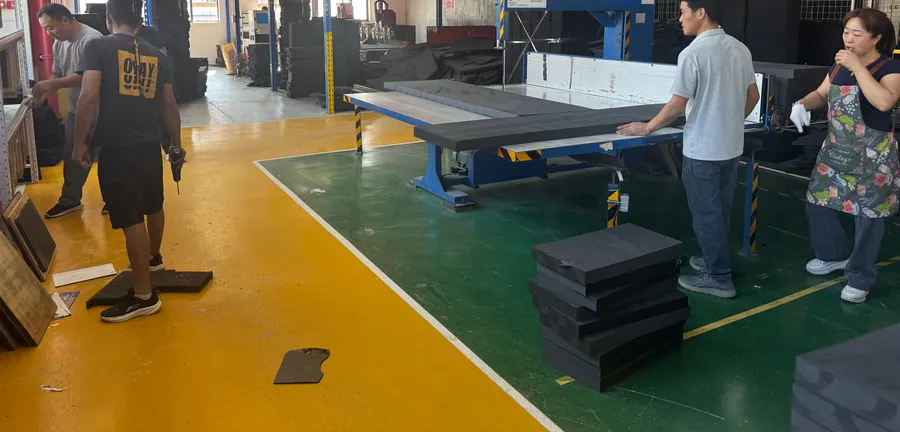
Foam is where most of the value sits. We publish Pick and Pluck, die-cut, CNC-cut, EVA, PE and EPE options with top foam, base foam, convoluted layers and custom cut, and custom thickness and custom shape are listed as options rather than defaults. A CNC-cut set for a gripper and its plate is quoted from a drawing; MOQ for standard and custom foam cases is one unit, so a single prototype layout is possible before a batch. Hardware options published across the range include latch count, a padlock-compatible latch body, hinge, feet, fixed or telescopic handles, wheels, shoulder strap, a pressure equalisation valve and a document holder, all named per configuration. Logo, colour and OEM are published at 300 units, and a new mould is 125 days from 3000 units per component. If you need the shell itself re-shaped, that is a tooling programme; if you need it fitted, marked and coloured, it is not.
Purchasing notes: wholesale terms, EXW and FOB, and how to verify a supplier
Terms are wholesale and OEM only. We sell on EXW or FOB, do not sell single units at retail, do not quote DDP and hold no overseas warehouse, so your own forwarder or agent handles the import leg. An OEM programme on an existing shell is quoted at about 45 days to a first approved sample with a 30% deposit; a new mould is about 125 days. To verify any supplier in this category, including us, ask four things and compare the answers: a specification sheet that names internal and external dimensions per model rather than a size range; the wall thickness and net weight for the model you are actually ordering; a written statement of which protective fields are measured and which are not; and a packing figure tied to a carton size. A listing that answers everything with a rating code and no measurements is telling you about marketing, not about your kit. Send us the packed dimensions of your end effector, controller or spare-parts tray, the mass and the handling route, and the shortlist comes back with published numbers attached.
Customisation
Everything described above is configurable on a standard shell: interior layout (pick-and-pluck, die-cut or CNC-cut), foam grade and thickness, colour, logo method, latch and lock count, pressure-equalisation valve, cable ports, document holder and identification plate. A bespoke exterior geometry requires a new mould — 125 days, from 3,000 units per moulded component.
Procurement considerations
| Question | What to send us |
|---|---|
| Which shell fits? | Equipment L × W × H as packed, plus required clearance per axis |
| What does it cost? | Order quantity and estimated annual quantity — the two drive different answers |
| Is tooling needed? | Whether an existing shell clears the envelope with usable foam depth |
| Lead time? | Your required delivery date, not just the order date |
| Certification? | The exact standard your tender names — we will say whether we can test to it |
| Freight? | Destination and preferred terms; carton and pallet data supplied with the quotation |
Comparison and selection guide
The tables on this page exist because a protective case is chosen by comparing three things: the envelope, the environment and the handling chain. Where no table applies, the rule below is.
| Situation | What To Do |
|---|---|
| Fixed inventory | CNC or die-cut silhouette with part numbers printed on the foam. |
| Variable kit | Pluck foam plus a loose tray. |
| Bench work | Removable trays that lift out square so the case doubles as a stand. |
- Size on internal dimensions plus clearance, never on a product name.
- Choose the carrying method before the shell: it changes the series, not just the price.
- Specify the interior last, and decide up front whether the end user will reconfigure it.
Protective Cases for Machinery, Moulds & Spare Parts for Robots & End Effectors relates to Procurement Guide. Related families: Tool Cases / Equipment Transport Cases / Custom Protective Cases / Instrument & Equipment Cases / Rolling Cases. Related sectors: field and industrial equipment. Continue in the Procurement Guide cluster.
This page is written from our own production data. If your requirement differs, send the dimensions and we will tell you which of the 155 models fits, or whether a custom route is needed.