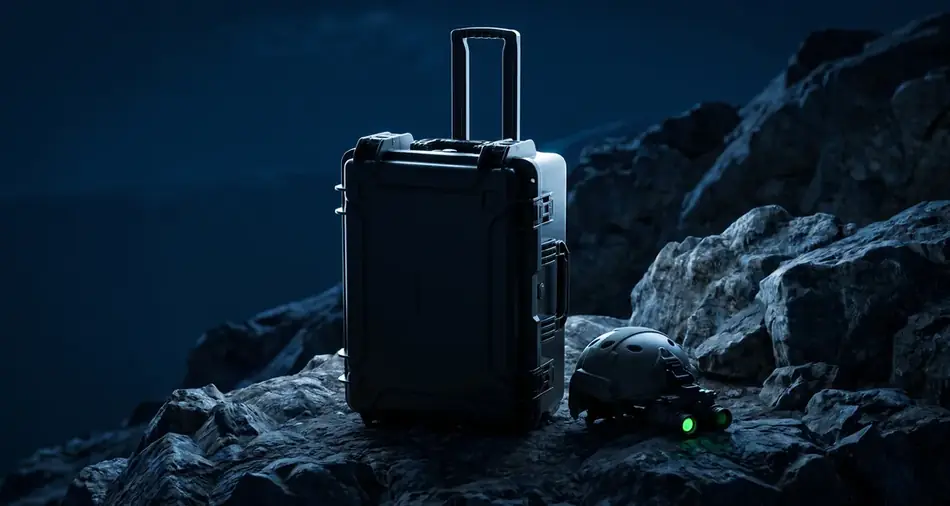
How should buyers choose an outdoor case?
Buyers should choose an outdoor case by working through seven checkpoints in order: measure the equipment and add clearance, define the real environment, decide the interior layout, check hardware and stacking, confirm customisation scope, agree commercial terms, then verify everything against the data published per model. In our outdoor line that sequence ends in ten shells from 3.6 to 9.2 litres of internal volume, quoted wholesale on EXW or FOB terms with a 30 percent deposit and third-party inspection welcome. Choose the sequence before you choose the shell, and the shell decision largely makes itself.
Key points
- Start from internal dimensions plus a clearance rule, not from external size; on KX 3113 the walls consume 17 mm of length and 24 mm of width.
- Apply at least 20 mm of clearance per axis around the equipment; the recommendation is published on our product pages.
- Our current outdoor shells are listed without a fitted gasket; if the route includes submersion risk, start from the waterproof-cases family.
- Check stacking and carton pack before freight: KX 2808 ships 20 pieces per 560 x 445 x 415 mm carton, and pallet counts are calculated per route.
- Logo and colour programmes start at 300 units, OEM on an existing mould at 300, and a new mould at 3,000; lead times run 45 and 125 days.
- We quote wholesale and OEM only on EXW or FOB terms with 30 percent deposit; third-party inspection before shipment is welcome.
How buyers choose an outdoor case: the seven-step sequence
Most disappointing case purchases are not caused by a bad shell; they are caused by answering the questions in the wrong order. Buyers who choose an outdoor case by first falling for a photo usually discover too late that the cavity is 20 mm too shallow for a lens hood, or that the family has no gasket for a monsoon route. The sequence we recommend, and the one this page walks through, puts measurement first, environment second, interior third, hardware and freight fourth, customisation fifth, commercial terms sixth, and a documentation check last. Work the checkpoints in order and the shortlist usually collapses to two or three models within an afternoon.
Steps 1 to 2: measure the equipment, then add clearance
Measure each item at its widest point, including knobs, hoods, cables and connectors, then compare against internal dimensions rather than external ones, because the two numbers are not the same. On KX 3113, for example, the external footprint is 313 x 282 x 129 mm while the internal cavity is 296 x 258 x 121 mm, so the walls consume 17 mm of length and 24 mm of width before the first item is packed. Our product pages recommend at least 20 mm of clearance per axis, and the datasheets also publish a narrow internal width, 158 mm on KX 701 for instance, which is the number that quietly disqualifies wide lenses and pistol-grip tools.
Step 3: define the environment honestly
The second checkpoint is deciding which risks the case really faces: rain on a forest trail, dust on a gravel track, a boat deck, an airline hold, or a vehicle parked in the sun. Buyers should choose an outdoor case for the worst environment the cargo actually sees, not the average one. Our current outdoor shells are hard, stackable, pigmented thermoplastic bodies listed without a fitted gasket; for splash and weather exposure that is the right tool, while for submersion-adjacent routes we point buyers to our waterproof-cases family and to the buyer-education pages that explain what an IP code is and is not. No IP code is stated on our outdoor shells, and accredited testing is quoted per configuration when a programme genuinely needs a documented number.
Step 4: choose the interior before the shell colour
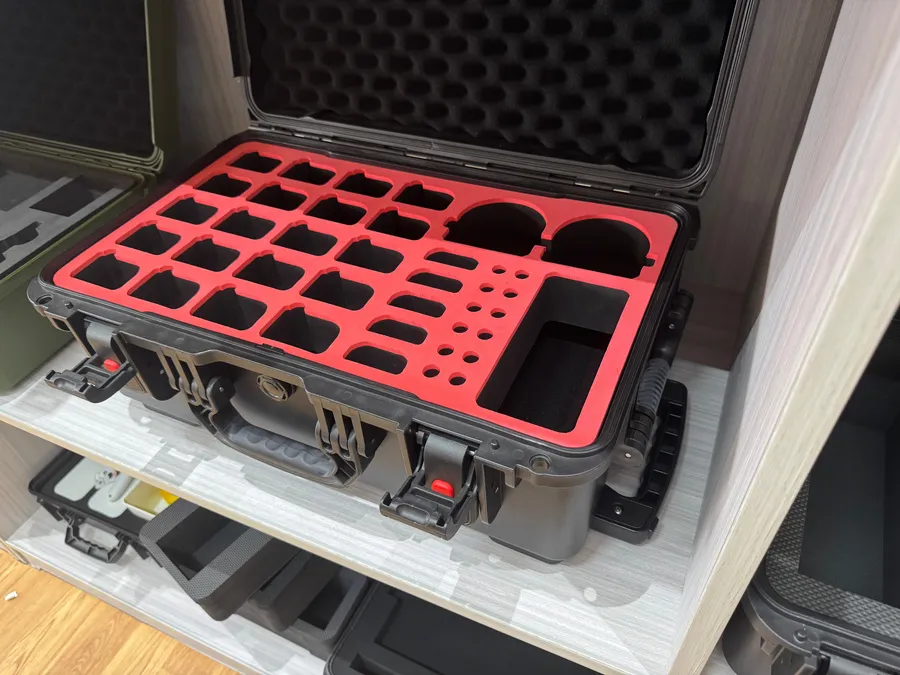
Interior layout decides daily usability more than shell colour ever will. We offer pick-and-pluck, die-cut and CNC-cut foam in PE, EVA, EPE and EPS by zone, with custom thickness and shapes quoted from a drawing, a photograph of the packed kit or a physical sample. Base and lid depth also vary inside the same size class: KX 2813 splits its 117 mm cavity as a 25 mm base plus a 92 mm lid for shallow bulk items, while KX 3113 splits 121 mm as 38 mm plus 83 mm. That split decides whether a tripod head lies flat or a radio stands upright, so settle it before the branding conversation starts.
Five outdoor buying scenarios compared
The table below maps the five enquiries we answer most often to the checkpoint that decides them, so buyers can shortcut the sequence without skipping any step in it.
| Scenario | Checkpoint That Decides It | What We Would Quote From | Follow-Up Question |
|---|---|---|---|
| Camera or drone kit | Internal dimensions plus 20 mm clearance per axis | KX 3113 or KX 3114 with layered PE or EVA foam | Do lid and base depth match the assembled kit, not just the body? |
| Hand tools on a service route | Mass distribution and base support | A deep-base shell with die-cut base foam and a pick-and-pluck top | Which sockets and testers must stay visible without unstacking? |
| Camping and overlanding gear | Volume per module and stacking height in the vehicle | Stackable shells with published carton pack data | Will the cases be moved by one person or two? |
| Monsoon or boat-deck route | Sealed versus vented cavity | The waterproof-cases family instead of this line | Is a pressure-equalisation valve needed for the altitude profile? |
| Branded fleet programme | Logo, colour and OEM volume | 300-unit programmes on PP or engineering PP shells | Existing mould or new tooling, and who owns it? |
Step 5: hardware, portability and stacking
Hardware choices decide whether a case is pleasant at camp or a nuisance for a decade. Our outdoor shells ship with a fixed folding handle, a latch body that accepts a standard padlock, pin hinges and feet; wheels are not listed on this line, so buyers needing trolley mobility usually step across to our rolling-cases family for those legs of a journey. Every shell in the line is stackable, which matters once ten cases come home from a season and have to live in a store room. Pallet loading is calculated from the carton footprint against your pallet size rather than guessed, and KX 2808 packs 20 pieces per 560 x 445 x 415 mm carton, which is the arithmetic freight planners care about.
Step 6: customisation scope and lead time
Customisation is priced in tiers, and knowing the tiers early keeps a programme realistic. Stock shells and custom foam start at a single unit; logo, colour and OEM builds on an existing mould start at 300 units; a newly cut mould starts at 3,000 units. Lead times are 45 days for OEM work on an existing mould and 125 days when new tooling must be cut, with a 30 percent deposit and the balance payable after inspection. Because the same shells carry all three tiers, a serious buyer can pilot the material and interior choices at small volume and later scale the branding programme without changing the product underneath.
Step 7: commercial terms to confirm in writing
The final checkpoint is commercial, and it is where importers lose the most time when skipped. We are KeXin New Materials (Guangdong) Co., Ltd., and we sell wholesale and OEM only: no retail, no drop-ship, no DDP and no overseas warehousing, on EXW or FOB terms from our Guangdong facilities. Payment is a 30 percent deposit with the balance after inspection, and your nominated third-party inspector is welcome before shipment. Ask every supplier on your shortlist the same terms questions, including who owns a new mould and what happens to it if the programme pauses. Our sales contact is Fred Zhao of the KeXin sales team, reachable on WhatsApp at +86 135 3588 0002.
How outdoor buyers choose an outdoor case for mixed loads
Mixed loads are the honest test of the sequence. Outdoor buyers who choose an outdoor case for a van programme, say a drone plus batteries, a tool roll and a first-aid module, usually end up with two or three sizes from the same family rather than one large compromise shell, because stackable footprints and shared latch geometry make the set behave like one system. We support that by publishing every internal and external dimension per model, by marking which properties are measured and which are not, and by cutting zone foam from a drawing so each module lands where it should. If the same set must also survive monsoon rain, the sealed members come from the waterproof family while the vented members stay outdoors.
Common mistakes we see in outdoor RFQs
Three mistakes dominate the outdoor enquiries we receive. First, buyers send external equipment dimensions and no weights, which makes both clearance and freight guesswork; the fix is one line per item with mass included. Second, buyers ask for a rating nobody has measured; the productive phrasing is to ask which properties are published and which are recorded as not measured, then decide whether accredited testing belongs in the budget. Third, buyers specify branding before interior layout, and the foam ends up redesigned twice. An RFQ that answers all three takes ten minutes to write and routinely removes two weeks of back-and-forth from the schedule.
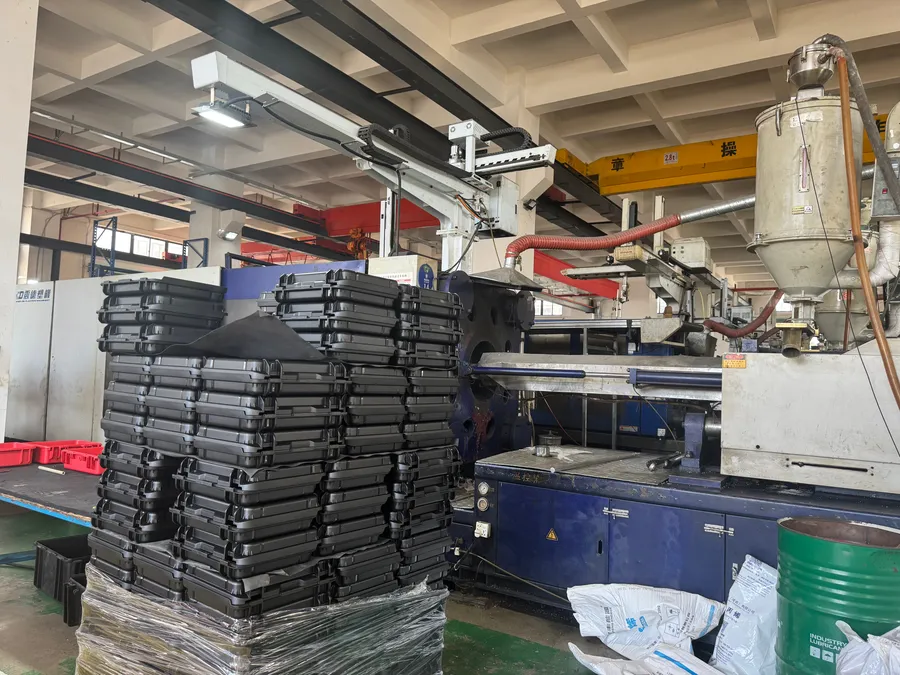
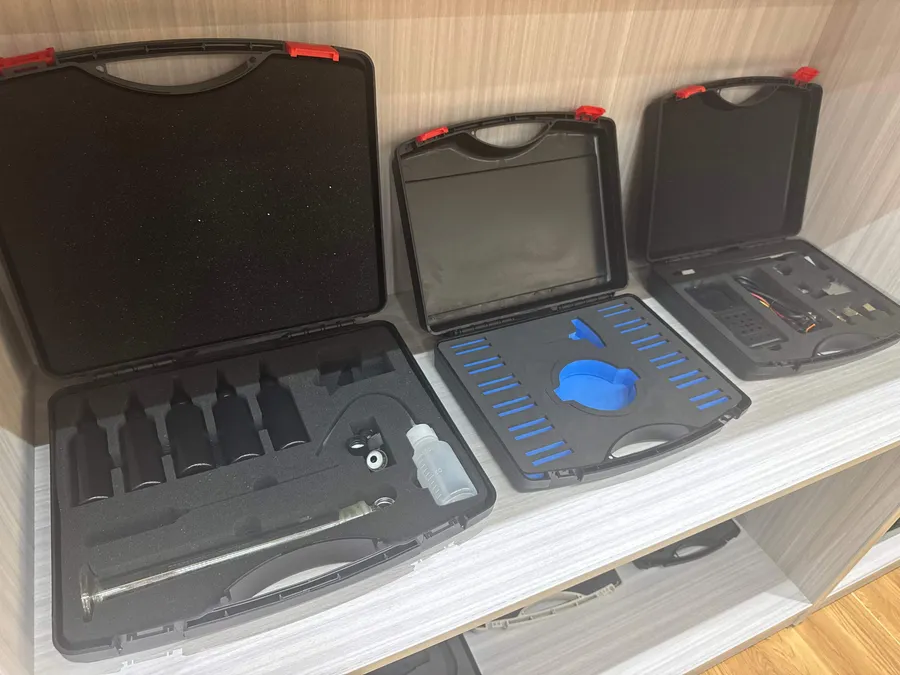
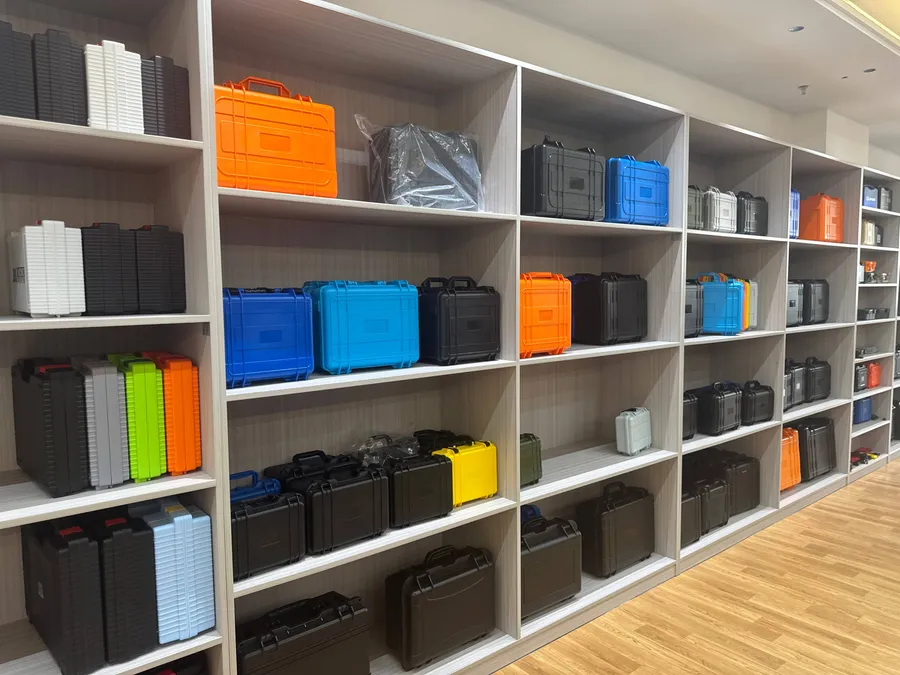
Customisation
Everything described above is configurable on a standard shell: interior layout (pick-and-pluck, die-cut or CNC-cut), foam grade and thickness, colour, logo method, latch and lock count, pressure-equalisation valve, cable ports, document holder and identification plate. A bespoke exterior geometry requires a new mould — 125 days, from 3,000 units per moulded component.
Procurement considerations
| Question | What to send us |
|---|---|
| Which shell fits? | Equipment L × W × H as packed, plus required clearance per axis |
| What does it cost? | Order quantity and estimated annual quantity — the two drive different answers |
| Is tooling needed? | Whether an existing shell clears the envelope with usable foam depth |
| Lead time? | Your required delivery date, not just the order date |
| Certification? | The exact standard your tender names — we will say whether we can test to it |
| Freight? | Destination and preferred terms; carton and pallet data supplied with the quotation |
Comparison and selection guide
The tables on this page exist because a protective case is chosen by comparing three things: the envelope, the environment and the handling chain. Where no table applies, the rule below is.
| Situation | What To Do |
|---|---|
| Marine or wet | Sealed configuration with a drain-friendly interior and stainless hardware. |
| Dry and dusty | A close-fitting rim and a lid that can be opened one-handed without spilling contents. |
| Carried far | Under 10 kg packed, with a padded handle or shoulder webbing. |
- Size on internal dimensions plus clearance, never on a product name.
- Choose the carrying method before the shell: it changes the series, not just the price.
- Specify the interior last, and decide up front whether the end user will reconfigure it.
How should buyers choose an outdoor case? relates to Procurement Guide. Related families: Outdoor Protective Cases / Waterproof Cases / Rolling Cases / Custom Protective Cases. Related sectors: field and industrial equipment. Continue in the Procurement Guide cluster.
This page is written from our own production data. If your requirement differs, send the dimensions and we will tell you which of the 155 models fits, or whether a custom route is needed.