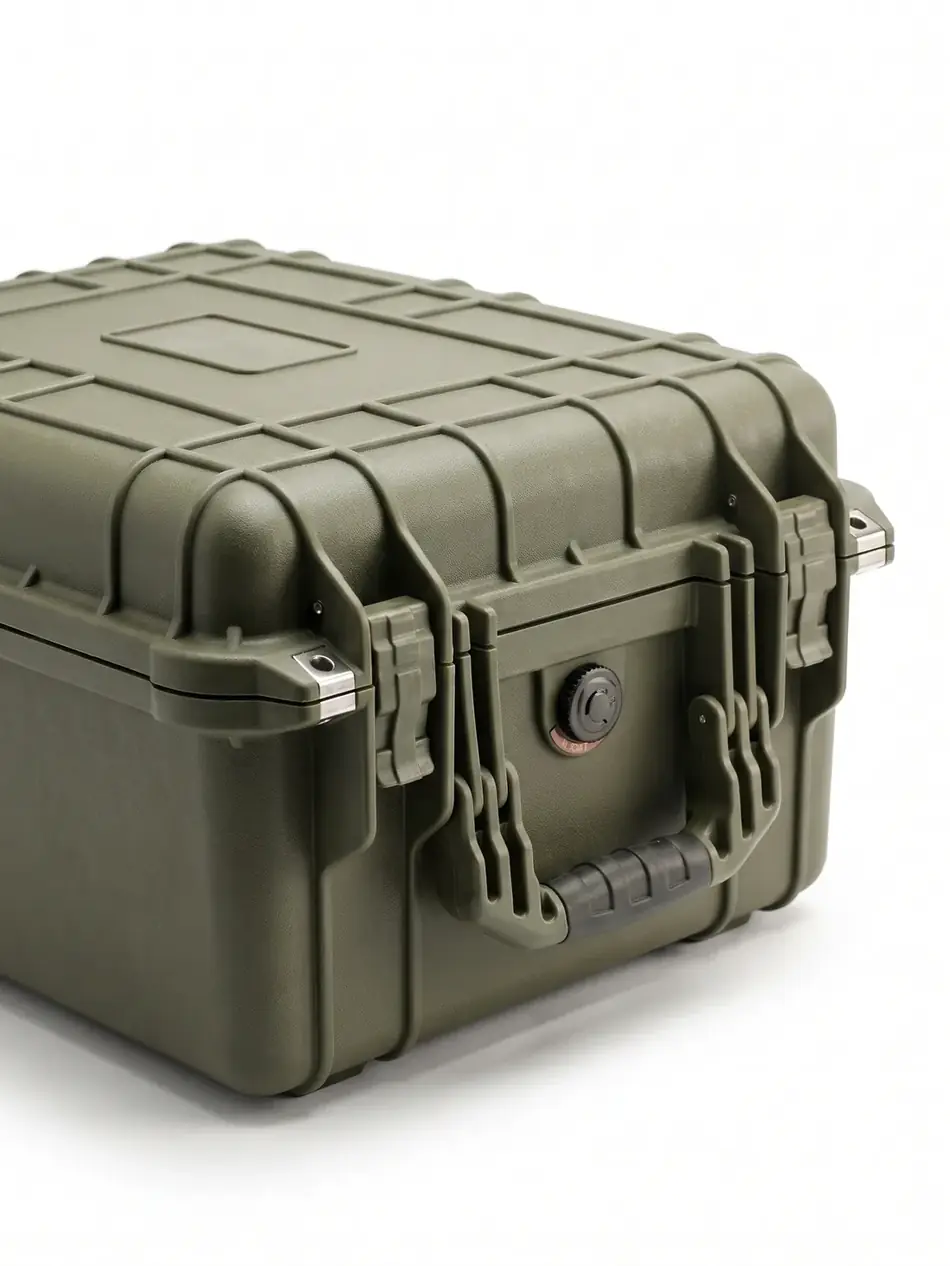
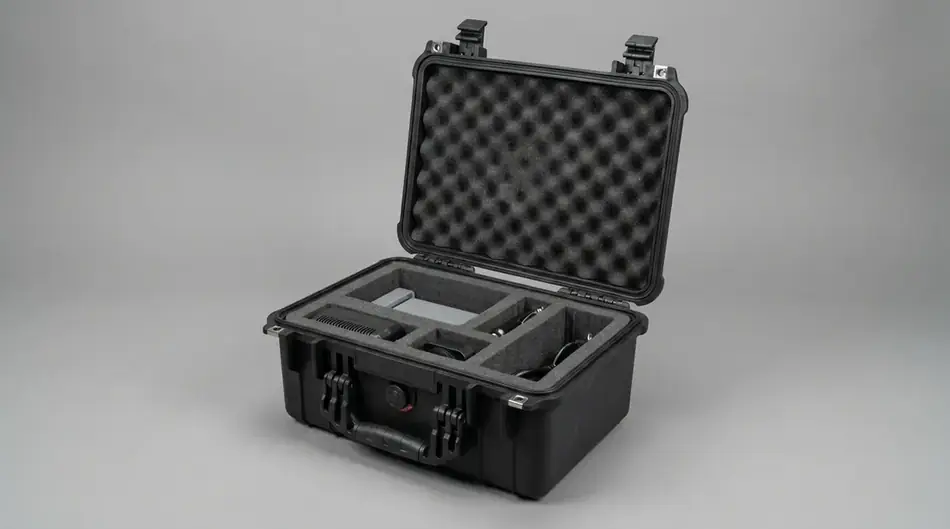
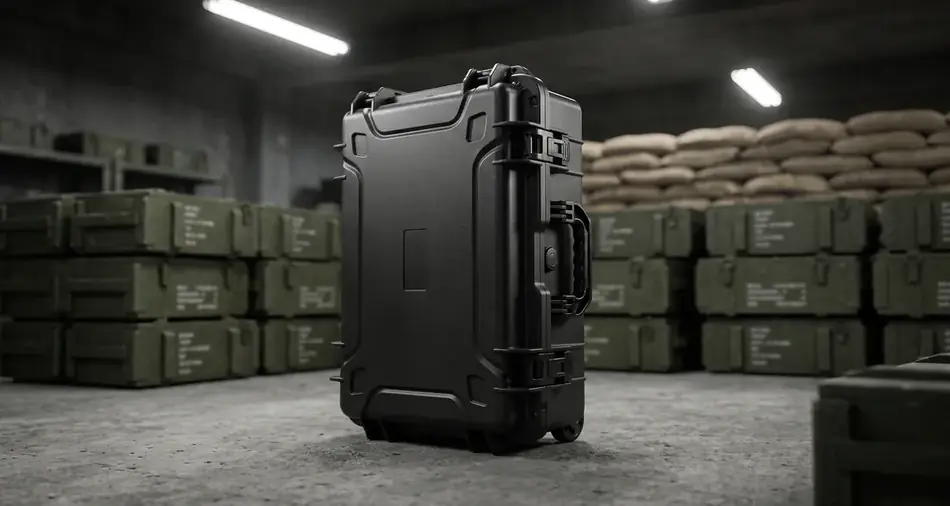
Can long cases include wheels?
Yes, within a size limit that is set by the shell rather than by the idea. Nineteen of our active models carry two moulded wheels and a telescopic handle, and they run from 463 mm to 843 mm of external length, with the largest holding 740 by 518 by 364 mm inside. Every one of them is a two-wheel trolley layout, which means the case is tipped onto its wheels to move and stands on handle, wheels and feet when parked. Our longest shells, the 956 mm and 1356 mm external heavy-duty boxes, are published without wheels and with stackability instead, so above roughly 0.85 m of shell length the real decision is whether the case has to survive a stack or has to be pulled by one person.
Key points
- Wheels exist on long shells up to 843 mm external length in our range; the 956 mm and 1356 mm shells are not offered with them.
- Every wheeled model we publish is a two-wheel trolley, so the case must be tilted to roll and cannot be walked upright.
- None of the nineteen wheeled shells is listed as stackable, while all seven non-wheeled shells of 700 mm or more are.
- Published telescopic handle heights run from 240 mm to 485 mm, and eight wheeled models list no handle height at all.
- Shell mass alone ranges from 4.9 kg to 15.3 kg across the wheeled models, and that is the load someone lifts to tilt it.
- Decide the stow path first: a vehicle bay, pallet or shelf is a stacking problem; a platform or airport tarmac is a wheel problem.
What counts as a long case in this catalogue
Length is only meaningful against a stow path, so we describe it by what the shell encloses rather than by a label. Twelve active models publish an internal length of 600 mm or more, and the longest of them, the KX-814641, gives a 1280 by 350 by 140 mm internal bay in a shell of 1356 mm external length, with a 100 mm lid over a 40 mm base. Below that sit shells such as the KX-89616 at 880 mm internal, the KX-88015 at 725 mm and the KX-87926 at 737 mm. These are single-piece mouldings, not hinged halves bolted together, which is why their length is a constraint on how they are moved and stacked rather than a feature that can be added on.
A useful way to read the range is by internal depth as much as by length. A 1280 by 350 by 140 mm bay takes a long item lying flat in a shallow base. A 740 by 518 by 364 mm bay, which is the wheeled KX-88442, takes the same item standing on end or takes a shorter item with accessories stacked above it. Those two shapes behave completely differently on a trolley, and choosing between them is a layout decision, not a size decision.
The wheeled configuration, as published
All nineteen wheeled models are T Series shells with two wheels and a handle that is described in our data as telescopic plus fixed folding, which means the case keeps a normal carrying handle as well as the pull bar. Eighteen of them publish a compressible gasket in a continuous moulded channel; the KX-5126 does not, so a sealed wheeled shell and an unsealed one are different purchases at the same size. Wall thickness across the group runs from 4.2 mm to 6.0 mm, which is materially heavier than the compact shells in the same catalogue and is what lets a long base resist the bending load that wheels introduce.
| Model | External Length Mm | Internal Length Mm | Net Mass Kg | Telescopic Height Mm | Stackable |
|---|---|---|---|---|---|
| KX-85022 | 463 | 437 | 5.012 | not published | No |
| KX-85726 | 576 | 520 | 5.6 | 385 | No |
| KX-86836 | 677 | 595 | 10.6 | 310 | No |
| KX-97227 | 720 | 590 | 10.0 | 485 | No |
| KX-87336 | 733 | 650 | 10.66 | 240 | No |
| KX-88337 | 830 | 723 | 10.866 | 240 | No |
| KX-88442 | 843 | 740 | 15.32 | 295 | No |
Two wheels rather than four, and what that changes
A two-wheel trolley is not a downsized luggage case. To move it, someone tilts the shell until the handle takes the weight, and from then on the case balances on two wheels plus the operator's arm. That is the right layout for a long shell for three reasons. It keeps the base clear of the ground so the sealing face and the interior do not drag. It puts the wheel load into the moulded corners where the wall is thickest instead of under the middle of a long span. And it lets a 0.8 m shell be pulled through a doorway by one person, which a four-wheel dolly arrangement of the same footprint does not, because a rigid four-wheel base cannot go over a kerb without lifting.
The cost is that the case will not stand upright on its own and cannot be pushed like a cart. Parked, it rests on wheels, feet and handle. Loaded with a long item that must be presented flat, the tilt angle is a handling question you should test with the actual contents, because the centre of mass of a rifle, a mast section or a tripod set is not in the middle of the envelope. Where a four-wheel or upright arrangement is genuinely required, the answer is usually a smaller shell plus a separate carrier, not a longer one with wheels added.
The trade nobody mentions: wheels remove stacking
Every one of our nineteen wheeled shells is published as not stackable. Every one of our seven non-wheeled shells with an external length of 700 mm or more is published as stackable. That is not an accident of the data; a moulded wheel set and a telescopic handle track occupy the faces that a stack would otherwise bear on, and a long lid cannot be relied on to carry a second case when its centre is unsupported.
This is the point at which most enquiries get reversed. A buyer describes a long item, asks for wheels because the item is awkward, and then ships the cases on a pallet or parks them in a vehicle bay where they must be stood one on another. A wheeled shell in that stow path is a single-layer load, so it takes floor area rather than height. If your storage is measured in shelf positions or in container deck height, the correct answer is the non-wheeled long shell and a plan for moving it, such as a two-person lift or a separate dolly. If your handling is a platform, a ramp or a tarmac, the wheel earns its weight.
Telescopic height is a fit-to-operator number, not a spec sheet decoration
Where we publish it, extended handle height runs 240 mm on the KX-88337 and KX-87336, 295 mm on the KX-88442, KX-86136, KX-85827 and KX-85835, 310 mm on the KX-86830 and KX-86836, 385 mm on the KX-85726 and 485 mm on the KX-97227. Those are real differences in how the case is pulled. A short extension means a stooped back or a case that is dragged at an angle; a tall extension means the handle geometry above the shell takes space in a low vehicle bay.
Eight of the nineteen wheeled models carry no published handle height, which is a data gap rather than a claim of zero. Ask for it before you commit, together with the wheel diameter and whether the wheels and the handle track are field-replaceable, because those three numbers decide what happens in month eighteen of a service life rather than on the day the goods arrive.
Mass, and who is expected to lift it
Empty shell mass across the wheeled group goes from about 4.9 kg on the KX-85021 and 5.0 kg on the KX-85022 up to 15.3 kg on the KX-88442, with the 10 kg band occupied by the KX-86830, KX-86836, KX-87336, KX-97227 and KX-88337. That is the case alone, before contents, before an interior that adds its own mass, and before whatever is strapped to the lid pocket. To tilt a two-wheel trolley you lift that entire mass through an angle, so the number to test is shell mass plus packed contents, not the payload you were worried about.
Where the total is beyond what one person should tilt routinely, there are three answers and only one of them is wheels: split the load into two smaller stackable shells, choose a shell with a fixed handle and a two-person lifting plan, or accept a single-layer stow and buy the wheeled version knowingly.
Which long loads suit a wheeled shell, and which do not
Long equipment that travels by air or road through a terminal, in ones and twos, over kerbs and thresholds is the natural home for a trolley shell: instrument tripods, mast and antenna sections, survey equipment with tripods, cable sets, generator spares, and long firearms in a transport case that is walked from a vehicle to a range and back. In all of those the case is upright-ish most of the time and the distance is short but repeated.
Long equipment that lives in a rack, a vehicle bay, a store shelf or a container stack does not. There the shell is laid flat, bears load from above, and is moved rarely, which favours the stackable heavy-duty shells at 788 mm, 800 mm, 956 mm and 1356 mm external length, with an interior doing the protection work. Ammunition and bulk stores follow the same rule: they are stacked by design, so a wheel is a liability on the face that has to carry weight.
Customising a long wheeled case
Our work is wholesale and OEM on EXW or FOB terms. We do not sell retail, do not quote DDP and hold no overseas warehouse stock. A standard shell and a custom foam cut both start from 1 piece, which is enough to prototype a long-item layout; logo, colour and OEM configurations start at 300 pieces, and a new mould at 3,000 per component. On an existing mould, a first OEM sample runs about 45 days and a new mould about 125 days, with a 30 per cent deposit to start.
For a long shell, the interior is where the value is, because a 1280 mm bay lets an item travel along its length and pick up a wall at either end. We cut from cross-linked PE, EVA or EPS by zone, in layered, base-plus-top, convoluted or CNC configurations, and we need a drawing, a photograph of the packed kit or the physical item before cutting. Ask specifically for blocks or carriers that stop fore-and-aft travel; that single feature does more for a long item than an extra millimetre of wall.
What to confirm before you order
Take five checks to the enquiry. First, the stow path: name the pallet, bay or shelf dimension the case must fit and whether it will ever bear a second case. Second, internal length with clearance at both ends, since a long item needs room for the cut face of the foam and for anything protruding past the muzzle or foot end. Third, published net mass, so the tilt test is done against real numbers. Fourth, the handle, wheel and latch items, including replaceability and the count of latches on the configuration quoted, which our data records per configuration rather than per family. Fifth, whether the seal is on the shell you are buying; eighteen of nineteen wheeled models carry a gasket and one does not.
Then ask only for figures the supplier will put in writing per model. External and internal dimensions, narrow internal width where published, base and lid depth, wall thickness and mass are measured data. Impact and shock provisions are configuration items on our sheets, with a note that no drop height is claimed without a test, and where we hold no record we say so instead of implying one. That tri-state answer is worth insisting on from everybody you quote against.
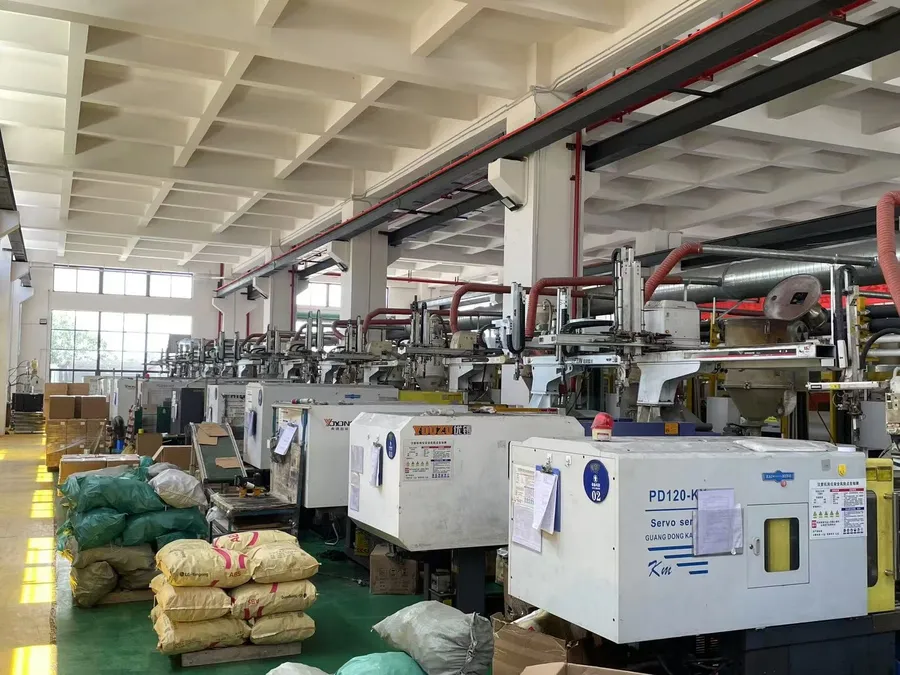
Customisation
Everything described above is configurable on a standard shell: interior layout (pick-and-pluck, die-cut or CNC-cut), foam grade and thickness, colour, logo method, latch and lock count, pressure-equalisation valve, cable ports, document holder and identification plate. A bespoke exterior geometry requires a new mould — 125 days, from 3,000 units per moulded component.
Procurement considerations
| Question | What to send us |
|---|---|
| Which shell fits? | Equipment L × W × H as packed, plus required clearance per axis |
| What does it cost? | Order quantity and estimated annual quantity — the two drive different answers |
| Is tooling needed? | Whether an existing shell clears the envelope with usable foam depth |
| Lead time? | Your required delivery date, not just the order date |
| Certification? | The exact standard your tender names — we will say whether we can test to it |
| Freight? | Destination and preferred terms; carton and pallet data supplied with the quotation |
Comparison and selection guide
The tables on this page exist because a protective case is chosen by comparing three things: the envelope, the environment and the handling chain. Where no table applies, the rule below is.
| Situation | What To Do |
|---|---|
| Length | Allow at least 25 mm at each end beyond the equipment so the foam can absorb end impact rather than the shell. |
| Depth split | A deeper base carries the mass; a shallow lid retains it. We normally recommend a 60/40 or 70/30 base-to-lid split. |
| Closure | Latches on the long edge give better sealing on a flexing shell; latches on the short edge are faster to open. |
- Size on internal dimensions plus clearance, never on a product name.
- Choose the carrying method before the shell: it changes the series, not just the price.
- Specify the interior last, and decide up front whether the end user will reconfigure it.
Can long cases include wheels? relates to Firearm & Long Equipment Transport Cases. Related families: Firearm Transport Cases / Long Equipment Cases / Military Transport Cases / Military Protective Cases. Related sectors: field and industrial equipment. Continue in the Firearm & Long Equipment Transport Cases cluster.
This page is written from our own production data. If your requirement differs, send the dimensions and we will tell you which of the 155 models fits, or whether a custom route is needed.