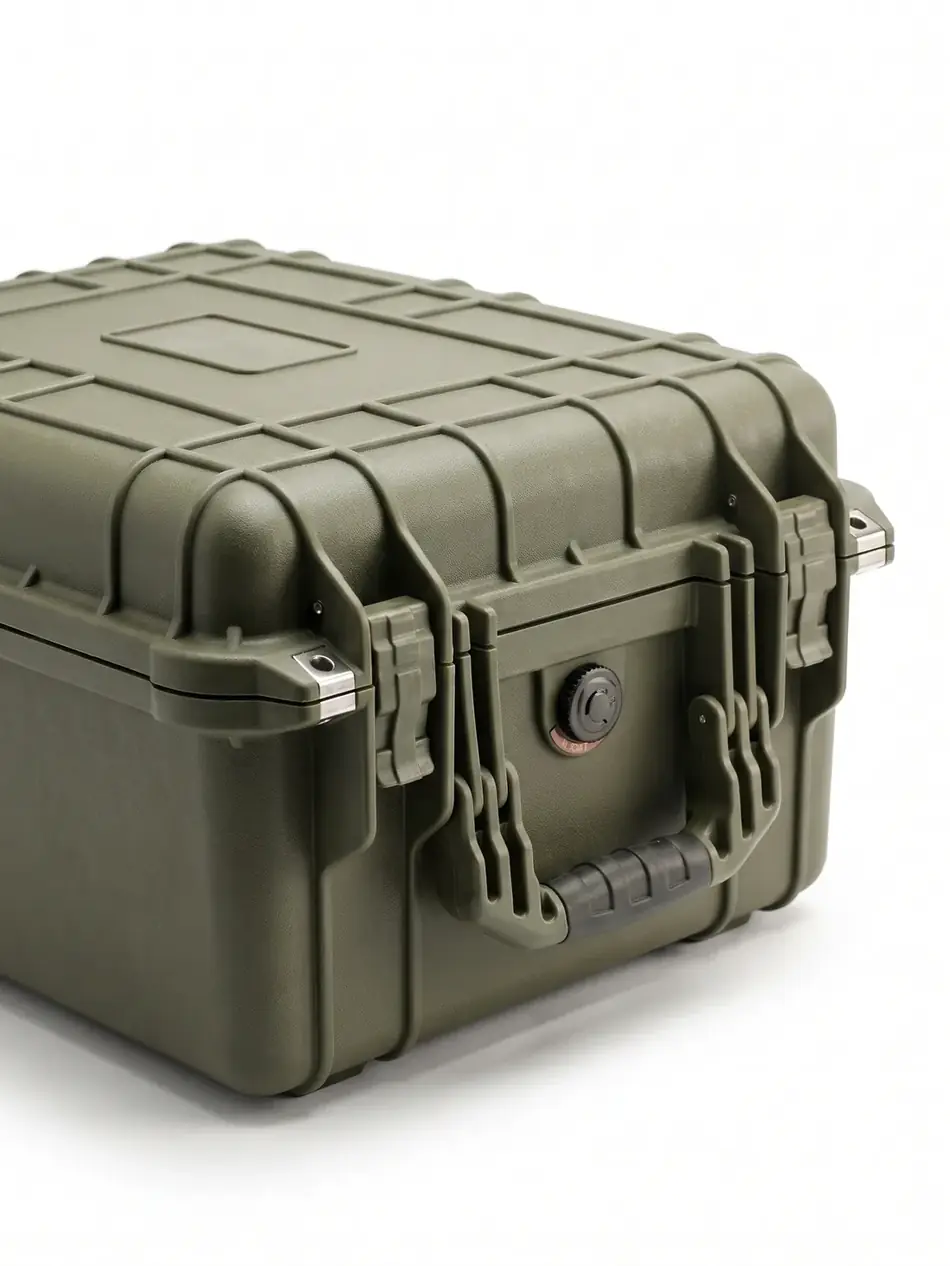
What Is CNC-Cut Foam?
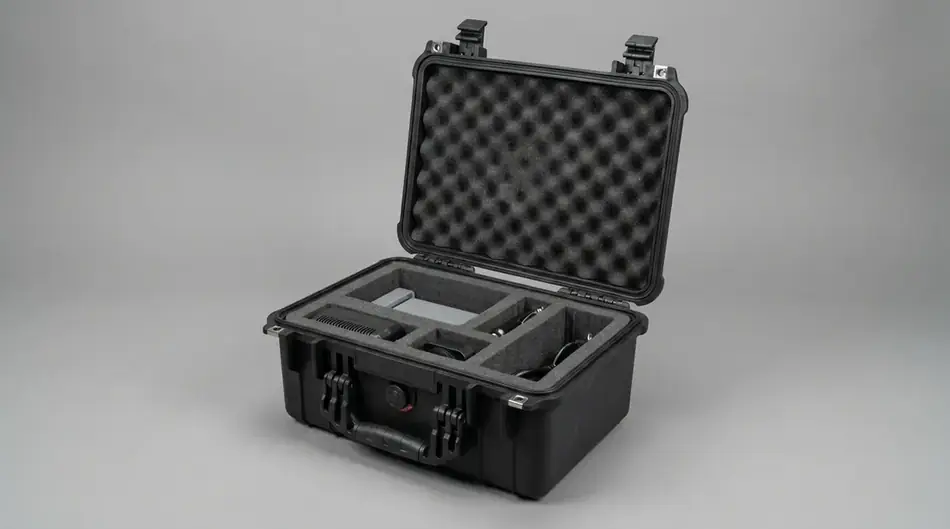
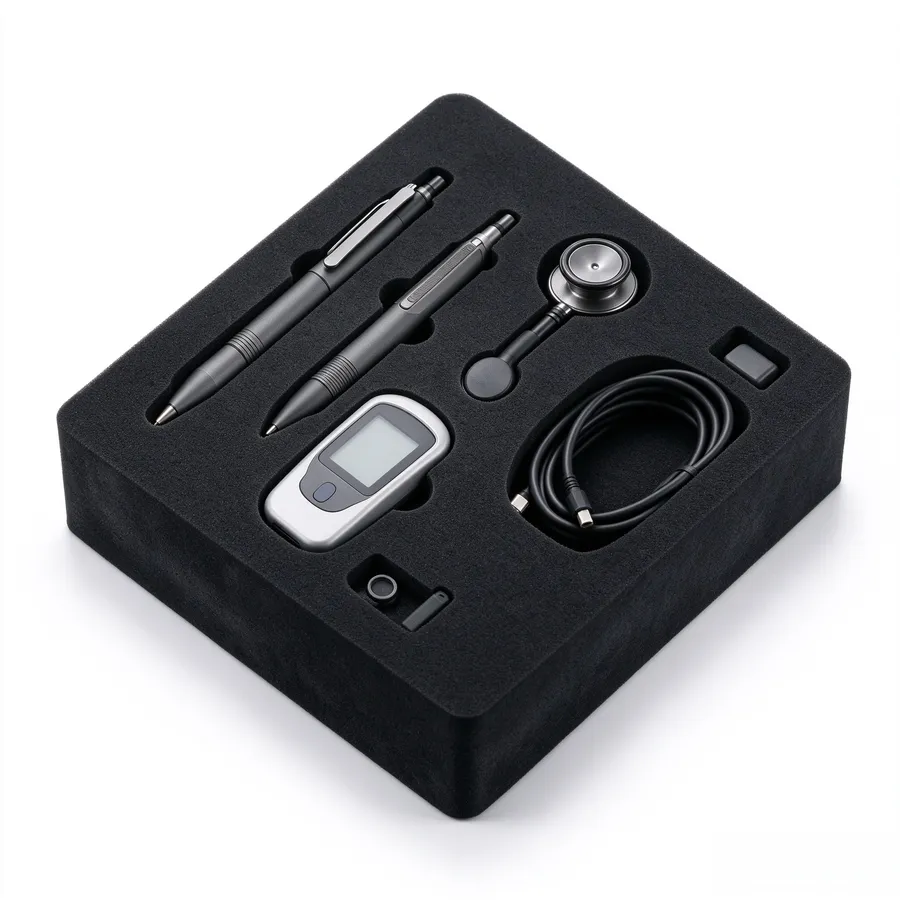
CNC-cut foam is a case interior produced by a numerically controlled cutter that follows a digital outline of each item, so a receiver, barrel, optic, magazine or instrument sits in a pocket shaped to it and nothing else. The result is a fixed layout: every object has one place, the pockets are separated by real walls of foam, and the same drawing reproduces the same interior on every unit in the run. That distinguishes it from pick-and-pluck foam, where the end user tears out cubes by hand, and from die-cut foam, where the profile is pressed out with a shaped tool. Because the geometry comes from a file rather than from a hand or a die, a machined interior is what we specify when the contents are known, valuable and packed the same way every trip.
Key points
- CNC-cut means a machine follows a digital profile, so the pocket on unit one matches the pocket on unit five hundred.
- The layout is frozen once it is approved: a machined insert locates items precisely but is not meant to be re-cut by the user.
- Precision is the reason to choose it and lost flexibility is the reason not to, so match it to a kit that does not change.
- Pocket depth is capped by the published internal height and the lid-to-base split of the shell, so read both before approving.
- We cut from a drawing, a photograph of the packed kit or a physical sample; the insert is only as correct as its reference.
- A machined interior is not a shock rating: dimensions are published per model and untested protection fields stay blank.
The definition in plain terms
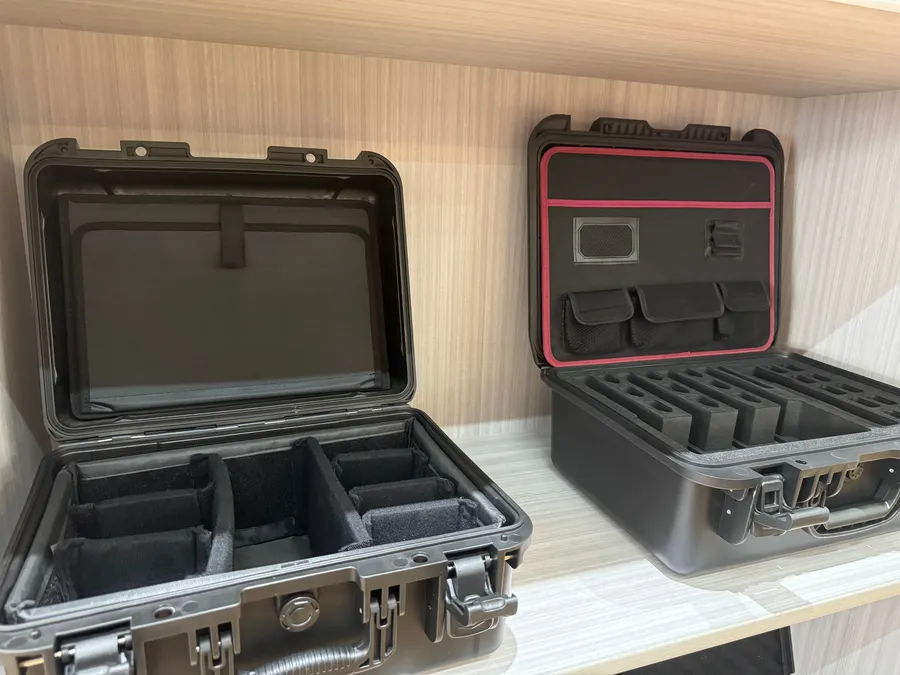
Take a photograph of a case interior you rate and look at where the objects sit. In a machined insert each one rests inside an outline cut to its own shape: the receiver sits in a channel, the barrel in a shallower trench beside it, the optic in a rounded recess, the magazines in two square bores. Those outlines are not pressed, torn or glued. They are cut by a machine that reads coordinates, which is what the letters CNC stand for: computer numerical control. The cutter removes the foam where the object goes and leaves the foam everywhere else, so the void and the support are produced in one pass from one file.
The practical consequence is repeatability. A hand-cut or hand-plucked interior records the judgement of whoever made it, and that judgement varies from unit to unit. A machined interior records a drawing. The first case and the last case in a production order share pocket positions, pocket depths and the wall thickness between neighbouring items, which is what makes the layout auditable when a fleet of cases has to pack identically across depots.
How the interior is produced
It starts with a reference, not with foam. We ask for a drawing with dimensions, a photograph of the kit laid out as it will be packed, or the physical items themselves, because the cut path has to be derived from something measurable. From that reference the outline of every item is turned into a cutting file together with the pocket depth, the separation between neighbouring pockets and the outer frame that bonds to the base of the shell. The cutter then works through the sheet, and what comes out is a layer with the voids already in place.
Interiors are usually built as bonded layers rather than as one thick slab, because different zones need different work. The catalogue publishes base foam, top foam, egg-crate or convoluted faces and layered assemblies as distinct construction options, and the cut types listed for the range are pick-and-pluck, die-cut and CNC-cut in PE, EPE and EVA grades. A typical firearm layout is a firm machined carrier that holds the mass, a cut-out for the muzzle and the stock, and a softer or convoluted face over the sight and the finish. The material by zone is a configuration decision, so we quote it against the load rather than as a blanket statement about the range.
Pockets, walls and the lid-to-base split
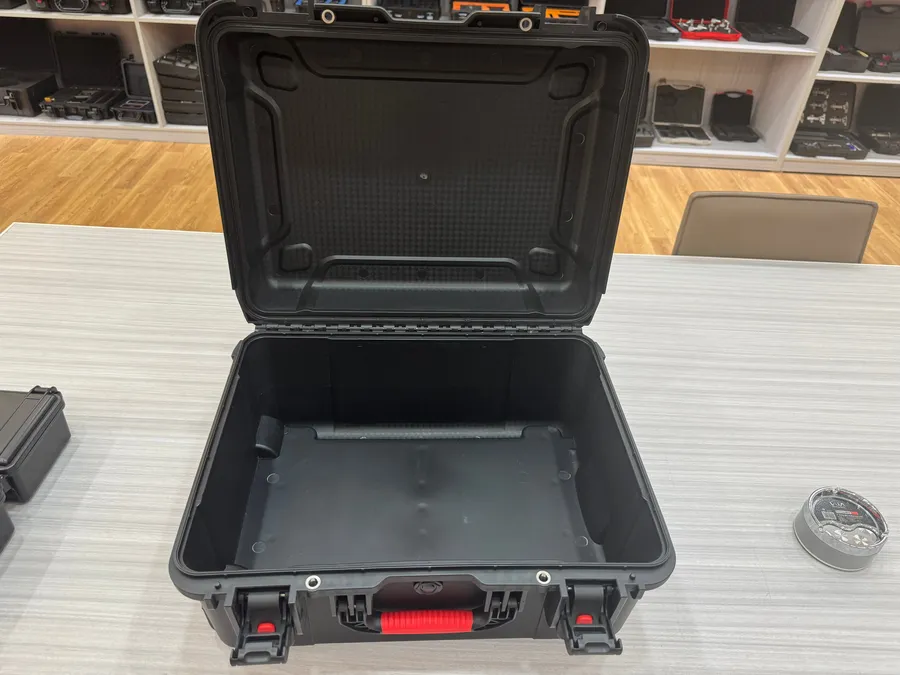
A machined pocket has a hard budget, and it is set by the shell. Two published numbers decide how deep a pocket may be cut: the internal height of the case and how that height divides between lid and base. The KX-4010 publishes 390 by 315 by 88 mm internal with an even 44 mm plus 44 mm split, so a deep object has to be bedded in the base and cleared by the lid, or the closure will not stay flat. The KX-4318 publishes 407 by 187 by 178 mm internal with an uneven 38 mm lid over 140 mm base, which puts almost the whole stopping depth in one half. The KX-88442 is the opposite case again: 740 by 518 by 364 mm internal with 320 mm of lid above a 44 mm base, so the items stand in a shallow floor layer and the lid carries the depth.
The second budget is width. Where a shell tapers, the catalogue publishes a narrow internal width below the nominal figure, and a pocket must be planned against the narrow number or the cut will run into the wall. On the KX-4710 family the nominal internal width is 345 mm while the published narrow width is 308 mm, a 37 mm difference that a drawing made from the outside of the case would miss. Length is rarely the limit: the published range runs to 1,280 mm internal on the KX-814641, which is why long, rigid items are the most common request for this interior type. Wall thickness on the shells runs from 2.0 mm to 6.0 mm depending on model, and it is the reason the same object can sit at a different height in two cases of the same outside size.
CNC-cut against the other ways to fill a case
Read the table as a trade between accuracy and adaptability rather than as a ranking. A machined pocket wins whenever the question is whether an item is present and where it is, because the void is visible when empty. Pluck foam wins whenever the question is what will be packed next month, because nobody has to wait for a drawing. In practice many programmes split the interior: a machined base carrier for the fixed core and a pluckable or convoluted top layer for whatever rotates around it.
| Method | Who Shapes It | Best At | What It Gives Up |
|---|---|---|---|
| CNC-cut from a file | The machine, from an approved drawing | Repeatable location of a known kit, missing-item checks | Reconfiguration by the end user |
| Pick-and-pluck grid | The user, by pulling out cubes | Contents that change between jobs with no re-order | Positional precision and a clean look in volume |
| Die-cut profile | A shaped tool pressing the outline | One repeated shape across a long run | Flexibility when the layout changes shape |
| Egg-crate or convoluted face | Pre-formed peaks, no per-item drawing | Even pressure over an irregular surface | Locating anything: items can still shift |
| Empty shell with dividers | The packer, each trip | Mixed loads and very large items | Any guarantee the item stays where it was put |
How to choose a machined interior
Start by counting how often the contents change. If the answer is never, and the same items go back in the same way each trip, machine it: the layout holds position, separates neighbours and makes a shortfall obvious at a glance. If the contents change weekly, do not machine the whole interior; machine the permanent part and leave a pluck or convoluted layer above it. If the case carries several owners' gear in one fleet, standardise on pluck and accept the looser fit, because a drawing signed for one depot will be wrong for another.
Then size it against the shell rather than against the item. Measure the packed envelope as it will actually sit, add the clearance you want around it, and only then compare that against published internal dimensions, the narrow width where one is given, and the lid-to-base split. Specify the pocket depth per zone instead of asking for one thickness everywhere: the mass needs a firm carrier, the finish needs a softer face, and a single uniform grade is what lets an item creep sideways over months of storage. Finally write the layout onto the purchase order, because the interior is a specified item, not a default that comes with the shell.
Where this interior is used
The most obvious application is the long, rigid load: firearms and other long equipment lying flat in a shallow channel, separated so that no two of them share a contact point, with the muzzle, the sight and any suppressor cleared by cut-outs rather than by guesswork. That is the case where a hand-torn grid performs worst, because the length is what transmits movement and the optic is what breaks.
The same logic carries across the rest of the range. Optics and instruments sit in machined bores so a lens never meets a wall. Communication kits use a cut base for the radios with a pluck top for cables and power supplies, which keeps the expensive part located and the variable part free. Medical and laboratory loads need a closed-cell face that wipes clean after spillage, so the machined layer is specified as cleanable and the loose items go above it. Drone and battery loads need separated bores so that no two packs share a wall. None of these are separate products; they are one interior method applied to different load lists.
Customising a machined interior under OEM or ODM
A cut-to-fit interior is our standard OEM entry point, and it is the cheapest customisation we offer: custom foam starts at a single unit on an existing shell, because the work is a drawing and a cutting path rather than a tool. Identification printing, matched shell colour and OEM production on an existing mould start at 300 units, with a first sample scheduled at 45 days. A brand-new shell size is a different class of project: a new mould is quoted at 125 days and from 3,000 units per component, with a 30 percent deposit before cutting starts. If your layout can live inside a published internal size, you are in the first category, and that is where most programmes belong.
To start one, send the packed-kit reference together with the load list and the count per case, tell us which items are permanent and which rotate, and name the clearance you want. We return a layout drawing for approval before any cutting path is released, so the pocket positions are agreed on paper rather than discovered at delivery. Private label and custom packaging can be combined with the interior on the same order, and hardware such as latches, hinges, handles and wheels is specified per configuration.
Purchasing notes and the limits of the claim
Three cautions save more money than the price negotiation. First, do not let an interior be quoted as an accessory line without a drawing attached; a price that includes foam but no approved layout is not a like-for-like number, and comparing it with a competitor's bare shell is meaningless. Second, quote the interior against the model, not the brand: internal dimensions, narrow width, lid and base depth and wall thickness are published per model, and they are what determines whether your pockets fit. Third, ask what is measured and what is offered. We publish dimensions, wall thickness and net weight as measured per model, while shock and impact protection are described as manufacturer options that depend on the layout you order.
On that last point we hold a firm line. A machined interior is a real construction, and it does exactly what it is designed to do, but it is not by itself a drop figure. Where a protection value has not been measured on the assembled case, the model page leaves the field blank instead of stating one, and accredited testing can be commissioned as a separate work package against the configuration you buy. Business terms are equally plain: this is wholesale and OEM manufacture only, quoted EXW or FOB from the factory, with no retail sale, no DDP door-to-door delivery and no overseas stocking, so plan your own onward freight from the port.

Customisation
Everything described above is configurable on a standard shell: interior layout (pick-and-pluck, die-cut or CNC-cut), foam grade and thickness, colour, logo method, latch and lock count, pressure-equalisation valve, cable ports, document holder and identification plate. A bespoke exterior geometry requires a new mould — 125 days, from 3,000 units per moulded component.
Procurement considerations
| Question | What to send us |
|---|---|
| Which shell fits? | Equipment L × W × H as packed, plus required clearance per axis |
| What does it cost? | Order quantity and estimated annual quantity — the two drive different answers |
| Is tooling needed? | Whether an existing shell clears the envelope with usable foam depth |
| Lead time? | Your required delivery date, not just the order date |
| Certification? | The exact standard your tender names — we will say whether we can test to it |
| Freight? | Destination and preferred terms; carton and pallet data supplied with the quotation |
Comparison and selection guide
The tables on this page exist because a protective case is chosen by comparing three things: the envelope, the environment and the handling chain. Where no table applies, the rule below is.
| Situation | What To Do |
|---|---|
| Length | Allow at least 25 mm at each end beyond the equipment so the foam can absorb end impact rather than the shell. |
| Depth split | A deeper base carries the mass; a shallow lid retains it. We normally recommend a 60/40 or 70/30 base-to-lid split. |
| Closure | Latches on the long edge give better sealing on a flexing shell; latches on the short edge are faster to open. |
- Size on internal dimensions plus clearance, never on a product name.
- Choose the carrying method before the shell: it changes the series, not just the price.
- Specify the interior last, and decide up front whether the end user will reconfigure it.
What Is CNC-Cut Foam? relates to Firearm & Long Equipment Transport Cases. Related families: Firearm Transport Cases / Long Equipment Cases / Custom Protective Cases / Optical Equipment Cases / Military Protective Cases. Related sectors: field and industrial equipment. Continue in the Firearm & Long Equipment Transport Cases cluster.
This page is written from our own production data. If your requirement differs, send the dimensions and we will tell you which of the 155 models fits, or whether a custom route is needed.