Why is internal length important when selecting a case?
Internal length decides whether long equipment fits straight, fits at an angle, or does not fit at all, and it is never the largest number on a listing. Across the 155 models in our current data, external length overstates usable length by 5 to 130 mm, a median of 26 mm, because wall thickness, rim overlap, latch bosses, handle channels and wheel housings all take their share from the inside. On the 98 models we tag for firearm transport the loss runs from 1.1 to 18.1 percent of external length. Two shells make the point plainly: an 843 mm external case gives 740 mm inside, while a 720 mm rolling case gives 590 mm. Specify against the internal length published per model, compare it with the equipment measured fully assembled with optics and muzzle devices fitted, and treat the external figure as packaging, not capacity.
Key points
- External length is packaging; internal length is capacity. The gap runs 5 to 130 mm across our 155 models, with a median of 26 mm.
- On the 98 firearm-tagged models the loss spans 1.1 to 18.1 percent of external length, and 30 of the 91 measured shells lose a tenth or more.
- KX-814641 is the only model reaching four figures inside: 1280 mm of internal length from a 1356 mm external shell.
- Wheels cost length: KX-97227 gives 590 mm inside from 720 mm out, while the shorter-external KX-86216 gives 582 mm inside from 620 mm out.
- One footprint, three depths: KX-88421, KX-88434 and KX-88442 all hold 740 mm of internal length and differ only in internal height.
- Order against equipment measured fully assembled, optic and muzzle device fitted; the foam cavity is cut into the internal space, not added around it.
Internal length is the only length that holds anything
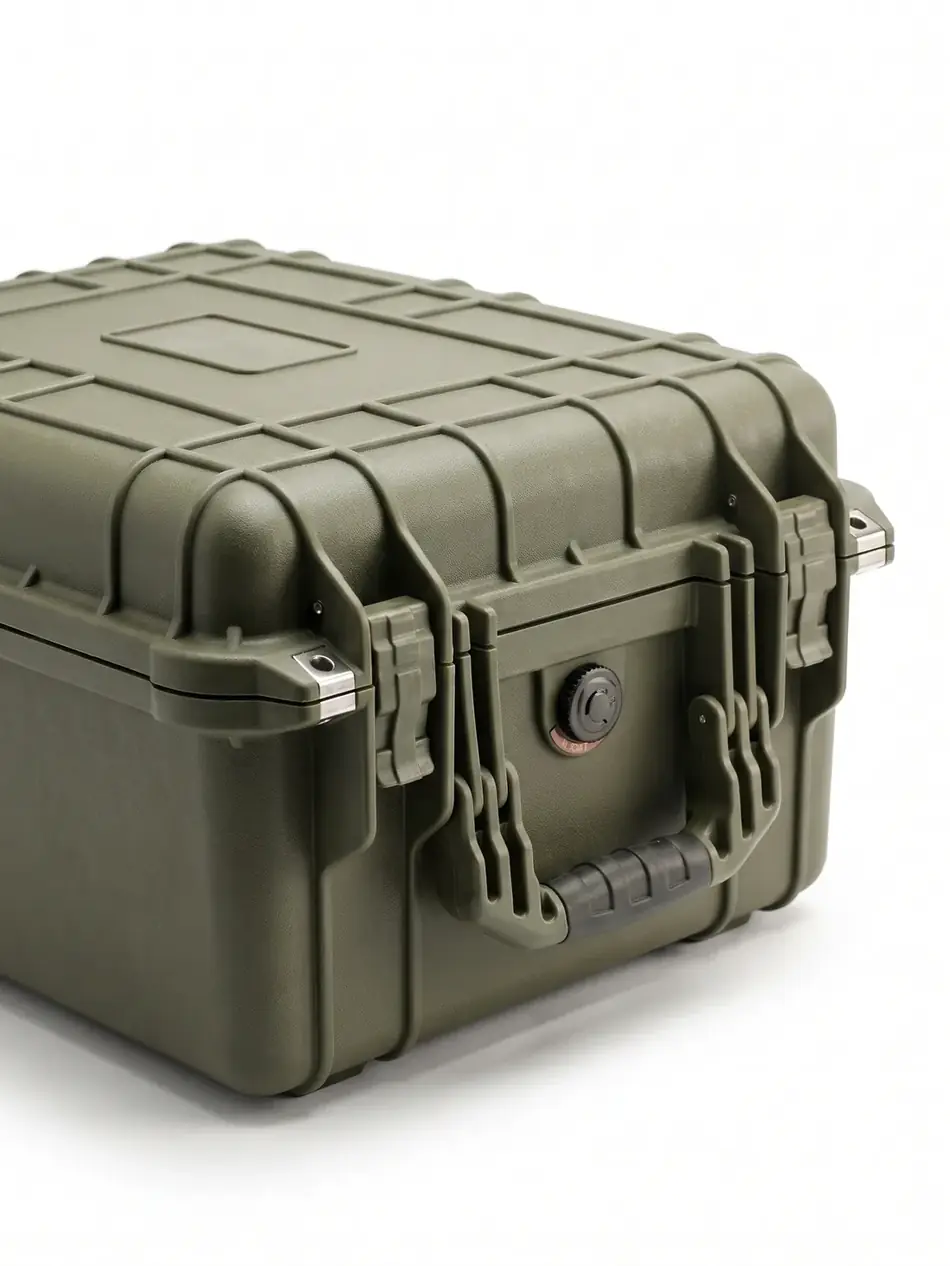
A long case advertises itself by its external length, and buyers quote that number back to each other all day. It is the wrong number for one specific job: deciding whether the equipment fits. External length is what shelves, cartons, pallets and vehicle beds see; internal length is what the contents see. Between the two sit the two shell walls, the rim overlap where lid meets base, the latch bosses, the hinge web and, on some shells, a handle channel or wheel housing. Every one of them is moulded into the envelope, and every one of them takes its share from the interior rather than from the outside.
That is why the two numbers have to be read as a pair with a known gap. Across the 155 models in our data the gap on the length axis runs from 5 mm on the smallest shells to 130 mm on the worst case, with a median of 26 mm, and the models that publish a wall thickness number 148. The external figure is not useless: it drives freight, storage and handling. But the moment the question is whether a rifle, a tripod or a boom fits, the external length has already told you nothing. The internal row of the datasheet answers the question, and the rest of this article is about reading it honestly.
Where the missing millimetres go
Wall thickness is the fixed part of the loss. It is published on 148 of our 155 models and runs from 2.0 mm on the thinnest utility shells to 6.0 mm on heavy-duty and rolling constructions, which means 4.0 to 12.0 mm gone from the length axis before anything else is counted. The variable part is hardware: the rim overlap that gives a stacking lid its bearing surface, the latch bosses along the front edge, the hinge web along the back, and on rolling shells the channel the telescopic handle retracts into and the housings that shield the wheels. None of those can be deleted from a shell that needs them.
Measured on the 91 firearm-tagged models that publish a wall thickness, the total length loss spans 5 to 130 mm, with a median of 34 mm, or 1.1 to 18.1 percent of external length with a median of 6.5 percent. Thirty of those 91 shells lose a tenth or more of their external length, while 18 lose no more than 5 percent and 12 stay within 3 percent. The spread is the point: if a buyer assumes a single typical gap, roughly one shell in three will disappoint them in a direction the assumption cannot predict. Only the published internal figure per model is safe to build on.
External length does not rank cases
The clearest argument for internal length is a pair of comparisons from our own data. KX-97227 measures 720 mm outside and gives 590 mm inside, an 18.1 percent loss, because it is a rolling shell: the telescopic handle channel and the wheel housings are paid for along the length axis. KX-86216 measures 620 mm outside and gives 582 mm inside, a 6.1 percent loss, on a thin-walled shell with no wheels. The longer box is 8 mm shorter where it matters. A buyer sorting candidates by external length would rank these exactly backwards.
The same inversion appears higher up the range. KX-88421 measures 843 mm outside for 740 mm inside, while KX-87926 measures 788 mm outside for 737 mm inside: 55 mm more external buys 3 mm more internal. External length ranks freight and storage; internal length ranks capacity; and the two orders disagree often enough that only one of them can be trusted at specification time. When a procurement team asks us for the longest case in the range, the first thing we send back is the internal length column, because that is the column their requirement actually belongs in.
What the range offers in internal length
Of the 98 models tagged for firearm transport, the published internal lengths run from 380 mm to 1280 mm with a median of 459 mm. Thirty-five of the 98 give 500 mm or more of internal length, eight give 700 mm or more, and exactly one reaches four figures: KX-814641, at 1280 mm inside a 1356 mm shell. The table below lists the models that anchor the top of that range, with the loss figures that this article has been arguing about, so the trade between external size and internal capacity is visible rather than implied.
| Model | External Length Mm | Internal Mm | Length Lost Mm | Loss Pct | Usable L | Stackable | Wheels |
|---|---|---|---|---|---|---|---|
| KX-814641 | 1356 | 1280 x 350 x 140 | 76 | 5.6 | 50.2 | Yes | No |
| KX-89616 | 956 | 880 x 350 x 140 | 76 | 7.9 | 34.5 | Yes | No |
| KX-88421 | 843 | 740 x 518 x 189 | 103 | 12.2 | 57.9 | Yes | No |
| KX-87926 | 788 | 737 x 257 x 240 | 51 | 6.5 | 36.4 | Yes | No |
| KX-88015 | 800 | 725 x 350 x 140 | 75 | 9.4 | 28.4 | Yes | No |
| KX-87323 | 733 | 650 x 430 x 210 | 83 | 11.3 | 47.0 | Yes | No |
| KX-97227 | 720 | 590 x 435 x 210 | 130 | 18.1 | 43.1 | No | Yes |
| KX-86216 | 620 | 582 x 300 x 130 | 38 | 6.1 | 19.5 | Yes | No |
| KX-4010 | 400 | 390 x 315 x 88 | 10 | 2.5 | 9.3 | Yes | No |
Length is necessary, not sufficient: depth and width for scoped configurations
Internal length is the binding constraint most of the time on long equipment, but it is not the only axis a scoped configuration stresses. Depth is the usual second constraint: the sight line sits above the bore, so the deepest feature of an assembled firearm is the optic on its mounts. Our long shells handle this with asymmetric depth splits. KX-814641 divides its 140 mm of internal height as 100 plus 40; KX-88421 divides 189 mm as 145 plus 44; KX-97227 divides 210 mm as 42 plus 168. The deep half is what the optic lives in, and the split is published per model precisely so the buyer can check it against the assembled height rather than discovering it on arrival.
Width matters for the same reason: rings, bolt handles and muzzle devices extend the envelope sideways and forwards. The internal width and height figures are published per model, and the same measuring discipline applies as everywhere else on the site: measure the equipment fully assembled, in travelling condition, at the widest point of each axis. A firearm that fits its case bare can miss by a ring or a suppressor once everything is mounted, and the case that was nearly right is then exactly wrong.
Straight fit, diagonal fit, or take-down
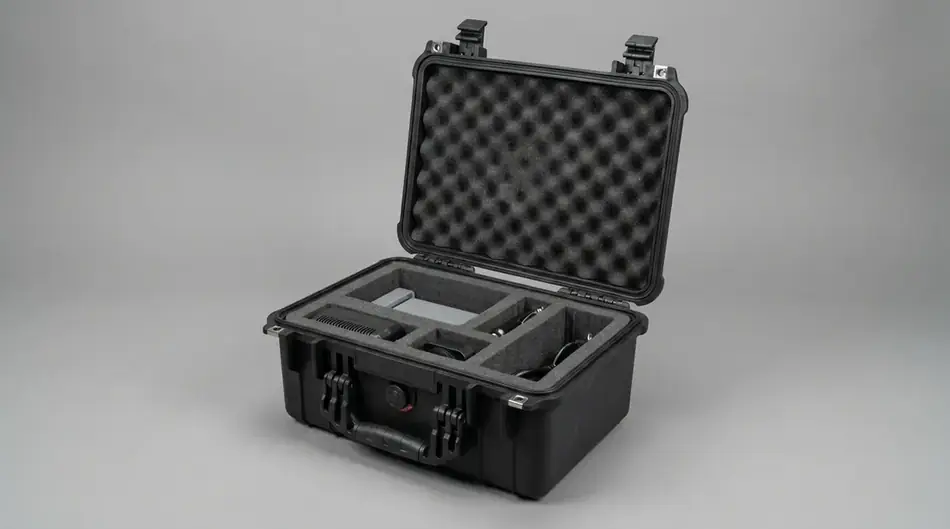
There are three ways to house equipment longer than the internal length, and they are not equivalent. A straight fit is what the foam does best: the equipment lies on its longest axis, supported along its length, and the cavity drawing is trivial to keep consistent across a fleet. A diagonal fit is arithmetic before it is geometry: the planar diagonal of KX-88421's 740 by 518 mm interior is 903 mm by simple calculation, which is a bound, not a promise. The shell tapers inside the rim, the foam walls consume part of the space the arithmetic assumed, and the diagonal only works if the equipment can flex into the corners while staying supported. We publish dimensions, not a diagonal-fit rating, so a diagonal layout is something to verify against the specific model with us before it is specified.
A take-down or two-piece configuration relaxes the length requirement entirely and changes the problem into support and alignment: each section needs its own cavity, and the assembly has to be repeatable in the dark by someone wearing gloves. That is a foam and layout question more than a case question, and it is covered in depth in our article on supporting long equipment inside a case. What the length axis contributes here is the honest starting number: the internal length each section must fit, read from the datasheet, not from the box.
Specifying by internal length: a working method
The method that survives procurement is short. Measure the equipment fully assembled, optic mounted and muzzle device fitted, at the widest point of each axis. Take the published internal length, width, height and depth split of each candidate model, not its external row. Require the internal length to exceed the measured length with room for end cushions, which the foam layout will place, and require the depth split to cover the optic in one half or accept a cradle across the parting line. Then check the storage and freight flags before the order: stackability for the armoury rack, external length and pack quantity for the pallet, and wheels or no wheels for the route the case will actually travel.
That last flag is worth restating because it runs through our range as a package. All 19 wheeled models in the catalogue are marked non-stackable, and the wheeled shells sit at the top of the length-loss table, while the fixed-handle shells stack and keep more of their external length. Neither is better; they are different answers to different routes. The error is choosing by silhouette and then being surprised by the published numbers, when the numbers were in the datasheet all along.
Where internal length is the binding constraint
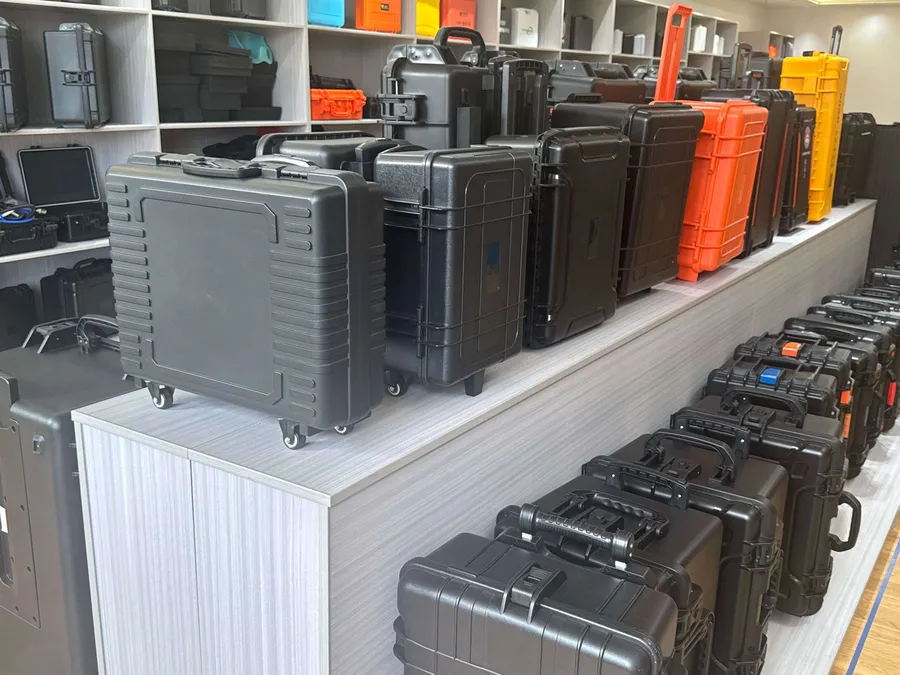
Firearm transport is the obvious case, and it is why 98 of our models carry that tag, but the same constraint governs any long, rigid, one-piece load: tripods and antenna masts, boom poles, survey staves, rifle-length tools and fixture rails. In all of them the equipment cannot bend, so the internal length either clears it or does not, and the diagonal options discussed above get weaker as the load gets heavier and less flexible. Law-enforcement armories, range programmes and defense units tend to meet this as a fleet problem: one internal length that covers every configuration in service, so any case accepts any unit.
For a fleet, the three-variant footprint families in our data are the useful pattern. KX-88421, KX-88434 and KX-88442 share an 843 by 592 mm external footprint and a 740 by 518 mm internal length and width, differing only in internal height: 189, 284 and 364 mm. The same pattern repeats on the 650 mm and 595 mm families. A programme can therefore fix its internal length once and scale depth per configuration, which keeps the foam library, the rack layout and the pallet plan coherent across the whole set instead of renegotiating the length axis with every new item.
Custom interiors and what to confirm before ordering
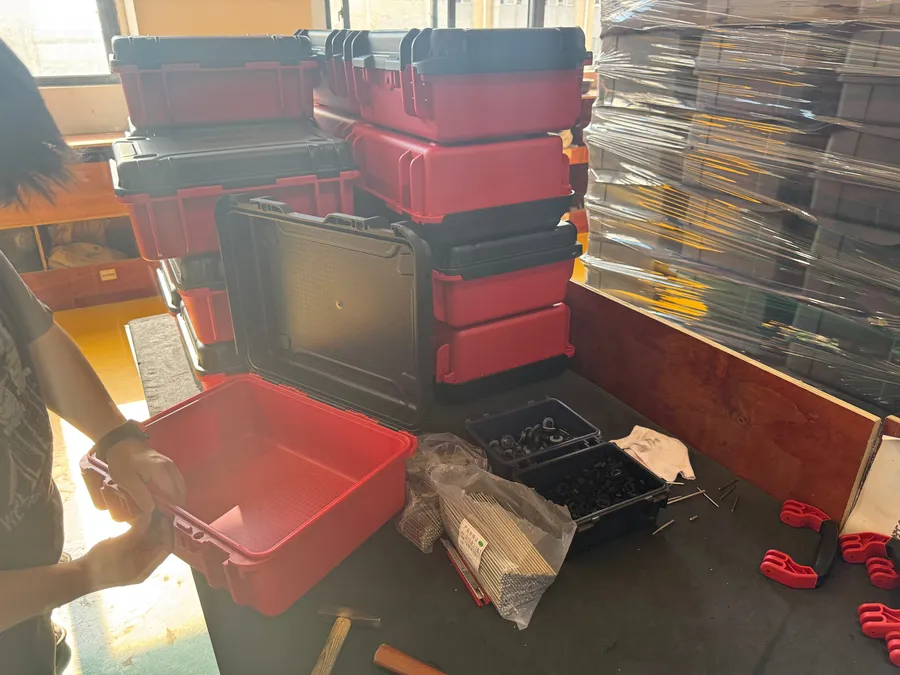
When the standard interior does not match the measured equipment, the interior is what changes. Foam layouts are cut to the measured numbers against the internal dimensions of the chosen shell, so the internal length the datasheet publishes is also the space the cavity drawing has to respect. Interior and hardware configuration changes on existing tooling are quoted from 45 days, with logo, colour and OEM work at 300 pieces per item; a new shell, including a genuinely new length, is a new mould at 125 days and an MOQ from 3,000 pieces per component. We supply wholesale and OEM only, on EXW or FOB terms, with no retail channel, no DDP and no overseas warehouse stock.
Before an order is placed, five confirmations close the loop this article opened: the equipment measurement taken fully assembled against the internal row; the depth split against the optic; the width at the widest point; the stackability flag against the storage plan; and the pack quantity against the freight plan. If any of those five turns into a negotiation after delivery, the specification was written from the wrong column. If they are checked before the order, the internal length does the job it was published for, which is the only reason a datasheet exists.
Customisation
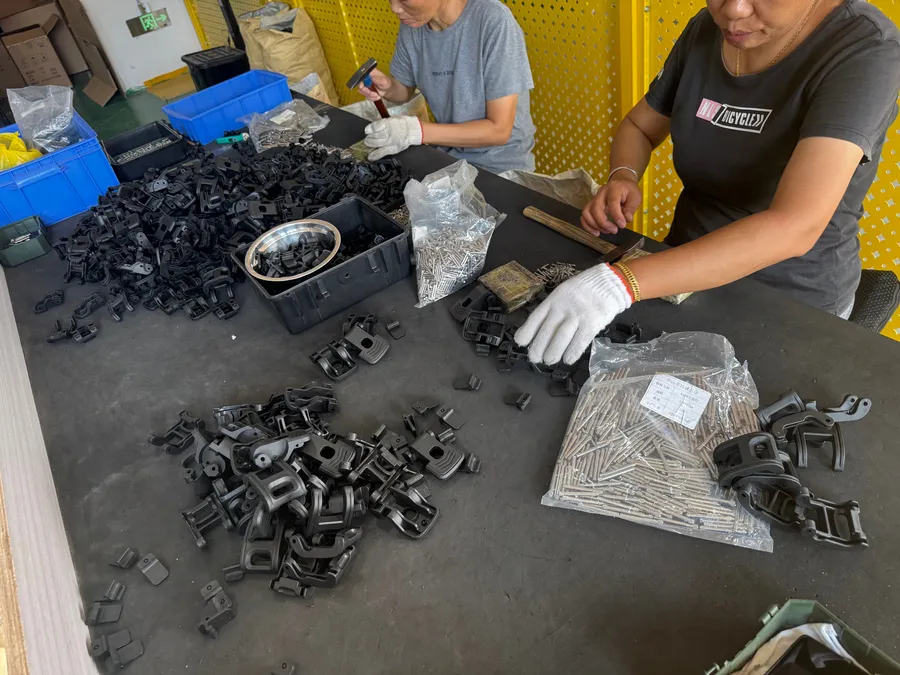
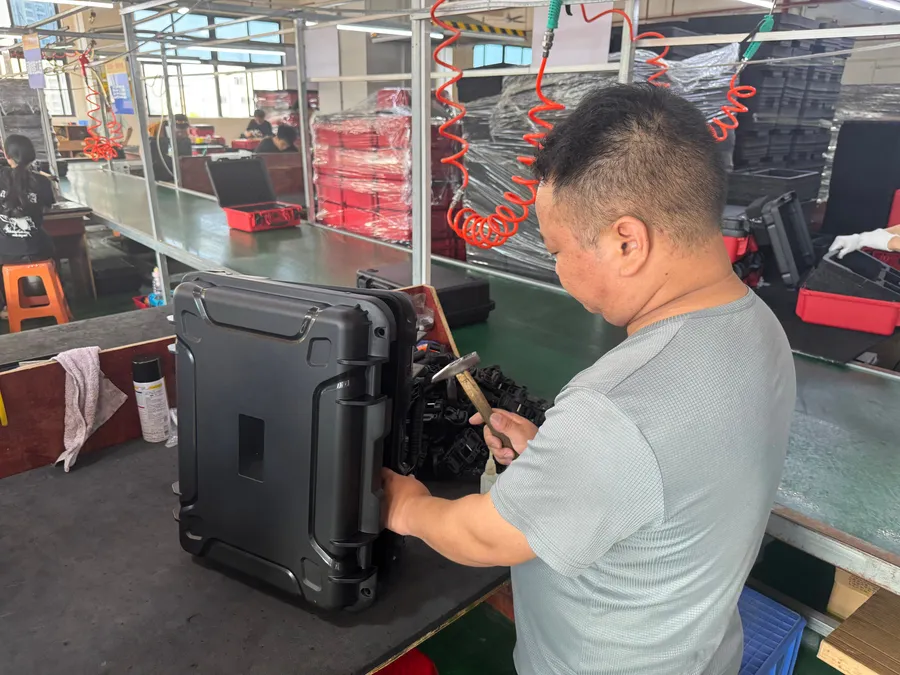
Everything described above is configurable on a standard shell: interior layout (pick-and-pluck, die-cut or CNC-cut), foam grade and thickness, colour, logo method, latch and lock count, pressure-equalisation valve, cable ports, document holder and identification plate. A bespoke exterior geometry requires a new mould — 125 days, from 3,000 units per moulded component.
Procurement considerations
| Question | What to send us |
|---|---|
| Which shell fits? | Equipment L × W × H as packed, plus required clearance per axis |
| What does it cost? | Order quantity and estimated annual quantity — the two drive different answers |
| Is tooling needed? | Whether an existing shell clears the envelope with usable foam depth |
| Lead time? | Your required delivery date, not just the order date |
| Certification? | The exact standard your tender names — we will say whether we can test to it |
| Freight? | Destination and preferred terms; carton and pallet data supplied with the quotation |
Comparison and selection guide
The tables on this page exist because a protective case is chosen by comparing three things: the envelope, the environment and the handling chain. Where no table applies, the rule below is.
| Situation | What To Do |
|---|---|
| Length | Allow at least 25 mm at each end beyond the equipment so the foam can absorb end impact rather than the shell. |
| Depth split | A deeper base carries the mass; a shallow lid retains it. We normally recommend a 60/40 or 70/30 base-to-lid split. |
| Closure | Latches on the long edge give better sealing on a flexing shell; latches on the short edge are faster to open. |
- Size on internal dimensions plus clearance, never on a product name.
- Choose the carrying method before the shell: it changes the series, not just the price.
- Specify the interior last, and decide up front whether the end user will reconfigure it.
Why is internal length important when selecting a case? relates to Firearm & Long Equipment Transport Cases. Related families: Firearm Transport Cases / Long Equipment Cases / Military Protective Cases / Rolling Cases. Related sectors: field and industrial equipment. Continue in the Firearm & Long Equipment Transport Cases cluster.
This page is written from our own production data. If your requirement differs, send the dimensions and we will tell you which of the 155 models fits, or whether a custom route is needed.