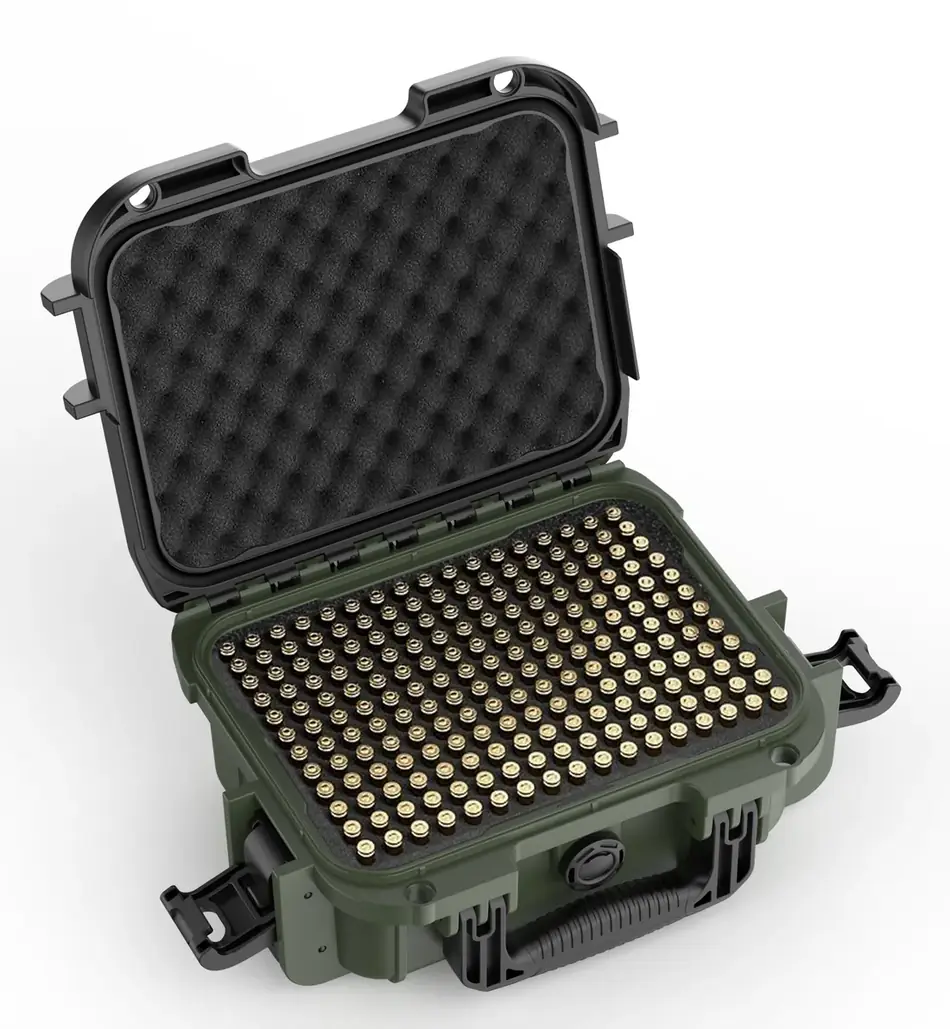
Can ammunition storage boxes be customized?
Yes. Ammunition storage boxes are customized on several separable fronts, and the key distinction is whether a change touches the moulded shell or only what is added to it. The interior can be cut to any layout — routed foam, layered PE, EVA or EPS, dividers and tie-down rails — and that carries no tooling charge and can begin from a single unit. A printed logo, a body colour, packaging and an OEM build are batch items that begin around three hundred units. Lockable hardware, latch count and, where the model lists one, a compressible gasket are configuration choices on an existing part. Only a genuinely new external footprint requires a dedicated mould, which starts near three thousand units per component on a roughly one-hundred-and-twenty-five-day clock. What is never customized is an invented capacity: the safe interior depends on the specific round or component, so we shape it from your sample or drawing rather than publish a generic round count.
Key points
- Almost every useful customisation of an ammunition box is interior, hardware or print, and none of those needs a new mould, so start from a published model.
- A custom-cut foam interior begins at one unit with no tooling charge, which makes a fitted trial order the cheapest first customisation to request.
- Colour, logo and packaging are batch items at around three hundred units; a dedicated new-shape mould begins near three thousand per component.
- Sealing is offered per model, so confirm whether the exact box lists a gasket before specifying ingress behaviour rather than assuming the whole range seals.
- Give the payload dimensions and the handling sequence, not a target round count; the interior that keeps items separated is defined by the item itself.
What can be changed and what cannot
An ammunition storage box is a small assembly: a moulded base, a lid, one or more latches, a hinge, sometimes a handle, and an interior. Customization means configuring that assembly around a specific payload. The cheap, fast variables are everything cut, bolted or printed onto the shell — the foam, the dividers, the latch and padlock choice, the colour and the logo — and a buyer can move these on a published part without any new tool. The expensive, slow variable is the shell geometry itself. As long as your load fits inside a published internal envelope, you customise the interior and the print and keep the schedule in weeks.
What we do not customize is a number we have not measured or a capacity we cannot verify. Ammunition, primers, magazines and components differ in shape and mass, so the safe interior is defined by the item you carry, agreed from a sample or a dimensioned drawing. We will not print a generic round count on a box to make a specification look complete; we will shape located separation for the exact item and confirm wall, seal and hardware for the model you choose.
The published size ladder you customise on top of
Most enquiries start from a close existing part and adjust it, so it helps to know the real spread. On the small end, KX-1204 is published at 120 by 90 by 40 millimetres outside and 115 by 78 by 32 inside, a 2.6 millimetre wall and a 100 gram net mass in polypropylene with no seal listed. A step up, KX-1905 is 190 by 190 by 45 outside with a 3.0 millimetre wall and a seal, and KX-62109 is 211 by 165 by 93 outside at 470 grams. These already cover a wide range of small-parts and component storage without any new tool.
On the storage-and-transport end, KX-2811 is published at 280 by 225 by 111 millimetres outside and 253 by 180 by 98 inside with a 5.0 millimetre wall and an 890 gram net mass, while KX-92817 keeps the same footprint but deepens to 280 by 225 by 165 outside and 253 by 180 by 152 inside at 940 grams. KX-62810 sits at 275 by 226 by 100 outside, and an ABS-bodied KX-63413 reaches 339 by 310 by 125 outside with a 4.8 millimetre wall at 1680 grams. Because internal dimensions are always smaller than external by roughly twice the wall plus the rim, you specify the payload and let the published interior of the chosen model confirm the fit.
Interior customisation: separation and location
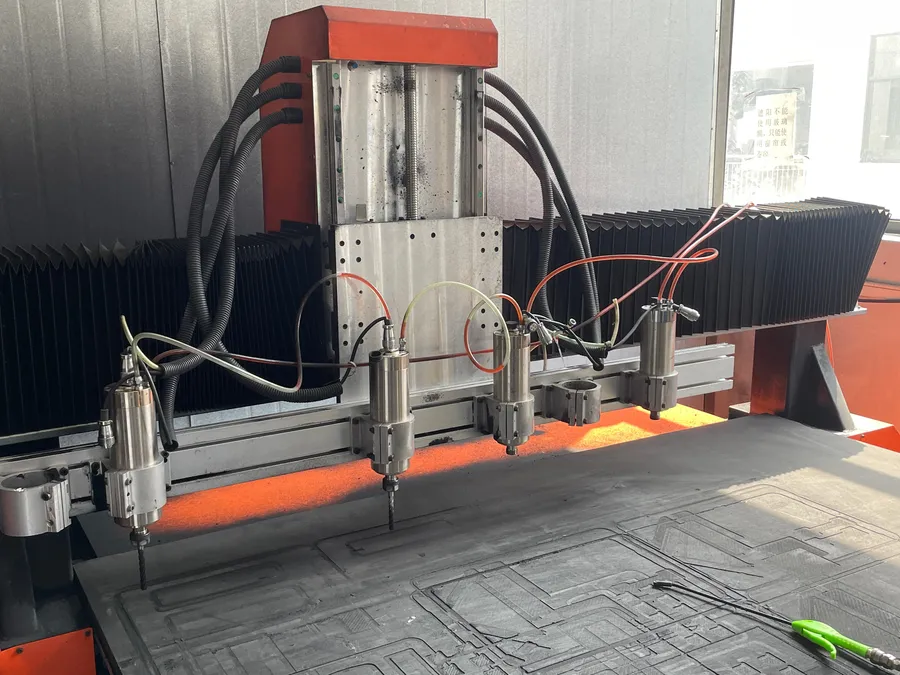
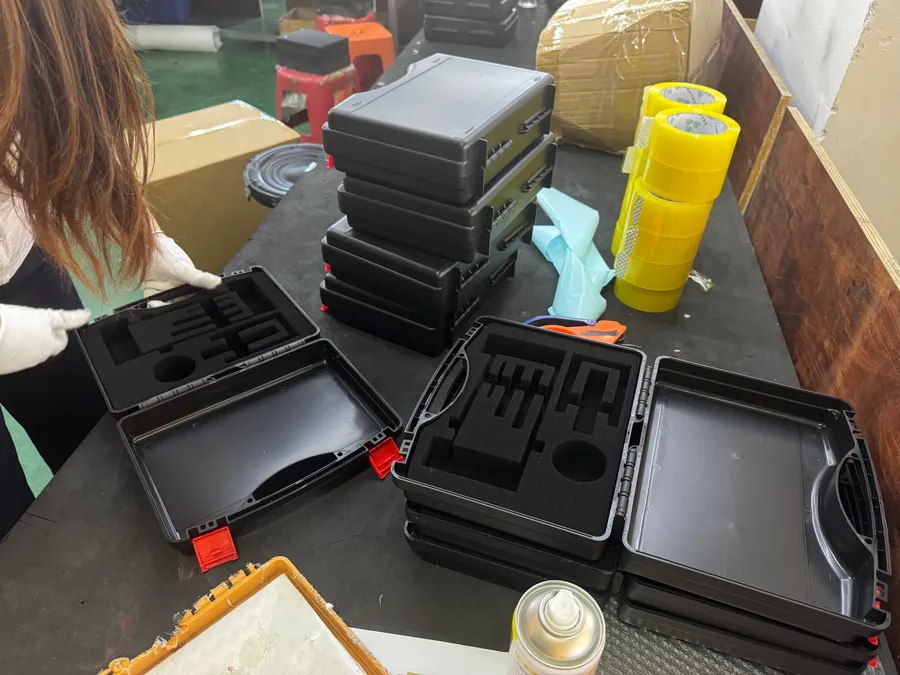
The insert is where an ammunition box earns its keep, and it is the one part with no tooling charge. Interior foam is cut from board stock in cross-linked PE, EVA or EPS by zone, so a denser layer carries a heavy corner while a softer layer cradles a sensitive item. Pick-and-pluck, die-cut, CNC-cut and layered constructions are all available, along with dividers, machined pockets and tie-down rails, and a custom interior can start from a single unit so you can fit and evaluate before scaling.
For ammunition and ordnance handling the goal is located separation: individual items are kept from touching each other and from concentrating a shifting load on one wall in transit. The layout is agreed from a physical sample or a dimensioned drawing of the contents, and the lid and base depths are chosen so the compressed stack still latches. Because this is cutting rather than moulding, the interior can be revised between batches as the payload evolves, which is why a modular tray of interchangeable layers is often a better first specification than one fixed bespoke cut.
Sealing, lockable hardware and finish
Sealing is a per-model feature, not a switch that is on across the range: some published boxes list a compressible EPDM or equivalent gasket between lid and base and some do not. Where a gasket is offered it only resists ingress where the latches pinch it closed, so latch count and placement matter as much as the gasket, and the honest question is whether the exact model you are quoting lists one. On the hardware side the latch body on our published models accepts a standard padlock, and latch count, hinge type, handle and optional feet are configuration choices agreed per order.
The visible customisations sit at the next tier. A moulded or printed logo, a body colour change and branded packaging are private-label options at around three hundred units, and an OEM build to your specification begins at the same order. Colour and print do not change the protection the shell gives; they change how the box reads on a shelf or in a fleet, which is often the point for a reseller building a repeatable line.
Customisation options at a glance
| Change | Needs A New Mould | Moq | Lead Time |
|---|---|---|---|
| Interior foam and dividers | No | From 1 unit | Days, no tool |
| Seal and padlock-ready latches | No, where the model lists it | From 1 unit | Batch build |
| Colour, logo, packaging | No | From ~300 units | Batch build |
| OEM build on existing mould | No | From ~300 units | About 45 days to sample |
| New external footprint | Yes | From ~3000 per component | About 125 days |
How to specify a customised ammunition box
Work outside-in but confirm inside-first. Start from the payload: its dimensions, its mass, how many of them must be separated, and how a person actually lifts and closes the box. Then pick the smallest published model whose internal envelope holds that layout with clearance for a foam base and a closed lid; on the ladder above, that is often the difference between a 40-millimetre-deep KX-1905 and a 165-millimetre-deep KX-92817. Customise the interior and the print on that part, and only open a new tool when the required outside dimension genuinely does not exist on any current mould.
Choose sealing and lockable hardware deliberately. If the box will sit in a damp store or travel open-air, ask which candidate models list a gasket and confirm the latch count that pinches it; if it must be secured, confirm the padlock-ready latch and add hasps as a configuration. Where several products share one platform, prefer a modular tray so you revise a cut insert instead of re-tooling a shell, and where the box stacks in a rack or on a pallet, prioritise the rim and wall specification over cosmetics.
Where customised ammunition boxes are used
Customised boxes are specified where the standard configuration does not match the item: component and primer storage needing small footprints like KX-1204 or KX-62810; range and armoury boxes needing located separation and a padlock-ready latch; field and logistics kits that travel stacked, where a consistent external footprint divides cleanly into a pallet; and OEM or private-label programmes where a reseller needs a branded colour and printed mark on a proven shell. In every case the customisation is rarely exotic — it is usually the right interior and the right hardware on a close existing model, which is why beginning from a published part number shortens the whole process.
Customisation and procurement terms
KeXin, trading as KeXin New Materials (Guangdong) Co., Ltd., supplies wholesale and OEM only, quoted EXW or FOB, with a thirty percent deposit; there is no retail, no DDP landed price and no overseas warehouse stock, so plan your own freight from the shipping port. On an existing mould an OEM build is planned at about forty-five days to first sample; a new mould at about one hundred and twenty-five days. State on the enquiry which customisations you need, send a dimensioned drawing or a physical sample of the payload, and give your pallet size so the external footprint and carton counts can be planned against your deck height. Protection, pallet and container figures are published per model where measured; where a value was not measured the quotation supplies it for your configuration rather than assuming a line-wide number.
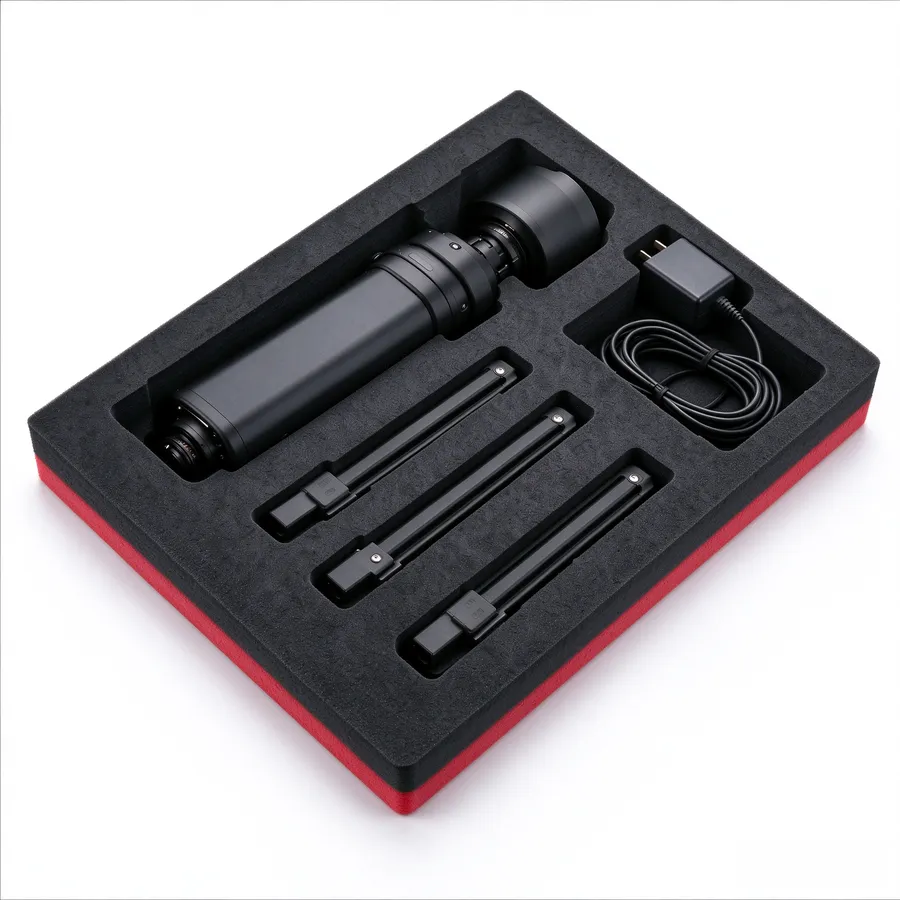
Customisation
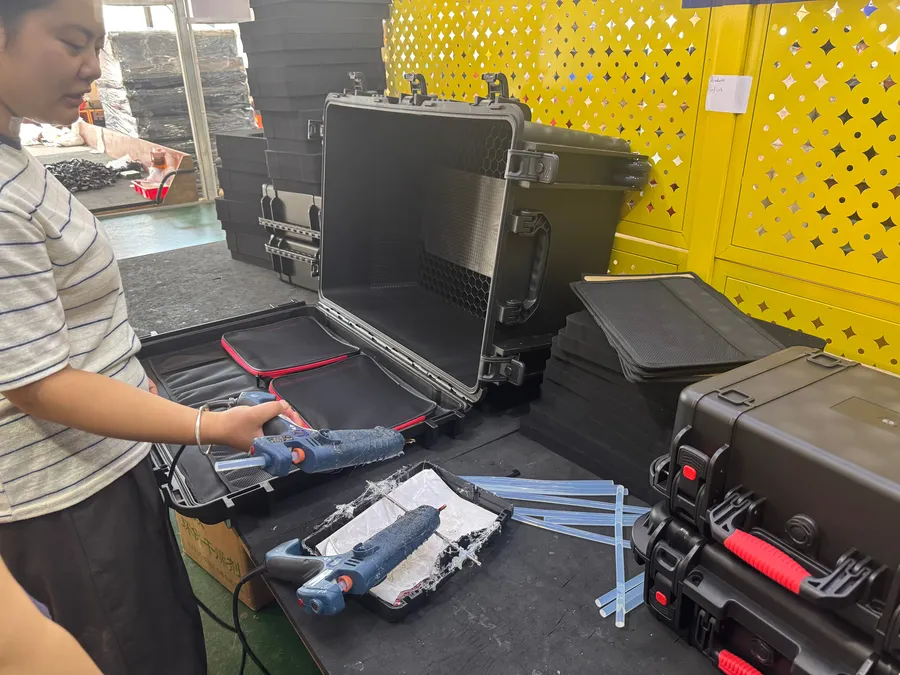
Everything described above is configurable on a standard shell: interior layout (pick-and-pluck, die-cut or CNC-cut), foam grade and thickness, colour, logo method, latch and lock count, pressure-equalisation valve, cable ports, document holder and identification plate. A bespoke exterior geometry requires a new mould — 125 days, from 3,000 units per moulded component.
Procurement considerations
| Question | What to send us |
|---|---|
| Which shell fits? | Equipment L × W × H as packed, plus required clearance per axis |
| What does it cost? | Order quantity and estimated annual quantity — the two drive different answers |
| Is tooling needed? | Whether an existing shell clears the envelope with usable foam depth |
| Lead time? | Your required delivery date, not just the order date |
| Certification? | The exact standard your tender names — we will say whether we can test to it |
| Freight? | Destination and preferred terms; carton and pallet data supplied with the quotation |
Comparison and selection guide
The tables on this page exist because a protective case is chosen by comparing three things: the envelope, the environment and the handling chain. Where no table applies, the rule below is.
| Situation | What To Do |
|---|---|
| Fixed installation | Choose a box whose external height matches your racking pitch, and check the narrow internal width if the shell tapers. |
| Mobile use | Prefer a four-latch configuration and a lid that can be removed cleanly with gloves. |
| Inventory control | Specify a foam or partition layout so that a shortage is visible without opening compartments. |
- Size on internal dimensions plus clearance, never on a product name.
- Choose the carrying method before the shell: it changes the series, not just the price.
- Specify the interior last, and decide up front whether the end user will reconfigure it.
Can ammunition storage boxes be customized? relates to Storage & Transport Box Guide. Related families: Ammunition Storage & Transport Boxes / Tactical Equipment Cases / Custom Protective Cases. Related sectors: field and industrial equipment. Continue in the Storage & Transport Box Guide cluster.
This page is written from our own production data. If your requirement differs, send the dimensions and we will tell you which of the 155 models fits, or whether a custom route is needed.