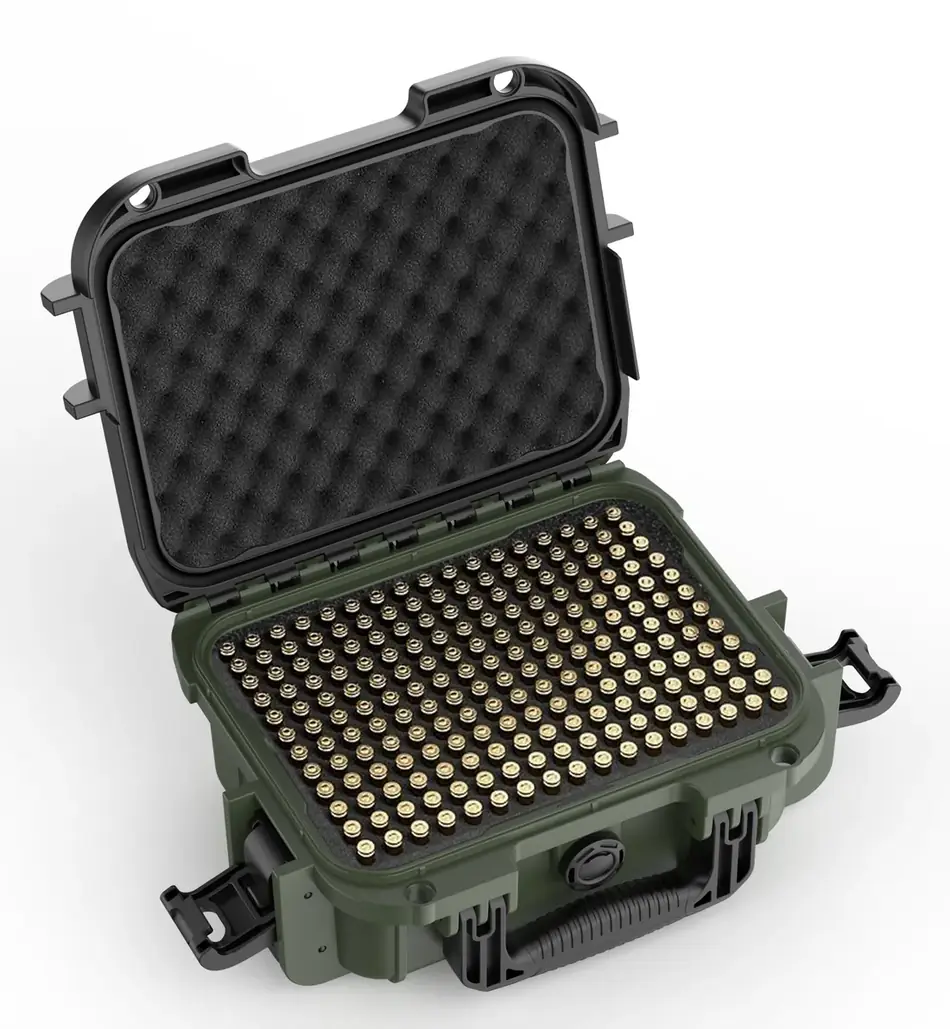
What should buyers ask before ordering ammunition storage boxes?
Before you order ammunition storage boxes wholesale, the questions worth asking are practical, not marketing: what internal envelope does each model actually publish, and does your load fit it with room for a foam base and a lid; what wall thickness and net mass are listed per model; is a seal offered on that model or not; what MOQ applies to stock versus custom work; and what EXW or FOB price, packing and lead time come with the quantity you intend to buy. This page lists the questions and the numbers you can already check on the model pages.
Key points
- Ask for the published internal envelope first; external footprint matters second because fit and stacking depend on interior and lid clearance.
- Request wall thickness and net mass per model rather than a single claim applied across the whole range.
- Confirm whether the specific model lists a seal, because sealing hardware varies and is not offered on every size.
- Tie the question to your quantity: stock and custom foam start at one unit, while logo, colour and OEM start near three hundred.
- Ask how the order will be packed and palletised, since pallet counts are planned from carton size against your pallet, not assumed.
- Get the commercial terms in writing: wholesale only, EXW or FOB, a thirty percent deposit, and a stated lead time for the tier you need.
Start with the internal envelope, not the picture
The first number to ask about is the usable interior, because that is where the load actually sits. On the model pages each ammunition box lists both an external size and a smaller internal size, and the gap between them is wall, flange and lid geometry. A KX-3213, for example, is published at 315 by 260 by 128 millimetres outside and 308 by 230 by 118 millimetres inside, giving about 7.2 litres of usable volume, while a shallower KX-3609 is 360 by 310 by 90 outside and 355 by 280 by 80 inside. Ask the supplier to confirm interior length, width and depth in millimetres and to state whether that figure is the open box or the space left after a foam base, because those two numbers are different.
Then add clearance. Rounds, primers, magazines, tools or spares each need a little air around them, and a tight fit that looks efficient on paper turns into scuffed edges and a lid that will not latch once the seal is compressed. If you already know the item, send its dimensions and ask which model leaves a sensible margin; if you do not, ask for the interior drawing before you commit to a size.
Wall thickness and mass, and what they do not tell you
Wall thickness is a real, published per-model figure and it is a fair thing to ask about, but it should be read next to the material, not on its own. The polypropylene KX-2811 is listed with a 5.0 millimetre wall and an 890 gram net mass, while the ABS KX-63413 shows a 4.8 millimetre wall at 1680 grams across a different shape. Those are two different design points, and a heavier box is not automatically a tougher box for your specific load. Ask which material and wall each candidate model uses, and ask the supplier to keep the comparison to models of similar size and purpose rather than quoting one number for the whole catalogue.
What wall thickness and mass do not tell you is an ingress rating or a drop height. We publish measured dimensions and mass per model, and we do not attach a protection code or a drop figure that we have not tested on that model. Treat any unmeasured durability claim as a question to send back, not as a spec to copy into your own document.
Sealing, latches and hardware are model-specific
Sealing is not a switch that is on for the whole range. Some models are published with a seal between lid and base and some are not, so the honest question is whether the exact model you are quoting lists one. Where a gasket is offered, it only resists ingress where the latches pinch it closed, which is why latch count and latch placement matter as much as the gasket itself. Ask how many latches the model has, whether the handle is a fixed carry handle, and whether the model is listed as stackable, then confirm what stackable means in your handling plan rather than assuming a stacking load that was never measured.
Interior, foam and customisation
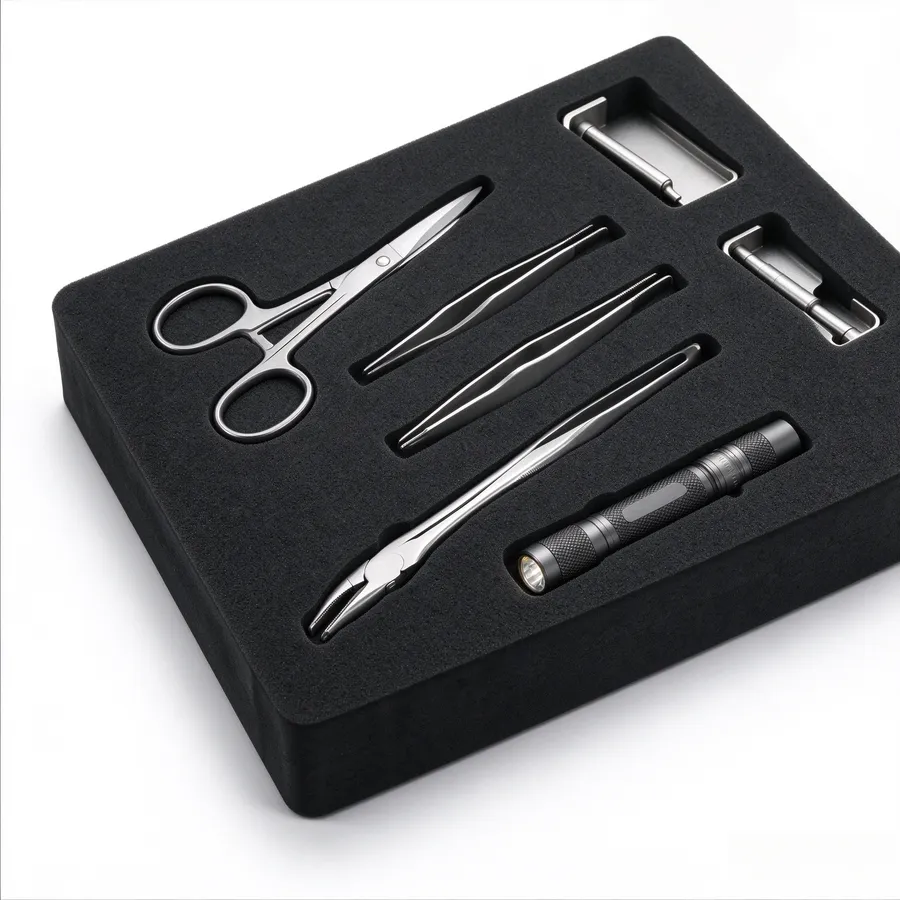
Ammunition and the gear that travels with it rarely sit loose. Ask what interior options exist for the model: a routed foam base, a flat foam sheet, dividers or a cut tray. On our terms a custom foam insert can start from a single unit because it is cut rather than tooled, so a small trial order can still get a fitted interior. If you need a moulded tray, a printed logo or a body colour, that moves you into a different tier of minimum quantity and lead time, which is the next set of questions worth putting in writing.
MOQ, tooling and lead time, asked as one question
Buyers usually ask these three separately and then get a price that surprises them. The published MOQ tiers are simple to check: standard stock and a custom foam insert begin at one unit; a printed logo, a body colour change and an OEM build each begin around three hundred units; and a dedicated custom mould begins around three thousand units. Lead time follows the same ladder: an OEM build on an existing mould is planned around forty-five days to first sample, while a new mould is planned around one hundred and twenty-five days. Ask the supplier to confirm which tier your request falls into before you compare prices, because a unit price only means something at the quantity that unlocks it.
A comparison of published figures across live models
| Model | Shell | External Mm | Internal Mm | Wall Mm | Usable L | Seal Listed | Net G |
|---|---|---|---|---|---|---|---|
| KX-2811 | PP | 280 x 225 x 111 | 253 x 180 x 98 | 5.0 | 3.6 | Yes | 890 |
| KX-3213 | PP | 315 x 260 x 128 | 308 x 230 x 118 | 3.0 | 7.2 | Yes | 860 |
| KX-3609 | PP | 360 x 310 x 90 | 355 x 280 x 80 | 3.0 | 6.9 | Yes | 900 |
| KX-63413 | ABS | 339 x 310 x 125 | 310 x 255 x 106 | 4.8 | 6.7 | Yes | 1680 |
| KX-83813 | PP | 384 x 230 x 128 | 350 x 170 x 115 | 3.3 | 5.8 | Yes | Not published |
Commercial terms and the packing plan
Finally, put the business questions in the same email as the technical ones. We work wholesale and OEM only, quoted EXW or FOB, with a thirty percent deposit; we do not sell retail, do not quote DDP landed prices and do not hold overseas warehouse stock. Ask how the quantity will be cartoned and palletised: pallet counts are planned from the carton footprint against your pallet size rather than copied from a generic figure, so a palletise the boxes to your deck height and tell us the pallet dimensions you load to. A buyer who confirms fit, published specs, the MOQ tier and the packing plan in one pass gets an accurate quote; one who asks only for a price per unit usually gets a number that changes at the sample stage.
Customisation
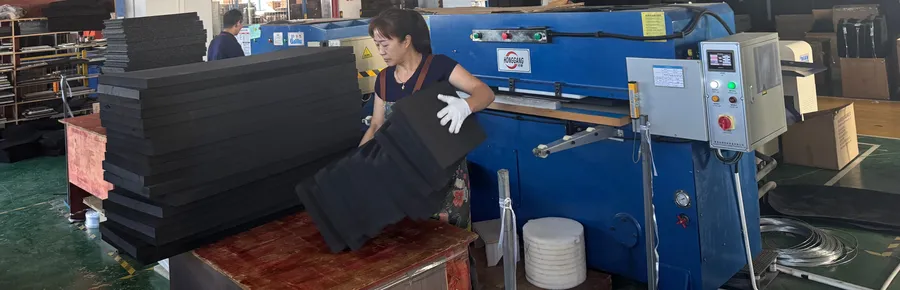
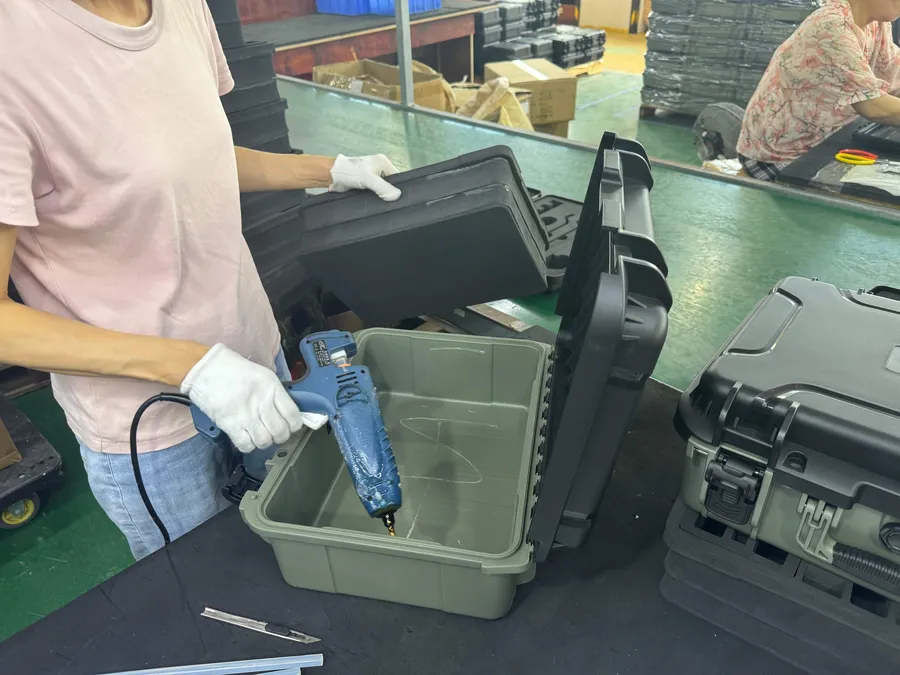
Everything described above is configurable on a standard shell: interior layout (pick-and-pluck, die-cut or CNC-cut), foam grade and thickness, colour, logo method, latch and lock count, pressure-equalisation valve, cable ports, document holder and identification plate. A bespoke exterior geometry requires a new mould — 125 days, from 3,000 units per moulded component.
Procurement considerations
| Question | What to send us |
|---|---|
| Which shell fits? | Equipment L × W × H as packed, plus required clearance per axis |
| What does it cost? | Order quantity and estimated annual quantity — the two drive different answers |
| Is tooling needed? | Whether an existing shell clears the envelope with usable foam depth |
| Lead time? | Your required delivery date, not just the order date |
| Certification? | The exact standard your tender names — we will say whether we can test to it |
| Freight? | Destination and preferred terms; carton and pallet data supplied with the quotation |
Comparison and selection guide
The tables on this page exist because a protective case is chosen by comparing three things: the envelope, the environment and the handling chain. Where no table applies, the rule below is.
| Situation | What To Do |
|---|---|
| Fixed installation | Choose a box whose external height matches your racking pitch, and check the narrow internal width if the shell tapers. |
| Mobile use | Prefer a four-latch configuration and a lid that can be removed cleanly with gloves. |
| Inventory control | Specify a foam or partition layout so that a shortage is visible without opening compartments. |
- Size on internal dimensions plus clearance, never on a product name.
- Choose the carrying method before the shell: it changes the series, not just the price.
- Specify the interior last, and decide up front whether the end user will reconfigure it.
What should buyers ask before ordering ammunition storage boxes? relates to Storage & Transport Box Guide. Related families: Ammunition Storage & Transport Boxes. Related sectors: field and industrial equipment. Continue in the Storage & Transport Box Guide cluster.
This page is written from our own production data. If your requirement differs, send the dimensions and we will tell you which of the 155 models fits, or whether a custom route is needed.