What materials are commonly used for storage boxes?
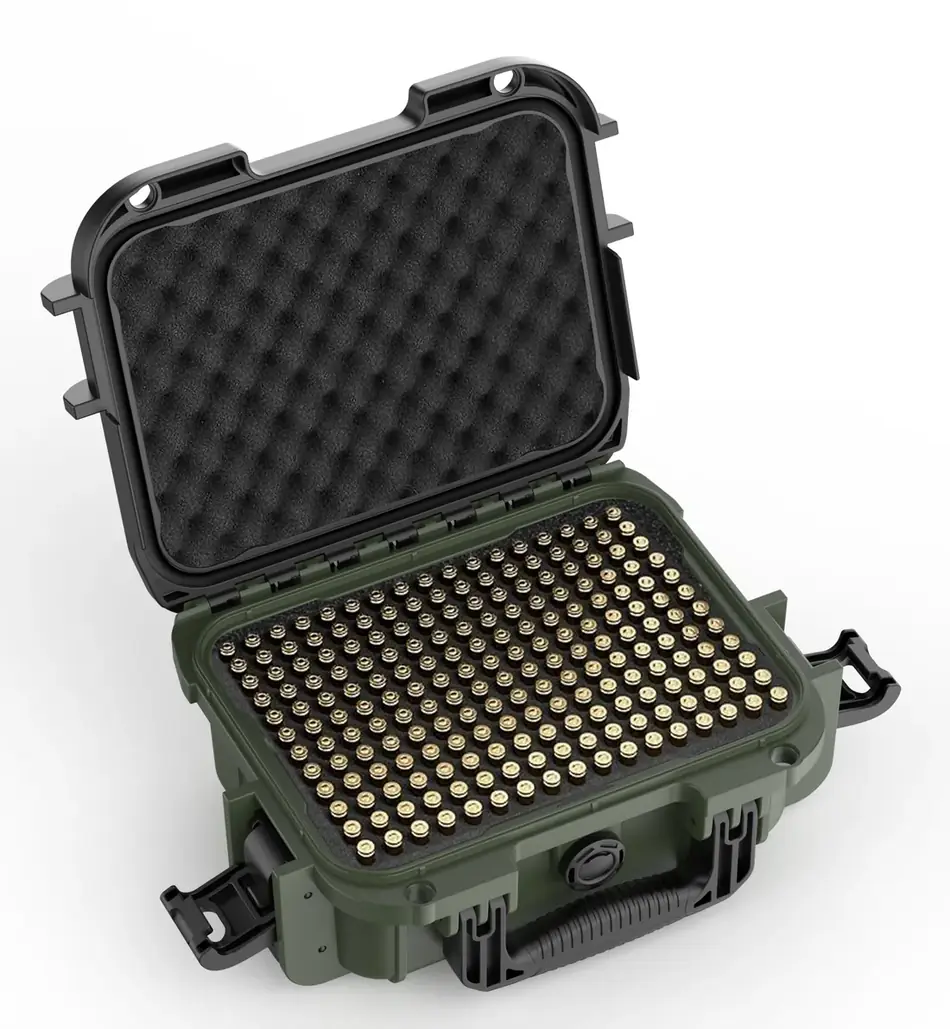
Most storage boxes in active commercial use are moulded from thermoplastics — polypropylene for the widest range of sizes, engineering polypropylene where a deeper, heavier box has to stay stiff in a stack, and ABS where rigidity and surface finish matter more than weight. Outside the plastics, storage boxes are also made of galvanised or stainless steel, aluminium, plywood, corrugated board and coated fabric, each trading cost against durability in a different way. In the twenty models published under our ammunition storage category, the shells are polypropylene, engineering polypropylene or ABS with wall thickness stated per model, the gasket option is EPDM or an equivalent compressible seal, the foam option is cross-linked PE, EVA or EPS, and hardware is metal or polymer by configuration — so the material answer for any order is read from the datasheet of the exact model, not from the category name.
Key points
- Match the material to the job: polypropylene for bulk stacked storage, engineering polypropylene for deep heavy boxes, ABS where rigidity and finish matter.
- Wall thickness is a stacking number, not a styling one — it is published per model between 2.0 and 5.0 mm across the range, so compare models on it.
- A thermoplastic shell has no ferrous corrosion path, which is why moulded boxes replace steel and plywood in damp storerooms.
- Seals, foam and hardware are material choices too: EPDM gasket option, cross-linked PE, EVA or EPS foam, metal or polymer fittings by configuration.
- Ask for the datasheet of the exact model before you order; shell material, wall thickness and empty mass are published per model and do differ.
- Where a material property has no test record for a model we do not state it; unmeasured values can be commissioned as a separate work package.
The materials you actually meet
Walk through any storeroom and the storage boxes fall into a short list of materials: injection-moulded thermoplastics, steel, aluminium, plywood, corrugated board and coated fabric. Each occupies a different corner of the trade between cost, mass, durability and how the box behaves in a stack. Corrugated board is cheap and light but fails once humidity or stacking loads rise; steel and plywood carry weight and shrug off rough handling, but they add mass and cost, and steel brings a corrosion path that has to be managed with coatings; aluminium sits between the two. Thermoplastics have taken most of the mid-range because a moulded shell combines repeatable dimensions, a stacking rim, a shell with no ferrous corrosion path and a unit cost that falls with volume — which is exactly the profile a bulk storage programme needs.
Polypropylene, engineering polypropylene and ABS
Inside the plastics, three names cover the published range. Polypropylene (PP) is the default for small and mid boxes: it is light, it flexes rather than cracks under repeated latch use, and as a material class it is broadly resistant to moisture and to most common workshop chemicals. Engineering polypropylene is a stiffer formulation used on deeper, heavier boxes where the walls of a loaded stack must not bulge — the KX 3508, KX 3315 and KX 9-2817 in our published ammunition category all use it. ABS is harder and more rigid than PP at the same wall thickness, and it appears on mid-size boxes such as the KX 6-2810 and KX 6-3413, where a rigid structure and a cleaner surface finish are worth the extra mass and cost. None of the three is universally better; the right question is which behaviour your contents and your stack actually demand.
How the common materials compare
The table below is the practical comparison a buyer makes before shortlisting. It describes material families in general; the figures that govern an order — wall thickness, empty mass, internal volume, packing count — are published per model, and the model you specify is quoted from its own datasheet.
| Material | Strengths | Limits | Typical Use |
|---|---|---|---|
| Polypropylene (PP) | Light, tough, flexes rather than cracks, broadly resistant to moisture and common chemicals, economical at volume | Less rigid than ABS at equal thickness; deep loaded boxes need engineering grades or thicker walls | Small and mid stackable storage boxes |
| Engineering PP | Stiffer than standard PP, holds shape in tall loaded stacks, still light and corrosion-free | Costs more than standard PP; reserved for deeper or heavier models | Deep-base heavy storage boxes |
| ABS | Hard, rigid, dimensionally stable, clean surface finish | Heavier and costlier than PP at equal wall thickness; chosen when rigidity and finish outweigh mass | Mid-size equipment-style boxes |
| Steel, galvanised or stainless | Carries heavy loads, resists rough handling, can be welded into fixed racking | Mass, cost, and a corrosion path that depends entirely on coating quality | Fixed shelving and site containers |
| Aluminium | Light for a metal, stiff, does not rust | Dents under impact; costs more than plastics for small boxes | Framed transit and flight-style cases |
| Plywood | Cheap per litre of volume, easy to modify in small batches | Heavy, absorbs moisture unless sealed, quality varies between sheets | Bulk crates and one-off packing |
| Corrugated board | Very cheap, very light, recyclable | Loses strength with humidity and stacking; single-trip economics | Cartons and one-way packaging |
| Coated fabric | Folds flat, light, cheapest to ship empty | No stacking structure; the contents carry the load | Soft bags and organizers |
What the published range uses, model by model
Material is not a range-level claim; it is a per-model fact. The six models below are drawn from the twenty published under the ammunition storage category, and they show how shell material, wall thickness and empty mass move together. Read them as examples of how to read a datasheet, not as a blanket specification for the category.
| Model | Shell | Wall Mm | Internal Mm | Volume L | Net Weight G |
|---|---|---|---|---|---|
| KX 3207 | PP | 3.0 | 308 x 230 x 64 | 4.5 | 570 |
| KX 3508 | Engineering PP | 3.0 | 344 x 268 x 72 | 6.6 | 995 |
| KX 2811 | PP | 5.0 | 253 x 180 x 98 | 4.5 | 890 |
| KX 6-2810 | ABS | 4.0 | 253 x 182 x 86 | 4.0 | 900 |
| KX 6-3413 | ABS | 4.8 | 310 x 255 x 106 | 8.4 | 1680 |
| KX 3315 | Engineering PP | 4.1 | 303 x 224 x 135 | 9.2 | 1670 |
Beyond the shell: gaskets, foam and hardware
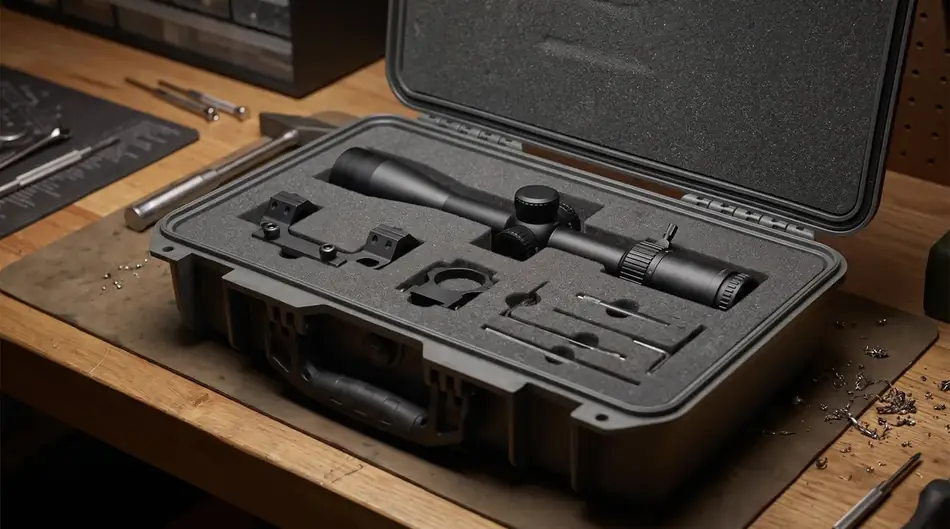
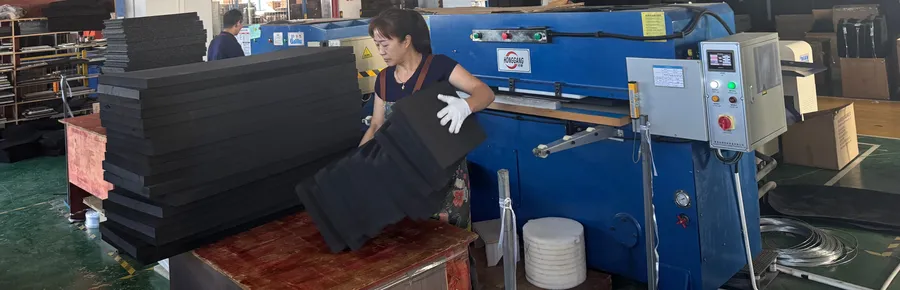
A storage box is a material system, and the shell is only the largest part of it. The seal option across the range is an EPDM or equivalent compressible gasket sitting in a continuous moulded channel — a compressible elastomer is what keeps the closure line closed through thousands of open-and-close cycles instead of leaning on a perfectly flat mating edge. The interior foam option is cross-linked PE, EVA or EPS, laid out by zone as pluck, die-cut or CNC-cut layers that hold items in counted positions. Hardware — latches, hinges, handles — is metal or polymer by configuration, and every model is specified with stacking in mind: the load rides on the rim and the walls, never on the flat of the lid panel. One corrosion-related property is stated from production records for these thermoplastic shells: there is no ferrous corrosion path, which is the quiet reason plastic displaces steel in damp storerooms.
Choosing a material for your application
Start from the stack, not from the material table. If boxes will be stacked several high while fully loaded, stiffness is the property that matters, so look at engineering polypropylene or a thicker ABS wall, and compare the published wall thickness — the range runs from 2.0 mm on the smallest utility boxes to 5.0 mm on the deep models. If the boxes travel and are handled hard, toughness and latch-cycle life point to polypropylene. If the box is part of an equipment kit where appearance and rigidity matter more than mass, ABS earns its cost. Then check the two material numbers buyers forget: the seal, because a gasketed closure is what keeps dust out of counted contents between inventories, and the empty mass, because a box that lives in a stack is lifted thousands of times a year. Where a datasheet does not state a property, treat it as unstated rather than assumed.
Customising the material specification
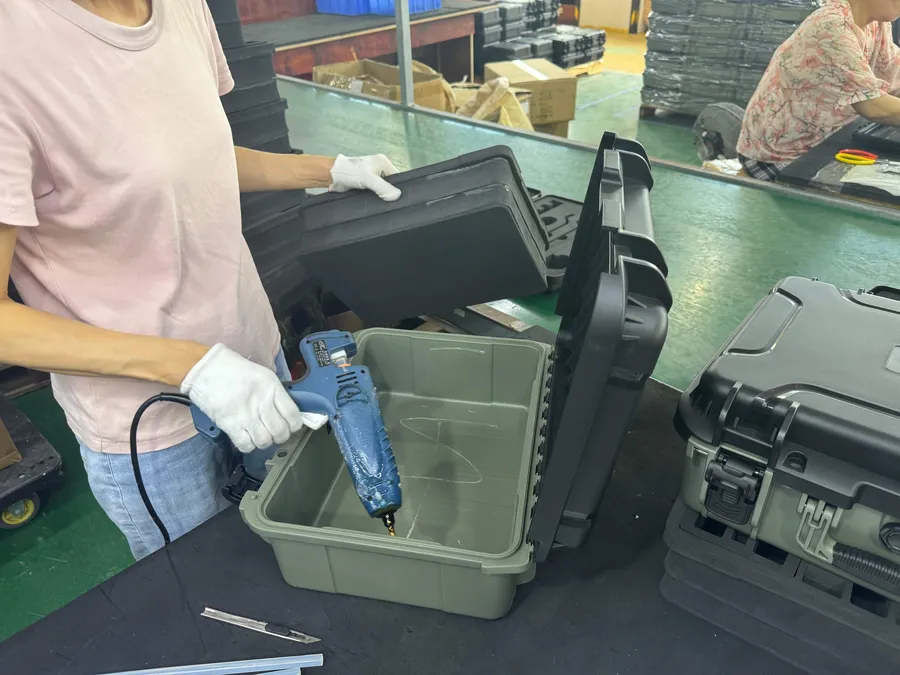
As a wholesale and OEM manufacturer we can move a box between materials, but the cost of that move depends on which mould it rides on. A colour or logo change on an existing shell carries a minimum order quantity of 300 pieces; a custom foam interior can be quoted from a single box; a genuinely new mould is quoted at 3,000 pieces, with about 125 days to a new tool and a 30 percent deposit, while a first OEM sample on an existing mould is quoted at about 45 days. Changing the shell material on an existing mould is a conversation rather than a tick-box: the same tool fills differently in different polymers, so wall thickness and stack behaviour are re-checked before the change is quoted. Production and quotations run on EXW or FOB terms for wholesale and OEM buyers.
Notes before you buy
We sell to distributors, integrators and OEM programmes on wholesale terms and do not retail single boxes; quotations are EXW or FOB, and we do not offer DDP or hold stock in an overseas warehouse. Order against the datasheet of the exact model: shell material, wall thickness, internal and external dimensions, empty mass and packing count are published per model and differ across the twenty ammunition storage models as much as they do across the wider range. On material properties we keep the site-wide position: figures come from our own production or incoming-material records, options we can supply are marked as configuration-dependent, and where no test record exists for a model we do not state a value — accredited testing can be commissioned as a separate work package.

Customisation
Everything described above is configurable on a standard shell: interior layout (pick-and-pluck, die-cut or CNC-cut), foam grade and thickness, colour, logo method, latch and lock count, pressure-equalisation valve, cable ports, document holder and identification plate. A bespoke exterior geometry requires a new mould — 125 days, from 3,000 units per moulded component.
Procurement considerations
| Question | What to send us |
|---|---|
| Which shell fits? | Equipment L × W × H as packed, plus required clearance per axis |
| What does it cost? | Order quantity and estimated annual quantity — the two drive different answers |
| Is tooling needed? | Whether an existing shell clears the envelope with usable foam depth |
| Lead time? | Your required delivery date, not just the order date |
| Certification? | The exact standard your tender names — we will say whether we can test to it |
| Freight? | Destination and preferred terms; carton and pallet data supplied with the quotation |
Comparison and selection guide
The tables on this page exist because a protective case is chosen by comparing three things: the envelope, the environment and the handling chain. Where no table applies, the rule below is.
| Situation | What To Do |
|---|---|
| Fixed installation | Choose a box whose external height matches your racking pitch, and check the narrow internal width if the shell tapers. |
| Mobile use | Prefer a four-latch configuration and a lid that can be removed cleanly with gloves. |
| Inventory control | Specify a foam or partition layout so that a shortage is visible without opening compartments. |
- Size on internal dimensions plus clearance, never on a product name.
- Choose the carrying method before the shell: it changes the series, not just the price.
- Specify the interior last, and decide up front whether the end user will reconfigure it.
What materials are commonly used for storage boxes? relates to Storage & Transport Box Guide. Related families: Ammunition Storage & Transport Boxes / Tool Cases / Military Protective Cases. Related sectors: field and industrial equipment. Continue in the Storage & Transport Box Guide cluster.
This page is written from our own production data. If your requirement differs, send the dimensions and we will tell you which of the 155 models fits, or whether a custom route is needed.